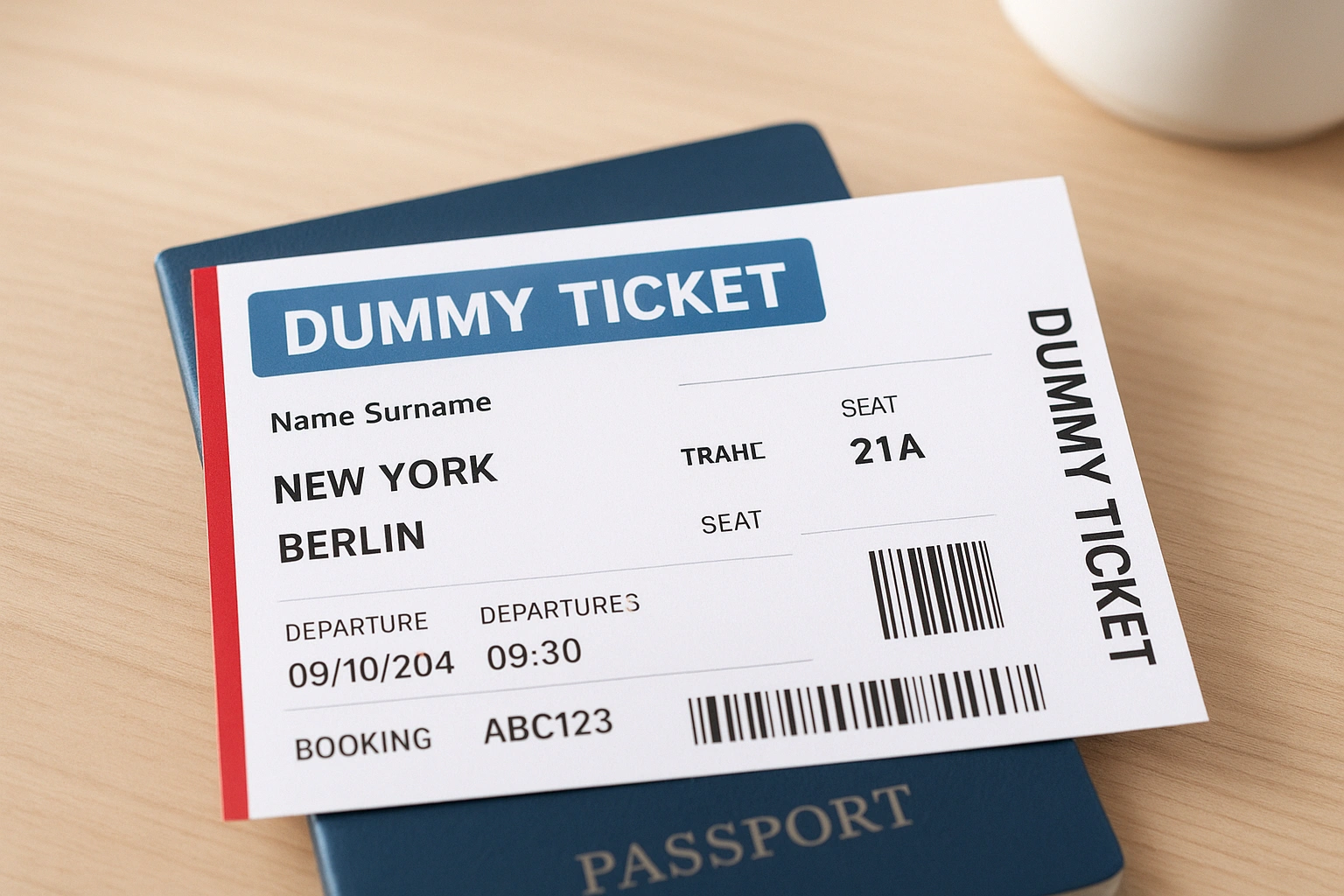
Every visa checklist eventually asks for an employer leave letter. For freelancers, that line has no answer, because there's no employer to sign it and no HR department to confirm a return date. That gap changes how closely the rest of your application gets read, starting with your flight reservation. A visa officer isn't just missing a form. They're missing proof that someone else expects you back on a certain day.
Your flight reservation can't fix that alone, but it can carry even more weight than it would for a salaried applicant. The real decision is which dates, contracts, and invoices you line up before you lock that reservation in. Book a visa reservation that matches the return date your freelance work already fully supports.
Key facts before creating a freelancer visa reservation:
- A freelancer usually cannot provide a normal employer leave letter.
- Client contracts, invoices, tax records and bank statements should replace the missing HR proof.
- The reservation dates should match real project gaps, not only the visa window.
- A client letter can help, but it should not pretend the client is your employer.
- The cover letter should explain self-employment clearly and briefly.
In This Guide
- Official-source check
- What an Employer Letter Actually Proves: Why a Flight Reservation Alone Can't Replace It
- Rebuilding the Three Functions of the Leave Letter Without an Employer
- Reservation Mistakes That Are Unique to Freelancers (and Why Salaried Advice Doesn't Apply)
- Sequencing the File — Where the Reservation Fits Among Everything Else You're Submitting
- Turning a Missing Letter Into a File That Speaks for Itself
- FAQ
Official-source check: freelancer files need evidence that replaces salaried employment proof. GOV.UK visitor supporting-document guidance says applicants may provide business registration documents or recent invoices that confirm ongoing self-employment. GOV.UK business visitor guidance separates permitted business visits from work visa routes. France-Visas self-employed guidance also emphasizes proving the professional and financial basis of independent activity. Your destination checklist remains the controlling source.
Reviewed for: freelancer evidence, missing employer leave-letter explanation, client/invoice proof, project-calendar date logic, visa-reservation terminology, PNR wording and non-refundable ticket risk.
What an Employer Letter Actually Proves: Why a Flight Reservation Alone Can't Replace It

Most visa checklists were built with a salaried applicant in mind. That becomes obvious the moment a freelancer reaches the stage asking for an employer letter, because nothing on their side of the paperwork looks like what the checklist expects.
The "Return Date Without a Reason" Problem
A Leave Approval Letter does more than confirm time off work. It confirms permission to take time off, and it gives the embassy a clear reason to believe you're coming home. The letter typically states your travel dates and the purpose of your trip, which lets a visa officer verify employment continuity in one glance. It's essential for visa applications, and its absence often causes delays that salaried applicants rarely see.
For a freelancer, that single document doesn't exist because there's no HR office to issue it. What's left is a flight reservation with a return date the applicant picked themselves. That's where the real issue starts.
A return date chosen only because it falls near the end of the visa's allowed stay reads very differently from a return date tied to something outside the applicant's control. Take Sarah, a freelance graphic designer based in Mumbai applying for a short-term visa. If her flight reservation shows a return date exactly 89 days into a 90-day visa window, with nothing else in her file explaining why that date matters, it looks arbitrary. It suggests she's staying as long as legally possible rather than returning because something in her life requires it.
Compare that to a return date lined up with a signed client deliverable, a scheduled project handoff, or a recurring retainer cycle. The date stops being a number picked off a calendar and starts being a fact she can back up. This is the same logic embassies apply through other tools freelancers may already be familiar with. A No Objection Certificate, for instance, confirms permission for travel and is frequently required for Schengen visa applications.
An NOC must list travel dates and confirm the applicant's return, which helps demonstrate ties to the home country. Employers or educational institutions issue these, which is exactly why freelancers can't produce one. The absence isn't a paperwork oversight. It's a structural gap in the applicant's file that a well-chosen flight reservation can only partly fill.
Why Consulates Read Freelancer Files Differently From Salaried Files
A salaried applicant's file gets reviewed against one strong anchor: the employer. Confirm that letter, cross-check the leave dates against the flight reservation, and most of the credibility question is settled. A freelancer's file doesn't offer that shortcut, so reviewers tend to widen the check instead of narrowing it.
This shows up as more cross-referencing between weaker pieces of evidence. Instead of confirming one letter, an officer may look at how the flight reservation lines up with the applicant's bank statements, business registration, or client invoices. Self-employment documentation like business registration and client invoices exists precisely to fill in what a payslip would have shown a salaried reviewer. Income Tax Returns matter here too, since they demonstrate a reliable history of earnings over time rather than a single month's snapshot.
Bank statements carry more weight for freelancers for the same reason. They're essential to demonstrate financial self-sufficiency, especially when there's no employer confirming a steady paycheck will keep arriving during and after the trip. A freelancer applying without this kind of layered evidence is, in effect, asking a reviewer to trust a single self-selected flight date instead of a documented pattern.
It also helps to know that immigration systems have started building pathways that assume this exact profile. Digital Nomad Visas exist specifically to let freelancers live and work abroad without a traditional employer attached to their application. Countries like Spain and Portugal now offer dedicated visas for freelancers who work for foreign clients, and the UAE's freelance permits let professionals operate independently without a local sponsor.
Many other countries have added similar alternative pathways for independent contractors, often asking for proof of professional qualifications or a portfolio instead of an employer reference. These programs exist because the traditional employer letter was never designed for this category of traveler, and the gap it leaves behind has to be filled with something else.
None of this means a freelancer's flight reservation is disposable or beside the point. It still matters, and it still needs to be booked with the same care any traveler would apply. What changes is how much that single date is being asked to carry on its own, and what has to sit around it before it can do that job convincingly.
Rebuilding the Three Functions of the Leave Letter Without an Employer
Once you know exactly what a Leave Approval Letter was supposed to prove, the fix becomes a lot more specific than "book a return flight and hope for the best." Each function that letter used to serve needs its own replacement, built from documents a freelancer actually has.
Replacing "Confirmed Return Date" With a Client-Anchored Itinerary
The easiest fix here is also the one most freelancers skip. Instead of choosing a return date based on how long the visa allows, choose one based on when your work actually pulls you back.
Take James, a freelance software developer working with two clients based in Delhi. If he's applying for a 30-day visa, his instinct might be to book a return flight for day 29 or 30, simply because the visa permits it. A stronger approach is checking his contracts first. If one client has a deliverable due on day 22 and another expects a status call on day 24, his return date should sit right after those commitments, not at the outer edge of what the visa technically allows.
This does two things at once. It gives the embassy a return date backed by something concrete, and it gives James a travel window that actually fits his workload. A reservation booked around a real deadline reads as intentional. A reservation booked around a visa limit reads as opportunistic, even when the traveler has every intention of coming home.
If your contracts don't have a hard date attached, look for the next closest anchor. Recurring retainer clients, scheduled invoicing cycles, or a standing weekly call with a client can all serve the same purpose. The goal is a return date that exists independently of the visa application itself.
Replacing "Income Continuity" With a Reservation That Matches an Active Invoicing Pattern
A Leave Approval Letter reassures an embassy that income won't stop the moment the applicant leaves the country. Freelancers have to demonstrate that same continuity without a single document that does it automatically.
This starts with keeping your travel window inside a period where your income history is already documented and active, not somewhere it creates an unexplained pause. If your last three invoices are dated within the past two months and your bank statements show regular incoming payments, a trip that fits neatly inside that pattern looks consistent. A trip that starts right after a long gap in invoicing, with no client work scheduled during or after travel, raises a different question: what happens to this person's income while they're away, and what happens when they get back?
A few practical habits help here:
- Keep at least one active invoice or signed agreement dated close to your travel window, not months before it.
- If you're between projects when you apply, avoid scheduling the trip during that gap. Wait until a new contract is confirmed, even if it delays the booking slightly.
- Make sure your bank statements cover a period that overlaps with your travel dates, not just the months before the trip was planned.
This is also where Income Tax Returns carry more weight than most freelancers expect. A single strong month of earnings doesn't demonstrate continuity on its own. A consistent filing history across multiple years does, and it tells the embassy this income didn't appear specifically to support a visa application. Pairing that history with a flight reservation that sits inside an active, well-documented earning period does far more than either piece could do alone.
Replacing a Named Employer With Verifiable Freelance Proof
The third function is the hardest to replace, because it relies on someone else vouching for the applicant. An employer letter works partly because a reviewer can, in theory, contact the company and confirm the story. A freelancer has no equivalent name to point to.
What can stand in for that, at least partially, is the verifiability of the reservation itself. A flight reservation that can be checked against a real booking system, complete with an authentic PNR, does more work for a self-employed applicant than it would for someone with a full employment file backing them up. It's one less thing a reviewer has to take on faith.
This is where BookForVisa becomes genuinely useful for freelancers specifically, not just convenient. A reservation that's instantly verifiable, comes with a real PNR and a downloadable PDF, and allows unlimited date changes means your itinerary can stay accurate even as client deadlines shift, without needing to explain a discrepancy later.
It's worth being clear about the limits here too. A verifiable reservation confirms that a booking exists and that the dates are real. It doesn't confirm income, and it doesn't confirm ties to your home country. Those still rest on the invoicing pattern and tax history covered earlier. Comprehensive cover letters can help close that remaining gap. A well-written explanation of your self-funded travel, referencing your client base, your income history, and your reason for returning, gives a reviewer something closer to what an employer's name would have provided, in writing, from the applicant directly.
Freelancers applying for dedicated programs, such as freelance permits in the UAE or the freelancer-specific visas offered by countries like Spain and Portugal, often find this three-part rebuild easier, since those pathways already expect self-employment documentation instead of a traditional employer reference. But for standard tourist or short-term visas, where the checklist still assumes a salaried applicant, this is the manual work of substitution that has to happen deliberately, one function at a time.
Even with all three pieces addressed, freelancers still run into booking mistakes that have nothing to do with missing documents and everything to do with how the reservation itself is chosen.
Reservation Mistakes That Are Unique to Freelancers (and Why Salaried Advice Doesn't Apply)

Even after freelancers rebuild the three functions a Leave Approval Letter used to serve, reservation habits borrowed from salaried travel advice can still work against them. The mistakes below show up specifically in freelancer applications, not in the general playbook most travelers get told to follow.
Picking Dates Around the Visa Window Instead of Around the Work Calendar
A salaried employee applying for a Schengen tourist visa typically starts with a fixed set of leave dates already in hand. Their HR manager approves the request, the company issues a NOC letter, sometimes called an objection letter, on company letterhead, adds a company stamp, and lists the employee's position and travel dates as an official document confirming the whole arrangement. The flight reservation gets booked around those already-approved dates, not the other way around.
Freelancers reverse that order without realizing it. Many pick a return date based purely on how long a visa allows them to stay abroad, then try to make everything else fit afterward. That habit ignores the fact that supporting documents, invoices, bank statements, and client agreements need to line up with the reservation, not with the visa's outer limit.
Salaried advice tells travelers to book a round-trip flight and move on, because that guidance assumes financial stability and employment proof already exist elsewhere in the file, backed by salary slips and a stable employer confirming both. A freelancer without those pieces needs the return date itself to do more work. It should be tied to a deliverable, an invoice, or a client payment they can already point to, evidence they need to obtain well before the reservation ever gets booked.
Reusing One Reservation Pattern Across Multiple Visa Applications
Freelancers who work with clients across the Schengen area often apply for more than one visa a year, sometimes for different countries within a short stretch of time. It becomes tempting to reuse the same reservation pattern each time: the same trip length, the same routing logic, the same return-date habit that worked once before.
Consider Emma, a freelance marketing consultant who applied for a 21-day tourist visa in the spring and reused the exact same reservation structure for a different country's visa four months later, without checking whether her client schedule still supported it. That approach can get an application rejected even when nothing about the underlying documents changed. A consulate reviewing a freelancer's file already knows there's no organization backing the trip. When the reservation itself looks templated, applied the same way regardless of destination or the client involved, it reads as routine rather than a specific trip built around specific work.
Each application deserves its own reservation, built from that trip's own client obligations, not copied from the last one that got approved. Booking the correct dates for this particular visit, rather than recycling a pattern that happened to work before, keeps the reservation consistent with everything else being submitted alongside it.
A Reservation That Doesn't Match Where the Applicant's Clients Actually Are
Routing mismatches are one of the easier problems to miss and one of the harder ones to explain later. If your invoices show clients based in Mumbai and Delhi who hire your services regularly, but your flight reservation routes through or lingers in a country with no business connection, a reviewer may ask for further details before moving toward visa approval.
It helps to think about this the way a student's application gets reviewed. A student applying to study abroad typically submits an invitation letter from a university, naming the subject they intend to study and the school issuing the offer, with a stamp on the letter that ties the whole trip directly to a place and a reason. Freelancers need that same kind of tie, just built from client relationships instead of enrollment.
That means including contact details for at least one client whose location matches your route, listing details of the working relationship, along with a sample invoice or contract that shows the connection clearly. Some consulates still expect applicants to post physical copies of these other documents rather than submit everything online, so it's worth keeping printable versions ready well ahead of your appointment.
None of this needs to be complicated. It just needs to hold up if a visa officer leaves comments questioning why the reservation and the invoicing trail point in different directions. Different Schengen countries apply slightly different laws around how strictly this gets checked, but the underlying expectation, strong ties between your route and your actual work, stays the same across the region. Submitting a reservation that matches your client base the first time avoids the back-and-forth altogether, and it keeps the rest of your file doing the job it was built to do: showing an embassy exactly why you plan to return, and to what.
Getting the reservation right on its own still isn't the finish line. Where it sits alongside everything else you submit determines whether it actually strengthens your case or just adds one more document to the pile.
Sequencing the File — Where the Reservation Fits Among Everything Else You're Submitting
Everything covered so far assumes the reservation is being built correctly on its own. The bigger question is when it gets built, because a reservation locked in at the wrong point in your prep can undo work you've already done elsewhere.
What Should Be Dated Before You Lock the Reservation
Most applicants treat the flight reservation as an early step, something to get out of the way before moving on to bank statements and contracts. For freelancers, that order works against them.
The reservation should be one of the last things finalized, not one of the first. Before choosing a return date, your contract timelines, invoice dates, and bank statement period should already be settled and internally consistent. Once those pieces are locked, the reservation can be dated to sit naturally inside that picture instead of forcing everything else to catch up to a date you already committed to.
This matters because reversing the order creates small inconsistencies that are hard to notice until a reviewer points them out. A reservation booked first, then adjusted around later, often ends up with a return date that no longer matches the invoice or contract it was meant to align with. Locking dates in this order avoids that entirely:
- Finalize active contracts and confirm invoice or payment dates
- Pull bank statements that cover a period overlapping your planned travel
- Choose a return date that fits inside that already-consistent timeline
- Book the reservation last, once nothing else needs to shift around it
This isn't about adding extra steps for the sake of process. It's about making sure the one document with a self-selected date, the reservation, is the one shaped to fit everything else, rather than the anchor everything else has to bend toward.
Presenting Multiple Clients as a Strength Instead of a Gap
Freelancers often approach their file apologetically, as though having several clients instead of one employer is something to explain away. That framing works against them. A single employer letter shows one relationship and one person's judgment about whether the applicant should be trusted to return. Several active clients can show something an employer letter never could: a pattern.
Instead of presenting client relationships individually and hoping each one is convincing on its own, lay them out together as a set. A reviewer looking at three or four ongoing contracts, each with its own invoicing history and its own scheduled work, sees a freelancer whose livelihood depends on staying reachable and reliable across multiple relationships at once. That's a stronger continuity signal than a single job, because it doesn't collapse if one client relationship ends.
Organize this clearly rather than scattering it across separate documents. A short summary listing each active client, the nature of the work, and the expected timeline gives a reviewer one place to see the whole pattern. The reservation dates should then visibly sit within that pattern, not float separately from it. When a reviewer can see the return date fits logically around work that's already documented across multiple sources, the absence of a single employer stops looking like a missing piece and starts looking like a different, equally valid kind of stability.
What to Do If the Visa Officer Asks About the Missing Letter Directly
Some applications move past this stage without any direct questions. Others don't, and it helps to have a response ready that doesn't sound like an apology.
If asked directly why there's no employer letter, avoid framing the answer around what's missing. Point instead to what replaces it. Reference the specific contracts, the invoicing history, and the reservation dates already submitted, and explain briefly how they connect. A response that says, in effect, "here's the client work that already confirms this return date" lands very differently than one that starts with "I don't have an employer, but."
Keep the explanation short and specific. Naming exact dates and documents already in the file shows the reviewer you've thought this through, rather than improvising an answer on the spot. If the question comes through a written query rather than an interview, the same principle applies: point back to specific evidence already submitted instead of adding a general explanation that isn't backed by anything on file.
Handled this way, the missing letter stops being the center of the conversation. What takes its place is a file that already answers the question before it's fully asked, built from documents that were sequenced correctly from the start.
Turning a Missing Letter Into a File That Speaks for Itself
Not having an employer letter was never really the problem. The problem was leaving that gap unfilled and hoping the rest of your application would cover for it. Once your contracts, invoices, and reservation dates are sequenced correctly, that gap closes on its own.
Trust the order you've built. Lock your client work first, then let your flight reservation fit around it, not the other way around. A file built this way doesn't need to apologize for looking different from a salaried applicant's. It just needs to be consistent, and now it is.
Final pre-submission check:
- Your cover letter says you are self-employed, not employed by a company.
- Client contracts or invoices support your income and ongoing work.
- The reservation dates avoid active delivery deadlines and match the stated travel purpose.
- Bank statements, tax records or business registration support the freelance activity.
- Any client letter confirms project continuity without pretending to be an employer leave letter.
- The final paid ticket waits until the visa path and project calendar are stable.
Freelancer without an employer leave letter? Create a clean visa reservation with BookForVisa that matches your project calendar before you buy the final airline ticket.
Create Your Visa ReservationFrequently Asked Questions
Can freelancers submit a visa reservation without an employer leave letter?
Yes, but the file needs other evidence that explains work status, income continuity, trip timing and return logic. A visa reservation helps show travel dates, but invoices, client letters, business registration or contracts usually need to support the story.
What replaces an employer leave letter for freelancers?
Common alternatives include client contracts, recent invoices, business registration, tax documents, bank statements, project schedules, retainer letters and a cover letter explaining how the trip fits your freelance calendar.
Should the visa reservation match my client work calendar?
Yes. The travel dates should avoid major deadlines, active delivery dates or unexplained gaps in income. A reservation looks stronger when it fits your actual workload.
Can a client letter help if I am self-employed?
Yes. A client letter can confirm an ongoing project, remote work arrangement, contract timeline or expected return to work, without pretending the client is your employer.
Does a flight reservation prove income for freelancers?
No. It proves intended travel dates and route logic. Income should be supported separately through invoices, bank statements, tax records, contracts or business documents.
How should freelancers explain the missing leave letter?
Use a calm cover-letter sentence explaining that you are self-employed and therefore do not have an employer leave letter. Then point to client, invoice, business and financial proof.
Should I buy a real ticket before approval?
Usually no. Freelancers often face shifting project schedules, so a reservation is safer for the application stage than a non-refundable ticket bought too early.
What if the visa officer asks about the missing letter?
Answer directly: you are self-employed, so no HR department issues leave. Then show business evidence, client proof, project timing, funds and the reservation dates.
Can BookForVisa prepare a visa reservation for freelancers?
Yes. BookForVisa can prepare a visa reservation that matches your freelance travel dates, route, passenger details and supporting document timeline.
Does a visa reservation guarantee approval?
No. It supports the travel-proof part of the file. Approval depends on eligibility, funds, purpose, ties, freelance evidence, document consistency and the visa authority’s decision.
Friendly reminder: BookForVisa provides temporary travel-proof documents for planning and application support. Requirements vary by country, visa category, airline, route and applicant situation. A flight reservation can support a file, but it does not guarantee approval, boarding or entry.