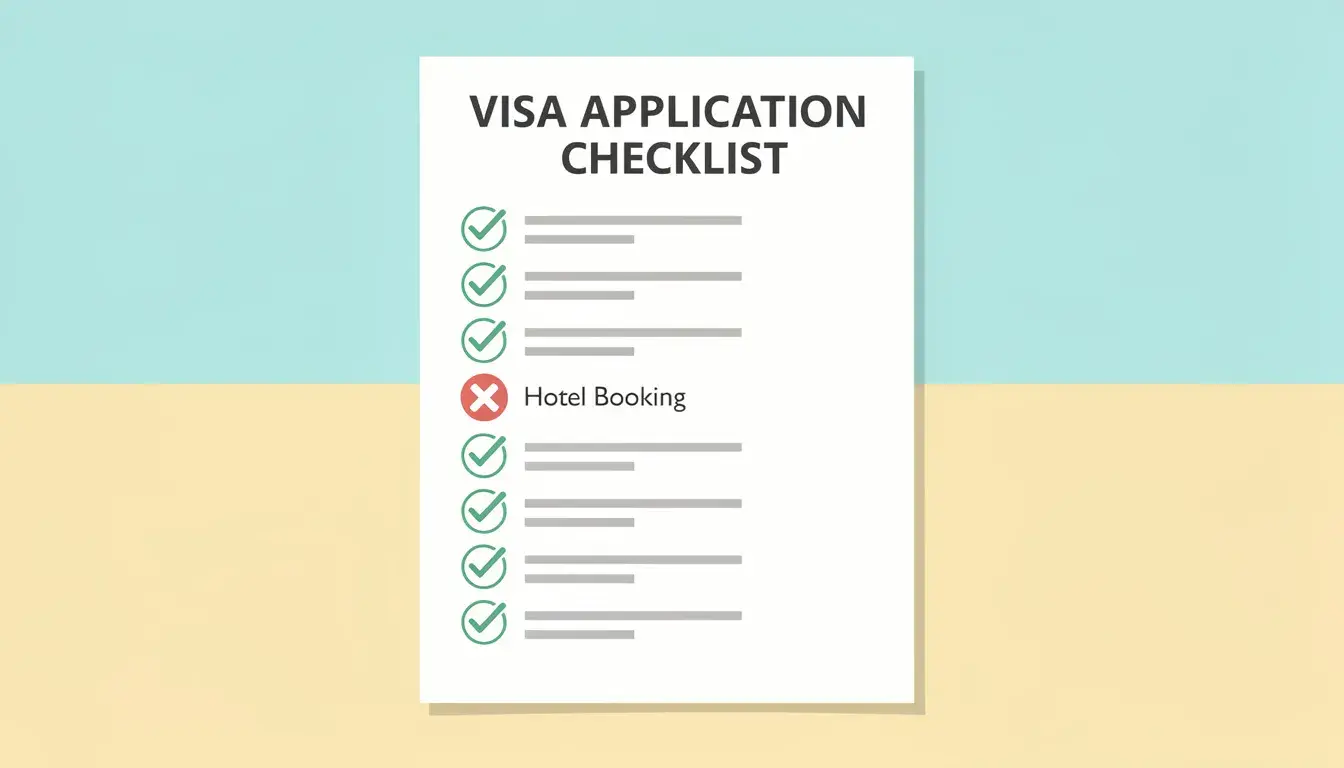
Your hotel confirmation just came through, and the name on it belongs to your travel agent, your spouse, or whoever handled the booking, not you. That feels harmless to you. To a visa officer reviewing your file, it can look like a gap between your application and your proof of stay.
This mismatch doesn't have to derail your appointment. What matters is knowing when the hotel can simply add your name, when a short cover note solves it, and when you need a fresh reservation built around you specifically. We'll walk you through each option so you can choose the right one before your interview date arrives. When timing is tight, create a booking for visa that keeps traveler names, hotel proof and travel dates aligned before submission.
Key facts before submitting a hotel booking under another name:
- Your name should appear on the confirmation when possible.
- Shared bookings are safer when every traveler is listed as a guest.
- A spouse, agent or company account holder can book, but the applicant must be connected to the stay.
- Hotel dates should match the flight booking, insurance and cover letter.
- If the hotel cannot update the document, add relationship proof, payment proof or a short explanation.
In This Guide
Official-source check: visa checklists commonly review accommodation and travel-proof consistency together. GOV.UK Standard Visitor guidance focuses on whether the applicant can support the visit, pay for the journey and leave at the end of the stay. France-Visas guidance directs applicants to the competent visa authority and supporting-document process for their place of residence. For hotel proof, follow the destination checklist and visa-center rules first.
Reviewed for: hotel guest-name mismatch, shared booking proof, spouse/agent/company-account holder wording, accommodation-date alignment, visa booking terminology and proof-of-stay document consistency.
Why Your Hotel Confirmation Might Show A Different Name Than Yours

A hotel confirmation is one of the most routine documents in a visa file, but it causes more confusion than almost anything else on the checklist. Visa officers routinely verify hotel bookings during applications, and most embassies require the visa applicant's name to appear directly on that proof of accommodation. When it doesn't, the reason is rarely suspicious. It usually comes down to how the booking was made in the first place.
When One Traveler Books For The Whole Group
Group trips almost never get booked the way visa applications expect them to be. One person books the room, enters their own contact details, and the confirmation email lands in their inbox alone. Everyone else in the group is simply along for the stay.
This happens constantly with:
- Family trips where a parent handles all the logistics
- Friend groups traveling together to Delhi or Mumbai for a shared itinerary
- Tour groups booked through a single lead traveler
Take a couple applying for an Indian visa together. Sarah Mitchell books a hotel in Mumbai using her name, her card, and her email address. Her partner James is traveling on the same dates, staying in the same room, but his name never enters the booking form. The hotel's system was built to capture a billing contact, not a full passenger manifest. That's a structural limitation of how most reservation platforms work, not a red flag someone inserted on purpose.
The problem shows up later, when James submits his visa application and his proof of accommodation lists someone else's name. Accommodation proof must align with the visa application itinerary, and a booking under a different name doesn't automatically do that on its own. Some visa authorities accept reservations under another guest's name if there's supportive evidence of shared travel, such as a joint itinerary or proof the applicants are traveling together. Others expect the applicant's name to appear directly on the document itself. This is exactly why checking specific embassy guidelines matters. Requirements for hotel accommodations vary enough between missions that what satisfies one visa office may not satisfy another.
Why Transliterated Names Rarely Match Your Passport Exactly
Name mismatches don't only come from group bookings. They also come from how names get converted between scripts.
Applicants whose legal names are written in Arabic, Chinese, Cyrillic, or Devanagari script rely on an official transliteration to appear on their passport. That transliteration follows specific formatting rules. Booking platforms don't always follow the same rules.
Enter a name at check-out, and the platform's auto-correct or transliteration engine can quietly generate a slightly different spelling. A passport might read "Mohammed" under standard ICAO formatting, while the same name typed into a hotel booking form auto-populates as "Muhammad" or "Mohamed." Visually, the difference looks tiny. On paper, in front of a visa officer comparing two documents side by side, it's still a mismatch.
Names on hotel bookings must match passport details exactly, and this is one of the easier problems to catch before it becomes a real issue. Unlike a group-booking name gap, a transliteration error is usually a single-field correction. Update guest details on booking platforms directly, or contact the hotel and ask them to reissue the confirmation with the name spelled exactly as it appears in the passport's machine-readable zone. Catching this early, ideally the same week the booking is made, avoids a scramble closer to the appointment date.
It's worth building this check into the same review pass as everything else in the file. Accommodation proof must match the flight reservation and visa form, so a spelling inconsistency on the hotel side can stand out even if every other document in the application is otherwise clean.
Corporate Booking Portals And The "Company Account Holder" Problem
Business travelers run into a different version of this problem, and it deserves its own explanation because the fix looks nothing like the ones above.
Many companies book employee travel through a centralized portal. The account is registered to a travel administrator, an HR contact, or a company-wide login rather than the individual employee who's actually flying. When the confirmation email arrives, it often lists the company's registered contact name, not the traveler's.
David Chen, a software engineer traveling to Delhi for a client meeting, might find his hotel confirmation issued under the name of his company's travel coordinator, someone who never sets foot on the trip. The booking is completely legitimate. The paperwork just doesn't reflect who's actually staying at the property.
This category needs a different kind of fix than a quick hotel email. Because the reservation is tied to a corporate account, the traveler usually can't amend it directly. It typically requires the company's travel desk or HR team to either add the employee's name to the reservation or issue a supporting letter confirming who the traveling employee is. Business travelers should flag this early, since it often takes longer to resolve through an internal department than it does to fix a personal booking with a hotel directly.
A few things stay consistent no matter which of these three situations applies. A hotel booking should include the guest name, address, and property details, along with dates that cover the full length of the stay. Submitting a hotel reservation with no clear connection to the applicant is generally discouraged when accommodation proof is required, and applicants must provide information that's truthful and consistent with their actual trip. It's also worth staying cautious about where that booking comes from in the first place. The Indian government has warned against relying on unauthorized intermediary websites for visa-related services, so any reservation used as supporting proof should come from a verifiable, traceable source.
Whichever of these three scenarios matches your situation, the next step depends on something specific: how a visa officer is actually going to read that mismatch when your file lands on their desk.
How Visa Officers Actually Read A Mismatched Hotel Name
A name mismatch on its own rarely tells a visa officer the whole story. What matters is how that mismatch sits alongside everything else in the file, and different consulates read that context in very different ways.
Schengen Consulates And The Passenger List Expectation
Schengen visa applications tend to be the strictest about this particular detail, and it comes down to how the checklist is structured.
Many Schengen consulates expect a hotel confirmation to function as a passenger list, not just a reservation record. If four people are applying together for a trip to Paris or Amsterdam, the expectation is that the hotel confirmation names all four, since the booking is meant to demonstrate accommodation for every applicant in that group, not just the one who happened to book it.
This is where families and travel groups run into friction most often. A parent books a hotel using their own name, submits four separate visa applications for the family, and the confirmation only shows one name attached to a reservation for four. The consulate isn't reading that as fraud. It's reading it as an incomplete answer to the question "where is each of these four people staying."
A few practical points matter here:
- A dummy hotel booking shows planned accommodation for a visa application, and Schengen officers use it specifically to confirm that every named applicant has a place to stay for the dates listed on their form
- Attach a copy of the primary booker's ID or passport alongside the application when the booking was made under someone else's name, since this gives the officer a direct link between the person who made the reservation and the travelers listed on it.
- A host invitation letter can substitute for a hotel booking entirely in some Schengen cases, particularly when the applicant is staying with family or friends rather than in paid accommodation, so it's worth checking whether this route removes the name-matching issue altogether.
None of this means every Schengen file needs a passenger list attached to the booking. It means the applicant should check the specific consulate's checklist rather than assuming the requirement is identical across all Schengen member states, since individual missions do interpret this differently in practice.
Why A Single-Name Booking Isn't Automatically A Red Flag
It helps to separate what actually worries a visa officer from what simply needs a bit more context.
A booking made under someone else's name, on its own, is an administrative detail. It reflects how the reservation system captured the traveler information, not an attempt to mislead anyone. Officers see this pattern constantly, especially with family bookings, tour groups, and reservations made through shared accounts.
What changes the read entirely is whether the rest of the file supports that name or contradicts it. A hotel confirmation under a spouse's name, submitted alongside a marriage certificate or a joint visa application, tells a coherent story. A hotel confirmation under a name that appears nowhere else in the file, with no explanation and no connection to the applicant, tells a much weaker one.
This distinction matters because of how consequences work on both sides of the spectrum. A dummy hotel booking is a temporary reservation used specifically to satisfy the accommodation proof requirement during the application stage, and using one appropriately doesn't put an application at risk. What does carry risk is submitting something that isn't accurate. Fake hotel confirmations, meaning documents fabricated to look like a real reservation that doesn't actually exist or was never genuinely held, can lead directly to application rejection. Some consulates go further, and legal consequences may follow from submitting fabricated documents as part of a formal application.
There's also a longer-term cost worth understanding. One fake booking can damage future visa applications, since many consulates keep records tied to an applicant's history, and a flagged document in one file can resurface as a concern in a later one, even for a completely different trip or destination.
None of that applies to a booking that's simply under a different name for a legitimate reason. The two situations look similar on the surface: a name that doesn't match the applicant, but they carry entirely different weight once an officer looks past the name field itself.
Signs An Officer Will Read As Inconsistency, Not Coincidence
There's a practical way to gauge whether a particular mismatch is likely to raise questions or pass without comment, and it comes down to whether the name on the booking connects to anything else in the file.
Patterns that typically read as low risk include:
- A shared surname between the applicant and the name on the booking, such as a spouse or parent
- A name that also appears as a co-applicant or travel companion elsewhere in the same visa file
- A cover letter or supporting note that directly explains the connection
Patterns that tend to draw more scrutiny include:
- A name with no shared surname, no appearance elsewhere in the file, and no explanation attached
- A booking name that doesn't match the flight itinerary, the invitation letter, or any other document submitted alongside it
- Pre-paid stay confirmations submitted as the sole piece of accommodation proof, since these are rarely accepted on their own and often need to be paired with additional documentation showing the applicant's specific involvement in the trip
This last point catches a lot of applicants off guard. A fully paid, non-refundable hotel stay feels like stronger proof than a flexible one, since money has already changed hands. In practice, many visa officers weigh it the opposite way. A pre-paid confirmation with a mismatched name and nothing else supporting it often reads as less convincing than a flexible booking accompanied by a clear explanation of who's staying and why the name doesn't match.
The self-check that actually helps here is simple. Look at the booking name next to everything else in the application and ask whether a stranger reviewing the file could immediately see why that name is there. If the answer is yes, the file is probably in good shape. If the answer is no, that's the exact gap the next steps in this guide are built to close.
Fixing The Mismatch Before You Submit

Once you understand how a visa officer is likely to read the name on your booking, the next step is straightforward: close the gap before it ever reaches a reviewer's desk. Most fixes here take less time than applicants expect, and the right one depends on how your booking was made in the first place.
Asking The Hotel Or Booking Platform To Add Every Traveler's Name
Start with the simplest fix, because it solves the problem at the source rather than working around it.
Most properties will amend a reservation to include every traveler's name if you ask before your hotel check-in date. This is especially true for bookings made with free cancellation or full payment already processed, since these tend to have more flexible cancellation terms and fewer restrictions on edits. A quick email or phone call to the property, or a message through the platform you booked with, is usually enough.
When you contact the hotel, be specific about what you need:
- Full names exactly as they appear on each traveler's passport
- Correct hotel dates covering the full stay, from the first night through checkout
- The booking reference clearly listed on the updated confirmation
- Full address of the property, room type, and room configuration (single, double room, or otherwise)
A clean PDF confirmation showing all of this together is far more useful to a visa officer than a booking that only lists one name and leaves the rest to interpretation. This single document becomes your core piece of accommodation evidence, and it should read as a coherent plan for the entire trip, not just a fragment of one.
One caveat worth checking first: some heavily discounted or non-refundable rate types restrict changes to guest details after the booking is confirmed. If your rate falls into that category, the hotel may not be able to add names even if you ask early. It's worth reviewing your cancellation terms before assuming this option is available, since it will shape whether this fix works or whether you need to move to one of the next two options.
When To Split One Booking Into Individual Confirmations
For some travelers, amending the original reservation isn't realistic, and splitting it into separate bookings is the cleaner path.
This matters most when each applicant is submitting an individual visa application rather than one joint file. A UK Standard Visitor visa, for example, is typically assessed as a standalone application per traveler, even when a whole family is applying around the same trip. In that context, a single hotel confirmation listing four names attached to one reservation can create more confusion during verification practices than four separate confirmations, each showing one applicant staying at the same property on the same hotel dates.
Splitting a booking usually means creating individual reservations for the same hotel room or a matching room type, rather than genuinely amending the original. That's a meaningful trade-off. It can mean forfeiting a non-refundable rate or paying a small difference in price to secure flexible terms across multiple bookings instead of one. Weigh this against how much time is left before your appointment and how strict the destination country's official checklist is about applicant-specific accommodation evidence.
This approach tends to work best when:
- Every applicant is filing independently rather than as part of one household application
- The destination's visa systems expect a one-to-one match between applicant and accommodation evidence
- There's enough time before the appointment to process new bookings without rushing
It's rarely necessary for every trip. A couple traveling together and applying jointly, for instance, often has no reason to split a double room booking into two separate confirmations, since the shared reservation already reflects how they're actually traveling.
Writing A One-Paragraph Explanation Letter That Actually Helps
When neither of the first two options is available in time, a short explanation letter can carry real weight, provided it's built around the right content.
A useful letter does two things and nothing more. First, it states your relationship to the person whose name appears on the booking, whether that's a spouse, parent, colleague, or travel agency contact who processed the reservation on your behalf. Second, it confirms that you're a named traveler within that reservation for the stated destination and dates, even though the account holder's name is what shows on the confirmation itself.
Keep the letter tight. One paragraph is usually enough. Officers reviewing hundreds of files respond better to a clear, direct explanation than to a page of unrelated travel history or justification. A letter padded with irrelevant detail can actually work against document credibility rather than reinforcing it, since it suggests the applicant is trying to compensate for something instead of simply clarifying a detail.
This approach works particularly well for consulates that don't have a strict line item requiring an all-traveler hotel confirmation but still expect the file to read as internally consistent. Pair the letter with supporting travel proof where possible, such as a flight itinerary showing your arrival date into the same city, or bank statements reflecting your portion of the trip cost. Together, these give a verification officer a full picture without requiring the hotel confirmation to carry the entire burden on its own.
It's also worth remembering what this letter is not for. It isn't a substitute for a fake confirmation or a workaround for a genuinely fake hotel booking. A dummy hotel booking used properly, one that reflects a real intended stay or a placeholder for planning purposes consistent with your actual trip purpose, is a normal part of many visa applications, and most visa centres are familiar with seeing them. What creates extra scrutiny is a document that doesn't match anything else in the file, or one that appears fabricated rather than simply incomplete.
For travelers with more risk tolerance and comfortable timelines, this letter-based approach can resolve most single-country, single-city applications cleanly. For those applying closer to their appointment date, or facing a visa type with stricter accommodation rules for one country in particular, the next step depends on how much runway is actually left before that hotel check-in arrives.
What To Do If You Can't Change The Name In Time
Sometimes there simply isn't enough runway before your appointment to amend a booking or split a reservation. When that happens, the goal shifts from fixing the document to strengthening everything around it.
Pairing The Accommodation Proof With Proof Of Relationship Or Booking Payment
If the hotel can't update the name on time, the next best option is showing a clear paper trail connecting you to the reservation itself.
A payment receipt or a card statement showing you paid for the stay, even partially, gives a visa officer something concrete to work with. It demonstrates that you were financially involved in securing the hotel room, not just listed as an afterthought. This works well when the booking details on the confirmation already show accurate hotel nights and dates, even if the name field doesn't match your passport.
For travelers staying with family, a document showing a shared surname or a shared home address can do similar work. It doesn't need to be an official certificate. Even something as simple as two passports listing the same registered address helps a reviewer connect the dots without requiring a new booking altogether.
Consider pairing this with:
- A card or bank statement showing the transaction tied to the reservation
- A joint itinerary listing you alongside the other guests on the booking
- Any correspondence with the property confirming your presence for the hosted nights in question
Treat this as a supporting layer, not a replacement for trying to resolve the booking directly first. It's most useful when time is genuinely short, and there's no realistic path to getting the hotel to reissue the confirmation before your appointment.
Rebooking Through A Hotel Reservation Service That Lists Exact Traveler Names
When there's no time left to negotiate with a hotel or wait on a corporate travel desk, generating a new reservation from scratch is often the more reliable route.
This approach avoids the mismatch entirely rather than explaining it after the fact. Instead of working around a name that doesn't match, you start with a confirmation where your name is entered correctly from the beginning, exactly as it appears on your passport, tied to the correct first city or hotel city on your itinerary.
BookForVisa issues reservations with instantly verifiable PNRs and a transparent flat price of around $15 (roughly ₹1,300), which is useful here specifically because each traveler's name can be entered individually rather than inherited from a shared account or a tour operator's booking portal. This matters most for applicants managing multiple stops, since accuracy across the first hotel and any additional properties on the route needs to hold up consistently, not just for one leg of the trip.
Keep this to one clean fix rather than juggling multiple partial solutions. A single, accurate reservation tends to hold up better under review than several overlapping documents trying to explain the same gap.
Building A Backup Hotel Booking Plan If The Consulate Flags It During Review
Even with a solid fix in place, it helps to prepare for the possibility that a reviewer asks a follow-up question anyway.
Most consulates that flag a mismatch don't move straight to rejection. More often, the process looks like a request for additional documents, sent through a visa centre notification, an email, or a portal update, with a short window to respond. This is standard practice, not a sign that visa approval is at risk.
The practical rule here is simple: keep everything, even after you think the issue is resolved. Hold onto the original booking's payment proof, any email correspondence with the hotel, and copies of whatever explanation letter or supporting document you submitted. If a reviewer asks for clarification during the interview or afterward, having these ready to send within the requested window keeps the process moving instead of stalling it.
Not every embassy accepts the same level of explanation for the same issue, so what resolves one file smoothly might prompt a follow-up question in another. That's less about anything you did wrong and more about how differently visa systems across countries are built to review accommodation evidence.
A mismatch caught late is a timeline to manage carefully, not a reason to assume the worst about how your file will be read.
Getting Your Name And Your Booking On The Same Page
A mismatched hotel name isn't a crisis. It's a documentation gap, and now you know exactly how to close it. Start with the hotel if there's time. Write a clear explanation if there isn't. Rebook with accurate names if neither option is available before your appointment.
What matters most is consistency. Your accommodation proof should tell the same story as the rest of your file, with your name attached to it clearly. Applicants who catch this early rarely think about it again once they're at the visa centre. If your appointment is close and a fresh reservation makes more sense, BookForVisa can get your name on the booking correctly from the start.
Final pre-submission check:
- Your name appears on the hotel confirmation or supporting hotel note.
- The main booker’s relationship to you is easy to understand.
- Hotel dates match the travel booking, insurance and cover letter.
- The hotel address supports the city and purpose shown in the visa file.
- Payment proof or relationship proof is ready if the booking is under another name.
- A cleaner backup reservation is ready if the original confirmation cannot be corrected.
Frequently Asked Questions
Is a hotel confirmation valid if another guest name appears first?
It can be acceptable when your name is clearly listed as a guest or the booking relationship is explained. If your name does not appear anywhere, ask the hotel or platform to add it before submission.
What should a booking for visa show when travelers share one room?
It should show the hotel name, address, stay dates, booking reference and the names of all travelers who rely on that accommodation proof.
Can my spouse or travel agent be the main hotel-booking name?
Yes, but the file should explain the relationship and your name should still appear on the confirmation or a supporting note from the hotel, platform or main booker.
Will a guest-name mismatch cause visa refusal?
Not automatically. It becomes risky when the officer cannot connect the accommodation proof to the applicant, travel dates or stated trip purpose.
How do I fix a hotel booking under another name?
Ask the hotel or booking platform to add every traveler name, reissue the confirmation, or provide a written note confirming that you are included in the stay.
Should I split one group booking into individual confirmations?
Split it when the visa center expects applicant-specific accommodation proof or when the shared booking does not clearly list each traveler.
What if I cannot change the hotel confirmation before my appointment?
Bring relationship proof, payment proof, a short cover note and any message from the hotel confirming you are included. If the mismatch is serious, create a cleaner backup reservation.
Should hotel dates match the flight booking for visa?
Yes. Hotel stay, flight booking, insurance and cover letter dates should support the same travel window. A name mismatch becomes more damaging when the dates also conflict.
Can BookForVisa help align hotel and flight proof?
Yes. BookForVisa can help prepare travel-proof documents so your booking for visa, route, dates and applicant details tell one consistent story.
Does a booking for visa guarantee approval?
No. It supports the accommodation or travel-proof part of the file. Approval depends on the complete application, eligibility, funds, purpose, document consistency and the visa authority’s decision.
Need your hotel and travel proof to line up before submission? Create a clean booking for visa with BookForVisa before your appointment.
Create Your Booking for VisaFriendly reminder: BookForVisa provides temporary travel-proof documents for planning and application support. Requirements vary by country, visa category, airline, route and applicant situation. A flight reservation can support a file, but it does not guarantee approval, boarding or entry.