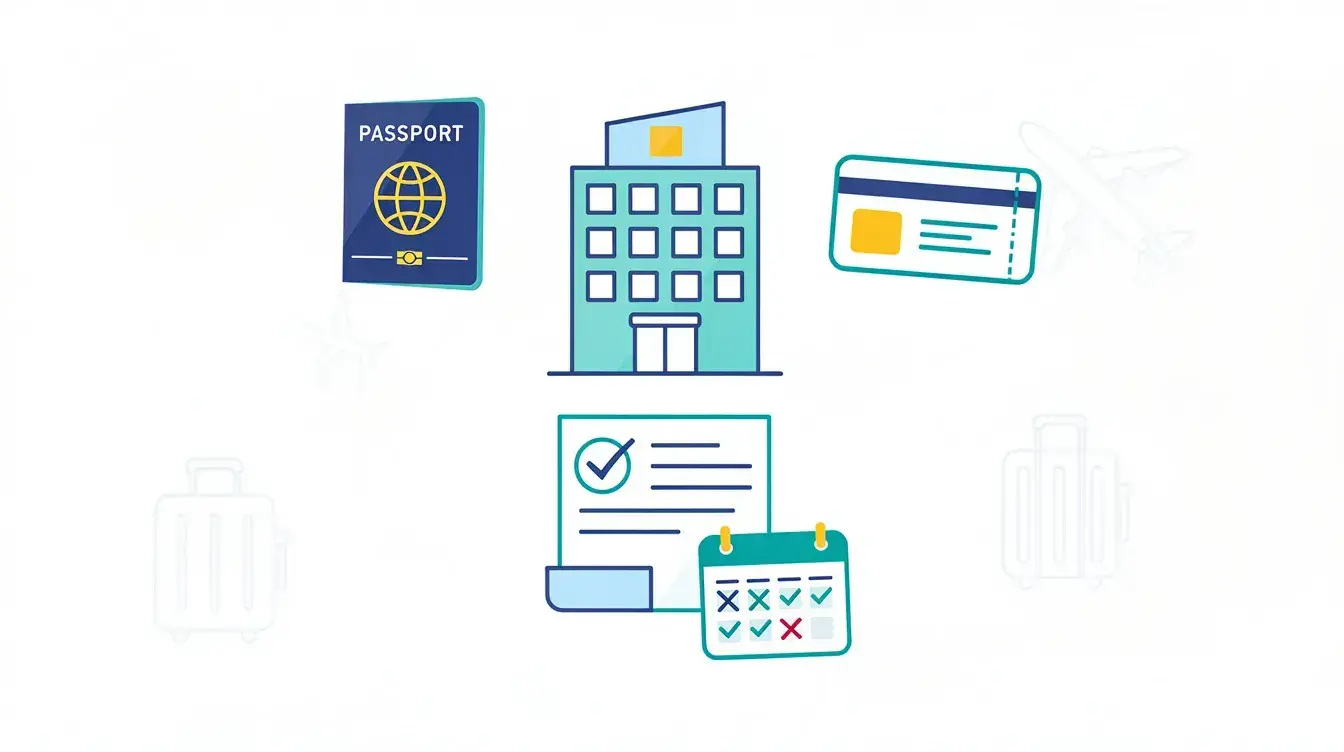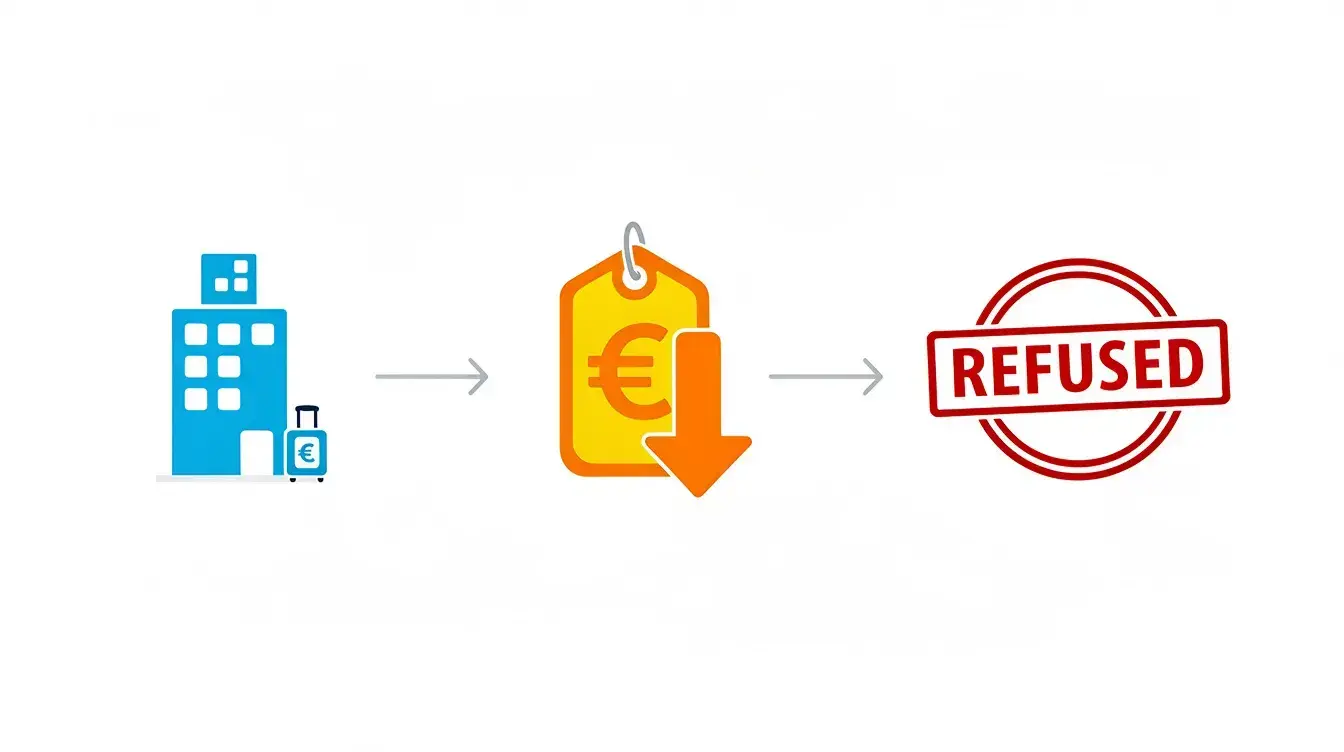
A free-cancellation hotel reservation looks harmless until a visa officer asks why nothing was paid. Pay-at-property bookings feel easy to make, but consulates do not always read them the same way hotel platforms do. The same confirmation PDF that reassures you can quietly weaken the file if the cancellation window, dates, property choice or guest information does not hold up under review.
This guide explains when a pay-at-property accommodation booking is reasonable for a visa file, when it should be upgraded, and how to make the hotel proof support the same travel story as your flight reservation, itinerary, cover letter and funding evidence. The goal is not to make the booking look expensive. The goal is to make it look believable, stable and consistent.
Key facts before using a pay-at-property hotel booking:
- Pay-at-property does not automatically mean weak, but the reservation must look real and current.
- The hotel dates should match flight arrival, checkout, onward travel and insurance coverage.
- A booking with no card, no deposit, vague guest names or a short cancellation window can invite more questions.
- The cover letter should explain the travel plan, not over-defend the unpaid hotel.
- Upgrade the booking if the visa file is high scrutiny, late-stage, interview-based or heavily dependent on accommodation proof.
Need travel proof that matches your accommodation plan? Prepare a clean flight reservation for visa with BookForVisa so your hotel dates, arrival city, return route and application timeline support one consistent file.
In This Guide
- Official-source check
- What pay-at-property means to a visa officer
- The cancellation-window problem
- Why some unpaid hotels look like placeholders
- Hotel cancellation risk before interview
- Matching hotel dates with flights and forms
- How treatment differs across visa systems
- Construction checklist
- What to say if questioned
- When to upgrade
- FAQ
Official-source check: the EU Visa Code requires supporting documents for short-stay visa applications, including documents relating to accommodation or proof of sufficient means to cover accommodation, as well as evidence of sufficient means and intention to leave before expiry. The European Commission’s Schengen visa guidance also lists supporting documents for accommodation, financial means and return intention, and notes that consulates may request additional documents. Sources: EU Visa Code and European Commission Schengen visa guidance.
Reviewed for: pay-at-property hotel wording, accommodation-proof consistency, Schengen supporting-document logic, flight-date alignment, cancellation-risk clarity and BookForVisa reservation intent.
What Pay-at-Property Actually Means to a Visa Officer
To a hotel platform, pay-at-property usually means the traveler has a reservation but payment will be collected later. To a visa officer, the same phrase can raise a different question: how committed is this accommodation plan?
That difference matters. Hotels think operationally. Consulates think evidentially. A hotel may be perfectly happy to hold a room without charging your card today. A visa reviewer may still ask whether the booking proves a real stay, or whether it is a soft placeholder created only to satisfy a document checklist.
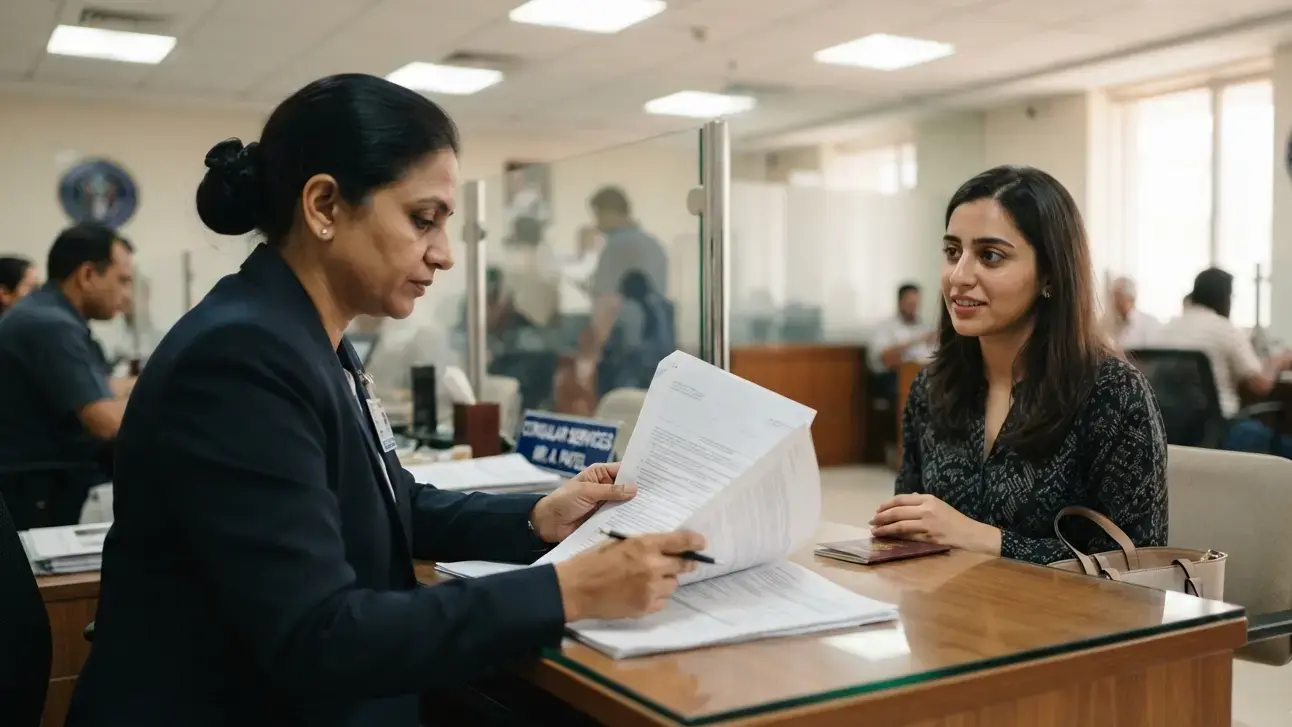
The booking engine’s definition vs the consulate’s definition of confirmed
A booking engine often uses “confirmed” to mean the hotel system has accepted the reservation. It does not always mean the guest has paid, the hotel has verified the traveler, or the reservation will remain active until the appointment or travel date.
That is why the word “confirmed” on a hotel PDF is not enough by itself. The reviewer may look at the full pattern:
- Is the guest name visible and consistent with the passport?
- Are check-in and checkout dates aligned with the trip?
- Does the property location make sense for the stated purpose?
- Is there a booking reference that the hotel could recognize?
- Does the payment status create doubt or remain normal for that booking type?
A pay-at-property booking can still support the application when those signals are strong. The problem is not that the booking is unpaid. The problem is when the unpaid nature combines with weak details, loose dates or a route that already looks fragile.
Why “no card required” language can backfire
“No card required” is attractive to travelers because it reduces financial risk. For a visa file, the same line can make the booking look easier to abandon. A reviewer may not reject a file because of one phrase, but the phrase can add friction when the rest of the evidence is already thin.
This is especially true when the confirmation also says:
- Free cancellation until the day of arrival.
- No prepayment needed.
- Payment due only at the property.
- Booking can be cancelled by the property if arrival is late.
- No guest card, phone number or arrival-time confirmation is visible.
Those features are not automatically bad. Many real travelers use them. But if your whole application depends on showing a stable travel plan, the hotel proof should not look like something created casually and removable without consequence.
The three checks a reviewer makes on a hotel PDF
A visa officer rarely needs to study every decorative line of the hotel confirmation. The practical review is simpler. The document should answer three things fast:
- Who is staying?
- Where are they staying?
- Do the dates match the rest of the file?
If those three answers are clear, the booking has done most of its job. If any answer is missing, the officer has to spend more time reconciling the file. That extra thinking is where avoidable doubt starts.
For family, group or business trips, the guest field becomes even more important. A booking under one lead guest may be normal, but the application should still show who the room covers. If a spouse, child, colleague or invitee is part of the same stay, the hotel confirmation, cover letter or supporting itinerary should make that visible.
The Free-Cancellation Window Problem
The feature that protects your money can weaken the appearance of the file when it is too loose. A booking that can disappear before the appointment, before the decision or before arrival does not always carry the same evidential weight as a more stable reservation.
This does not mean every applicant should pay for non-refundable hotels. It means the cancellation terms should match the risk level of the application. A low-risk tourist with strong bank statements, simple dates and a standard route may not need to over-engineer accommodation proof. A high-scrutiny applicant with a complex route, a weak travel history or an interview may need stronger proof.
How a same-day cancellation policy reads as non-binding
A same-day cancellation policy is convenient, but it can read as weak when the booking is meant to prove where you will stay. If the hotel can be cancelled at 6 p.m. on the arrival date with no cost, the document may show an option rather than a commitment.
The risk increases when the booking was made only minutes before submission, covers a long stay, has no deposit and sits far from the stated activity. That pattern can look like a placeholder, even if the booking is technically valid.
A stronger presentation usually has a more grounded pattern:
- The hotel was selected for location, route and purpose.
- The stay covers the correct nights without unexplained gaps.
- The cancellation terms are reasonable for the trip timeline.
- The traveler has enough funds to pay at check-in.
- The cover letter does not oversell the hotel as prepaid if it is not prepaid.
Visa categories where cancellable bookings get extra scrutiny
Some files rely more heavily on accommodation proof than others. A short tourist visa, first-time Schengen file, high-refusal-route application, multi-country itinerary or trip with limited personal ties may be reviewed more carefully than a simple repeat-visitor file.
Pay-at-property bookings can attract extra attention when:
- The applicant has little previous travel history.
- The trip has several cities or countries.
- The accommodation is far from the declared purpose.
- The hotel booking covers a long stay but requires no deposit.
- The stated budget is tight and the hotel cost is not explained.
- The stay involves a host for some nights and hotels for other nights.
In those situations, the safer move is not always to pay everything in advance. The safer move is to make the proof chain coherent. If you use pay-at-property accommodation, pair it with a clear itinerary, realistic transport dates and a flight reservation for visa that supports the same travel window.
Timing the booking date relative to the application date
Hotel proof should be recent enough to feel active but not so rushed that it looks fabricated for upload day. If the reservation is made months before the appointment, check that it has not expired, auto-cancelled, changed terms or been moved to a different property. If it is made minutes before the appointment, be ready to explain why the route was finalized late.
A balanced approach is to finalize the hotel proof after the travel dates, flight plan and appointment timeline are stable. For a simple route, that may be straightforward. For a multi-city file, prepare a night-by-night ledger first, then book accommodation in the exact order the trip will happen.
The booking date should support your story. A traveler who has planned a conference for months should not appear to have chosen every hotel on the morning of submission. A traveler whose appointment moved suddenly may reasonably update the booking close to filing.
Why Some Embassies Treat Pay-at-Property Bookings Like Placeholder Reservations
Some unpaid hotel bookings look very similar to placeholder accommodation evidence. They show a property, dates and a guest name, but they do not always prove that the stay is funded, stable or likely to happen.

What pay-at-property confirmations and placeholder vouchers have in common
On paper, both can show a hotel name, address, guest, dates and reference number. Both may be cancellable. Both may be unpaid. Both may be created quickly. That overlap is why the surrounding file has to do more work.
The accommodation document should not stand alone. It should connect with:
- The application form address field.
- The arrival and departure flights.
- The daily itinerary and city sequence.
- The cover letter explanation.
- The bank balance and budget logic.
- Travel insurance dates.
If the hotel proof connects to those documents, it feels like part of a real travel plan. If it sits alone, it can look like a document collected only to satisfy a checklist.
Signals that separate a legitimate booking from a weak placeholder
A legitimate pay-at-property booking usually has a believable reason behind it. Maybe the hotel is near the conference venue. Maybe it is close to a train station for the next country. Maybe it fits the applicant’s budget and family size. Maybe the cancellation policy is normal for the destination and season.
Positive signals include:
- Correct passport name or visible lead guest details.
- Hotel address matching the city stated on the application.
- Check-in after arrival and checkout before onward travel.
- Room capacity matching the number of travelers.
- Price that fits the bank statement and trip budget.
- Property category that matches the purpose and travel style.
- No obvious editing, cropping or screenshot-only presentation.
Weak signals include unclear guest details, impossible check-in timing, duplicate hotel bookings for the same night, missing addresses, suspiciously cheap long stays, or accommodation in a city that the traveler never explains in the itinerary.
How to mention it in the cover letter
Do not over-defend a pay-at-property booking. Overexplaining can make the document look more suspicious than it is. The cover letter should simply make the itinerary coherent.
A calm explanation is enough:
- State the city and dates of stay.
- Explain why the location fits the trip.
- Confirm that accommodation costs are included in the budget.
- Make clear whether the hotel is reserved, prepaid, hosted or employer-arranged.
Avoid saying the booking is “guaranteed” if it is not prepaid. Avoid saying “the hotel is only for visa” or “I will cancel after approval.” Those phrases shift attention away from the real itinerary and toward your intent to remove evidence later.
If the reader is actually asking about a dummy ticket rather than BookForVisa’s booking-for-visa and reservation-planning logic, DummyFlights is the cleaner place for that terminology. This article stays focused on accommodation and flight-reservation consistency for BookForVisa users.
The Hotel Cancellation Risk Nobody Warns You About
A pay-at-property booking can disappear before the appointment or interview. The traveler may not notice until the hotel sends a quiet email, the platform updates the reservation status, or the officer asks for fresh proof.
This risk is higher when a hotel requires a card guarantee and the card fails, the property overbooks, the traveler misses a confirmation message, or the booking platform uses automatic cancellation rules.
Why unpaid reservations get auto-cancelled more often
Hotels manage inventory. If a room is unpaid, unguaranteed or connected to a card that cannot be charged, the property may treat it as less secure than a prepaid stay. During busy seasons, trade fairs, school holidays and major events, hotels may be stricter because every room has value.
Common cancellation triggers include:
- Card pre-authorization failure.
- No response to property messages.
- Late arrival without confirmation.
- Duplicate bookings under the same name.
- Rate-plan changes after the booking was made.
- Hotel overbooking or property closure.
If the booking disappears after submission, do not edit the PDF. Replace the proof with a current reservation and update connected documents if the dates, city or property changes.
Check the property before relying on it
Before placing a pay-at-property hotel in a visa file, check whether the property looks stable enough to rely on. A real hotel can still be a bad evidence choice if it frequently cancels, has unclear addresses, does not answer messages or uses confusing payment terms.
Look for practical signs:
- A complete address that appears consistently across platforms.
- Recent reviews showing the property is operating normally.
- Clear check-in rules and reception hours.
- Transparent cancellation and payment policy.
- Contact details for confirmation if needed.
- Location that fits your itinerary, event or host plan.
For a visa file, the cheapest property is not always the strongest property. A slightly more credible hotel can reduce doubts more than a suspicious bargain can save money.
What to do if the hotel cancels before interview
If the property cancels before the interview or additional-document request, act quickly and cleanly. Keep the old email privately as a record, but do not submit an obsolete reservation as if it remains active.
Then update the chain:
- Book a replacement hotel in the same city and date range if the route stays the same.
- Check that the new hotel address matches the application and cover letter.
- Update the daily itinerary if location or transport changes.
- Check insurance dates if the travel window changes.
- Update flight proof only if arrival, departure or city sequence changes.
If the visa office asks why the hotel changed, keep the explanation simple: the original property cancelled or became unavailable, and the new reservation supports the same travel plan. Do not describe the old reservation as active once it is not.
Matching Hotel Dates With Flights, Itinerary and Cover Letter
Most pay-at-property problems are not payment problems. They are matching problems. The hotel may be acceptable, but the dates do not match the route, the guest name is incomplete, or the application form says something different.
Date mismatches that are easy to miss
A hotel booking should cover the nights the traveler actually needs accommodation. That sounds simple until time zones, overnight flights, airport arrivals and multi-city routes enter the file.
Common mismatches include:
- Hotel starts one day before arrival with no early check-in explanation.
- Hotel starts one day after arrival, leaving the first night uncovered.
- Checkout happens before the final night in the country.
- Two hotels cover the same night in different cities.
- The flight arrives after midnight but the hotel starts on the wrong calendar date.
- The cover letter says seven nights while hotels show six or eight.
Create a simple night ledger before submission. Write each calendar date, the city where you sleep, the hotel or host proof, and the transport connected to the next movement. This catches gaps faster than reading PDFs one by one.
City-sequence errors in multi-city accommodation
Pay-at-property bookings can become messy when the itinerary has several cities. Travelers often book hotels as they research, then forget to remove the old version. A visa file should not show three possible trips. It should show one active plan.
If your route is Rome, Florence, Venice and Paris, the hotels should follow that order. A Florence hotel overlapping with a Venice flight, or a Paris hotel before the France arrival date, can make the file look careless.
The same logic applies to flight proof. A hotel route becomes stronger when the arrival city, transfer city and final departure in the flight itinerary for visa match the accommodation trail. The officer should be able to follow the journey without guessing.
Guest fields that disappear from hotel platforms
Some booking engines show only the lead guest. Others omit passport numbers, second guests, children or room-sharing details. That can be normal, but the application pack should still make the traveler identity clear.
Before uploading, check whether the confirmation shows:
- Lead guest name.
- Number of adults and children.
- Room type and capacity.
- Hotel address and contact details.
- Booking reference.
- Check-in and checkout dates.
- Payment or cancellation terms.
If the confirmation does not show every traveler, your cover letter or group itinerary can clarify who stays where. Do not edit the hotel PDF to insert names. Use legitimate supporting explanation instead.
How Pay-at-Property Bookings Are Treated Across Visa Systems
There is no single global rule that says every pay-at-property booking is accepted or rejected. Requirements vary by country, consulate, visa type, applicant profile and the local application centre’s checklist.
Schengen short-stay files and accommodation proof
Schengen guidance focuses on accommodation, financial means, purpose of travel and return intention. It does not automatically require every hotel to be prepaid in every case. But the applicant still needs to show where they will stay or that they have sufficient means to cover accommodation.
That means a pay-at-property booking can be usable when it is coherent. It is weaker when the route has missing nights, the property looks temporary, or the applicant cannot show enough funds to pay for the stay.
For Schengen-style files, also check main destination logic. If the longest stay, main purpose and accommodation trail point to different countries, the hotel proof may create a jurisdiction problem. The issue is not pay-at-property. The issue is that the application route does not explain itself.
eVisa portals and automated document review
Some online portals rely on document uploads and basic consistency checks. The system may not “understand” payment status in a human way, but it can still expose obvious mismatch problems such as unreadable PDFs, wrong dates, missing guest names, oversized files or a hotel address in the wrong country.
For portal submissions, presentation matters. Use a complete PDF, not a cropped screenshot. Make sure the document is readable after compression. Keep file names clean and avoid uploading several hotel versions for the same city.
When refundable bookings are preferred over prepaid hotels
In many visa situations, buying non-refundable travel too early is not wise. A refundable or cancellable booking can be practical, especially when the visa decision is uncertain. The key is to avoid making “flexible” look like “fictional.”
A reasonable refundable booking can show planned accommodation while protecting the traveler from unnecessary losses. But if the booking is free, unpaid, cancellable, unsupported and inconsistent, flexibility becomes a weakness.
The same balance applies to flights. Applicants often use reservation documents instead of buying final airfare too early. The broader flight reservation for visa complete guide explains how reservation timing, PNR presentation, route logic and document consistency work together in a visa file.
Building a Pay-at-Property Booking That Survives Manual Review
A strong accommodation booking is not only a hotel PDF. It is a document that fits the rest of the visa story. Before you submit it, run the booking through a construction checklist.
Pay-at-property booking checklist:
- Hotel name and full address are visible.
- Guest name matches the passport or lead-applicant explanation.
- Check-in date follows the arrival date.
- Checkout date matches onward travel or final departure.
- Room capacity matches travelers.
- Cancellation terms do not make the stay look disposable.
- Payment status is not misrepresented as prepaid.
- Hotel cost fits the budget and bank evidence.
- Location matches purpose, event, host or sightseeing plan.
- The PDF is readable without edits or strange cropping.
Choose properties that look reliable
A reliable property is easier to explain than a random bargain. Look for accommodation that is active, reachable, properly mapped and appropriate for the route. If the hotel is far from the city centre, airport, event or host, be ready to explain why it was selected.
For business travelers, the hotel should make sense beside the meeting location. For tourists, it should connect naturally with the city sequence. For family visitors, a mix of host stay and hotel stay should be clearly divided by date.
Format the PDF for fast review
The best booking PDF is boring in the right way. The officer can find the guest, hotel, address, dates, booking number and terms without zooming, guessing or comparing several screenshots.
Before uploading:
- Use the full confirmation PDF where possible.
- Avoid screenshot fragments unless the portal requires images.
- Keep the file name clear, such as “Hotel Paris July 5-9.”
- Do not highlight, crop or manually rewrite hotel details.
- Make sure the document opens after compression.
When adding a deposit can help
A small deposit is not always necessary, but it can improve the appearance of commitment in higher-risk situations. If the hotel allows partial payment or card guarantee without making the booking non-refundable, that may create a more stable document.
Consider stronger hotel proof when the application has several risk factors: first-time travel, complex route, weak funding story, urgent appointment, long stay, large family group, or a destination where accommodation proof is central to the checklist.
What to Say If a Consular Officer Questions the Unpaid Hotel
If an officer asks why the hotel is pay-at-property, answer directly. Do not panic, overexplain or imply that the booking is fake. The safest answer is usually practical: the reservation is active, the hotel permits payment at arrival, the stay matches the itinerary, and the funds are available.
Explain “no payment was taken” without sounding evasive
Simple wording works best:
- “This hotel allows payment at check-in.”
- “The booking is for the dates shown in my itinerary.”
- “The accommodation cost is included in my travel budget.”
- “I can provide an updated confirmation if required.”
Avoid wording that suggests the hotel exists only for the application. Do not say “I will cancel after the visa” or “It is only a formality.” Those phrases weaken intention and make the officer focus on what happens after approval instead of what the documents show now.
Phrases that reassure without overpromising
Good interview language is factual. It does not promise approval, invent commitments or exaggerate the hotel’s status.
- “The accommodation matches my planned arrival and departure dates.”
- “The hotel is near the place I plan to visit.”
- “My bank statement shows I can pay for the stay.”
- “The booking reference and hotel address are visible on the confirmation.”
- “If the hotel changes, I will update the file according to the consulate’s instructions.”
Rehearse the follow-up question: what if you cancel?
The officer may ask what happens if the hotel changes. The answer should show stability, not a plan to abandon the trip. You can explain that travel arrangements may be adjusted after the visa decision, but the current booking reflects the intended route and budget.
If you do need to change accommodation later, update the documents cleanly. Do not keep an old hotel confirmation in the active travel folder if it no longer reflects your real plan.
When to Upgrade From Pay-at-Property to Paid or Verified Proof
Pay-at-property can be acceptable, but it is not always the strongest option. Upgrade when the unpaid booking is doing too much work inside the application.
Red flags that mean free cancellation may not be enough
Consider stronger proof if any of these apply:
- The visa checklist places heavy weight on accommodation.
- You have a first-time or high-scrutiny application.
- The trip has multiple cities, hosts or countries.
- The hotel is unpaid, cancellable and created at the last minute.
- Your bank balance barely covers the stay.
- The property has unclear contact details or cancellation terms.
- You have an interview or additional-document request coming up.
Upgrading does not always mean buying the most expensive hotel. It may mean choosing a better-located property, adding a deposit, using a clearer confirmation, updating the booking closer to the appointment, or replacing a weak hotel with a stronger one.
Switching late without delaying the visa file
If you switch hotels late, keep the route stable where possible. Changing the property is easier than changing the whole city sequence. The fewer connected documents you disturb, the easier the update becomes.
Before replacing the booking, check:
- Does the new hotel cover the same nights?
- Does the city remain the same?
- Does the cost still fit the bank statement?
- Does the address match the itinerary and cover letter?
- Do flights, insurance and internal transport still line up?
If only the hotel changes, explain only the hotel change. If dates or cities change, recheck the entire file. A late change should make the application cleaner, not create a new contradiction.
Where verified reservation support earns its cost back
Verified reservation support is most valuable when the file needs consistency more than decoration. If your travel dates are still moving, your appointment is close, or your route has multiple parts, a clean reservation pack can reduce avoidable mismatch risk.
BookForVisa is useful when the applicant needs a travel-proof set that matches the application timeline without buying final non-refundable airfare too early. The flight proof should support the accommodation proof, and the accommodation proof should support the form. When the documents move together, the file becomes easier to review.
How to Decide Whether Pay-at-Property Is Strong Enough
The right accommodation strategy depends on the whole file. A pay-at-property booking can be perfectly reasonable for one applicant and too weak for another. The difference usually comes from risk signals around travel history, funding, route complexity, destination rules and how much the application relies on accommodation proof.
Think of the hotel booking as one part of a larger evidence chain. If the chain is already strong, the booking does not need to carry the whole application. If the chain is thin, the hotel proof must work harder.
Use pay-at-property more confidently when:
- The route is simple and the stay is short.
- The hotel is clearly located near the stated purpose.
- The traveler has strong funds and normal account history.
- The flight dates, hotel nights and insurance dates already match.
- The booking shows the guest name, address, reference and clear terms.
- The checklist does not specifically require prepaid accommodation.
Upgrade the proof when:
- The itinerary covers several countries or cities.
- The booking was made at the last minute with no card or deposit.
- The hotel cost looks high compared with the bank statement.
- The applicant has limited travel history or previous refusals.
- The application depends heavily on proving a temporary stay.
- The hotel confirmation does not show every traveler clearly.
This decision should happen before upload, not after an officer questions the file. If the booking already looks weak to you, it will probably look weak to a reviewer too. Fix the proof while you still control the timeline.
Pay-at-Property Strategy by Traveler Type
Different applicants create different accommodation expectations. A tourist, business traveler, student, family visitor and sponsored applicant may all use hotel proof, but the reason behind the stay changes. The booking should match that reason.
Price can matter as much as payment terms; see whether a visa can be refused because the hotel is too cheap.
Tourist applicants
Tourist files usually need the hotel to support the city sequence. If the plan is five nights in Rome and three nights in Florence, the accommodation should make that sequence obvious. A pay-at-property hotel can work if the cities, dates and budget look normal.
The risk appears when a tourist books luxury hotels without the funds to support them, extremely cheap rooms far outside the city, or several backup properties for the same dates. The officer does not need to judge the traveler’s taste. They only need to see whether the stay is believable.
Business travelers
Business travelers should connect accommodation to meeting dates, event venues or employer instructions. A hotel near the meeting location is easier to understand than a random property chosen only because it had free cancellation.
If an employer pays for accommodation, the hotel proof should not contradict the employer letter. If the applicant pays personally, the bank evidence should cover that cost. If a company booked the room under a corporate name, the cover letter can explain the arrangement without making the file noisy.
Family visitors and host stays
Some applicants stay with a host for part of the trip and use hotels for the rest. That can be normal, but the dates must be clean. A host invitation covering the same dates as a hotel booking may look contradictory unless the side trip is explained.
For example, if a relative hosts you in Paris from June 5 to June 12 and you also submit a hotel in Lyon from June 8 to June 10, explain that Lyon is a short side trip inside the wider visit. Do not leave the officer to guess.
Students and long-stay applicants
Students and long-stay applicants often have a different accommodation pattern. They may show temporary arrival accommodation while longer-term housing is arranged after arrival. That can be credible when the visa type and school documents support it.
A pay-at-property hotel for the first few nights can work as arrival accommodation, but it should not pretend to cover the entire stay if it does not. The file should explain the transition from short-term hotel to dormitory, rental, family stay or employer-supported housing.
Sponsored applicants
Sponsored applicants need extra clarity because the person paying may not be the person traveling. If a sponsor pays for the hotel, the sponsor letter, bank evidence and booking should support the same story. If the traveler pays for the hotel while the sponsor covers flights or daily expenses, say that clearly.
The worst version is a file where every document quietly assigns responsibility to someone different. The hotel says pay at property, the cover letter says sponsor pays everything, and the bank statement shows the applicant cannot cover the stay. That mismatch is fixable before submission but difficult to explain afterward.
Payment Status Wording That Keeps the File Clean
Do not hide the payment status. Do not exaggerate it either. If the hotel is pay-at-property, call it a reservation or hotel booking, not a prepaid stay. If a deposit was paid, say partial payment or deposit, not full payment. Accurate wording is safer than aggressive wording that collapses under one question.
Useful wording includes:
- “Accommodation reserved for the stated travel dates.”
- “Payment is due at check-in under the hotel’s rate terms.”
- “Accommodation cost is included in the applicant’s travel budget.”
- “The hotel confirmation matches the itinerary and application form.”
Risky wording includes:
- “Fully paid” when no payment was made.
- “Guaranteed approval hotel booking.”
- “This booking is only for the visa.”
- “I will cancel the hotel immediately after approval.”
Strong conversion copy can still be truthful. The article can be commercially confident without pretending that a hotel booking controls the visa decision. The winning position is clear: use a booking that looks real, matches the file and avoids unnecessary financial exposure.
Financial Proof Behind Pay-at-Property Accommodation
An unpaid hotel shifts attention to the applicant’s ability to pay later. If the hotel is not prepaid, the bank statement and budget logic become more important. The officer may ask whether the traveler can afford the stay when they arrive.
Build the budget from the itinerary:
- International flight or flight reservation cost.
- Hotel cost for each night.
- Internal transport between cities.
- Food, local transport and daily expenses.
- Insurance and fixed event costs.
- Buffer for price changes, deposits or emergency changes.
Then compare that budget with the bank evidence. A pay-at-property hotel is easier to trust when the account can clearly absorb the future accommodation cost. If the booking shows a high nightly rate and the balance is tight, the hotel can make the financial story look weaker.
Applicants sometimes think prepaid hotels always look stronger. Not necessarily. A prepaid hotel with a suspicious funding pattern can create its own problem. A pay-at-property hotel with a strong bank statement, clear route and reasonable price may be cleaner than a prepaid booking funded by a sudden unexplained transfer.
How to Monitor the Booking After Submission
Accommodation proof does not stop mattering after upload. Some applicants submit the file and forget the hotel until the interview. That is risky with pay-at-property bookings because the reservation can change status quietly.
After submission, check the booking at sensible intervals:
- Immediately after submission, confirm that the uploaded PDF matches the active reservation.
- Before biometrics or interview, confirm the booking still exists.
- After any appointment delay, recheck the cancellation terms and date validity.
- Before travel, confirm late-arrival rules and payment requirements.
If the hotel sends a message asking for arrival time, card confirmation or deposit, respond quickly. A ignored hotel message can turn into an automatic cancellation. If the booking changes, update the active travel folder so you do not carry old and new versions together.
Common Pay-at-Property Mistakes That Weaken Visa Files
Most weak files fail because of small, preventable details. The hotel may be real, but the evidence looks careless. Before you file, remove anything that makes the officer work harder than necessary.
- Submitting a screenshot instead of a full confirmation PDF.
- Using a property with no clear address.
- Booking a hotel in the wrong city or far from the stated purpose.
- Leaving the first arrival night uncovered.
- Keeping cancelled hotel confirmations in the upload pack.
- Using one lead-guest booking without explaining family or group travelers.
- Calling an unpaid booking prepaid in the cover letter.
- Ignoring time-zone and after-midnight arrival dates.
- Using a hotel price that does not fit the financial proof.
Fix these before improving the design of the file. A clean layout helps, but accuracy is what makes the proof stronger. The hotel booking should make the officer’s job easier: one traveler, one route, one set of dates and one believable accommodation plan.
How to Place the Hotel Booking Inside the Visa Pack
A pay-at-property booking is easier to trust when it appears in the right place inside the document pack. Do not bury it behind unrelated papers, duplicate reservations or old screenshots. Put the travel proof in an order that follows the trip itself.
A practical order is:
- Application form or appointment confirmation, if required in the same packet.
- Cover letter with the route, dates, purpose and funding explanation.
- Flight reservation or travel itinerary showing arrival and departure.
- Hotel or host proof in date order.
- Internal transport proof, if the route changes city or country.
- Travel insurance covering the relevant stay.
- Financial proof and sponsor documents.
- Invitation, event registration or employer letter when applicable.
This order helps the reviewer understand the journey before judging the hotel. If the officer first sees a pay-at-property hotel with no route context, the booking may feel thin. If the officer first sees a clear travel plan and then the hotel confirms where each night fits, the same booking becomes more useful.
Example: simple tourist stay
A traveler applies for a seven-night tourist trip to Barcelona. The flight reservation shows arrival on May 4 and departure on May 11. The hotel booking starts May 4 and ends May 11, with one guest, a visible address, a booking reference and pay-at-property terms. The bank statement shows enough money for the hotel cost and daily expenses.
That file is usually easy to understand. The hotel does not need to be prepaid to make sense because the trip is simple and the funds support the future payment.
Example: split accommodation stay
A traveler visits Paris for three nights with a host, then stays two nights in a Lyon hotel before returning to Paris for the flight home. This can work, but the cover letter should explain the side trip. The host invitation should cover the Paris nights only, and the Lyon hotel should cover only the Lyon dates. The flight and train movements should connect the two parts.
If the Paris invitation says the host covers the entire stay while the Lyon hotel covers the same dates, the file contradicts itself. The problem is not pay-at-property. The problem is that the documents assign the same nights to two different accommodation stories.
Example: business trip with flexible dates
A business traveler may hold pay-at-property accommodation because the meeting schedule could move by one day. That is reasonable when the employer letter, meeting invitation and flight reservation all show the same expected window. If the meeting dates are tentative, the cover letter should say so calmly and explain the current plan.
What weakens the file is a hotel booking that covers a random week while the employer letter names different dates. If the business purpose is fixed, the accommodation should sit around it. If the business purpose is flexible, the documents should acknowledge the flexibility rather than pretending every date is final.
Getting Your Accommodation Proof Right Before You File
Before submission, review the file like a skeptical officer. Do not start with whether the hotel platform says “confirmed.” Start with whether the whole application tells one clean story.
Final pre-submission check:
- The application form lists the same stay dates shown in the bookings.
- The first hotel begins on the correct arrival date.
- Every night is covered by hotel, host, transit or another clear explanation.
- The final hotel checkout connects to onward travel or return travel.
- Payment status is described accurately.
- Accommodation cost fits the financial evidence.
- The cover letter explains complexity without sounding defensive.
- Old hotel versions are removed from the active file.
A pay-at-property hotel booking can support a visa file when it is selected carefully, presented honestly and aligned with the rest of the application. It becomes risky when it is treated as a throwaway checkbox. The strongest version is not the loudest or most expensive one. It is the one that makes the travel plan easy to believe.
Need your flight proof to match a pay-at-property hotel plan? Create a BookForVisa reservation that supports your application dates, accommodation trail and cover-letter timeline before you submit.
Frequently Asked Questions
Can I use a pay-at-property hotel booking for visa applications?
Yes, in many cases it can be used if the booking is genuine, current, readable and aligned with the rest of the visa file. It becomes weaker when it has no deposit, unclear guest details, loose cancellation terms or mismatched dates.
Does a hotel booking for visa need to be prepaid?
Not always. Some visa files can use reserved or cancellable accommodation, depending on the checklist and applicant situation. The key is to show accommodation or sufficient means to cover it, and to avoid misrepresenting an unpaid booking as prepaid.
Why can free cancellation weaken accommodation proof?
Free cancellation can make the stay look less committed when the booking is unpaid, created late, cancellable until arrival or poorly connected to the itinerary. It is not automatically bad, but it needs strong supporting context.
What should a pay-at-property confirmation show?
It should show the hotel name, address, guest name, check-in and checkout dates, booking reference, room details, cancellation terms and enough information to connect the stay with the traveler’s route and budget.
What if the hotel cancels before my visa interview?
Do not edit the old PDF. Replace it with a current booking and update connected documents if dates, cities, hotel addresses or route logic change. Keep the explanation factual if the visa office asks what happened.
Should my flight reservation match my hotel booking?
Yes. Arrival city, departure city, travel dates and hotel nights should tell the same story. A strong flight reservation supports the accommodation trail and makes the visa file easier to review.
Can I mix hotel stays and host stays in one visa file?
Yes, but the dates must be clear. Show which nights are covered by hotel bookings and which nights are covered by host accommodation, invitation evidence or another official explanation.
Is pay-at-property safer than buying a non-refundable hotel?
It is safer financially, but not always stronger as proof. The best option depends on the visa type, route, cancellation terms, applicant profile and whether the file already has strong financial and travel evidence.
What should I say if asked why the hotel is unpaid?
Say that the hotel allows payment at check-in, the booking matches your itinerary, and the accommodation cost is included in your travel budget. Avoid saying the booking is only for the visa or will be cancelled after approval.
When should I upgrade to stronger accommodation proof?
Upgrade when the file is high scrutiny, the route is complex, the appointment is close, the hotel terms are weak, or accommodation proof is central to the checklist. Stronger proof can mean a clearer hotel, better location, deposit or updated reservation.
Friendly reminder: BookForVisa provides travel-proof documents for planning and visa-application support. Requirements vary by destination, consulate, visa category and applicant situation. A flight reservation can support a file, but it does not guarantee approval, boarding or entry.