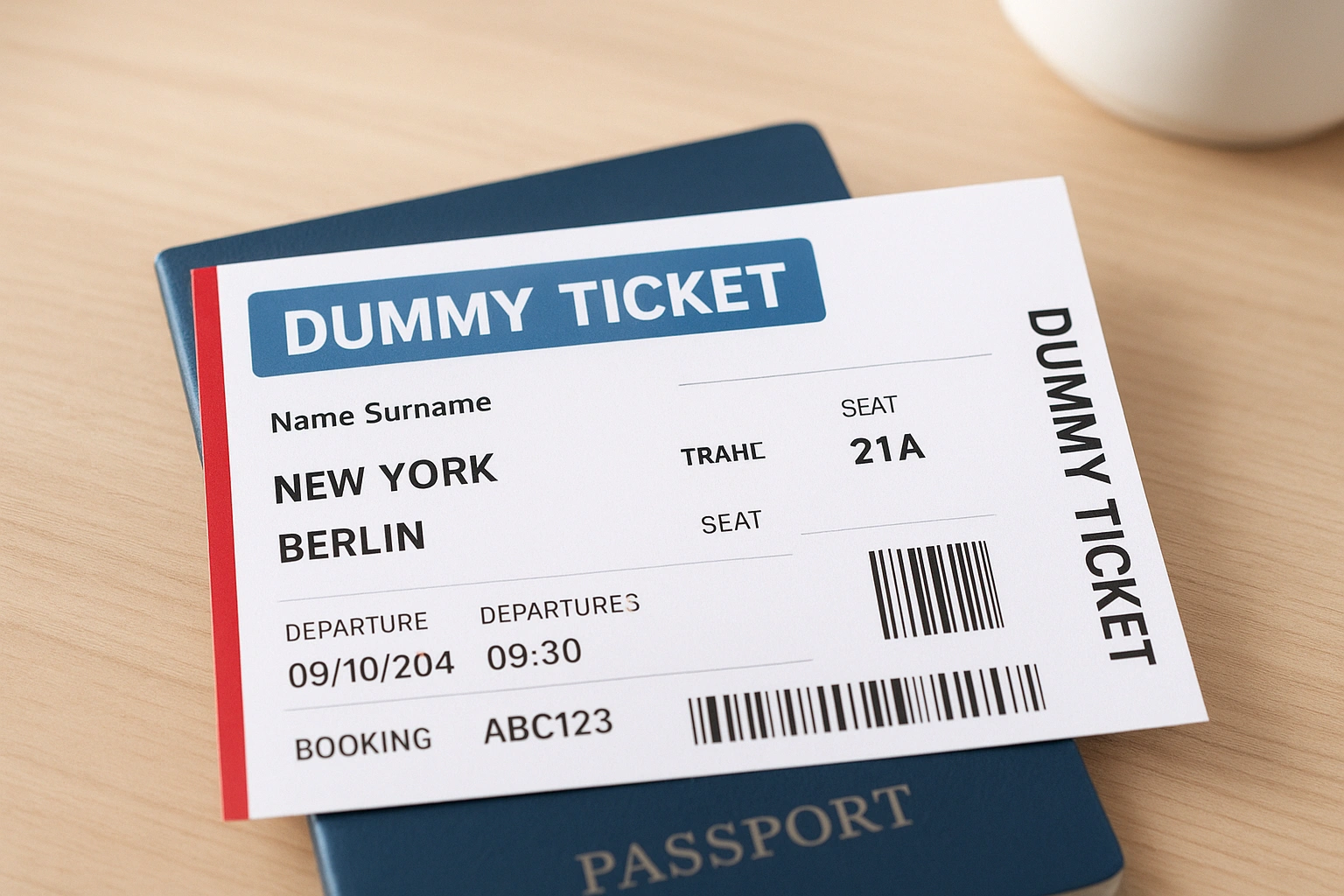
Picture this: your passport says one country, your visa application says another, and your flight itinerary starts in a third. Officers read that itinerary as part of your story, and any small mismatch is often the first thing they flag.
Expats, students studying abroad, digital nomads, and travelers connecting through a busy regional hub all run into this same problem. The trip doesn't start at home, so the usual booking advice doesn't quite fit anymore. You need an itinerary that matches your current location, your consulate's jurisdiction, and your entry stamps, not a generic round-trip template. This detailed guide walks through exactly how to build that reservation, scenario by scenario, so your departure city matches the rest of your application instead of raising fresh questions. Create a flight itinerary for visa that lines up with your real departure city, residence proof and route logic.
Key facts before creating a third-country flight itinerary:
- Your departure city should match where you are lawfully staying before the trip.
- Residence proof, entry stamps or local status documents should support the third-country origin.
- Consulate jurisdiction matters when passport country and application country differ.
- Multi-leg routes should look practical, not artificially complicated.
- The itinerary, cover letter, hotel proof and insurance should all tell the same route story.
In This Guide
- Official-source check
- Why Your Departure City Confuses Visa Officers More Than You Think
- Four Real-World Scenarios Where Your Trip Doesn't Start at Home
- Building a Flight Reservation That Matches Your Actual Travel Story
- Mistakes That Get Third-Country-Origin Itineraries Rejected
- Making Your Third-Country Departure Work In Your Favor
- FAQ
Official-source check: third-country visa files depend on residence, jurisdiction and route logic. France-Visas guidance on where to submit an application explains that applications are normally handled by the competent visa authority for the applicant’s place of residence. GOV.UK Standard Visitor guidance focuses on proving you can leave at the end of the visit and support the journey. Use the destination checklist and local visa-center rules as the controlling source for your case.
Reviewed for: third-country departure logic, consulate jurisdiction wording, residence-proof alignment, multi-leg itinerary clarity, cover-letter consistency, flight itinerary terminology and final-ticket timing.
Why Your Departure City Confuses Visa Officers More Than You Think

Visa officers process hundreds of applications a week, and most follow the same pattern: passport country, home address, and departure city all match. The moment one of those three doesn't line up, your file gets a second look. That second look is where most third-country departures run into trouble, and understanding why it happens is the first step to avoiding it.
The Passport-Residence Mismatch Trigger
When your passport is issued by one country, your visa application is filed from another, and your flight itinerary shows a departure from a third, you've created three separate data points that all need to agree on the same story.
Officers aren't trained to assume the worst. They're trained to check for consistency. A passenger holding a US passport, applying through a consulate in Berlin, with a flight departing from Amsterdam, isn't automatically suspicious. But it does raise a question the officer needs answered before they can move forward: why here, and how are you here legally?
This is where documentation does the talking your itinerary can't. A residence permit, a valid work visa, or a student ID from the departure country closes that gap immediately. Without one of these, the mismatch sits unexplained, and unexplained mismatches slow down or stall applications.
A few practical points worth keeping in mind:
- Show evidence of legal stay in the third country if you entered before applying for this trip.
- Include proof of how you reached the departure country if it isn't obvious from your travel history.
- Keep your personal details, including your full name and date of birth, exactly as they appear on your passport across every document you submit.
Consistency across all documents is what actually earns trust here. It's not about having a perfect explanation. It's about having documents that agree with each other before the officer has to ask.
Consulate-Specific Jurisdiction Rules You Can't Ignore
Here's something a lot of applicants miss entirely: many consulates, Schengen ones in particular, only accept applications from people who reside within their specific consular district. This isn't a suggestion. It's often a hard requirement written into the consulate's own guidelines.
If you're applying to a consulate in Madrid but your flight itinerary shows a departure from Rome, and neither city matches your documented residence, the application can look like consulate shopping rather than a genuine trip. Consulate shopping, applying wherever seems fastest or easiest rather than where you're actually based, is one of the more common reasons third-country applications get extra scrutiny.
Before you book anything, check the jurisdiction rules for the exact consulate you're applying to. Every consulate publishes this information, and it varies more than most applicants expect. Some accept applications from short-term visitors within their district. Others require proof of residence stretching back months.
Once you know the jurisdiction, build your itinerary around it rather than the other way around. A round-trip itinerary is generally preferred for Schengen visa applications, and it should originate from a city that matches, or at least logically connects to, the jurisdiction you're applying under.
If your situation genuinely requires departing from outside that jurisdiction, a cover letter explaining the trip's origin from a third country becomes essential. Cover letters should explain unusual starting points in detail, not vaguely. Name the reason: a work assignment, a study program, a family visit that predates your visa application. Specific reasons carry weight. General ones don't.
Why "It's Just a Layover" Doesn't Always Read as Obvious
You know the difference between a genuine transit connection and a disguised starting point. The officer reviewing your file doesn't, at least not without help.
This is where the details of your flight itinerary matter more than most applicants realize. Embassies accept flight reservations, not fully paid tickets, but that reservation still needs to function as a complete, verifiable document. A flight itinerary shows planned travel details without payment, while a flight ticket is a paid document allowing boarding. Most embassies advise against buying tickets before visa approval, since a rejected application would leave you with a paid ticket you can't use.
What the reservation absolutely needs, regardless of payment status, includes:
- A booking reference, or PNR, that the embassy can verify online.
- Airline and flight numbers clearly identified for each leg of the journey.
- Precise local departure and arrival times for each flight segment.
- Airport details with full names and IATA codes for all flights.
- A chronological travel timeline showing departures and arrivals clearly.
A layover reads as a genuine transit point when the connecting flight numbers are real, the layover window is realistic, and the final destination lines up with your stated purpose of travel. It reads as something else entirely when the routing looks unnecessarily complicated, or when the "layover" city happens to be where all your other documents place you.
Online reservation services can provide verifiable flight itineraries for around $10, and most reservations stay valid for 24 to 72 hours, which is typically enough time to submit your application before the hold expires. Travel agents can also hold tickets for three to seven days for a fee, though this route tends to cost more and take longer to arrange than a dedicated reservation service.
The goal isn't to over-explain a layover in a cover letter. It's to make the itinerary itself hard to misread, so the officer's first glance already tells the right story. That same logic, building a reservation that speaks for itself, becomes even more important once you start looking at the specific situations that lead someone to depart from a third country in the first place.
Four Real-World Scenarios Where Your Trip Doesn't Start at Home
The right way to build your flight reservation depends heavily on why you're abroad in the first place. A contract worker, a student, a remote professional, and a regional traveler each carry a different kind of proof, and each needs a different kind of itinerary to match it.
The Expat Or Contract Worker Applying From A Host Country
Someone working in Singapore on a valid employment pass, applying for a Schengen visa to visit Portugal, already has a built-in explanation for their departure city. The employment pass itself answers the question before the officer has to ask it.
What ties this scenario together is documentation that confirms the work arrangement is real and current. This typically includes:
- An employment letter stating the role, employer, and duration of the contract.
- A copy of the residence or work permit valid through the travel dates.
- A local address that matches the one listed on the visa application.
The flight reservation itself should reflect round-trip logic back to the host country, not the passport country. If Sarah holds a US passport but lives and works in Singapore, her itinerary should show Singapore to Lisbon and back to Singapore, since that's where her legal status and ongoing obligations actually sit.
A round-trip flight reservation is often required for Schengen visa applications specifically, and this scenario makes that requirement easy to satisfy. The return leg proves she has a reason and a legal right to go back to where she started, which is exactly what the officer needs to see.
The Student Studying Abroad Who Wants To Travel During A Break
University enrollment does a lot of heavy lifting here. If Marcus is enrolled at a university in Toronto and wants to visit Delhi and Mumbai during his semester break, his student status already explains why his trip doesn't start in his passport country.
The mistake students make most often is booking a reservation that routes through their passport country first, before heading to the actual destination. This contradicts the story the rest of the application is telling. If every other document says "currently studying in Toronto," the flight itinerary needs to say the same thing.
A clean version of this itinerary follows a simple loop: host country to destination, destination back to host country. For Marcus, that means Toronto to Delhi, then Delhi back to Toronto, timed to align with his actual academic calendar.
Timing matters more here than in most other scenarios. The travel dates need to fall within a real break period, since a trip that overlaps with active semester dates raises questions the enrollment letter alone can't answer. Keeping the dates on the itinerary consistent with the university's published academic calendar removes that friction entirely.
The Digital Nomad With No Single Fixed Base
This is the scenario without a clean anchor point, and it takes more care to get right. Someone working remotely with no employment permit, no enrollment, and no single fixed address has to build credibility a different way.
The most practical approach is using the most recent country of entry as the origin point for the itinerary. If Emma has been in Mexico City for the past six weeks and is now applying for a visa to Italy, her flight reservation should depart from Mexico City rather than attempting to route through a country she hasn't been to recently.
What supports this origin without a formal permit:
- Recent accommodation receipts showing an active stay in the departure city.
- A local SIM card or utility bill tied to the current address.
- Bank statements showing recent local spending activity.
Accommodations must correspond to the travel dates listed in the visa application, so any proof of stay submitted alongside the itinerary needs to match the actual dates Emma has been in Mexico City, not just the dates of her upcoming trip. A mismatch between accommodation dates and travel dates is one of the fastest ways to undercut an otherwise solid application.
There's no benefit to fabricating a connection back to the passport country in this scenario. A recent, well-documented base beats a technically accurate but practically meaningless link to a home address the applicant hasn't lived at in years.
The Visa-Run Traveler Departing From A Regional Hub
Regional hub travel is common across Southeast Asia, the Gulf, and parts of Africa, often for cost reasons or simply because direct routes don't exist. Someone based in Bangkok flying through Dubai to reach a European destination isn't doing anything unusual, as long as the routing looks like a real connection rather than an engineered workaround.
The difference between a genuine hub connection and a suspicious one usually comes down to details an officer can check in seconds. Real airline routing has consistent flight numbers, a layover window that makes operational sense, and a final destination that matches the visa being requested.
A few things keep this scenario credible:
- Layover times that reflect actual airline scheduling, not artificially extended windows.
- A route that a real traveler would book, not one stretched across unnecessary extra legs.
- Airport codes and terminal details that match the airline's published routes.
Ensure the itinerary shows a clear route from the third country to the destination country, since ambiguity here is exactly what invites extra questions. If the application also includes any kind of travel map or visual route summary, it should depict the intentional nature of the trip from the third country, showing a direct, logical path rather than a scattered or unclear one.
A return or onward flight is necessary in every one of these four scenarios, since it proves the traveler intends to exit the destination country rather than overstay. Whether that return leg goes back to a host country, a university city, a recent base, or a regional hub, it needs to close the loop the same way the outbound leg opened it.
Once the right scenario is identified, the next step is turning that understanding into an itinerary that holds up leg by leg, which is where the actual construction work begins.
Building a Flight Reservation That Matches Your Actual Travel Story
Once you know which scenario fits your situation, the actual construction work starts. This is where a solid travel itinerary stops being an abstract idea and becomes a document with specific dates, specific airports, and a specific route that has to hold together end to end.
Matching The Reservation To Your Entry/Exit Stamp History
Your passport tells a story before your flight itinerary ever does. If it shows a recent entry stamp into the country you're departing from, your flight reservation needs to agree with that stamp completely.
Run a simple check before finalizing anything: could a visa officer lay your passport stamps next to your proposed travel route and find zero contradictions? If the departure city on your itinerary doesn't match your last documented entry, that's a gap worth closing before you submit, not after a visa refusal forces you to explain it.
This matters more for tourist visas and transit visa applications than most applicants expect, since both rely heavily on a clean, logical sequence of entries and exits. An officer reviewing your visa application process wants a detailed schedule that reads in order, not one that requires guesswork to piece together.
A few things help here:
- Keep your departure and arrival airports consistent with your actual movements, not your intended narrative.
- If your passport shows a gap between your last entry and your proposed flight date, be ready to account for it.
- Treat your entry stamps as the anchor point for the entire itinerary, then build everything else around them.
Structuring Multi-Leg Bookings Without Overcomplicating Them
One connecting leg is usually enough to get from a third country to your destination. Origin country to hub, hub to destination. That's it.
A common mistake is stacking three or four legs into a single air ticket booking, thinking more detail signals more legitimacy. It doesn't. An overly complicated planned route tends to look engineered rather than genuine, and it gives the officer more booking details to cross-check, which increases the odds of finding something that doesn't add up.
Keep your flight details realistic. Layover windows that are too short raise doubts about whether the connection is even possible. Layovers stretched out for twelve or fifteen hours look manufactured, as if the route was picked to create a specific narrative rather than to actually get somewhere.
A confirmed flight reservation with a verifiable PNR code is what matters here, not the number of segments. Reliable flight itinerary providers book you with major airlines like Lufthansa or Emirates, and a real booking from an airline system will show consistent flight numbers and accurate timing you can check directly against the airline's website. Fabricated PNR codes that don't return real results during PNR verification are one of the fastest ways to turn a routine visa appointment into a drawn-out problem, so this step is worth double-checking before submission.
Aligning Return Dates With Your Actual Status Abroad
Here's a detail plenty of visa applicants overlook entirely. Your return flight needs to land before any permit or visa tied to your third-country stay expires, not just before your destination visa expires.
If your work permit in the departure country runs out three weeks after your proposed trip, but your return or exit travel plans have you landing back a month later, that's a contradiction the officer will notice. Your entire application needs to reflect concrete plans that make sense across every document, not just the ones related to the destination country.
This is also where the question of ticket type comes up. Most embassies don't require a fully refundable ticket or a purchased ticket at all, since a flight reservation stay valid for the visa processing window is generally sufficient. Buying a non-refundable ticket before approval is a risk most travel agency professionals would advise against, since airlines charge cancellation fees, and some airline companies won't offer refundable fares at standard economy pricing anyway. A reservation that's still pending payment avoids that risk completely while still giving the embassy everything it needs to see.
Some applicants also ask about travel insurance or medical insurance requirements at this stage. These typically get evaluated separately from your flight itinerary, but it's worth keeping their dates aligned with your travel plans too, since a specific embassy may cross-check coverage dates against your proposed travel window during the visa decision process.
Getting all of this right manually- correct flight date, matching airports, a route that holds up to scrutiny- takes time most visa applicants don't have before an embassy appointment. This is where BookForVisa helps you out, generating a confirmed flight reservation with a real, verifiable PNR code and PDF flight confirmation for $15 (around ₹1,300), with unlimited date changes included if your travel plans shift before your visa appointment.
A flight itinerary helps your application stand on its own, without relying on lengthy explanations to fill the gaps a well-built reservation could have closed from the start.
Mistakes That Get Third-Country-Origin Itineraries Rejected
Most rejections in this category don't come from bad luck. They come from small inconsistencies that were avoidable with a bit more attention before submission. Here's where things typically go wrong.
Ignoring The Consulate's Jurisdiction Requirement Entirely
Booking a flight from a country that has no real connection to your residence or the consulate's stated jurisdiction is one of the most common triggers for visa rejection in this scenario. Applicants sometimes treat the departure city as a minor detail, when in reality it's one of the first things checked against jurisdiction rules.
Fix this by confirming jurisdiction requirements before you finalize any air ticket booking. Every consulate publishes its own rules on who can apply from within its district, and building your itinerary around those rules from the start saves you from having to explain a mismatch later.
A Departure Address That Doesn't Match Any Supporting Document
Officers routinely cross-check your departure city against your proof of stay, cover letter, and financial documents. Any inconsistency here reads as a red flag, even if the rest of your application is solid.
This mismatch often comes from applicants updating one document but forgetting to update the rest. If your flight booking shows a departure from a city you moved out of two months ago, but your bank statements still list your previous address, that gap needs closing.
Every document in your application packet should reference the same current location, including:
- The address listed on your visa application form.
- The departure city on your flight reservation or plane ticket.
- Any proof of stay or accommodation documents submitted alongside it.
Keeping these aligned removes one of the easiest reasons for a reviewer to pause on your file.
Overexplaining In The Cover Letter Instead Of Fixing The Itinerary
A common instinct is to write a lengthy explanation covering every possible reason for departing from an unexpected city. In practice, this often raises more questions than it answers.
A one-line clarification is usually enough. Something specific, like noting a recent relocation for work or an ongoing study program, gives the officer detailed answers without turning the cover letter into a defense. If your flight itinerary is already built to make sense on its own, you shouldn't need paragraphs of justification to support it.
The better use of your time is fixing the itinerary itself so it doesn't need heavy explanation in the first place. A confirmed, accurate flight itinerary carries more weight than any amount of written context.
Booking A One-Way-Only Logic With No Clear Return Path
This mistake shows up most often with digital nomads or travelers without a fixed home base. A one way flight itinerary with no onward or return travel listed can suggest an intention to stay indefinitely, which most tourist visa categories are specifically designed to screen against.
Even without a fixed permanent address, your return leg should land somewhere you have a documented right to be. This could mean returning to a country where you hold a valid visa, a country where you have legal residency, or your passport country itself.
A few practical notes worth keeping in mind here:
- Most flight reservations stay valid for a limited window, so timing your booking close to your visa appointment matters more than booking far in advance.
- If a reservation expired before your embassy appointment, requesting an updated one from your online service is usually simpler than trying to extend the original booking.
- Airlines and reservation platforms differ in how far ahead they'll issue a valid itinerary, so check this detail before relying on it for a specific appointment date.
None of these fixes require buying a full ticket outright. They simply require making sure the return portion of your itinerary is as complete and specific as the outbound leg, so the whole journey reads as a real, closed loop rather than an open-ended trip.
Getting each of these details right- the jurisdiction match, the consistent address, the concise cover letter, and the closed travel loop- is really about building an itinerary that answers questions before they're asked.
Making Your Third-Country Departure Work In Your Favor
A flight itinerary that starts somewhere unexpected isn't a weakness in your application. It just needs to match the rest of your story. Once your departure city lines up with your residence, your entry stamps, and your supporting documents, the mismatch stops being a question mark.
Before you book anything, map out your actual travel history and current status on paper first. Let that shape your itinerary, rather than booking first and hoping the explanation catches up later. A little planning here goes a long way toward a smoother visa appointment. When you're ready to move forward, BookForVisa can help you put together a reservation that reflects your real route.
Final pre-submission check:
- The itinerary starts from the country where you can prove current presence or residence.
- The consulate jurisdiction matches your residence, nationality or visa-center rule.
- The cover letter explains the third-country departure in one calm sentence.
- The route, hotel dates and insurance dates match the same travel window.
- Any transit or regional hub stop has a practical reason.
- The final paid ticket waits until the visa path is clear.
Frequently Asked Questions
Can I use a flight itinerary for visa if I am departing from a third country?
Yes, if the itinerary matches your current residence, legal status, visa application form and travel purpose. The departure city should look explainable, not random.
Should the itinerary start from my passport country or my current country?
It should usually start from where you will realistically begin the trip. If you live, work or study in a third country, support that departure point with residence proof, entry stamps, student documents or employment evidence.
Will a third-country departure confuse the consulate?
It can if the file does not explain jurisdiction and residence. A third-country departure is easier to accept when the application shows why you are applying from that location and why the route makes sense.
What documents support a third-country departure?
Useful documents include residence permit, work permit, student enrollment, long-stay visa, recent entry stamp, local address proof, employer letter, university letter and accommodation proof tied to the same travel dates.
Should I mention the third-country departure in my cover letter?
Yes, briefly. Do not overexplain. One clear sentence explaining that you currently live, study, work or are lawfully present in that country is usually stronger than a long defensive paragraph.
Can I use a multi-leg itinerary for visa?
Yes, when the legs are logical. Multi-leg routes should show a clean path from current location to destination and back or onward, without unnecessary stops that make the trip look artificial.
What if my residence country and passport country are different?
That is common for expats and students. The key is consistency: passport identity, residence proof, application jurisdiction, itinerary origin and supporting documents should all explain the same story.
Does BookForVisa prepare third-country flight itineraries?
Yes. BookForVisa can prepare a flight itinerary for visa use that starts from your current country and matches your route, dates, passenger name and application story.
Should I buy the final ticket before the visa is approved?
Usually no. Many official sources advise against final travel purchase before a visa decision. Use a reservation or itinerary for the application stage and buy the final ticket after the visa path is clear.
Does a flight itinerary for visa guarantee approval?
No. It supports the travel-proof part of the file. Approval depends on the full application, jurisdiction, residence proof, funds, purpose, document consistency and the visa authority’s decision.
Starting your visa trip from a third country? Create a clean flight itinerary for visa with BookForVisa before you buy the final airline ticket.
Create Your Flight Itinerary for VisaFriendly reminder: BookForVisa provides temporary travel-proof documents for planning and application support. Requirements vary by country, visa category, airline, route and applicant situation. A flight reservation can support a file, but it does not guarantee approval, boarding or entry.