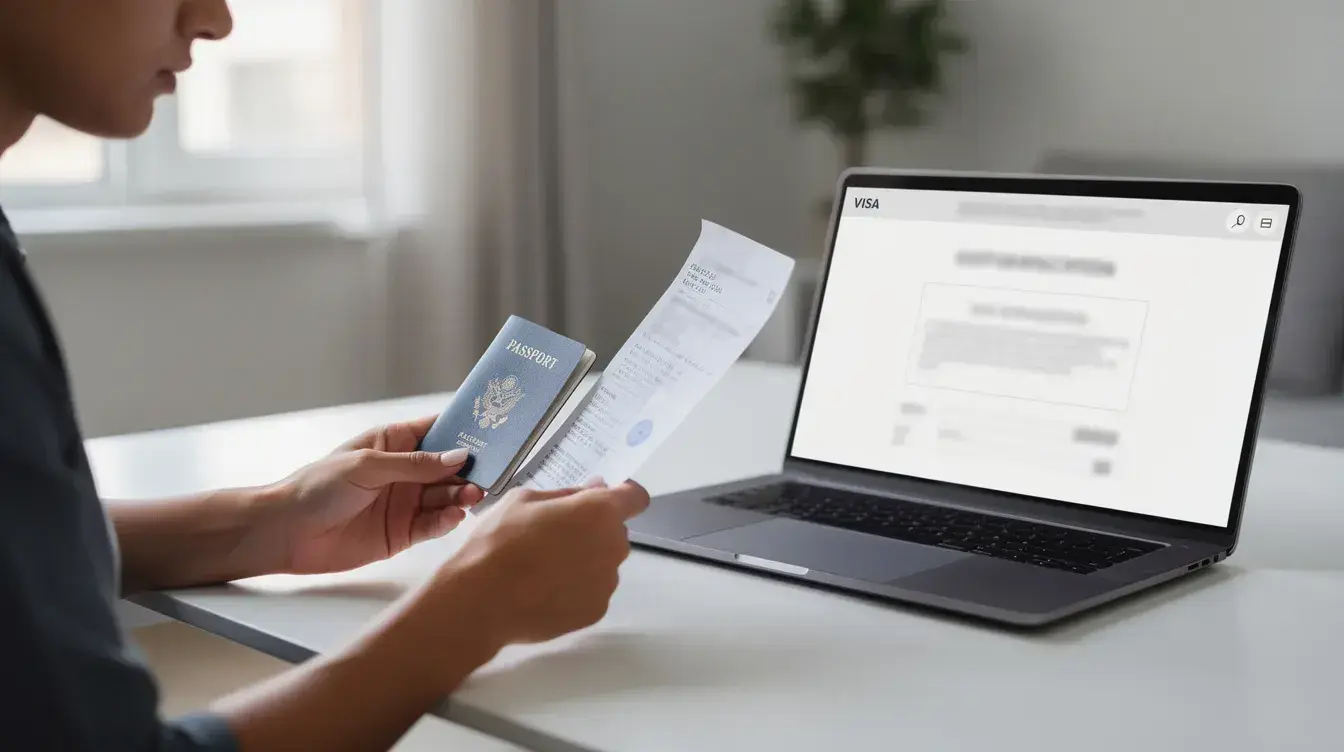
Short answer: A separately paid return leg can support a visa file when both bookings identify the same passenger and form one logical journey. Present the outbound and return confirmations together, match every route and date to the application, and explain the employer, spouse or other payer when the checklist or funding evidence makes that relevant. A flight ticket for visa does not need one payment card to tell one consistent travel story.
Key facts
- The passenger name and journey matter separately from the person or organisation that paid.
- Two booking references are acceptable when the documents clearly form one outbound-and-return itinerary.
- Funding and sponsorship evidence should explain third-party payment when the applicable checklist requires it.
- Public airline lookups do not display every valid agency, codeshare or partner-airline reservation.
- Use genuine documents and follow the responsible consulate’s current instructions.
Need travel proof for a split-payment itinerary? Build one passenger-level journey from both reservations, then check every route, date and booking reference before submission.
Prepare your reservationIn This Guide
- Why Visa Officers Care More About Names Than Who Paid For Your Ticket
- Building One Flight Itinerary Out Of Two Separate Reservations
- Choosing Between A Temporary Reservation And A Refundable Ticket For The Return Leg
- Presenting A Split-Payment Flight Itinerary Without Raising Questions
- Turning A Split Booking Into A Clean Visa File
Official-source check: For the Schengen examples in this article, review the European Commission’s Schengen visa application overview. It identifies supporting evidence relating to purpose, financial means, accommodation and intention to return; the responsible consulate’s current checklist determines whether and how flight and sponsor evidence must be presented.
Reviewed for: passenger-versus-payer distinction, two-PNR route logic, third-party funding evidence, temporary-versus-refundable options, booking-reference accuracy, official-source relevance and evergreen wording.
Split-payment evidence check
- Passenger: both legs use the passport-level name and correct personal details.
- Journey: arrival, internal movement and return form one understandable route.
- Dates: both reservations agree with the form, hotels, insurance and leave evidence.
- Payer: employer, spouse, sponsor or personal payment is documented where relevant.
- Records: each booking reference comes from a legitimate issuing channel and is described accurately.
Why Visa Officers Care More About Names Than Who Paid For Your Ticket

A split booking can look unusual on paper, but separate payment is not automatically a visa problem. The useful question is whether each reservation identifies the same traveller and whether the two legs form one coherent journey. If funding evidence is requested, the file should also explain who paid and why.
How Passenger Name Matching Works On A Split Booking
Every airline reservation system stores passenger information separately from payment information. Booking systems allow separate fields for payer and passenger, which is exactly why a parent can book a child's flight, or a company can book an employee's trip, without any conflict at check-in or at a visa counter.
For the visa file, passenger identity and itinerary consistency usually matter more than which card was used. A reviewer may compare the name on the outbound reservation with the name on the return reservation and passport. Payment or sponsorship can still matter when the checklist requests proof of funds, reimbursement or third-party support.
Passenger details must match the passport exactly, down to how your middle names are spelled.
If your first name appears as "Mohammed" on one leg and "Mohd" on the other, that inconsistency raises more questions than the fact that two different cards paid for two different tickets. Spelling consistency across your whole file carries more weight than the source of the funds ever will.
A short checklist helps before you confirm either booking:
-
Match the spelling of your name to your passport exactly, including how it splits between given and middle names.
-
Keep your passport number, date of birth, and gender marker consistent across both reservations if the airline portal requests them.
-
If a family applies together, confirm each traveler's name is linked to the correct reservation number, not mixed up between relatives.
Third-party payments are common for flight bookings, so airlines and travel agents design their systems around this reality. A colleague booking your onward travel, a sibling paying for your return leg, or a corporate travel desk handling both directions is routine.
These arrangements are common, but the consulate still evaluates the complete file. Clear passenger records, logical dates and an appropriate sponsor or payment explanation remove avoidable ambiguity.
Picture a common applicant situation: a corporate travel desk books an employee's outbound leg for a conference, while the employee books their own return flight once meeting dates are confirmed. Two different PNRs, two different platforms, one traveler.
This is precisely the kind of file that looks fragmented until you check the actual data behind it. The company's booking will show the correct passenger name even though the invoice goes to the employer's account, and the employee's personal booking will show the same name from a completely different payment source.
Neither reservation needs to reference the other directly. What ties them together, for visa purposes, is that both display the identical name, matching the passport, on dates that form one uninterrupted trip.
Once you understand that visa officers are matching identity and travel logic rather than tracing invoices, a split booking stops feeling like a liability.
What Happens When The Payer And Applicant Are Different People
Where applicants actually run into trouble isn't the split payment. It's an incomplete paper trail. If your return flight was booked independently of your outbound leg, you need a document proving the reservation exists and belongs to you.
When the checklist requests proof of independently booked return or onward travel, provide the official confirmation PDF or other accepted evidence. It should show the passenger name, booking reference, route and travel dates that align with the application. Without clear evidence, the reviewer may struggle to connect both halves of the journey.
A consulate or its service provider may check a booking reference through an airline, agency or reservation system. Not every valid partner or agency booking appears in a public airline tool, so describe the issuing channel accurately. A cancelled, expired or contradictory record can create questions; the separate payer is not necessarily the issue.
Verification of sufficient funds may be required if bookings are made with separate carriers, since an officer may want to see that the trip's overall cost, however it was distributed among payers, is accounted for somewhere in your supporting documents. Keep a note of who paid for what if your visa form or interviewer asks.
Save both confirmation PDFs together, label them by leg and date, and make sure the airports, passenger name, and dates on each one tell the same travel story before you move on to matching them into a single itinerary that a visa officer can read in under a minute.
None of this changes if you're applying from your home country for tourist visas or business travel, or if immigration officials at your destination end up reviewing your file a second time on arrival.
Visa officers check if travel dates match the visa application, and that same date consistency matters again at the border, well after your visa has already been approved for the purposes stated in your original form.
Avoid using fake or fabricated flight tickets as they can lead to visa refusals. A verifiable reservation, temporary or fully paid, is always the safer route than anything that can't be looked up in an airline's system if questioned.
Building One Flight Itinerary Out Of Two Separate Reservations
Once you know both reservations carry the correct name, the next task is turning two separate bookings into one itinerary that reads as a single trip rather than two unrelated flights.
Matching Your Outbound and Return PNRs To The Same Travel Story
Start with the basics: your departure and arrival airports need to connect logically. If your outbound flight lands in Paris but your return leg was booked departing from Amsterdam, an officer will want an explanation, even if both PNRs are individually valid. Either adjust the booking or add a short note in your file explaining the connecting travel in between.
When flight evidence is requested, its details should agree with the visa application and supporting documents. The cities listed on the form, the route shown by the reservations and the responsible authority’s checklist should all point to the same trip.
If each leg has its own booking reference or PNR, present both references clearly in one combined PDF or in two clearly labelled documents. A legitimate reference should connect to the record held by its issuing airline, agent or reservation system; public lookup availability varies.
For the wider document sequence, use this visa flight itinerary requirements guide. Practical steps that keep both legs aligned:
-
List your outbound and return flight numbers side by side in your cover letter or application notes.
-
Confirm your return date falls within any visa duration limits stated in your visa form.
-
Check that layover cities, if any, don't create unexplained gaps of several days.
This kind of mismatch is easy to prevent but easy to miss if you're managing bookings across two different accounts or two different people.
Before you finalize either leg, sit down with both confirmations side by side and read them the way an outside reviewer would, checking that the destination on your outbound ticket is the same city your return ticket departs from, and that neither leg quietly extends your stay beyond what your visa application form actually requests.
A five-minute review at this stage saves considerably more time than correcting a flagged file later, and it gives you one more chance to catch a typo, a wrong month, or an airport code entered by whoever handled the other half of your booking.
What A Verifiable PNR Actually Needs To Show
A genuine PNR is more than a random code typed onto a printed page. It should correspond to a reservation record issued through a legitimate airline, agency or reservation channel. Access methods differ, so a public website is not the only possible verification route.
Where the checklist accepts reservation evidence, include the genuine booking reference provided by the issuing channel for the outbound leg, return leg or both. Never fabricate or alter a code.
At minimum, each PNR should display the passenger's full name exactly as it appears on the passport, the flight number, the departure and arrival airports, and the travel dates.
Ensure all flight details match your visa application form and supporting documents, since a mismatched date or a swapped airport code is one of the more common reasons a straightforward file gets flagged for a second look.
Before submission, confirm each record through the issuing airline, agent or reservation channel. Some partner-airline and agency bookings do not appear on a public airline page, so a failed public lookup is not automatically proof that the record is invalid. Resolve any uncertainty with the issuer before using the document.
This single habit catches typos, expired holds, and booking errors long before a consular officer ever sees them, and it takes far less time than dealing with a visa decision that gets delayed over a document that couldn't be verified.
Treat this lookup as part of your standard routine any time a flight reservation lands in your inbox, whether you booked it yourself or someone booked it for you.
If your outbound and return legs were booked through different airlines or agents, don't worry about the format looking different between them. Airline policies vary on how confirmation PDFs are laid out, and consulates are used to seeing different templates in the same file.
What they're checking is consistency of content: same passenger, same trip, dates that line up with the intended travel described elsewhere in your application.
Once both PNRs are verifiable and the details line up, you've effectively built a single itinerary out of two bookings, and you're ready to think about which type of reservation belongs on the return leg in the first place.
Where the checklist accepts flight reservations and the issuing channel provides booking references, show both the outbound and return references clearly. Treat the two confirmations as connected evidence rather than unrelated afterthoughts inside the Schengen itinerary.
Many visa checklists request a flight itinerary, reservation or other travel-plan evidence. Where it is required, the dates and route should match the application and any supporting documents, subject to legitimate details such as overnight arrival.
Choosing Between A Temporary Reservation And A Refundable Ticket For The Return Leg

Applicants handling a separately paid return leg usually face one more decision: whether that leg should be a temporary reservation or a fully paid, refundable ticket. The right call depends on what your specific visa file actually needs.
When A Dummy Flight Ticket Covers The Return Journey Well Enough
A dummy ticket for visa can show intended travel without purchasing a final ticket, which may make it a practical option for the return or onward leg of a split booking. A dummy ticket is a temporary flight reservation that includes passenger name, route, and travel dates, all without committing you to the cost of a real ticket before your visa is even decided.
Many authorities do not ask for a fully paid, non-refundable ticket at the application stage, and some caution against purchasing before a decision. Requirements differ, so follow the responsible checklist and understand the applicable fare rules before paying.
This is where a legitimate temporary reservation may help when the checklist permits it: the document can show intended travel without the same commitment as a non-refundable ticket. It still carries service costs and does not eliminate every financial or application risk.
A few practical notes worth knowing before you rely on one:
-
Temporary-reservation validity varies by airline, issuing channel and fare conditions, so confirm the actual window instead of assuming a fixed number of hours.
-
Some Schengen checklists accept reservation or itinerary evidence; use the exact format requested by the responsible consulate.
-
Dummy tickets do not guarantee visa approval or boarding, since they exist purely to demonstrate travel plans during the application stage.
-
A temporary reservation may cost less than a refundable fare, but compare the current terms, validity and change options before choosing.
A dummy ticket shows planned flight details without purchase, and a dummy ticket includes passenger name, route, and travel dates just like a final ticket would, minus the financial commitment.
This is exactly why dummy tickets are used to show travel intent for visa applications: they satisfy the paperwork requirement for visa use without asking you to pay for a trip that isn't confirmed yet.
Because temporary-reservation validity depends on the airline, fare and issuing channel, confirm the actual window and time the document around the submission or appointment without assuming a universal duration.
Temporary holds may be available through an airline, travel agency or reservation service, with different fees, display formats and validity conditions. Use a legitimate issuing channel and assess the resulting document against the responsible checklist rather than assuming every route produces equivalent evidence.
When A Refundable Ticket Makes More Sense For Separately Paid Travel
There are situations where a temporary reservation isn't the better fit. Refundable tickets are fully paid and can be canceled, and refundable tickets are best when a confirmed ticket is required, such as certain visa on arrival processes or specific embassy checklists that explicitly reject temporary reservations.
If the person paying for your return leg, an employer or a relative, has already committed to a fully paid booking for reasons unrelated to your visa file, a refundable ticket can double as both your travel proof and your actual return flight.
The tradeoff is upfront cost, since a confirmed ticket ties up money on a trip that hasn't been approved yet.
This is also where tourist visas issued for shorter stays tend to differ from longer study or work visa categories.
A two-week tourist trip rarely requires anything beyond a temporary reservation for either leg, while longer-stay categories sometimes ask for more concrete proof of a return date, especially when the applicant's home country has a higher scrutiny profile with a given consulate.
If you're unsure which category your trip falls into, your consulate's own checklist is the fastest way to settle it, rather than assuming your situation matches a friend's recent visa approval.
Whichever option you choose, use genuine evidence issued through a legitimate channel and accepted by the checklist. Fabricated or altered confirmations can undermine the entire application and may have serious consequences beyond the flight section.
A dummy flight ticket, legal for embassy use across many countries, remains the more common choice specifically because it avoids locking in a non refundable ticket before the visa decision is final.
For split bookings specifically, a mixed approach often works best: a dummy flight ticket for the outbound leg if it's still flexible, paired with whatever confirmed or temporary reservation already exists for the separately paid return.
What matters most is that both pieces, together, form a complete round trip on paper, regardless of which airline or which payer issued each one.
Presenting A Split-Payment Flight Itinerary Without Raising Questions
The final step is packaging everything so an officer reviewing your visa file can understand the booking structure in a single pass, without needing to ask you to clarify anything afterward.
Writing A Cover Letter That Explains The Booking Structure
Detailed cover letters are recommended to explain travel logistics in visa applications, and a split booking is exactly the kind of applicant situation that benefits from one.
A short paragraph noting that your outbound flight was booked by you directly, while your return leg was arranged separately by a family member or employer, removes any ambiguity before an officer even starts reading your reservations.
Keep the letter factual and brief. State the reservation number for each leg, confirm that passenger names match across both, and note the relationship between you and the third party if one paid for a portion of your trip. This single paragraph often prevents the kind of follow up question that slows down an otherwise straightforward visa decision.
Indian travelers and applicants from many other home countries commonly deal with family members splitting travel costs, so this is a normal, well-understood scenario for most visa officers reviewing international travel files. There's no need to over-explain or apologize for the arrangement. State it clearly and move on.
If your consulate does raise a follow-up question about the booking structure, respond the same way your cover letter already does: clearly, briefly, and without unnecessary detail. Most follow-up requests at this stage are routine, not a sign that your visa decision is trending negative.
Officers ask for clarification on split bookings often enough that a calm, factual reply, restating who booked what and confirming the passenger name matches across both legs, usually resolves it without further delay.
Double Checking Your File Before You Submit
Before submission, run through the whole file one more time as if you were the officer reading it cold. Provide booking confirmation PDFs showing your PNR for both outbound and return journeys, placed together rather than scattered across separate attachments.
Attach hotel proof, travel insurance, and any other supporting paperwork your specific consulate's checklist asks for, since a flight itinerary rarely stands alone.
A quick final pass should confirm:
-
Your name matches your passport on every document, not just the flight reservations.
-
Your travel dates align across your flight proof, hotel proof, and visa application form.
-
Your confirmation numbers and reservation numbers are legible and not cut off in any scanned copy.
Requirements vary by consulate, so if your destination's checklist mentions anything specific about proof of onward travel or separately booked return flights, follow that guidance over general assumptions. This flight reservation for visa guide provides a broader final-file audit.
Keep in mind that a visa file is rarely judged on a single document in isolation.
Reviewers weigh your flight proof alongside your hotel proof, your travel insurance, your financial documents, and the narrative your cover letter provides, so a split booking that's well documented tends to blend into a stronger overall file rather than stand out as a red flag.
Treat the flight itinerary as one piece of a bigger, consistent picture, not the single factor your visa decision hinges on.
When in doubt, a guide official source check, meaning a direct look at your consulate's published visa requirements, settles most uncertainty faster than guessing.
Turning A Split Booking Into A Clean Visa File
A separately paid return leg is not automatically a red flag. Modern trips are often booked and paid for by different people or organisations. The strongest file explains that arrangement where necessary and keeps every passenger name, date and route consistent, but no single document or payment structure earns approval by itself.
Treat the outbound and return reservations as two halves of one journey, not two separate errands. Combine or label them clearly, add a brief payer explanation when it helps, and check the current destination requirements before submission.
Ready to assemble one clean itinerary from two bookings? Keep the passenger, route and dates consistent, pair the confirmations clearly and add a short payer explanation only where it helps the file.
Prepare your flight reservationFrequently Asked Questions
Can someone else pay for my return ticket for a visa application?
Yes. A spouse, employer, sponsor or other person can pay for a flight while you remain the passenger. The reservation should identify you correctly, and any funding or sponsorship evidence required by the checklist should explain the arrangement.
Can outbound and return flights have different PNRs?
Yes. Present both booking references clearly and make sure the two records form one logical journey. Combining the confirmations into one labelled PDF can make the route easier to review where the upload system permits it.
Should I include the payer’s card details or receipt?
Only include payment or sponsor evidence that the responsible checklist requests or that is needed to explain the funding. Do not expose full card numbers or unnecessary sensitive information.
Must both flight reservations use the exact passport name?
The passenger identity should follow the passport and remain consistent across both bookings and the visa application. Airline character limits may affect spacing or punctuation, but unexplained spelling or passenger changes should be corrected.
Is a temporary reservation or refundable return ticket better?
It depends on the checklist, current travel certainty and fare risk. A temporary reservation may be suitable where accepted, while a refundable ticket may suit a genuinely confirmed trip. Verify the actual cancellation and change terms before paying.
Does a separately paid return flight reduce visa approval chances?
Not by itself. The complete application is assessed under the applicable rules. A clear passenger identity, logical route, consistent dates and appropriate funding explanation can prevent payment structure from becoming an avoidable question.
Friendly reminder: BookForVisa provides temporary travel-proof documents for planning and application support. Requirements vary by destination, airline, route and applicant situation. A reservation can support a file, but it does not guarantee approval, boarding or entry.