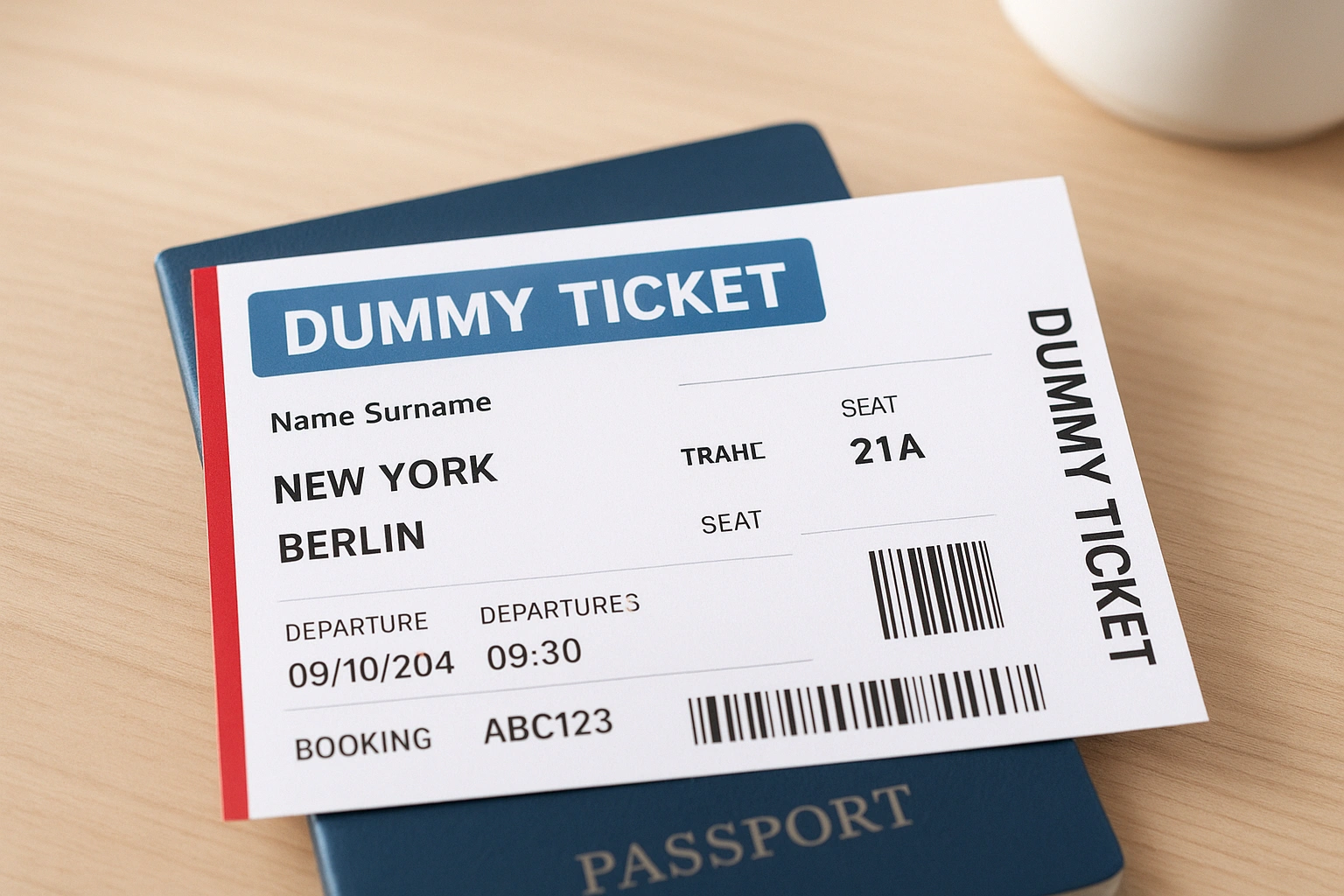
When an embassy checklist says “flight booking,” the phrase can feel dangerously vague. It may mean a simple reservation with a valid PNR, a flight itinerary, a confirmed booking reference, or in limited situations a paid ticket. The mistake is assuming the same wording means the same thing for every embassy, visa type and applicant profile.
The practical goal is not to buy the most expensive document. The goal is to submit the flight proof that matches the wording, timing and risk level of your application. A strong file makes your route, dates and supporting documents feel consistent before an officer has to ask a second question.
Key facts before choosing reservation or paid ticket:
- “Flight booking” is usually broader than “paid ticket,” but the checklist context matters.
- “Flight reservation” normally points toward a reserved itinerary, not a final airfare purchase.
- “Ticket,” “e-ticket number,” or “proof of purchase” signals a stronger paid-ticket expectation.
- A PNR helps only when the route, date, name and document story are consistent.
- The flight document should match the visa form, cover letter, hotel proof, insurance and financial evidence.
In This Guide
- What Embassies Actually Mean When They Write "Proof of Flight Booking"
- The Real Difference Between A Reservation, An Itinerary, And A Paid Ticket
- When Embassies Quietly Expect a Paid Ticket (Even If They Don't Say So)
- Decision Framework: Should You Book, Reserve, or Wait?
- What Happens If You Guess Wrong: Two Very Different Risk Paths
- How to Verify What Your Specific Checklist Is Really Asking For
- Building a Flight Document That Satisfies Ambiguous Wording
- How Embassy Sample Itineraries Reveal More Than the Checklist Itself
- Handling Flight Documentation for Family and Group Visa Applications
- Getting Your Flight Documentation Right, Whatever the Wording Says
- FAQ
What Embassies Actually Mean When They Write "Proof of Flight Booking"

Every checklist has that one line. Short, vague, and doing a lot of heavy lifting. Before you decide what document to submit, you need to understand what the phrase itself is signaling.
The Four Wording Patterns That Show Up On Checklists
Most embassy checklists use one of four phrasings when it comes to flight documentation. Each one leans in a different direction, even though officers rarely explain the distinction.
"Flight booking" tends to be the most neutral term. It usually accepts a reservation, since "booking" implies the act of reserving a seat, not necessarily paying for it.
"Flight reservation" almost always points toward a reservation-only document. This is the phrasing you'll see most often on Schengen visa checklists, including for France, Germany, and Italy.
"Proof of onward travel" shows up frequently on tourist and transit visas, including several Southeast Asian and Gulf country applications. It's asking you to demonstrate you have a way out of the country, not that you've already paid for it.
"Confirmed itinerary" is the trickiest of the four. Some consulates use it loosely to mean a reservation with valid flight details. Others, particularly certain long-stay or work visa categories, use it to mean a ticket that's been paid for and issued.
If your checklist uses the word "ticket" directly, alongside phrases like "e-ticket number" or "airline confirmation," treat that as a stronger signal toward a paid document. If it sticks to softer language like "booking" or "reservation," a well-built reservation is usually enough.
Why The Same Phrase Means Different Things At Different Consulates
Here's where it gets frustrating. Checklist wording is often reused across multiple visa categories within the same embassy's system, even when the underlying expectations are completely different.
Take a country that issues both tourist and long-stay work visas from the same consulate. It's common to see identical wording, "proof of flight booking," on both checklists, even though the tourist visa desk regularly accepts a reservation while the work visa desk expects to see a purchased ticket tied to a fixed travel date.
Translation adds another layer of confusion. A checklist originally written in German, French, or Arabic and then translated into English for the applicant portal can lose precision in the process. A term that clearly meant "reservation" in the original language can come across as ambiguous, or even lean toward "ticket," once it's translated.
There's also the timing problem. Consulates update their checklists at different speeds. An applicant from Delhi applying to a European consulate might pull up a checklist that was last revised eight months ago, while a friend applying to the same country's consulate in Mumbai sees a version updated just last month, with slightly different wording. Neither version is wrong. They're just out of sync with each other.
This is why relying on a friend's successful application, or a forum post from two years ago, can lead you astray. The wording that worked for them may not reflect what your specific consulate is asking for today.
Reading Between The Lines: Clues That Signal "Ticket" vs "Reservation"
Once you know the four wording patterns, the next step is learning to read the smaller clues embedded in the checklist and application form together.
Start with specificity. If the checklist or the online application form asks you to enter a ticket number, that's a strong indicator the system expects a purchased ticket, since reservations typically don't carry a finalized ticket number until payment is processed.
Next, look at how the form treats your return date. If the visa application requires you to state an exact return date and cross-references it elsewhere in the form (such as your accommodation dates or your stated length of stay), that's a sign the embassy wants a document with locked, verifiable dates. A reservation with a valid PNR usually still satisfies this, but the dates need to be firm and consistent.
Watch for language around cancellation or refundability too. Some checklists explicitly state they won't accept a ticket that's fully refundable or easily cancelled without penalty, since that undermines the intent-to-travel argument. This wording is a signal that the embassy cares less about reservation versus ticket, and more about whether the document shows genuine commitment to the trip.
Finally, pay attention to whether the checklist asks for the document in a specific format, such as a PDF with airline branding, a booking confirmation email, or an official e-ticket receipt. A request for a specific format often hints at what's expected behind it. An airline-branded PDF with a valid PNR, for instance, is typically read the same way whether or not the ticket has been paid for, as long as it's verifiable.
None of these clues work in isolation. A checklist that says "flight booking" but also asks for a ticket number and rejects refundable options is really asking for a purchased ticket, even though the headline word sounds softer. Learning to read these signals together, rather than fixating on a single word, is what separates a confident submission from a guess. And once you can decode the wording, the next question becomes just as important: what does that reservation or ticket actually prove once it's in front of a visa officer?
The Real Difference Between A Reservation, An Itinerary, And A Paid Ticket
Once you've decoded what your checklist is asking for, the next step is understanding what each type of document actually proves once it lands on a visa officer's desk. The terms sound similar, but they carry very different weight.
What A PNR Actually Proves (And What It Doesn't)
A PNR confirms that a booking exists inside an airline's reservation system. That's it. It doesn't confirm payment, and it doesn't guarantee the seat will still be held next week.
Most embassies do not require a fully paid ticket when submitting a visa application. What they're really asking for is a flight reservation that clearly shows your entry and exit dates from the destination country. A valid PNR, tied to real flight numbers and dates, usually satisfies that requirement on its own.
That said, not every PNR is built the same way. A genuine flight reservation should include a few specific elements to hold up under scrutiny:
A booking reference in standard airline format, not a shortened or placeholder code
Passenger details that match the passport exactly, including full legal name and spelling
Clear entry and exit dates, with flight numbers attached to each leg
Miss any of these, and the reservation stops looking like proof of travel intent and starts looking like an incomplete document. Visa officers who process hundreds of applications a week can spot the difference quickly, so precision matters more than most applicants expect.
It's also worth knowing that most flight reservations are valid for 48 hours before the airline's system automatically cancels the hold. If your visa processing timeline runs long, or if a consulate asks for updated proof partway through review, you'll likely need a fresh reservation rather than relying on the one you submitted weeks earlier.
Why "Confirmed" Doesn't Always Mean "Paid"
The word "confirmed" causes more confusion in visa applications than almost any other term on a checklist. A reservation can be fully confirmed, meaning it has a valid PNR and is actively held in the airline's system, without a single dollar having been paid toward it.
This distinction matters because a temporary booking or itinerary is designed to do exactly one job. It shows your intended entry and exit dates, along with your flight numbers, in a way that reads as genuine to anyone reviewing the file. It was never meant to represent a completed purchase, and most embassies don't expect it to.
Here's a quick way to test whether your reservation would hold up:
Would the airline confirm the PNR if someone called their reservations line directly?
Do the passenger details match the passport, with no shortened names or typos?
Are the flight numbers and routing realistic for the airports involved?
A genuine flight reservation should display your details exactly as they appear in your passport, along with accurate flight information tied to a real, bookable route. If all three of those hold true, the document is doing its job, whether or not it's been paid for.
Where applicants run into trouble isn't usually the reservation-versus-ticket distinction itself. It's when they try to shortcut the process by using a manually edited PDF instead of a genuinely generated booking. Never submit a fabricated or manually edited flight itinerary. Visa officers are trained to spot inconsistencies in formatting, fonts, and booking reference structures, and a document that doesn't match a real airline's output pattern is one of the fastest ways to trigger a rejection.
The One Document Feature Visa Officers Look For First
Ask any experienced visa officer what actually gets applications flagged, and the answer usually isn't "reservation versus ticket." It's consistency.
Embassies require a coherent travel story from every application. That means your flight itinerary needs to align with your hotel booking dates, your travel medical insurance coverage, and the dates you've listed elsewhere in your application form. When these pieces don't match, it raises questions regardless of whether your flight document is a reservation or a paid ticket.
Consider a simple example. If your flight itinerary shows arrival in Rome on the 4th, but your hotel booking starts on the 6th, that two-day gap has no explanation attached to it. An officer reviewing dozens of files a day isn't going to assume it's a simple oversight. They're going to flag it.
The same logic applies to your travel insurance. Your flight dates must align with your medical insurance coverage window and your accommodation bookings, forming one continuous, logical story from entry to exit. A flight itinerary should also show a sensible route. Flying into Mumbai and then departing from a city with no logical connection to your stated itinerary, without any explanation, tends to draw the same kind of scrutiny.
Inconsistent dates are one of the most common reasons visa applications get rejected, and it's an entirely avoidable one. Before you submit anything, it's worth laying your flight dates, hotel dates, and insurance dates side by side and checking that they tell one clean, believable story.
This is also where the temptation to purchase a real ticket early can backfire. Embassies generally advise against buying a ticket before visa approval, and for good reason. If your travel dates shift during processing, a paid, non-refundable ticket can no longer match your updated itinerary, and correcting airline errors on a purchased ticket often comes with real fees attached. A reservation, by contrast, can be updated or reissued to match new dates without that financial risk.
Getting the reservation itself right is only half the picture, though. The other half depends on how well that reservation fits the wider context of your specific visa category, since some applications carry far less room for error than others.
When Embassies Quietly Expect a Paid Ticket (Even If They Don't Say So)

Not every checklist tells you the full story. Some visa categories carry unwritten expectations that go beyond whatever phrasing appears on the official document list, and knowing where those expectations exist can save you from a costly guess.
Visa Categories Where Reservations Alone Tend to Raise Flags
A reservation that works perfectly for one visa category can look thin for another, even at the same embassy.
Short-stay tourist visas and transit visas tend to be the most forgiving. These categories are built around brief visits with a clear, predictable exit, so a reservation showing entry and exit dates usually satisfies what the officer needs to see. The underlying question for these categories is simple: does this person have a credible plan to leave when they say they will?
Work visas, long-stay visas, and anything tied to sponsorship shift that question. Here, the officer isn't just checking whether you'll leave. They're often evaluating whether your entire travel story, including the flight itself, reflects a serious, committed plan rather than a placeholder. A reservation alone can still work, but it tends to draw more follow-up questions in these categories than it would for a two-week tourist trip.
Multi-entry visas add another layer. If you're applying for a visa that allows several entries over one or two years, a single reservation showing one round trip may not fully represent your travel intent. Some consulates handle this by asking for a general travel plan instead of a specific reservation, while others expect the first trip's documentation to be airtight, since it sets the tone for how the rest of the visa is used.
Consider two applicants applying to the same country. One is requesting a two-week tourist visa with a straightforward round-trip reservation. The other is requesting a one-year work visa and submits the same style of reservation, just with different dates. The tourist applicant's file rarely gets a second look at the flight documentation. The work visa applicant's file often does, simply because the stakes and scrutiny attached to that category are higher.
The Financial-Proof Connection Nobody Talks About
Flight documentation rarely gets reviewed in isolation. Most visa officers read it alongside your bank statements and financial proof, and that connection can quietly change what document works best for you.
Here's the part that surprises a lot of applicants: a paid ticket isn't automatically the safer choice. If your bank statements show modest savings, a large non-refundable ticket purchase can actually raise a question mark rather than settle one. An officer might reasonably wonder why someone with limited funds committed a significant amount of money to a ticket before even knowing if the visa would be approved.
A reservation avoids that particular problem entirely. It shows travel intent without creating a financial commitment that has to be explained or justified elsewhere in the file.
This becomes especially relevant for applicants who are already walking a tight line on financial documentation. Take someone from Delhi applying for a visa where the minimum funds requirement is close to what they can actually show in their account. Spending several hundred dollars on a ticket purchase, on top of visa fees, accommodation costs, and insurance, can shrink that available balance right at the moment it's being reviewed. A reservation keeps that money in the account and out of the conversation.
The reverse can also be true, though less often. In categories where officers expect to see genuine commitment, such as certain long-stay or relocation-related visas, a paid ticket paired with strong financial documentation can reinforce a consistent, well-funded story. The key is that the ticket and the finances need to support each other. A paid ticket next to thin financial proof tends to create more questions than it answers.
Regional Patterns Worth Knowing (Without Assuming They're Rules)
Certain regions do show consistent tendencies when it comes to flight documentation, and knowing them gives you a useful starting point, even though they're not guarantees.
Schengen-area consulates, including those for France, Germany, Spain, and Italy, generally lean toward accepting reservation-based documents for short-stay visas. Their guidelines are built around demonstrating a return plan, not proving a completed purchase, which is why reservations remain the standard approach for the vast majority of tourist and business visitor applications in this region.
Some Gulf countries follow a similar pattern for tourist and visit visas, where a reservation with clear entry and exit details is typically sufficient, particularly when the visa is being processed through a streamlined online system.
Long-stay and sponsorship-based visa systems, on the other hand, sometimes lean the other way. Certain relocation, dependent, or long-term study categories in various countries have been known to request more concrete proof of travel arrangements as part of a broader push to confirm the applicant's overall commitment to the move.
None of these patterns should be treated as fixed rules. Consulates within the same country, and even different visa windows at the same consulate, can vary based on internal policy updates or the specific officer reviewing your file. A friend's experience applying to a consulate in one city doesn't guarantee the same outcome at a different consulate handling the same visa type.
The smartest way to use regional patterns is as a starting hypothesis, not a final answer. If you're applying for a short-stay Schengen visa, it's reasonable to expect a reservation will be sufficient, but it's still worth checking your specific checklist for any wording that suggests otherwise. If you're applying for a long-stay or sponsorship-based visa, it's worth going in expecting a bit more scrutiny around your flight documentation, even if the checklist wording looks identical to a tourist visa's requirements.
Once you've weighed your visa category, your financial documentation, and the regional tendencies that apply to your situation, you're left with one final question: how do you actually decide, for your specific application, whether to book, reserve, or wait?
Decision Framework: Should You Book, Reserve, or Wait?
At some point, analysis has to turn into action. This is where you take everything you've assessed about your checklist wording, your visa category, and your financial picture, and turn it into one clear decision for your specific trip.
A Simple Self-Assessment Before You Spend a Dollar
Before you open a booking site or a reservation service, run through a short set of questions about your own application. The answers will point you toward a document strategy without much guesswork left over.
Start with the checklist itself. Does it ask for a ticket number, an e-ticket, or an airline confirmation specifically? If yes, lean toward treating this as a purchase-expecting checklist. If it sticks to softer language like "booking" or "reservation," a well-built reservation is likely your answer.
Next, look at your visa category. Are you applying for a short-stay tourist or transit visa, or something longer, like a work visa, study visa, or a sponsorship-based category? The former typically tolerates a reservation without issue. The latter often invites more scrutiny, even when the checklist wording looks identical to a tourist visa's requirements.
Then check your own financial documentation. Does it comfortably clear the minimum funds requirement for the country you're applying to, with room to spare? Or is it sitting close to the line? If your funds are tight, a reservation protects your balance sheet during review. If your funds are strong, a paid ticket is less likely to raise concerns, though it's still not required in most cases.
Finally, ask yourself how firm your travel dates actually are. If there's a real chance your dates could shift, whether due to processing delays, work schedules, or personal circumstances, that's a strong argument for holding off on a purchase regardless of what the checklist says.
Three or four straightforward questions, answered honestly about your own file, usually make the decision far less complicated than it first appears.
Matching Your Visa Type to the Right Document Strategy
Visa type deserves its own dedicated pass, separate from the checklist wording, because the same document strategy doesn't scale evenly across categories.
For a standard tourist visa, whether you're heading to a Schengen country, the UK, or a Southeast Asian destination on a short visit, a reservation with accurate dates and a verifiable PNR is typically the right call. These applications are built around a clear entry and exit, and that's exactly what a reservation demonstrates.
For a business visa, the calculation shifts slightly. Business visas often come with a letter of invitation or a company sponsor, which already signals purpose and legitimacy. A reservation still tends to work well here, but it needs to align closely with the dates mentioned in that invitation letter, since any mismatch between the two documents draws attention fast.
For a student visa, timing becomes the deciding factor. If you're applying well before your program start date, a reservation makes more sense, since your actual travel plans may still shift based on enrollment confirmation or housing arrangements. Booking a real ticket months in advance of a semester that could change dates is rarely worth the risk.
For a work visa or long-stay relocation visa, treat your flight documentation as part of a bigger, more scrutinized package. Pair your reservation, or ticket if the checklist clearly calls for one, with financial documentation and supporting letters that all point in the same direction. This is the category where copying someone else's approach without adjusting for your own visa type tends to backfire most often.
One mistake worth calling out directly: don't assume that because a document strategy worked for a friend or a forum post, it will work for you. Visa type changes the entire calculation, even when the destination country and even the consulate are exactly the same.
When Waiting Until After Approval Is the Smarter Move
Sometimes the best decision isn't reservation versus ticket at all. It's timing. Specifically, whether to wait until your visa is approved before purchasing anything beyond a reservation.
For high-cost routes, especially long-haul international flights running into several hundred dollars or more, waiting until after approval is almost always the financially smarter move. A reservation gets you through the application stage. A purchase can happen once you know your travel dates are locked in, and your visa has actually been granted.
This becomes even more important for non-refundable fares. Airlines rarely offer meaningful flexibility on their cheapest ticket classes, and a rejected visa application, or even an approved one with adjusted travel dates, can leave you holding a ticket that no longer matches your actual plans.
The trade-off is real, though, and worth naming honestly. Waiting protects your money, but it does place more weight on your reservation holding up during review. If your checklist wording leans toward expecting a purchased ticket, waiting becomes a bigger gamble, since you're betting that a reservation will satisfy an expectation the checklist may not have stated clearly.
A practical rule of thumb: the stricter and more specific your checklist wording, the less room you have to wait. Vague, reservation-friendly wording gives you more flexibility to delay a purchase. Wording that explicitly asks for a ticket number, ticket confirmation, or non-refundable proof narrows that window considerably, and in those cases, purchasing closer to your expected approval date, rather than waiting entirely until after, can strike a reasonable middle ground.
Even with a solid decision in hand, it helps to know what actually happens on the other end if that decision turns out to be the wrong one for your specific consulate.
What Happens If You Guess Wrong: Two Very Different Risk Paths
Every choice around flight documentation carries a downside if it turns out to be the wrong call for your specific consulate. The good news is that these downsides look nothing alike, and understanding both helps you weigh which one you can actually afford to risk.
The Cost of Over-Preparing: Buying a Ticket You Didn't Need
Buying a real ticket feels like the safe choice. It rarely is, and the reasons go beyond the obvious price tag.
The most immediate cost is financial. International routes, especially long-haul ones, can run several hundred dollars or more. If your visa gets approved with different dates than expected, or denied altogether, that money is often gone. Airlines rarely refund the cheapest fare classes in full, and even when partial refunds exist, processing fees eat into whatever comes back.
There's a second cost that catches people off guard even more than the price. Visa processing timelines shift constantly. A consulate that typically takes three weeks can stretch to six without warning, and by the time your visa is approved, the departure date on your paid ticket may have already passed or landed on a day that no longer fits your plans.
Consider someone applying for a tourist visa with a planned two-week trip. They purchase a ticket right after submitting their application, confident it will speed things along. Six weeks later, their visa is approved, but their original flight dates are long gone. Now they're stuck either paying a change fee, which airlines frequently charge on top of any fare difference, or absorbing the full loss and booking a new ticket entirely.
This is the quiet, easily avoidable cost that most applicants only recognize after it happens. The reservation they could have used instead would have cost a fraction of the price and could have simply been updated once their real dates were confirmed.
The Cost of Under-Preparing: Submitting a Reservation They Wanted as Proof of Purchase
The opposite mistake carries a different kind of cost, one that shows up in your timeline rather than your wallet.
If your consulate's checklist wording actually leaned toward expecting a purchased ticket, and you submitted a reservation instead, the most common outcome isn't an outright rejection. It's a delay. Many consulates respond to this kind of gap by sending a request for additional documentation, asking you to provide a more concrete travel arrangement before they'll continue processing your file.
That request can add real time to your timeline. Depending on how the consulate handles follow-up requests, you might be looking at an extra one to three weeks added to your original processing estimate, sometimes longer if the request gets queued behind other pending cases.
There's also a psychological cost worth naming. Once a consulate flags your flight documentation as insufficient, it can put your entire file under a slightly closer read going forward. Other elements of your application, ones that might have passed without a second glance, sometimes get reviewed a bit more carefully once that first flag has been raised.
The upside here is that this outcome is rarely a hard rejection on its own. A reservation that fell short of expectations usually gets treated as a fixable gap rather than a disqualifying one. Compare that to the financial loss from an over-purchased ticket, which is often permanent the moment travel dates change. When you're weighing which mistake to risk, a delay you can recover from tends to be the lighter cost between the two.
How Visa Officers Typically Respond to Ambiguous Bookings
When a submitted document doesn't clearly match what a consulate expected, the response usually falls into one of a few predictable patterns, and knowing them in advance takes some of the anxiety out of the process.
The mildest response is a simple request for clarification. This might come as a short email or a note added to your application portal, asking you to confirm your travel dates or provide additional detail about your booking. These requests are usually quick to resolve and don't significantly slow down your timeline.
A slightly more involved response is a request for an updated document. This happens when your original reservation has expired, your dates have shifted since submission, or the consulate wants to see a version of the booking that includes details your first submission left out, such as a full passenger name or a specific flight number. Responding promptly with a fresh, accurate reservation usually resolves this without further complication.
The response applicants worry about most, though it's also the least common, is having the application treated as incomplete. This tends to happen only when the flight documentation gap is paired with other missing or inconsistent elements, rather than being flagged as the sole issue. A reservation that's slightly softer than what was expected, submitted alongside strong financial proof, consistent hotel dates, and a clear travel purpose, rarely triggers this outcome on its own.
Here's the pattern worth remembering across all three responses: consulates are generally trying to fill a gap in your file, not looking for a reason to close it. A prompt, accurate reply to any follow-up request tends to move your file right back into normal processing.
The real goal, then, isn't chasing certainty that your document will be read exactly as intended. Given how much checklist wording varies, that certainty rarely exists. The more realistic goal is minimizing your exposure to the disruptive outcomes, the drawn-out delays, and the financial losses, while accepting that a quick clarification request is a manageable, low-stakes possibility rather than something to fear.
Once you understand how these two risk paths actually play out, the next logical step is figuring out how to reduce your odds of landing in either one, starting with a closer read of what your specific checklist is really telling you.
How to Verify What Your Specific Checklist Is Really Asking For
Reading the checklist wording carefully gets you most of the way there, but the strongest applicants go one step further. They cross-reference multiple sources before finalizing their decision, rather than trusting a single document to tell the whole story.
Cross-Checking the Checklist Against the Visa Application Form
The checklist is rarely the only place a country's flight documentation expectations show up. The application form itself often reveals far more detail, and it's worth reading line by line rather than skimming past the travel section.
Start by opening the checklist and the application form side by side. Read through every field related to your trip, not just the ones labeled "flight" or "travel." Some forms bury flight-related requirements inside sections titled "trip details" or "itinerary summary," and it's easy to miss a field asking for a ticket number if you're only scanning for the word "flight."
Pay close attention to any field that asks for information a reservation might not include. If the form has a dedicated box for an e-ticket number, a fare class, or a payment confirmation reference, that's a stronger signal than anything written on the checklist itself. Checklists tend to use general language, while application forms often get specific because the fields need to be filled with actual data.
The reverse check matters too. If the checklist mentions "flight booking" but the form only asks for basic trip dates and a general itinerary summary, with no ticket number field anywhere, that's a good indication the country is comfortable with a reservation.
Here's a short method worth using on your own application:
Read the checklist first and note the exact phrase used for flight documentation
Open the application form and search for every field connected to travel dates or flight details
Flag any form field that asks for something more specific than the checklist implies
If the form asks for a ticket number or payment reference, treat that as the stronger signal
This cross-check takes maybe ten extra minutes, but it often resolves ambiguity that the checklist alone leaves wide open.
Where Embassy FAQs and Application Portals Contradict Their Own Checklists
Here's something most applicants don't expect. The checklist, the FAQ page, and the online application portal for the same visa don't always agree with each other, even though they all technically come from the same consulate.
This happens more often than it should. Checklists are frequently PDF documents that get updated on a slower schedule, sometimes only reviewed once or twice a year. FAQ pages and online portals, on the other hand, tend to get updated more frequently, especially when a consulate is responding to a wave of applicant questions or adjusting its process based on recent policy changes.
The result is that you might find a checklist stating "flight reservation" while the FAQ page on the same consulate's website specifically mentions that a "confirmed and paid itinerary" is preferred, or vice versa. Neither source is necessarily wrong. They're just out of sync with each other, and the applicant is left to figure out which one to trust.
The safest approach is to treat the most recently updated source as the most likely to reflect current practice. Most embassy websites display a "last updated" date somewhere on FAQ pages and portal instructions, even when the checklist PDF itself doesn't carry one. If you can find that date, use it to judge which version of the guidance is more current.
It's also worth saving evidence of whatever you're relying on. Take a screenshot of the FAQ page or portal instruction you used to make your decision, along with the date you accessed it. Store it somewhere easy to find. If a discrepancy comes up later during processing, having a record of what the consulate's own website said at the time you applied gives you something concrete to reference, rather than trying to explain your reasoning from memory.
This habit becomes especially useful for applicants dealing with consulates that update their guidance mid-cycle. It's not uncommon for wording to shift a few months into a visa season, and applicants who submitted earlier, based on the guidance available at the time, shouldn't be penalized for a change they had no way of knowing about.
When (and How) to Contact the Consulate Directly Without Wasting Their Time
Sometimes cross-checking the checklist, the form, and the FAQ still leaves you without a clear answer. When that happens, contacting the consulate directly can be worth the effort, but only if you approach it the right way.
Reach out directly when you've found a genuine conflict between two official sources, such as the checklist saying one thing and the FAQ page clearly saying another. This is the scenario where a direct query adds real value, since you're asking the consulate to resolve their own inconsistency rather than asking them to explain something the documentation already answers.
Skip the direct query when your question is really about general curiosity or reassurance rather than a documented conflict. Consulates receive high volumes of routine questions, and vague inquiries like "what flight document should I use" without pointing to a specific point of confusion often get generic, templated responses that don't add anything beyond what the checklist already says.
When you do decide to reach out, phrase the question so it's answerable in a single reply. Reference the exact wording from both sources you found conflicting, and ask a specific, closed-ended question rather than an open one. Something like: "Your checklist states 'flight reservation,' while your FAQ page mentions a 'confirmed itinerary.' Could you confirm whether a reservation with a valid booking reference is sufficient for a tourist visa application?" This kind of question gives the consular staff something concrete to respond to, and it significantly increases your odds of getting a useful, specific answer rather than a form letter.
Keep a copy of whatever response you receive, along with the date and the name of the person or department who replied if that information is available. This becomes part of the same documentation trail you started with your FAQ screenshot, and it can matter if any question comes up later in your application's processing.
Building a Flight Document That Satisfies Ambiguous Wording
Everything up to this point has been about interpretation. This last piece is about execution, making sure the actual document you submit is built well enough to hold up regardless of how strictly your checklist wording gets read.
What a Reservation Needs to Include to Pass as "Proof of Booking"
A flight booking for visa only does its job if it's built correctly. Missing or mismatched reservation details are far more likely to cause problems than the reservation-versus-ticket question itself.
Start with your name. Every letter needs to match your passport exactly, including middle names, hyphenation, and spelling. A reservation listing "Jon Whitfield" when your passport reads "Jonathan Whitfield" isn't a minor typo in the eyes of a visa officer. It's a document that doesn't clearly belong to the applicant, and it can trigger the exact kind of follow-up request that slows down your file.
Next, check that your booking reference follows a standard airline format. Most airlines generate references as a six-character alphanumeric code, and a quick PNR verification through the airline's own lookup tool confirms that the reservation exists in their live system. A reference that looks unusually short, oddly formatted, or inconsistent with how that airline typically structures its codes can raise questions, particularly if an officer decides to check it directly.
Your flight numbers and routing need to reflect a real airline reservation, not a placeholder built around numbers that were true at some point but may have since changed due to schedule adjustments. Confirm your departure city, your arrival airports, and the planned route between them all correspond to flights that the airline actually operates on the date shown. A reservation referencing a route the airline no longer flies looks careless at best, and unverifiable at worst.
Here's a quick list of what a solid, verifiable reservation should include:
Full passenger name matching the passport exactly
A booking reference in standard airline format
Correct flight numbers tied to real, current routes
Clear entry and exit dates with departure and arrival airports listed
Airline branding or formatting consistent with that carrier's actual documents
An unverifiable or clearly template-generated document is a bigger risk than the reservation-versus-ticket question ever was. Visa officers conduct document review on enough files to recognize a genuine airline-generated PDF from something assembled in a generic editor, and a reservation that doesn't look like it came from the airline's own system tends to draw more scrutiny than a reservation would on its own merits.
Matching Your Onward Travel Dates to Your Stated Visa Purpose
A technically correct reservation can still cause problems if its exact travel dates don't line up with the rest of your application. This is where a lot of otherwise solid files run into trouble.
Start with your visa's requested duration, as stated on your visa form. If you're applying for a 15-day tourist visa, your flight dates should reflect a trip of roughly that length, not a two-month stay that stretches well past what you've requested. A mismatch here doesn't automatically sink a visa decision, but it does create a question an officer has to resolve before moving forward, and unresolved questions slow down processing or, in stricter cases, contribute to a visa refusal.
Your hotel dates need the same treatment. If your flight shows arrival dates that land two days before your hotel booking begins, that gap needs closing, since booking hotels and flights for the same period is one of the clearest signals of a coherent exit plan. The same logic applies to your departure date and your hotel checkout date, and to your return flight matching the end of your stated trip back to your home country.
If your visa application states a specific purpose tied to your main destination, such as attending a conference, visiting family, or starting a course, your flight dates should make sense against that purpose too. This is exactly where many applicants miss an easy win. Arriving a week before a stated conference start date isn't unusual and doesn't need explaining. Arriving a month early, with no stated reason, can prompt a question about what the extra time is actually for, and it weakens the visa proof your travel itinerary is meant to provide.
Run through this short mental checklist before locking in your planned travel:
Does my trip length match what I've requested on the visa application?
Do my flight dates align exactly with my hotel check-in and checkout dates?
Does my arrival date make sense relative to my stated purpose of visit?
Have I accounted for enough buffer time without creating an unexplained gap?
Getting these four questions right does more to protect your application than agonizing over whether your document technically counts as a reservation or a ticket.
A Quick Pre-Submission Checklist for Flight Documentation
Before you submit anything, it helps to run one final pass over the document itself, treating it the way a visa officer would on first read.
Check the name spelling one more time, letter by letter, against your passport's biographical page. This is the single most common error applicants catch when they slow down for a final review, and it's also one of the easiest to miss when you're moving quickly through an application.
Confirm your booking reference is verifiable, and resist the urge to buy tickets or arrange full payment on a flight ticket before your visa is actually granted. A purchased airline ticket carries real cancellation risk if your dates shift, while a well-built reservation gives most consulates everything they need without that exposure. Any major embassy processing high volumes of routine tourist applications is used to seeing reservations rather than a full flight ticket, since embassies accept flight reservations as standard practice across most short-stay categories, and embassies worldwide generally structure their checklists around exactly that expectation, including guidance shaped in part by frameworks like those coordinated through the European Commission for Schengen-area travel.
Recheck date consistency across every document in your file, not just the flight and hotel booking. If you're also submitting travel insurance, make sure its coverage dates match your flight dates on both ends of the trip, since this is one of the details embassy checks most consistently during review.
Finally, go back to the exact wording your checklist used, whether that was "flight booking," "flight reservation," or "proof of onward travel," and confirm your document directly addresses that specific phrase. If the checklist mentioned an airline ticket number and your document doesn't have one, that's worth resolving before submission, not after a follow-up request arrives. You don't need a travel agent or a travel agency to sort this out.
BookForVisa.com is built specifically around applicants who've already worked through a complete guide like this one and just need a clean, reliable document to match it. A reservation that's instantly verifiable by the airline, delivered as a PNR with a downloadable PDF, and paired with unlimited date changes at a flat, transparent rate of around $15 (₹1,300), covers exactly this final need without requiring a full ticket purchase.
How Embassy Sample Itineraries Reveal More Than the Checklist Itself
A handful of embassies do something most applicants never think to look for. They publish an actual example of what an acceptable flight document looks like, tucked away from the checklist that everyone reads first.
Where These Specimen Documents Hide in Plain Sight
Most applicants read the checklist, note the phrase "flight reservation" or "proof of onward travel," and stop there. But a specimen document, when one exists, often sits somewhere entirely different.
Consulates that publish these examples tend to bury them inside downloadable application guides, visitor visa handbooks, or annex documents attached to the main application portal, rather than linking them directly from the checklist page itself. A German consulate's Schengen visa guidance, for instance, sometimes includes a sample itinerary as part of a broader PDF covering the entire application process, several pages past the checklist section most applicants skim and close.
The same pattern shows up with some Gulf country e-visa systems, where a sample booking confirmation appears inside a "document requirements" annex rather than on the main checklist screen. Applicants who only read the headline checklist page miss it entirely, even though it was sitting one click away the whole time.
Finding these documents takes a bit of deliberate digging. Search the consulate's website for terms like "sample itinerary," "specimen flight reservation," or "example booking confirmation" rather than relying on the checklist page alone. Check any downloadable visa guide or handbook PDF in full, rather than jumping straight to the checklist section. And if the application is processed through a third-party visa center, check their resource pages too, since these centers sometimes host supplementary guidance the embassy's own site doesn't include.
Not every embassy provides one of these specimens, and their absence doesn't mean anything is wrong with your application. But when one exists, it's often the single most useful document available, more useful than the checklist wording you've been trying to decode all along.
What the Fields in a Specimen Document Actually Tell You
Once you find a specimen, the real value isn't in the example itself. It's in what the embassy chose to include, and what they left out.
Every field present in a sample document reflects a deliberate choice by whoever built it. If the specimen shows a ticket number field filled in, that's a far stronger signal toward expecting a purchased document than any checklist wording could offer. If the specimen instead shows a booking reference with no payment or ticket number field anywhere, that tells you the embassy is comfortable working from a reservation alone.
Look closely at a few specific details:
Fare class or ticket status. If the sample explicitly shows a fare class or marks the booking as "issued" versus "held," that distinction matters. A reservation that's merely held, without a fare class assigned, may not match what the specimen is modeling.
Payment status language. Some specimens include a line reading "paid" or "confirmed, no payment required." This single line often resolves the entire reservation-versus-ticket debate for that specific consulate, more definitively than any checklist phrasing.
Booking agent or issuing party field. A few specimens include a field naming who issued the booking. If this field is present and filled with an airline name specifically, rather than left blank or generic, it may suggest the embassy expects the reservation to come directly through the airline's own system rather than a third-party booking tool.
Level of passenger detail shown. Some specimens display full passport-matching details, including date of birth, while others show only a name and flight number. Matching this level of detail in your own document reduces the odds of your submission looking incomplete by comparison.
Reading a specimen this way, field by field, often answers questions the checklist wording left open. It's the closest thing to seeing exactly what an approved document looked like before you submit your own.
Translating a Specimen's Format Into Your Own Booking
Finding a useful specimen is only half the work. The other half is applying what you've learned without simply copying the example's content, which obviously won't match your own trip.
Start with structure, not substance. Note the order in which the specimen lists information: passenger name first, then flight numbers, then dates, then booking reference, for example, and check whether your own reservation follows a similar logical flow. This matters less for how a computer system reads the document and more for how quickly a human reviewer can locate what they're looking for. A reservation that buries the booking reference at the bottom of a cluttered page, when the specimen placed it prominently near the top, creates unnecessary friction during a quick review.
Match the level of detail shown, not the specific data. If the specimen includes both departure and arrival airport codes for every leg of the trip, make sure your own reservation does too, rather than showing only a city name. If the specimen displays a full date and time for each flight, avoid submitting a reservation that only lists the date.
Pay attention to formatting cues as well. Some specimens are clearly generated directly from an airline's own booking system, complete with the airline's branding and standard layout. Others look more like a general confirmation template. If your consulate's specimen reflects the former, a reservation styled similarly, carrying recognizable airline branding and a standard e-ticket-style layout, tends to feel more familiar and expected to whoever reviews your file.
One last thing worth checking: whether the specimen shows a single one-way leg, a round trip, or a multi-city routing. If your own trip genuinely differs from the specimen's structure, that's fine, but it's worth double-checking that your reservation still communicates a clear entry and exit in the same way the specimen's example did, even if the specific route looks different.
Treat the specimen as a reference for form, not a script to follow word for word. Applicants who study these examples closely tend to submit documents that read as familiar and complete on first pass, which is often the difference between a smooth review and one that generates an unnecessary follow-up question.
Handling Flight Documentation for Family and Group Visa Applications
Everything covered so far assumes a single applicant traveling alone. Families and groups face a different set of questions, and getting this wrong tends to create problems that ripple across every file in the group, not just one.
Whether Each Applicant Needs a Separate Reservation or One Shared Booking
The first decision families face is structural: one shared reservation covering everyone, or individual reservations per traveler.
A single group PNR, where every family member is listed on one booking with one shared reference number, works well for most tourist and visit visa applications. Airlines routinely issue group bookings this way, and a reservation listing a spouse, two children, and a grandparent under one reference is a completely normal document for a consulate to see. Most checklists that use general language like "flight booking" or "proof of onward travel" don't distinguish between individual and group applicants, so a shared reservation typically satisfies the same requirement each person would need on their own.
Where this gets more complicated is when family members are submitting fully separate visa applications rather than one combined family application. Some consulates, particularly for longer-stay or work-related categories, require each applicant's file to be complete on its own, meaning every document, including the flight reservation, needs to be attached individually to that person's file even if the underlying booking is shared. In these cases, the safest approach is including a copy of the same shared reservation in each family member's individual application packet, with each person's name clearly visible on the shared document.
A practical way to decide which approach fits your situation:
If the application is submitted as one combined family or group application, a single shared reservation covering all travelers is usually sufficient.
If each applicant is filing a separate individual application, even as part of a family trip, include the same reservation document in every applicant's file.
If the consulate's checklist specifically asks for "each applicant's flight booking" rather than "the applicant's flight booking," treat that as a signal they want to see the document attached to every file, not just referenced once.
When in doubt, err toward including the reservation in every family member's file. Reviewers rarely penalize a document for being submitted twice, but they will flag its absence.
Matching Surnames, Dates, and Routes Across Every Traveler's File
Group applications carry a specific risk that solo applicants don't face. Consulates read a family or group's documents as one connected story, and any inconsistency between travelers tends to draw more attention than the same inconsistency would in a single applicant's file.
Start with names. Every family member's name on the reservation needs to match their own passport exactly, not just be close enough to recognize. A reservation listing "Sarah Bennett" when the passport reads "Sara Bennett" is a problem for that individual's page in the document, even if the rest of the family's names are spelled correctly. Reviewers checking a group file often compare each name against its corresponding passport line by line, precisely because families are more likely to have this kind of small transcription error slip through.
Dates need to match across every traveler without exception. If one family member's reservation shows a return date one day earlier than everyone else's, with no explanation attached anywhere in the application, that gap becomes a question mark for the entire group's file, not just that one person's. Consulates generally expect a family or group traveling together to arrive and depart together, so any date mismatch reads as a potential inconsistency rather than a simple scheduling quirk.
Routes matter just as much as dates. If the group is flying together, every traveler's reservation should show the same departure city, the same connecting points if applicable, and the same arrival airport. A reservation where one family member's itinerary routes through a different connecting city than the rest of the group, without a stated reason, tends to invite a follow-up question about whether that person is actually traveling with the others or independently.
Before submitting a group application, it's worth laying every family member's reservation side by side and checking name spelling, dates, and routing across all of them at once. This single check catches the majority of inconsistencies that otherwise surface only after a consulate flags them.
What Changes When One Traveler's Plans Differ From the Rest
Not every family trip involves everyone moving in perfect lockstep, and consulates generally understand that. The key is documenting the difference clearly, rather than letting an unexplained gap speak for itself.
A common scenario involves one family member extending their stay beyond the rest of the group, often a parent staying an extra week for work while the rest of the family returns on schedule. In this case, that traveler's reservation should clearly show the later return date, and it helps to note the reason briefly within the application itself, whether that's a cover letter or a designated remarks field, so the consulate isn't left guessing why one file looks different from the others.
Another frequent case involves a family member arriving separately, joining the rest of the group a few days into the trip rather than flying together from the outset. This is common when one parent travels ahead for a work commitment before the rest of the family joins. Here, that individual's reservation will naturally show a different departure date and possibly a different departure city, and it's worth making sure their hotel dates and any other supporting documents reflect that same adjusted timeline consistently, rather than accidentally using the family's shared dates on unrelated paperwork.
A third case worth planning for is a family member applying under a different visa category entirely, such as a student joining parents on what is otherwise a tourist family trip. In this situation, that traveler's flight documentation should align with their own visa category's expectations, which may differ from the reservation-versus-ticket standard the rest of the family is working with, even though they're all traveling on the same underlying trip.
In every one of these cases, the goal is the same. A difference in one traveler's plans isn't a problem on its own. An unexplained difference is what creates friction, so a short, clear note addressing why one person's documentation looks different tends to resolve the question before a reviewer has to ask it.
Getting Your Flight Documentation Right, Whatever the Wording Says
Embassy checklists rarely spell things out clearly, but you don't need a perfect answer, just a well-reasoned one. Read the wording closely, weigh it against your visa category and financial picture, then build a reservation that's accurate, consistent, and verifiable down to the last detail.
That's really the whole decision. Get your dates aligned across every document, keep your passenger details exact, and trust the process you've just worked through. If you'd rather skip the guesswork on the reservation itself, a quick, verifiable booking from BookForVisa.com can handle that part while you focus on the rest of your application.
Create a flight booking for visa that matches your file
Prepare a clean flight booking, flight reservation or flight itinerary with passenger details, route, dates and booking reference aligned before you submit your visa file.
Create Your Flight Booking for VisaFrequently Asked Questions
Does “flight booking” on an embassy checklist mean a paid ticket?
Not always. “Flight booking” often means a reservation or itinerary, but some checklists use the word loosely. If the checklist asks for an e-ticket number, proof of payment or confirmed ticket, treat that as a stronger paid-ticket signal.
Is a flight reservation for visa usually enough?
For many visitor and short-stay applications, a flight reservation for visa can be enough when it matches the application form, travel dates, accommodation, insurance and purpose of travel. The specific consulate checklist still controls.
What is the difference between a flight booking and a flight ticket?
A flight booking can be a reserved itinerary showing route and passenger details. A flight ticket usually means a paid airline document issued for travel. Embassy wording is important because the two are not always interchangeable.
Does a PNR prove that a ticket is paid?
No. A PNR proves a reservation record or booking reference exists in a system, but it does not automatically prove final payment, ticketing or long-term validity.
When should I avoid buying a paid flight ticket before approval?
Avoid buying a non-refundable ticket too early when the embassy accepts a reservation, when your travel dates are still uncertain, or when the official guidance advises against locking in final airfare before a visa decision.
When might a paid ticket be safer?
A paid ticket may be safer when the checklist explicitly says ticket, e-ticket number, proof of purchase or paid booking, or when a long-stay, work, relocation or sponsored case requires stronger travel commitment.
Can one shared booking work for a family visa application?
Sometimes, yes. A shared reservation can work when every traveler’s name, route and date are clear. If one family member has a different plan, the file should explain the difference cleanly.
What should a flight booking for visa include?
It should include the passenger name, route, travel dates, airline-style details, booking reference or PNR when available, and a clean PDF format that matches the rest of the visa file.
What happens if I submit the wrong type of flight proof?
The embassy may request clarification, ask for additional proof, delay review, or question whether the trip plan is credible. The risk depends on the visa category and the rest of the evidence.
How do I know what my embassy really wants?
Read the exact checklist, compare it with the application form and FAQ, check whether payment or ticket number is mentioned, and choose the document type that fits the strongest interpretation of the wording.
Friendly reminder: BookForVisa provides temporary travel-proof documents for planning and application support. Requirements vary by country, visa category, airline, route and applicant situation. A flight reservation can support a file, but it does not guarantee approval, boarding or entry.