
Short answer: For a child travelling alone, a visa flight reservation should show a route the operating airline can actually carry and dates that match the child’s consent, host and return plan. Keep the visa application’s flight proof separate from the airline’s unaccompanied-minor service. Confirm both the destination’s child-travel rules and every carrier segment before paying; neither a reservation nor a visa guarantees boarding.
This guide is specifically about a child flying without a parent or guardian on the aircraft. It is distinct from a minor travelling a different route from their family. The controlling questions are who authorises departure, who receives the child, and whether the operating carrier accepts the exact age and itinerary.
Key facts
- UK Standard Visitor guidance requires written parent or guardian consent and suitable reception arrangements for a child travelling alone.
- Other destinations and departure countries may ask for different consent or custody evidence.
- Airline unaccompanied-minor ages, transfer rules, forms and fees are carrier-specific.
- A proposed visa reservation is not automatically a ticket or a confirmed minor-service booking.
- The named departure and receiving adults must fit the carrier’s actual handover process.
In This Guide
- A Solo Child’s Visa File: Consent, Reception and Flight Proof
- Design a Flight Reservation the Airline Could Actually Carry
- After the Visa: Confirm the Operating Airline’s Solo-Child Policy
- Airport Day: Follow the Confirmed Carrier Handover
- Final Check: The Visa File and Airline Handover Must Both Work
- Practical decision workflow
- Frequently asked questions
Official-source check: GOV.UK’s under-18 Standard Visitor guidance explains consent, contact details and suitable reception for children travelling alone. Air India’s current young-passenger policy illustrates why age, operating carrier and transfer restrictions must be checked for the actual booking. These are examples, not worldwide rules; use the destination’s visa checklist and the operating airline’s current policy.
Reviewed for: UK solo-child visitor rules, destination consent variation, operating-airline age and transfer rules.
A Solo Child’s Visa File: Consent, Reception and Flight Proof

A solo child’s application has two separate questions: does the destination permit the proposed visit, and is the child’s travel and care arrangement suitable? The flight reservation describes the journey; consent and reception evidence explain who is responsible. Requirements differ by country and application location.
Check the Child’s Actual Visa and Consent Checklist
Begin with the destination’s current rules for this child’s nationality, purpose and age. Check passport validity, parental or guardian consent, relationship or custody evidence, accommodation and funding. Do not assume that every embassy requires notarisation, a birth certificate original or the same number of blank passport pages.
- Passport and entry permission required for this nationality and route.
- Parent or guardian consent in the form the destination and departure country require.
- Relationship, custody or guardianship evidence where relevant.
- Receiving adult, accommodation, funds and insurance evidence as specified by the visa checklist.
A birth or adoption record can establish the relationship where the checklist asks for it. If names or legal responsibility differ, include the relevant legal explanation and certified translation only when required. Do not claim that a minor’s birth certificate always carries more weight than every other document.
Certified translations may be needed if any paper is not in the destination's language. Ask the embassy which languages it accepts. Translate early, since the translator also needs time.
Keep secure copies of the documents for the adults who are legally authorised to access them. If the authority asks for a replacement, use its accepted submission route; do not put a child’s passport or custody records in an unrestricted shared folder.
Where one parent or a guardian signs, check whether the authority requires the other parent’s consent or proof of sole responsibility. A court order, death certificate or guardianship record may explain the arrangement when relevant; the document list is jurisdiction-specific.
Hypothetical example: Daniel, 13, will fly from Mumbai to stay with his aunt. His mother has sole legal responsibility. She checks the destination’s consent instructions and submits the relevant custody proof and aunt’s reception details. This is a planning example, not a real consular decision.
Allow Time for the Published Process, Not an Assumed Minor Delay
A child’s application is not automatically processed more slowly. Use the authority’s published window and appointment instructions, then allow practical time for missing-document requests and passport return. A temporary flight hold may expire before a decision.
If the authority requests additional child-protection evidence, answer through the official channel. Do not infer from one family’s experience that every solo minor will receive an extra request.
The visa decision and the airline’s acceptance of a solo child are separate. Both must work for the actual route. The applicant should not present an attractive reservation for a connection the operating carrier will not accept for an unaccompanied minor.
Build a buffer into your plan:
- Use the official application window and published processing estimate.
- Keep fare commitments proportionate to the requested proof.
- Allow practical time for document requests and passport return.
- Check that any reservation will be current when submitted.
Check whether this child needs a visa or other entry permission for every destination and transit point. A valid passport alone is not enough if a required visa is missing; equally, a visa may not be required for every nationality or journey.
Confirm Appointment Attendance and the Receiving Adult
Use the relevant visa centre’s appointment instructions for minors. A parent, guardian or authorised adult may need to attend or sign, but the rule is not identical everywhere. Bring the originals or copies the checklist specifies.
For a UK Standard Visitor under 18 travelling alone, GOV.UK asks for written parent or guardian consent, contact details and suitable living arrangements, including the receiving adult’s identity, address and relationship. Other destinations set their own evidence standard.
Your host letter should state:
The full name and contact details of the designated guardian at the destination
The address where the child will stay
The length of any overnight stay before the return journey
The host's ID proof and legal status in the country
Show the relationship to the host only to the extent the route asks for it. A host letter, family record or other document may help. Do not assume every consulate requires a certified family tree or the same proof of kinship.
Travel medical insurance requirements depend on destination and visa category. Check the official checklist and the child’s actual travel dates; do not infer a global rule for minors.
Prepare the Child for Truthful, Age-Appropriate Questions
A consulate may ask the child, parent or guardian about the trip, but no universal interview script exists. Help the child know the actual destination, host and journey without coaching an invented answer.
Expect questions like these:
Who will meet the child at arrival?
Where does the child sleep each night?
Who pays for the trip, and who covers emergencies?
When does the child return to school?
Check the destination and departure country’s official child-travel rules. Some require particular consent wording or authentication; others rely on different evidence. Airline documentation is additional, not a substitute for entry permission.
Your accommodation arrangements deserve extra care. Name the host, the address, and the dates. If the child stays in more than one place, list each stay. A single gap in the plan can lead to a request for more documents.
A child travelling alone should also know the basics. Teach them the host's name, the address, and the phone numbers by heart. Practise a short, honest answer to each likely question. Officers value calm, clear replies.
Once the papers and host details hold together, the officer turns to the next piece of the file: a flight plan that makes sense for a child.
Design a Flight Reservation the Airline Could Actually Carry
A child’s proposed route should be feasible under the operating carrier’s solo-travel policy. The visa itinerary and later ticket need not be the same booking record, but the application should not conceal a transfer that the airline will not support.
Choosing Direct Flights Over Connecting Flights
A direct flight can simplify the handoff, but it is not automatically available or required. Choose the route the child can genuinely travel under the carrier’s age, connection and pickup rules.
A connection may require supervision, a minimum connection time or a carrier-only itinerary. Some airlines do not accept interline handoffs. Confirm every operating flight and both airport procedures before presenting the route as viable.
Check these details before you commit to a route:
Whether the carrier accepts an unaccompanied minor on every flight sector
Whether a domestic flight sits before the international leg
How long the layover lasts, and who stays with the child during it
A domestic feeder leg can have a different age, identification or service rule from the international leg. Check the operating carrier for each sector and the transition between them.
A late final flight may leave fewer recovery options after a missed connection. There is no blanket prohibition, but ask the airline how it protects, supervises or returns the child if disruption occurs.
Setting Travel Dates That Leave Room for Delays
Work backward from the real visit date, application window, host availability and the airline’s bookable service. A reservation that departs before a visa decision is only a proposal, not a promise the child can board.
Work backwards from the first travel date:
- Confirm the real travel window and host availability.
- Check the current visa appointment and processing guidance.
- Confirm that the operating airline accepts the child and route.
- Choose a reservation or ticket status the authority actually requests.
Where the application asks for return or onward travel, show the child’s genuine exit plan within the permission sought. Match school and host dates if those are relevant supporting facts; do not invent a return to make the file look stronger.
If the host letter covers a different period from the proposed stay, correct it or explain the genuine difference. Not every mismatch predicts refusal, but unresolved contradictions weaken clarity.
School holidays add another squeeze. Airlines can fill their unaccompanied minor slots early during breaks, so seats may sell out for children while adults still find space. Peaks like these strain international travel for young travellers more than for adults.
Use a Reservation Only Where the Checklist Accepts It
Some applications accept proposed travel or a reservation before the decision; others ask for an issued ticket or no flight proof. Follow the authority’s exact wording. A temporary reservation is not the airline’s final unaccompanied-minor service booking.
Treat visa evidence and carriage acceptance as separate checkpoints. Before paying for the final journey, confirm that the operating carrier can carry the child at their age and on every segment, and that the required service is added to the booking.
A travel agent can help coordinate bookings, but the parent or guardian should verify the child’s exact passenger details, consent, pickup adult and carrier confirmation. Share only necessary documents through secure channels.
Match the child’s name and proposed dates to the passport and application. If the final airline booking differs after approval, check whether the authority must be notified rather than pretending the old reservation remains current.
Syncing Arrival Times With the Host's Availability
Arrival time matters more for a child than for an adult. A child's flight that lands at midnight forces a host to wait alone in a quiet terminal. Pick a landing slot that suits the pickup adult.
Compare these timing factors:
The host's working hours and travel time to the airport
The child's age and ability to cope with a long layover
Public transport hours if the host cannot drive
The time zone change and the child's sleep
A daytime arrival may make pickup easier, but there is no universal morning-flight rule. Choose a schedule that the named receiving adult and airline can support.
Plan the whole child's journey as a chain. Home, departure airport, aircraft, arrival airport, host's front door. Each link needs a named adult or a trained staff member. If one link has no name beside it, fix that before you pay.
After approval, the real work starts, and it begins with the airline's own age rules and fee structure.
After the Visa: Confirm the Operating Airline’s Solo-Child Policy
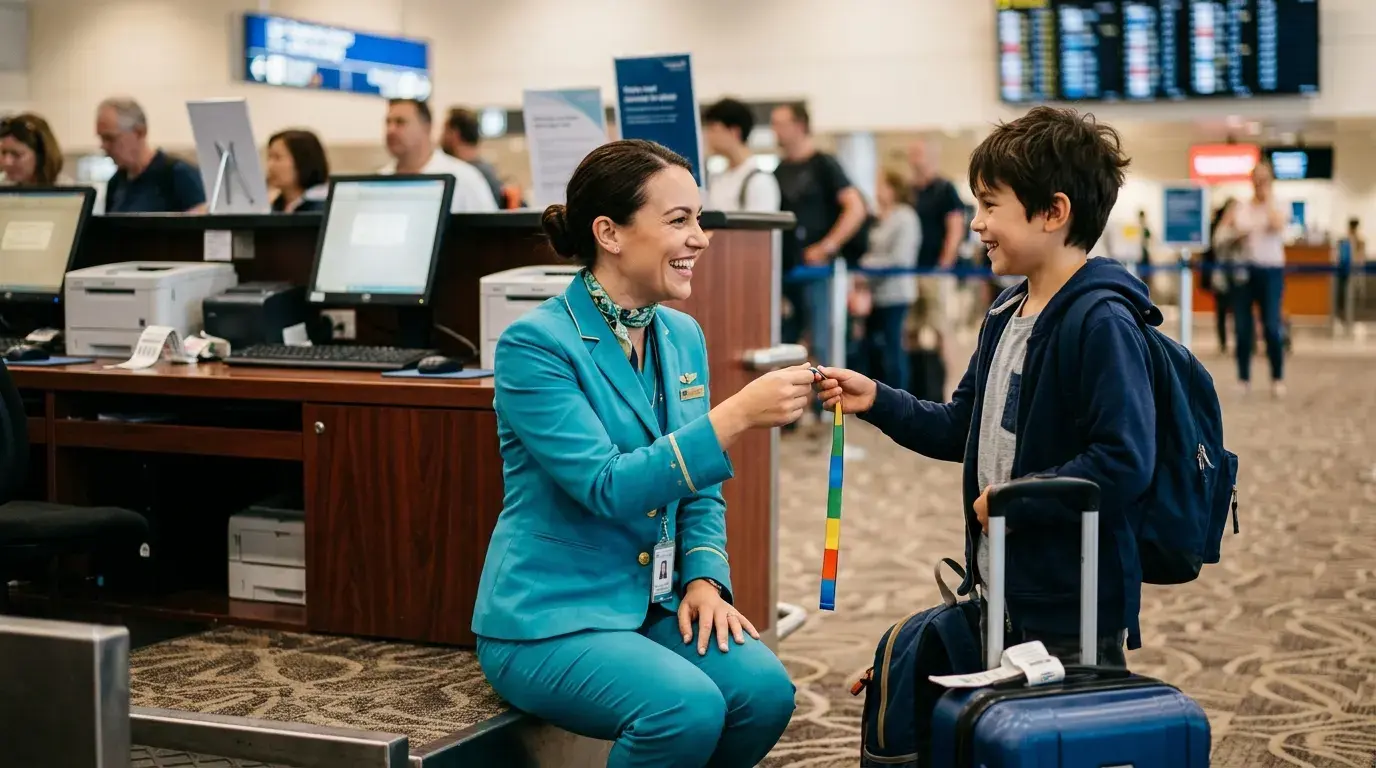
A visa or visa-free entry permission does not compel an airline to carry a solo child. Read the operating carrier’s current age bands, route restrictions, booking process, forms and fees before purchase.
Age Bands Depend on the Carrier and Route
There is no universal “all children aged 5–11 must use the service” rule. Air India, for example, describes unaccompanied-minor and young-passenger categories separately and notes service restrictions on partner-operated segments. Check the policy for the child’s age on the travel date.
Some carriers have a minimum solo-travel age and optional assistance for older children; others set different categories. The same child may qualify on one carrier and not another. Confirm rather than generalise.
The booking steps differ from a normal purchase:
- Check the carrier’s age band on the travel date.
- Confirm every operating sector and connection is eligible.
- Ask how the service must be booked and when it must be confirmed.
- Complete the carrier’s current forms and name both handover adults.
The carrier may require telephone or special-service booking even when ordinary online seats are available. Get the unaccompanied-minor service explicitly confirmed for every operating leg.
An unrelated adult in the cabin does not automatically become the child’s authorised escort. Ask the carrier whether such an arrangement changes its solo-child classification, and keep visa and consent records truthful.
Ask what the booked service includes and excludes: departure handover, transit, arrival pickup, disruption handling and change rules. A service name alone is not a contract for unlimited supervision or date changes.
Price the Actual Fare, Service and Each Segment
Do not assume a full adult fare plus a fixed handling fee. Age-based fares, service charges and per-sector pricing differ. Obtain a written total for the exact route before purchase.
- Record the actual child or adult fare quoted.
- Add the service fee for each applicable sector.
- Check change, cancellation and missed-connection terms.
- Verify whether partner-operated flights are excluded.
Calculate the whole outbound and return itinerary using the carrier’s quoted fare and service charges. A connection may attract another charge, or the carrier may not accept the transfer at all.
Ask the airline for the complete fee list in writing. Include any additional fees for date changes or late bookings. A written quote protects you from surprises at the counter.
A service fee pays for a carrier-defined handling arrangement; it is not proof that the route is suitable. Compare the written service terms before choosing.
Codeshare Flights and Partner Airline Traps
The marketing airline and operating airline may differ. Check which carrier actually flies each segment, whose minor policy applies and whether a supported handoff exists. Air India’s current guidance, for instance, warns of limits when a sector is operated by another airline.
Age bands, forms and transfers can change across carriers. Do not buy a codeshare merely because the first airline advertises an unaccompanied-minor service.
Put these questions to the airline:
Which carrier operates each flight?
Does the service apply on every leg?
Where does handover happen at connecting airports?
Can guardians reach the gate area at arrival airports, or does the child exit through a handover desk?
Keep the answers in one email thread. If a problem appears at the airport, you can show the agent exactly what the airline promised.
Questions to Settle With the Airline Before You Pay
Ask the operating carrier before payment and save its answer with the itinerary. If a sales agent’s statement conflicts with the published policy, request written clarification.
Ask about:
Whether a booking changes if the visa date moves
How the airline handles a missed connection for a child
Whether the child can bring a tablet or phone through the process
Which meals and drinks the cabin crew can offer
Disruption arrangements vary. Ask who supervises the child after a missed connection, whether an overnight stay is possible and when the departure adult may be called back.
Finally, ask how the airline records changes to the pickup person. A late change by phone is not always accepted. Send updates in writing and request a reply.
With the booking confirmed, the focus moves from paperwork to the day itself, where small mistakes at the airport can undo months of preparation.
Airport Day: Follow the Confirmed Carrier Handover
Preparation pays off on this day. Every step has a person responsible and a document ready. Walk through the sequence with your child the night before.
Check-In Counter Steps for the Departing Parent
Use the airline’s stated check-in deadline for this airport and international route. Two hours is not a universal safe arrival time for a child-service check-in.
Find the carrier’s designated check-in location and present the required identification, consent and handover forms. The airline may issue a tag or pouch, but do not rely on a universal badge system.
At the counter:
- Present the carrier’s current minor-service forms and required identification.
- Check the child’s passport, entry permission and any route-specific consent.
- Confirm the authorised receiving adult’s details.
- Ask when the departing adult may leave the airport.
Ask the airline when the departing adult may leave the airport. Some carriers require the adult to remain until takeoff; do not assume the same rule applies everywhere.
Pack essentials within the airline’s hand-baggage and security rules. Keep the child’s original travel documents accessible according to carrier instructions, and let the child know which staff member is responsible.
From the Departure Gate to the Aircraft Door
The carrier’s published service describes the supervision it offers from check-in through handover. Confirm the actual scope, especially during transit and disruption, rather than treating every airline service as identical.
If the airline uses identification tags and staff escort, explain them to the child. Security, immigration and gate procedures vary by airport and carrier; ask how the child is transferred between teams.
Boarding priority and seat assignment are carrier-specific. The child should know how to ask crew for help. Do not promise that every solo minor boards first or sits next to a crew station.
Exit-row seating is normally restricted for children under airline safety rules. Check the confirmed seat and any special-service notation on the actual booking.
Brief the child using the carrier’s actual instructions: identify the authorised staff, stay with the assigned escort and ask for help if unsure. Avoid telling the child that every airline uses the same badge or handover form.
Arrival Pickup and Secure Handover
The pickup adult’s name, identification and authority must match the carrier’s form. A separate letter may be required for the visa, departure or airline, but no single pickup-letter format applies worldwide.
The authorised receiving adult should carry the identification the airline specifies and arrive on time. The airline should release the child only through its documented handover process; the pickup point is not always the gate.
Ask the carrier what happens if the named adult is delayed or absent, and keep both adults’ phone numbers live. Never improvise a replacement pickup person without following the carrier’s change procedure.
A secure handover also needs timing. Tell the pickup adult to reach the airport before the plane lands. Share the flight number and live status. Ask for a message the moment the child is in their arms.
Preparing Your Child for the Long Walk Through the Terminal
Children cope better when they know what happens next. Walk through the journey on a quiet evening at home. Use simple words and keep the tone calm.
Cover these points:
- Cover the carrier’s actual identification and handover process with the child. Teach them to seek help from authorised airline or airport staff, not to follow an unfamiliar person and to use their contact card if needed.
Pack a small activity bag. A book, headphones, and a favourite snack go a long way. Add a spare change of clothes for younger children.
Give the child a written card with names and numbers. Keep it in the same pouch as the forms. If the child feels nervous, the card brings reassurance.
Agree on a check-in routine for the first hours after landing. Ask the host to message you from the arrival hall, again from the car, and once more at the front door. Set the same routine for the return journey. Short, regular updates calm everyone.
Done well, the whole sequence gives your child a smooth journey from the first counter to the last hug.
Final Check: The Visa File and Airline Handover Must Both Work
A complete child-travel plan connects permission to enter, parental or guardian authority, a workable route, a carrier-accepted service and a named receiving adult. Each layer is separate; no reservation alone guarantees boarding or a visa decision.
Check every document against the real trip, confirm the airline’s policy in writing and keep the pickup contacts available on travel day. Update genuine changes through the proper channels instead of relying on an old itinerary.
The Two-Checkpoint Solo-Child Decision Workflow
| Checkpoint | What to verify | Do not assume |
|---|---|---|
| Visa or entry file | Child’s nationality, purpose, consent, custody, receiving adult, accommodation and requested travel evidence. | Every mission demands notarisation or an issued ticket. |
| Airline carriage | Age band, operating flights, transfer eligibility, service booking, fees and handover forms. | Visa approval means the airline must carry the child. |
| Airport handover | Named adults, IDs, contact numbers, check-in timing and disruption procedure. | A different adult can collect the child without a formal change. |
Hypothetical example: A 12-year-old’s UK visit is supported by written parent consent and an aunt’s address and agreement to host. The family first checks whether the airline treats a 12-year-old as a young passenger or an unaccompanied minor on the chosen flight. Only then do they select a flight proof document that the visa checklist accepts and book the carrier service required for final travel.
For a child travelling on a separate route from their family, see the split-route minor guide. For the reservation-versus-ticket distinction, see DummyFlights’ child-ticket explainer.
Need a child’s proposed flight itinerary? Check the visa evidence type and the airline’s solo-child policy first. Then choose a genuine reservation that matches the child’s real plan.
Review BookForVisa reservation optionsFrequently Asked Questions
Can a child apply for a visitor visa while travelling alone?
That depends on the destination and the child’s circumstances. UK Standard Visitor guidance permits solo travel by an under-18 where written consent and suitable travel and stay arrangements are in place.
Does every embassy require notarised consent?
No universal rule applies. Check the destination, departure country and relevant consulate’s current consent requirements, including custody exceptions.
Is the visa flight reservation the airline’s unaccompanied-minor booking?
No. The visa document describes proposed travel when requested. The operating airline must separately accept the child and confirm any required solo-child service on the final booking.
Can an unaccompanied minor change airlines during a connection?
Only if each operating carrier accepts the child and a supported handover exists. Some airlines restrict partner-operated or interline itineraries.
What if the receiving adult changes?
Contact the airline through its required change process and update any visa or consent document that materially names the receiving adult. Do not rely on an informal phone message.
Must the child buy a ticket before the visa decision?
Follow the exact official checklist. Some routes accept proposed travel or a reservation; others specify a ticket or do not request flight proof.
When can the departing adult leave the airport?
Follow the operating carrier’s handover instruction. Some require the adult to remain until departure, but the precise rule is carrier-specific.
Friendly reminder: BookForVisa provides travel-proof documents for planning and visa-application support. Requirements vary by destination, consulate, visa category and applicant situation. A flight reservation can support a file, but it does not guarantee approval, boarding or entry.