
A flight booking can be examined at two different moments: by a carrier before departure and by an immigration or border officer after arrival. Those roles overlap around identity and travel permission, but they are not interchangeable. The safest preparation is to carry one current itinerary, understand what each field proves, and keep the route and dates aligned with the journey you will describe.
This guide focuses on travel-day evidence rather than visa-application review. It explains which booking details deserve a pre-airport check, what staff may ask you to clarify, how to handle schedule changes, and how to present the record without making unsupported claims about access to airline systems.
What Airlines and Border Officers Can Check
Role boundary: Airline staff and border officers do different jobs. Carriers check whether passengers have the documents required to travel, while the destination authority decides admission. UK carrier guidance makes this distinction explicit and describes checks of passports, visas and permission to travel; it does not say that every carrier or border officer retrieves a passenger’s full commercial booking record. See the UK government’s passenger-document guidance for carriers.
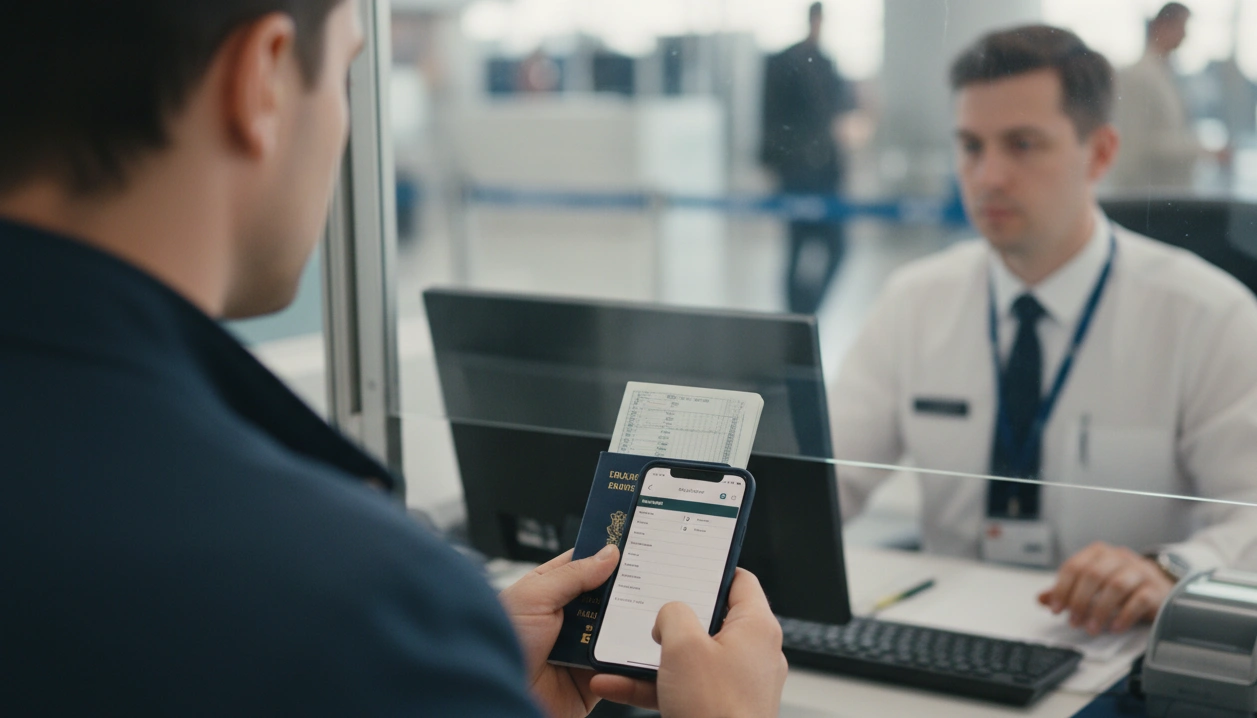
At Frankfurt passport control on a Schengen entry, the question can come fast: “Where is your onward ticket?” By the time you unlock your phone, border systems may already contain passenger and flight data supplied through official carrier channels, although the exact data visible depends on the jurisdiction and checkpoint.
Separate Pre-Arrival Data From the Document You Carry
Pre-arrival data is not the same as your PDF. Governments can require carriers to transmit passenger and service information electronically. The UK’s 2026 passenger-information direction covers carrier transmission of passenger and PNR data. That does not mean a traveller can see the same record, or that every officer manually opens every PNR. Present the document requested and avoid claims about unseen systems.
At a major arrival desk in places like Singapore Changi or Dubai, the officer is not building your trip from scratch. It helps to distinguish three information sources that may be involved, without assuming every officer sees an airline’s complete commercial booking record.
1) Airline-Sent Passenger Data
On many international routes, airlines transmit passenger details ahead of arrival. When you fly from Istanbul to Amsterdam, the border system can receive your identity and flight details before you reach the counter. That means your answers get compared to data already on screen.
2) Airline Booking Signals
Your document can display a carrier reference and status wording, but a reference alone does not prove that a ticket was issued or that every segment remains active. If you arrive in Toronto on a visitor profile, staff may compare the document with your stated dates and route, or ask for a clearer source if the record is incomplete.
3) What You Present In The Moment
Your PDF, email, or app view is the third stream. It can solve a question in seconds or create a new one. A clean document that matches your passport and the flight you just landed on in Paris helps. A cropped screenshot with missing reference lines can slow the process right when you want speed.
This page owns the travel-day question: what to carry, which booking fields matter at airline check-in or border control, and how to resolve a mismatch on the spot. For the earlier planning stage—choosing a reservation method, timing it around an application and keeping the complete document set aligned—use the complete flight-reservation planning guide. Keeping those intents separate prevents application advice from being mistaken for a universal border procedure.
Reservation Status: Held, Confirmed and Ticketed Are Not Identical
Some borders treat flight-proof like a quick credibility check. Others treat it like a gate on intent. The practical question is whether the document reliably supports the departure or onward journey you describe.
If you are entering the UK as a visitor after landing in London Heathrow, a booking that reads like a hold can trigger the next question: “So are you actually leaving?” The issue is not your tone. The issue is the status your booking implies.
Here is how that distinction shows up in real checks:
- A ticketed itinerary suggests the trip is committed and traceable through airline systems.
- A held itinerary suggests the trip might disappear, which makes it a weak answer to “when do you leave?”
Now connect that to your profile. A short-stay Schengen visa with a 10-day plan is easier to explain when the exit date and route align with the permitted stay. A long-stay scenario, like arriving on a student visa to Australia, still benefits from clarity because unclear dates or contradictory documents can lead to further questions at first entry.
An e-ticket number or issuance line helps distinguish a ticketed itinerary from a temporary reservation, but neither guarantees admission. If it does not, you need a stronger plan for what you will show and say.
Segment Status Wording That Can Create Uncertainty
You might notice codes or short words next to flight segments. A traveller should not rely on internal-looking codes to prove certainty. Plain wording such as waitlist, on request or cancelled is more important to resolve before travel.
At Narita in Japan, an arrival officer may ask whether an outbound segment is confirmed if the document itself appears provisional.
Watch for these types of cues, because they create follow-up questions:
- Words like pending, on request, or waitlist
- Segments that show as changed without a clean final version
- A multi-leg itinerary where one segment looks confirmed and another looks questionable
This matters on any multi-leg route where one uncertain segment breaks the stated exit plan. If you fly from Cairo to Madrid with a tight onward connection to Casablanca, one uncertain segment makes the whole plan look shaky. The officer’s logic is simple: if one piece can fail, your exit plan can fail too.
The best outcome is boring. You want every segment to look consistent, stable, and final at a glance.
What Your Route Communicates About the Journey
Route logic can be compared with the purpose, location and duration you state. A routing can be technically valid and still feel suspicious if it does not match your stated purpose.
If you enter the United States on a B1/B2 visitor profile and show a route like New York to Reykjavik to Lisbon for no clear reason, you invite a question: “Why that path?” If your answer is “cheaper,” you should be ready to explain the routing factually and show how the segments connect.
A route reads clean when it matches three realities:
- Geography: Karachi to Doha to Paris makes sense as a standard connection pattern.
- Timing: A same-day onward from Rome to Istanbul looks normal; a 19-hour layover with no hotel plan looks messy.
- Purpose: A conference in Berlin pairs well with a direct or standard connection, not a five-stop maze.
Even transit patterns can change the tone of the check. A Schengen entry through Vienna with an onward to Zagreb reads differently from a Schengen entry with a long stay in the airport and a split booking across two carriers.
Your goal is simple: make your route tell one clear story that fits your visa type, your stay length, and the first city you claim you will visit, because next, we move into the exact booking fields officers cross-check to test that story.
Flight Booking Fields to Check Before Travel
A traveller also needs to know what the document actually represents. A reservation reference, confirmed segment and issued ticket are related but not interchangeable. The foundational flight-reservation guide explains the ordinary fields and purpose of a reservation used during visa preparation. Here, the narrower task is checking that the version carried on travel day still matches the passport, route and departure date you will state.

A flight booking is not just proof that you once clicked “reserve.” At an arrival desk, it becomes a compact data sheet. When it is requested, the useful fields are the ones that establish identity, route, dates and the current status of the journey.
Name Matching and Normal Airline Formatting
Name matching is the first silent test. It is also the easiest place for friction, because airlines and passports format names differently.
Officers do not expect perfect typography. They do expect a clear identity. If your passport shows a long given name chain and your booking compresses it into initials, you can still pass. But you must avoid anything that makes the name look like a different person.
These mismatches are worth correcting before departure:
- Surname and given name swapped so the booking reads like a different identity
- An extra family name was added that does not appear anywhere on your passport bio page
- Middle name omitted in one document but used as part of the surname in another
- Spacing and hyphen shifts that change how the name is interpreted
The objective is to make the identity match obvious. You help that by keeping the name in your booking aligned with your passport’s structure.
If your passport has no middle name, do not invent one in your booking profile. If your passport includes a middle name, it is usually safer to include it in the same place each time you book flights.
Also, watch the order in PDFs. Many itineraries print as SURNAME/GIVENNAME. Some travelers panic and think it is reversed. It is not. The issue begins when your booking prints as GIVENNAME SURNAME, but your email confirmation prints SURNAME GIVENNAME, and one of them contains an extra word.
Passport and Identity Data When It Appears in the Booking
Some itineraries include passport fields. Some do not. The risk is not the absence. The risk is wrong data when it is present.
If a booking or airline profile displays a passport number that differs from the document you present, airline staff may need to correct the passenger data, and border staff may ask why the records differ.
Common causes are simple:
- You renewed your passport after the booking was created
- Your airline profile auto-filled an old passport number
- A digit error slipped in during manual entry
- You have two passports and used the wrong profile during booking
The clean way to handle this is to keep your travel identity stable.
Before you travel, check these fields anywhere they appear:
- Passport number
- Date of birth
- Nationality
- Document expiry date
If the itinerary does not show passport details, you do not need to add them. If it does show them and they are wrong, you want a corrected version or a consistent explanation supported by documentation.
A common situation is a passport renewal between visa approval and travel. If your visa is linked to an old passport, the required procedure varies by destination; check the issuing authority’s current instructions rather than assuming the old passport alone is sufficient. Your flight booking should match the passport you will hand over at the counter, not the one sitting at home.
Dates, Airports and Connections as One Travel Chain
When flight details are requested, dates, airports and connections should form one coherent chain.
At Schengen entry points like Amsterdam, the trip must make sense end-to-end:
- Your arrival flight aligns with the city you claim you will enter
- Your onward or return flight aligns with your planned stay length
- The connection sequence is feasible
Small details matter because they can create a genuine date or routing contradiction.
Watch these items:
- Date and local time for each segment
- Airport codes that can look similar but are not the same city
- Arrival date shifts caused by overnight flights and time zones
- Connection windows that look impossible
A classic mismatch happens when the itinerary prints departure and arrival times in local time, but you explain it as if it is one time zone. Another happens when a traveler books a departure from a different airport in the same metro area and does not notice the code difference.
If you are entering Canada and your onward flight shows departure from a different city than where you land, you need a clear explanation and ideally a matching domestic segment. Otherwise, the document does not explain how you reach the departure airport.
Schengen applicants should keep application-stage requirements separate from checks at an external border. The Schengen flight-reservation requirements guide covers consular route and date evidence for the visa file. At travel time, the Schengen Borders Code governs external-border entry conditions, and the European Commission explains that border checks and short-stay entry requirements operate under that common framework; an issued visa does not by itself guarantee entry.
Return and Exit Logic for a Temporary Visit
Return or exit evidence may be used to assess whether a temporary-visit plan fits the period and purpose stated at the border.
If you are arriving in the United States as a visitor, an onward flight outside the period you state can trigger questions, even if you insist you might stay shorter. If you are entering a Schengen country on a short-stay visa, a return that falls outside your stated plan can feel inconsistent.
Check for this simple alignment:
- Your stated stay length matches your return or onward date
- Your first stop matches your booking route
- Your purpose matches the travel timeline
If you say “one week in Spain,” but your return is six weeks later, you are now explaining a discrepancy under pressure.
Booking Reference, Ticketing and Version-Control Fields
Some fields make a document easier to understand, but no single field proves admissibility.
Useful fields include:
- A clear booking reference that does not look cropped or edited
- An issuance or ticketing indicator when applicable
- Consistent passenger count and segment list
- A visible contact channel, such as an email header or agent line, that looks normal
Be careful with mismatched versions. One PDF showing a different departure time than your latest email creates an avoidable discrepancy. Two itineraries for the same route with different names are worse.
How Flight Booking Evidence May Be Checked

There is no universal border procedure for checking a flight booking. Staff may inspect the document, compare it with your answers and travel documents, or ask for a current source when local entry rules make departure evidence relevant.
Four Ways Staff May Test the Evidence
At a Schengen area entry desk, the first method is a rapid consistency scan. The officer checks your valid passport, then compares your stated onward travel plans to the dates and route on your flight itinerary.
At US ports of entry, a booking reference or e-ticket number can help identify the journey, although public retrieval is not available for every airline, agency or reservation system.
At airports like Dubai or Singapore, staff may ask for the carrier email or app view when a static screenshot omits important context.
At places like London Heathrow, follow-up questions may be used to clarify the route and timing. They may ask for your return ticket date, your destination country address, or why your routing looks unusual, because that reveals whether your booking matches your spoken story.
You can plan for all four by keeping a simple “show-first” order that works across many countries:
- Open the itinerary PDF, then show the same booking in your email or app if asked
- Keep the same name format across travel documents and passport visa pages
- Be ready to state your exit date and route in one clean sentence
- Keep supporting documents like bank statements or invitation letters available only if requested
Why a Polished PDF Can Still Be Weak Evidence
A polished PDF can still fail at Canadian border control if it removes the parts that make it verifiable. A clear layout cannot replace missing identity, date, route or status information.
One common issue is over-cropping. At airports in Japan, a screenshot that cuts off the booking reference, segment status, or passenger details makes the evidence harder to assess and can prompt a request for the complete record.
Another issue is mixing versions. At an Australian arrival counter, you might show a PDF with one departure time, then open an email confirmation with a different time. Even if the change is harmless, the mismatch needs a simple explanation and a current version.
A third issue is presenting the wrong layer of proof. On some routes into the UK, a boarding pass proves a completed or imminent segment, not a later exit journey. The officer wants to see the itinerary record that supports your entry requirements, not just the airport artifact.
Also, watch the handoff moments around security screening. Airline staff at the check-in counter sometimes ask for onward proof before you fly. If you show one document to airline staff and a different one to border control after landing, you create a version conflict that staff may ask you to resolve.
Keep your presentation clean. Show one coherent record that looks stable, complete, and consistent.
Common Travel-Day Failures and Focused Fixes
At a Schengen entry point like Amsterdam, a name mismatch can slow an immigration or carrier document check. Fix it by using a booking that matches your passport name order and spelling closely, and avoid mixing initials with full names across versions.
At a US port of entry, provisional or contradictory status wording may require clarification. If the itinerary reads like a hold, it may not answer a request for confirmed departure evidence. Fix it by carrying a version that clearly signals confirmation, and keep your explanation short and factual.
At airports in Singapore, broken routing logic can prompt practical questions. A route that lands in one city but departs from another without a connecting segment forces you into explanations under pressure. Fix it by aligning the trip chain so every hop makes sense on the page.
At UK border control, date logic can fail even when the flights are real. If your itinerary implies a longer stay than you just stated, the officer may question your intent. Fix it by syncing your travel window to what you will actually say at the desk.
In many countries’ arrival halls, access failure is its own problem. If you cannot open your documents due to roaming issues, you lose time. Fix it by saving an offline copy and keeping a single clear file ready to open.
For Schengen travel, the European Commission’s border-crossing guidance is the governing overview. It confirms that the Schengen Borders Code sets common external-border checks and entry conditions. Requirements and questioning still depend on the traveller’s status and facts, so this checklist is preparation guidance rather than a promise that a particular document will be requested.
Build a Travel-Day Booking Pack
A solid flight booking is built for real-world checkpoints, not just for your inbox. When an officer asks for proof, you want an itinerary that reads cleanly at border control and stays consistent under quick questions.
Use Plausible Route and Timing Rules
At a Schengen entry desk in Paris, plausibility starts with a route that matches your stated first city. If you say “Paris first,” your flight itinerary should not land in Milan unless you can explain the ground transfer in one sentence.
At UK border control in London, plausibility is also about timing. A return flight three weeks out while you claim “a five-day visit” makes you work harder than you need to.
On international flights into Toronto, choose connections that look feasible without a long story. A 45-minute terminal change across airports can look like you did not understand the route.
In the United States, plausibility is about intent. If your international trip includes a long detour through a third country for no clear reason, it can look like route-shopping rather than normal travel.
Choose One Current Version to Present
At the check-in counter, airline staff may ask for onward proof before they issue your boarding pass. You want a simple “show-first” order so you do not fumble between apps, screenshots, and downloads.
Here, we focus on a presentation stack that works at both departure and arrival:
- A saved PDF of the itinerary that opens offline
- The matching email confirmation on the same date version
- An app is viewable only if the officer asks for source validation
At a busy arrival hall like Dubai, speed matters. One clean file with the booking reference visible reduces questions.
For first-time international travellers arriving in Singapore, consistency matters even more. If your phone shows one date and your printed PDF shows another, staff may ask which version is current.
Treat your itinerary like one of your essential documents. Keep it easy to open, easy to scroll, and identical across every version you might show.
Handle Schedule Changes Without Version Conflicts
At Frankfurt passport control, changes are normal, but conflicting versions are not. If you changed dates after visa issuance, do not carry three PDFs and hope the officer picks the latest one.
At airports that run tight connections, a last-minute change can create unexpected expenses if you need to rebook quickly. That is exactly why you want one current itinerary version that matches what you will say out loud.
Frequent travelers often get caught by “autopilot mistakes.” They book an updated return, but forget the old PDF sitting in a downloads folder. At a secondary desk in Madrid, opening the wrong file can create an unnecessary contradiction.
If you must change a segment, make sure the itinerary still reads as one coherent chain. At US entry points, a broken chain needs supporting transport evidence or a concise explanation.
One-Minute Pre-Airport Self-Audit
At the airport, run this quick audit before you leave for departures:
- At the airline desk, your itinerary opens offline and matches the date you will state at check-in
- At immigration, your name on the itinerary matches your passport name order closely enough to be obvious
- At border control, your onward date fits your stated stay length and your return plan back to your home country
- At transit, every segment reads like a connected journey with feasible timing and no unexplained gaps
- Upon arrival, you can show the same version in PDF and email without contradictions
Present One Coherent Journey
At places like Frankfurt passport control, London Heathrow border control, or Schengen area entry in Paris, the useful standard is a current itinerary whose identity, dates and route match your valid passport and stated plan. When your name, dates, and onward travel plans line up, the document is easier to assess, although no itinerary controls the admission decision.
Keep one current version ready on your phone, with your essential documents easy to open and your answers consistent from the check-in counter to border control. If an officer asks about hotel bookings, show only what supports the same timeline. Do a one-minute self-audit before you leave home, and your journey starts on solid ground.
If your booking includes a QR code, our guide explains whether border officers scan booking QR codes and what they verify instead.
Disclaimer: Entry and carrier-document rules vary by nationality, destination, transit point and immigration status. Check the destination government and airline before travel. This article explains document preparation and does not guarantee boarding, entry or any immigration outcome.
Flight Booking Checks at the Airport: FAQ
Do immigration officers always check a flight booking?
No. Whether flight or onward-travel evidence is requested depends on the destination rules, the traveller’s status and the circumstances of the inspection. Carry a current copy when the applicable rules or your travel profile make it relevant.
Can an immigration officer see my full airline booking?
Do not assume so. Authorities may receive passenger and flight data through official carrier channels, but the data available and the way it is used vary by jurisdiction. Present the requested document instead of speculating about internal systems.
Is a PNR the same as a ticket number?
No. A PNR identifies a reservation record, while an e-ticket number normally indicates ticket issuance. A reservation can exist without an issued ticket, and a displayed reference does not by itself prove that every segment remains active.
What flight-booking details should match my passport?
The passenger identity must clearly correspond to the passport. Where the booking or airline profile displays passport data, check the number, nationality, date of birth and expiry date. Also verify the route, dates and passenger count.
Is a screenshot enough for an onward-travel check?
A complete screenshot may help, but it can be weak if it hides the passenger name, booking reference, route, dates or current status. Keep an offline PDF and the matching carrier or agency email available so you can show the complete context if asked.
What should I do after a flight schedule change?
Keep only the latest itinerary readily accessible, confirm that every segment still connects, and make sure the new exit date matches the stay you will describe. Retain the change notice in case staff ask why an older document differs.
Does a flight reservation guarantee entry?
No. A reservation or ticket can support a travel explanation, but the competent border authority decides admission under the applicable immigration rules. Identity, permission to travel, purpose, duration and other entry conditions may also matter.
Should I show a flight booking without being asked?
Usually, present the passport and required travel documents first, then answer the question asked. Keep the itinerary easy to open and provide it when airline or border staff request departure, return or route evidence.
Friendly reminder: BookForVisa provides travel-proof documents for planning and visa-application support. Requirements vary by destination, consulate, visa category and applicant situation. A flight reservation can support a file, but it does not guarantee approval, boarding or entry.