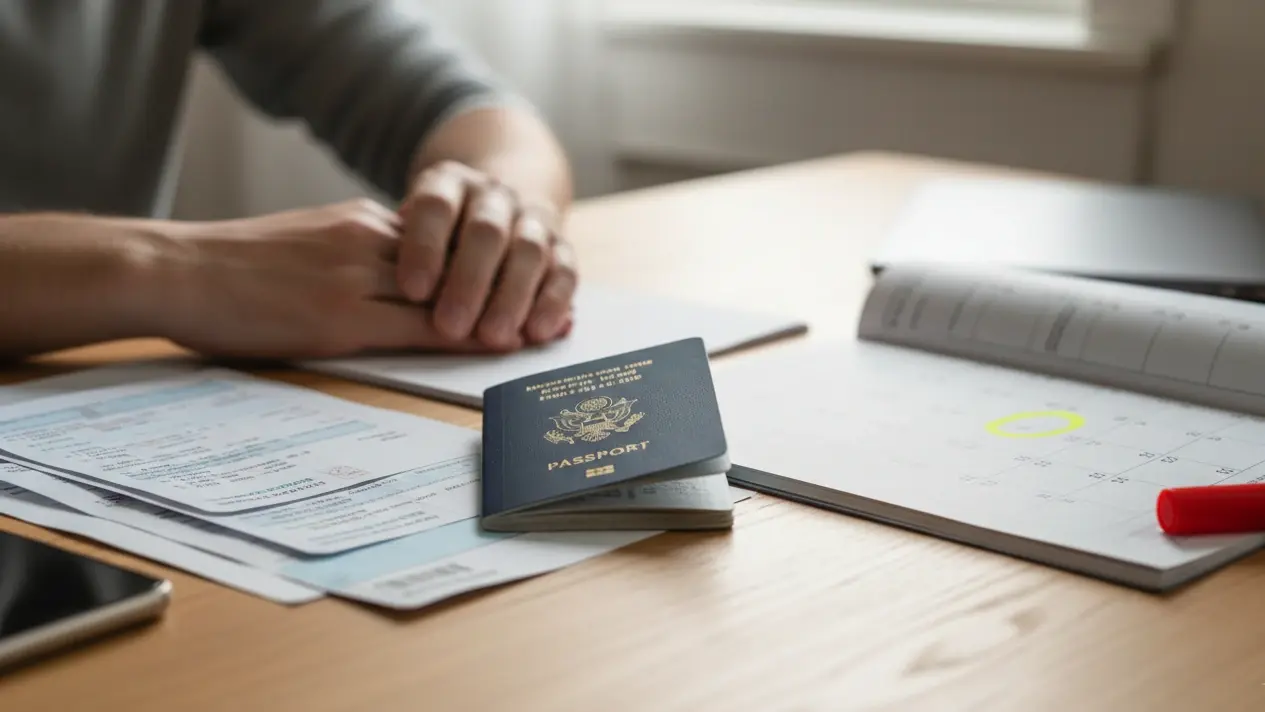
A Netherlands business visa file is strongest when the invitation, hotel proof, insurance dates and flight reservation for visa all tell one clean Schengen timeline. The reviewer should be able to see why you are entering the Netherlands, where you will stay, who pays, when you leave and why the travel dates match your business purpose.
Your Netherlands business visa file can look perfect until a reviewer spots one mismatch: flight dates that do not align with your appointment timeline, hotel nights that skip a city, or insurance that starts a day late. In Schengen cases, those tiny gaps read like a weak plan, not a small mistake.
In this guide, we’ll build your checklist the way embassies actually scan it. You’ll learn when to create or refresh reservations, what hotel proof format holds up best for business trips, how to keep every document consistent across dates, cities and sponsors, and the file order that makes your story easy to trust. Attach a clean flight reservation for visa only after your Netherlands business dates, hotel proof and insurance window match.
Key facts before preparing Netherlands business visa documents:
- Your invitation letter, hotel proof, flight reservation and insurance should point to the same dates.
- A travel reservation in your name is needed, but a paid travel ticket is not required.
- Hotel proof should cover every night, or the host invitation should clearly explain the stay.
- Insurance should cover all Schengen countries for the entire travel window.
- Your file should read like one business timeline, not separate PDFs stitched together.
In This Guide
Official-source check: NetherlandsWorldwide’s business/official visit checklist says a Netherlands business visa file needs an invitation stating personal details, visit dates and reasons; proof of stay such as a hotel reservation for the full trip or host-arranged accommodation stated in the invitation; proof of who pays travel and stay costs; a travel reservation in the applicant’s name to and from the Schengen area or another document showing travel plans; and travel medical insurance covering all Schengen countries for the entire stay with at least €30,000 in medical expenses. It also states that a paid travel ticket is not required.
Reviewed for: Netherlands business visa checklist alignment, invitation-letter dates, hotel proof coverage, travel reservation timing, paid-ticket-not-required wording, Schengen insurance requirements, employer/sponsor consistency, city-night logic and PDF file-order clarity.
Why The Reservation Timing Rules That Keep Your Netherlands File “Logical”
A Netherlands business visa file is judged like a timeline, not a pile of PDFs. When your dates and document timestamps tell one clean story, your plan feels real and easy to approve.
The Timeline Logic Reviewers Expect (And What Breaks It)
For a Netherlands business trip, reviewers often sanity-check your sequence in seconds. They look for a plan that was built around real commitments, not patched together after the fact.
Here is what usually reads as “logical”:
- Meetings or event dates first, backed by an invitation letter or registration.
- Leave approval next, or an employer letter that clearly aligns with the travel window.
- Reservations and insurance created close enough to the plan that they look current and intentional.
What breaks that logic fast:
- A flight reservation created long before your invitation letter date, with no explanation for why the trip existed before the business purpose existed.
- Hotel nights that do not match the cities you claim you will be in, especially when your itinerary has same-day jumps.
- Insurance that starts after your outbound flight time or ends before your return date, even by one day.
For Schengen business files, “small mismatch” often reads as “unclear plan.” We want your dates to behave like one system.
When To Create Or Refresh Flight Reservations
You do not need one perfect rule. You need a timing choice that matches your appointment reality and how stable your dates are.
Use this as your practical decision path:
- If your appointment is soon and your travel dates are already fixed Create flight reservations after your key documents are ready (invitation, employer letter, itinerary table).
- Keep a tight alignment between the reservation date and your final travel window.
- If your appointment is weeks away, and dates may move Hold off on locking anything that could expire or become outdated.
- Prepare your itinerary table and supporting letters first, then generate reservations closer to submission.
- If your company confirms meeting dates late Do not rush reservations ahead of the invitation letter.
- Build the core narrative first, then add reservations that match it.
- If you may reschedule biometrics or your appointment Choose an approach that lets you update dates cleanly without rewriting your whole file.
- Keep your “master itinerary table” editable so every document stays consistent.
This is not about being early or late. It is about looking coherent.
The “Match Window” Concept: Align Reservations With Your Strongest Documents
Think of your application as a set of documents that should all point to the same calendar. The strongest anchors in a Netherlands business visa file are usually your invitation letter and employer support.
Here, we focus on building a match window where everything agrees:
- Invitation letter date and meeting dates
- Employer letter date and approved leave period
- Itinerary table dates and cities
- Flight dates and entry and exit logic
- Insurance coverage dates that fully cover the trip
A simple workflow helps:
- Finalize your itinerary table with exact cities and nights inside the Netherlands.
- Confirm your invitation letter includes the same meeting window you plan to travel for.
- Align your employer letter and leave approval with that travel window.
- Only then generate flight reservations and insurance to match the final set.
If any anchor changes, treat it as a system update. Update the anchors first, then the supporting proofs.
How To Handle Date Changes Without Leaving Traceable Inconsistencies
Date changes happen. What matters is how cleanly you update the file, so the reviewer never sees “two versions of the story.”
When one date moves, update in this order:
- Itinerary table first (your single source of truth)
- Cover letter next (your narrative)
- Invitation letter addendum if the host confirms a revised schedule
- Hotel nights, so every city night still matches your plan
- Flights and insurance last, because they must match the final dates exactly
Watch these common version traps:
- Your cover letter says “arrive Monday,” but your flight arrives Tuesday.
- Your invitation letter lists meetings in Amsterdam, but your hotel nights show Rotterdam for the same dates.
- Your insurance starts on the meeting date, not on the day you enter Schengen.
If you are departing on a multi-segment route like Delhi → Amsterdam, be extra strict with name order and passport details across every PDF, since minor formatting differences can show up across segments and confuse a quick scan.
If your main concern is date shifting between appointment and travel, you may prefer a reservation setup that is easy to update while keeping the file consistent. BookForVisa helps keep reservation dates, passenger details, route logic and PDF presentation aligned when your Netherlands business timeline changes.
Hotel Proofs For A Netherlands Business Trip: What Counts, What Looks Weak, And How To Fix It
For a Netherlands business visa, hotel proof is not judged in isolation. It is judged against your business purpose, your city plan, and the way your trip moves day by day.
Pick Your Hotel Proof Type Based On Who Pays And Who Hosts
Before you choose any booking format, lock one thing: who is responsible for your stay. In the Netherlands, business cases, confusion around payment, and hosting are some of the fastest ways to trigger follow-up questions.
Start with a clean choice:
- You pay for your stay. Your hotel proof should show your name, all nights, and a clear property address in the Netherlands.
- Keep the booking aligned with the city where your meetings happen. If meetings are in Amsterdam, an airport-area hotel with no explanation can look odd.
- Your Dutch host pays for or arranges accommodation. Your invitation letter should clearly state the accommodation plan, not just “we invite the applicant.”
- If the host arranges a hotel, the booking may show the company as the payer, but your name should still appear as the guest for the nights you will stay.
- Split plan (some nights hosted, some nights self-paid). Treat it like two mini-trips inside one itinerary.
- Your invitation letter should cover the hosted nights precisely, and your booking should cover the rest with no gaps.
A practical rule helps: every night in your itinerary must be explained by either a booking or a host statement, with dates that match exactly.
The Hotel Proof Strength Ladder (From Safest To Riskiest)
Not all hotel confirmations feel equally “real” to a visa reviewer. Some read like a final plan. Others read like an early idea.
Here is a simple strength ladder you can use when building a Netherlands business file:
- Strongest: Guest-named booking with full stay details. Your full name as a guest
- Check-in and check-out dates that cover all nights
- Full property address in the Netherlands
- Clear booking status and terms
- Strong: Company-arranged booking where you are listed as a guest. Works well for hosted trips
- Needs the invitation letter to match the same nights and city
- Moderate: Booking that is correct but incomplete. Covers only part of the stay
- No city gaps are allowed unless those nights are clearly hosted and documented elsewhere
- Weak: Confirmation that feels “placeholder.” Missing guest name or unclear dates
- No address
- Nights that do not match your itinerary
To tighten any hotel proof, check these items line by line:
- Guest name format: matches passport spelling and order
- Dates: match your itinerary table nights exactly
- City: matches where you claim to be for meetings
- Address: present and readable
- Room occupancy: consistent if you list any companion on the application
If one of these is missing, we fix it before submission. We do not leave the reviewer to “assume.”
Multi-City Within Schengen: Keeping Nights And Cities Consistent
The Netherlands is compact, which creates a common trap. Applicants plan meetings in multiple cities, but the hotel plan looks like a tourist route with random jumps.
If you have Amsterdam meetings plus a day in Rotterdam or The Hague, your hotel proof should still tell a clean movement story.
Use these practical patterns:
- Single base hotel, multiple-day meetings You stay in one hotel in Amsterdam.
- Your itinerary shows day trips for meetings in Rotterdam or The Hague.
- This works well if travel times are reasonable and your meeting times do not look impossible.
- Two hotels, split by meeting clusters Nights 1–2 in Amsterdam for meetings and site visits
- Nights 3–4 in Rotterdam for a second office or event nearby
- Your itinerary should explain the shift with a clear reason, not vague sightseeing.
Watch for “night math” problems. A reviewer often checks:
- You say you arrive on Tuesday and leave on Friday.
- That means three nights in most cases.
- Your hotel proof must show those three nights, not two.
Also, avoid city spelling drift across documents. If your itinerary uses “The Hague” but your booking uses “Den Haag,” that is fine, but keep it consistent where you can, especially in your itinerary table and cover letter.
Special Case: Trade Fairs, Conferences, And Peak Season Availability
Business trips to the Netherlands often revolve around events. Hotels can fill up fast, and you may not want to commit to one property too early.
If availability is tight, you still need a plan that looks stable.
Here is a clean way to handle it without sounding uncertain:
- Choose accommodation near the event location or main meeting area.
- Keep the booking dates aligned with the event schedule and your meeting days.
- If you expect a hotel change, make sure the city and night count stay the same, so your core story remains intact.
If you cannot secure the exact property early, avoid a vague “we will book later” approach. A Netherlands business file reads best when every night is already accounted for, even if the booking is flexible.
Problem Solver: When You’re Staying With A Contact Instead Of A Hotel
This comes up in business cases more than people expect. You may be hosted by a colleague, a partner company contact, or a personal connection who lives near your meeting location.
If you use this route, the proof must be structured. A casual note is not enough.
A strong host package usually includes:
- A signed hosting statement with: Full address in the Netherlands
- Exact hosting dates
- Relationship to you and why you are staying there
- A copy of the host’s ID or residence proof, where appropriate
- A short line in your cover letter that matches the same dates and address
Common mistakes to avoid:
- Hosting dates that leave one night uncovered
- Host address in one document and a different area implied by your meeting schedule
- A hosting statement that does not match what the invitation letter says about who is responsible for accommodation
If your employer's letters sometimes show your name in different formats, standardize your passport name across the hotel guest field and any hosted-stay statement so the reviewer never has to guess whether documents refer to the same person.

Schengen Consistency Checks: The “Silent Audit” That Makes Or Breaks Business Visas
A Netherlands business visa file is often decided during a quick consistency scan. If your story holds together across pages, the reviewer can move forward without questions.
The Netherlands As Main Destination: Proving It Without Overwriting Your Story
For a Schengen visa, “main destination” is not just where you land. It is where your business visit clearly happens and where your nights are anchored.
We prove that with three practical signals that Dutch authorities can verify fast:
- Purpose signal: your Dutch company invitation matches your travel plans and meeting dates.
- Night signal: your hotel nights sit in the Netherlands for the core of the short stay.
- Route signal: your entry and exit logic supports the Netherlands as the trip’s center, even if you pass through a Dutch airport or connect onward.
If you add a short meeting in a non-Schengen country before or after, keep it outside the Schengen travel window. That way, your Schengen visa application stays clean and easy to read. If you add a meeting in another Schengen countries city, show why it is secondary. Two lines in your itinerary table can do it, but the dates must match your supporting documents.
The Consistency Grid: One Page That Prevents 80% Of Mistakes
Here, we focus on a single-page grid that lets you test “does everything agree?” before you print or upload. This is how you catch problems before the Dutch embassy does.
Create a grid with these columns:
- Date
- City And Country
- Purpose
- Host Or Payer
- Hotel Proof
- Transport Proof
- Insurance Coverage
Then fill it row by row for the full short stay period. Now, cross-check the grid against all the documents in your Schengen visa application:
- Your Schengen visa application form travel dates
- Invitation letter and meeting agenda
- Employer letter, including your job title and leave dates
- Hotel booking confirmations or hosted stay statement
- Flight reservation dates and route
- travel insurance certificate dates
This grid exposes common issues that get files rejected:
- A hotel night exists in the grid, but there is no proof of that night in the following documents.
- The invitation says “two meetings,” but the grid shows four days with no purpose.
- Your insurance covers fewer days than your actual travel plans.
Treat the grid as the source of truth. If any page disagrees with it, we update the page, not the grid.
Employment And Sponsorship Alignment (Where Business Files Often Contradict Themselves)
For a Schengen visa application, the employment story must match the money story. Reviewers compare your role, who is paying, and whether the trip fits your professional profile.
If you are employed, your employer letter should align with:
- A job title that matches your business visit purpose.
- Travel dates that match your leave approval.
- Who pays for flights, hotels, and daily expenses?
If you are self-employed, we keep it just as structured:
- registration or business certificate that supports your status.
- Recent invoices that show active work.
- bank statements that match the scale of your trip.
- a cover letter that explains the business reason clearly.
Sponsorship confusion is a common reason a file feels incomplete. Fix it with a simple rule: every expense category must have one clear owner. Use plain words that match the evidence you attach, such as “paid by employer,” “paid on behalf of the applicant by host,” or “paid by applicant.”
Also, keep your personal status clean. If a family member is traveling with you, avoid mixing files. The consulate should be able to separate each visa application without guessing which supporting documents belong to whom.
The Insurance Reality Check: Coverage Dates, Territory, And Edge Cases
For a short-stay visa, travel insurance is not a formality. It is a consistency test. One wrong date can create doubt across the whole file.
Check these points before you submit:
- Coverage starts on the day you enter the Schengen area, not the day after.
- Coverage ends on the day you leave the Schengen region, not the day before.
- Territory wording covers the Schengen countries, not just one country.
- Your certificate is readable and includes your name as in your valid passport.
Edge cases matter in the Netherlands business trips:
- If you arrive late at night, make sure the coverage still includes that calendar day.
- If you depart early in the morning, do not let the policy end at midnight the day before.
- If your meeting schedule could shift, build a small buffer day into coverage, but only if your itinerary also reflects it.
If you hold a residence permit or a valid residence permit for a Schengen countries state, do not assume it replaces insurance requirements for a separate short stay elsewhere. Treat it as supporting documentation, not a shortcut, and keep the coverage aligned with your travel plans.
Small Details That Trigger Big Doubts
The Netherlands file review is detail-heavy because the Schengen visa process depends on consistency across pages. Tiny misalignments look like poor documentation, even when your intent is valid.
Run this final precision check:
- Your valid passport number appears in the same format everywhere.
- Your name spelling is identical across bookings, letters, and the form.
- The city sequence makes sense around a Dutch airport arrival and your meeting locations.
- bank statements show funding that matches who pays, with no unexplained gaps.
- All the documents you reference in your cover letter actually exist in the packet.
Also, check completeness. A common failure is thinking you attached the required documents, but missing a page when you print or upload. Before submission, do one clean pass:
- Open every PDF in order
- Confirm each file is complete
- Verify that each date appears consistently across the Schengen visa application form and supporting documents
When this silent audit is tight, your file feels credible without extra explanation, and then we can focus on the last piece: arranging all the documents into a reviewer-friendly order that prevents misunderstandings.

Reviewer-Friendly File Order For A Netherlands Business Visa Pack
A Netherlands business visa file can be strong but still fail if it is assembled in a confusing order. We want the reviewer to understand your plan in minutes, not hunt for proof across random pages.
The Reviewer’s Reading Path: Build Your File In The Same Sequence
Most reviewers do not read every page like a book. They scan for a reliable story, then check whether the proof supports it. If your packet forces them to jump around, they may miss context and ask for additional documents, or decide the file is not complete.
Here is the reading path we built for:
- First, your trip purpose and schedule make sense as a short stay, not a vague idea.
- Then, your ties to your job and your return are clear.
- Then, your logistics match the schedule, including hotel nights and transport.
- Finally, your financial capacity supports the plan for the whole period, even if it is close to the maximum allowed duration of 90 days.
Keep your file clean and consistent across European countries, naming and city spelling. A reviewer should never wonder whether “Holland,” “Netherlands,” and “NL” refer to different things.
Recommended File Order (With Reasoning For Each Block)
We keep the pack simple. We also keep it reviewer-friendly if pages get separated during printing, scanning, or uploading.
Block 1: Cover Letter And Itinerary Table
- Put your cover letter first. Make it direct.
- Add a one-page itinerary table right after it.
- This creates the framework for everything that follows and prevents misinterpretation of your travel plans.
Block 2: Business Purpose Proof
- Invitation letter from the Dutch company
- Event registration or meeting agenda, if relevant
- Any supporting letters that clarify hosting, accommodation, or expenses
This block proves why the business visit exists. It also frames any request for permission to enter and attend meetings during the trip.
Block 3: Employment And Leave Support
- Employer letter with your job details, approved leave, and return expectations.
- If available, add a line item that confirms salary only when it is already present in the letter and consistent with your financial profile.
- If self-employed, swap in registration and business proofs that align with the invitation.
This block is where many Schengen files break. The job story must match the purpose and the trip length.
Block 4: Transport Proof
- Your flight reservation pages in a single PDF.
- Put outbound first, then return.
- Keep airport codes and dates readable, especially if you connect through a Dutch airport before reaching another Dutch city.
A clean transport block helps the reviewer confirm your entry and exit logic fast.
Block 5: Accommodation Proof
- Hotel bookings in date order, one property at a time
- Hosted stay statement, if any, placed exactly where those nights appear in the itinerary
- If the plan is split, keep hosted and self-paid nights clearly separated
This prevents the common “missing night” confusion during a scan.
Block 6: Insurance And Medical Coverage
- Add a travel insurance certificate that covers the full trip window
- Place it after transport and accommodation, so the reviewer can compare dates easily
Block 7: Financials And Supporting Evidence
- Bank statements and financial proofs.
- Any invoices or business financial documents, if you are self-employed.
- Keep it tight. Too many unrelated papers reduce clarity.
If the Dutch embassy requests additional documents later, this order also makes it easier to add them without reshuffling the entire packet.
Netherlands Business Visa Documents: When Your Case Doesn’t Fit The “Standard Trip”
Some Netherlands business trips do not fit the neat pattern of one city, one host, one hotel. We can still present them cleanly if we structure the file around logic.
Common non-standard cases and how to document them:
- Multiple Dutch cities with client meetings Show one primary base hotel and day meetings, or clearly split hotels by meeting clusters.
- Add a short route line in the itinerary table so travel times look realistic.
- Trade fair plus internal meetings Anchor your dates around the fair schedule, then add meeting slots.
- Keep accommodation near the event location to reduce “why this hotel?” questions.
- Partly hosted expenses In the invitation letter, the host should state what they cover, such as accommodation or local transport.
- In your cover letter, mirror that wording so there is no ambiguity about who pays.
- You are a student attending a business event This is not common, but it happens for incubators, pitch events, or sponsored visits.
- Be explicit about why the student status is relevant to the visit, and keep financial support clear.
One practical example: if you have meetings in Amsterdam and a single afternoon meeting in Antwerp, keep the Netherlands as the core purpose and nights. If the secondary meeting is in another Schengen city, make it visibly secondary in the itinerary table and keep hotel nights aligned with the Netherlands focus.
Risk Management Checklist: What To Fix Before You Submit
Here, we focus on risk points that cause avoidable friction during processing. These checks are specific to the Netherlands business files and the way reviewers scan them.
Run this checklist before you print or upload:
- Your itinerary table and accommodation proof have no uncovered nights.
- Your hotel address city matches your meeting city logic, with no unexplained detours.
- Your transport proof matches the itinerary dates exactly, including the return date.
- Your insurance coverage dates fully cover the travel window.
- Your employer letter matches your role and business visit purpose, with no mismatched job title.
- Your bank statements support the trip duration and spending pattern without odd gaps.
- Your PDFs are complete and readable, with correct page order and no missing pages.
Also, check the “separation risk.” In one instance, applicants upload pages as separate files, and the reviewer opens them out of order. Put your name and passport number on the cover letter and itinerary table so they anchor the file if pages get split.
Some Schengen Visa Scenarios: What You Submit In Real Life
Real cases rarely stay perfect. Small changes can happen between appointment scheduling and submission.
Use these micro-scenarios to decide what to update, and what to leave untouched:
- The meeting date has been moved by one day Update the itinerary table first, then the invitation addendum if available.
- Update hotel booking dates to match the revised night count.
- The hotel changed, but the city and nights stay the same Replace the hotel proof PDF only.
- Keep the itinerary table unchanged if dates and cities remain consistent.
- Return date moved earlier Adjust transport proof and insurance end date.
- Ensure the last hotel night matches the new exit.
- Sponsor changes from self-paid to partly hosted Add the revised invitation letter line about coverage.
- Adjust your cover letter wording so it matches exactly.
If you are applying from a busy center, such as an applicant in Mumbai who gets a rescheduled appointment, keep your packet modular so date edits do not force a full rebuild of all documents.
Once your file is ordered like this, the conclusion becomes simple: your plan reads clean, your proof supports it, and the Netherlands stays the clear business destination.
Your Visa Application For Schengen Countries Should Read Like One Clean Timeline
For a Netherlands business visa, the Dutch embassy is looking for a plan that stays consistent across dates, cities, hosting details, and document order. When your flight timing, hotel nights, and travel insurance all match the same itinerary, your file feels straightforward and credible.
Now, take your itinerary table and do one final cross-check against every PDF you plan to submit. If each page supports the same Amsterdam or Rotterdam business schedule without gaps or contradictions, you’re ready to submit with confidence.
Create a Flight Reservation That Matches Your Netherlands Business File
Prepare a clean flight reservation for visa after your invitation, hotel proof, itinerary table and insurance dates are aligned.
Create Your Flight ReservationFrequently Asked Questions
What documents are needed for a Netherlands business visa?
A Netherlands business visa file normally needs a Schengen visa application form, passport, photo, legal residence proof, employment or business ties, invitation, proof of stay, travel-cost proof, travel reservation, medical insurance and any country-specific documents requested by the Dutch checklist.
Do I need a paid flight ticket for a Netherlands business visa?
No. NetherlandsWorldwide says you need a reservation in your name for travel to and from the Schengen area, or another document showing travel plans. A paid travel ticket is not required.
When should I create a flight reservation for visa?
Create or refresh the flight reservation after the business invitation, meeting dates, employer letter and itinerary table are stable. The reservation should match the final travel window, not an early draft of the trip.
What hotel proof is strongest for a Netherlands business trip?
The strongest hotel proof shows the applicant’s name, full stay dates, property address, readable booking status and nights that match the itinerary. If the Dutch host arranges accommodation, the invitation should say that clearly.
What if a Dutch company is paying for the trip?
If the inviting party in the Netherlands pays travel or stay costs, the invitation should state this. The rest of the file should use the same wording so the reviewer does not have to guess who pays for flights, hotels or daily expenses.
How should I handle a multi-city Netherlands business trip?
Use one clear itinerary table. Every city, date, meeting, hotel night, transport segment and insurance day should line up. If Amsterdam is the main destination and Rotterdam or The Hague is secondary, make that clear.
How much travel medical insurance is needed?
For a Schengen visa, the insurance proof should cover all Schengen countries for the entire stay and include at least €30,000 in medical expenses, including emergency care and repatriation.
Can date changes hurt the application?
Date changes can hurt if old and new versions remain in the file. Update the itinerary table first, then the cover letter, invitation addendum if needed, hotel proof, flight reservation and insurance so every document tells one timeline.
What makes a Netherlands business visa file look weak?
Common weak points include missing hotel nights, inconsistent city logic, insurance that starts late, invitation dates that do not match travel dates, unclear payer responsibility, unreadable PDFs and flight reservations that no longer match the final plan.
Does a clean reservation guarantee visa approval?
No. A clean flight reservation can support the file, but it does not guarantee approval, boarding or entry. The decision depends on eligibility, documents, funds, purpose, travel history, route and current rules.
Friendly reminder: BookForVisa provides temporary travel-proof documents for planning and application support. Requirements vary by country, visa category, airline, route and applicant situation. A flight reservation can support a file, but it does not guarantee approval, boarding or entry.
| Check | Result |
|---|---|
| BookForVisa kingdom focus | flight reservation for visa / visa reservation / booking for visa |
| Cross-brand leakage | Removed |
| CTA placement | Before FAQ |
| FAQ structure | Individual FAQ blocks + JSON-LD |
| Official source | NetherlandsWorldwide business checklist |
| Images | 4 preserved at width 800 |
| Meta title length | 35 characters |
| Meta description length | 131 characters |