
Short answer: To apply for a China visa from India, fill in the online form on the China Online Visa Application site, upload documents for review, then submit your passport in person at the Chinese Embassy in New Delhi or Consulate General in Mumbai. A tourist visa costs Rs2900 single entry. A flight reservation for visa files costs $15 per person.
Indian citizens need a visa to visit mainland China for tourism, business, family visits or most other purposes. The process changed recently. From 26 October 2026, the Chinese Embassy in India and the Chinese Consulate General in Mumbai accept and process visa applications directly, and the Embassy temporarily handles the consular district of the Consulate General in Kolkata. Every applicant starts online and then visits the mission in person.
This guide walks through each step for applicants living in India: visa categories, consular districts, the online application and review, general and category documents including the tourist (L) visa rules on bank balances, flight and hotel bookings, fees payable by demand draft, fingerprint rules, processing times, collection, visa exemptions such as 240-hour transit, common mistakes and a planning checklist.
Facts come from the Embassy of the People's Republic of China in India (in.china-embassy.gov.cn) and the Ministry of Foreign Affairs China Online Visa Application site unless another source is named. Fees and rules change often, so confirm on those sites on the day you apply.
Key facts: China visa from India
- Main visa for tourists: L visa; business trips use the M visa, and family visits use Q2 or S2 depending on the host.
- Where: online form and document upload first, then in person at the Chinese Embassy in New Delhi or the Consulate General in Mumbai, by consular district (from 26 October 2026).
- Fees for Indian passport holders: Rs2900 single entry, Rs4400 double entry, Rs5900 six-month multiple, Rs8800 for 12 months or above multiple, paid by demand draft at collection.
- Processing: 7 working days regular, 4 working days express (Rs1800 extra), 2 working days urgent where applicable (Rs2700 extra).
- Tourist funds: 6 months of personal savings statements with an average monthly balance of at least INR 1 lakh, or a deposit certificate of similar amount made at least 3 months earlier.
- L visa travel proof: travel itinerary plus hotel and round-trip flight booking.
- BookForVisa flight and hotel reservations: a flat $15 per person each, real PNR on flights, valid 48-72 hours, free date changes on the booking day only.
Preparing a China L visa file? The Embassy asks tourists for a travel itinerary with hotel and round-trip flight booking, so show verifiable reservations instead of paying for fares before the visa is issued.
Get a $15 reservation with a real PNRIn This Guide
- Which China Visa Do Indians Need?
- Where Do You Apply for a China Visa in India?
- How the Online Application and Review Work
- What General Documents Does Every Applicant Need?
- Documents for a China Tourist (L) Visa
- Documents for Business, Family and Exchange Visits
- How Strong Financial Evidence Looks for China
- How to Build a China L Visa Itinerary and Bookings
- How Much Does a China Visa Cost From India?
- Applying Through an Agent or for Children
- Fingerprints and Personal Appearance
- How Long Does a China Visa Take From India?
- Do Indians Need a Visa for Transit Through China?
- What Happens After Your China Visa Decision?
- What Are Common Mistakes in China Visa Applications From India?
- Planning Checklist and Timeline
- What Do Real China Visa Applications From India Look Like?
- Frequently Asked Questions
Official-source check: Application steps, consular districts, general and category documents, fingerprint rules, exemptions, processing times and office details come from the Embassy's Notice on Chinese Visa Application (2026.10.22) and its visa category table. The direct-acceptance change comes from the Embassy's notice of 22 October 2026. Fees and payment rules come from the Embassy's Notice on Schedule of Fees for Consular Service (2026.10.22). The online application process comes from the China Online Visa Application site. Checked 5 November 2026.
Reviewed for: Visa need for Indian passport holders, visa categories, consular districts, direct acceptance from 26 October 2026, online application and review, general documents, L, M, Q2 and S2 category documents, tourist bank balance rule, invitation letters and cover letters, photos and passports, fees and demand drafts, express and urgent service, fingerprint collection and exemptions, processing and collection, visa exemptions including 240-hour transit, planning checklist, and wording of any flight reservation in the file.
Which China Visa Do Indians Need?
China issues visas by letter category. The Embassy's category table lists the purpose and the supporting documents for each. The ones most Indian applicants use are:
| Category | Purpose | Key supporting documents |
|---|---|---|
| L | Tourism | Travel itinerary, hotel and round-trip flight booking, personal bank statements (6 months, INR 1 lakh average) or deposit certificate, and an invitation letter from an entity or individual in China plus the inviter's ID (if any) |
| M | Commercial and trade activities | Invitation letter from the Chinese partner, business licence of the inviting company, ID of its legal representative or inviter, and the applicant's cover letter |
| F | Exchanges, visits, study tours and other non-commercial activities | Invitation letter from the relevant entity or individual in China |
| Q2 | Visiting relatives who are Chinese citizens or foreigners with permanent residence | Invitation letter, inviter's ID or passport and permanent residence permit, and proof of family relationship |
| S2 | Short-term family visits to foreigners working or studying in China | Invitation letter, inviter's passport and residence permit, and proof of kinship |
| G | Transit through China | Onward ticket with confirmed date and seat to the destination |
Longer stays use other categories, such as Z for work, X1 for study over 180 days, Q1 and S1 for long-term family reunion, and D for permanent residence. This guide focuses on short trips. The Embassy notes that its procedures cover travel to the Chinese mainland; for Hong Kong or Macao, check the immigration authorities of those regions.
Where Do You Apply for a China Visa in India?
The Embassy's notice of 22 October 2026 says that from 26 October 2026 the Chinese Embassy in India and the Chinese Consulate General in Mumbai directly accept and process visa applications. Services for the Kolkata consular district are temporarily handled by the Embassy. Older guides refer to the Chinese Visa Application Service Center; follow the current Embassy notice instead.
| Mission | Applicants residing in | Hours (Monday to Friday, except public holidays) |
|---|---|---|
| Chinese Embassy in India, Gate No. 4, Nyaya Marg, Chanakyapuri, New Delhi 110021 | All states except Maharashtra and Karnataka, including Bihar, Jharkhand, Odisha, Chhattisgarh and West Bengal (temporarily) | Applications 9:00 to 12:00; collection 15:00 to 17:30 |
| Chinese Consulate General in Mumbai, 10th Floor, Nariman Bhavan, Nariman Point, Mumbai 400021 | Maharashtra and Karnataka | Collection 10:00 to 12:30; applications 14:30 to 17:30 |
Diplomatic, official and courtesy visa applicants must book by phone before submitting. Everyone else submits in person after online approval, as explained below. The Embassy's consular office closes for Chinese public holidays; for example, it announced closures from 25 to 27 September and 1 to 7 October 2026, so check notices before you travel.
How the Online Application and Review Work
The Embassy's visa application notice sets out four steps:
- Choose the right mission for your consular district.
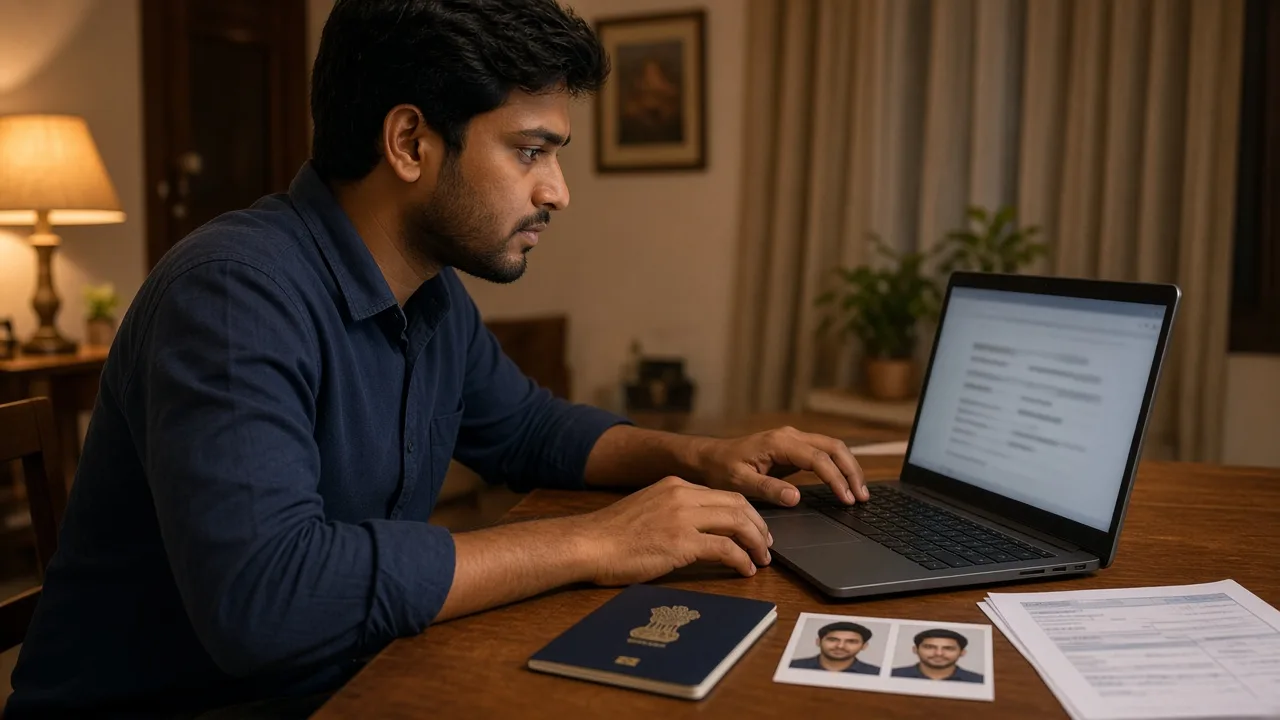
- Go to the China Online Visa Application site, fill in the Visa Application Form of the People's Republic of China online, upload the required documents and submit them for online review. No fee is paid at this step.
- When the online review is approved, you receive an email. Within 30 days of that email, go to the Embassy or Consulate General to submit your passport, application form and other documents, and give fingerprints if required.
- On the expected collection date on your pick-up slip, return to pay the fee and collect the visa.
The online site lets you read guidance, start a new application or continue a saved draft, and track your status or make an appointment for the next step. The Embassy stresses that the form must be accurate and complete, that the phone number and email must belong to the applicant, and that the uploaded photo of your identity document must be clear, free of reflection and complete at the edges, without cropping or photographing a screen.
What General Documents Does Every Applicant Need?
The Embassy lists these general documents for all applicants:
- The Visa Application Form of the People's Republic of China.
- Your passport, valid for more than 6 months with at least 2 blank visa pages, plus a copy of the information page (last page) and any previous passport issued within the past 5 years. If your name differs between passports, add an official name change certificate.
- Two recent colour photos, 48 mm x 33 mm, white background, no head covering, taken within the past 6 months.
- Chinese visas obtained in the past three years, if any.
- For applicants under 18: a birth certificate, the guardian's identity document and a consent letter from the guardian.
- If a third party or travel agency submits for you: the agency's qualification documents and the agent's identity document.
Non-Indian citizens living in India must also show a valid visa or certificate of stay, residence, employment or study in India. The Embassy adds that marriage and birth certificates must be notarised and authenticated, and that a marriage certificate authentication and a certificate of no criminal record may be no more than 6 months old. If the consular officer asks for other documents, provide them promptly.
Documents for a China Tourist (L) Visa
For tourism, the Embassy's category table asks for:
- A travel itinerary.
- Hotel booking and round-trip flight booking.
- Personal savings bank account statements for the most recent 6 months, with a consistent average monthly balance of at least INR 1 lakh, or a personal deposit bank certificate of a similar amount made at least 3 months before the application date. A deposit certificate must be signed and stamped with the bank's official seal.
- An invitation letter from an entity or individual in China and the inviter's identity document, if you have one.
If special circumstances apply, such as the applicant being a minor, you can use a parent's or guardian's bank statement with an authorisation letter signed by the account holder.
The itinerary, hotel and flight details should line up day by day. Our guide to the difference between a flight itinerary, booking and reservation explains what each document is, and our guide to hotel reservation formats embassies accept covers the accommodation side. Some travellers search for a dummy ticket for this; what helps is a real, checkable reservation rather than an edited document.
Documents for Business, Family and Exchange Visits
Business (M) visa
The Embassy sets strict rules for M visas:
- Copies of the inviting Chinese company's business licence (showing its scope of business) and the identity document of the legal representative or inviter must be valid and clear.
- Both copies must carry a handwritten (not printed) endorsement in Chinese stating that the document is only for the visa application of the named applicant, with a handwritten Chinese signature and date.
- The invitation letter must state the purpose of visit, carry a handwritten Chinese signature and be stamped with the company's official seal. Contract seals and personnel seals are not accepted.
- Your cover letter must give a company profile, such as year of establishment and scope of business, and state the specific purpose and exact duration of the trip. General phrases such as "business visit" or "business meetings" might not be accepted.
Family visits (Q2 and S2)
Q2 is for visiting relatives who are Chinese citizens or foreigners with Chinese permanent residence. You need an invitation letter, the inviter's Chinese ID card or foreign passport and permanent residence permit, and proof of family relationship such as a marriage certificate, birth certificate, kinship certificate from the Chinese public security authority, or a notarised kinship certificate. S2 is for short family visits to foreigners working or studying in China, with an invitation letter, the inviter's passport and residence permit, and proof of kinship.
The Embassy defines family members as spouse, parents, parents-in-law, children, children's spouses, brothers and sisters, grandparents and grandchildren.
Exchanges and study tours (F)
F visas cover exchanges, visits, study tours and other non-commercial activities, with an invitation letter from the relevant entity or individual in China.
How Strong Financial Evidence Looks for China
China is unusual in publishing a specific funds figure for Indian tourists. The Embassy asks for personal savings account statements for the last 6 months with a consistent average monthly balance of at least INR 1 lakh, or a deposit certificate of a similar amount made at least 3 months before you apply.
- Use a personal savings account in your own name, not only a current or joint business account.
- "Consistent average" means the balance should hold across the 6 months, not spike just before applying.
- A fixed deposit opened recently will not meet the 3-month rule; the certificate must be bank-signed and sealed.
- For a minor or dependent, use a parent's or guardian's statement with a signed authorisation letter.
- Keep names, addresses and dates consistent with your passport and online form.
For business visas, the cover letter and the inviting company's documents carry more weight; for family visits, the inviter's status and proof of relationship matter most. Our guide on how embassies evaluate travel intent from visa documents explains how officers read these pieces together.
How to Build a China L Visa Itinerary and Bookings
The L visa is the only common category where the Embassy lists a travel itinerary, hotel booking and round-trip flight booking together. Officers compare these with your online form, so treat them as one set rather than three separate papers.
- Itinerary: list each day with the city, the main places you plan to visit and where you sleep that night. Keep it realistic for the number of days.
- Hotel booking: cover every night from arrival to departure, with names matching your passport, and cities matching the itinerary.
- Round-trip flight booking: arrival and departure dates must match the first and last day of the itinerary and the dates on your online form.
- Travelling companions: if family members apply together, use the same itinerary and show each person on the reservations.
- Invitation letter: if a friend or company in China invites you, the dates and places in the letter should match too, and attach the inviter's identity document.
A BookForVisa flight reservation shows a real PNR that can be checked with the airline, costs $15 per person and is for visa applications and onward proof only. It stays valid for 48-72 hours, and date changes are free on the booking day only, so build your itinerary first and order the reservation when you are ready to upload documents online.
How Much Does a China Visa Cost From India?
The Embassy's schedule of fees (2026.10.22) sets these visa fees for Indian passport holders:
| Visa | Fee for Indian passport holders |
|---|---|
| Single entry | Rs2900 |
| Double entry | Rs4400 |
| Six-month multiple entry | Rs5900 |
| 12 months or above multiple entry | Rs8800 |
| Group visa, each applicant | Rs1800 |
Express and urgent service cost extra and apply to all consular services:
| Service | Collection | Extra fee |
|---|---|---|
| Express | Four working days | Rs1800 |
| Urgent (if applicable) | Two working days | Rs2700 |
How to pay
The Embassy and Consulates in India accept only demand drafts; cash, personal cheques and other methods are temporarily not accepted. The draft must be printed by an international or domestic bank in India; handwritten or incomplete drafts are not accepted. Write your full name, pick-up slip number and phone number on the back. Make drafts for the Embassy payable to "CHINESE EMBASSY, NEW DELHI", and for Mumbai to "CONSULATE GENERAL OF THE PEOPLE'S REPUBLIC OF CHINA IN MUMBAI". You pay when you collect the visa.
Applying Through an Agent or for Children
Using a travel agency or third party
The Embassy allows a third party or travel agency to submit documents for you, but the file must then include the agency's qualification documents and the identity document of the person submitting. Even when an agent helps, the phone number and email on the online form must be the applicant's own, so make sure you can receive the online approval email and any requests from the consular officer.
Check that the agent submits within 30 days of the approval email and that the demand draft is printed by a bank with your name, pick-up slip number and phone number on the back. You remain responsible for the accuracy of everything in the form.
Children under 18
Each child needs a separate application. Besides the general documents, the Embassy asks for the child's birth certificate, the guardian's identity document and a consent letter from the guardian. For L visas, a child can rely on a parent's or guardian's bank statement with an authorisation letter signed by the account holder. Children under 14 are exempt from fingerprint collection.
People who are not Indian citizens
Foreign nationals living in India apply at the same missions by consular district, and add a valid visa or certificate of stay, residence, employment or study in India. Their fees may differ from the Indian passport rates in this guide, so check the Embassy fee schedule for their nationality.
Fingerprints and Personal Appearance
The Embassy says that until 31 December 2026, fingerprint collection is exempted for all short-term visa applicants staying no more than 180 days. Applicants for stays over 180 days, for D, J1, Q1, S1, X1 and Z visas that require a residence permit after entry, and for multiple-entry visas should, in principle, give fingerprints at the Embassy or Consulate General.
Fingerprints are also exempted for:
- People under 14 or over 70.
- Holders of diplomatic passports or those eligible for diplomatic, official or courtesy visas.
- People who gave fingerprints at the same Chinese embassy, consulate general or visa application service center with the same passport within five years.
- People whose fingerprints cannot be collected.
Whether or not you give fingerprints, you still submit your passport and documents in person within 30 days of the online approval email, unless a third party or travel agency submits with the documents the Embassy requires.
How Long Does a China Visa Take From India?
Processing time is counted from the day after you submit your passport:
- Regular: 7 working days.
- Express: 4 working days, Rs1800 extra.
- Urgent: 2 working days where applicable, Rs2700 extra.
Add the time for online review before that, and the 30-day window to submit after approval. Plan around Chinese public holidays, when the consular office may close, and around Indian holidays. Avoid paying for fares before the visa is issued; reservations with a real PNR let you show the round-trip booking the L visa category asks for, and they stay valid for 48-72 hours, so order them close to the online upload.
Do Indians Need a Visa for Transit Through China?
The Embassy lists situations where no visa is needed:
- Holding a valid Chinese permanent residence permit or other valid residence permit.
- Holding a valid APEC Business Travel Card (not a virtual card).
- Transiting through China by international air, sea or rail to a third country or region with connecting tickets, staying no more than 24 hours without leaving the designated port area.
- Travel covered by a mutual visa exemption agreement.
- 240-hour visa-free transit, regional visa exemption and other visa-free situations.
Eligibility for 240-hour visa-free transit depends on nationality, route and port, and the Embassy lists it only as a category. Check the current conditions with Chinese immigration before relying on it. If you leave the transit area beyond these rules, you need a G or other visa, and the G category asks for an onward ticket with a confirmed date and seat to your destination.
What Happens After Your China Visa Decision?
On the collection date shown on your pick-up slip, return to the Embassy or Consulate General during collection hours, pay the fee by demand draft and collect your passport with the visa. Check the visa type, number of entries, validity dates and duration of each stay before you leave the counter.
If the consular officer asks for more documents during processing, provide them promptly, as the Embassy notice requires. The Embassy's notices do not list reasons for refusal, so make sure your file meets the published category requirements: complete and accurate forms, documents that match, a clear purpose and, for tourists, the INR 1 lakh average balance or a qualifying deposit certificate.
What Are Common Mistakes in China Visa Applications From India?
- Going to the wrong mission for your state, or to a service centre instead of the Embassy or Consulate General after 26 October 2026.
- Using a phone number or email that is not the applicant's own.
- Uploading cropped, glared or screen-photographed passport images.
- Missing the 30-day window to submit in person after the online approval email.
- Bank statements that do not show a consistent INR 1 lakh average, or a deposit made less than 3 months before applying.
- Business invitations without the handwritten Chinese endorsement, signature or official company seal.
- Vague cover letters that only say "business visit" or "business meetings".
- Bringing cash or a handwritten demand draft to pay the fee.
- Passports with under 6 months of validity or fewer than 2 blank visa pages.
Planning Checklist and Timeline
- 6 to 8 weeks before travel: confirm the visa category, check passport validity and blank pages, and gather previous passports from the last 5 years.
- 4 to 6 weeks before: print 6 months of savings statements (or the deposit certificate), get two 48 mm x 33 mm photos, and collect any invitation letter and inviter ID.
- Same week: build your day-by-day itinerary and get hotel and round-trip flight reservations that match it.
- Online: complete the form on the China Online Visa Application site, upload documents and wait for the approval email.
- Within 30 days of approval: submit your passport and documents in person at the Embassy or Consulate General during application hours.
- Collection date: bring a bank-printed demand draft for the fee, collect your passport and check the visa details.
Keep copies of everything you uploaded online, because the Embassy expects the paper set you submit in person to match the reviewed file. If anything changes between the online approval and your visit, such as travel dates or hotels, update your reservations so that the bookings, itinerary and form still agree. Before collection, check the Embassy website for holiday closures and any new notices, since the move to direct acceptance in October 2026 shows that procedures in India can change at short notice.
What Do Real China Visa Applications From India Look Like?
Example 1: family from Delhi, Beijing and Shanghai holiday
Vikram, 45, Anita, 43, and their son Aarav, 15, plan 9 days in Beijing and Shanghai. They file three L visa applications online, upload a day-by-day itinerary, hotel reservations and a round-trip flight reservation with a real PNR, and Vikram's and Anita's savings statements showing a steady balance above INR 1 lakh. For Aarav, they add his birth certificate, a guardian consent letter and Vikram's statement with an authorisation letter. They submit at the Embassy in New Delhi and pay Rs2900 each by demand draft at collection.
Example 2: importer from Pune meeting a supplier
Priya, 38, applies for an M visa at the Consulate General in Mumbai, which covers Maharashtra. She has an invitation letter from a supplier in Guangzhou, a copy of the supplier's business licence with a handwritten Chinese endorsement, and a cover letter giving her company's year of establishment, scope of business, exact dates and purpose.
Example 3: parents from Bengaluru visiting their daughter in Shenzhen
Ravi, 64, and Kamala, 60, visit their daughter, who works in Shenzhen on a residence permit. They apply in Mumbai for S2 visas with her invitation letter, copies of her passport and residence permit, and their notarised and authenticated birth certificate for her. For a single-entry trip of under 180 days, they are exempt from fingerprints until 31 December 2026, but still submit in person within 30 days of online approval.
Ready to upload your China visa documents? Get a flight or hotel reservation with a real PNR for $15 per person, matched to your itinerary, and it can be issued even while you are at the Embassy counter.
Book your visa reservationFrequently Asked Questions
How do I apply for a China visa from India?
Fill in the visa form on the China Online Visa Application site and upload your documents for online review, which is free. After the approval email, submit your passport and documents in person within 30 days at the Chinese Embassy in New Delhi or Consulate General in Mumbai, then return to pay and collect the visa.
How much is the China visa fee for Indians?
The Embassy's 22 October 2026 fee schedule sets Rs2900 for single entry, Rs4400 for double entry, Rs5900 for six-month multiple entry and Rs8800 for 12 months or above multiple entry. Express service adds Rs1800 and urgent service adds Rs2700. Pay only by a bank-printed demand draft when you collect the visa.
Where do I submit a China visa application in India?
From 26 October 2026, the Chinese Embassy in New Delhi and the Consulate General in Mumbai accept applications directly. Residents of Maharashtra and Karnataka go to Mumbai. All other states, including the Kolkata district states of Bihar, Jharkhand, Odisha, Chhattisgarh and West Bengal, temporarily go to the Embassy in New Delhi.
How much bank balance is needed for a China tourist visa?
The Embassy asks L visa applicants for personal savings account statements for the last 6 months with a consistent average monthly balance of at least INR 1 lakh. Alternatively, show a bank-signed and sealed deposit certificate of a similar amount made at least 3 months before applying. Minors can use a parent's statement with authorisation.
Do I need a flight booking for a China tourist visa?
Yes. For the L visa, the Embassy asks for a travel itinerary plus hotel and round-trip flight booking. A BookForVisa reservation carries a real PNR, costs $15 per person, stays valid 48-72 hours and allows free date changes on the booking day only, so order it close to your online document upload.
How long does a China visa take from India?
Regular processing takes 7 working days, express takes 4 working days for an extra Rs1800, and urgent takes 2 working days where applicable for an extra Rs2700. Add time for the online review before you submit your passport, and allow for Chinese and Indian public holidays when the consular office may close.
Do Indians need fingerprints for a China visa?
Until 31 December 2026, short-term applicants staying no more than 180 days are exempt. Multiple-entry visas and stays over 180 days require fingerprints in principle. People under 14 or over 70, and those fingerprinted at the same mission with the same passport within five years, are also exempt from fingerprint collection.
Friendly reminder: BookForVisa prepares flight and hotel reservations to support visa applications and onward-travel proof. Requirements vary by destination, consulate, visa category and applicant situation. A reservation supports your file; it is not a paid ticket for travel and does not guarantee visa approval or entry.