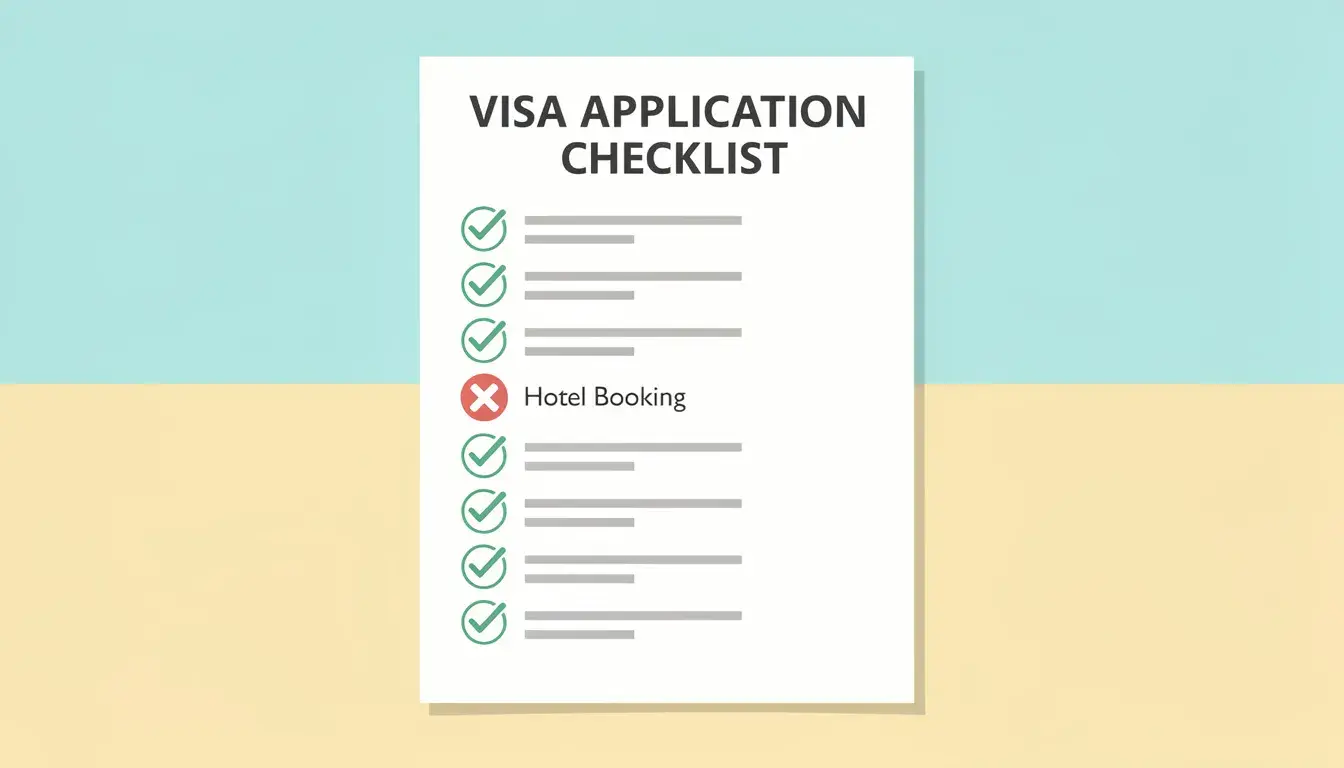
“Without a hotel booking” does not always mean “without accommodation proof.” The practical question is what the responsible embassy, consulate or immigration authority accepts for the intended stay: a hotel confirmation, a host document, institution-arranged lodging, a rental agreement, proof of funds for accommodation, or no booking evidence at all.
This guide separates those possibilities, then shows how to build one consistent accommodation narrative across the form, cover letter, itinerary, funding evidence and any follow-up response. It also explains when partial bookings create an avoidable gap and when a change after submission should be reported.
Do Official Visa Rules Always Require a Hotel Booking?
No. The required evidence depends on the visa system and the application channel. The European Commission’s current Schengen application guidance lists evidence of accommodation among the supporting documents. It does not state that every applicant must use a hotel: destination-specific rules may allow private accommodation, sponsorship or another appropriate document.
A hotel reservation is one form of accommodation evidence, but it is not the only form in every checklist. For example, the German missions in India family-and-friends checklist lists hotel, holiday-home or campus reservations and, for a stay with family or friends, host evidence of sponsorship or private accommodation. This is a Germany-specific example, not a universal exemption from hotel proof. Follow the accommodation and invitation requirements for your destination, purpose and filing location.
The UK takes a different approach. Current UK Standard Visitor supporting-document guidance focuses on genuine-visitor status, purpose, funds and return intent, and lists hotel bookings among documents considered less useful. If a sponsor provides accommodation, the guidance instead asks for evidence of the support, relationship, funds and the sponsor’s lawful UK status where applicable.
| Application situation | Likely accommodation approach | Main caution |
|---|---|---|
| Schengen tourism | Hotel reservation or another form accepted by the destination checklist | Coverage and format can be consulate-specific |
| Staying with a Schengen host | Invitation, sponsorship or private-accommodation form where required | A casual letter may not replace an official local form |
| UK Standard Visitor | Explain the stay and sponsor support where relevant; hotel bookings are not strong evidence by themselves | The applicant must still establish purpose, funds and genuine-visitor requirements |
| Program or employer housing | Institution or employer letter stating address, dates and responsibility | Use only when the visa checklist accepts it |
Accommodation proof and transport proof answer different questions. If the visa channel also requests travel evidence, the complete flight-reservation planning framework explains when to use a reservation, how to time it and how to align it with the rest of the file. This article remains focused on whether a hotel booking is needed and what can replace it.
When You Can Skip A Hotel Booking And Still Look Credible

You may be able to apply without a hotel reservation when the applicable checklist accepts another form of accommodation evidence. The file should still identify where you intend to stay and provide the dates, address and responsible person or organization requested by that application channel.
If You’re Staying With A Host, A Booking Is Often The Wrong Document Anyway
When you stay with a friend, partner, or relative, a hotel booking can look like noise. It can even create contradictions if your form lists a residential address, but you submit hotel PDFs “just in case.”
Here, we focus on building a host stay that reads like a real plan, not a favor you invented for the application.
Your host evidence needs to do three jobs at once:
- Fix the address you will actually use during the stay
- Prove the host is real and reachable
- Make the relationship believable without oversharing
A clean host pack usually includes:
- A short invitation letter with the full address, contact details, and exact dates you will stay there
- A proof the host can be linked to that address (residence proof, lease, or a local registration style document, depending on the country)
- One simple relationship link if your case needs it (for example, a shared surname, prior visit proof, or a brief explanation that matches your history)
Avoid writing a novel. The useful evidence is the verifiable address, host connection and matching timeline; extensive personal history is usually unnecessary unless requested.
A host arrangement becomes incomplete when its dates do not cover the claimed stay. If your trip is 12 nights, but the invitation covers only seven, you create a gap that you then have to explain. If your itinerary shows you moving cities, but the host letter claims you will stay at the same address the whole time, the documents present competing versions of the trip.
For a Short or Single-City Trip, Use One Clear Base Address
A three-to-seven-day trip with one base city is the easiest version of “no hotel booking.” It is not because the rules are looser. It is because the story is easier to check.
You want your file to read like this:
- You arrive in one city
- You stay at one address
- Your daily plan fits that base
- Your departure matches that same timeline
If you have not booked accommodation yet, pick the most realistic base and make it consistent across the file. For example, if you will attend meetings in central Paris, but your address is in a far suburb with no explanation, that is a credibility problem even if you had a booking.
Also, align the lodging story with your finances. A host stay paired with a modest daily budget often looks coherent. A “no hotel booking” claim paired with luxury spend patterns can raise questions about what you are actually planning to do on the ground.
A practical move is to keep your plan tight, not vague. Write one clear line in your cover letter that matches the form entry, such as staying with a host at a specific address for the full stay, or securing accommodation after confirmation of final meeting dates. Keep it short and consistent.
When Only Part Of The Stay Is Unbooked, You Can Sometimes Submit With “Anchors”
Many real trips have a fixed start and a flexible middle. That can work in a visa file if you anchor the parts that prove you have a legitimate base.
Anchors are simple. They are the pieces that make the trip verifiable, even if you have not confirmed every night.
Strong anchors include:
- First nights in the arrival city that match your entry date
- A fixed-location commitment, such as a conference schedule or training address
- A return-to-base pattern where day trips start and end in the same city
What you should avoid is submitting a multi-city plan with no lodging evidence anywhere. A five-city route with “to be decided” in every location reads like an itinerary you can’t defend.
A safer approach is to show two to four nights booked at the start, then explain the remainder as flexible but bounded. Bounded means you still name the base city and keep dates stable. The application should show a bounded plan rather than an undefined intention to decide later.
When Your Lodging Is Tied To A Program, Booking Proof Can Be Replaced By Program Proof
Some visa trips are built around a program, not a hotel. Think of an academic workshop, an organized tour with accommodation included, or employer-arranged lodging.
In those cases, your strongest document is often the program proof that already contains accommodation details. What matters is that the program document clearly states:
- Where you will stay or where you will be based
- For which dates
- Who is responsible for arranging or paying
If the letter does not state an address, you still need a clean way to fill the form fields. Use the program’s accommodation address if it exists, or a confirmed base that matches the program location. Do not leave a required address field blank. Application forms often require specific accommodation details.
One common mistake is mixing signals. Applicants submit a program letter, then add random hotel holds in a different neighborhood because they feel underprepared. That creates a second story and increases scrutiny.
If your appointment is in New Delhi and your file is otherwise strong, a host-stay plan can work well, but only when your form address, host letter, and dates align exactly.
Situations That Look “Booking-Free” But Usually Still Need Accommodation Proof
Some trips can survive without a hotel booking. Others almost always need at least one strong lodging document.
Expect more friction when:
- Your trip is long enough that “we will decide later” sounds unrealistic
- Your itinerary moves across multiple cities with internal transport gaps
- Your entry city and claimed base city do not match
- Your lodging plan depends on people you cannot credibly link to an address
- Your timeline is tight, and your application leaves too many blanks
Schengen applicants should treat the destination consulate’s list as the controlling source because private-host forms, sponsorship procedures and coverage expectations vary. The Schengen flight-reservation requirements guide owns the separate entry, exit, main-destination and transport-proof analysis. Here, the narrower task is ensuring that accommodation evidence covers the stay and supports the same city sequence.
What Consulates Are Really Checking When There’s No Hotel Reservation

Without a hotel confirmation, the remaining evidence must still cover the required nights and make the accommodation arrangement checkable.
The Core Question Is Verifiability, Not Comfort
The relevant documents should identify the place of stay and connect the address to a host, property or institution when the checklist calls for that proof.
Verifiability usually comes from at least one of these anchors:
- A fixed address tied to a real person or institution
- A confirmed first base that matches your arrival date
- A program or sponsor document that clearly states accommodation arrangements
- A rental or housing agreement that reads like a real stay, not a placeholder
Notice what is not on that list. Hotel branding, star rating, and “fancy” confirmations do not matter on their own. A simple address that matches everything else often beats a polished PDF that conflicts with your itinerary.
A practical way to think about it is this. The accommodation evidence should answer three questions without relying on assumptions:
- Where will you be based on Day 1
- Where will you be based on the majority of nights
- Who can confirm that arrangement if asked
The Application Form Forces Specificity, And That’s Where Most Problems Start
Visa forms are built for certainty. They ask for an address, a phone number, and dates. Many applicants try to keep options open, then enter vague details that do not survive scrutiny.
We see three common failure points in lodging fields:
1) The Address Is “Generic” Instead Of Specific
A city name without a street. A street without a unit or neighborhood. A host name without any link to the address. The form ends up looking like you avoided the question.
2) The Address Is Specific, But The File Disagrees
Your cover letter says you will stay in Osaka, but the form lists Tokyo. Your itinerary shows three cities, but the lodging field lists one address for the entire trip with no explanation.
3) The Dates Do Not Behave Like A Real Stay
Your trip dates are 10 to 20, but the lodging dates in the form show 12 to 18. The submitted dates contain an unresolved mismatch.
If your lodging plan is not fully booked yet, pick a structure you can defend. That might be a host address for the full stay, or a first base with a clear statement that the rest will remain in the same city. What matters is that the file does not contain competing versions.
A strong form strategy is to treat the lodging field like a contract with your own file. Once you enter an address, every other document must behave as if that is your base.
Cross-Document Consistency Checks
Accommodation details can be compared with the form, itinerary, funding evidence and other supporting documents.
Here are the checks that often surface issues when lodging is missing or flexible:
- Entry Point Versus Lodging City: If you land in one city but claim you will stay primarily in another, your transit plan must be clear and plausible.
- City Order Versus Daily Plan: A day-by-day itinerary that jumps between cities without travel time looks invented fast.
- Funding Versus Lodging Type: A host stay paired with funds that barely cover food and transit can look tight. A claimed “luxury” stay with modest funds looks unstable.
- Companions Versus Space: If you mention traveling with family, but your lodging plan is a single-room arrangement with no explanation, it can trigger questions.
- Duration Versus Proof Strength: Longer stays generally require stronger evidence covering the required nights under the applicable checklist.
This is why “we will book later” becomes risky. It is not the sentence itself. It is the chain reaction it causes across date fields, city sequencing, and budgets.
What Makes A “No Booking” Schengen Visa File Look Invented
Here, we focus on the patterns that suggest the lodging story was created for the application.
These are the red flags that show up repeatedly:
- A host invitation that uses a different spelling of the address than your form
- A rental document with no dates, no address details, or no named occupant
- An itinerary that mentions sightseeing in one city while your base is far away, with no explanation
- A cover letter that claims flexibility but then lists fixed city-to-city travel like a tour schedule
- A lodging address that looks copied, such as missing unit numbers, in a city where units are standard
- A timeline that has “gaps” where no one knows where you sleep for several nights
Also, watch for a subtle issue. Applicants sometimes submit multiple accommodation ideas at once. A host letter, plus two hotel holds in different neighborhoods, plus a “maybe we will decide later” note. That is not flexibility. That is three competing narratives.
If your plan is uncertain, show one coherent plan. Keep it realistic. Keep it consistent.
The Clean Substitute Evidence Ladder (From Strongest To Weakest)
Not all alternatives to hotel bookings carry the same weight. The best substitutes share a simple trait. They can be checked without calling you.
Here is a practical ladder you can use when deciding what to submit:
Strongest Options
- Host invitation with full address and dates, plus a credible link between the host and the address
- Official program or employer letter that states accommodation is arranged, with location details
Solid Options
- First-night or first-few-nights confirmation in your arrival city, with the rest of the plan staying in that same city
- A rental or serviced apartment agreement that clearly shows the address, dates, and the name of the person staying
Riskier Options
- Vague statements without an address, without dates, or without a verifiable contact
- Multiple conflicting accommodation proofs that do not match each other
Practical Document Paths If You Don’t Have A Confirmed Hotel Yet

Most problems happen when you try to apply for a visa without a hotel booking, and you patch the gap with documents that do not match each other. The objective is one accommodation record that is complete and internally consistent.
Path A — Staying With Friends Or Family: Build A Verifiable Host Pack
For a Schengen visa, a host stay may satisfy the accommodation requirement when it follows the destination state’s invitation or private-accommodation rules. The embassy is not guessing where you will sleep. You are making it obvious.
Keep the host pack tight, and make it read like a real visit:
- Host letter with full address, phone, and your exact travel dates
- Prove your host is linked to that address in the destination country
- One simple link that explains the relationship without dumping personal history
- A short note from you that ties the lodging to your tourist visa plan and entry city
The key is that all the details align. If the host letter says you will stay in Lyon, do not present an itinerary that spends most nights in Paris. If your visa application form requires a contact, do not list a different person than the one who signed the host letter.
If you are using a travel agent for the rest of your file, ask them to keep the host address identical across every form field, so the submitted address remains identical across the file.
Path B — Only Some Nights Are Uncertain: Use “Anchored Nights” Without Overbooking
A partial plan should be used only when the responsible consulate’s checklist permits it and the fixed portions cover the required accommodation evidence. This works best when you can show a first base that matches your arrival and your schedule.
A practical approach for a Schengen visa application is to anchor the parts that prove you have a real starting point:
- First 2 to 4 nights in your arrival city with a booking confirmation
- A clear day plan that returns to the same base for most nights
- A statement that the remaining nights will be finalized after meeting confirmations or event scheduling
Do not spread anchors across multiple cities unless you can show the transport logic. If your file shows Amsterdam, Brussels, and Paris in one week but offers no nights that connect to those stops, the route remains unsupported by the accommodation record.
If you also attach flight tickets, make sure your arrival city matches your first anchored property. A mismatch between a landing airport and the first-night address is one of the fastest ways to trigger follow-up questions.
Path C — Rental Or Serviced Apartment: Make It Look Like Housing, Not A Screenshot
For visas that require a full stay address, like some long-stay visitor files or certain study-related entries, a rental agreement can work if it reads like a real housing arrangement. Here, we focus on making the document usable for verification.
Your rental evidence should include:
- Full address and dates of occupancy
- The name of the person staying and the host or property owner's name
- Any required sign or acceptance indicator that shows it was actually issued to you
- Terms that make sense for your duration, not a vague “open-ended” note
Avoid low-credibility prints that look edited or incomplete. If the document does not show who is staying there, it will not function as proof of accommodation.
Also, keep the financing story consistent. If you claim a premium apartment but your bank balance suggests you can barely afford daily costs, you create a credibility gap that has nothing to do with the format of the document.
A hotel confirmation cannot substitute for requested transport evidence, and a flight itinerary cannot prove where each night will be spent. For the foundational meaning, fields and practical role of flight evidence, the core flight-reservation guide covers that separate document. Use it only when the applicable checklist asks for travel arrangements, then match its arrival and departure dates to the accommodation record.
Path D — If You Choose a Temporary Reservation, Check the Evidence Fields
For many applicants, temporary reservations are the most practical bridge between uncertainty and basic requirements. The goal is not to look luxurious. The goal is to show a reservation that can be checked, with dates and names that match the rest of your file.
You will usually see three types of holds in the market:
- Prepaid but refundable bookings with clear cancellation terms
- Pay-later holds that still generate hotel booking confirmations
- Book-now, confirm-later structures from travel companies that issue a document with a reference
Whichever you use, check the minimum fields before you pay. Your booking confirmation should show the property address, guest name, check-in and check-out, and the policy line on cancellation.
If your case includes a flight itinerary, keep it consistent with the hotel dates. If the case also includes a flight itinerary, its arrival date should align with the first night of accommodation shown in the file.
What To Write In Your Cover Letter When You Have No Hotel Booking
For a Schengen consulate, your letter should be short and structured. You are not persuading. You are clarifying.
Include these points in plain language:
- Where will you stay first, and where will you be based after that
- Why are some nights not locked in advance, without sounding hesitant
- A clear explanation of what remains provisional and when it will be finalized
- A line that your passport details match all reservations and supporting documents
- A note that your plan fits your money available and your ties to your home country
If you are applying first time, avoid dramatic statements like you will “risk losing everything” if the visa is not granted. Such language does not establish the required accommodation facts.
Risk Management: If Your Accommodation Changes After You Apply

Plans move. Meetings shift. A host situation changes. The risk is not the change itself. The risk is creating a paper trail that no longer matches what you already submitted to the embassy.
Before Submission: Run A 10-Minute Consistency Audit
Here, we focus on catching contradictions before they become a case note. Do this once, right before you upload or hand over your packet, especially if you apply for a visa without hotel booking or you only have partial hotel booking confirmations.
Use this audit as a final pass:
- Dates: Your travel dates must match across your form, cover letter, and any booking confirmation you submit.
- Address: The address you enter should match character-for-character across every place it appears.
- City Logic: Your itinerary should not spend most nights away from the address you listed as your main stay.
- Contacts: If you list a host contact, the same name should appear on the host letter and any supporting proof.
- Funding Fit: Your bank statements should support the type of stay you claim, whether that is a host stay, rental, or hotel reservation.
- Uploaded Files: Check that each PDF is readable and not cropped where the name, dates, or address appear.
If you are submitting several documents online, label them in a way that makes the story obvious at a glance. For example, “Accommodation Address And Dates” is clearer than “Document 7.”
Also, check your fallback plan. If a hotel cancels or a host becomes unavailable, decide now what you will switch to and whether that switch stays in the same city and date window.
After Submission: What Changes Usually Don’t Matter, And What Can Create Trouble
Once your visa application is submitted, changes fall into two buckets. Some changes keep your story intact. Others change core facts in the submitted application.
Changes that may leave the core itinerary intact, subject to the application channel’s update rules:
- Switching to a different property in the same city with the same check-in and check-out
- Changing room type while the address and dates stay the same
- Moving from one hotel to another nearby because of availability, while keeping your itinerary stable
Changes that materially alter the submitted accommodation narrative:
- Shifting your main base city, especially if your form lists a specific address
- Extending or shortening the trip in a way that changes the number of nights you need to explain
- Switching from a host stay to unknown lodging with no verifiable replacement
- Adding internal travel that breaks the original city order
For a Schengen visa application, this matters because many consulates treat accommodation as part of your intended route inside the Schengen area. If your route changes across borders, the logic of where you apply and what you submit can also change.
If you used a flight reservation to show entry and exit, keep it aligned with your stay plan. A date change that moves your arrival earlier than your first-night accommodation can trigger questions if the embassy reviews your file again.
If You’re Asked For Additional Documents, Respond Like A Verifier, Not A Storyteller
A follow-up request is not an argument to win. It is a verification step. Your goal is to answer the exact question with clear evidence.
Start by identifying what they are really asking:
- Do they want a full hotel reservation for the entire stay, or a clearer address for your base?
- Do they want a corrected booking confirmation because the dates do not match?
- Do they want proof that your host can legally accommodate you?
Then respond with a simple package:
- One updated accommodation document that solves the gap
- One short explanation that states what changed and what stayed the same
- Matching updates in any form fields you are allowed to correct, if the process supports it
Avoid adding new details that were not requested. If they ask for accommodation, do not suddenly attach extra travel plans, new companions, or unrelated financial notes. That creates new angles to review.
If your clarification includes a new flight reservation, keep it consistent with the original trip purpose and timeline. Treat the new document like a replacement part that fits the same machine, not a new machine.
Border-Control Reality: Your Visa Approval Isn’t The Only Check
Even when you are approved, arrival questions can still happen. Border authorities may ask for the accommodation address or supporting evidence as part of entry checks.
You should be able to present:
- A specific address for the first night
- A host contact or property contact number
- A clear explanation of where you will be based for the majority of the trip
If you booked accommodation late, keep your confirmation accessible. If you are staying with a host, keep the host letter and address details available offline in case you do not have data when you land.
Also consider routing. A short layover, a last-minute change, or an airline schedule shift can change your arrival time. Make sure your check-in date and timing still make sense. If you land after midnight, your accommodation should reflect that reality.
The One Risk You Should Never Take
Here, we focus on what can damage credibility in a way that is hard to fix later. Do not submit an address you cannot stand behind.
That includes:
- A made-up stay location was entered to satisfy a form field
- A hotel reservation you cannot explain if asked basic questions about it
- A host address that the host cannot confirm if contacted
- A file where accommodation and flight reservation dates conflict in an obvious way
If you need flexibility, build flexibility honestly. Use a real base city, realistic dates, and verifiable details. A consistent plan that can be checked is safer than a perfect-looking packet that collapses under one question.
How To Submit A Booking-Free File Without Creating Doubts
For a Schengen visa application, the issue is rarely “no hotel.” It is whether your stay is verifiable. When you apply for a visa without a hotel booking, keep one clear base address, match it across your visa application form and support packet, and make your travel dates behave like a real trip inside the Schengen Area. That consistency is what keeps the embassy moving forward without extra questions.
Now, take 10 minutes to recheck your booking confirmation or host documents, your flight reservation dates, and the exact address you entered online, then submit several documents only if they all tell the same story.
Frequently Asked Questions
Can I apply for a visa without a hotel booking?
Sometimes. The answer depends on the visa category and the checklist for the authority handling the application. You may need alternative accommodation evidence even when a hotel reservation is not required.
Can I apply for a Schengen visa without a hotel reservation?
Schengen applications generally require evidence of accommodation. A host invitation, sponsorship document, private-accommodation form or other accepted evidence may replace a hotel reservation under the destination state’s rules.
Do UK visitor visa applicants need hotel bookings?
UK supporting-document guidance lists hotel bookings as relatively weak evidence. Applicants should focus on the genuine-visitor requirements and document sponsor-provided accommodation when relevant.
What can replace a hotel booking in a visa application?
Depending on the checklist, alternatives may include a host invitation, an official private-accommodation form, a sponsor letter, a rental agreement, or a program or employer letter that states the address and dates.
Can I submit bookings for only the first few nights?
Only when the responsible authority permits partial accommodation evidence. A partial booking can leave unexplained nights, so verify the checklist before relying on an anchored-first-night strategy.
Should accommodation dates match the flight itinerary?
Yes. When both documents are submitted, arrival, departure and city sequence should be consistent. An overnight flight or post-midnight arrival should be explained by the actual local dates.
What if my hotel changes after I submit the visa application?
Follow the application channel’s update instructions. A same-city replacement on the same dates may leave the trip logic intact, while a new city, changed duration or uncovered nights can materially alter the submitted plan.
Can I use a fabricated hotel confirmation temporarily?
No. Do not invent an address, edit a confirmation or submit a booking that cannot be supported. Use genuine evidence permitted by the responsible authority or wait until you can document a defensible plan.
Friendly reminder: BookForVisa provides travel-proof documents for planning and visa-application support. Requirements vary by destination, consulate, visa category and applicant situation. A flight reservation can support a file, but it does not guarantee approval, boarding or entry.