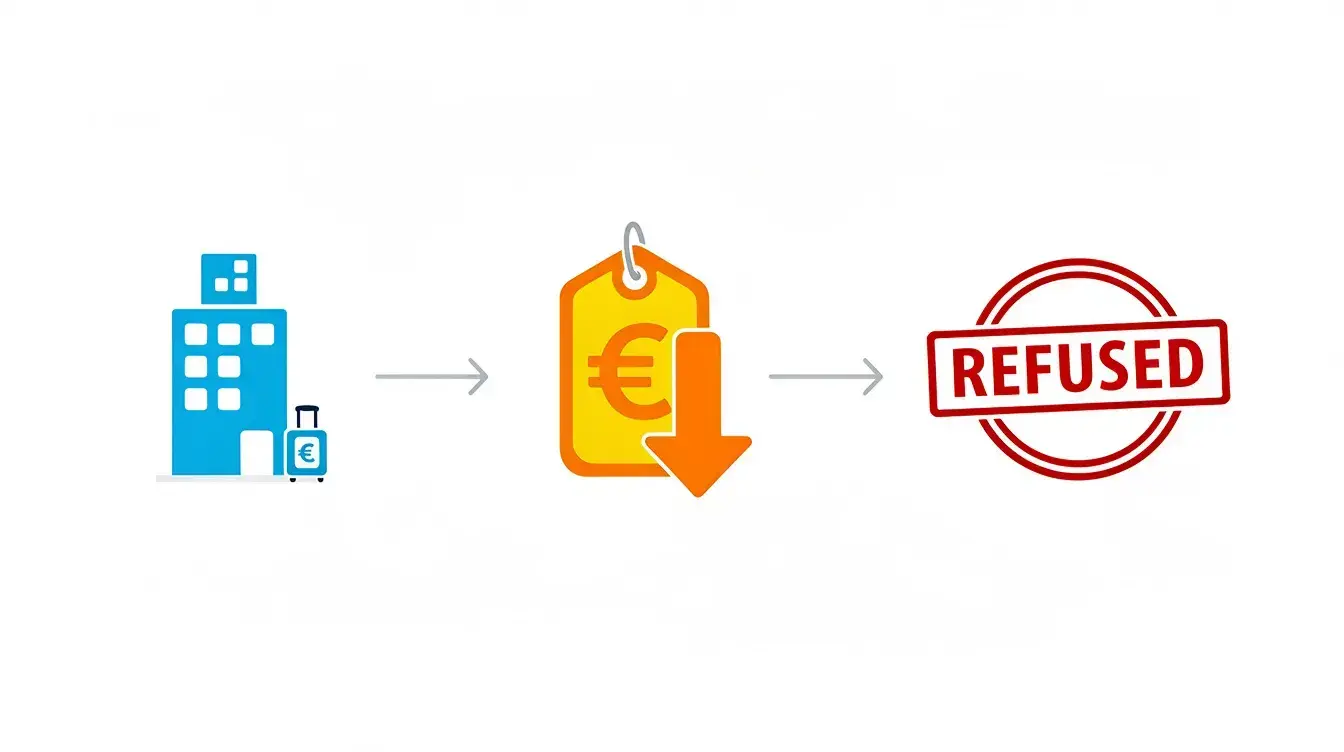
A signed lease can look official, but visa officers do not review it like a landlord or property lawyer. They scan it as accommodation proof. That means the strongest version is not the longest contract; it is the version that makes the address, tenant name, stay window and verification path obvious in seconds.
If the rental agreement has open-ended dates, belongs to a sponsor, starts after arrival, or covers only part of the trip, the fix is usually a targeted support document — not rewriting the lease, not over-explaining, and not forcing the wrong proof into the file.
Key facts before using a rental agreement for visa proof:
- A lease is strongest when the applicant name, address, dates and landlord details are easy to verify.
- Short-stay tourist files often need hotel-style proof for each night, not only a long lease.
- Open-ended or monthly leases should be explained with intended stay dates in the cover letter.
- If the lease is not in your name, add a host, sponsor, employer or named-tenant confirmation.
- Do not alter a lease to fit visa dates; support unclear wording with a separate document.
Need your accommodation proof and travel dates to read as one clean file? Prepare your BookForVisa travel proof with route, date, passenger and booking details aligned before submission.
Prepare Booking for VisaIn This Guide
- Official-source check
- Why lease proof and visa checklists differ
- When a rental agreement helps or hurts
- Date-matching problems
- When the lease is not in your name
- Documents to pair with a rental agreement
- Country-specific accommodation realities
- Remote-work and long-stay files
- Rental-agreement rejection triggers
- Submit as-is, support it, or replace it
- Final visa-file checklist
- FAQ
Official-source check: The European Commission’s Schengen visa guidance says applicants may need supporting documents for purpose of stay, accommodation during the stay, financial means and intention to return, and that consulates may request additional documents. GOV.UK says Standard Visitor applicants provide information such as planned travel dates and where they will stay, and must provide documents that show eligibility when applying. Practical takeaway: a rental agreement can support accommodation proof, but it should be checked against the visa category, destination rules, travel dates, flight reservation, financial proof and any cover-letter explanation. Sources: European Commission Schengen visa guidance and GOV.UK Standard Visitor visa guidance.
Reviewed for: rental-agreement date coverage, tenant-name alignment, accommodation-proof wording, lease-support documents, short-stay versus long-stay intent, flight-reservation consistency, dummy-ticket terminology clarity and official-source alignment.
Your signed lease proves you have a place to live. It doesn't always prove what a visa officer needs to see: exact dates, your name on the document, and a clear line between rental terms and travel dates. That gap trips up long-stay applicants more than any other document mismatch.
A lease built for a landlord rarely translates cleanly into proof an embassy accepts at face value. Dates run open-ended, agreements list a sponsor's name instead of yours, or coverage stops short of your actual travel window. Before you submit that agreement as is, you need to know exactly where it holds up and where it needs backup. If the accommodation gap is only a night or two, solve it with hotel, host or landlord proof; if the separate issue is travel proof, a dummy ticket for visa belongs on DummyFlights rather than inside a BookForVisa accommodation file.
Why A Landlord's Contract And A Consulate's Checklist Aren't Speaking The Same Language

A rental agreement and a visa application form were written for two completely different readers. A landlord's lawyer drafted one to protect rent payments and property rights. A consulate designed the other to answer one narrow question: where will you sleep, on which nights, and can that be checked? When you hand a caseworker your lease expecting it to answer their question, you're often handing them a document that was never built to.
What A Rental Agreement Is Legally Designed To Prove
A lease exists to protect two parties in a financial and legal relationship, not to satisfy a visa officer.
Its core job is to establish:
-
Who is responsible for paying rent, and how much
-
How long the tenancy legally runs, including renewal or exit terms
-
What happens if either party breaches the agreement
-
Who holds liability for damage, maintenance, or early termination
Notice what's missing from that list. Nowhere does a standard lease state "the tenant will physically occupy this address on these specific calendar dates." That's not an oversight. It's simply not the lease's job. A landlord in Toronto or Berlin doesn't care whether their tenant is present every night; they care that rent clears on the first of the month. A visa officer reviewing an application for a work permit or long-stay visa cares about exactly the opposite.
This mismatch becomes obvious the moment someone tries to use a 12-month tenancy contract to answer a question that was really asking, "prove you have somewhere to stay for the 45 days you're requesting."
What A Visa Officer Is Actually Scanning For
Caseworkers move through hundreds of files a week. They're not reading your lease line by line looking for legal nuance. They're scanning for three fast answers:
-
Do the dates on this document match the dates on the itinerary? If your travel dates say June 3 to June 20 and the lease says nothing about June at all, that's a gap they have to fill in manually, which slows down or jeopardizes your file.
-
Is there a real, contactable party behind this document? A phone number, an email, a name they could theoretically verify if they chose to.
-
Does this look like something an applicant fabricated hours before submission, or a real, ongoing arrangement?
A lease can satisfy all three of those questions well. Plenty do. But it wasn't drafted with that scan in mind, which means applicants often submit leases missing exactly the detail the officer is looking for, even when everything else about the tenancy is completely legitimate.
Take an applicant named Sarah Mitchell relocating from Chicago to Lisbon for a six-month remote-work visa. Her lease, signed a month before her application, lists a start date of "the first of the month following signature," with no fixed end date because Portuguese rental law allows indefinite renewal. Every clause is legally sound. But an officer scanning for a clean start and end date sees ambiguity where Sarah sees a normal, compliant lease.
The Three Friction Points That Repeat Across Countries
Across nearly every visa category, from Schengen long-stay permits to Gulf work visas to North American study permits, the same three friction points show up again and again when applicants submit a rental agreement as their sole proof of accommodation.
Date ambiguity. Leases frequently don't start on the first day of the applicant's actual physical presence, and many don't specify an end date at all, particularly in countries where month-to-month renewal is standard practice. A caseworker comparing your itinerary dates against a lease that reads "commencing upon occupancy" has nothing concrete to check against.
Ambiguous occupancy. A lease proves who's financially responsible for a property. It doesn't always prove who's actually living there. Family leases, shared housing arrangements, and situations where a spouse or parent signed the agreement all create a version of this problem, which we'll unpack in more detail later.
No cancellation or verification trail. Hotels operate booking systems that allow near-instant confirmation by phone or email, and consulates know this. Landlords, especially private individuals renting out a single unit, often don't respond during the exact window a visa office is processing an application. If an officer tries to verify a lease and can't reach anyone within a reasonable window, that silence can work against the applicant even when the lease itself is entirely genuine.
None of this means a rental agreement is a weak document. In many visa categories, it's actually the strongest possible proof of accommodation, stronger than any short-term booking, because it demonstrates a real, ongoing commitment rather than a one-time reservation. The issue isn't the document's credibility. It's whether the specific details a consulate is scanning for happen to be visible on the page in front of them.
Understanding this distinction changes how you prepare your file. Instead of assuming your lease will be read the way your landlord reads it, you start reading it the way an officer will: hunting for dates, names, and verifiability, and noticing exactly where those three things go quiet. That's the audit every applicant with a rental agreement needs to run before submission, and it looks different depending on what kind of visa you're actually applying for.
When A Rental Agreement Is The Expected Proof And When It Raises A Flag
Not every visa category treats a lease the same way. Some caseworkers expect to see one and get suspicious without it. Others see a lease and immediately wonder why you're not submitting something simpler.
Visa Categories Where A Lease Is The Natural Fit Instead of a Hotel Reservation
Certain visa categories are built around the assumption that you're settling somewhere, not just visiting. In these cases, a rental agreement isn't just acceptable. It's often the strongest document you can submit.
Long-stay national visas, work permits, relocation visas, digital nomad permits, and dependent or spousal join applications all fall into this group. Officers reviewing these files are specifically looking for evidence of a stable, ongoing arrangement rather than a short reservation.
For these categories, a few details make your lease significantly stronger:
-
Make sure the rental agreement dates cover your entire intended stay. A lease that runs shorter than your requested visa duration leaves an unexplained gap the officer has to flag.
-
Confirm the lease shows both tenant and landlord details clearly, along with the full property address. A lease missing any of these three elements looks incomplete even if it's legally valid.
-
In several countries, including India, the agreement should be executed on state-approved e-stamp paper to be treated as a legitimate legal document rather than an informal draft.
Some long-stay and residency applications go a step further. Depending on the country and visa type, you may also need to complete a police verification report to support your residency claim, particularly when the lease is being used as proof of a fixed address for local registration rather than just travel purposes. This isn't required everywhere, but it comes up often enough in South Asian and Gulf residency processes that it's worth checking before you assume your lease alone will close the file.
If your lease doesn't include every detail an officer might want, supporting evidence for rental agreements, such as recent utility bills or rent payment receipts, can help confirm the arrangement is active and genuine rather than a document signed purely for the application.
Take a case like Daniel Reyes, applying for a one-year work visa to relocate from Austin to Amsterdam. His lease starts the week before his requested visa start date and runs a full year beyond it. Paired with two months of utility bills in his name at the same address, his file gives the officer nothing to question. That's what a lease is supposed to do in this category, and it does it well.
Visa Categories Where A Lease Looks Out Of Place
The picture flips completely for short-stay tourist and business visas. Here, a 12-month lease can work against you rather than for you.
Short-stay visas, particularly Schengen tourist visas, are built around a different expectation entirely. A hotel booking confirmation is essential for Schengen visa applications, and officers reviewing these files are trained to look for exactly that kind of short, dated, verifiable reservation rather than a long-term legal contract.
If you show up with a signed annual lease for a two-week Schengen trip, the officer isn't going to assume you're simply well-prepared. They're going to ask why someone visiting for 14 days needs a full year of housing secured.
For short trips, several accommodation proof types tend to read more naturally than a lease:
-
A confirmed hotel or hostel booking, refundable where possible, is recommended for visa applications because it demonstrates a genuine, cancellable reservation tied to specific dates.
-
Airbnb reservations can also serve as valid proof of accommodation for many visa types, as long as the booking confirmation clearly shows the property address and host contact details.
-
Tour package reservations can serve as proof of accommodation for applicants traveling on an organized itinerary rather than booking accommodation independently.
-
If you're staying with a host or family member, an invitation letter must include the host's address and contact details, and for family stays specifically, this same requirement applies so the officer has someone to verify if needed.
One detail matters regardless of which of these you use. A confirmed booking is necessary for visa purposes; pending or unconfirmed reservations are not acceptable, since an officer has no way to verify a booking that could still fall through.
Whatever confirmation you submit should show a valid reservation code along with the property address, and the hotel or accommodation dates should match your travel itinerary exactly. A booking that starts two days after your listed arrival date creates the same kind of gap a mismatched lease would.
Some countries add another layer entirely. Certain jurisdictions require accommodation proof to be attested by local authorities before it's considered valid for visa purposes, which is a step a private rental agreement typically can't fulfill on short notice.
Given how much this varies, it's advisable to check the specific visa requirements for accommodation documents before deciding which proof to submit, since what satisfies one embassy can fall short at another entirely.
The Intent Mismatch Officers Are Trained To Catch
Every visa application tells a story about intent. The documents you submit either support that story or contradict it, and officers are trained specifically to notice when they don't line up.
A tourist visa application declares a short, temporary visit. When the accommodation proof behind that declaration is a long-term lease, the officer isn't just confused about a technicality. They're seeing two conflicting stories in the same file: one where you're visiting for two weeks, and another where you've apparently arranged housing for a year.
This mismatch tends to raise a specific set of concerns:
-
Undisclosed relocation plans, where the officer suspects the "tourist" trip is actually the first step of a longer, unstated move
-
Overstay risk, since a long lease can look like evidence you intend to remain past your authorized visa period
-
Inconsistency between your stated purpose of travel and the financial commitment shown in the lease, which can suggest the application wasn't fully thought through or wasn't entirely honest
None of this means a lease is inherently risky. It means the lease has to match the story the rest of your application is telling. A relocation visa application paired with a 12-month lease tells a consistent story. A tourist visa application paired with the same lease tells a story that doesn't add up, and officers notice inconsistency faster than almost anything else in a file.
The fix isn't complicated once you see the pattern. It comes down to matching your accommodation proof to what your visa category is actually asking you to demonstrate, rather than assuming any legitimate housing document will automatically satisfy any visa type.
The Date-Matching Problem — Why Lease Terms Rarely Line Up With Travel Dates

Dates are the single detail an officer checks first, and they're often the detail a rental agreement handles worst. Once you understand why leases and travel calendars rarely align on their own, fixing the gap becomes far more straightforward.
Open-Ended And Renewing Leases
Most residential leases aren't written with a visa office in mind. They're written to protect an ongoing tenancy, which means a lot of them simply don't have a fixed end date.
This shows up in a few common forms:
-
Month-to-month agreements that auto-renew unless either party gives notice, common in countries like Germany, the Netherlands, and parts of Canada
-
Rolling contracts that state a minimum term but no maximum, leaving the tenancy open indefinitely
-
Verbal-to-written arrangements formalized after the fact, where the "start date" on paper doesn't match when the tenant actually moved in
None of these structures are unusual from a housing standpoint. Landlords use them because they're flexible and don't require constant renewal paperwork. But a visa officer isn't reading the lease as a landlord would. They're reading it looking for two anchor points: a clear start date and a clear end date that together cover the exact window on your itinerary.
When neither of those anchors exists, the officer is left guessing. And guessing isn't something caseworkers are inclined to do on your behalf. An open-ended lease that would never bother a landlord can quietly stall a visa file, not because anything is wrong with the tenancy, but because the document doesn't answer the one question it's being asked to answer.
Take an applicant like Emma Larsen, who signed a rolling lease in Copenhagen with a "minimum six months, renewable thereafter" clause and no listed end date. Her actual visa application requests an eight-month stay. On paper, nothing about her lease is inaccurate. But an officer scanning the document sees six months of guaranteed coverage and eight months requested, with the remaining two months resting on an assumption about renewal that the lease itself never states outright.
Leases That Start Before Or After The Travel Window
A second, equally common issue has nothing to do with open-ended terms and everything to do with simple scheduling mismatches.
This happens in a few predictable ways:
-
Signed in advance. Applicants frequently sign a lease weeks or months before their actual travel date, especially when relocating for work or study. The lease might begin January 1st, but the applicant's flight and requested visa window don't start until February 15th.
-
Extended beyond the original term. Some applicants extend their stay informally with a landlord's verbal agreement, without ever updating the written lease to reflect the new end date.
-
Overlap with a prior residence. Applicants moving between two addresses sometimes hold two overlapping leases briefly, which can look confusing rather than clarifying when both are submitted together.
Each of these scenarios creates a visible gap between what the lease says and what the visa application is requesting. And a gap, even a small one, is exactly the kind of detail that turns a routine review into a request for additional documentation.
The instinct many applicants have here is to worry that the gap itself is disqualifying. It usually isn't. What actually causes problems is submitting a mismatched lease with no explanation at all, leaving the officer to either guess at the reason or assume the worst. A lease that starts three weeks before your requested visa period isn't a red flag by itself. A lease that starts three weeks early with zero context attached is what invites a follow-up request or, in tighter-processing countries, a straightforward rejection.
How To Annotate Or Supplement Without Altering The Original Document
This is the part applicants get wrong most often, and it's worth being precise about. You should never edit, retype, or "clean up" the original lease to make the dates look tidier. Altering a legal document, even with good intentions, undermines the credibility of everything else in your file and can be treated as document fraud in serious cases. The lease stays exactly as signed.
What you can do instead is build a short, separate explanation that sits alongside the lease rather than inside it.
A simple cover note works well for most situations. It should be:
-
One page, plainly written, no legal jargon
-
Addressed generally to the visa office reviewing your file
-
Specific about the exact dates you'll be occupying the property, even if the lease itself doesn't state them precisely
-
Signed and dated by you, the applicant
For example, if your lease runs month-to-month with no listed end date, your note might simply state the exact window you intend to occupy the property, referencing the lease's start date and confirming your understanding of the renewal terms. This doesn't change the legal document. It just gives the officer, in plain language, the specific dates they were originally scanning the lease to find.
If the mismatch involves a lease that starts after your requested visa window begins, a short annexure explaining your travel and housing timeline can close that gap just as effectively. Something as simple as noting that you'll be staying with a friend or in a short-term arrangement for the days before your lease begins, and naming that arrangement specifically, removes the ambiguity without requiring you to touch the original contract at all.
A few practical habits make this process smoother:
-
Keep your cover note consistent with every other date on your application, including your flight itinerary and any financial documents
-
Avoid vague language like "approximately" or "around" when referencing specific dates; officers respond better to precision than to hedged estimates.
-
If your lease has a renewal clause, quote the exact clause language in your note rather than paraphrasing it, so the officer can cross-reference it directly against the original document.
This kind of supplementary note isn't about padding your file with extra paperwork. It's about translating a legal document written for one purpose into language that answers the specific question a different reader is asking. The lease remains your legitimate, unaltered proof of tenancy. The note simply makes sure nobody has to guess what it means.
Applicants who take this step tend to move through document review faster, not because their housing situation is inherently stronger than anyone else's, but because they've removed the one thing that slows an officer down: uncertainty about a date they can't confirm on their own.
The "Named Party" Problem — What to Do When the Lease Isn't in Your Name
A lease answers who's financially responsible for a property. It doesn't always answer who's actually sleeping there, and that distinction becomes a real problem the moment your name isn't on the document at all.
Living With A Sponsor, Family Member, Or Partner
This is the most common version of the named-party problem, and it trips up applicants who assume that living somewhere legitimately is the same as proving it on paper.
Picture an applicant like James Whitfield, moving to Toronto to join his partner, who signed the apartment lease two years before they met. James has never appeared on any tenancy document for that address. He genuinely lives there, splits every bill, and has done so for over a year. None of that is visible in the lease itself.
An officer reviewing his file sees a document with someone else's name on it and no formal link connecting James to that address. Without additional context, the lease alone doesn't prove James has a right to stay there. It proves his partner does.
The fix here isn't complicated, but it does require an extra document most applicants don't think to prepare:
-
A short letter from the named tenant confirming that you live at the address, how long you've been there, and your relationship to them
-
The tenant's contact details, so the letter can be verified if the officer chooses to follow up
-
Ideally, something that ties your name to the address independently, such as a piece of mail, a bank statement, or a government-issued document listing that same address
None of these documents need to be elaborate. A single page from the named tenant, written plainly and signed, usually closes this gap completely. What matters is that the officer isn't left connecting the dots on their own between an applicant's name and an address that belongs, on paper, to someone else entirely.
Shared/Roommate Situations
Roommate arrangements create a quieter version of the same problem, and they're easy to overlook because the living situation feels completely normal from the inside.
Many shared apartments operate on a single master lease, signed by one tenant who then collects rent informally from roommates who never appear on any official document. This works fine for day-to-day living. It works less well when one of those roommates needs to prove their accommodation for a visa application.
A few patterns show up repeatedly here:
-
The master-lease holder is a friend, not a family member, which means there's no obvious relationship for an officer to infer the way they might with a spouse or parent
-
Rent is paid in cash or informal transfers between roommates, leaving no paper trail connecting the applicant to the address at all.
-
Multiple names were originally on a rental application, but only one ended up on the final signed lease, often due to a landlord's preference for a single point of contact.
If you're in this situation, the strongest fix is a landlord-issued occupancy letter rather than relying on the master tenant alone. A short note directly from the landlord or property manager, confirming that you're a recognized occupant of the unit alongside the named tenant, carries more weight than a peer-to-peer confirmation because it comes from someone with an independent stake in accuracy.
Where a landlord letter isn't easily available, a joint statement signed by both you and the master tenant, paired with any shared utility account or joint bank transfer history, can serve a similar purpose. The goal is simply giving the officer something beyond your word that ties you to the address.
Corporate Or Employer-Provided Leases
Relocation and work-visa applicants run into a different version of this problem entirely, one where the tenant on record isn't a person at all.
Many companies handling employee relocations sign the lease directly, with the employer listed as the tenant and the employee simply named as the occupant, if named at all. This is standard practice at large multinational employers moving staff between offices, but it leaves individual applicants holding a lease with a company name where their own should be.
An employer letter is what bridges this gap, and it needs to include specific details to actually do its job:
-
The employee's full name and the exact address they'll be occupying
-
Confirmation that the company holds the lease on the employee's behalf, with the lease term stated clearly
-
The move-in date, and ideally the intended duration of the assignment
-
A contact name and number at the company that a visa office could reach if verification is needed
Without this letter, an officer reviewing a corporate lease has no way of connecting a company's tenancy agreement to a specific individual's travel dates. With it, the lease and the letter function together as a single, complete accommodation proof, each covering exactly what the other one leaves out.
Subletting And Informal Arrangements
Subletting sits at the far end of this problem, and it's the version that draws the most scrutiny, particularly when the arrangement was never formalized in writing until the visa application forced the issue.
Informal subletting typically looks like one of these situations:
-
An original tenant renting out a spare room without informing the landlord, meaning no official document acknowledges the sub-tenant's presence at all
-
A written sublet agreement drawn up quickly, sometimes just days before a visa application, with none of the legal formality of a standard lease
-
Verbal arrangements between friends or acquaintances that get typed up retroactively once someone realizes they need proof of address
Officers tend to view these arrangements with more caution than a standard lease, not because subletting itself is unusual, but because the paper trail is often thin and recently created, which makes it harder to distinguish from a document assembled purely for the application.
A few steps make an informal arrangement more credible:
-
Get the original tenant's written acknowledgment that subletting is happening, even if the landlord was never formally notified, since this at least establishes consistency between the two parties
-
Where possible, have the original landlord co-sign or acknowledge the arrangement directly, which removes the biggest source of doubt entirely.
-
Keep any payment records between you and the person you're subletting from, since a documented financial relationship supports the arrangement far more than a written agreement alone.
None of this means subletting disqualifies you from using it as proof of accommodation. It means the arrangement needs enough independent support that an officer isn't left relying solely on a document that was clearly put together at the last minute.
What to Pair With Your Rental Agreement So It Reads as Complete Proof
By now the gaps are familiar: missing dates, missing names, missing verifiability. The fix for most of them isn't a new document that replaces your lease. It's a short, targeted addition that closes the specific hole your lease leaves open.
The Cover Note That Translates Legal Language Into Plain Confirmation
Think of this note as a translator sitting between your lease and the officer reading it. Your lease speaks in tenancy clauses and legal terms. The officer wants a plain answer in seconds. The cover note bridges that gap without touching the original document at all.
A strong cover note stays short and skimmable:
-
One page, written in plain language, no legal terminology carried over from the lease itself
-
States your exact occupancy dates clearly at the top, even if the lease phrases them differently
-
Confirms your relationship to the property, whether you're the sole named tenant, a joint occupant, or staying under someone else's tenancy
-
Signed and dated by you directly
What makes this note effective isn't length. It's precision. An officer scanning a stack of files responds far better to five clear lines than to a full page trying to restate everything the lease already says. The note's only job is to answer, instantly, the exact question the lease leaves ambiguous.
Utility Bills, Bank-Linked Address Proof, and Why They Rarely Help Here
Applicants often reach for utility bills or bank statements first, assuming any document with their name and address on it will strengthen their file. For a different kind of application, that instinct is correct. For this specific problem, it usually isn't.
Utility bills and bank-linked address proof answer a question about duration: how long have you been associated with this address? They're excellent for proving ongoing residence over months or years, which is exactly why they show up so often in long-stay renewal applications or residency audits.
But that's a different question from the one a visa officer is asking when reviewing your accommodation proof for a specific trip. The officer isn't trying to confirm you've lived somewhere for a while. They're trying to confirm you'll be at a specific address on specific dates tied to your travel.
A three-month-old electricity bill doesn't tell an officer anything about where you'll be next month. It tells them where you were when the bill was issued. That's useful supporting context in some files, particularly when paired with a lease to demonstrate the tenancy is active and genuine rather than newly created for the application. But on its own, it doesn't solve the date-matching or occupancy problem your lease already has. Treat these documents as background reinforcement, not a primary fix.
When A Landlord Confirmation Letter Adds More Credibility Than the Lease Itself
There's a specific moment where a short letter from your landlord does more work than resubmitting your entire signed lease, and it's worth recognizing when that moment applies to you.
If your lease has an open-ended term, doesn't clearly list your name among the tenants, or was signed months before your actual travel dates, a landlord confirmation letter can resolve all of that in a fraction of the length. Because it comes from an independent third party rather than the applicant, it carries a kind of credibility a self-written note can't fully replicate.
An effective landlord letter includes:
-
The exact address of the property
-
Confirmation that you are currently, or will be, residing there for the specific window matching your travel dates
-
The landlord's contact information, so the letter can be verified directly if the officer chooses to follow up
-
A signature and date, ideally on letterhead or with some form of official stationery if the landlord is a property management company rather than an individual
What makes this document powerful is that it doesn't require the lease to be perfect. A month-to-month lease with a vague renewal clause becomes far less concerning when a landlord separately confirms, in writing, that the applicant will be occupying the unit for the exact dates in question. The letter effectively does what the lease's language couldn't: state the answer plainly, from a source the officer has reason to trust.
This is particularly worth pursuing in situations involving informal or unregistered rental agreements, where a formal document might be missing entirely. A landlord willing to put a confirmation in writing can sometimes substitute for gaps that would otherwise be difficult to close through the lease alone.
Where A Verifiable Short-Term Hotel Booking Still Has A Role
Not every gap in a lease can be closed with a letter, and that's worth acknowledging directly. Some applicants have travel dates that genuinely extend beyond what their lease covers, particularly when a trip includes a few nights before a move-in date or after a lease has technically ended.
Picture an applicant whose lease begins on the 1st of the month, but whose flight lands five days earlier. Those five nights simply aren't covered by any document related to the tenancy, because no tenancy exists yet during that window. A cover note or landlord letter can't manufacture coverage for dates that fall outside the lease entirely.
This is the one scenario where a separate, dated accommodation booking genuinely earns its place alongside a rental agreement, not as a replacement for the lease, but as coverage for the specific nights the lease doesn't reach.
A confirmed, verifiable reservation for exactly those uncovered dates gives an officer the same clean date-and-address confirmation a hotel booking would provide for a short trip, BookForVisa.com offers an instantly verifiable hotel booking with a PNR and downloadable PDF, priced transparently around $15, which can be useful specifically for covering those handful of nights that fall outside your lease's start or end date rather than serving as your primary proof of accommodation.
The distinction matters. Your lease remains the core document establishing where you'll be staying for the bulk of your trip. A short-term booking, where relevant, simply fills the narrow date range your lease doesn't touch, so the officer isn't left staring at a gap in your itinerary with nothing to account for it.
Country-Specific Realities — Where Rental Agreements Are Welcomed, Tolerated, or Rejected
The same lease that sails through one embassy can trigger a follow-up request at another, purely because different processing systems are trained to check for different things. Knowing what each region actually prioritizes changes how you prepare your file before you submit it.
Schengen Consulates and the "Where Exactly Will You Sleep Every Night" Standard
Schengen visa processing operates on a night-by-night logic that catches a lot of rental-agreement applicants off guard. Officers reviewing these files aren't just checking that you have accommodation somewhere in the country. They're checking that every single night of your trip is accounted for, with no unexplained stretch in between.
If your lease covers the full length of your Schengen trip with matching start and end dates, this works in your favor. It's treated as strong, ongoing proof, often stronger than a short hotel booking would be, since it demonstrates a settled arrangement rather than a last-minute reservation.
The friction shows up when coverage is partial. A common scenario looks like this:
-
An applicant's lease in Barcelona runs from the 10th of the month through the following year
-
Their Schengen visa request covers a 20-day trip starting on the 1st
-
The first nine nights fall entirely outside the lease's coverage window
An officer reviewing this file isn't going to assume those nine nights sort themselves out. They'll expect a document accounting for exactly where the applicant is staying during that gap, whether that's a hotel booking, a stay with a host, or some other verifiable arrangement.
This standard applies uniformly across Schengen consulates, regardless of which member state is processing the application. Applicants moving between multiple Schengen countries during one trip should also expect scrutiny on whether accommodation is documented for each leg, not just the primary destination.
The UK's Preference for Named, Dated Confirmation
UK Visas and Immigration casework leans heavily on documents that answer three questions immediately: who is staying, where exactly, and for how long. A lease that's vague on any of these tends to generate a follow-up request rather than an outright rejection, but that follow-up costs time most applicants don't want to lose during processing.
Family and sponsor-based leases are where this shows up most often. A UK-based sponsor's lease naming only the sponsor, with no reference to the visiting family member at all, leaves a caseworker with no direct link between the applicant and the property. Unlike some other systems that accept an informal connection, UKVI casework tends to expect that link stated explicitly, usually through a sponsor letter that names the applicant directly and confirms the exact dates of their stay.
A few patterns tend to draw additional requests in UK applications specifically:
-
Leases with no explicit end date, since UKVI processing generally expects a defined window matching the visa category being requested
-
Sponsor accommodation where the relationship between sponsor and applicant isn't stated anywhere in the submitted documents
-
Family visit applications where the host's lease is submitted alone, without an accompanying letter confirming the visitor's name and exact stay dates
The fix mirrors what's already been covered around named-party gaps: a short, dated letter from the tenant or sponsor, naming the applicant directly, tends to resolve UK cases faster than resubmitting a cleaner copy of the lease itself.
US Visa Interviews and the Verbal Override
The US system works differently from most others, and applicants coming from paperwork-heavy visa systems sometimes over-prepare for a process that doesn't weigh documents the same way.
For the majority of US nonimmigrant visa categories, the consular interview carries more weight than any single document in the file. A rental agreement submitted alongside a DS-160 application functions as background support, not as the deciding factor in the outcome. Officers frequently ask applicants directly, in the interview itself, where they'll be staying, and a clear, consistent verbal answer often matters more than the paperwork sitting in front of them.
This doesn't mean the lease is irrelevant. It means its role shifts. Rather than serving as the primary evidence an officer scrutinizes line by line, it functions as a fallback that confirms whatever the applicant says out loud. An applicant who describes their accommodation clearly and confidently, and whose lease broadly supports that description, tends to move through the interview smoothly regardless of minor date discrepancies that might trip up a paper-only review elsewhere.
Where this becomes a genuine risk is when the verbal answer and the written document contradict each other outright. An applicant who tells an officer they're staying with a cousin, while holding a rental agreement in someone else's name entirely with no connection explained, creates exactly the kind of inconsistency US interviews are designed to catch. Consistency between what you say and what you can show, rather than document perfection alone, is what carries the most weight here.
Gulf and Long-Stay Work Visa Systems That Require Registered Tenancy Contracts
Gulf countries operate under a fundamentally different legal framework, and this is where a private, unregistered lease runs into its hardest limit regardless of how well it's formatted or supplemented.
Several Gulf nations, including the UAE and Saudi Arabia, require tenancy contracts to be officially registered through government systems, such as the UAE's Ejari registration for Dubai leases, before they carry legal standing for residency or long-stay work visa purposes. A private agreement signed directly between a tenant and landlord, no matter how detailed or properly executed, doesn't satisfy this requirement on its own if it was never registered through the appropriate municipal system.
This distinction catches expatriate applicants off guard more than almost any other regional variation covered here. An applicant relocating for work might sign a lease, move in, and pay rent for months, all while assuming the signed document itself is sufficient proof for their residency visa. In these jurisdictions, that assumption can stall an application entirely, because the visa authority isn't asking whether a lease exists. It's asking whether that lease has been formally registered as a legal tenancy contract.
For applicants navigating this specific requirement, a few things matter more than usual:
-
Confirm registration status directly with your landlord or property management company before assuming your lease alone will suffice for visa purposes
-
Government registration typically requires the landlord's cooperation and sometimes additional fees, so this step needs to happen early rather than close to a visa deadline.
-
Some employer-sponsored work visas allow the company to handle housing registration directly, which shifts this responsibility away from the individual applicant entirely.
This requirement doesn't apply universally across every long-stay or residency system worldwide, but it's common enough across Gulf work-visa processing that any applicant relocating to the region should verify it before relying on a private lease as their sole proof of accommodation.
Digital Nomad, Remote-Work, and Long-Stay Visas — Where the Rental Agreement Becomes the Centerpiece
Everything covered so far has treated the rental agreement as a document that needs support, translation, or extra evidence to satisfy a visa officer. This category flips that entirely. Here, the lease isn't a supporting document. It's often the single most important piece of your entire application.
Why These Visa Types Reverse The Usual Logic
Tourist and short-stay visas treat a long lease as something to explain away. Digital nomad permits, remote-work visas, and other long-stay categories treat the absence of one as the actual problem.
These programs exist specifically to let applicants live somewhere for an extended period while working remotely or building a life in a new country. Housing isn't incidental to that goal. It's the eligibility criterion the entire application is built around. A caseworker reviewing a digital nomad application for Portugal, Spain, or Croatia isn't asking "does this person have somewhere reasonable to stay." They're asking "has this person demonstrated a fixed, stable address that supports the extended residency they're requesting?"
This changes what "strong" documentation looks like. In a tourist visa file, a rental agreement can look excessive. In a digital nomad or long-stay file, a short-term or vaguely worded lease can look like the applicant hasn't actually committed to the relocation they're claiming.
Consider an applicant like Sophie Bennett, applying for a one-year remote-work visa to Lisbon. If she submits a three-month sublet agreement alongside a request for twelve months of residency, the mismatch itself becomes the issue. The officer isn't wondering whether Sophie has bad intentions. They're wondering whether she's actually secured housing for the period she's requesting, or whether she's assuming she'll figure the remaining nine months out after arrival. Programs built around long-term commitment expect the paperwork to reflect that same commitment upfront.
Minimum Lease Duration Requirements Programs Quietly Enforce
Many long-stay and digital nomad programs don't just prefer a lease that matches the requested visa period. Some enforce minimum duration requirements as a quiet but firm eligibility standard, even when that requirement isn't spelled out prominently in the program's public marketing materials.
This shows up differently depending on the country and program:
-
Some digital nomad visas explicitly require a lease covering the full requested residency period, often six months to a year, with no exceptions for shorter agreements
-
Others require proof of accommodation for at least the initial months of the visa, with the expectation that renewal or extension documentation follows once the applicant has settled.
-
A few programs accept month-to-month agreements, but only when paired with a clear statement of intent to renew, since a purely short-term lease can undercut the "long-stay" premise the entire visa category is built on.
The risk here isn't always an outright rejection. It's often a request for additional documentation that slows processing by weeks, precisely because the initial lease didn't meet a duration threshold the applicant wasn't fully aware existed. Applicants sometimes assume that any signed lease satisfies the "proof of accommodation" checkbox on a program's requirements list, without realizing the program's internal review standards expect something more specific.
Before signing a lease for a digital nomad or long-stay application, it's worth checking the program's stated minimum stay period and matching your lease term to it directly, rather than signing whatever term a landlord initially offers. A six-month lease submitted for a program expecting twelve months of coverage puts you in the position of needing to submit a renewal or extension mid-process, which adds friction you can avoid by matching the term from the start.
Proving Ongoing Tenancy When You Haven't Moved In Yet
This is the scenario that catches the most applicants off guard, because it involves a genuine chicken-and-egg problem built into how these visa categories work.
Many long-stay programs require proof of accommodation as part of the initial application, submitted before the applicant has actually relocated or received approval to travel. That means applicants are often asked to prove tenancy at a property they've never physically occupied, sometimes in a city they've only visited briefly, if at all.
A signed lease alone can feel thin in this situation, since there's no occupancy history to point to yet. A few documents help fill that gap credibly:
-
A deposit receipt. Proof that a security deposit or advance rent has actually been paid demonstrates the arrangement is real and financially committed, not just a signed piece of paper with no money behind it.
-
A move-in date letter from the landlord. A short, separate confirmation stating the specific date you're expected to take possession of the property adds a layer of specificity beyond what the lease itself might state.
-
Correspondence trail. Email exchanges with the landlord or property manager, showing the arrangement was negotiated and finalized over a reasonable timeline rather than assembled last-minute, can support the lease's credibility if questioned.
Applicants sometimes worry that a lease for a property they haven't lived in yet looks suspicious on its face. In most long-stay and remote-work programs, this isn't unusual at all. Officers reviewing these categories expect applicants to secure housing before arrival, precisely because the visa itself is often contingent on having a fixed address. What matters is that the supporting details- deposit paid, move-in date confirmed, correspondence consistent- make clear the arrangement is genuine rather than a document obtained purely to satisfy a checklist.
Where this becomes more complicated is when an applicant needs to demonstrate a fixed address before a lease can realistically be signed, such as programs requiring proof of accommodation at the time of a preliminary application stage, before the applicant has had the opportunity to travel and view properties in person.
In these cases, some applicants turn to short-term reservations or extended-stay bookings as an interim placeholder while finalizing a longer lease after arrival, though this approach should always be checked against the specific program's stated requirements, since some explicitly require a registered tenancy contract rather than a booking of any kind.
Common Rejection Triggers Tied Specifically to Rental Agreements
Most of the issues covered so far involve gaps that can be closed with the right supporting document. Following are the mistakes that don't just create ambiguity; they actively work against your file, and they're worth catching before submission rather than explaining afterward.
Unsigned Or Unstamped Drafts Submitted As Final Documents
This happens more often than applicants expect, usually not out of carelessness but out of simple timing pressure. A lease negotiation runs right up against a visa deadline, and the version sitting in an applicant's email inbox is the last draft exchanged before signing, not the executed final copy.
Officers reviewing rental agreements are trained to look for the markers of a completed, legally binding document: signatures from both parties, dates, and in many countries, an official stamp or seal confirming registration. A draft missing any of these doesn't read as a minor formatting oversight. It reads as an agreement that was never actually finalized, which raises an immediate question about whether the housing arrangement is real at all.
The consequences compound quickly once this happens. An officer who spots an unsigned draft doesn't just flag that one document. It tends to lower their confidence in the rest of the file, since a missing signature suggests the applicant either submitted paperwork carelessly or didn't have a completed agreement at the time of application.
Before submitting, confirm the document in hand is the fully executed version:
-
Both tenant and landlord signatures are present, not just one
-
Any required stamps, seals, or notarization specific to that country's legal system are visible on the copy
-
The date of execution appears clearly, matching what's referenced elsewhere in the application
A completed agreement submitted a day later is always a better outcome than a draft submitted on time.
Translated Leases That Lose Legal Formatting In Translation
Applicants relocating to a country where the local language differs from their own often need a translated version of their lease alongside the original. This step is necessary, but it's also where a surprising number of otherwise solid leases lose credibility, not because the translation is inaccurate, but because it strips out the formatting that made the original look legitimate in the first place.
A well-translated lease should preserve, not just the words, but the structural elements that give a legal document its weight:
-
Clause numbering. If the original lease organizes terms into numbered clauses, the translation should mirror that structure rather than condensing everything into flowing paragraphs.
-
Notarization stamps and seals. These often get described in a translator's note rather than visually represented, which can make the translated copy look like a summary rather than a faithful rendering of a notarized document.
-
Signature blocks and dates. Translated copies sometimes reformat these into a different layout than the original, making it harder for an officer to cross-reference the translation against the source document side by side.
The safest approach is working with a certified translator experienced specifically in legal documents, not general translation services, since the difference often comes down to formatting conventions a general translator wouldn't think to preserve. Submit both the original and the translated version together whenever possible, so an officer can visually confirm the translation matches the source rather than relying on the translation alone.
Leases From Unlicensed Or Informal Landlords
In countries where rental agreements must be registered through a government or municipal system to carry legal standing, a lease from an unlicensed or informal landlord can be disregarded entirely, regardless of how detailed or properly written it appears.
This differs from the registered tenancy requirement covered earlier in that it's not always about formal registration systems like Ejari. In some countries, it's simply about whether the landlord is operating within a recognized legal framework at all. Renting a room informally from a private individual who isn't registered as a landlord, particularly in markets with strict rental regulation, can mean the resulting agreement has no legal weight even if both parties sign it in good faith.
A few warning signs suggest this might be a factor:
-
The landlord operates entirely outside any formal rental registration system common in that country or city
-
No tax identification or property registration number appears anywhere on the lease
-
The arrangement was set up through informal channels, such as a personal connection or word-of-mouth referral, rather than a licensed property management process.
If you're uncertain whether your landlord's arrangement carries legal standing in the country where you're renting, it's worth confirming before relying on that lease as your primary visa document. Where informal arrangements are unavoidable, pairing the lease with additional evidence, such as payment records or a landlord confirmation letter, becomes even more important, since the lease alone may not hold up to scrutiny on its own.
Rent Amounts That Don't Match The Applicant's Declared Income
This trigger catches applicants off guard because it has nothing to do with the accommodation itself and everything to do with how the lease interacts with a completely different part of the application: financial capacity.
Visa applications typically require proof of sufficient funds, whether through bank statements, employment income, or sponsorship documentation. When a rental agreement lists a monthly rent that's disproportionately high relative to what the applicant's financial documents show they can afford, it creates an inconsistency an officer is trained to notice.
Consider an applicant whose bank statements show a modest monthly income, submitting alongside a lease for a high-end apartment with rent well beyond what that income would reasonably support. The officer isn't necessarily doubting the lease is real. They're wondering how the applicant is affording it, and whether that gap points to undisclosed income sources, a sponsor who isn't named anywhere in the application, or financial documentation that doesn't tell the full story.
This is worth checking before submission, particularly for applicants whose housing was arranged by a family member, employer, or sponsor rather than paid for directly:
-
If someone else is covering the rent, that arrangement should be explained clearly somewhere in the application, ideally through a sponsor letter or similar document
-
If the rent aligns with a joint income, such as a spouse or roommate contributing, that should be reflected in the financial documentation rather than left for the officer to assume
-
A rent amount that looks disproportionate to your own declared income, without explanation, is worth addressing proactively rather than hoping it goes unnoticed.
None of these four triggers are common knowledge among first-time applicants, largely because they sit at the intersection of legal documentation and immigration review rather than in either category alone. Catching them before submission is almost always faster than resolving them after a request for additional evidence arrives.
The Decision Tree — Submit As-Is, Submit With Support, or Don't Rely on It at All
Every scenario covered so far points toward one practical outcome: knowing exactly what to do with the lease sitting in front of you. Rather than treating each issue in isolation, it helps to run your specific situation through three straightforward categories and see where it lands.
Green-Light Scenarios
Some rental agreements are ready to submit exactly as they are, with no cover note, no formal invitation letter, and no additional booking reservation required. Recognizing when you're in this category saves time and avoids over-documenting a file that was already complete.
A lease contract belongs in this category when it checks every one of these boxes at once:
-
The rental contract dates fully cover your entire duration of travel or residency, with no gap before your planned arrival or after your intended departure
-
Your name appears directly on the document as a named tenant, not inferred through a family or roommate connection
-
The agreement is properly signed, dated, and where applicable, registered or stamped according to local rules in that country.
-
The visa category you're applying for expects long-term housing proof of this kind, such as a work permit, relocation visa, campus housing arrangement for student visas, or dependent join application.
An applicant relocating to Berlin for a two-year employer-sponsored work visa, holding a lease that runs the full two years with their name listed as sole tenant and proper registration completed, doesn't need to add anything. The lease answers every question an officer would ask before they ask it, and it helps verify your accommodation arrangements without a second document. Adding a cover note or landlord letter on top of a file this clean doesn't strengthen it. It just adds paper an officer has to sift through unnecessarily.
The key signal here is completeness across all four points simultaneously. A lease that's strong on three of the four still belongs in the next category, not this one.
Yellow-Light Scenarios Needing A Supporting Document
Most applicants land here, and it's worth saying plainly that needing a supporting document doesn't mean your lease is weak or your application is at risk. It simply means one specific gap needs a targeted fix rather than a wholesale replacement, and most visa applications tolerate this kind of supplement well.
A few common situations fall into this category:
-
Partial date coverage. Your lease covers most, but not all, of your travel window, such as a lease that begins a few days after your check-in date. This calls for either a confirmed hotel booking covering the uncovered nights, ideally with free cancellation or fully refundable terms in case your travel plans shift, or a landlord letter confirming an earlier informal move-in.
-
A non-named applicant. You're genuinely living at the address, but the lease is signed by a partner, family member, employer, or master tenant instead of you directly. This calls for a host invitation or letter from the named party confirming your residence, along with the full address and contact details for verification. Applicants joining a spouse abroad sometimes need to provide proof of the relationship itself too, such as a marriage certificate, alongside the accommodation certificate from the host.
-
An informal or unregistered landlord. Your agreement is legitimate but wasn't processed through a formal registration system, which some countries require for full legal standing. This calls for supporting evidence like payment records showing consistent payment status or a signed landlord confirmation to reinforce the arrangement's credibility.
-
Ambiguous or open-ended dates. Your lease renews monthly or lacks a clear end date, leaving the officer without a defined window to check against your itinerary. This calls for a cover note stating your exact intended occupancy dates in plain language, alongside reservation documents for any short stay that bridges the gap.
Take an applicant like Grace Thompson, applying for a nine-month remote-work visa to Valencia. Her lease is fully signed, registered, and legitimate, but it's held under her partner's name since he signed it before she decided to join him. Her fix isn't a new lease. It's a single letter from her partner confirming her residence at the address, alongside both their names on record for anyone verifying the file. That one document moves her from a yellow-light scenario to a fully resolved application and supports her overall visa approval.
The pattern across every yellow-light case is the same: identify the exact gap, not the whole document, and address that gap specifically rather than assuming the entire lease needs to be reworked or replaced.
Red-Light Scenarios Where The Lease Shouldn't Be The Primary Document
This category is smaller than the other two, but it's the one applicants most often get wrong, usually by assuming any legitimate housing document automatically strengthens an application regardless of context.
A lease doesn't belong as your primary accommodation evidence in these situations:
-
Short-stay tourist or business visa applications, including trips within the Schengen area or a Japan visa application, where a long-term lease creates an intent mismatch rather than reassurance, since the officer is expecting confirmed accommodation proving a brief, temporary stay rather than a settled arrangement
-
Jurisdictions where private leases carry no legal standing, such as Gulf countries requiring government-registered tenancy contracts, where an unregistered agreement simply won't satisfy the accommodation requirements no matter how well-documented it is otherwise
-
Situations where the lease itself can't be verified within a reasonable timeframe, such as an unreachable landlord during a fast-moving visa deadline, leaving the officer with a document they have no practical way to confirm
In these cases, the better approach is leading with a dated, verifiable hotel reservation as your primary proof, while holding the lease as secondary or supplementary evidence if it adds useful context. A tourist visa applicant with a signed annual lease back home, but traveling for a two-week trip across multiple countries, is better served booking their first hotel through a reliable booking platform and matching each additional hotel room to the itinerary for every leg of a trip spanning different countries, rather than leading with a lease that raises more questions than it answers. Applicants going through a tour operator for part of their trip can usually rely on the operator's own booking reservation as evidence for those specific nights.
Whichever route you take, it helps to receive confirmation quickly. A booking confirmation should clearly display the confirmation number, guest name matching your passport exactly, full address of the chosen hotel, and the cancellation terms attached to it. Pairing this with basic travel insurance for the trip rounds out a file that reads as complete rather than improvised, and refundable bookings in particular give you flexibility if your dates shift before you provide evidence at your appointment. If the accommodation proof also has to match route dates and return intent, compare the whole file against the flight reservation for visa complete guide before submission.
This isn't a judgment on the lease's legitimacy. It's a recognition that the right document depends entirely on what the specific visa category is designed to verify, and forcing a long-term legal contract into a short-stay application often works against the applicant rather than for them.
A Quick Self-Check Before You Submit
Before finalizing any application involving a rental agreement, three questions can quickly reveal which category your situation actually falls into.
-
Does this cover every night of my trip? If there's a gap of even one day, you're in yellow-light territory until that gap is addressed.
-
Does my name appear on it? If not, and no one else has confirmed your connection to the property in writing, that's the first thing to fix before submission.
-
Would a stranger reading this in 30 seconds know exactly where I'm sleeping and when? If the answer requires explanation, context, or interpretation an officer wouldn't have time for, that's the gap your supporting document needs to close.
Running through these three questions takes a few minutes and tends to surface exactly which fix, if any, your specific lease actually needs, rather than leaving you guessing whether your accommodation proof is strong enough until an officer's follow-up request tells you otherwise.
Making Your Rental Agreement Work For Your Visa File
Your lease can do exactly what a visa officer needs it to, once you know which gap to close. Match the dates to your itinerary, confirm your name appears where it should, and add the one supporting document your specific situation calls for. That's the whole process.
Skip the guesswork of wondering whether your lease "looks right." Run it through the three questions from the decision tree, fix what's missing, and submit with confidence. For the rare nights your lease doesn't cover, a quick, verifiable booking closes that gap cleanly, without complicating a housing arrangement that's already genuine.
Submitting a visa file with rental accommodation proof? Create a clean BookForVisa travel-proof document that keeps the flight reservation, dates and application story consistent with your lease or supporting accommodation letter.
Create Booking for VisaFrequently Asked Questions
Can I use a rental agreement as proof for booking for visa?
Yes, when the visa category and destination accept private accommodation or long-stay housing proof. The lease should show the address, tenant or occupant connection, dates, landlord details and enough verification trail to support the application.
Is a rental agreement better than a hotel booking for visa?
It depends on the visa type. A rental agreement can be stronger for long-stay, study, work, relocation, dependent or remote-work files. A hotel booking is often cleaner for short tourist trips because it shows exact nights and easier verification.
What if the rental agreement is not in my name?
Add a host, sponsor, family, employer or named-tenant letter explaining your right to stay there. The letter should include your name, the full address, dates, relationship to the named tenant and contact details.
Does the lease need to cover every night of travel?
Ideally yes. If the lease starts late, ends early or renews monthly, cover the gap with a landlord letter, hotel booking, host confirmation or short explanation that matches the rest of the visa file.
Should I edit my lease to match visa dates?
No. Do not alter legal documents. If the lease wording is unclear, add a cover note or landlord confirmation instead. The original agreement should remain accurate, signed and consistent.
Can a rental agreement replace a flight reservation for visa?
No. Accommodation proof and travel proof answer different questions. A lease explains where you stay; a flight reservation explains route, arrival, departure and travel-date logic.
What supporting documents make a rental agreement stronger?
Helpful support can include a rent receipt, deposit receipt, utility bill, landlord confirmation, host letter, property registration proof or certified translation, depending on the country and visa category.
Is an open-ended rental agreement a problem?
Not always. Open-ended leases are normal in many countries, but your visa file should still explain the intended stay window so the officer can compare accommodation dates with the itinerary and application form.
When should I use hotel proof instead of a rental agreement?
Use hotel proof when the trip is short, the lease is unverifiable, the lease belongs to someone unrelated, local rules require hotel-style confirmation, or the rental dates do not support the actual travel window.
Does a strong accommodation file guarantee visa approval?
No. A complete accommodation file supports credibility, but visa decisions also depend on purpose, funds, ties, immigration history, eligibility, official rules and the officer’s overall review.
Friendly reminder: BookForVisa provides travel-proof documents for planning and visa-application support. Requirements vary by destination, consulate, visa category and applicant situation. A flight reservation can support a file, but it does not guarantee approval, boarding or entry.