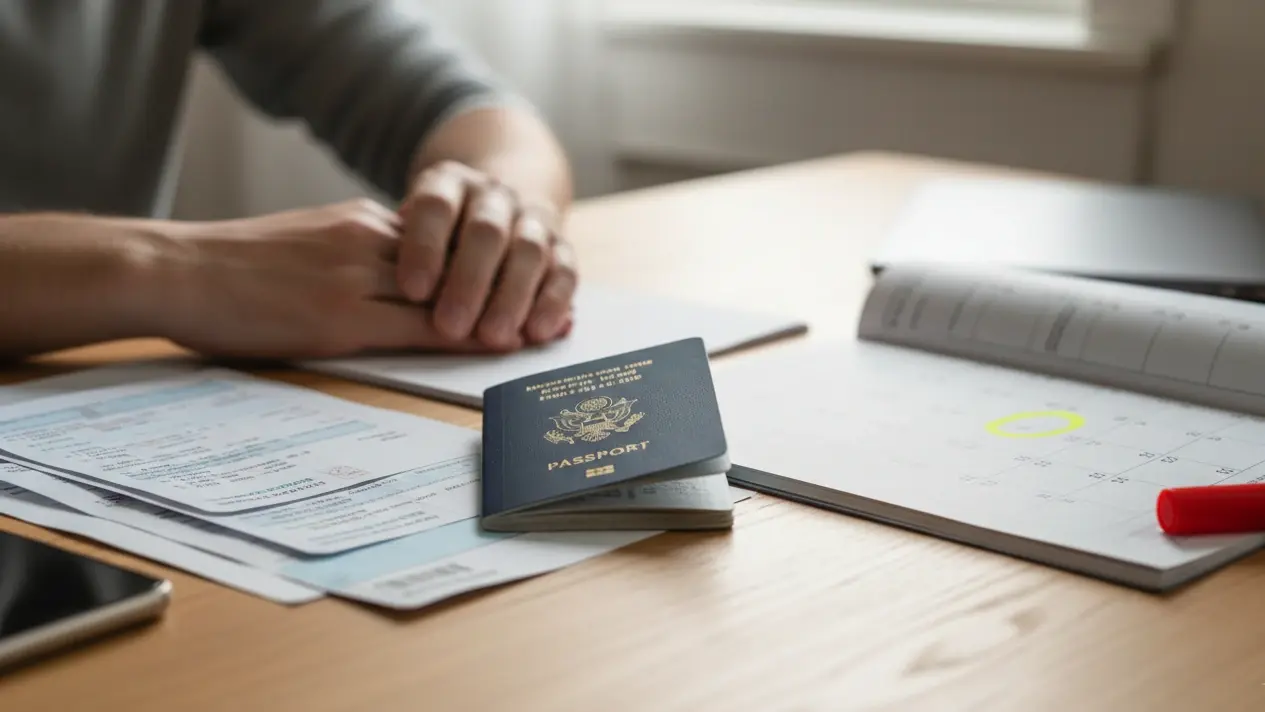
Your hotel confirmation says "Property to be confirmed." You paid, you got a reference number, and your travel dates are locked in. But the name your visa file actually needs won't reveal itself for weeks, sometimes not until you're standing at the front desk.
That gap creates a real problem when your appointment lands before the reveal window opens. This post walks through why opaque booking models create it, what a consular checklist actually needs to see, and how a hidden-name property can quietly clash with the rest of your visa flight itinerary requirements.
You'll also find the fastest ways to close the gap before your appointment date, so you know exactly which fix fits your timeline instead of gambling on a booking that still isn't ready yet. If your hotel reveal window will not beat your appointment, a clearly named accommodation reservation keeps your file ready today.
-
A hidden hotel name is usually a documentation timing problem, not proof that the booking is fake.
-
Visa accommodation proof is strongest when the property name, address, guest name and dates are visible immediately.
-
A booking reference number alone rarely explains where you will stay or whether the accommodation matches the trip.
-
Before the appointment, the practical fixes are early disclosure, a refundable named booking, or a verified hotel reservation.
-
Any accommodation fix should match your flight dates, city order, cover letter and visa form.
If your third-party hotel confirmation still hides the property name, create a BookForVisa hotel reservation that shows the details your visa file needs before the appointment.
Create Your Hotel ReservationIn This Guide
Official-source check: Hidden-name hotel bookings are risky because official visa guidance focuses on accommodation evidence that can support the stated stay. The EU Visa Code says Schengen applicants may be asked for documents relating to accommodation or means to cover accommodation, and its supporting-document examples include accommodation documents and travel-plan evidence. The European Commission says Schengen applicants need supporting documents for purpose, financial means, accommodation and intention to return. The Czech Foreign Ministry says accommodation proof can include hotel bookings, vouchers or invitations with names, addresses and visit dates, and that proof of accommodation must be submitted for a visa application to be accepted. GOV.UK visitor caseworker guidance also treats accommodation and funds as part of the genuine-visitor assessment. Sources: EU Visa Code Article 14, European Commission Schengen visa guidance, Czech Foreign Ministry accommodation guidance and GOV.UK visitor caseworker guidance.
Reviewed for: hidden-hotel booking logic, proof-of-accommodation completeness, OTA reveal-window timing, hotel name/address verification, flight-and-hotel date matching, refundable booking alternatives, fake-confirmation risk language, BookForVisa/DummyFlights intent separation and official-source alignment.
How "Mystery Hotel" and Blind-Rate Bookings Actually Work (And Why They Trip Up Visa Officers)
Opaque hotel pricing isn't a glitch in the checkout flow. It's a deliberate model, and most travelers don't realize they've opted into it until they go looking for a hotel name that isn't there. Understanding how these bookings actually work is the first step to knowing whether yours will hold up in a visa file.
Blind Bidding, Opaque Deals, And "Hotel Revealed After Booking": The Three Common Models
Third-party platforms use a handful of variations on the same idea: withhold the property's identity in exchange for a lower rate. Some opaque bookings intentionally conceal hotel information until payment is made, and travelers rarely notice this trade-off during a fast checkout.
-
Blind bidding. You name a price range and star rating, submit payment, and the system assigns a property afterward. You won't know the hotel's name until the booking is finalized on the platform's end, which can take hours or days.
-
Opaque discount listings. The deal shows a deep discount upfront, but the property name stays locked until a set window closer to your stay. Third-party platforms may reveal hotel details only after payment processing is complete, sometimes not until the trip itself is close.
-
Bundled package rates. Flight-and-hotel combos often draw from a pool of "partner properties." The exact hotel isn't finalized until you're closer to check-in eligibility, even though the booking shows as confirmed and paid.
Each of these models works fine for the trip itself. The traveler shows up, gets a real room, and the discount holds. The trouble starts when that same booking gets pulled into a visa file that needs a named, verifiable address weeks before the reveal ever happens.
The Moment Your Hotel Name Should Appear And Why Visa Timing Doesn't Wait for It
Every opaque model has a disclosure point, but that point rarely lines up with when a visa application actually needs it. Blind-bid bookings might reveal a property within a day or two. Opaque discount listings often hold the name until 24 to 72 hours before check-in. Bundled packages can stay unresolved until the traveler is nearly at the airport.
Visa authorities may require proof of accommodation for the entire stay well before any of these windows open. An appointment booked six weeks out, or a document deadline tied to a biometric submission, doesn't wait for a hotel platform's internal timeline. If your reveal window sits after your submission date, the booking simply won't produce a usable document in time, no matter how legitimate the reservation itself is.
This is where travelers get caught off guard. They assume the booking will "sort itself out" before the trip, which is true for travel purposes but irrelevant for a visa checklist that needs the information now. Many consulates require verifiable proof of accommodation for visa applications, and verifiable means the details exist and can be checked at the time of submission, not at some point down the line.
Why A Booking Reference Number Alone Doesn't Satisfy An Accommodation Requirement
A paid confirmation with a reference number looks official. It has a total, a date range, sometimes a cancellation policy. But a reference number confirms a payment and an inventory hold. It does not confirm a hotel's identity, address, or licensing, and that distinction matters far more for a visa file than it does for the traveler's own itinerary.
Visa officers may verify hotel bookings during applications, and in some cases consulates can contact hotels directly to confirm the reservation exists as stated. If there's no named property to call or search, there's nothing for that verification step to land on. A vague reference number doesn't give a reviewer anything to check against.
This gap also creates a credibility problem that has nothing to do with the traveler's honesty. Blind hotel bookings can weaken a visa file because of unverifiable details, not because the applicant did anything wrong, but because the document cannot be confirmed as complete at the point of review. Confirmation must clearly display the hotel's name and address for it to function as real proof of accommodation, and an opaque booking, by design, withholds exactly that.
It's worth being clear about what this isn't. A hidden-name booking is not the same as a fake one, and the two get treated very differently. Fake hotel confirmations can lead to refusal, credibility problems, application bans or fines in some jurisdictions, and even one fake booking can damage the credibility of future visa applications.
An opaque booking carries none of that risk on its own. It's a real, paid reservation that simply hasn't disclosed its details yet. The issue is timing and documentation, not integrity, and that's an important distinction to hold onto as you figure out your next step.
Where this becomes a genuine problem is when the missing details collide with what a reviewer is actually trained to look for on an accommodation document, and that's exactly where the file starts to unravel.
What A Consular Officer Actually Checks On Your Accommodation Document And Where Hidden-Name Bookings Fall Apart
A visa reviewer doesn't read your accommodation document in isolation. It gets scanned in seconds against a short mental checklist, then cross-referenced against everything else in your file. Knowing what that checklist actually contains makes it much easier to see exactly where an opaque booking comes up short.
The Four Data Points Every Proof Of Accommodation Must Show Clearly
Every accommodation document, regardless of destination or visa type, needs to answer four questions at a glance.
-
Does the guest name match the applicant? Embassy requirements include the guest's name matching the booking confirmation, either as the sole guest or clearly listed within a group booking.
-
Is the property name and address verifiable? Visa authorities require accommodation evidence that identifies the place of stay, not just a city or neighborhood.
-
Do the dates match the declared travel window? A hotel booking must match the flight reservation for visa details, and any gap between the two invites questions.
-
Is the booking status clear and final, not speculative? A confirmation that reads as pending, unassigned, or subject to change signals incompleteness rather than proof.
Blind bidding fails point two outright, since there's no address to check. Opaque discount listings often fail points two and three together, showing a star rating but no confirmed dates against a named property. Bundled package rates can fail all four at once if the partner property hasn't been assigned yet. A verified hotel reservation is a temporary accommodation document for visa applications, and even a temporary reservation clears all four points better than an opaque booking when it shows the actual property name, address, dates, and guest details.
Why "Hotel In [City], Star Rating 4+" Isn't The Same As An Address
A star rating and a city name tell a reviewer almost nothing they can act on. There's no way to confirm the property exists, holds a valid license, or is priced consistently with the rest of the applicant's stated budget. That absence of a concrete anchor is where inconsistent documents raise suspicion and can lead to visa rejection, even when the traveler has done nothing deceptive.
Consulates may accept hotel reservations that fully disclose accommodation details without hesitation, because there's nothing left to question. A reservation that shows only a category and a general location asks the reviewer to fill in gaps that aren't theirs to fill. That's not a rejection of the traveler's honesty. It's simply a document that doesn't do its one job: proving where the applicant will actually be staying.
This is also where the financial side of the file gets murky. A fully paid hotel booking is not automatically stronger for visa applications if it lacks a verifiable identity, and reviewers know the difference between a reservation that proves a real, checkable stay and one that proves only that money changed hands. Refundable hotel bookings reduce financial risk before visa approval, which is part of why travelers often prefer refundable bookings for visa submissions to ensure compliance rather than locking into a discounted but unnamed opaque rate.
How Embassies Cross-Check Accommodation Against Your Declared Itinerary
Accommodation proof doesn't get judged on its own merits. It gets placed next to your flight itinerary, your dates of travel, and sometimes your stated purpose of visit, and the reviewer checks whether the pieces tell one consistent story.
Say a Toronto-based applicant lists a two-week trip through Italy, with flights landing in Rome and departing from Milan. If the hotel booking shows a district that doesn't align with either city, or covers only four of the fourteen nights, that's a visible gap. Hotel reservations should match the applicant's travel itinerary exactly, covering the full span of the trip and sitting in locations consistent with how the traveler says they're moving through the country.
Opaque bookings introduce this kind of silent contradiction more often than travelers expect. A blind-bid property might land in a district nowhere near the airport the itinerary lists as the arrival point. A bundled package's assigned hotel might sit in a completely different city than the one named in the flight confirmation. None of this means the traveler is lying. It means the document, through no fault of the applicant, doesn't line up with the rest of the file the way it needs to.
Inconsistent hotel booking details can weaken a visa application even when every individual document is genuine, because embassies assess the overall credibility of the trip, not just the hotel reservation on its own. A single unnamed or mismatched booking can undercut an otherwise strong application.
In some cases, applicants realize the mismatch too late and end up scrambling for emergency accommodations that meet embassy standards just days before a deadline, which is a stressful position to be in when it's avoidable.
Once you see how directly these four data points and this cross-checking process shape a reviewer's read on your file, the next question becomes practical: what's the fastest way to close the gap if your booking has already run into this problem?
Fixing An Opaque Booking Before Your Visa Appointment: Four Realistic Paths

Once you know your booking is missing a hotel name, the next move is figuring out which fix actually fits your timeline. Not every option works for every applicant, so it helps to weigh them honestly before picking one.
Option 1: Contacting The OTA To Request Early Hotel Disclosure
The first path is the simplest on paper: ask the platform to reveal the property early. Some reservation systems allow support teams to release the hotel name and full address ahead of the standard reveal window, especially when a traveler explains that a visa centre appointment is approaching.
This works best when you can show a firm deadline. A quick message noting your appointment date and asking whether the confirmation reference can be updated with the actual property sometimes gets resolved within a few hours. Other times, support simply can't override the system, and you're left waiting regardless of how clearly you explain the situation.
It's worth trying regardless, since it costs nothing and doesn't affect your existing paid booking. But don't build your entire timeline around a response that may or may not arrive before your visa form is due. If the platform confirms the hotel city but not the exact hotel room or full address, that's still not enough for most consulates reviewing a Schengen visa file or any destination with strict accommodation certificate expectations.
Option 2: Switching To A Refundable, Fully-Named Booking Before You Apply
The second path is booking a second reservation, one with free cancellation and a hotel name that's visible immediately. This gives you a valid hotel reservation to submit as proof while leaving your original, possibly cheaper, opaque booking untouched for the actual stay.
Look specifically for cancellation terms that don't penalize you for canceling after your visa decision comes through. Many hotels offer this on standard rate types, and paying upfront isn't usually required to secure one. That matters, since you want a booking you can cancel without financial exposure once its only job, standing in as your accommodation certificate, is done.
Match the hotel dates to your declared travel plans exactly. If your itinerary shows you arriving in Paris and departing from Amsterdam, don't submit a reservation that only covers your first city and leaves gaps for the rest. Missing nights on a reservation, even a well-documented one, can trigger follow up questions from a reviewer who's checking whether your accommodation covers the entire trip.
Once your visa decision is finalized, cancel promptly and confirm the cancellation went through. Holding two active paid bookings longer than necessary just adds hidden costs and complicates your own trip plan.
Option 3: Using A Verified Hotel Reservation As A Clean Backup
The third path is the fastest when your appointment is close, and neither the OTA nor a refundable rebooking will land in time. A hotel reservation for visa proof works like a temporary travel reservation: it is a verifiable document built specifically for visa submission, not a promise that this must be the room you eventually sleep in after approval.
This matters because verification practices vary by consulate, and many consulates now cross-check the confirmation number, property address, and guest name against their own records or by contacting the hotel directly. A properly issued reservation includes all of that from the start, so there's nothing incomplete for a reviewer to flag.
For travelers who need a document with instantly verifiable hotel details rather than waiting on a platform's reveal window, BookForVisa offers verified hotel reservations with a clear confirmation that shows on the PDF immediately, transparent pricing, and unlimited date changes if your departure dates shift before your appointment. If your wording specifically uses dummy hotel booking, keep that terminology separate from this BookForVisa accommodation-proof fix so each page stays focused on its own intent.
This route also sidesteps a risk some travelers do not consider: a fake hotel booking or fake confirmation submitted to avoid paying for a real reservation can lead to serious consequences, including future credibility problems or bans in some jurisdictions. A verified reservation is not the same thing. It's a real, checkable booking issued through legitimate reservation systems, which is a meaningfully different position to be in than presenting a fabricated document.
Option 4: Why Canceling And Re-Booking Isn't Always The Safer Choice
The fourth path, simply canceling the opaque booking and starting over with a new paid accommodation booking, sounds clean but carries its own risks. Refund timelines on opaque rates can run long, sometimes past your appointment date, which means you'd be paying twice while waiting for money back.
Rebooking also means losing the original rate. If the opaque booking covered every hotel night of your actual stay at a strong price, re-booking a comparable hotel room at standard rates can get expensive fast, and that additional cost sits alongside anything else you're already covering, from travel insurance to bank statements showing sufficient funds for the trip.
There's also no guarantee the replacement booking solves the underlying issue. If you rebook through the same type of platform without checking for reveal windows or opaque pricing, you could land right back in the same situation days before your visa centre appointment.
This path makes more sense when your opaque booking wasn't particularly discounted to begin with, or when you're not confident it'll survive a consistency check against your other documents, such as a sponsorship letter, cover letter, or flight confirmation. In those cases, starting clean with two documents, one for the actual stay and one you're confident matches every other detail in your file, can be worth the extra cost.
Fixing the booking you already have solves the immediate deadline, but it's worth understanding how to avoid landing in this position again before your next trip through the Schengen area or anywhere else that expects a full, verifiable overnight transit or accommodation record.
How To Avoid Booking A "Hidden Hotel" By Accident Next Time You Apply For A Visa
Fixing one booking solves today's problem, but the same opaque pricing trap can resurface on your very next trip if you don't know what to look for. A short screening habit at checkout is usually all it takes to catch this before payment goes through.
Five Warning Signs A Listing Might Be An Opaque Rate
Opaque listings tend to give themselves away if you know where to look, even when the page is designed to move you quickly toward payment.
-
The property name field says "to be revealed" or shows only a category. If the listing describes a star rating or area instead of a named hotel, that's the clearest signal of a blind or opaque rate.
-
The price looks unusually low for the location and room type. A steep discount on a listing that won't confirm which hotel you're getting is a trade-off, not a bonus.
-
The booking terms mention a "reveal window" or "confirmation closer to arrival." Any language suggesting the details firm up later means you won't have a usable document today.
-
No full address appears anywhere in the checkout flow. Most hotels list a complete address on their own booking pages. If a listing skips this entirely, treat it as a flag.
-
The confirmation lacks a contact number or named property despite showing a paid status. A real, disclosed booking usually gives you a way to reach the property directly. An opaque one often doesn't, because there's nothing to reach yet.
None of these signs mean the deal is untrustworthy for travel. They just mean the listing isn't built to double as a visa document on short notice.
Questions To Ask Before You Pay: A Quick Screening Habit
Before completing checkout, especially in the weeks leading up to a visa appointment, a few quick questions can save a lot of backtracking later.
Ask whether the property name and address will appear on your confirmation immediately, not after a delay. If the answer is unclear or the listing avoids the question, that's worth noting before you commit to an upfront payment.
Check whether it's a bundled or package rate, and if so, which partner properties are eligible. Bundled deals covering flights and hotels together often carry the widest gap between booking and disclosure, so it's worth asking directly rather than assuming your hotel will be locked in from day one.
Review the cancellation terms specifically in case the property details aren't provided in time. Some opaque bookings do offer a way out if the reveal doesn't happen before your travel window closes in, and it's better to know that upfront than to discover it while your appointment is days away.
Building this screening habit into how you book hotels during visa season, specifically, makes sense even if you do not apply it every time you travel. For broader document timing across flights, hotels and itinerary logic, use the flight reservation for visa 2026 complete guide as your wider planning base. It's the one period where a missing hotel name has consequences beyond your own convenience.
When A Verified Hotel Reservation Is Safer Than A Real But Hidden One
For the narrow purpose of a visa submission, a verified reservation that discloses its details in full can be more useful than a genuine but opaque paid booking. The document's only job at that stage is to be checkable, not to represent where you'll actually sleep, and a reservation built specifically for that purpose does the job cleanly.
This isn't a case against opaque or discounted bookings generally. They work well for the trip itself, and plenty of travelers use them without any issue outside of visa timing. The problem only shows up when flight dates, appointment deadlines, and hotel disclosure windows don't line up, and that's a scheduling conflict, not a flaw in the discount model.
Once you see it that way, the fix stops feeling like a workaround and starts feeling like a scheduling decision, the same kind you'd make if a flight connection was too tight to trust. And that's really what this entire situation comes down to: matching the right document to the right moment in your visa timeline.
Making Sure Your Hotel Proof Is Ready Before Your Appointment, Not After
An opaque booking isn't a mistake. It's a timing conflict between when a hotel name becomes real and when your visa file needs it to already be real. Once you see it that way, the decision gets simple: disclose it early, replace it with a fully named booking, or use a verified reservation built for exactly this gap.
Whichever path fits your appointment date, the goal stays the same. Walk in with a document that answers every question a reviewer might have, not one that raises new ones. Build this check into how you book for every future trip, and this particular problem won't catch you off guard again.
Need a clean accommodation document before the third-party site reveals the hotel? BookForVisa can help you prepare a named reservation that matches your city, dates, guest details and visa timeline.
Prepare Accommodation ProofFAQ
Can I use a hotel booking if the third-party site hides the hotel name?
It is risky for visa submission because the officer may not be able to confirm the property, address or stay location. The booking can be real for travel but still incomplete as accommodation proof.
What details should hotel proof for visa show?
It should normally show the guest name, property name, full address, stay dates, booking status and contact details where available. These details help the accommodation proof match your itinerary and visa form.
Is a booking reference number enough for accommodation proof?
Usually no. A reference number confirms there is a platform record, but it does not prove the exact hotel, address or city location unless the named property details are also visible.
What should I do if my appointment is before the hotel reveal date?
Ask the platform for early disclosure first. If that fails, use a fully named refundable booking or a verified hotel reservation that gives you complete accommodation details before the appointment.
Is a hidden hotel booking the same as a fake hotel booking?
No. A hidden-name booking can be a genuine paid booking, while a fake booking is fabricated or unverifiable. The hidden booking problem is usually timing and incomplete disclosure, not deception.
Can a refundable named hotel booking fix the problem?
Yes, if it shows the property name, address, guest name, dates and status clearly. Make sure the cancellation terms are acceptable and cancel only according to the hotel or platform rules.
Should my hotel dates match my flight reservation?
Yes. Hotel dates should match your arrival, departure and city order. If there are missing nights, overnight transit, host stays or city changes, explain them clearly in the rest of the visa file.
Can I submit both the hidden booking and a backup reservation?
You can, but avoid creating confusion. If one document is for the actual stay and another is for visa-proof timing, the cover letter or file order should make the accommodation story clear.
What if the hidden hotel reveals a different city or district later?
Update the visa file if the revealed property no longer matches your declared itinerary. A different city, wrong district or missing nights can create consistency problems even if the booking is genuine.
Does a complete hotel reservation guarantee visa approval?
No. It can strengthen the accommodation portion of the file, but approval depends on the full application, including purpose, funds, ties, itinerary, documents and the officer’s assessment.
Friendly reminder: BookForVisa provides travel-proof documents for planning and visa-application support. Requirements vary by destination, consulate, visa category and applicant situation. A flight reservation can support a file, but it does not guarantee approval, boarding or entry.