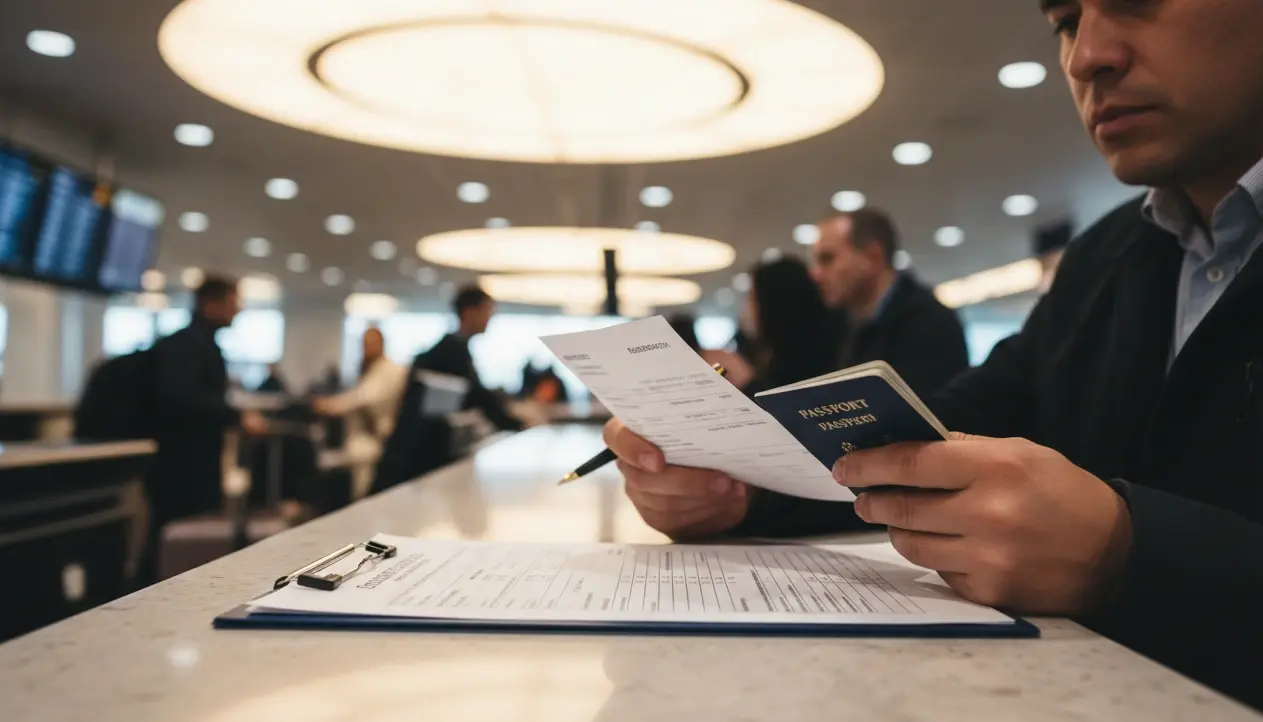
Short answer: When your sponsor lives outside your main destination, first confirm which authority handles the visa—Schengen applicants generally apply through the country where they spend the most nights. Then make your sponsor letter, flight reservation for visa, accommodation, insurance and return plan describe the same route and dates. A reservation can support a truthful file where permitted, but it cannot guarantee approval, boarding or entry.
Key facts:
- For Schengen travel, the main destination usually determines the responsible consulate; the sponsor’s address alone does not.
- Separate the sponsor’s roles as host, payer or both, and document each role according to the current checklist.
- Passenger name, entry and exit cities, dates, accommodation nights and insurance should tell one consistent story.
- Every night away from the sponsor needs its own accommodation evidence and a clear hand-off date.
- A reservation supports evidence only where the destination permits it; preserve the submitted version and update the whole file if plans change.
Need flight proof that fits a sponsor abroad? Prepare a temporary reservation around the main destination, the sponsor’s documented role and the dates your supporting evidence can defend.
In This Guide
- Why A Sponsor In Another Country Changes Which Consulate Handles Your File
- Building A Flight Booking That Fits A Two-Country Itinerary
- Sponsor Paperwork And Accommodation Proof That Cross Borders Cleanly
- Timing, Repeat Entries, And Repairing A Thin File Before You Submit
- Ready To File With A Sponsor Who Lives Abroad?
- FAQ
Official-source check: For the Schengen examples in this article, review the European Commission’s Schengen visa overview and the current checklist of the embassy or consulate handling your main destination. The destination authority controls sponsorship, accommodation and repeat-entry evidence; verify airline-facing transit rules separately.
Reviewed for: sponsor-outside-destination logic, main-destination rules, route and date alignment, sponsor identity and funding evidence, accommodation hand-offs, insurance coverage and repeat-entry wording.
Sponsor-location evidence check:
- Identify the authority that covers your residence and main destination before collecting sponsor documents.
- State whether the sponsor is hosting, paying or doing both, then attach evidence for that exact role.
- Map every flight, hotel or host night and insurance date to the same itinerary.
Your cousin lives in Rotterdam, but you plan to spend most nights in Italy. The Dutch consulate is not yours, the Italian consulate has never met your cousin, and your itinerary has to explain both countries. Files stall right here, when the sponsor's papers say one thing and the bookings say another. The consulate compares every single page you send.
This guide shows you how to pick the right consulate, what your sponsor must send, and which dates belong on each booking, using the visa flight itinerary requirements guide as a cross-check. Each step works through a realistic case with dates, and you will also see how to ask for repeat entries. A well-timed reservation can show the intended route while your sponsor's paperwork is assembled, where the destination checklist permits reservation evidence. If the document is actually a dummy ticket for visa, describe it accurately rather than calling it a paid fare.
Why A Sponsor In Another Country Changes Which Consulate Handles Your File

A sponsor who lives in one country while you travel to another splits your trip in two. Consulates read that split closely, so decide who owns your file before you collect a single document.
Finding The Country That Owns Your Application
Picture a simple case. Your cousin Daniel lives in Rotterdam. You plan ten nights in Italy and four in the Netherlands. Italy becomes your main destination because you spend the longest time there.
The same logic applies to any Schengen visa application. The country where you stay longest takes the file. If the nights are equal, the country where you enter first decides. Your sponsor's address does not change that order.
Short-stay Schengen rules commonly use a 90-days-in-180-days limit; verify the current rule for your visa type. Your Italian nights and Dutch nights draw from one shared allowance across the Schengen area. Count both stops before you promise dates to anyone.
Two more rules decide where you file. The location of the visa submission depends on the applicant's residence. The visa appointment is generally booked in the applicant's country of residence. A Delhi resident files in Delhi, even when the sponsor lives in Rotterdam.
Only the competent consulate can accept your file, so confirm which office covers your city. Some Schengen countries have no office there and rely on other member states to take applications for them. Check that list before you book a slot.
If your sponsor lives in another Schengen state, tell your consulate early. A short note explaining the split stay saves questions later. Attach it to the file rather than hoping the officer connects the dots.
Multiple-entry visa applications are processed by the main destination country. That rule matters when your sponsor's country is only a side stop. Your Dutch host will not be the one who decides your request.
When Your Sponsor Lives In A Country You Are Not Visiting
Sponsors do not always live where you land. Your aunt might live in Dubai while you visit Spain. Your host might be a UK resident while your main stop is France. Both live in a third country, and consulates treat that setup with extra care.
Say your aunt holds a work permit in Dubai. The consulate may want proof that the permit is valid and that she can pay for your stay from there.
Destinations may permit or restrict sponsorship from those living outside the country. Read the visa rules for your destination before you ask anyone to sign a form.
Visa eligibility may depend on the sponsor's legal residency in the destination country. Some consulates separate the sponsor's two roles, host and payer. Ask which role your sponsor can play from abroad.
Sponsorship requirements can vary based on visa category. A tourist visa request may need only a short support statement. A business visa request may call for an invitation letter from a company.
A national long stay visa often demands far more detail on the sponsor's status and funds. Compare all visa categories before you copy anyone else's paperwork. Then read the visa requirements page of your consulate line by line.
Now the question of who can sponsor. Some consulates say it bluntly. Only first-degree relatives can be visa sponsors. Others accept a wider circle. A friend can also act as a sponsor under certain conditions.
Those conditions usually cover proof of the friendship, the host's stable income, and a clear statement about who pays for what. Ask your consulate rather than guess.
A visa sponsor covers expenses for applicants without income. Students, homemakers, and retirees often fall into this group. The sponsor's funds then stand in for your own travel expenses, such as flights, food, and local transport.
If you are visiting family, expect a request for proof of the relationship, such as a birth or marriage certificate. A family visit to a parent looks different from a trip to see a friend, and the paperwork should reflect that.
Coordination Habits For A Sponsor Who Lives Abroad
The visa application process requires careful coordination when the sponsor lives abroad. Time zones, courier delays, and notary queues all eat into your schedule. A few habits keep the work moving:
-
Keep one shared folder that you and your sponsor can both open.
-
Pull the current checklist from the consulate website, not from an old forum thread.
-
Follow the official instructions on document size, language, and translation.
-
Agree on trip dates before either of you prints anything.
Agree on roles as well. Your sponsor handles the letter, the ID copies, and the bank papers. You handle the form, the reservation, and the appointment. Clear roles stop duplicate work and missing pages.
The applicant must show ties to their home country during the visa application process. Employment letters, property papers, and family responsibilities do that job.
Financial sponsorship does not replace the need for the applicant to provide their circumstances. Your sponsor can pay the bills, but you still explain your job, your leave, and your reason for returning.
Visa applicants who lean only on a sponsor's bank balance often leave the file lopsided. Both halves of the story need proof. Your itinerary is the first place where those halves must agree.
Building A Flight Booking That Fits A Two-Country Itinerary
Your itinerary is where a split-location trip either holds together or falls apart. Visa officers compare it with the sponsor's letter before they read anything else.
What The Itinerary Must Show When Your Host Lives Elsewhere
A flight reservation shows a realistic itinerary for visa applications. That realism matters more when your host lives in a different country from your main stop.
A flight reservation must show travel dates and itinerary. The route should also make sense for both countries. Reservations must include full name, flight number, and travel dates. Check the following details before you attach the document:
-
Your name, spelled exactly as in your passport
-
Flight numbers for every leg
-
Departure and destination airports for each leg
-
The booking reference, often called the PNR
-
Dates that fit inside your planned stay
Your passport number will not usually appear on the reservation. It does appear on the visa application form, so keep your name spelling identical in both places.
Now think about the route. Say you fly from Mumbai to Rome and leave from Amsterdam. That open route fits an Italy-first trip that ends at your cousin's home.
A round-trip itinerary into Rome alone would leave the Dutch leg unexplained, unless your letter mentions a train. Show onward travel between the two countries in your plan, even when it is a train or a bus.
Your return flight should leave from the place where your stay ends, not from the place where it began. Officers notice when the sponsor lives in Rotterdam and the flight home departs from Milan with no explanation.
Sometimes the sponsor's country is only a hub. Suppose your aunt lives in Dubai and your main stop is Madrid. Your route may pass through the Gulf, so say that a meeting with your aunt explains the stopover. Plan the return journey with the same care as the outbound leg.
Keep the airline detail simple. Reliable providers book you with major carriers, and you should not expect to choose one. What matters is a real flight number on real dates that officers can check.
Matching Dates Across The Sponsor Letter, Insurance, And Bookings
Flight reservations should match the travel dates on other documents. One wrong date can make the whole file look careless.
Suppose your sponsor's letter covers 12 June to 26 June. Your itinerary lands on 10 June and leaves on 29 June. Your insurance covers only the sponsor's dates. The officer now sees three different trips.
Line up these items before you submit:
-
The dates written in the sponsor's letter
-
The arrival and return date on your reservation
-
The nights covered by your accommodation proof
-
The insurance dates on your policy
Write months in words, such as 12 June, so nobody confuses day and month. A date like 06/12 reads as June in one country and December in another.
Treat your travel documents as one set. They should all describe the same journey, and the nights should add up to your intended stay.
A vague intended journey invites questions. A proposed trip should read like a plan that a real person would follow. If your route crosses two countries, attach a one-page travel plan that lists each stop with dates.
Where You Land, When You Enter, And What Happens On Exit
The arrival city on your reservation sets your first entry. That entry must fall inside the visa's validity, so never book a flight that lands a day before the visa starts.
Think about exits too. A single-entry visa ends once you leave the Schengen area. Suppose your sponsor lives in London and you want a weekend visit there. You would need a multiple-entry visa to come back.
Without it, your flight home should leave from inside the area. Officers check this logic quickly, so make it obvious on paper.
Reservation Or Paid Fare: What You Book And When
A flight reservation is not a fully paid ticket and may expire. Check the hold period and confirm it lasts through your appointment and processing time.
Buy the final ticket only after visa approval, once your dates are firm. Until then, the reservation displays the route without locking your money into a fare you may never fly.
Keep a simple routine while you wait:
-
Book the reservation once your appointment date is confirmed
-
Note the expiry date and set a reminder
-
Save the PDF and the PNR in your shared folder
-
Rebook only if your sponsor's dates change
A reservation with a PNR and PDF can support the file where the checklist permits it, but if your sponsor's calendar moves, review and replace the reservation so every date remains truthful.
Dates are only half of the story, because your sponsor's paperwork has to sit right beside them.
Sponsor Paperwork And Accommodation Proof That Cross Borders Cleanly

Your sponsor's documents travel further than you do. They must be accurate, current, and acceptable in the country that reads them.
The Support Letter That Answers Questions Before They Are Asked
A signed sponsorship letter should detail the relationship and financial support during the visit. Keep it to one page and use plain language. Include these points:
-
The sponsor's full name, address, and ID number
-
How the sponsor knows you
-
Your exact dates of stay
-
What the sponsor will pay for
-
A phone number and email for follow-up
A sponsor must provide specific documents with the visa application. Treat these sponsor documents as a package and follow the consulate's list without shortcuts.
Say Anna Weber sponsors her brother Thomas from Vienna while he visits Portugal. Her letter should state that she is his sister, that she covers his daily costs, and that he returns to Delhi on a named date.
Avoid vague wording such as "full support for all costs." Officers prefer numbers and named items, like fourteen nights of accommodation and a daily allowance.
Valid proof of the sponsor's legal status is essential when applying for a visa. A residence permit or citizenship record does the job. Check that it will not expire before your trip ends.
Add a copy of the sponsor's ID page and a recent record that shows the sponsor's address, such as a tenancy agreement or utility bill. Officers use these to confirm that the person who signed the letter really lives where the letter says.
Money Papers And The Notarization Step For Schengen Visa Application
Sponsorship documentation typically includes financial proofs from the sponsor. Recent bank statements and payslips usually lead the list. Officers want steady income, not one large deposit made last week.
This financial evidence should cover several months and show a balance that matches the promises in the letter. If your sponsor holds savings in more than one account, include each one.
Documentation from the sponsor often needs notarization or legalization. Ask your consulate which one applies. Notarization confirms that the sponsor signed before an official. Legalization confirms that the official's seal is genuine.
Then allow extra days, because a notary in one country and an apostille office in another rarely share a schedule.
Send originals by tracked courier and keep scans for yourself. Translate any financial documents that are not in a language your consulate accepts. Supporting documents that arrive unreadable count for nothing.
A strong money file often includes:
-
The last three months of statements
-
The latest payslips or tax return
-
An employer letter that confirms role and salary
-
Proof of any savings the sponsor mentions
Proof Of Accommodation When You Split Your Nights
Proof of accommodation is required for visa applications. When you stay with your sponsor, a host declaration plus proof of the address can work as accommodation evidence.
Some consulates want a formal accommodation document, such as an official host form. Check whether yours does. Then think about the nights you spend elsewhere. Your first nights in Italy, for example, need their own proof.
Proof of accommodation can be a hotel booking confirmation. A hotel reservation for those nights sits neatly beside the sponsor's address for the Dutch leg. Every night in your itinerary should have a bed attached to it.
A private stay is not less credible than a hotel. It only needs more written detail, because no booking system backs it up. Ask your sponsor to confirm the address in writing and to state how many nights you will stay.
Watch the handover dates. If your hotel ends on 20 June and your sponsor's home begins on 21 June, one night has no proof at all. Officers spot gaps like that in seconds, and a simple fix on paper prevents a long email exchange later.
Health Cover That Works In Both Countries
For Schengen examples, travel medical insurance commonly requires at least €30,000 and coverage across the states you plan to enter; confirm the current destination rule. The policy should also apply in every Schengen state you plan to enter. A policy that covers only the sponsor's country will not do.
Any travel insurance you buy should name you as the insured person. Your sponsor may pay the premium, but the certificate carries your details. Attach the insurance certificate as a clear PDF.
Check three things before you pay:
-
The policy period starts on your arrival day
-
The policy period ends on your departure day
-
The policy covers emergency treatment and return home if you fall ill
Buy the policy only after your dates are final. Changing dates later may mean paying for a new certificate.
With the paperwork settled, timing decides how smoothly the file moves.
Timing, Repeat Entries, And Repairing A Thin File Before You Submit
Two calendars, yours and your sponsor's, now compete for the same weeks. Plan around both.
How Early To File When Two Calendars Are Involved
Some Schengen applications have minimum timing rules, but appointment availability and sponsor paperwork make early filing safer; confirm the current deadline. Sponsor paperwork takes longer to arrive, and school holidays fill appointment slots quickly.
Applications for multiple-entry visas can take up to 45 days to process. Build that time into your plan.
Officers may ask for more papers, and each request adds days. A calm buffer protects you from rushing toward a visa decision with half your bookings expired.
Work backward from your travel date. A sample timeline might look like this:
-
Ten weeks before travel: ask your sponsor to start the letter and bank papers
-
Eight weeks before: complete notarization and courier the originals
-
Six weeks before: book the appointment and the reservation
-
Four weeks before: submit the file
Your sponsor's own busy season matters too. A host who travels for work in July may not be able to sign anything that month, so ask early.
Peak seasons change the math too. Summer and winter travel crowd appointment calendars in many cities. Book the earliest slot you can get and keep your reservation flexible.
Asking For Repeat Entries When Your Sponsor Lives Elsewhere
A multiple-entry visa may allow repeated entries during its validity; confirm whether your visa category and destination permit that travel. That helps if you visit a sponsor outside Europe and then return. The European Commission publishes the current multiple-entry rules; check the latest version before relying on them.
The European Commission publishes the updated rules for consulates. Your file still needs a reason for repeated travel, such as a sponsor across a border or recurring trips to relatives. Multiple entries are never automatic.
The same principle applies to every request you make. Ask for what your plan justifies, and show it on paper.
Say so in your cover letter. Name the sponsor, the country where the sponsor lives, and the reason you expect to travel more than once. Attach earlier visas or stamps that show you have followed the rules before. A strong request explains three things:
-
Why you travel more than once
-
Whom you visit and where that person lives
-
How you complied on earlier trips
If you cannot justify repeat travel yet, apply for a shorter visa and build a clean record first. A tidy small trip helps a larger request later.
Writing A Plain Answer For Every Gap In Your File
Every gap needs a plain answer. Perhaps your sponsor's income letter arrives late, or your bookings cover only part of the stay. A truthful explanation in your cover letter beats silence.
Add additional evidence that proves the point, such as an email thread or a payslip. If an original paper is missing, send different evidence that shows the same fact, and say why.
Consider a sponsor whose account records show a foreign currency. Add a short note with the exchange rate and the date you used. Officers should never have to guess what your numbers mean.
Now suppose your sponsor is a friend, not a relative. Add photos, message history, and proof of past meetings. Keep it modest. A few clear items beat a folder of screenshots.
Officers read your visa file in minutes. A complete file with tidy tabs and matching dates leaves little room for doubt. Cleverness does not help. Clarity does.
Keeping Records That Help Your Next Trip
Save every version of your submission, including the reservation, the letter, and the receipts. Past trips that ended on time support future applications. Note the reference numbers so you can quote them later.
Keep these items together:
-
The final application form and submission receipt
-
The reservation, insurance, and accommodation papers
-
The sponsor's letter and supporting IDs
-
Any emails with the consulate
Store the file in two places, one for you and one for your sponsor. If the consulate asks a follow-up question months later, you can answer in minutes instead of days.
Set a calendar reminder for the day your visa expires, too. If a new trip to your sponsor is likely, that date tells you when to start collecting fresh papers. Keep those records tidy, because they shape how you finish this process.
Ready To File With A Sponsor Who Lives Abroad?
A sponsor outside your main destination does not weaken your case. It asks for tighter coordination. Confirm the right consulate, match every date, and keep your sponsor's papers valid and legalized. That approach works whether your sponsor lives one border away or one continent away.
Your next step is simple. Line up the letter, the reservation, and the insurance on one calendar. Submit early, answer gaps honestly, and let a consistent file do the talking. Do that, and the distance between you and your sponsor stops being a risk and becomes a routine detail.
Ready to align a sponsor-abroad itinerary? Keep the main destination, sponsor role, reservation, accommodation and return plan consistent before you submit.
Frequently Asked Questions
Which consulate handles my application if my sponsor lives elsewhere?
For a Schengen trip, the main destination generally determines the responsible consulate, while your place of legal residence determines where you submit. Confirm both points with the current authority before booking an appointment.
Can someone who lives outside my destination sponsor my visa trip?
Sometimes, but the destination may limit who can host or fund an applicant. Check the visa category rules and show the sponsor’s legal status, relationship, address and financial role exactly as required.
What should the flight reservation show when the sponsor lives abroad?
Use your own passport name and show the entry city, onward route, exit point and dates that match the sponsor letter, accommodation, insurance and stated purpose.
How do I match accommodation when some nights are with my sponsor?
Create a night-by-night map. Use the host declaration or address evidence for the sponsor’s nights and a hotel or other accepted confirmation for every remaining night, including hand-off dates.
Do I need a multiple-entry visa to visit a sponsor outside Schengen?
If you leave the Schengen area and plan to return, a multiple-entry permission may be necessary. Confirm that the visa category and destination allow it; do not assume a single-entry visa covers a second entry.
Does a consistent reservation guarantee visa approval?
No. A coherent reservation can reduce avoidable contradictions, but the destination authority evaluates the complete application and retains final discretion over approval, boarding and entry.
Friendly reminder: BookForVisa provides temporary travel-proof documents for planning and application support. Requirements vary by destination, airline, route and applicant situation. A reservation can support a file, but it does not guarantee approval, boarding or entry.