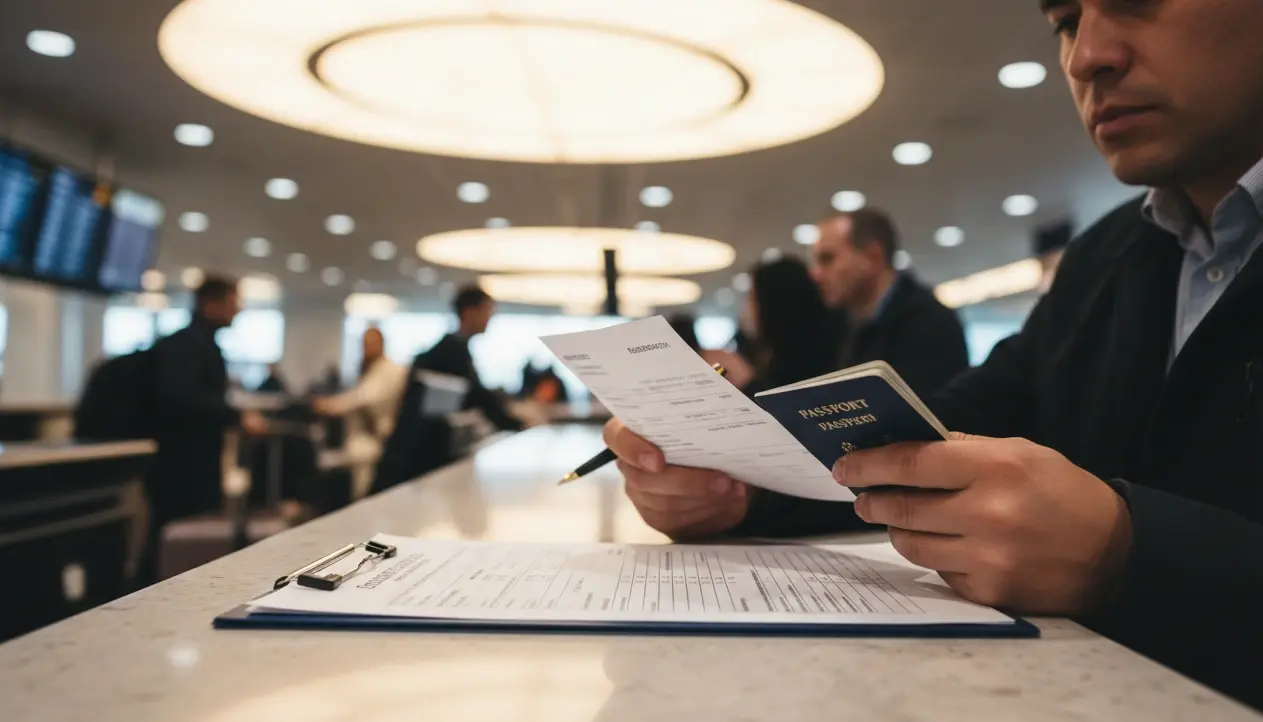
Short answer: When a visa file uses hotel bookings, host letters, insurance, bank evidence and other proof types together, assign each night and expense to the document that actually supports it. Your flight reservation for visa should frame the same entry, route and exit dates, but it cannot replace accommodation, funding or relationship evidence. A coherent mixed file supports clarity where permitted; it does not guarantee approval, boarding or entry.
Key facts:
- Build a night-by-night proof map before booking hotels, requesting host letters or preparing the flight reservation.
- Use a host letter for genuine private-stay nights and a hotel confirmation for nights you actually spend in a hotel.
- Passenger name, route, dates, insurance, funds, leave evidence and sponsor details should agree across the file.
- Choose the visa category and responsible consulate before collecting documents; good proof aimed at the wrong category still fails.
- Keep one reference per document, preserve the submitted version and update the complete evidence set if the itinerary changes.
Need flight proof that fits mixed accommodation evidence? Build the reservation around the same dates and route used by your hotel, host, insurance and funding documents.
In This Guide
- Why a Split Trip Needs More Than One Kind of Proof
- Deciding Which Night Gets Which Proof
- Building the Flight Layer of a Mixed File
- Making a Host Letter Work Beside Hotel Bookings
- Insurance, Money, and Employer Papers That Must Agree With Your Bookings
- Which Consulate Reads Your File When the Trip Crosses Borders
- Names, Dates, and Numbers: Where Mixed Files Quietly Fall Apart
- Arranging the Folder So the Officer Reads One Clear Story
- Timing Your Submission Around Appointments and Processing Windows
- Your France Application Should Read Like One Story From Paris to Milan
- FAQ
Official-source check: For the Schengen examples in this article, review the European Commission’s Schengen visa overview and the current checklist of the embassy or consulate handling your main destination. That authority controls which accommodation, sponsorship, financial and insurance documents it accepts.
Reviewed for: mixed accommodation proof, host and hotel hand-offs, flight-date framing, insurance and funds alignment, visa-category fit, main-destination logic and document-reference clarity.
Mixed-proof evidence check:
- Assign every night to one host, hotel or other accepted accommodation proof.
- Match the flight reservation’s arrival and exit dates to the proof map and insurance period.
- Label sponsor, payer, host and applicant roles so the officer never has to infer who covers what.
Your Schengen file shows four nights in a Paris hotel, five nights with a host in Lyon, and a flight home from Milan. The officer reads all three in under a minute. If they tell the same story, the file moves forward. If they do not, questions follow.
Mixed proof suits a route like this, but only when each document covers a clear stretch of the trip. You must decide which nights get a hotel, which get an invitation letter, and how your flights frame both. Then every name and date has to match.
Here is how to build that file without any gaps or surprises. Pair your hotel and host nights with a truthful flight reservation that mirrors the same entry and exit dates. If you specifically need a dummy-ticket document, see what a dummy ticket is and label it accurately.
Why a Split Trip Needs More Than One Kind of Proof

Some routes are simple enough for one hotel and one flight. Yours is not, and the proof you build should admit that from the start.
The Paris Hotel, the Lyon Host, and the Milan Weekend on One File
Take Mark, who lives in Mumbai and plans twelve nights across the Schengen area. He lands in Paris, spends four nights in a hotel, then takes a train to Lyon to stay five nights with his college friend Daniel. The last three nights are a weekend in Milan. He flies home from there.
That one trip needs three kinds of proof for a single Schengen visa. Paris needs hotel proof. Lyon needs an invitation letter from Daniel. Milan needs its own hotel booking. Above all three sits a flight itinerary that enters through France and exits through Italy.
Here is Mark's proof map before he books anything:
-
Nights 1 to 4 in Paris: a hotel booking in his passport name
-
Nights 5 to 9 in Lyon: an invitation letter from Daniel with address and dates
-
Nights 10 to 12 in Milan: a second hotel booking for the weekend
-
Both flights: outbound into Paris on night one, return from Milan after night twelve
Nothing overlaps, and nothing floats. Every night belongs to exactly one document.
Mixed proof works best for complex travel itineraries like this one. A single hotel booking cannot explain Lyon, and a single letter cannot explain Milan. Each proof type covers the stretch of the trip it fits best.
A hybrid proof strategy also reduces verification questions. When every night has a matching document, the officer has fewer gaps to probe. Your visa application moves through review with less back and forth.
The proof map also protects you from over-documenting. Someone who attaches three hotel bookings, a letter, and a spare itinerary invites the officer to compare all of them. Fewer, sharper documents give the officer less to cross-check.
Many visa applicants book one hotel for the whole stay because it feels simple. On a split route, that shortcut leaves a hole the officer can see straight away.
What a Visa Officer Sees When Proof Types Do Not Line Up
Officers do not judge documents one at a time. Proof of accommodation is judged against the entire visa application. If Mark's Lyon letter and a Paris hotel booking cover the same nights, the officer will ask a simple question: where will he sleep?
Picture the alternative. Mark books a Paris hotel for all twelve nights and leaves out Daniel's letter. His return flight departs from Milan on night twelve. The officer now holds a hotel in Paris and a plane in Milan, with nothing to explain how he moves between them.
Think of each document as a witness. One witness can be doubted. Three witnesses who agree on dates, names, and places are much harder to dismiss.
These mismatches raise questions most often:
-
A hotel booking that overlaps nights an invitation letter already covers
-
A flight into Paris that lands days before the first night of any proof
-
A return flight from Milan while the last accommodation ends in Lyon
-
A travel plan in the cover letter that differs from the bookings behind it
None of these is fatal alone. Together, they suggest the plan changed halfway through, or that documents were prepared without checking each other.
Officers often compare the application form with the bookings first. If the form says twelve nights and your documents cover ten, the gap shows up on page two.
Give each reservation its own booking reference and quote it in your cover letter. That lets the officer tie every page to a specific night or leg. Each booking shows names, dates, and places. Your job is to make those details add up to one picture.
A file that contradicts itself slows review and invites requests for extra paperwork. Every request adds to the processing time. A consistent file lets the visa decision rest on your purpose and funds instead.
Trips That Should Never Rely on a Single Document Type
Some trips carry too many moving parts for one proof type. Plan a mixed file from the start if your trip matches any of these:
-
Multi-city routes with hotel nights in one city and host nights in another
-
Cross-border side trips where you enter through one country and leave through another
-
Stays in different countries that each need their own accommodation proof
-
Business trips with a tourism extension, where purpose documents differ for each half
-
Long stays where trip length approaches the ninety-day limit in any 180-day period
Each of these leaves a question that one document cannot answer. Mixed proof answers it before the officer asks.
Take Anna, who flies from Delhi for a two-day conference in Lyon and then adds four days in Nice. The conference invitation covers the first two nights. A hotel booking covers the rest. Her employer letter and event registration are purpose documents that explain the first half, while the hotel explains the second.
Relocation files sit at the far end of this list. Someone moving for work may hold a job offer, a hotel for the first week, and a lease that starts later. That paperwork cannot fit inside one accommodation proof. .
Short trips can go the other way. A five-night visit to one Paris hotel needs one solid booking and nothing more. Adding a host letter to a trip with no host only creates confusion.
Ask one question about every trip: can a single document show where you sleep every night? If the answer is no, one proof type is not enough.
Most Europe itineraries that involve friends, family, or two cities still benefit from mixing. The real work is deciding which night belongs to which document, and that decision comes next.
Deciding Which Night Gets Which Proof
Every night abroad needs an owner. Give each one to a hotel booking or a host letter, then build the flights around that plan.
Nights With a Host: Let the Letter Carry the Weight
Use temporary hotel bookings or host invitation letters for every night abroad. That rule settles the Lyon stretch of Mark's trip. Daniel's letter covers nights five through nine, so no hotel is needed for them.
A host letter works when the person hosting you can be verified. It should name the host, give the address, and state the exact dates of your stay. It should also say how you know each other and who pays for what.
Ask Daniel to describe the visit in plain terms, such as seeing an old friend and exploring Lyon. That purpose must match your cover letter and your application form. A letter that promises a family celebration while your form says sightseeing sends mixed signals.
Do not pad a host stay with a hotel "just in case." Two documents for the same night make an officer wonder which one is real.
The letter also has a job in the wider file. It is the only proof for those nights, so it needs the same care as a hotel booking: full names, matching dates, and contact details that work.
If your host lives in a different city from your entry point, say so. Lyon is not Paris, and the file should show how you get there. A short line in your travel plan, such as a morning train on the sixteenth, closes that gap.
Count nights the right way, too. A night belongs to the place where you sleep, not the place where you spend the day. Five nights with Daniel means five sleeps under his roof, and the sixth morning is departure day.
Nights in Hotels: Where a Temporary Booking Fits Best
Hotels fit the nights where no host is involved. That usually means your arrival city and any city you visit for tourism. A temporary hotel booking gives the officer a real address and a real stay, while leaving you room to adjust if your dates move.
Align accommodation proof with your travel dates for consistency. If your flight lands in Paris on the 12th, the hotel's check-in date should be the 12th. Accommodation proof must match travel dates and itinerary. A booking that starts a day late leaves one night unaccounted for.
Hotel bookings should show the guest's name as it appears in the passport. Skip nicknames and shortened first names. Officers check names early, and a mismatch here casts doubt on everything after it.
A complete hotel booking shows:
-
The guest's full name, matching the passport
-
The hotel's name, address, and contact details
-
Check-in and check-out dates
-
A booking reference the consulate can quote
-
The number of guests and rooms
Choose a hotel that fits your budget and your bank balance. A luxury suite beside modest savings raises a question the rest of your file has to answer. A mid-range hotel in the right neighborhood raises none.
Choose free cancellation when the rate allows it. Visa outcomes are never certain, and plans can shift before you travel. A flexible rate lets you adjust the booking without losing money, and it keeps the reservation in your hands until you are sure.
The Side Trip Rule: Using Hotels to Clarify Your Route
Use hotels for side trips to clarify your travel route. Milan is a good example. It sits in a different Schengen state from the one handling Mark's application, and Daniel's letter does not cover it. A hotel booking there shows exactly where he goes, when, and for how long.
Your accommodation proof should explain your travel route logically. Read Mark's file as an officer would: Paris, Lyon, Milan, home. Each step has a document. If the route jumped from Lyon to Milan with nothing in between, the officer would have to guess.
Follow these habits for side trips:
-
Give every side trip its own hotel booking, even for one night
-
Keep the side trip shorter than your main stay, because the main stay shapes who processes your file
-
Check that your last hotel sits in the same city as your departure flight
-
Mention the train between cities in your cover letter, even if you have not booked it
Do not add side trips you do not plan to take. Extra bookings make the route look inflated, and they create more dates that have to match.
A Night-by-Night Grid You Can Fill in Before Booking Anything
Before you book anything, build a grid. Use one row per night block, and fill in the city, where you sleep, and the document that covers it. Keep the rows in chronological order.
Here is Mark's grid:
|
Nights |
Dates |
City |
Where You Sleep |
Proof |
|---|---|---|---|---|
|
1 to 4 |
12 May to 16 May |
Paris |
Hotel |
Temporary hotel booking |
|
5 to 9 |
16 May to 21 May |
Lyon |
Daniel's home |
Host letter |
|
10 to 12 |
21 May to 24 May |
Milan |
Hotel |
Temporary hotel booking |
An empty row is a gap. A row with two documents is an overlap. Both are easier to fix on a grid than on a finished file.
Fill in the grid with pencil-level flexibility until your flights are fixed. Then lock it. Every later document, from insurance to your cover letter, should copy dates from this grid and nowhere else.
Add two more columns once the basics are filled: the reference number of each document and the date you created it. The officer never sees this grid. It is your private control sheet, and it will save you when a date changes and four documents need to follow.
With the nights assigned, the flights can be built to frame them.
Building the Flight Layer of a Mixed File

Your flights frame every night in the grid. If the frame is off by a single day, the documents inside it start to look wrong.
What the Outbound and Return Legs Need to Show
A flight itinerary must include dates and flight numbers. Without them, it reads like a rough plan. With them, the officer can see when you enter, when you leave, and how long you stay.
Each leg should show:
-
Your name exactly as it appears in the passport
-
Departure and arrival airports, with local times
-
Flight dates for every leg
-
Flight numbers and the operating airline
-
A booking reference the consulate can use to verify the reservation
A reliable flight booking supports your visa application consistency. The officer is not checking your seat. The officer is checking whether your dates hold up against the hotel and host documents.
Mark's outbound flight lands in Paris on 12 May, the first night of his hotel booking. His return leaves Milan on 24 May, the morning after his last hotel night. Nothing sits outside the frame.
Late arrivals need a quick check. If Mark's flight lands at 11:40 p.m. on 12 May, the hotel's first night still starts on 12 May. Confirm the hotel accepts late check-in, so the booking and the arrival tell the same story on paper.
Count the nights once more. Twelve nights on the grid must equal twelve nights between arrival and departure. If the flights imply thirteen, one night has no owner.
Also check the direction of each leg. An outbound that arrives in Paris and a return that departs from Milan should both match cities on your grid. If a leg starts or ends somewhere your other documents never mention, the officer will ask why.
Reserving Your Route Without Paying for the Seats
You can obtain a flight itinerary without purchasing a ticket. That matters, because consulates ask for proof of planned travel, and many advise against paying for a flight ticket before the visa is granted.
Two routes are common. Some providers issue temporary reservations, while some airlines may offer short holds. Terms, validity and verification vary, so compare the current conditions and keep the document truthful. Both formats should show flight numbers, dates and a booking reference when the checklist permits reservation evidence.
The difference is timing. An airline hold expires on the airline's schedule, while another temporary reservation may have a different validity period. Do not promise a date change; if the appointment moves, review the complete file and obtain a current reservation that matches it.
An air ticket booking made for visa use has a different goal from one made for travel. You need proof of intent, not a seat you plan to sit in. The flight reservation only has to be accurate, verifiable, and consistent with the rest of the file. Use the flight reservation for visa guide to check the basic reservation-versus-ticket distinction.
Schengen applicants should also watch how the reservation reads. It should show a real route, real flight numbers, and dates that fit your grid. A reservation that looks generic invites doubt.
Before you attach the PDF, check three things. The name must match the passport, the flight numbers must fit the route, and the reference must retrieve the reservation on the airline's own system. A ten-minute check here prevents a two-week delay later.
A reservation with a PNR and PDF may support a visa file where the destination checklist permits it. Describe its status accurately, and obtain a current version if your route or dates change.
Mark uses one reservation with two legs: Mumbai to Paris on the outbound, Milan to Mumbai on the return. Both legs match his hotel and host dates.
Flight Tickets: When You Fly Into One City and Out of Another
Mark arrives in Paris and leaves from Milan. Travelers call this an open-jaw route, and it is perfectly normal for a trip with a side trip. What matters is whether your other documents explain it.
The test is simple. The exit city must appear on your grid. Mark's last three nights are in a Milan hotel, so his Milan departure makes sense. If Milan had no accommodation proof, the return flight would look like it came from nowhere.
Follow these checks:
-
Confirm your final hotel sits in your departure city or a clearly connected one
-
Add a line in your cover letter about the train from Lyon to Milan
-
Make sure your arrival day and your first accommodation night are the same day
Your entry point does not decide which consulate handles the file. The nights do. Mark enters through France and applies to France, but that is because he spends the most nights there, not because he lands in Paris. We explain how that rule works when we reach the consulate discussion.
Watch the transfer days as well. The move from Lyon to Milan happens on 21 May, the day the Lyon letter ends and the Milan booking begins. A realistic day is one where the last night ends, you travel, and the next check-in starts.
Keeping Every Other Document Inside Your Arrival and Departure Days
Flight dates set the outer limits for the whole file. Every other date has to sit inside them. That includes hotel nights, invitation dates, and insurance dates.
Think of your travel window as the stretch between arrival and departure. Use this order:
-
Hotel and host nights fall inside the travel window
-
Invitation dates start on or after arrival and end on or before departure
-
Insurance dates begin on or before arrival and end on or after departure
-
Employer leave covers the travel window, plus any days needed to travel
Insurance is the one document that can extend past the flights. A policy that starts a day early and ends a day late is fine. A policy that starts after you land is not.
Now test a change. Suppose Mark's flight moves back by one day. His Paris hotel, Daniel's letter, and his insurance all have to shift with it. One date change ripples through four documents. That is why flexible reservations help while you wait for an appointment.
Of all those documents, the letter from your host is the hardest to change once it is signed. It deserves the most care, and it comes next.
Making a Host Letter Work Beside Hotel Bookings
A host letter carries more weight than a hotel booking, and it is easier to get wrong. Treat it as formal evidence, not a favor note between friends.
The Relationship Line That Makes a Letter Believable
A clear relationship with the host strengthens invitation letters. Daniel should say how he knows Mark, how long they have known each other, and why the visit makes sense now. A line such as "We studied together in Mumbai, and Mark is visiting Lyon for the first time" does real work.
Vague phrases do not. "A good friend" tells the officer nothing. A named relationship, a shared history, and a reason for the visit give the officer something to weigh.
If the host is a relative, name the relationship precisely: sister, uncle, cousin. Supporting proof of that link, such as a family record, can make the letter even stronger.
Relationship lines that carry weight look like this:
-
Former college classmates who have stayed in touch for years
-
A cousin who lives in Lyon and invited the applicant for a family visit
-
A former colleague who moved to France for work and offered a spare room
Add a reason for the timing. A local festival, a new apartment, or a milestone birthday gives the trip a natural anchor.
The letter should also say who pays for what. If Mark covers his own food and transport and Daniel offers only a bed, the letter should say exactly that. Unclear cost lines make the officer question your funds.
Finally, check that the letter's purpose matches your travel purpose everywhere else. A visit described as leisure in one document and work in another is a contradiction that one sentence can prevent.
What the Host Must Get Exactly Right
Sponsor details must be accurate for visa approval. The officer may verify them, and a wrong address or a misspelled name can stall the entire file. The host details in the letter need to be complete:
-
Full legal name, exactly as on the host's ID or residence permit
-
Date of birth and nationality or residence status
-
Home address in full, including the postcode
-
A working phone number and email address
-
A signature and a recent date
Correct details matter in both directions. The letter must also name the applicant exactly as the passport does, and include the passport number if the format calls for it.
Many consulates ask for a copy of the host's ID or residence permit. Place it directly behind the letter, so the officer never has to hunt for it.
Some countries want a formal host certificate rather than a plain letter. Check whether France requires a set format for private stays, and whether an official body must validate the document. A perfect letter in the wrong format can still count as missing.
If Daniel pays for anything beyond the bed, the file may need his financial proof as well. Tell Daniel to expect contact. An officer who cannot reach a host has one more reason to doubt the stay.
Where Host Nights and Hotel Nights Should Touch
Host nights and hotel nights should meet at a shared date, not overlap. The day one ends is the day the next begins. Mark checks out of his Paris hotel on 16 May, and Daniel's letter starts on 16 May.
Here is the full handover schedule:
-
Paris hotel: check-in 12 May, check-out 16 May
-
Lyon host letter: 16 May to 21 May
-
Milan hotel: check-in 21 May, check-out 24 May
-
Flight home: 24 May
Every check-out date matches the next start date. The night of 15 May belongs to Paris. The night of 16 May belongs to Lyon. Nothing is counted twice, and nothing falls between.
A common mistake is dating the letter from 15 May because Mark leaves Paris that morning. That gives the officer two documents for the night of the 15th, and the question of which one is real returns.
Invitation dates must also match everywhere else. If Daniel's letter says 16 May to 21 May and your travel plan says 17 May to 22 May, the officer trusts neither. Copy the dates straight from your grid.
Add a line about the move between cities. A note that Mark takes a morning train from Paris to Lyon on 16 May explains how he reaches the host, and it confirms that the handover day is intentional. Even a two-night host stay deserves this level of detail.
When the Host Lives in a Different Country From Your Main Destination
Suppose Daniel lived in Turin, and Mark's five host nights moved there. The nights now read four in Paris, five in Turin, and three in Milan. Italy holds eight nights, and France holds four.
Nothing in the file is wrong, yet the application is now aimed at the wrong consulate. Italy would process it, not France. The host's location changed the answer, and the letter did it quietly.
Check the nights before you choose the host, not after. If the host stays in a different country from your main destination, work out which country holds the most nights. That country handles your application.
Follow these habits when a host is abroad from your main stay:
-
Confirm which country will hold the most nights on your grid
-
Ask the host for the letter format their country expects
-
Explain the route in your cover letter, so the officer sees why the host is in another state
-
Keep the host's ID copy and address proof in the same order as the letter
Different countries in one file are perfectly normal. They only cause trouble when the file does not explain them.
Once the host and the hotels agree on where you sleep, the rest of the file has to agree on how long you can stay and how you pay for it.
Insurance, Money, and Employer Papers That Must Agree With Your Bookings
Bookings show the officer where you will be. Insurance, funds, and work papers show whether that plan is realistic.
Insurance That Covers Every Night on the File
Travel insurance for a Schengen trip must cover the whole stay across the Schengen area, with minimum medical coverage of €30,000. It is one of the documents required by nearly every consulate, so treat it as part of the core file.
Mark's policy must start on or before 12 May and end on or after 24 May. If it ended on 21 May, when he leaves Lyon, the Milan weekend would sit outside the cover. The officer sees that gap straight away.
Check each policy against this list:
-
Insurance dates cover arrival to departure with no gaps
-
The coverage area includes every Schengen state on your route
-
The applicant's name matches the passport
-
Medical and repatriation cover meet the stated minimum
-
The policy number and insurer contact details are visible
Policies are often bought last, which is why dates go wrong. Buy yours only after the grid is locked.
If your flights shift, ask the insurer to amend the dates instead of issuing a second policy. Two policies in one file make the officer ask which one is current.
Ask about refusal terms before you pay. Some insurers refund the premium if the visa is refused, while others do not. Also make sure each traveler has a named policy line if you apply as a family, because one policy that lists only one name leaves the others uncovered on paper.
Some consulates want an insurance certificate that states the coverage area and amount, not just a payment receipt. Download the certificate, and check that it shows the same passport spelling as your other pages.
Bank Statements That Match the Days You Will Be Away
Provide recent bank statements covering three to six months. Ensure bank statements reflect sufficient funds for the entire trip. The officer weighs your balance against the days you plan to be away and the way you plan to sleep.
Mark's five host nights lower his accommodation costs. They do not remove food, transport, or entry fees, so his balance still has to make sense.
Some countries require attested bank statements. That usually means a bank stamp or signature confirming the statements are genuine. Read the checklist before you order them, because attestation can take extra visits to the bank.
Financial means read best at a glance. Regular income, a steady balance, and no unexplained lump sums make the file easy to trust. A large deposit shortly before you apply may prompt questions, so keep a short explanation ready.
Match your funds to the mixed proof in the file:
-
Paid hotel nights should look affordable against your income
-
Host nights should come with a clear statement of who pays daily costs
-
If a host covers more than the bed, add the host's financial proof if the checklist asks
-
Statements should end close to your application date, not months earlier
A trip that costs less than your monthly income looks very different from one that costs three months of it. The officer will do that arithmetic even if you do not.
Keep statements in the currency your bank issues. If your account is in rupees, do not convert amounts yourself. Let the officer read the bank's own figures.
Average balance tells a better story than one peak. A balance that holds steady across months looks like real savings. A balance that spikes once looks borrowed.
If a family member pays for the trip, attach a sponsorship letter and that person's statements. A sponsor without documents is only a name on a page.
The name on every statement must match your passport too. A statement in a shortened or older name needs a note explaining the difference, and it is better to avoid the question altogether.
Employer Papers and Leave Letters That Fit Your Time Away
An employment contract, a leave approval letter, and recent pay slips prove that you have a job to return to. They also show how long your employer expects you to be gone.
Mark's leave letter should cover 12 May to 24 May, with an extra day at either end if travel needs it. If the letter approves ten days but the trip runs twelve nights, the officer sees the mismatch in seconds.
A strong employer letter includes:
-
Your job title and employer contact details
-
Your employment start date and salary
-
The exact leave dates approved
-
A line confirming your role continues after you return
Purpose documents change with the trip. For a tourism visit, the leave letter is the main purpose document. For a business trip, add the company invitation, event registration, or a meeting schedule.
Anna's conference registration belongs beside her leave letter, not in place of it. The registration explains why she is going. The leave letter explains that her employer knows.
Self-employed applicants swap the leave letter for a business registration and recent tax filings. Other documents, such as property papers or proof of family ties, can support the file, but only when they clarify why you will return home. Adding pages just to look thorough only gives the officer more to cross-check.
Attach three months of pay slips that show the same employer and job title as the letter. A different title on a pay slip creates a mismatch you did not need.
Ask for the leave letter after your dates are locked. A letter issued for earlier dates has to be reissued, and that costs days. If you joined the company recently, your employment contract carries extra weight, because it shows a job waiting for you at home.
Ask HR to issue every letter on company letterhead, signed, and with a contact who can confirm it. A letter that no one can verify is only a page.
Your funds, insurance, and employer papers now line up with your bookings, so the next question is which consulate will actually read them.
Which Consulate Reads Your File When the Trip Crosses Borders
Where you apply is not a matter of taste. Your nights decide it, and the checklist that follows depends on that choice.
Main Destination or Longest Stay: Who Gets Your Application
The rule is simple. Apply to the consulate of the Schengen state where you will spend the most nights. If your nights split equally, apply to the state where you first enter.
Mark holds nine nights in France and three in Italy. France handles his file, so his application starts on the France Visas portal, not with an Italian office. The Milan weekend does not change that.
If your plans change after you build the file, re-count the nights before touching anything else. One extra night in Milan is harmless. Four extra nights can flip the consulate.
Here is how different splits change the answer:
-
Four nights Paris, five Lyon, three Milan: France holds nine nights and handles the file
-
Three nights Paris, two Lyon, seven Milan: Italy holds seven nights and handles the file
-
Six nights Paris, six Milan: the nights tie, so the state of first entry handles the file
The country you land in does not decide this by itself. Nights do, and the grid from earlier already shows them.
Do not shift nights on paper just to reach a preferred consulate. Your bookings should reflect the trip you plan to take. Choosing a consulate for its shorter queue, without the nights to support it, is the kind of pattern officers are trained to notice.
Count nights the way consulates do: by nights slept in each Schengen state, not by days spent passing through. A train ride across Switzerland is not a stay. A night in a Milan hotel is.
Schengen applicants who cross several states should also keep a note of the split in their cover letter. One line, such as nine nights in France and three in Italy, tells the officer why they are the right reader.
Reading the Checklist Before You Book Anything
Organize documentation according to the visa authority's official checklist. For route and document alignment, review the visa flight itinerary requirements guide. Review embassy-specific guidelines to avoid missing required formats. The French portal builds a list from your nationality, country of residence, and reason for travel, and that list matters more than any general advice.
Checklists differ from one country to another. One may want a hotel booking for every night. Another may accept a host document for part of the stay. Some name a required format for host papers, and others say how many months of statements they want.
Use the checklist like this:
-
Generate it before you book anything, so formats do not surprise you later
-
Match every item to one of your proof types
-
Flag any item the consulate has requested that is not on your grid
-
Save a dated copy of the checklist with your file
The online application form asks for your accommodation and dates, so complete it after the grid is locked. A form that says one thing and a booking that says another is the mismatch officers spot first.
Checklists also change. Check again a few days before you submit, in case a requirement moved.
Check which languages the consulate accepts for documents, too. A host letter written in Italian may need a translation before it counts.
Print the checklist and write the matching file name beside every line. A marked-up checklist is the fastest way to spot a missing page.
Note any order the consulate asks for, too. Some ask for the application form on top; others want a specific sequence for supporting papers. Following the requested order costs nothing and shows care.
Short Stay or Long Stay: Choosing the Wrong Visa Type Wastes Good Proof
Visa category matters more than most travelers expect. Short-stay Schengen rules commonly use a 90-days-in-180-days limit for tourism, visits and brief business trips; verify the current rule for your visa type. A long-stay visa covers longer plans, such as work or study. The proof for each is different.
A mixed file built for twelve nights is useless if the real purpose is a job in France. The officer reads the category first and everything else afterward.
Watch for these mismatches:
-
Choosing tourism while attaching a job offer
-
Choosing a family visit while providing only hotel proof
-
Choosing a short stay for a plan that runs beyond 90 days
Pick the category first. Then pick the proof types that support it. Doing it the other way round leaves you with good documents pointed at the wrong request.
The 90-day limit counts across the whole Schengen area, not per country. Twelve nights split across France and Italy still use twelve of your 90 days. Anyone planning a longer route should count total days before choosing a category.
Pages cannot fix the wrong category. Adding more documents to a short-stay file does not turn it into a long-stay file, and correcting the category often means starting a new application.
Moving for Work: A Different Accommodation Story
Relocation files follow another rule set. A long-stay work visa may need a lease, employer housing, or a temporary hotel booking until move-in day. The night-by-night logic still applies, only over a longer span.
Use a temporary hotel booking for the first nights and a lease or employer letter for the long-term home. That is a mixed file too: the hotel explains where you land, and the lease explains where you settle.
Check what the consulate wants for flights. For a long-stay visa, some checklists ask only for a planned date of entry and not a return flight. Others still want a full itinerary. Read the list before you book anything.
Employer papers do more work in a move. Your signed contract, start date, and address of the workplace should all sit next to your accommodation proof, so the officer can trace how you get from arrival to a stable home.
Ask your employer whether they arrange temporary housing for new hires. If they do, their letter can act as accommodation proof for the first weeks, and it may replace a hotel booking altogether.
With the right consulate and checklist locked in, the biggest remaining risk is the small mistakes that hide across many pages.
Names, Dates, and Numbers: Where Mixed Files Quietly Fall Apart
Big errors are rare. Small ones pile up when six documents come from six different sources.
Names on Every Page Must Read Like the Passport
Ensure consistency among all documents for names, dates, and details. Incorrect personal details can lead to visa rejection. A file with a hotel booking, a host letter, a flight reservation, an insurance policy, and a bank statement has at least five chances to misspell one name.
Passport spelling is your only reference. Copy the name from the machine-readable lines at the bottom of the photo page, not from an email signature or a social profile.
Here is what goes wrong. Mark's passport reads Mark Anthony Reeves, yet his file shows:
-
Hotel booking: Mark Reeves
-
Flight reservation: Marc Reeves
-
Insurance policy: M. A. Reeves
-
Host letter: Mark Anthony Reeves
Each version is close. Together they raise four questions, and none of them helps you.
Apply these rules to every page you control:
-
Keep the same order of given and family names
-
Use middle names wherever a form has a field for them
-
Match hyphens, accents, and spaces exactly
-
Keep the applicant name identical in the cover letter, the application form, and every attachment
Names with several parts cause the most trouble. If your passport lists one word in the surname field, do not invent a second word to fill a booking form. Use the same layout everywhere the field allows.
Skip titles such as Mr or Ms on bookings unless a form requires them. Then keep a master sheet with your exact name, passport number, and dates, and copy from it every time. One source of truth prevents most typing errors.
Date Formats and Overnight Arrivals That Confuse Reviewers
A date written as 03/04 can mean 3 April or 4 March. Write the month in words on every document you control, and use the same style throughout. Mark's dates read 12 May and 24 May on every page, with no exceptions.
Overnight flights create a quieter problem. If Mark's outbound leaves Mumbai late on 11 May and lands in Paris on 12 May, the departure and arrival dates differ by one day. The night of 11 May is spent in the air, so it needs no accommodation.
Say that in one line in the cover letter, and the gap explains itself.
The return flight needs the same care. A departure at 00:30 on 24 May means Mark leaves Milan on the evening of 23 May. His last hotel night is then 22 May, not 23 May. A hotel booking that runs through 23 May while the flight leaves after midnight puts him in two places at once.
Read every time as local time. Departure and arrival times on an itinerary follow each airport's clock, so a flight that looks short may actually cross a time zone.
Check these three points against your grid:
-
The arrival date matches the first accommodation night
-
The departure date matches the last check-out or the night before it
-
Any overnight leg carries a one-line note in your cover letter
Apply the same discipline to your date of birth and passport expiry date. Insurers and forms often ask for both, and a swapped day and month is one of the most common typing errors in any file.
One Confirmation Number Per Proof, Listed Once
Every proof in your file should carry one identifiable reference. Hotels give a confirmation number. Flight reservations give a PNR. Insurers give a policy number. A host letter gives a date and a signatory.
List them together in a single block in your cover letter:
-
Flight reservation: the PNR shown on the PDF
-
Paris hotel: its confirmation number
-
Lyon host letter: the date and the host's name
-
Milan hotel: its confirmation number
-
Insurance: the policy number
That block lets the officer verify each proof without opening every page. It also shows that you know exactly what your file contains.
A clean file has one document per night, one policy, and one itinerary. If you changed the Paris hotel, delete the old confirmation from the folder. Two confirmations for the same night look like two separate stays.
Save each confirmation as a PDF the moment it arrives. A screenshot is a weaker second choice, because it hides details that sit below the fold.
The same goes for old itinerary versions. Keep only the reservation that matches your final dates. A stack of superseded PDFs makes the officer wonder which plan is real, and nobody at the counter has time to work it out for you.
Warning Signs an Officer Spots Before the Second Page
A mismatch in accommodation can lead to visa application rejection. Verify that dates and details match across documents to avoid inconsistencies. Most red flags appear in the first few pages, before an officer has read your funds or your employer letter.
Watch for these:
-
A hotel booking and a host letter covering the same night
-
Flights that start before the first accommodation night
-
Insurance that ends before the return flight
-
Phone numbers or email addresses that do not work
-
Reservation references that cannot be verified
-
Two different addresses for the same host
-
A cover letter route that differs from the bookings
Run a five-minute cross-check before you submit. Underline every name and date on each page, then compare them with your grid. If a date differs, correct the document that is wrong and reissue it. Do not add an explanation letter to cover a mistake you can fix at the source.
Then hand the file to someone who has not seen your plan. Ask them to say where you sleep on each night. If they hesitate, the officer will too.
Small errors are fixable at this stage, and the next step is making sure the folder itself does not hide them.
Arranging the Folder So the Officer Reads One Clear Story
Good documents can still fail when they arrive in a pile. Structure is part of your proof.
A Cover Letter That Walks Through the Trip in Order
Include a cover letter summarizing documents and outlining travel purpose. Create a coherent narrative that matches the purpose of the trip across documents. One page is enough, and plain language works best. Narrative here means order, not drama.
Mark's letter follows this structure:
-
Opening: who Mark is, his job, and the short-stay visa he requests for France
-
Purpose: tourism and a visit to a friend
-
Route by dates: Paris from 12 May to 16 May, Lyon until 21 May, Milan until 24 May
-
Where he sleeps: hotel, host, hotel, each with its reference
-
Funds: who pays and where the statements show it
-
Attachments: a numbered list of everything in the file
State the split in plain numbers: nine nights in France, then three in Italy. That single line tells the officer why France reads this application.
Keep the letter consistent with the form. If the form says tourism and the letter says a business meeting, the officer will believe neither.
Add one sentence on ties to home, such as your job, your family, or your property. Sign and date the letter, and keep it near 300 words. A longer letter starts to repeat the documents it introduces.
A cover letter is not a place for persuasion. Do not argue that you deserve a visa. Show that each document agrees with the next, and let the file make the argument.
Sorting Documents Into Financial, Professional, and Travel Groups
Sort documents into distinct categories such as financial, professional, and travel. Group documents logically for easier review by visa officers. An officer who looks for accommodation proof should never have to dig through pay slips to find it.
Use these groups:
-
Identity and application: passport copy, form, photographs, cover letter
-
Travel: flight reservation, hotel bookings, host letter with ID copy, insurance
-
Financial: bank statements and any sponsor statements
-
Professional: employer letter, leave approval, pay slips, or business registration
-
Supporting: property papers or family-ties documents, only if they help
Order matters inside each group. Put statements newest first. Put travel documents in the order you will use them.
Add a one-page index at the front that lists each group and its page range. It costs five minutes and saves the officer far more.
Do not mix groups to save pages. A hotel booking tucked between two bank statements is easy to miss, and a missed document counts the same as a missing one.
If you apply with family members, keep each applicant's documents in a separate folder. Shared bookings can be copied into each one, so no folder depends on another.
Use colored dividers in the paper folder, one color per group, and use subfolders with the same names on screen. If a page fits two groups, such as an employer letter that mentions your trip dates, place it where the officer will look first.
Scans, Translations, and Originals: Keeping Digital and Paper Apart
Check that scanned documents are high-resolution and clear. Blurred stamps, cut-off edges, and shadows across signatures make a page harder to accept. Scan flat, in even light, with all four edges visible.
Translate any non-English documents by certified translators and have them notarized. Confirm which languages the consulate accepts, and attach each translation directly behind its original. A translation that floats elsewhere in the file is easy to lose.
Keep digital files separate from physical originals when submitting. Send digital copies through the portal or application center. Keep the originals in their own folder, and bring them only when the consulate asks.
Prepare originals and copies for visa interviews if required. An officer may want to see the host's ID copy against a signed letter, or the original employer stamp.
Maintain a clear structure in digital submissions and physical files. Name your PDFs in order, such as 01 Cover Letter and 02 Flight Reservation. Then arrange the paper folder in the same sequence, so page six online is page six in your hands.
Keep each file within the size limit the portal sets. Compress the scan instead of shrinking the page, so text stays readable. Certified translations should carry the translator's name, credentials, and date, and the notary's seal should appear on the same page.
A Chronological Order That Follows Your Actual Route
Arrange travel itineraries and bookings in chronological order. Mark's travel group runs like this:
-
The flight reservation, covering the outbound and the return
-
The Paris hotel booking
-
The Lyon host letter with the host's ID copy
-
The Milan hotel booking
-
The insurance policy
An officer reading top to bottom follows Mark across Europe in the order he will travel. Nothing needs to be reassembled.
If your outbound and return are separate reservations, place the outbound first and the return last, with the accommodation between them. That mirrors the trip and keeps the frame around the nights.
Resist grouping all hotels together. That order looks tidy, but it hides the route. If you have booked the train from Lyon to Milan, place it between the Lyon and Milan documents. If you have not, the line in your cover letter is enough.
Number the pages, and list each page range in the cover letter. A file that says "Paris hotel, pages 6 to 7" tells the officer exactly where to look.
Test the order by reading only the first line of each travel document, top to bottom. You should be able to narrate the trip: land in Paris, sleep in Paris, move to Lyon, sleep with Daniel, move to Milan, sleep in Milan, fly home. If the narration stumbles, the order is wrong.
Once the folder reads in order, the last piece is when you send it.
Timing Your Submission Around Appointments and Processing Windows
Even a flawless file can be damaged by poor timing. Create each proof in the order you will need it, and leave time for corrections.
How Far Ahead to Create Each Proof
Start with the host letter. It needs another person's time, a signature, and sometimes formal validation. Everything else can move faster.
Work backwards from your appointment date. Give the letter the longest lead, then leave a week between finishing the last document and walking into the appointment. Ask your host to send a clear scan of the signed letter right away, and keep the original safe for later.
Keep a simple tracker with one line per document. Note the reference, the date issued, and the person who can reissue it. When a date changes, you will know within minutes who to contact and which pages to replace.
Then build the file in this order:
-
Host letter: first, because other people control its speed
-
Employer leave letter: once your dates are close to final
-
Flight reservation and hotel bookings: after the grid is locked
-
Insurance: after flights and hotels are final
-
Bank statements: last, so they stay recent
Schengen consulates generally accept applications from six months before travel, and ideally at least fifteen calendar days before it. That window is wider than most people use. Applying early gives you room to fix mistakes.
Appointment slots can be scarce in busy seasons. Book the slot first if you can, then build the file to match the date. Reservations with flexible dates help here, because your appointment may move.
Do not pay for non-refundable flights or hotels until the visa is approved. Temporary bookings and reservations exist so you can stay flexible while the consulate decides.
The Rejection Risk of Applying Too Close to Departure
Applying too close to travel dates increases rejection risk. Processing time is typically up to fifteen calendar days, and it can run longer when the consulate needs more information. A short window leaves no room for a request, a correction, or a delay.
Peak travel months bring heavier demand for appointments. If your trip falls in a popular season, start earlier than feels necessary. Employer leave adds another risk, because a late decision can collide with the dates your manager approved.
If the decision arrives after your planned departure, every date in your file is out of date. The flights, hotel nights, host letter, and insurance all have to be rebuilt. That costs more than starting earlier would have.
Reservations can expire before the decision arrives. An airline hold may lapse, and some hotel rates cancel automatically. Choose bookings that can move with your dates, or refresh them before you submit.
A visa decision is never guaranteed, so plan for processing variability and keep your evidence current. A trip that only works if the visa arrives in ten days is a fragile trip.
Build a buffer into your own calendar:
-
Apply well before the date you must leave
-
Keep your host informed about possible date shifts
-
Check that your leave letter allows for a small shift
-
Recheck insurance dates whenever a flight moves
A calm timeline is part of a strong file. It gives every document a chance to be right.
What to Do When the Officer Asks for a Missing Page
Missing documents can render a visa application incomplete. If the consulate sends a request, respond fast and send exactly what was requested. Do not resend the whole file with silent changes.
Suppose the officer asks for proof of Daniel's address. Daniel sends a recent utility bill, and Mark adds it directly behind the host letter with a short note. The file stays in order, and the request is closed.
Follow these steps when a request arrives:
-
Answer the exact request and nothing more
-
Label the new page with your file reference
-
If a date moved, replace every affected document
-
Reply within the stated deadline
-
Keep proof of when you sent it
If a date changes because of the consulate's timeline, update your flight reservation, hotel bookings, host letter, and insurance together. A single updated document beside three old ones creates the mismatch you spent weeks avoiding.
If you cannot supply a document in time, say so and explain why. An honest short note reads better than a page that does not fit the rest of the file.
If the officer asks for a more recent bank statement, order a fresh one that continues where the earlier statement ended. A gap between the two invites the next question. Reply through the same channel the consulate used, so the answer lands in the right file.
The Final Read Before You Submit File With Hotel & Flight Bookings
Everything this guide explains comes down to one final habit: read the file as an officer would before you submit. Use this last check:
-
Every night on the grid has exactly one document
-
Names match the passport on every page
-
Flight numbers and flight dates fit the hotel and host dates
-
Insurance covers arrival to departure
-
Statements are recent and cover three to six months
-
The employer letter covers the whole trip
-
The cover letter route matches the bookings
-
Scans are clear and in order
-
Every checklist item is ticked
-
The digital and physical folders follow the same order
Give each check a clear yes or no. A maybe counts as a no until you fix it.
Also check the shelf life of each page. Bank statements go stale, and reservations and insurance quotes can expire. Anything that will age before your appointment needs a fresh copy the week you submit. Then download each PDF one last time from its original source, so the version you attach is the latest one.
A clean file cannot promise a visa, but it removes the avoidable reasons for doubt. The best proof is the proof that agrees with everything around it. When every check passes, the file is ready to leave your hands.
Your France Application Should Read Like One Story From Paris to Milan
Mark's file works because each night has one owner. The Paris hotel, the Lyon host letter, and the Milan booking all sit inside the same flight dates, and every name matches the passport. That is what a France application needs when a trip crosses borders and proof types.
Start with the grid, lock your dates, and build each document from it. Read the file once as the officer would. If a stranger can say where you sleep every night, you are ready to submit.
Ready to make your mixed-proof file consistent? Match the reservation, nights, host role, funding, insurance and return plan before submission.
Frequently Asked Questions
How do I combine hotel bookings and a host letter in one visa file?
Map the nights in order, use the host letter only for genuine private-stay nights and add hotel confirmation for each separate hotel period. Make the hand-off dates meet without gaps.
Should the flight reservation cover the same dates as every accommodation proof?
It should frame the same overall trip. Check arrival, departure, insurance and accommodation dates together so no document starts late or ends early without an explanation.
Can a flight reservation replace a host letter or hotel booking?
No. A reservation shows planned travel, while accommodation proof explains where you sleep. Use each document for the fact it actually supports.
Which consulate reads a mixed-proof Schengen application?
The main destination generally determines the responsible consulate, subject to the current rules and your place of legal residence. Confirm the authority before collecting documents.
What if the sponsor pays for some costs but not others?
State the split clearly and attach the evidence for each role. Your own funds, the sponsor’s statements, accommodation proof and the cover letter should describe the same payment plan.
Does a complete mixed-proof file guarantee approval?
No. A clear file reduces avoidable contradictions, but the destination authority evaluates the full application and retains final discretion over approval, boarding and entry.
Friendly reminder: BookForVisa provides temporary travel-proof documents for planning and application support. Requirements vary by destination, airline, route and applicant situation. A reservation can support a file, but it does not guarantee approval, boarding or entry.