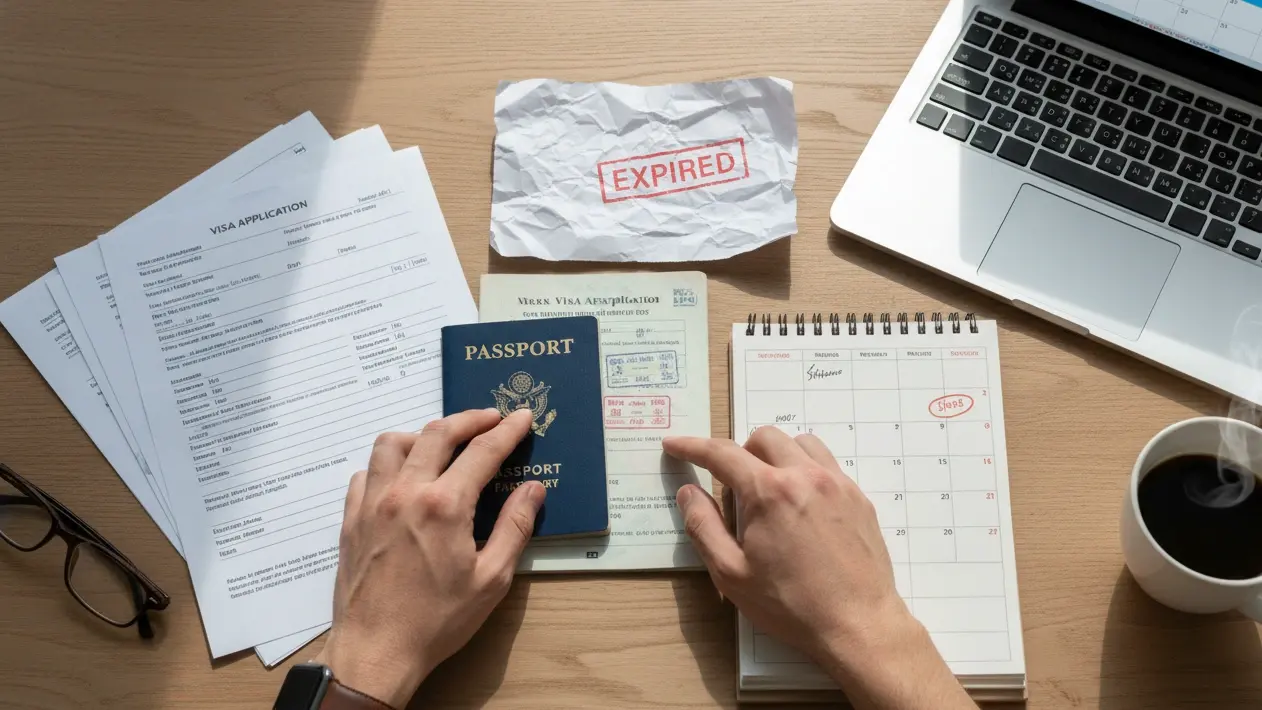
Short answer: If your arrival airport is not your final destination, show the complete journey: arrival airport, onward flight or ground connection, final city, accommodation and return route. Match each segment to your invitation, purpose, dates and visa checklist. A flight reservation for visa can support the route where the checklist permits it, but it cannot guarantee approval, boarding or entry.
Landing in one city and continuing to another is common for conferences, family visits and multi-city holidays. It becomes a visa-document problem when the itinerary ends at an airport the application never explains.
A reviewer should be able to follow the trip in chronological order without guessing how you reach the final destination, where you sleep or how you return. Include the internal flight, train or other connection when it materially explains the route.
Key facts
- Arrival airport and final destination can differ if the connection is documented.
- Show realistic transfer time and the correct airport or station for each leg.
- Invitation, accommodation, insurance and return evidence should follow the same route.
- Use provisional flight proof only where the current checklist permits it.
- Never submit fabricated or unverifiable booking information.
What each route document proves
- International flight reservation: entry and exit airports and dates.
- Internal transport proof: how you reach the final city and return to the departure point.
- Invitation or cover letter: why the final city and venue matter.
- Accommodation evidence: where you stay during each route segment.
For the wider travel-proof framework, read the complete flight reservation for visa guide before choosing the arrival airport.
Official-source check: The destination consulate or visa centre controls what route and transport evidence it accepts. Verify its current checklist directly. For US examples, consult State Department visa guidance and the IATA Travel Centre for carrier-facing checks.
Landing in Amsterdam and taking a train to Brussels the next day sounds simple, until an embassy asks why your flight itinerary ends at an airport that isn't your final stop. Visa officers see this pattern often, and if your paperwork doesn't explain it, they may read the gap as a red flag rather than a normal part of modern travel.
This guide breaks down how to build a flight reservation that accounts for the full trip, even when your plane lands somewhere other than your ultimate destination. You'll see how to sequence connecting segments, match dates across documents, and avoid the confusion that slows down approvals. Before you finalize anything, a well-structured dummy ticket can help you present that full route clearly to the embassy.
For the broader route-and-document framework, start with the complete flight reservation for visa guide before finalizing the arrival and onward cities.
Why Your Arrival Airport And Final Destination Don't Have To Match

Not every flight ends where the actual trip ends. Plenty of travelers land in one city and continue toward their real destination by train, bus, or a second flight, and this pattern is far more common than most visa applicants realize.
When Your Trip Continues By Train, Bus, Or Another Flight
A traveler heading to a wedding outside a capital city might fly into the nearest major hub because fares are cheaper, then take a two-hour train onward. Someone visiting family in a smaller town might land in a larger neighboring city instead, since it has more direct connections from their home country. Neither traveler is doing anything unusual. They are simply choosing the most practical or affordable route into the region.
The challenge appears when this logic isn't obvious on paper. A visa officer reviewing a flight itinerary that ends in a city the applicant never mentions visiting can read that gap as inconsistency rather than convenience. Making a flight reservation for a visa application requires a logical travel plan. That plan needs to connect every leg back to a stated purpose, not just show a single flight in isolation.
Common Scenarios That Confuse Visa Applicants
This mismatch between arrival airport and final destination shows up in a handful of predictable situations:
-
Flying into a hub city for lower fares before continuing by regional rail
-
Landing in one country and traveling onward to another for the bulk of the trip
-
Booking a connecting flight where the layover city has better airline availability
-
Choosing a route that involves an airport transit visa because a direct flight to the final city isn't available
Each of these is a normal part of planning international travel. None of them should count against a tourist visa or work-related application on its own. What matters is whether the applicant's paperwork tells the same story as their actual travel plans.
An open-jaw or multi-city itinerary commonly shows travel from one airport to another. That structure is well understood by visa authorities who process these files every day, so the shape of the trip itself is rarely the issue. The problem shows up when the itinerary looks incomplete, unexplained, or inconsistent with the rest of the visa file. Common travel structures for multiple stops or layovers must be coherent and logical for visa approval. The route needs to read like a plan a real traveler would actually follow, not a set of disconnected flights.
What This Means For How You Build Your Itinerary
If your arrival airport isn't your final stop, treat that gap as something to explain, not something to hide. The arrival airport should ideally match the first country or city visited. If it doesn't, your supporting documents need to fill in the rest of the story clearly.
That might mean adding a rail ticket, a bus reservation, or a second flight for the onward leg. It might mean writing a short note in your cover letter that walks through the route in order. Whatever method you choose, the goal is the same: give the visa officer a complete picture instead of a partial one.
Unverifiable or fabricated itineraries are the real risk on a multi-leg trip. A document that misstates a booking or cannot be checked can undermine the application and create airline or immigration problems. Use accurate travel proof and describe its status honestly; acceptance depends on the destination checklist.
Part of the issue is technical. A dummy ticket lacks a unique reservation number (PNR). This means there's nothing for an officer to check even if they wanted to verify it against an airline's system. A genuine temporary reservation and a fabricated document are not the same. If a reservation is used, it should have the status and reference details represented accurately and remain within its stated validity.
Some applicants search specifically for a dummy air ticket, hoping a different name changes the outcome, but the underlying limitation stays the same no matter what term is used: no verifiable PNR, no real segment, and no way for an officer to confirm anything if they choose to look.
Every country sets its own visa requirements for supporting travel documents, but the underlying expectation is consistent almost everywhere: the reservation should look like something a real traveler booked for a real trip. None of this means you need to buy full-price tickets before you have any approval. It means the reservation you do submit, whatever form it takes, needs to reflect a plan that actually makes sense from departure to final destination. Once that logic is clear, the next step is putting it into a format a visa officer can follow at a glance.
Structuring A Flight Itinerary That Explains Your Full Journey
A confusing itinerary doesn't have to be inaccurate to cause problems. Sometimes it just needs better formatting and a clearer order to stop raising questions it doesn't need to raise.
Listing Every Segment In The Right Order
All segments of a flight itinerary should be clearly presented in order for verification. Start with the outbound leg and end with the final return home, so nothing is left for the reader to piece together. If your arrival airport differs from your final destination, add the onward leg as its own clearly labeled segment rather than leaving it implied.
Flight itineraries must include specific dates, times, and routes that match corresponding documents. These may include hotel bookings, an invitation letter, or a conference registration, depending on the purpose of your trip. Travel proof for onward journeys may include tickets for secondary transport like trains or buses. These should sit right alongside your flight segments in the same document or file, not scattered across separate emails.
Itineraries should clarify transit routes and requirements for visa applications. This matters especially when a layover crosses into territory that has its own entry rules, since a short line noting the transit country and connection time removes any doubt about why that stop appears on the route.
A booking reference, sometimes called an airline booking reference, ties every leg of a connecting flight together inside the airline's system, and keeping that reference visible on your printed itinerary makes it easier for an officer to look up during review. If your onward leg is one of several separate bookings made with a different airline, list its own booking reference alongside the main itinerary rather than assuming the connection will be obvious on its own. Double-check the flight details on each leg before submission, since a single mismatched date or airport code is often what triggers a follow-up request.
Using Exact Airport Codes And Flight Numbers
Using exact IATA airport codes in itineraries prevents ambiguity in visa applications. Writing the full airport name alongside its code (for example, Charles de Gaulle, CDG) leaves no room for a reviewer to guess which airport you mean in a city with more than one.
A flight reservation must include flight numbers and travel dates. This applies to every leg of the trip, not just the first one. If your trip involves a connecting flight, list both flight numbers separately along with the layover duration, so the sequence reads as one continuous plan rather than two unrelated bookings.
Here's what a clean segment listing typically includes:
-
Departure and arrival airport codes for each leg
-
Flight number and airline for each leg
-
Departure and arrival times, including layovers
-
Total journey duration from first departure to final arrival
Visa authorities may request a flight itinerary without requiring full payment. They still expect that itinerary to be complete and specific rather than vague about dates or routing.
Matching Your Itinerary To Hotel Bookings And Other Documents
The final destination on the flight booking must match hotel bookings or activities. Whichever it is, it should be listed clearly elsewhere in your file. If your flight itinerary shows you landing in one city and continuing to another, your accommodation should reflect that same sequence, with dates that don't overlap or contradict each other.
It's crucial to ensure the itinerary reflects all supporting documentation for consistency. A hotel reservation that starts a day before your listed arrival, or a return flight that departs before your last night's stay ends, creates exactly the kind of inconsistency that draws follow-up questions.
Schengen visa applications often require a round-trip flight reservation. Visa applications often require a round-trip flight reservation. This isn't a Schengen-specific quirk; it shows up across many other regions too. A confirmed return ticket, or at minimum a return flight reservation, rounds out the itinerary and shows the visa officer exactly how the trip concludes, not just how it begins. If your route allows it, a direct flight for the return leg can simplify the paperwork, though a connecting flight home is just as acceptable as long as it's documented with the same care as the outbound journey.
A flight reservation includes a Passenger Name Record (PNR). It also lists flight numbers and travel dates for every leg you plan to fly. A flight reservation shows proposed travel without full payment. A flight reservation shows intended travel without full payment. Different embassies tend to phrase that same idea in slightly different ways. Visa authorities may accept a flight reservation instead of a paid ticket. That's exactly why the format and detail of your reservation matter so much. A flight reservation is not valid for boarding without ticketing. It should never be mistaken for the ticket you'll eventually need to fly.
Cross-check every date on your visa application form against your flight itinerary, since a visa form asking for exact travel dates leaves little room for discrepancy. Visa authorities assess applications based on overall documentation, not ticket cost. A reservation that's well organized and internally consistent often carries more weight than an expensive one that raises questions. A fully paid ticket is not universally required for visas.
This holds true across most visa categories, not just tourist ones. Schengen visa applications often accept flight reservations instead of paid tickets. That's exactly why a well-built reservation deserves the same attention as a real booking. Once your itinerary and supporting documents line up, the next thing to understand is how an officer actually checks that everything you've submitted is real.
Use the visa flight itinerary requirements guide to check that each airport, connection and return segment is explained.
What Visa Officers Check When Your Journey Isn't A Simple Round Trip

A multi-leg trip gives an officer more to review, not less. Knowing what they're actually looking for helps you prepare a file that holds up under that closer look.
How Officers Verify Your Reservation Against Airline Systems
Visa authorities can verify flight reservations through airline systems. This is exactly why a reservation needs to be genuine rather than something assembled to merely look convincing on paper. A valid Passenger Name Record (PNR) must be verifiable on the airline's website. A genuine flight reservation includes a Passenger Name Record (PNR). That single detail is precisely what makes this kind of check possible at any point in the process.
Fake or unverifiable itineraries can lead to application denials. This risk multiplies on a trip with several segments, since each leg is a separate point where the reservation can be checked. Visa officers verify if the itinerary aligns with the applicant's stated plans. They do this by comparing your travel dates, your invitation letter, and your accommodation against what the flight segments actually show.
It helps to know the difference in terminology here. An actual flight ticket, sometimes called an actual airline ticket or simply an actual ticket, is a fully issued airline ticket, while a reservation is a placeholder that shows intent without locking in payment. Visa officers understand this distinction well, and using the correct term in your cover letter avoids any confusion about what you're actually submitting with your file. Departure dates that shift after submission can also slow down visa processing, since the file may need to be re-checked against updated documents before a decision moves forward.
Proving Onward Travel When You Continue By Land
When your arrival airport isn't your final destination, the onward leg deserves its own proof, not just a mention in a cover letter. Matching the passport details on the flight itinerary is essential for visa applications. This applies to every ticket in the sequence, including the connecting or onward one.
A valid flight reservation should match the applicant's travel plans. This means matching the specific route, not just the general direction of travel. If you're continuing by train or bus after landing, keep that secondary ticket in the same format and level of detail as your flight documents: names, dates, and confirmed segments, all matching the rest of your visa file.
Keeping Passenger Details Consistent Across Every Document
Small mismatches cause outsized problems. A middle name spelled differently between your passport and your flight itinerary, or a departure date that shifts between your reservation and your cover letter, forces an officer to pause and ask why.
Keep these details identical across every document in your visa file:
-
Full legal name exactly as it appears on your passport
-
Passport number and expiry date
-
Every travel date mentioned, from first departure to final return
-
Airport names and codes for each segment, spelled the same way throughout
Requirements also vary slightly by region, so it helps to know which framework applies to your trip. The EU visa code sets baseline documentation standards across the Schengen area, while UK visas follow a separate framework with their own expectations for proof of onward travel. If your route touches more than one Schengen country, keep each leg's documentation equally thorough, since any one of them could end up being the point of entry review. Whatever region you're applying in, keep your reservation code accessible in case it's requested during an interview.
Getting this right doesn't guarantee an outcome, but it removes an entire category of avoidable questions. With the verification side covered, the remaining decision is more financial than procedural: how much of your actual airfare, if any, to commit before you know the result.
Reservation Or Paid Ticket? Managing Risk On Multi-Stop Trips
The financial side of a multi-leg trip carries more exposure than a simple round trip, since there are more segments that could go to waste if plans change.
Why Buying Early Can Cost You More Than It Saves
Many embassies advise against buying tickets before visa approval. Visa authorities advise against buying tickets before visa approval. There's a straightforward reason for this. A paid ticket does not guarantee a visa decision. No amount of money spent on it changes that. Purchasing a ticket before visa approval can lead to financial loss. That's the real risk if the outcome doesn't go your way.
Non-refundable tickets can result in total loss if a visa is denied. On a trip with multiple flights, that loss applies to every segment you've already paid for. Cancellation fees can significantly reduce any potential refunds. This applies even on the segments where a refund is technically possible. Airlines may charge fare differences for changing tickets after purchase. That's worth planning for if your travel dates need to shift once your visa file is complete.
Travelers who purchase tickets too early sometimes lose money they didn't need to risk in the first place, especially on a multi-stop trip where a single schedule change affects several segments at once instead of just one.
How Long A Reservation Stays Valid Before You Need To Act
A flight reservation does not require full airfare payment. This is exactly what makes it useful during the application stage, when the outcome is still uncertain. Some airlines allow holding a fare for 24 to 72 hours. A reservation submitted specifically for visa purposes often has a longer runway than that.
Flight reservations may remain valid for approximately two weeks. Airlines can impose a deadline for ticket issuance on reservations. After that point, the hold typically expires automatically. A flight reservation does not guarantee a locked fare. Prices can shift once that window closes, even on a reservation that looked solid a few days earlier.
Reservations should not be obtained too early to avoid expiration. Timing it too far ahead of your visa appointment or submission date defeats the purpose of holding a current one. Visa applications may require a current flight reservation upon submission. A reservation that's already expired by the time you apply won't serve its purpose. Expired reservations do not automatically lead to visa application refusal. Officers generally understand that dates sometimes need to be refreshed.
Keep your onward reservation aligned with your intended travel dates from the very first draft of your file, since revising your final travel plans after submission often means resubmitting several documents at once instead of just one.
Choosing A Reservation Method That Fits A Multi-Country Trip
Visa authorities often prefer flight reservations over paid tickets. A flight reservation shows intended travel without financial risk. That combination matters most on a trip built from several connecting segments rather than one simple pair of flights. A valid flight reservation should match the applicant's travel plans down to the route and dates, not just the general direction of travel. A temporary hold or fully refundable ticket can be used for visa applications instead of a non-refundable ticket.
A fully paid ticket includes an e-ticket number. That level of commitment usually isn't necessary or advisable for a multi-stop trip still awaiting approval. Choosing a reservation service that issues a clear PNR, correct flight numbers, and dates that match your full route gives you the same credibility with an officer, without the same financial exposure if plans need to change before your appointment.
A provisional itinerary built with a major carrier, whether that's a smaller regional airline or a larger international one like Air France, still needs the same level of detail as any other operator's booking: correct flight numbers, matching dates, and a valid booking reference for every leg. Pairing your reservation with travel insurance is worth considering on a multi-country trip, since it offers some protection if delays or cancellations affect one of several connecting segments. Keep hotel dates aligned with each leg of the journey too, so the accommodation timeline never contradicts the flight timeline sitting next to it in your file.
Whichever reservation channel you use, whether that's a travel agent, a travel agency, a reservation service, or booking directly through the airline website, make sure the confirmation includes a ticket number or PNR that can be looked up independently. That single detail does more for your credibility than any amount of extra paperwork around it.
If the final route needs provisional flight proof, the flight reservation for visa service can help document the complete journey where permitted.
Planning A Route That Actually Makes Sense
A flight itinerary doesn't need to be a straight line to be convincing. It needs to be complete, consistent, and easy for an officer to follow from first departure to final return, even when the arrival airport is only the first stop in a longer route.
Build your reservation around the trip you're actually taking, keep every document lined up with the same names and dates, and treat the onward leg with the same care as the flight itself. A visa decision rarely hinges on any single document, but a clean, consistent reservation removes one more variable from the visa outcome, whether you're departing from your home country for the first time or you've traveled abroad many times before.
Whether you eventually need a simple flight ticket, a full round-trip flight reservation, or a dummy flight reservation while you wait on a decision, hold off on booking final tickets until approval is in hand. If you'd like that full route reflected clearly in one provisional reservation, BookForVisa.com can help prepare the document that shows the entire journey in a format built for visa review.
Need a route document that explains the full journey? Keep the arrival airport, onward connection, final city, accommodation and return plan consistent before submitting.
Prepare your visa reservationFAQ
Can my arrival airport differ from my final destination?
Yes, when the onward route is plausible and documented and the destination checklist permits the itinerary.
Do I need proof of an internal flight or train?
Include it when it explains a material gap between the arrival airport and the final city or when the checklist requests it.
Should my hotel be in the arrival city or final destination?
It should match where you actually plan to sleep on each date. Explain any first-night or transfer accommodation clearly.
Can I use a temporary reservation for a multi-stop route?
Only where the current checklist permits provisional proof. Make sure the reservation accurately reflects the route and its status.
What if my return airport differs too?
Show the open-jaw or multi-city logic explicitly and match the return segment to your cover letter and accommodation.
Does a complete itinerary guarantee visa approval?
No. It removes avoidable route confusion, but the full application and destination rules determine the decision.
Friendly reminder: BookForVisa provides travel-proof documents for planning and visa-application support. Requirements vary by destination, consulate, visa category and applicant situation. A flight reservation can support a file, but it does not guarantee approval, boarding or entry.