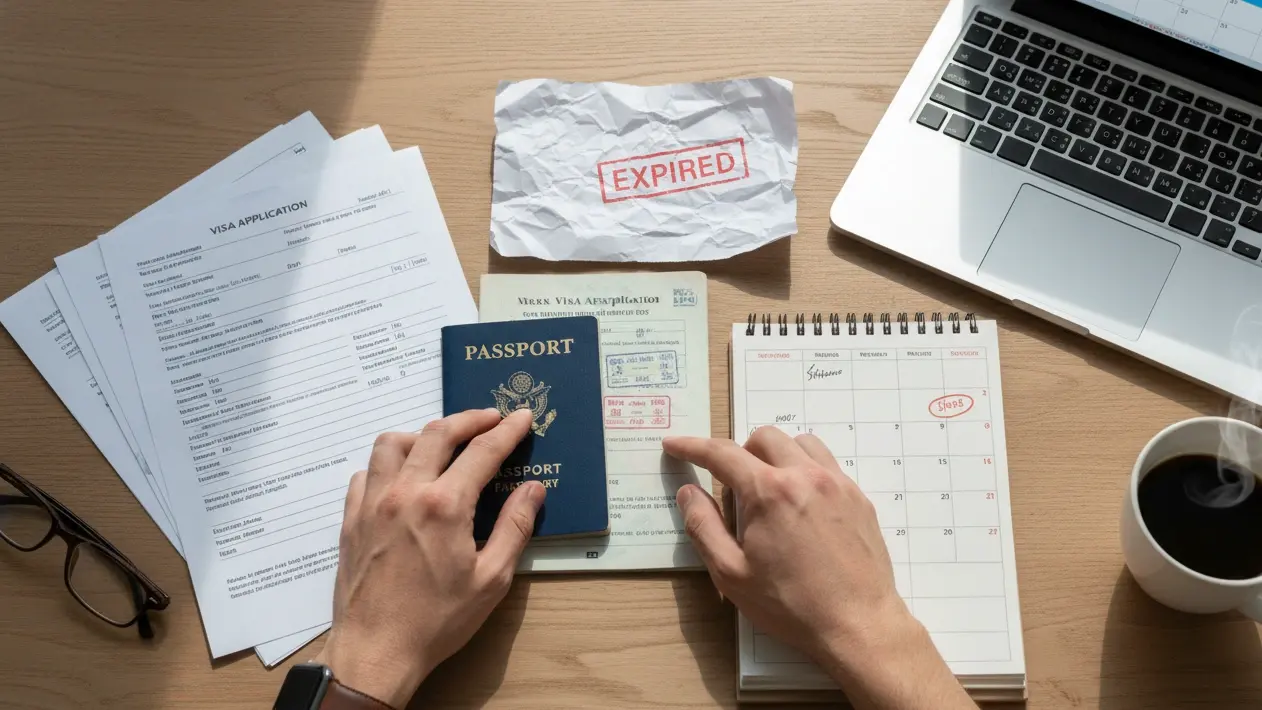
Short answer: If your conference is outside the city where your plane lands, show the complete route: international arrival, onward flight or ground connection, conference-city accommodation and return to the departure airport. Match every segment to the invitation, conference dates and visa checklist. A coherent itinerary can support a visa file, but it cannot guarantee approval, boarding or entry.
A conference venue outside your arrival city is not automatically a problem. It becomes a documentation problem when the itinerary stops at the airport and never explains how you reach the event, where you stay or how you return.
Visa reviewers need one chronological story, not two disconnected bookings. Name the arrival airport, the onward connection, the conference city, the accommodation and the return route, then keep those details consistent across the application.
Key facts
- Landing in one city and attending an event in another requires an explained connection.
- Every leg should have plausible dates, airports and transfer time.
- Conference invitation, accommodation, insurance and flight proof must tell the same story.
- Use a reservation where the checklist permits provisional travel proof; do not present it as a paid ticket.
- Destination-specific rules control whether internal flights, trains or other connections need separate evidence.
What each route document proves
- International flight reservation: intended entry and exit dates and airports.
- Internal flight or train proof: how you move from the arrival city to the conference venue and back.
- Conference invitation: purpose, host, venue and event dates; it does not replace transport evidence.
- Accommodation proof: where you sleep in each city, including nights around the transfer.
US and India perspective
Applicants in India may submit through a destination-specific document centre, while US applicants may follow a consular checklist. In both cases, the destination authority—not the applicant’s departure country—controls what route and conference evidence is required.
For the broader travel-proof layer, review the flight reservation for visa guidance before selecting the arrival and return airports.
Official-source check: The destination embassy or consulate controls the conference-visa checklist and any evidence required for internal travel. For US examples, verify current State Department visa guidance and applicable visa-service information; use the IATA Travel Centre for current carrier-facing checks.
Your conference is in one city. Your flight lands in another. For visa applicants, that gap between the arrival airport and the actual event venue causes more confusion than almost any other part of the itinerary.
A visa officer reading your application wants a clear travel plan, not two disconnected legs that read like separate trips. When your arrival city and your destination country schedule don't line up, even a genuine business trip can look shaky.
This guide walks you through building a flight itinerary that accounts for both cities and keeps your travel dates consistent throughout. Match your dummy ticket to both legs of this exact conference route before you submit.
For the broader travel-proof framework, start with the complete flight reservation for visa guide, then add the ground connection between the arrival airport and venue.
Why Your Plane Lands Far From Where The Conference Actually Happens

Most visa applicants assume their flight itinerary should end at the conference door. In reality, your international flight usually lands somewhere else entirely, and your application needs to explain that gap clearly.
Why International Flights Skip Straight To Regional Hubs
Airline ticket routes are built around major hub airports, not small regional cities. If your conference is happening in a smaller town, your flight booking will almost always land you at the nearest major hub instead.
That's simply how departure and arrival airports are structured across most countries, and recognizable airport codes for these hubs make the pattern easy to spot. Even well-organized conferences rarely sit inside an international gateway city.
This isn't a red flag on its own. It's just how global flight reservations work, and a flight reservation shows intended travel dates regardless of where the final venue happens to be. What matters is what happens after you land.
The visa application process rarely expects your flight to end exactly at the venue door. What it does expect is a route that a reviewer can trace from your home country to the event and back, without any unexplained jumps along the way.
Mapping The Gap Between Arrival Airports And Conference Cities
A visa officer needs to see two things clearly: where you land, and how you get from there to the conference. Internal transportation proof must document how you plan to travel from the arrival city to the conference city, whether that's a connecting flight, a train, or a shared transfer.
Key components for this kind of itinerary include your international arrival details and your conference details, placed side by side so the connection between them is obvious at a glance. Leaving out that connection is one of the most common reasons an otherwise solid flight plan looks incomplete.
Visa officers need to see a clear travel narrative whenever the arrival city differs from the conference location. Without it, your application reads like two unrelated trips stitched together rather than one coherent journey.
A clear route usually shows the journey from the arrival airport city to the conference city in a way that's easy to trace, and it typically includes:
-
Your international arrival airport and flight numbers
-
The method of internal transportation to the conference city
-
An estimated arrival time at the conference venue
-
The return route from the conference city back to the arrival airport
It helps to picture how a visa officer actually reads these documents. They rarely have time to research an unfamiliar city's geography, so your itinerary is doing that explanatory work for them. A route that spells out each step in plain terms saves them the trouble of guessing whether your trip makes sense.
This is especially true when the arrival city and conference city sit in different regions of the same country, or even in neighboring countries. The physical distance itself isn't the problem. An unexplained physical distance is.
What This Means For Your Supporting Documents
Every travel leg must align with other application documents to avoid processing delays, including your cover letter, invitation letters, and employer letter if the trip is work-related. A visa officer comparing these documents side by side should see the same story repeated everywhere, not two versions of your trip.
Creating a flight itinerary for a visa application requires showing a logical travel plan from start to finish, not just a single flight number pasted into a form. Your itinerary should reflect a coherent travel plan that a stranger, reading it for the first time, could follow without needing to ask you a single question.
Ensure your itinerary reflects the full route with complete logical connections between cities, from your home country all the way to the conference venue and back again. Your flight document set should also match your bank statements and application form in terms of dates, so nothing about your travel plan looks improvised after the fact.
Some applicants try to simplify things by leaving the internal leg out entirely, hoping the visa officer won't notice the distance between the arrival city and the venue. This usually backfires, since the gap is easy to spot once someone checks a map against your invitation letters.
A more reliable approach is to treat the internal leg as its own small piece of the puzzle. It doesn't need to be expensive or elaborate. It just needs to exist on paper, with a date and a mode of transport that matches the rest of your travel plan.
There's also a practical reason to plan this leg carefully rather than treating it as an afterthought. Conference organizers often publish shuttle schedules, recommended train times, or partner transfer services for exactly this situation, and using one of those options gives your itinerary a source you can point to if questioned.
If no official transfer option exists, a standard commercial booking works just as well. What matters far more than the provider is that the timing makes sense: your internal leg should land you at the conference city with enough buffer to check into your accommodation and attend the opening session without a rushed connection.
Once you understand why the gap exists, the next step is building a flight plan that actually connects both cities in a way visa officers recognize.
Structuring A Two-Leg Flight Plan That Tells One Consistent Story
A flight itinerary with two separate legs can either read as one coherent trip or two unrelated bookings. The difference comes down to how you structure it.
Booking The International Leg Into Your Arrival City
Visa applications should include a complete international flight booking that covers the journey from your home country to the arrival airport in the destination country. A flight itinerary shows proposed flights and travel details clearly enough that anyone reviewing it can reconstruct your route without guesswork.
This flight reservation shows your intended travel dates and gives the visa officer a starting point for the rest of your itinerary. This first leg should include:
-
Your departure airport and departure city in your home country
-
The arrival airport in the destination country
-
Flight numbers for both outbound and connecting segments
-
A departure date that matches your visa application form
Adding The Internal Connection To The Conference City
This is where a multi-city or two-leg structure becomes useful, since it lets you align the host venue's schedule and travel documents without forcing the arrival city and the conference city into a single, misleading flight number.
Instead of pretending the conference sits inside the arrival city, your itinerary should openly show a second leg, whether by air, rail, or road, that carries you from the arrival airport to the actual venue in line with the event schedule.
Internal transportation details don't need to be as formal as an international airline ticket. A booked train ticket, a transfer confirmation, or a simple travel plan note explaining the connection is usually enough, as long as it's consistent with your flight and hotel reservations for both cities.
It's also worth checking whether your conference organizer has published an official arrival guide, since many international events now include one specifically for attendees flying in from abroad. These guides often list the exact hub airport, recommended transfer options, and typical travel times, which makes your own itinerary easier to justify if anyone asks about it.
Keeping Every Flight Number And PNR Verifiable
Provide a verifiable booking reference that includes an active PNR and confirmation codes for every leg you submit, since a visa officer may want to check one before making a decision. A verifiable flight reservation reference removes the guesswork from an otherwise ordinary review.
A simple chronological itinerary helps the visa officer understand your travel plan without having to reorder scattered booking confirmations themselves. Listing each leg in the order it actually happens does most of the explanatory work for you.
Include conference registration and invitation letters with exact dates and venue details alongside your flight numbers, since these are the documents a visa officer will use to check that your route actually makes sense.
Before you move on, double-check that:
-
Flights are listed in the order you'll actually take them
-
Each leg carries a PNR and confirmation number
-
Flight details stay consistent with your application form and cover letter
It helps to think of the two legs as one continuous narrative rather than two separate bookings. The international leg answers "how did you get into the country," and the internal leg answers "how did you get to the event." Together, they should read as a single, uninterrupted trip.
Applicants who skip this step often end up submitting a flight reservation that stops at the arrival airport, leaving the visa officer to guess how they planned to reach the conference at all. That guesswork is exactly what a clear two-leg structure removes.
It also helps to keep a single reference document, even a simple one-page summary, that lists both legs together with their dates, cities, and confirmation numbers. This isn't a formal requirement in most cases, but it gives you a quick way to check your own itinerary for gaps before anyone else does.
Keep a copy of that summary alongside your other supporting documents so you can hand it over quickly if it's ever requested during a visa interview.
Some applicants worry that a two-leg structure looks more complicated than a single flight, and therefore riskier. In practice, the opposite is usually true. A clearly labeled two-leg itinerary shows more planning effort than a vague single booking that leaves the middle of the trip unexplained.
With both legs booked and verifiable, the next challenge is making sure every date across your application tells the same story as your itinerary.
Use the visa flight itinerary requirements guide to cross-check the conference dates, entry city and onward connection before submitting.
Aligning Your Travel Dates With The Conference Schedule And Your Application

Dates are where most flight itineraries fall apart, especially when a conference schedule doesn't perfectly match your travel dates.
Matching Departure And Arrival Dates To The Event Schedule
Your travel dates should align tightly with the official dates of the conference listed on your invitation letters and registration confirmation. Flight itineraries must match your visa application dates and purpose, so a trip listed as business travel should show flight dates that actually bracket the event.
Flight reservations must match visa application dates and details exactly, right down to the departure date and the return date you've declared elsewhere on the form. Flight dates must match your visa application dates, and a mismatch between your declared dates and your actual flight reservation is one of the fastest routes to a visa refusal.
Why Even A One Or Two Day Gap Raises Questions
Travel date gaps can lead to visa application refusals if they're left unexplained, and even a small gap is worth double-checking before you submit. A one-day gap between your invitation dates and your arrival date can trigger a credibility question during your visa interview.
Missing travel dates can create uncertainty for visa officers reviewing your application form. That uncertainty sometimes causes more damage than a slightly wrong date would, since an officer can't easily tell if a missing date is an oversight or a sign of a poorly planned trip.
A two-day gap can be acceptable if it supports a clear purpose, such as arriving early to recover from jet lag or attending pre-conference orientation. Unexplained gaps, on the other hand, can lead to visa denial, and in some cases outright visa rejection.
Some Schengen countries illustrate this well. Cyprus visa applications commonly require round-trip flight pre-bookings, even though Cyprus advises against purchasing tickets before visa approval is granted. A return flight reservation helps demonstrate your intent to leave Cyprus, and this same logic carries over to most other Schengen country applications.
A confirmed ticket may carry refund penalties if it's canceled later, which is exactly why many applicants prefer a reservation over a purchased ticket at this stage. A purchased ticket confirms paid carriage for travel, but that guarantee comes with financial risk attached if your travel plan changes before your visa is decided.
Return flight dates should fall within the visa validity period, whether you're applying for a Schengen visa, filling out a Schengen visa application form for a specific member state, or applying to any other Schengen country. This holds whether your route touches one destination or multiple countries across the Schengen area.
Keeping Hotel Dates And Insurance Dates In Sync
Travel dates must align with accommodation and insurance dates across every document you submit, not just the flight itinerary itself. Accommodation bookings should align with the travel timeline you've already established through your flight reservation, so nothing feels out of step.
Your hotel booking and accommodation details should cover your stay in both the arrival city and the conference city, matching each leg of your itinerary rather than only one of them. Accommodation bookings should cover your stay across both locations, since a gap here raises the same questions as a gap in your flight dates.
Your travel insurance and travel medical insurance need the same treatment. Insurance dates should span your full intended travel dates, and a mismatch between flight and accommodation dates is a common error that's easy to fix with a quick side-by-side check before submission.
It's worth building a simple side-by-side check before you submit anything. Line up your invitation letter dates, your flight dates, your hotel dates, and your insurance dates in one place, and scan for anything that doesn't match exactly.
This kind of check takes a few minutes but catches the small inconsistencies that are easy to miss when each document was booked separately, sometimes days or weeks apart from the others.
It's also worth remembering that visa officers are comparing your documents against each other, not just against a checklist. A flight itinerary that looks perfect in isolation can still raise questions if your hotel booking starts two days later or your travel insurance expires before your declared return date.
If your trip includes any pre- or post-conference travel, such as a short visit to another city before flying home, make sure those extra days are reflected consistently across your flight itinerary, accommodation details, and insurance coverage as well. An unexplained extra leg can raise the same kind of questions as an unexplained gap.
Once your dates line up across every document, the final step is making sure the smaller details, from your name to your return route, hold up under review.
Final Checks Before You Submit Your Itinerary
A well-structured itinerary can still get flagged over small details that are easy to overlook right before submission.
Getting Your Name And Route Details Exactly Right
Flight reservations should include your full name as it appears on your passport, without abbreviations or nicknames that don't match your travel documents. A passport spelling mismatch, even a single letter off, can create unnecessary friction at your visa interview or at the departure airport itself.
Double-check your flight numbers, departure city, and destination country details against your application form. Relevant documents should tell the same story from your cover letter to your bank statements, without contradicting your declared dates anywhere.
Planning The Return Journey Out Of The Conference Country
Return connections should map out the journey from the conference city back to the arrival city, followed by your onward travel home. A round-trip ticket, or a clearly documented structure using a one-way ticket paired with a separate return ticket, proves your intent to leave once the event ends.
This matters just as much for entry and exit across borders. If your trip touches more than one country in the Schengen area, your flight plan should show entry and exit points that match your declared route and return date.
If your conference happens to sit near a border, or if your internal transportation option happens to pass through a neighboring country, make a note of that in your travel plan as well. A route that quietly crosses a border without explanation can raise the exact same red flag as a missing internal leg.
Deciding Between A Paid Ticket And A Temporary Flight Itinerary
Many visa applicants weigh a paid ticket against a temporary flight itinerary before their visa is approved. Temporary reservations are sometimes used as temporary flight itineraries for visa applications precisely because they document your intended travel dates without locking you into a fare you might not use.
A temporary reservation, or dummy flight ticket, shows your intended travel without the financial risk of a fully paid airline ticket that might go unused. A flight reservation shows intended travel without financial risk in exactly this way, which is why so many applicants choose one over a purchased fare at this stage of the process.
A dummy air ticket works well specifically because it's a flight reservation, not a purchased fare, so canceling it if your plans shift costs you nothing.
No travel agency or travel agent can guarantee a visa decision, but a verifiable, correctly dated itinerary can reduce one avoidable documentation concern. Once your visa confirmation arrives, you can adjust your route or book final tickets with confidence.
This choice matters even more when a conference venue sits outside your arrival city, since you're effectively committing to two separate legs rather than one. Holding both as reservations, rather than paid fares, gives you room to adjust either leg if your visa timeline shifts or the event schedule changes before departure.
Whichever option you choose, treat the decision as part of the same planning process as everything else covered here. A route that connects two cities clearly, dates that agree across every document, and a name that matches your passport exactly will carry far more weight with a visa officer than the price you paid for any single flight.
When the route is ready, the flight reservation for visa service can help keep the documented segments aligned with the application.
Turning A Split Itinerary Into A Confident Visa Application
A conference in one city and a flight landing in another doesn't have to complicate your visa application. Once your route, travel dates, and supporting documents tell the same story, the gap between arrival and event becomes a small detail instead of a red flag.
Keep your international and internal legs consistent, match every date to your invitation and hotel dates, and double-check your name against your passport before you submit. If you need a flight reservation built around this exact route, BookForVisa.com can map a two-leg itinerary to your actual conference schedule.
Need a coherent conference travel itinerary? Keep the arrival airport, onward connection, event venue, hotel dates and return route aligned before you submit your visa file.
Prepare your visa reservationFAQ
Can I land in one city and attend a conference in another?
Yes, when the route explains how you travel between the cities and the dates, transport and accommodation match the conference invitation and checklist.
Do I need proof of the internal connection?
If the destination checklist or your route makes it material, include the internal flight, train or other transport evidence and allow realistic transfer time.
Should the conference invitation show the arrival airport?
Not necessarily, but your cover letter or itinerary should connect the arrival airport to the venue city and explain the transfer.
How should I handle a long gap between arrival and the conference?
Account for the nights with accommodation proof and explain the purpose of the intervening stay. Do not leave unexplained dates.
Can I use a temporary flight reservation before the visa decision?
Only where the destination checklist permits provisional proof. Describe it accurately and keep the route consistent with the final plan.
Does a coherent itinerary guarantee visa approval?
No. It addresses one documentation issue only; the complete application and destination rules determine the decision.
Friendly reminder: BookForVisa provides travel-proof documents for planning and visa-application support. Requirements vary by destination, consulate, visa category and applicant situation. A flight reservation can support a file, but it does not guarantee approval, boarding or entry.