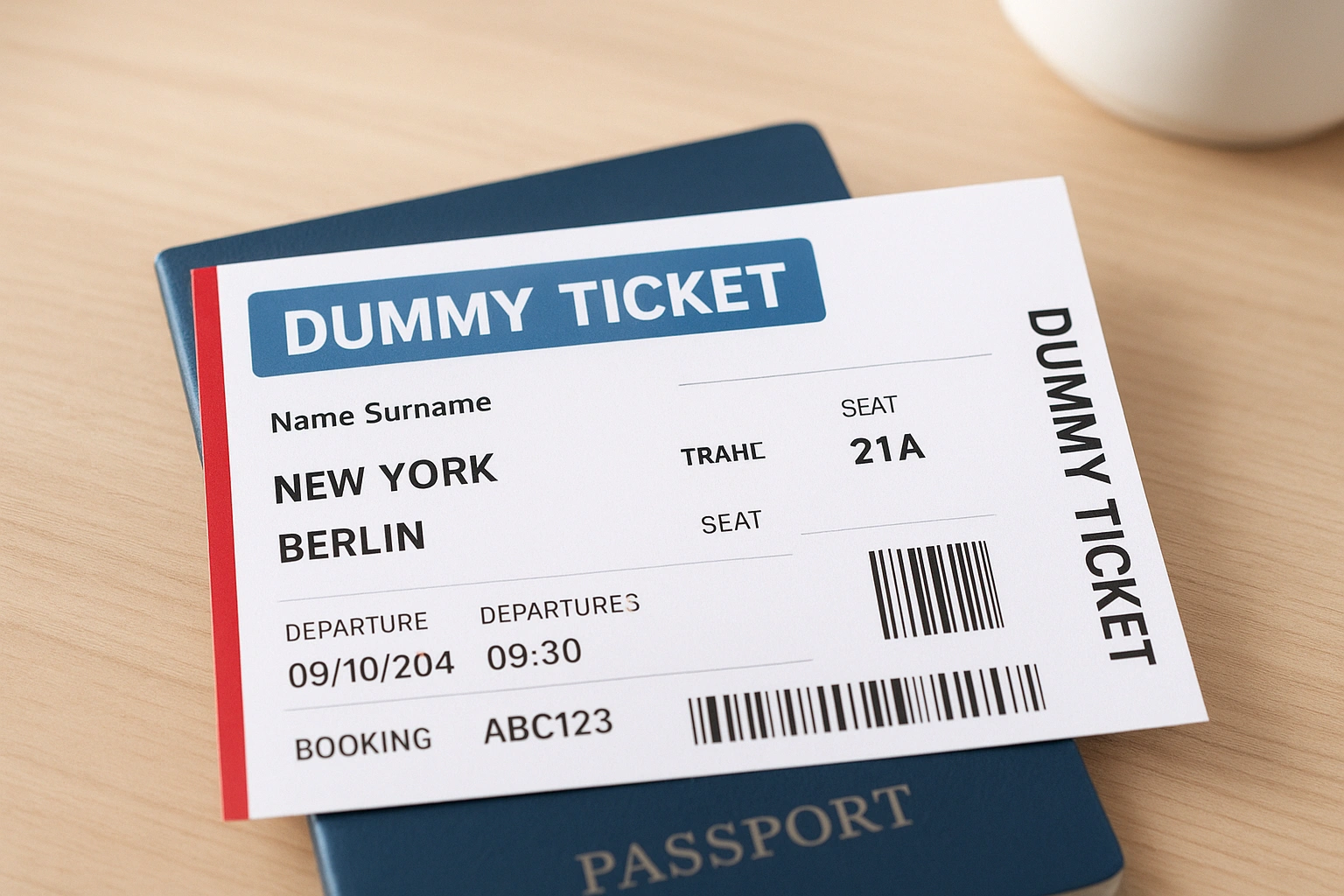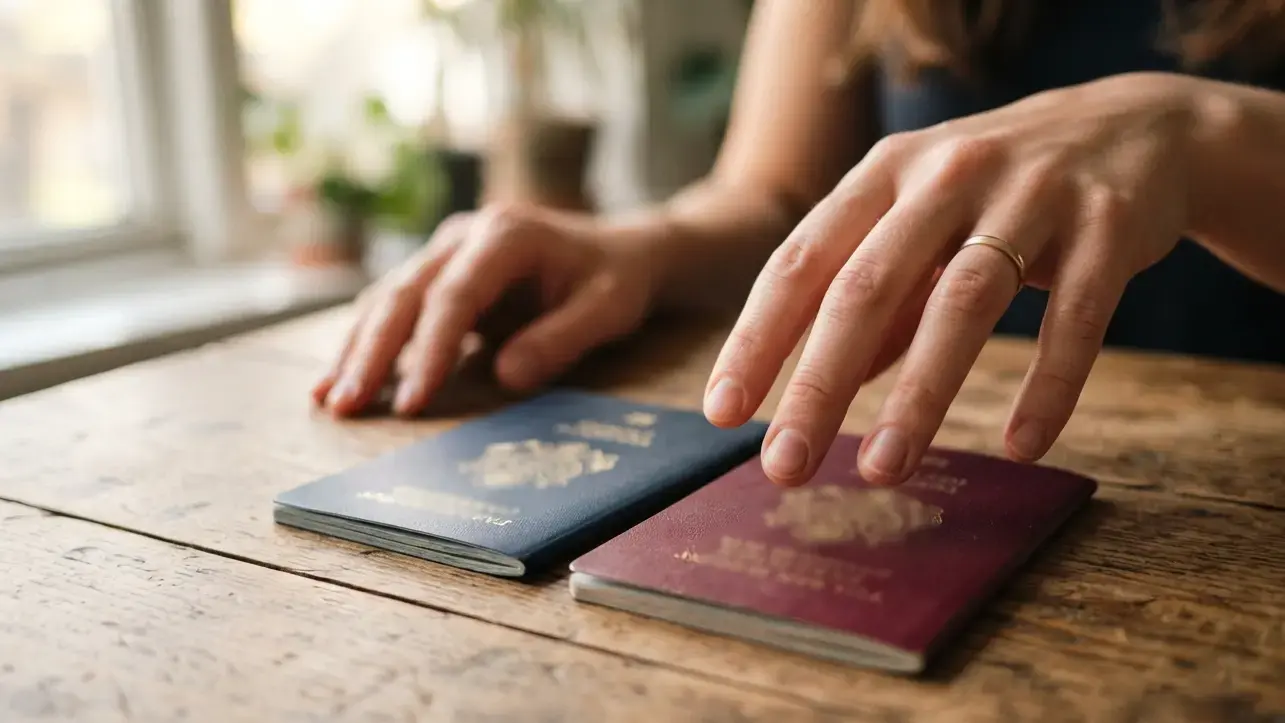
Two passports rarely cause problems until a visa officer compares your travel proof against the passport you declared. One mismatched name, one departure city that belongs to the other nationality, one return date that does not match your country of residence, and a clean application can start to look inconsistent.
Dual nationality is not a problem by itself. Officers see dual nationals every day. The problem appears when the file cannot answer a simple question: which identity is this trip built around? This guide walks through the real decisions dual nationality creates before you create a reservation: which passport controls the application, how to handle different name spellings, how to build return logic when “home” is not one country, and how to avoid transit or jurisdiction mistakes that make the file harder to read.
- Your reservation should match the passport submitted with the visa application.
- Name spelling should follow the passport bio page exactly.
- The departure city should support your residence and consular jurisdiction.
- Return or exit proof should match where you actually live, work or study.
- Transit rules can change depending on which passport you travel with.
- Old reservations are risky when passport, residence or visa category changed.
- Official-source check
- When Your Second Passport Becomes a Visa Officer Question
- Choose the Right Passport for the Reservation
- The Visa Eligibility Trap for Dual Nationals
- Return Flight Logic When Home Is Not One Country
- Consular Jurisdiction and Departure City
- Transit and Layover Rules by Passport
- Family and Group Applications With Mixed Passports
- Countries That Do Not Recognize Dual Nationality
- Practical Checklist Before You Create the Reservation
- FAQ
When Your Second Passport Becomes a Visa Officer Question

Holding two passports often works in your favor at the airport. In a visa file, it can do the opposite if the documents do not line up. The moment your application shows two nationalities, the officer may read every document against one practical question: which passport is this person actually using for this trip?
Nationality, citizenship and country of birth are not interchangeable
Many visa forms ask for current nationality, previous nationality, other nationalities held, citizenship, country of birth or residence. Those fields look similar, but they are not the same. A dual Canadian-Lebanese applicant, for example, may declare a Canadian passport while also showing a Lebanese birthplace. That is not automatically a problem. It becomes a problem when the reservation, departure city or return logic quietly points to a different identity than the passport being submitted.
If your form asks for all nationalities held, answer truthfully. Then build the travel proof around the passport that controls this specific application. The reservation does not need to showcase every passport you own. It needs to match the passport, name and route used for the visa file.
- Use one passport as the anchor document for the application.
- Keep the same spelling across the form, reservation and supporting letters.
- Do not let old booking profiles auto-fill details from the other passport.
- Explain unusual residence or departure-city logic in the cover letter, not inside the booking itself.
The passport you declare and the passport you fly on should not contradict each other
This is where dual nationals make the most avoidable mistake. They declare one passport on the visa form, but create the reservation under a saved airline profile tied to the other passport. The booking then shows a name spelling, nationality, document number or travel pattern that does not match the application.
Before creating the reservation, confirm which passport number goes on the visa form, which exact name spelling appears on that passport, and which departure city makes sense for someone applying under that document. A visa reservation that mirrors the declared passport removes an entire category of questions before they are asked.
Real patterns that create extra scrutiny
The reservation becomes especially important when the file already contains a detail that may slow the first read. A recently issued second passport, a birthplace that differs from current nationality, or a residence country that does not match either passport can all be normal. But the travel proof has to make the normal explanation obvious.
Officers are not usually trying to punish dual nationality. They are trying to confirm identity, eligibility, purpose and return logic. If the reservation adds another unanswered question, it makes the file less efficient. If it matches the declared passport and current residence, it helps the officer move through the file without stopping to reconcile two identities.
Dual nationality does not make an applicant suspicious, but certain patterns deserve extra care. A second passport issued close to the application date may invite questions if the reservation seems built around the newer identity. A second nationality with very different visa access can change how officers read the file. A reservation that belongs clearly to neither passport makes the application harder to trust.
Imagine a dual UK-South African applicant who declares a UK passport and London residence, but submits a Johannesburg departure with no explanation. That does not prove anything improper. It simply forces the officer to stop and ask why the travel proof does not match the declared residence story. The cleaner move is to align the reservation with the passport and residence already committed to on paper.
Choose the Right Passport for the Reservation
Picking a passport for the visa application is only half the decision. The other half is making sure the flight reservation reflects the same choice in the smallest visible details. That means name spelling, document logic, country of residence, return route and the way your trip is explained in supporting documents.
Name spelling must follow the passport under review
Name matching is not a cosmetic detail for dual nationals. It is one of the fastest ways for the officer to connect the traveler, passport, application form and travel proof. When two passports spell the same person differently, the reservation should not try to be universal. It should match the passport under review.
This is also why saved airline profiles are risky. A traveler may have booked previous trips under the second passport for years, then submit a visa application under a newer or more useful passport. If the saved profile inserts the old spelling, old document number or old nationality, the reservation no longer supports the application cleanly.
Your reservation should show the exact name printed on the passport submitted for the visa, not a preferred spelling, nickname, older spelling, frequent-flyer profile or the version printed on your second passport. This matters most when one passport includes a middle name and the other does not, or when names are transliterated differently between scripts.
For names such as Mohammed versus Muhammad, or surnames that include or omit prefixes, neither spelling may be “wrong” in real life. But only one spelling belongs to the passport under review. Treat the passport bio page as the single source of truth, then make the visa form, reservation, hotel proof, insurance and cover letter follow that same version.
- Check first name, middle name and surname exactly as printed.
- Watch hyphens, spacing, suffixes and diacritical marks.
- Disable saved traveler profiles if they belong to the other passport.
- Carry both passports if the consulate asks dual nationals to show travel history.
Do not book under a passport you are not actually using
Airlines, consulates and border officers do not always evaluate the same document at the same moment. The consulate reviews the visa application. The airline checks boarding eligibility. The border officer checks entry. For dual nationals, the safest reservation is the one that can survive all three checks without changing the identity story.
If you plan to travel with Passport A, but the reservation looks like Passport B, you may be able to explain it later. But a visa file should not rely on later explanation when the fix is available before submission. Choose the passport first, then create the reservation around that choice.
Some travelers choose the passport that made the fare cheaper, was already saved in an airline account, or seemed easier to use. That can backfire if the visa application is built around the other document. The booking trail should not contradict how you are legally required to travel.
U.S. citizen dual nationals, for example, must enter and leave the United States using a U.S. passport. If the reservation suggests travel under a foreign passport while the legal entry requirement points to the U.S. passport, the file becomes less clean. Similar issues appear when one passport qualifies for visa-free entry and the other does not, or when one country does not recognize dual nationality in the same way.
The safest rule is simple: build the reservation around the passport that owns the visa application and the border crossing. If the two are not the same, explain the legal reason clearly before submitting the file.
The Visa Eligibility Trap for Dual Nationals

Before polishing a reservation, ask the bigger question: do you actually need the visa route you are applying for? Dual nationals sometimes start a visa process through one passport when the other passport already grants entry, or when citizenship in the destination country means a visa is not appropriate at all.
Do not apply for a visa to a country where you are already a citizen
This issue is easy to overlook when someone has not used one passport for years. A person may grow up traveling mainly on one document and forget that the second nationality changes the legal entry path. Before buying anything or preparing travel proof, check whether the destination treats you as a citizen, a visa-exempt visitor or a visa-required applicant.
If the correct path is citizen entry, the reservation should support that path only after the passport question is settled. If the correct path is a visa application, then the reservation should be built around the passport that makes the visa application necessary and valid.
If one of your nationalities is the destination country, the correct path may be entry as a citizen, not a visitor visa. A dual French-Moroccan national entering Morocco, for example, may need to use Moroccan-citizen entry logic rather than treating the trip as a standard foreign-visitor application. A better reservation cannot fix an eligibility error.
Before you build travel proof, confirm whether either nationality matches the destination country, whether that citizenship is still active, and whether entry requires a valid passport from that country. If the issue is citizenship status, resolve that first. The reservation should support the correct legal path, not cover over the wrong one.
Visa-free access belongs to the passport, not the person in abstract
Visa-free access can disappear at the counter if the wrong passport is presented. A booking system may not care which passport gives the traveler better access, but document-check staff will. They normally look at the passport being presented, the destination, transit points, carrier rules and visible proof of exit or return.
This is why the reservation should not be built around theoretical eligibility. It should be built around the passport the traveler will actually use. If the stronger passport is being used for entry, the form, route and reservation should reflect that. If the other passport controls the visa application for a valid reason, the rest of the file should explain that choice.
A common dual-national mistake is assuming that because one passport qualifies for visa-free entry, the traveler is covered no matter which passport appears at check-in. In practice, visa-free access is attached to the document presented. If your Brazilian passport grants access but your Nigerian passport does not, the reservation and travel plan need to reflect which passport will actually be used.
This matters for airline document checks. Staff may not evaluate the full story of your dual nationality. They usually check the passport in front of them, destination rules and the travel proof attached to that route. If the reservation assumes one passport but the counter sees another, boarding can become harder than it needed to be.
Why applying when you could enter visa-free can raise questions
Officers may not object to a formal visa application when visa-free travel exists, but they may want to know why. The answer can be perfectly reasonable: a longer stay, a business purpose, study, family travel, medical treatment, conference attendance, or a need for documents that match other family members.
The reservation should reinforce that reason. For example, if the visa is being used because the trip is longer than visa-free entry allows, the dates should make that clear. If the family is traveling under one process, the dates and route should match the family file. If the purpose is business, the city and timing should match invitation letters or event dates.
Some applicants apply through the passport that requires a visa even though another passport would allow visa-free travel. That can be valid. Maybe the family is applying together, the stay is longer than the visa-free allowance, or the purpose is work, study, business or another category not covered by visitor entry. But if there is no clear reason, the officer may wonder why the applicant chose the harder route.
If the visa route is deliberate, make the reason visible in the file. Your reservation should match that choice, the cover letter should explain the travel purpose, and the return plan should show that you are not simply mixing documents out of habit.
Return Flight Logic When Home Is Not One Country
Every return or exit itinerary answers one quiet question: does this applicant have a credible reason to leave? For dual nationals, the answer is not always the country of citizenship. It is often the country of residence, employment, study, family life, tax residence or long-term base.
Build the return around residence, not only citizenship
Residence is often more persuasive than citizenship for return logic. A dual national may hold a passport from the country where their parents were born, but the officer still wants to know where the applicant actually lives, pays rent, works, studies or maintains regular obligations.
If the reservation returns to a country of citizenship that is not the applicant’s residence, the file should make that reason visible. Maybe the applicant is visiting family after the visa trip, relocating, attending a ceremony, or returning to manage property. Those can be valid reasons, but they should not be left for the officer to guess.
A dual Australian-Indian applicant living and working in Melbourne should usually build return logic around Melbourne if the file presents Australia as the residence base. A return to India may still be legitimate, but it needs an explanation if the visa form, employment documents and bank statements all point to Australia.
This is not about choosing the most prestigious passport. It is about making the travel story coherent. If the visa officer sees residence in one country, work ties in that country and a reservation returning somewhere else, the file should explain why. Otherwise, the itinerary creates doubt where none was necessary.
When returning to a citizenship country makes sense
A return to a citizenship country can be stronger than a return to residence when the supporting documents point there. Family obligations, business ownership, property documents, university enrollment, medical appointments or confirmed future commitments can make the route credible. The key is that the reservation should match the evidence already in the file.
If the supporting documents do not point to that country, use the cover letter to bridge the gap. The officer should not have to infer why the route ends in a second home country when the application form says the applicant resides somewhere else.
Sometimes the return country is a citizenship country even if it is not the current residence. That can make sense for family care, business obligations, property matters, academic commitments or a planned relocation. The key is to make the reason visible. A reservation can show the route, but it cannot explain the human reason behind the route by itself.
If the return country is not your current residence, support it with a short cover-letter explanation, relevant documents and dates that fit the rest of the file. The reservation should not feel like a random endpoint chosen because one passport made it convenient.
Multi-leg itineraries can be stronger than a simple round trip
For dual nationals, a realistic route is not always a simple home-destination-home loop. A student may leave from the country of study, visit the destination, then return to a family country for the break. A freelancer may leave from a residence base, attend meetings abroad, then return through the country where clients are located.
Multi-leg proof works best when each leg has a visible purpose. If the route looks like a random chain of cities chosen only to satisfy a departure requirement, it can create more questions. If each leg matches residence, work, school, family or trip purpose, it can make the file stronger than a generic round trip.
Dual nationals often travel through more than one base. A simple return may not reflect the real trip. A multi-leg route can be stronger when it shows a genuine pattern: departure from residence, visit to destination, return to work base, then later travel to a citizenship country for a separate reason.
The route should still be easy to understand. Avoid clever itineraries that require a long explanation. A strong visa reservation makes the officer’s job easier by showing the date order, route purpose and return logic at a glance.
Consular Jurisdiction and Departure City
Dual nationality also affects where you apply. A consulate may care less about the passport you prefer and more about where you legally reside. If the reservation begins in a city that does not match the consulate handling the application, the file can look misfiled.
Applying from the wrong consulate creates avoidable friction
Dual nationality can tempt applicants to shop for the fastest consulate. That is dangerous when the chosen location does not match legal residence or the destination rules. A reservation departing from one country while the application is lodged through another can make the jurisdiction issue more visible, not less.
The safest approach is to let the file answer jurisdiction naturally. Residence permit, address, bank statements, employment or business proof, departure city and reservation should point to the same application location. If they do not, explain why before the officer has to ask.
For Schengen applications, the European Commission explains that applicants generally apply through the consulate responsible for their legal residence and main destination. That matters when a dual national lives in one country, holds citizenship in two others, and tries to apply from whichever consulate has the fastest appointment.
Your departure city should support the jurisdiction story. If you apply from Dubai as a legal resident, a reservation departing from Toronto or Lagos with no explanation may weaken the file. If you are applying from a third country, show why you are legally there and why the route starts there.
The origin city can support or undermine the file
The origin city is one of the first travel details an officer can scan. For dual nationals, it can either confirm the stated residence or expose a gap. If the applicant lives in Singapore but the reservation starts in Manila, the officer may wonder whether the consulate, residence proof or travel dates are still accurate.
Sometimes the answer is simple: the applicant will already be in Manila for family reasons before the trip begins. That is fine if the file says so. The reservation should not be the first and only place where that change appears.
The origin city is more than a travel detail. It tells the officer where the journey begins in practical terms. For dual nationals, this becomes especially important because the officer may already be comparing citizenship, residence and application location.
- If residence is in London, a London departure usually supports the file.
- If applying from a third country, show legal residence or valid stay there.
- If the trip begins in a citizenship country, explain why you are there before travel.
- If the origin city changed after booking, update the reservation rather than forcing the old route.
Third-country applications need cleaner routing
Third-country applications are common for remote workers, expatriates, students and families in transition. The file becomes stronger when the applicant shows legal stay in the application country and uses a departure city that matches that stay. Without that, the officer may question why the application was not filed somewhere else.
A third-country base should be treated as part of the story, not a side detail. Residence permit, lease, utility bill, school letter, work contract, business registration or long-stay permit can all help the reservation make sense.
Third-country applications are common for remote workers, freelancers, students, spouses and families in transition. They are not automatically weak. They simply need cleaner evidence. A dual national applying from a country that is neither passport country should make the residence permit, appointment location, departure city and reservation all point to the same current base.
Transit and Layover Rules by Passport
The same route can be simple on one passport and complicated on another. This is where dual nationals sometimes create unnecessary risk: they choose a layover that works for one passport while the visa file is built around the other.
Transit visa rules can change by passport
A dual national may think of transit as a route issue, but it is also a passport issue. One passport may need an airport transit visa where the other does not. One passport may allow airside transit, while the other creates a document check at boarding. If the reservation uses the wrong identity logic, the route can become less believable.
Transit rules also affect family files. A parent may be eligible to transit without additional documentation while a child or spouse using another passport is not. If the group travels together, the route should work for the weakest passport in the group, not only the strongest one.
A route through London, Frankfurt, Istanbul, Doha, Dubai, Paris or Amsterdam can carry different transit requirements depending on nationality, visa status, residence permits and whether the traveler clears immigration. If your reservation is based on one passport but you present another at the airport, the transit answer can change.
Before creating a reservation, check transit rules using the passport that will actually be used for travel. Do not assume your second passport solves the issue unless it is also the passport reflected in the visa file and the one you will present during travel.
Avoid layovers that complicate an already layered story
Cheap routes with multiple stops can look efficient, but they are not always the best visa-file routes. If the application already involves dual nationality, third-country residence, mixed family passports or a sensitive travel history, a simple route usually reads better than an over-engineered one.
Choose layovers that make practical sense for the passport being used. Avoid transit countries that require extra explanation, create document uncertainty, or introduce political or nationality-sensitive complications that the trip does not need.
Dual-national files are easiest to read when the route is simple. If your application already includes two nationalities, a third-country residence and a consulate outside your citizenship countries, avoid unnecessary transit complexity. A direct or cleaner one-stop route is often stronger than the cheapest route with confusing layovers.
This is especially true where one nationality has sensitive entry history, special document rules, or weaker access through certain transit countries. The reservation should reduce questions, not create a new layer of document checking.
Family and Group Applications With Mixed Passports
Family applications can become messy when each person has a different passport combination. One parent may hold two nationalities, the spouse may hold one, and the child may have automatic citizenship somewhere else. The reservation needs to keep the family trip coherent without pretending every person has the same document status.
One trip, multiple nationalities
Group applications are easy to weaken accidentally. Each traveler may have a different passport, but the family journey should still look coordinated. Dates, destinations, hotel proof and reservation details should show the group moving together unless there is a clear reason for separation.
Children deserve special attention because their citizenship status may differ from their parents. A child may be born with automatic citizenship from one parent, passport eligibility from another country, or residence status that changes which document should appear on the booking. Do not assume the child follows the parent’s passport logic automatically.
If a family applies together, the travel dates and cities should usually match even if the passport details differ. Each person’s name must match their own passport, but the itinerary should still show one shared trip. Problems appear when one family member’s reservation uses a different return city, different date pattern or different trip purpose without explanation.
For children with automatic dual citizenship, confirm which passport goes on the visa form and booking. Some countries have specific entry and exit rules for minors or citizen children, so the family file should be planned before the reservation is created.
Separate applications still need coordinated reservations
Separate visa categories do not excuse inconsistent travel proof. If a spouse applies as a visitor while another family member applies for business or study, the reservations should still make sense beside each other. Officers can notice when one file describes a family trip and another file describes a completely different route.
If the family will split after arrival, make that visible. A different return date may be fine when one applicant has work, school, medical treatment or caregiving reasons. It becomes weaker when the files differ without any supporting explanation.
Families sometimes apply separately because categories differ: one tourist, one business visitor, one student, one dependent. That does not mean the travel proof should contradict itself. If the trip is shared, dates and route logic should still fit together. A spouse returning three weeks before the rest of the family may be reasonable, but the file should explain why.
Countries That Do Not Recognize Dual Nationality
Some countries do not recognize dual nationality for their own citizens, or treat it differently from the way another country does. In those cases, your reservation must respect the nationality the destination or issuing country actually recognizes.
When the second passport does not count legally
Some countries restrict, discourage or do not recognize dual nationality for their own citizens. That does not mean every dual-national application is unsafe. It means the applicant needs to know which legal identity the reviewing country will accept. A reservation that references a passport the country does not recognize may create a problem the applicant did not intend.
India, China and Japan are common examples people research because their nationality rules can differ from countries that freely accept dual citizenship. The exact effect depends on the applicant’s facts, so the reservation should stay aligned with the recognized passport and the official application route.
If a country requires or expects single citizenship, referencing a second passport casually can create problems. The safest approach is to identify which passport is legally valid for the application and build the reservation entirely around that identity.
This is not about hiding information. It is about avoiding a booking that contradicts the legal framework of the country reviewing the file. If the destination country will not acknowledge one of your nationalities, the reservation should not depend on that nationality to make the route look valid.
Keep the reservation consistent with the declared single nationality
Once a single nationality controls the application, remove stray signals from the other passport. That includes saved traveler profiles, old document numbers, past residence addresses, loyalty accounts, previously used name formats and old trip templates.
This is where a fresh reservation often beats a reused one. A reused booking can carry invisible assumptions from the last passport used. A fresh reservation created for the current file can match the current passport, current residence and current appointment timeline from the start.
Once the correct nationality is clear, keep every field disciplined: name, passport details, departure city, destination, return plan and supporting documents. Separate saved profiles for each passport can help if you travel often. So can a final line-by-line check before submitting the file.
Practical Checklist Before You Create the Reservation
The best dual-national applications are not the ones with the most explanation. They are the ones where the documents already agree before the officer starts reading. Run this check before creating or submitting the reservation.
Cross-check passport, form and reservation line by line
- Name spelling, including middle names, hyphens and spacing.
- Passport number and expiry date if the booking includes document details.
- New passport details after renewal or replacement.
- Enough blank pages and validity margin for the destination rules.
- Existing visas in either passport that could affect entry logic.
- Residence country, departure city and consular jurisdiction.
- Return or exit route that matches the real travel story.
Decide which passport owns this application
Ask which passport you are submitting, which one you will physically travel on, which visa category fits the trip purpose, which passport controls the return destination, and whether either nationality carries a special legal restriction. Once that is clear, every document should follow that decision.
Dual nationals sometimes try to keep both options open until the last moment. That flexibility is useful in travel planning, but it is not helpful inside a visa file. A file gets stronger when one passport identity clearly owns the application from start to finish.
Know when to create a fresh reservation
Reusing an old reservation can look efficient, but it is risky when the previous application used a different passport, old residence, outdated departure city or a different visa category. A fresh reservation is usually cleaner if your passport changed, your jurisdiction changed, your family group changed, or the old dates no longer match processing reality.
A flexible reservation also helps if one passport renews while the application is pending. If the renewed passport is the one used for the application, update the form and reservation together. If the unused second passport renews, it usually does not affect the current file unless the consulate specifically asks for both documents.
Final 48-hour review before submission
- The visa form and reservation use the same passport identity.
- The reservation name matches the passport bio page exactly.
- The departure city supports your legal residence or application location.
- The route avoids transit problems for the passport you will use.
- The return plan matches residence, work, study, family or trip-purpose evidence.
- The cover letter explains any route that is not obvious from documents alone.
- No saved booking profile inserted details from the other passport.
Make Your Two Passports Work Together
Dual nationality gives you options, but a visa application rewards discipline. The strongest file does not ask the officer to choose which passport matters. It shows one controlling passport, one consistent name, one believable route and one return logic that matches the rest of the evidence.
If the trip genuinely involves both nationalities, explain that in the cover letter or supporting documents. But keep the reservation itself clean. The booking should be easy to scan, easy to match against the application form, and easy to understand beside your residence proof, accommodation proof and insurance.
Create a BookForVisa reservation after you decide which passport controls the application, so your route, name and travel dates support one clean file.
Create Your Visa ReservationFAQ
Which passport should a dual national use for a visa reservation?
Use the passport that controls the visa application. The visa reservation should match that passport name, document number if shown, departure logic and return plan, not the second passport saved in an old travel profile.
Can I apply for a visa with one passport and fly with another?
Sometimes it is legally possible, but it is risky for a visa file if the reservation, application form and actual travel document do not align. If a specific country requires citizens to enter or leave on that country passport, plan the file around that rule before creating the reservation.
What if my two passports have different name spellings?
Use the spelling printed on the passport submitted with the visa application. The reservation, form, cover letter and supporting documents should follow that same spelling so the file reads as one traveler, not two versions of the same person.
Should the return flight go to my citizenship country or residence country?
Usually it should support your real return logic. If you live, work or study in one country but hold citizenship somewhere else, the reservation should match the residence and travel explanation used in the visa file.
Can dual nationality affect consular jurisdiction?
Yes. The consulate usually looks at legal residence and territorial responsibility, not only nationality. Your departure city and route should support the consulate where you are applying, especially when you apply from a third country.
Do I need to mention both passports in the reservation?
No. A reservation should normally show the passport identity relevant to the application. If a consulate asks about dual nationality separately, disclose it in the form or supporting explanation rather than mixing both identities inside the travel booking.
What if one passport renews during visa processing?
Update the visa file and reservation together if the renewed passport is the one used for the application. A reservation that still reflects the old passport can create an avoidable mismatch at review or appointment stage.
Is an old reservation safe to reuse for a dual-national application?
Only if every detail still matches the current passport, name, route, residence and visa timing. Dual nationals often change the controlling passport between applications, so a fresh reservation is usually cleaner than recycling an old itinerary.
Can BookForVisa help with dual-nationality visa files?
BookForVisa can create a visa reservation that matches the passport, route and dates you provide. You still need to confirm the correct passport and visa route for your situation before submitting the file.
Does a visa reservation guarantee approval?
No. A visa reservation supports travel-proof consistency, but approval depends on the embassy or consulate, visa category, eligibility, finances, residence ties, documents and the officer reviewing the case.
Friendly reminder: BookForVisa provides temporary travel-proof documents for planning and application support. Requirements vary by country, visa category, airline, route and applicant situation. A flight reservation can support a file, but it does not guarantee approval, boarding or entry.