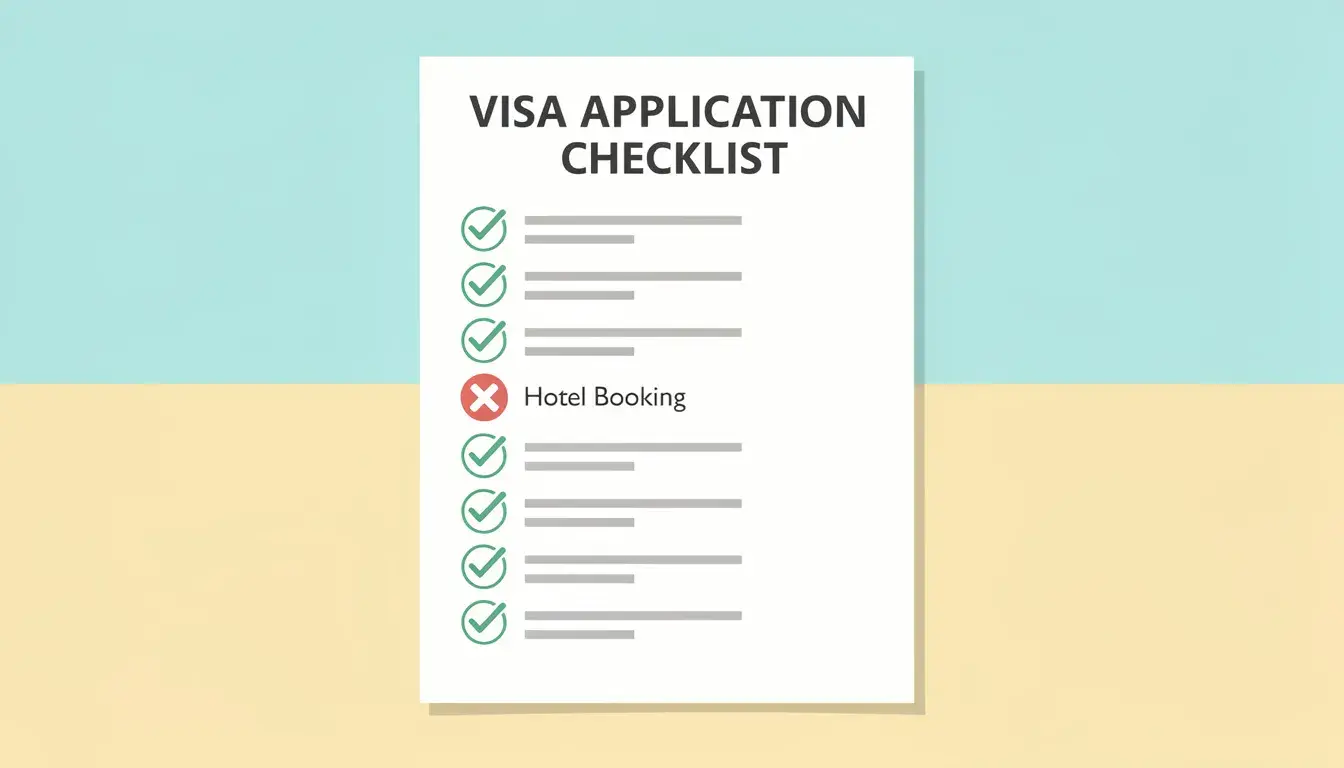
Paris hotel proof is not just a formality. France uses accommodation evidence to understand where you will stay, how long you will remain, whether your funds make sense and whether your itinerary is complete. The paid-versus-unpaid choice matters less than the file logic: one traveler, one date window, one believable stay pattern, and no unexplained hotel gaps.
France accommodation rule to know: France-Visas says travelers may be asked to show proof of accommodation covering the whole duration of stay, such as a hotel reservation or a town-hall validated host certificate. It also lists different means-of-subsistence amounts: 65 euros per day when a hotel booking is presented, 120 euros per day without a hotel booking, and a mixed calculation for partial hotel proof. Sources: France-Visas arrival guidance and France-Visas accommodation FAQ.
Paid Vs Unpaid For Paris Visa — A Decision Tree That Matches How Files Get Judged
Applicants often ask whether a Paris visa needs a paid hotel booking. The better question is whether the accommodation proof is complete, believable and stable enough for the application. France-Visas does not reduce the issue to “paid or unpaid.” It asks for accommodation proof covering the whole stay, and private host stays require a formal hosting certificate. That means an unpaid hotel can be strong, and a paid hotel can still be weak if the dates or guest details do not match.
What A Paid Booking Quietly Communicates
A paid Paris hotel booking can communicate commitment. It suggests the applicant has already put money behind the trip, selected a location and accepted the stay dates. This can be useful for short tourist trips, conference stays or applications where the trip dates are locked. Paid proof also reduces the “too flexible” feeling that sometimes comes from fully cancellable bookings created only for a visa appointment.
But payment is not magic. A paid booking in the wrong city, for the wrong dates, for only one guest in a family file, or for a hotel far outside the claimed Paris itinerary can still weaken the application. If the paid booking creates refund anxiety or financial stress, it may not be the smartest choice before the visa decision.
What An Unpaid Booking Can Communicate If It Looks Too Flexible
An unpaid or pay-at-property reservation can work when it looks like a real stay: named traveler, full address, correct dates, booking reference, cancellation rules and room details. It becomes weak when it looks like a disposable placeholder. A confirmation with no guest name, no full address, unclear cancellation terms or a checkout date that does not match the flight itinerary invites questions.
- Strong unpaid booking: clear property, dates, guest name, room type, reference and cancellation terms.
- Weak unpaid booking: vague email, missing names, no address, no room count or only partial stay coverage.
- Strong paid booking: matches flight and itinerary dates without creating refund pressure.
- Weak paid booking: expensive or inconsistent stay that clashes with funds or trip purpose.
The Paris-Focused Decision Tree
- If your Paris dates are final and refund risk is acceptable, use a paid or partially paid booking.
- If your visa timing is uncertain, use a genuine cancellable or pay-at-property booking with complete details.
- If you stay with a person in France, use the official hosting certificate route instead of pretending it is a hotel stay.
- If you split Paris with another city, cover every night with connected proof.
- If the booking cannot show names, dates and address clearly, choose another property or format.
The Cost Vs Credibility Trade You Are Actually Making
The tradeoff is not paid versus unpaid; it is cost risk versus document stability. Paying early may make the file look more committed but can hurt if the visa is refused or delayed. Keeping the booking unpaid protects money but requires stronger presentation. The safest middle is a real booking with transparent cancellation or pay-at-property terms that still looks like a practical Paris stay.
When Unpaid Is Often The Better Play
Unpaid can be the better play when the visa appointment is early, the decision window is uncertain, the trip may shift, or the applicant is still aligning flights and insurance. It is also sensible for family files where one date change could affect several rooms. The key is to choose a booking that remains credible if reviewed closely.
Make Either Booking Visa-Ready — The Proof-Of-Stay Workflow France Actually Responds To
Whether the booking is paid or unpaid, the workflow is the same: prevent file chaos, validate the confirmation, document the payment story, package the file clearly and update it if the stay changes. This is where many Paris applicants lose credibility. The hotel itself may be fine, but the file around it is messy.
Step 1 — Book In A Way That Prevents Later File Chaos
Start with the same travel window used for your flight reservation and visa form. If you plan to arrive in Paris on 8 October and leave on 15 October, the accommodation should cover those nights or clearly explain any city split. Do not book one hotel “just to have something” and then build the rest of the trip around a different calendar.
If the Paris trip also includes a Schengen flight reservation, keep flight and hotel logic together. BookForVisa’s Schengen visa flight reservation requirements guide explains the flight side; this page owns the hotel side. The two documents should support the same story, not compete with each other.
Step 2 — Validate The Confirmation Like A Visa Officer Would
- Applicant name appears clearly or the booking supports the whole group.
- Hotel name and full Paris address are visible.
- Check-in and checkout dates cover the intended stay.
- Room count and guest count make sense.
- Booking reference or confirmation number appears.
- Payment, deposit, cancellation or pay-at-property terms are understandable.
- The property location fits the itinerary and budget.
Step 3 — Document The Payment Story Cleanly
If paid, keep proof of payment privately and submit the confirmation if it already shows payment status clearly. If unpaid, do not hide that fact. A pay-at-property booking is not automatically weak, but it should be transparent. If partially paid, make sure the deposit and remaining balance are understandable. The goal is not to pretend; it is to avoid ambiguity.
Step 4 — File Packaging That Prevents Confusion At The VAC Counter
Package hotel proof in the same order as the itinerary. If all nights are in Paris, one confirmation may be enough. If there are two Paris hotels, combine them in date order. If Paris is one part of a France or Schengen trip, add each city accommodation in the same order as the travel plan. Avoid screenshots scattered across several pages without labels.
Step 5 — What To Do If Your Booking Changes After Submission
If the hotel changes after submission, do not panic. Keep the same trip logic and update the proof if asked or if the visa channel allows updated documents. The replacement booking should cover the same nights or explain the new route. If the change also affects flights, insurance or city order, update those documents together.
Micro-Checklist: The 10-Point Paris Booking Test
- Does the booking cover every night in France or Schengen?
- Does the name match the passport or group file?
- Does the address clearly place the stay in Paris or the intended area?
- Does the booking match the flight arrival and departure dates?
- Does the price fit the funds story?
- Does the room count fit the travelers?
- Are payment or cancellation terms visible?
- Are private-host stays handled with the official certificate route?
- Are old confirmations removed?
- Can the stay pattern be explained in one sentence?
Paris-Specific Scenarios Where Paid Vs Unpaid Is Not The Real Problem — Your Stay Pattern Is

Paris applications create specific stay patterns: one hotel for the whole trip, split stays, day trips, apartments, host stays, conferences and mixed business-tourism trips. Each pattern can work when documented clearly. The risk is not the pattern itself; it is an unexplained night or booking that does not match the itinerary.
Split Stays In Paris Without Raising Eyebrows
Two hotels in Paris can be fine. Maybe the first hotel is near Gare du Nord and the second is near the conference venue. Maybe a family starts near Disneyland Paris and ends near central Paris. The key is date continuity. Checkout from Hotel A on 10 May and check-in to Hotel B on 10 May is clean. Checkout on 10 May and next check-in on 12 May creates a gap unless another stay proof exists.
Day Trips From Paris And Why They Do Not Need Extra Hotels
Day trips to Versailles, Giverny, Champagne or even parts of Normandy usually do not require extra hotel proof if you return to Paris the same night. The Paris hotel remains the accommodation anchor. Your itinerary can mention day trips, but the hotel booking should still cover those nights in Paris.
Apartments And Short-Term Rentals
Apartments and short-term rentals can work when the confirmation is clear. It should show the address, host or property identity, guest name, stay dates and payment or cancellation terms. A vague platform message without a full address or guest details is weaker than a hotel confirmation. If the apartment is far outside Paris, make sure transport and itinerary logic still make sense.
Sponsored Or Employer-Paid Stays
Conference hotels, employer-paid stays and business-trip extensions need a clean payment story. If the company pays, the hotel confirmation or employer letter should explain that. If the applicant pays for extra tourism nights after the conference, separate the business and personal nights clearly. Do not let a business hotel cover only part of a trip while the rest of the nights disappear.
Private Host Stays In Paris
A private host stay is not simply “my friend wrote a letter.” France-Visas says people hosted by private individuals need the proper proof of accommodation obtained by the host from the town hall, with the original document required for the application and arrival. If you are staying with family or a friend, follow that path instead of uploading a hotel-style placeholder.
Hotel Booking For Visa To Paris — Where Applicants Lose Credibility With Hotel Proof
Credibility losses usually come from mismatch, not from whether the booking is paid. A cheap booking can be credible. A luxury booking can be credible. A cancellable booking can be credible. The problem is when the booking fights the rest of the file.
The Too-Refundable Trap And How To Fix It
A fully cancellable booking is not automatically weak, but it can look fragile when everything else also feels vague. Fix this by choosing a real property, realistic dates and a confirmation with complete details. If you use a cancellable booking, make sure the itinerary and funds show a serious trip. Do not rely on a disposable booking that could vanish before review.
Partial Payment, Deposits And Pay-At-Property
Partial payment and pay-at-property bookings are common. They should be readable. If the confirmation says a deposit is paid and the balance is due later, that can be fine. If it only says “reserved” with no address, no cancellation terms and no room details, choose better proof. The document should answer what is booked, for whom, where, when and under what terms.
One Night Only In Paris Or Short Stays That Do Not Match Your Story
A one-night Paris stay can work for transit or a short event, but it needs to match the stated purpose. If the visa form says a seven-day Paris tourism trip and the hotel covers one night, the file creates a funding and accommodation problem. France’s border guidance also shows why partial hotel proof can affect the daily resource calculation.
Multiple Applicants, One Booking
One hotel booking can cover a family or group if the room count and guest details support it. If the confirmation names only one person, add context where possible: family itinerary, group cover note or booking page showing guest count. Do not let a four-person application depend on a single-room booking that appears to cover one traveler.
Visa Refusal Anxiety: Should You Pay Knowing You Might Get Refused?
This anxiety is reasonable. Paying for Paris accommodation before a visa decision can feel risky. The best response is not to overpay for confidence; it is to choose terms that fit your risk. A refundable paid booking, pay-at-property booking or cancellable reservation can all work when the proof is complete and genuine. If you need support preparing visa travel documents, start from BookForVisa and keep the hotel proof aligned with your travel dates.
Hotel Proof And Flight Proof Must Share One Calendar
Hotel proof is strongest when it shares one calendar with flight proof. If the flight lands in Paris on 3 June, hotel starts 3 June or explains the overnight timing. If the flight leaves on 10 June, checkout on 10 June normally makes sense. For deeper flight-side planning, see BookForVisa’s guide to flight reservation for visa and the broader flight reservation for visa complete guide.
Your Schengen Visa Application Should Look Committed, Clear And Date-Accurate
A Paris hotel booking does not need to be the most expensive option. It needs to be the most coherent option for your file. Paid can work. Unpaid can work. Split stays can work. Apartments can work. Host stays can work. The winning standard is complete proof for every night, matched to the rest of the application.
Final Don’t-Get-Burned Checklist Before You Submit
- Every night is covered by hotel, apartment or official host proof.
- Paris stay dates match the visa form and flight reservation.
- Guest names or room count make sense for the applicants.
- Payment, deposit or cancellation terms are understandable.
- The property location fits the stated itinerary.
- Funds support the stay length and accommodation plan.
- Old hotel confirmations are removed.
- Private host stays use the correct official proof route.
If the hotel proof passes those checks, the paid-versus-unpaid question becomes much calmer. You are no longer trying to guess what a visa officer “likes.” You are showing a complete, stable and believable Paris stay.
FAQs About Hotel Booking For A Paris Visa
Is paid hotel booking mandatory for a Paris visa?
Not always. France-Visas refers to proof of accommodation covering the whole stay, such as a hotel reservation or a town-hall validated hosting certificate. A paid booking can be useful, but the stronger question is whether the proof covers the dates and matches the trip story.
Can I use an unpaid or pay-at-property hotel booking for a Paris visa?
Yes, if it is a genuine booking and the confirmation clearly shows the guest name, property, Paris address, check-in and checkout dates, cancellation or payment status, and room details. Avoid bookings that look like placeholders or can disappear before review.
Why does hotel proof matter for France more than applicants expect?
France-Visas states that proof of accommodation should cover the whole stay, and it also affects the means-of-subsistence amount: France lists 65 euros per day when a hotel booking is presented and 120 euros per day when no hotel booking is presented.
What if I stay with a friend or relative in Paris?
For a private host stay, France-Visas says the host must obtain an official proof of accommodation from the local town hall, and the original document is required for the visa application and arrival.
Can I split my Paris stay across two hotels?
Yes. Two hotels can be acceptable when the dates connect cleanly and the route makes sense. Make sure there are no unexplained nights between bookings and that all traveler names or room counts are clear.
Do day trips from Paris need separate hotel bookings?
Usually no. Day trips such as Versailles, Giverny or Champagne do not need extra hotel proof if you return to your Paris accommodation the same night. The Paris booking should still cover those nights.
Should hotel dates match the flight reservation?
Yes. Your Paris hotel dates should align with your arrival and departure plan. If the flight arrives late, exits after midnight or includes another Schengen city, explain the calendar logic with matching documents.
What details should a Paris hotel confirmation show?
It should show the applicant name, property name, full address, check-in date, checkout date, room or guest count, booking reference, payment or cancellation terms, and contact details where available.
Can multiple applicants use one Paris hotel booking?
Yes, if the booking shows enough capacity and names or guest count to support the group. Families should keep passport names and room occupancy clear so the booking does not look like it covers only one traveler.
What if my Paris hotel changes after visa submission?
Update the proof and keep the same travel story. If the dates, city order or stay pattern changes materially, update related documents such as the itinerary, flight reservation and insurance.
Does BookForVisa guarantee France visa approval with hotel proof?
No. BookForVisa can help prepare hotel and travel-document support, but visa decisions remain with the consulate or visa authority and depend on the complete file.
Should I choose the cheapest Paris booking for visa proof?
Not automatically. Choose a booking that is realistic for your budget, location, itinerary and group size. A very cheap or distant booking can create questions if it does not match the stated trip.
Important disclaimer: This guide is general visa-document information, not legal advice, hotel-booking advice, visa approval assurance or a guarantee that any accommodation proof will be accepted. France visa and Schengen requirements can vary by nationality, residence country, consulate, application channel and trip purpose. Always verify the current checklist through France-Visas, the relevant visa center and your official application channel before submitting hotel or travel documents.