Flight Reservation vs Flight Itinerary Explained for Visa
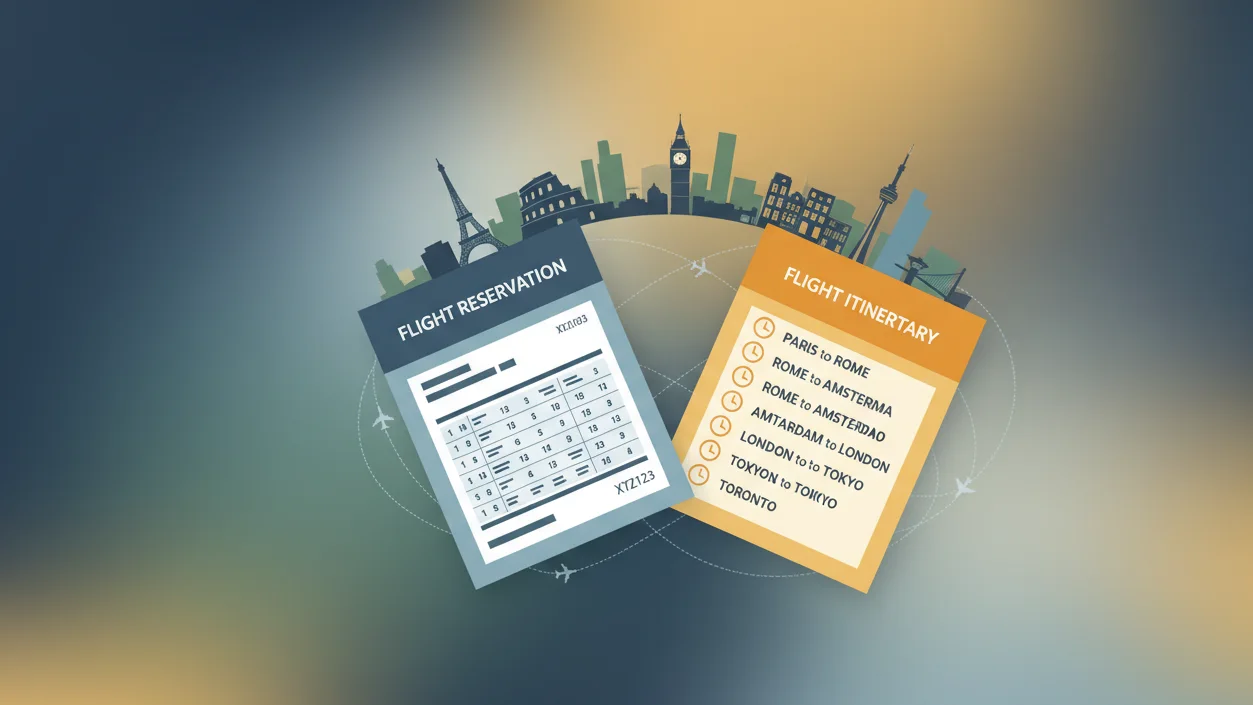
The checklist says “flight reservation,” but the officer emails back asking for “itinerary details.” Your appointment is in days, processing can take weeks, and the flight proof you upload today might expire long before anyone opens your file. That’s where most applications get messy, not because the plan is bad, but because the document type is wrong for the question being asked.
In this guide, we’ll help you choose the right evidence for your case: a reservation that signals verifiable booking status, or an itinerary that tells a clean travel story. You’ll learn how to read embassy wording, avoid date and route contradictions completely, and handle changes without triggering new doubts. For the broad evidence standard before comparing document types, use the 2026 flight reservation for visa complete guide and then apply the distinction below to your own checklist wording.
In This Guide
What You’re Proving: “Booked Status” vs “Travel Story”

Visa officers are not collecting travel documents as souvenirs. They are testing a claim. Your flight proof either supports that claim cleanly, or it creates new questions you did not plan to answer.
Official Framework: Why The Difference Matters
Official visa guidance usually frames flight proof as part of a wider evidence set, not as a standalone magic document. The EU Visa Code says Schengen applicants may need documents showing journey purpose, accommodation, sufficient means for the stay and return or transit, and information allowing assessment of intention to leave before the visa expires. EU Visa Code, Article 14 and Annex II
UK visitor guidance asks applicants to show they are genuine visitors, will leave at the end of the visit, can support themselves during the trip, and can pay for return or onward travel. It also warns applicants to consider booking risk before travelling or applying. GOV.UK visitor supporting documents guidance
Canada’s visitor visa guidance describes itinerary evidence as documents showing how long you plan to stay and what you will do, including flight details and proof of accommodation. Canada visitor visa application guidance
That is why the reservation-versus-itinerary distinction matters. A reservation is stronger when the checklist expects booking-status proof. An itinerary is stronger when the officer needs to understand travel logic, especially for flexible dates, multi-city routes, open-jaw travel or mixed transport. For Schengen-specific wording and route expectations, compare this article with the Schengen visa flight reservation requirements guide.
The One-Sentence Difference That Prevents Most Mistakes
A flight reservation is evidence of booking status. A flight itinerary is evidence of travel logic.
That single distinction changes how your file reads in the first minute.
A reservation tells the officer, “This traveler can produce a record that looks like it lives inside a real booking system.” That matters when the checklist wording leans toward confirmation, reference numbers, or proof that you can actually depart and return.
An itinerary tells the officer, “This traveler’s route makes sense, and the dates line up with the rest of the application.” That matters when you need flexibility, when processing times are uncertain, or when you are presenting a multi-stop trip where the story matters more than a locked seat.
Here is the practical takeaway. If you submit an itinerary when the officer expects a booking status, your file can look unfinished. If you submit a reservation when the officer expects logic, your file can look disconnected from the rest of your documents. The goal is not to look “more official.” The goal is to answer the question the officer is silently asking.
Why Embassies Treat These As Different Types Of Evidence
Embassies use flight-proof as a shortcut for three decisions:
- Intent: Are you visiting for the purpose you claimed?
- Timing: Do your dates match your stated plan and your supporting documents?
- Exit: Do you have a believable route out of the country or region?
A reservation supports intent differently than an itinerary. It suggests you have moved from “planning” to “action.” That can reduce doubt in cases where the officer expects a higher level of commitment.
An itinerary supports intent by showing structure. It can explain why you enter through one city, leave from another, or take a route that looks odd without context.
Timing is where the difference becomes obvious. A reservation can be rigid. If the dates shift, your flight proof can drift out of alignment with your cover letter, leave approval, and insurance window. An itinerary can be built to reflect a date range and still look coherent, as long as it stays realistic.
Exit is the big one. Many officers care less about your inbound flight than your outbound plan. An itinerary can show your exit leg clearly, even if the rest is flexible. A reservation can anchor your exit with more weight, but it must match the rest of the application, or it becomes a liability.
We should also talk about the “risk lens.” Officers see patterns. Some files are neat but hollow. Others are messy but honest. Your job is to create a file that feels consistent and low-drama. Picking the right document type is one of the easiest ways to do that.
The “Two Audiences” Problem: Case Officer Vs System Checks
A person reads your flight proof. A process may also touch it.
The person reads for sense. They look for a believable trip length, a logical route, and dates that match everything else you submitted.
The process reads for signals. That process could be a visa center intake team, a checklist-based pre-screen, or a backend verification step. The details vary by country and location, but the pattern is stable: some applications get a deeper look when the flight proof sends mixed signals.
Here is how the two audiences interpret the same document.
A case officer might look at an itinerary and think, “This plan is clean. Entry and exit are clear. Dates align.” A checklist-driven intake might look at the same itinerary and think, “This does not show booking status.” That’s how you end up with an email asking for a “confirmed reservation” even though your itinerary looked fine.
The reverse happens too. A reservation can pass intake because it looks like a booking record. Then the officer reads your file and notices your reservation dates do not match your stated trip plan. Now the officer is not thinking about your travel. They are thinking about your attention to detail.
So we need to make your flight proof do two jobs at once:
- Pass the first glance without looking incomplete
- Hold up under reading without creating contradictions
This is also why screenshots are risky. A screenshot can look real to a person, but it may look incomplete to intake staff because it hides the route context, passenger details, or booking status signals.
If your trip is simple, you can often satisfy both audiences with one strong document. If your trip has moving parts, you sometimes need a reservation for anchor legs and an itinerary to explain the structure. The key is clarity, not volume.
What “Looks Official” Can Still Be Weak Evidence
A polished PDF is not automatically persuasive. Officers are trained to look past formatting.
Here are examples of documents that often look official but still underperform:
- A “flight itinerary” that reads like a pricing quote, not a travel plan
- A reservation document that lacks the full passenger name as it appears on the passport bio page
- A routing page that shows cities but not dates, so it cannot be matched to your stated timeline
- A multi-page PDF where page one shows a route and page two shows a different date set
Weak evidence usually fails for one of two reasons.
First, it fails the matching test. The officer cannot match it cleanly to your application form and supporting documents.
Second, it fails the confidence test. The officer cannot tell if it represents a record or just a plan.
You can prevent both failures by checking what your document actually communicates at a glance.
Ask yourself these three questions:
- Does it show who is traveling, in the same name format used in the application?
- Does it show when, with dates that align with the rest of the file?
- Does it show what route, in a way that supports your stated purpose and length of stay?
If any of those answers is “sort of,” you are relying on the officer to interpret. That is not where you want to be.
A better approach is to make your flight proof self-explanatory. You want the officer to spend their energy validating your intent, not untangling your dates.
When Submitting Both Helps (And When It Creates Contradictions)
Submitting both a reservation and an itinerary can be powerful. It can also be the fastest way to create an avoidable mismatch.
It helps when each document has a distinct role.
A clean pattern that works in many cases is this:
- Use a reservation to anchor your entry and exit legs
- Use an itinerary to explain the structure in the middle, if your trip includes more than one stop or a non-obvious route
This approach makes your file feel stable. It says, “We know exactly when you enter and leave, and we can explain the route between.”
But submitting both creates contradictions when they overlap in the wrong way.
Here are the common conflict patterns:
- The reservation dates say 10 days, but the itinerary shows 14 days.
- The itinerary lists entry through one city, but the reservation shows entry through another.
- The reservation shows a late-night arrival, but your hotel check-in date assumes you arrived earlier that day.
- The itinerary includes a return leg, but the reservation only includes one-way segments.
You can avoid these conflicts by deciding which document is the “source of truth” for each detail.
Here, we focus on a simple rule. Only one document should be responsible for each claim.
- If your entry date is fixed, let the reservation own it.
- If your mid-trip movement is flexible, let the itinerary own it.
- If your exit is critical for the visa officer’s comfort, anchor it clearly and keep the rest consistent around it.
Now add a second rule that matters even more. Do not let the itinerary look more committed than the reservation.
If your itinerary shows a tightly packed multi-city route, but your reservation only covers a vague entry leg, the officer can read that as staged. Your itinerary should support the reservation, not outshine it.
A final practical point is version control. If you submit both, they must be created from the same decision set. That decision set is:
- Planned first entry date
- Planned final exit date
- Entry city
- Exit city
If any of those change, update both documents or submit only one updated document that cleanly replaces the other.
This is where many applicants lose time. They update the reservation after an appointment reschedule, but they forget to update the itinerary. The two documents now disagree, and the officer has a reason to request clarification.
How Flight Proof Gets Evaluated: The Cross-Checks Applicants Don’t See

When a UK Standard Visitor or Schengen short-stay file slows down, it is often because your flight proof did not answer the exact question the reviewer was checking. Here, we focus on the behind-the-scenes validation habits that shape whether your reservation or itinerary feels reliable.
The Three Most Common Verification Paths (And What Each Can Confirm)
For a Schengen short-stay application, the first path is usually a human plausibility review where the officer checks whether your Rome entry date matches your leave letter dates and your stated length of stay. For a Japan tourist visa, that same plausibility review often focuses on whether your Tokyo arrival and departure dates align with your day-by-day plan and hotel nights listed elsewhere in the file. For a Canadian TRV, the plausibility review frequently includes whether your return routing supports a clear exit timeline, especially if you list family ties or employment obligations as your reason to return.
The second path is a document integrity check, which is common at outsourced intake counters for Schengen applications lodged through visa application centres. For a French Schengen submission, intake staff may simply verify that the flight proof shows your full name, dates, and route in a readable format, because incomplete pages create processing friction. For a UK visitor file, the integrity check often looks for consistency across your uploaded PDF set, because the UK system review is sensitive to contradictions between your travel dates and your accommodation or employment evidence.
The third path is traceability validation, which tends to appear when the checklist language implies confirmation, such as some Schengen consulates that want a booking reference style proof. For a German Schengen file, traceability can mean the document looks like it came from a booking flow and not from a pricing quote layout that lacks booking status cues. For a US B1/B2 interview context, traceability is less about a reservation being “confirmed” and more about your plan looking credible and consistent with your stated purpose and duration, because the consular interview style often exposes weak travel logic fast.
If you want a practical lens for any Schengen or UK visitor application, think in three questions that map to those paths:
- Can a case officer match your flight dates to your stated trip window for that country’s visa type?
- Can intake staff read your proof without guessing what pages are missing or what the route actually is?
- Can a reviewer trust that your proof represents a coherent plan or a traceable booking record, depending on the wording used?
What Triggers “We Need More Documents” Even Without A Formal Refusal
For a Schengen short-stay file, a “please provide updated itinerary” email often starts with a simple mismatch, like your outbound flight date showing day 11 while your travel medical insurance shows coverage through day 9. For a UK Standard Visitor application, a request for additional documents often appears when your flight proof suggests one travel window, but your bank statement spending pattern suggests a different travel period, which makes your dates look opportunistic rather than planned.
For a Japanese tourist visa, a common trigger is an itinerary that reads like a generic route sequence that does not match your stated visit purpose, such as a business-style arrival and same-day departure pattern when you claimed a leisure itinerary. For a Schengen application to Spain, another trigger is an entry city that changes between documents, like Barcelona in the itinerary and Madrid in the cover letter, because Schengen officers often map your first entry to jurisdiction and trip logic.
For an Australian Visitor visa, a frequent trigger is an itinerary that compresses long-haul segments into unrealistic connection windows, because long layover logic is easy for an assessor to sanity-check against real airline schedules. For a Canadian TRV, another trigger is a one-way flight plan without a clear return narrative, because a return plan is often used as a quick risk signal in temporary resident contexts.
If you want to reduce “extra document” emails for Schengen and UK visitor cases, run this quick pre-upload test:
- Does every document that contains a date range, including your Schengen insurance certificate, match the same arrival and departure window shown in your flight proof?
- Does your route sequence match the story you told on the Schengen application form about your first entry and main stay location?
- Does your flight plan avoid any “floating days” that make your UK visitor timeline look like you might overstay?
Reservation-Specific Risks: When A Hold Looks Unreliable
For a Schengen consulate that expects a reservation-style proof, the biggest risk is an expiry that makes your booking status look unstable during processing; for the core reservation-quality baseline, check the flight reservation for visa guide. For a French Schengen file submitted weeks before travel, an expiring hold can create a gap where your proof no longer matches what an officer expects to see if they revisit the document later. For a UK Standard Visitor submission, a hold that disappears can create confusion if you later upload an updated document with different dates, because the UK review flow can treat date changes as a credibility signal.
For a German Schengen application, another reservation risk is a record that displays an incomplete passenger name, because German case officers often match the name format tightly to the passport and application form fields. For a Spanish Schengen file, a reservation that omits the return leg can cause an avoidable follow-up request, because return clarity reduces perceived overstay risk in short-stay contexts.
For a US B1/B2 context, reservation risk often looks different because an officer may interpret a heavily “locked” reservation as unnecessary if your travel is months away, which can lead to questions about why the dates are so fixed if the trip purpose is flexible. For a Japan tourist visa, a reservation that shows a route that clashes with your day plan can weaken your file, because Japan often expects the flight plan to support the itinerary narrative rather than override it.
Here, we focus on the fix strategy that stays consistent with typical Schengen and UK workflows:
- For a Schengen file, choose reservation dates that match your insurance window and hotel nights, because a date mismatch is more damaging than a flexible plan.
- For a UK visitor file, avoid multiple reservation versions unless you can keep all supporting documents aligned to the same updated window, because version drift looks like uncertainty.
- For a Japan tourist file, ensure the arrival city and first hotel night line up, because Japan reviewers often cross-check day one logistics.
Itinerary-Specific Risks: When A Plan Looks Like Guesswork
For a Schengen short-stay application, an itinerary looks like guesswork when it includes too many intra-Schengen flights that add complexity without a reason, because Schengen officers often prefer a clear first entry and clear exit story. For an Italy Schengen application, a route that bounces between Milan, Rome, and Venice by air can look artificial if your trip length is short, because the travel time overhead does not fit a realistic tourist pace.
For a UK Standard Visitor itinerary, guesswork often shows up as vague dates, such as “early April” travel windows, because UK reviewers need specific dates to evaluate your employment leave and financial ability for that exact period. For an Australian visitor itinerary, guesswork often shows up as unrealistic same-day cross-country hops, because Australia's distances make timing sanity checks easy for assessors.
For a Japan tourist visa itinerary, guesswork often shows up when your plan includes a transit city that has no connection to your declared purpose, because Japan reviewers often prefer a straightforward arrival plan that supports your accommodation and daily schedule. For a Canadian TRV itinerary, guesswork can appear when your itinerary shows a return flight that conflicts with your job start date or leave approval, because Canadian assessors look closely at ties and time-bound obligations.
If you want your itinerary to read as deliberate for Schengen, UK, Japan, and Canada cases, build it around constraints that an officer recognizes as real:
- For a Schengen itinerary, keep entry and exit cities stable across the application form, cover letter, and flight plan.
- For a UK visitor itinerary, pick exact dates that match your leave letter and payroll cycle evidence.
- For a Japan itinerary, tie arrival timing to a realistic first-night check-in plan in your day schedule.
- For a Canada itinerary, make the return date clearly consistent with the obligations you cite in your supporting documents.
How OTAs And Airlines Differ In The Kind Of Proof They Generate
For a Schengen consulate that expects reservation-like evidence, airline-generated documents often signal booking status more clearly than an OTA “itinerary receipt” that reads like a purchase summary rather than a booking record. For a France Schengen file, an airline-style confirmation can be easier for an officer to interpret quickly, because it tends to display passenger name, route, and dates in a standard layout that aligns with common Schengen review habits.
For a UK Standard Visitor application, an OTA document can still work well if it clearly shows the route, dates, and passenger identity in a consistent format, because the UK review process is often about internal consistency more than any single document’s layout. For a Japan tourist visa, the better proof is often the one that supports the day plan logic, because Japan reviewers frequently cross-check how your arrival time fits your first day narrative.
For a Canadian TRV, the practical difference is whether the proof looks like a stable plan rather than a speculative quote, because Canadian assessors tend to focus on whether your travel timeline aligns with your ties and finances. For an Australian Visitor visa, the practical difference is whether the route and connections look like real flight patterns, because Australia's distances make unrealistic itineraries stand out.
If you are choosing between two flight-proof formats for a Schengen or UK visitor file, compare them using these concrete questions:
- For a Schengen application, does the document present the route and dates in a way that supports a quick first entry and exit check?
- For a UK visitor application, does the document avoid confusing “optional” segments that make your travel window look uncertain?
- For a Japan tourist application, does the document reinforce the arrival and departure logic that your plan relies on?
- For a Canadian TRV, does the document avoid shifting dates that could weaken the ties and timeline you are presenting?
Which One Should You Submit For Your Case?

Most visa checklists talk about flights in a few words, but officers read those words very literally. Here, we focus on choosing the flight proof that matches what your target embassy is actually trying to confirm.
Is The Embassy Expecting Verifiable Booking Status Or Travel Logic?
For a Schengen short-stay (Type C) file, “flight reservation” usually signals they want a document that looks like a traceable booking record with clear entry and exit dates you can match to insurance and your application form.
For a UK Standard Visitor application, the UK guidance often treats flights as supportive rather than mandatory, but caseworkers still use your flight plan to test whether your timing matches your finances and leave approval.
For a Japanese tourist visa, consulates often care about whether your schedule is coherent, because your day-by-day plan and stay duration tend to be checked for internal consistency.
For a Canadian TRV, your flight proof is commonly read through a ties-and-timeline lens, meaning your return plan must align with the obligations you cite (employment, studies, family responsibilities).
Start by looking at the exact wording where you apply, not what blogs say. Then match it to one of these intent buckets:
- Confirmation wording (Schengen consulates often do this): they want booking status signals.
- Plan wording (Japan often does this): they want travel logic that fits your itinerary.
- Timeline wording (UK and Canada often do this): they want dates that match your supporting evidence.
Use This Workflow Exactly, Then Stop Second-Guessing
Use the country-specific phrases below like a translator. Pick the line that matches what your checklist or email says.
If you are applying for a Schengen visa and the checklist says any of these, submit a flight reservation as your primary proof:
- “Flight reservation”
- “Round-trip reservation”
- “Proof of transport”
- “Booking confirmation showing entry and exit”
If you are applying for a Japan tourist visa and the checklist or consulate instructions emphasize these, submit a flight itinerary as your primary proof:
- “Itinerary”
- “Schedule of stay”
- “Planned route and dates”
- “Entry and exit details matching your plan”
If you are applying for a UK Standard Visitor and the guidance or portal language uses these, decide based on your risk profile:
- “Travel details” or “planned travel dates”
Use an itinerary if your dates are still shifting, but keep them exact, not vague. - “Evidence of your plans”
Use whichever document best matches your leave window and budget proof.
If you are applying for a Canada TRV and your case depends heavily on ties and timing, prioritize whichever option keeps the return story clean:
- If your return date is tied to an obligation (job resumption, term dates), a reservation for the return leg can add weight.
- If your travel month is still flexible, an itinerary can reduce contradictions across documents.
If you get an email from a Schengen consulate asking for “updated reservation,” do not respond with a refreshed itinerary only. They are telling you which evidence type they want.
If you get an email from a Japanese consulate asking for “itinerary details,” do not respond with a single reservation PDF and no schedule context. They are asking for travel logic.
When A Reservation Is The Safer Default
For Schengen applications where you must prove entry and exit clearly, a reservation is often safer when your file can be judged on consistency and traceability. That includes many applications for France, Germany, Spain, Italy, and the Netherlands, where the flight proof is treated like a structural document that anchors the rest.
Choose a reservation-first approach for a Schengen file when any of these are true:
- Your insurance certificate is already issued for exact dates, and you need the flights to match that window.
- Your trip has a clear “start and end,” and you want the officer to see it instantly.
- You are applying through a visa application center that does strict intake checks, because incomplete flight evidence can trigger a request before the file even reaches an officer.
A reservation can also be the safer default for a Canada TRV when your timeline is strongly tied to an external obligation. If your leave letter says you must return to work on a specific date, a clean return reservation date can reinforce that narrative.
Use this quick reservation readiness test, built for Schengen short-stay logic:
- Does your reservation show a clear first entry into Schengen that matches the consulate you applied to?
- Does it show a clear final exit that matches your insurance end date and hotel nights?
- Does it avoid a route that makes your “main destination” look unclear, which can cause jurisdiction questions for Schengen?
If you fail any one of those checks, a reservation can create more friction than it solves.
When A Flight Itinerary For Visa Is The Smarter Choice
For Japan tourist visas, an itinerary-first approach is often smarter when the consulate cares about internal logic across your schedule, accommodation nights, and purpose. Your flights need to fit the plan, not override it.
An itinerary is also smarter for UK Standard Visitor cases when your trip dates could change due to appointment timing, processing uncertainty, or work constraints, but you still need a coherent travel window to align with finances.
Choose an itinerary-first approach when these are true in your target visa context:
- Your application relies on a tight schedule narrative, like a Japan plan with specific city days that must line up with arrival and departure.
- Your travel window is not locked, but you must still present exact dates for a UK visit to match your leave approval and spending plan.
- You have a multi-stop route where the officer needs to understand the logic, such as arriving in Paris and departing from Rome on a Schengen trip, where the travel story matters.
Make your itinerary stronger by anchoring it to constraints that officers commonly accept across Japan, the UK, and Canada:
- Use exact dates that match the rest of the file.
- Keep connections realistic for the route region. A Tokyo arrival with a same-hour transfer to a distant city can look careless in Japan reviews.
- Keep your entry and exit cities stable. For Schengen, shifting the first entry cities across documents can raise a jurisdiction issue.
“Both” Is Best When You Need Flexibility And Verifiability
For many Schengen files, the strongest approach is not “reservation or itinerary.” It is “a reservation where it matters, an itinerary where it explains.”
This is especially useful for Schengen multi-city trips, because officers often want verifiable anchors, but they also want a travel story that explains why your movement makes sense.
Use a combined approach when your trip has a clear structure, but the middle is flexible:
- Reservation for entry and exit legs so a Schengen officer can confirm the boundaries fast.
- Itinerary for the middle if you are visiting multiple cities or have an open-jaw plan.
Keep the two documents from fighting each other by assigning ownership to details in a way Schengen officers actually read:
- Let the reservation define your first entry date and final exit date.
- Let the itinerary define intermediate movement, but do not change the boundary dates.
- If you must change dates after submission, update both, or submit only the updated set that fully replaces the earlier one.
This approach also works well for Canada TRV cases where you want a clear return boundary, but you do not want to lock every segment too early. A return anchor plus a coherent travel plan often reads cleaner than an overly complex reservation set.
Build A Visa-Ready Flight Proof Set Without Locking Yourself In
Once you pick “reservation” or “itinerary,” the next risk is building flight proof that fights your own file. Here, we focus on a workflow that works for real visa contexts like Schengen short-stay, UK Standard Visitor, Japan tourist, and Canada TRV, where consistency and timing matter more than fancy formatting.
Step 1: Lock The “Non-Negotiables” Before You Touch Any Reservation
Before you generate anything, decide the four data points that your whole visa file will orbit.
- First Entry Date
- Final Exit Date
- Entry City
- Exit City
For a Schengen application, these must match your insurance dates and your form’s intended entry and exit window. For a UK Standard Visitor file, these must match your leave approval window and your financial evidence for that period. For a Japan tourist visa, these must match your schedule of stay and first-day feasibility. For a Canada TRV, these must match the timing of the ties you rely on, like a job start date, a return-to-work date, or a term date.
Then, decide the “must align” documents for your visa type.
For Schengen, your non-negotiables must align with:
- Your travel medical insurance start and end dates
- Your main trip dates in the application form
- Any supporting letter that states a duration, such as a leave approval
For the UK, your non-negotiables must align with:
- Your leave letter window
- Your bank statement period and cash flow narrative
- Any event timing you cite, such as a family visit or planned activity date
For Japan, your non-negotiables must align with:
- Your schedule of stay dates
- Your arrival day plan
- Your departure day plan
For Canada, your non-negotiables must align with:
- Your ties timeline, like work or study commitments
- Any stated event window you are traveling for
- Any dependent obligations you cite in supporting letters
Do not skip this step. If you generate the flight proof first, you will end up bending other documents to match it. That is how contradictions appear in real files.
Step 2: Decide Which Legs Need Booking Status (And Which Can Stay As Itinerary)
Now decide how much of your route needs to look like a booking record.
For a Schengen short-stay file, the highest value legs are usually:
- The leg that shows the first entry into Schengen
- The leg that shows the final exit from Schengen
For a Japan tourist visa, the highest value legs are usually:
- The leg that shows arrival into Japan on a date that matches your schedule of stay
- The leg that shows departure from Japan that fits your final day plan
For a UK Standard Visitor, the highest value legs are usually:
- The leg that pins down your arrival date so your leave letter and spending plan make sense
- The leg that pins down your return date so your temporary stay narrative is clear
For a Canada TRV, the highest value leg is often the return boundary, because ties and return timing are heavily scrutinized in many TRV decisions.
Here is a clean way to assign legs without overbuilding:
- If the embassy wording leans “reservation,” anchor entry and exit with a reservation-style proof.
- If the embassy wording leans “itinerary,” anchor dates and route logic with an itinerary, but keep the entry and exit explicit.
If your trip is open-jaw for Schengen, like flying into Paris and leaving from Rome, you can keep the middle flexible. Just make sure the first entry and final exit are stable across documents.
If you are doing a short Japan trip with a fixed schedule, keep the route simple. A complicated connection chain can distract from the plan and invite timing questions.
Step 3: Generate Airline Ticket Proof That Survives Scrutiny
Now you produce the actual flight proof, but we need it to survive the way embassies read.
Build to the strictest reader you might face.
For a Schengen file, assume the reviewer wants to confirm the boundary dates fast and then move on. For a Japan file, assume the reviewer compares your flight timing to your day-by-day schedule. For a UK file, assume the reviewer cross-checks your dates against leave and finances. For a Canadian TRV, assume the reviewer tests whether your return date supports your ties narrative.
Whether you submit a reservation or itinerary, make sure the document clearly includes:
- Passenger name that matches your passport name order
- Route cities that match your stated entry and exit story
- Dates that match your other documents
- A layout that reads as a travel document, not as a marketing page or price quote
Then run the “misread test.” It is simple and brutal.
If a visa officer scans only the first page for 15 seconds, can they answer:
- When do you arrive?
- When do you leave?
- Where do you enter?
- Where do you exit?
If they cannot, you are relying on goodwill and time. Most visa processes do not reward that.
Also watch for these high-friction details that show up in real Schengen and UK submissions:
- Time zones that make it look like you arrive after you depart
- City names are written inconsistently across pages
- One document uses local time formatting, and another uses a different style that creates confusion
If your file is for Japan, add one extra check:
- Does your arrival time support your first day plan, including realistic immigration and hotel check-in timing?
That single detail can separate “careful planner” from “generic itinerary.”
Step 4: Format For Submission, so Nothing Gets Misread
Formatting is not cosmetic. It changes how your proof is processed.
For Schengen, the common risk is intake staff rejecting or flagging documents that look incomplete. For the UK and Canada, the common risk is the caseworker missing context because your upload is fragmented. For Japan, the risk is the officer failing to connect your flight timing to your schedule because the documents are separated in a confusing way.
Here is a submission format that reduces misreads:
- Use one PDF per concept.
- One PDF for the flight proof.
- If you are also submitting a schedule of stay for Japan, keep it separate, but cross-check the dates.
- Keep the flight proof in chronological order, with entry first, exit last.
- If the document has multiple pages, ensure the passenger's name appears on the same page as the key dates, not only on a secondary page.
Use filenames that help an officer. Avoid anything that looks like internal jargon.
Good examples:
- “Flight Reservation Entry Exit Dates.pdf”
- “Flight Itinerary Proposed Route.pdf”
Bad examples:
- “final_final_v3.pdf”
- “ticketproofnew.pdf”
If you are submitting both a reservation and an itinerary, label them so the purpose is obvious:
- “Flight Reservation Entry Exit.pdf”
- “Flight Itinerary Route Logic.pdf”
That reduces the chance that an officer reads the itinerary and assumes it is your reservation proof.
Step 5: Plan For Changes Before They Happen
Visa timelines shift. Appointments move. Processing stretches. The best flight proof is the one you can adjust without creating contradictions.
Plan your change strategy based on visa type.
For Schengen, changes usually create trouble when they break alignment with insurance and accommodation nights. If your dates shift, you must decide whether you will update only the flight proof or also update the insurance window. Many applicants update one and forget the other. That triggers follow-ups.
For UK Standard Visitor, changes create trouble when they break alignment with leave approval and financial narrative. A shift of even a week can force you to explain why your planned spend period moved.
For Japan, changes create trouble when they break alignment with your schedule of stay. Japan reviews often look for a coherent day-by-day plan. If you change flight dates, your schedule must still match.
For Canada TRV, changes create trouble when they break the timeline you cite. If you say you must return to work on a fixed date, but your updated flight proof shows a later return, your file now argues against itself.
Use this change-control checklist before you upload any updated flight proof:
- Did the new dates change your trip length?
- Did the new dates change your first entry or final exit city?
- Do the new dates still match your leave letter if you are applying for the UK?
- Do the new dates still match your schedule of stay if you are applying for Japan?
- Do the new dates still match your insurance window if you are applying for Schengen?
- Do the new dates still fit your timeline if you are applying for Canada?
If you answer “no” to any one of those, update the related document or revert to the last consistent set.
Also, avoid the silent mistake that shows up in Schengen files. Applicants update the entry and exit flights, but forget that their application form still lists the old travel dates. That mismatch can trigger extra checks because it looks like the plan is unstable.
If you need flexibility, build it without vagueness. “Flexible dates” is rarely helpful. Exact dates that you can update cleanly are safer for most visa processes.
When An Itinerary Beats A Reservation: High-Value Scenarios Most People Miss
Some visa files get stronger when you show a clean plan instead of a locked booking record. Here, we focus on the situations where an itinerary can do more work than a reservation for visa officers reviewing Schengen short-stay, UK Standard Visitor, Japan tourist, and Canada TRV applications.
Scenario: Your Embassy Appointment Is Soon, But Your Travel Month Isn’t Final
This is common with Schengen and UK applications, where appointment availability forces you to submit before you have firm travel dates.
A reservation can backfire here if it anchors a date you are not ready to defend. When your appointment is next week, but your trip is four months away, a fixed reservation date can look like a guess that you later have to revise. That revision creates a version trail.
An itinerary can keep your file stable without pretending you have locked seats. The key is that “flexible” still needs to look structured for a real visa review.
For a UK Standard Visitor file, use an itinerary that pins exact dates that match your leave approval window and budget narrative. Do not use phrases like “mid-March.” UK caseworkers need dates.
For a Schengen file, use an itinerary that pins exact entry and exit dates that match your intended insurance window and the trip duration you state on the form. Schengen reviewers compare date ranges across documents quickly.
Use this “appointment-first” itinerary build that works across Schengen and the UK:
- Pick a travel window that matches your supporting evidence, not your wish list.
- Keep entry and exit cities stable. Do not create a multi-entry story if you are applying for a short stay.
- Choose one realistic routing family and stick to it. Do not show three different airline patterns across different pages.
If you later update the dates, an itinerary update is easier to keep consistent than a reservation update, especially when your application already contains documents tied to a date range.
Scenario: Open-Jaw Trips (Arrive One City, Leave Another)
Open-jaw trips are normal travel, but they often confuse visa officers if you present them only as isolated flight segments.
For a Schengen short-stay application, arriving in Paris and departing from Rome can be perfectly logical. The officer still needs to understand why the route is shaped that way and how the trip moves between those points.
An itinerary can do that explanation work better than a reservation, because it can show the route as a single story.
Make your itinerary do three jobs:
- Show the first entry clearly, because Schengen jurisdiction and main destination questions can appear when the entry is unclear.
- Show the final exit clearly, because exit logic is a core risk signal.
- Show a realistic connection between the cities, even if the middle is not flown.
A strong open-jaw itinerary avoids “teleporting.” If you show Paris inbound and Rome outbound with no bridge, the reviewer has to guess. For Schengen, guessing creates follow-ups.
Use one of these bridge styles, depending on your plan:
- If you will travel overland, add a single line in your itinerary that names the travel mode and date, like “Paris to Milan by train on Day 5.”
- If you will fly between cities, show a simple intra-Europe routing without excessive connections.
For a Japanese tourist visa, an open-jaw can also happen if you arrive in Tokyo and depart from Osaka. Japan reviewers often look for a coherent schedule of stay, so an itinerary that maps your city days to entry and exit points reads cleaner than two separate reservation pages.
Scenario: You’re Mixing Flights With Non-Flight Segments
This is where reservation-heavy submissions fall apart for Schengen and Japan cases.
A common example is a Schengen trip where you fly into Amsterdam, travel by train through Belgium and France, and then fly out from Madrid. If you submit only a flight reservation, the officer sees entry and exit but not the path. That can raise a main destination question if your accommodation or day plan suggests you spend most nights elsewhere.
An itinerary can be the glue. It can show the trip as a chain instead of two disconnected endpoints.
To make that glue credible, keep your itinerary disciplined:
- Use a day sequence that matches the nights you claim elsewhere in your file.
- Use realistic travel times. A same-day Brussels morning arrival and southern Spain evening arrival by train can look careless.
- Avoid listing five cities in three days. Schengen officers see that pattern often, and it reads like a template.
For Canada TRV applications, mixed segments show up when you plan to drive within a province or take domestic transport. An itinerary can explain why your route fits your visit purpose without forcing you to show multiple domestic flight reservations that may change.
Scenario: You’re Using Points/Miles Or Corporate Booking Later
This scenario matters for visas where officers care about coherence more than proof of purchase.
For a UK Standard Visitor file, many applicants will later book flights using points or corporate travel booking systems. You still need a credible travel plan now, and you need your dates to match your leave and finances.
An itinerary is usually the right choice because it lets you present a specific plan without creating a false impression that the ticket is already purchased.
For a Japan tourist visa, points bookings can also create timing uncertainty if you are waiting for award availability. Japanese reviewers still want a stable schedule of stay. An itinerary can show the dates and route that your schedule is built around, even if the final booking will be issued later.
Make your itinerary stronger in points or corporate booking cases by adding constraints that visa reviewers recognize as real:
- Keep dates aligned with leave approval or school calendar timing.
- Keep entry and exit airports stable.
- Keep connections conservative. Do not choose a routing that depends on a tight self-transfer, because that looks like you did not think through travel risk.
Also, avoid mixing signals. If your itinerary suggests one routing family but your cover letter implies a different arrival city, the reviewer may treat your plan as unsettled.
Mistake Checklist: The Reservation-Vs-Itinerary Errors That Get Files Flagged
Some flight-proof fails quietly. It does not get “rejected” on the spot. It just triggers a follow-up, a delay, or extra scrutiny that you did not budget time for. Here, we focus on the specific reservation-versus-itinerary mistakes that show up in real visa contexts like Schengen short-stay, UK Standard Visitor, Japan tourist, and Canada TRV.
Fast Audit: 12 Checks To Run Before You Upload Anything
Run these checks on the exact PDF you plan to upload, not on a draft.
- Name Match Is Exact
- Your full name appears in the same order as your passport bio page.
- If your passport includes a middle name, your flight proof does too.
- You do not switch between initials and full names across documents.
- Entry And Exit Dates Match Your Application Form
- For Schengen, your intended entry and exit dates match the form fields.
- For the UK and Canada, your travel dates match what you wrote in the online portal.
- Trip Length Matches Supporting Evidence
- Your leave letter supports the same number of days.
- Your stated trip duration in any cover letter aligns with your flight dates.
- Route Cities Match The Visa Story
- For Schengen, your first entry city matches the consulate jurisdiction logic you are using.
- For Japan, your arrival city matches your schedule of stay.
- For Canada, your arrival city fits the purpose you stated, such as visiting family in a specific province.
- Exit Leg Is Clear
- You show how you leave the destination country or region, not just how you enter.
- For Schengen, your final exit from Schengen is visible.
- For the UK, your return date is explicit.
- No Time Zone Traps
- You do not accidentally show an arrival time that appears to be after departure due to date lines.
- Overnight segments are obvious, not confusing.
- No Missing Page Signals
- Page headers or footers are not cut off.
- Multi-page documents are in the correct order.
- The key page that shows dates also shows the passenger's identity.
- No Duplicate Or Conflicting Segments
- You do not have two different outbound dates in the same file.
- You do not mix an old outbound segment with a new return segment.
- Language And Format Consistency
- If one page uses day-month format and another uses month-day, you resolve the ambiguity.
- You avoid mixing 24-hour time on one page and 12-hour time on another if it causes confusion.
- Connection Logic Is Plausible
- Layovers are long enough to be believable.
- You avoid tight self-transfers that look like guesswork, especially for Japan and Australia applications, where timing checks are easy.
- Your Flight Proof Does Not Contradict Your Purpose
- A Japanese tourist file does not show a route that implies business-style in-and-out timing when you claim leisure.
- A UK family visit does not show dates that conflict with the event window you cite.
- One Document Owns Each Claim
- If you submit both a reservation and an itinerary, they do not both claim different dates for the same leg.
- Entry and exit boundaries appear the same everywhere.
If you fail even two of these checks, you should fix the document set before you upload. These are the exact frictions that cause “please provide updated travel details” emails.
Reservation Failures (And How To Fix Them Fast)
Reservation issues usually create problems when the document looks like a booking record but does not behave like one in a file review.
Failure: The Reservation Looks Like A Quote
This happens when the layout emphasizes price or optional services, not travel structure. For a Schengen application, it can look like you generated a sample itinerary instead of a booking-style record.
Fix it by switching to a reservation-style document that emphasizes:
- Passenger identity
- Segment dates
- Route cities
- A consistent booking reference style presentation
Failure: The Reservation Expires During Processing
For Schengen consulates, this can matter because processing can stretch beyond the short validity windows some have. The problem is not that the reservation expires. The problem is that you submit updates that create contradictions.
Fix it with a controlled update approach:
- Update the reservation only when your boundary dates truly change.
- If you must refresh for validity, keep the same entry and exit dates whenever possible.
- Replace the whole flight-proof PDF with the refreshed version, not a partial page swap.
Failure: The Name Format Is Incomplete
A missing middle name can trigger a mismatch check for Schengen files, especially when the visa sticker will be issued exactly as the passport name.
Fix it by aligning the name fields across your reservation document and your application form. Do not try to “explain” the mismatch in a note. Correct the mismatch at the source.
Failure: One-Way Reservation In A Context That Expects Return
This is common for Schengen short-stay and UK Standard Visitor files. Even when a one-way route is legitimate, it can raise questions unless the exit plan is clear elsewhere.
Fix it by ensuring the return or onward plan is visible in the flight proof set you submit. If you truly need a one-way due to route design, your itinerary must make the onward movement explicit and consistent with your dates.
Failure: The Reservation Implies A Different Main Destination
For Schengen, a reservation that enters through one country but spends most of the trip elsewhere can trigger “main destination” doubts if your file does not support the logic.
Fix it by aligning your main destination logic across:
- Application form main destination field
- Hotel nights distribution
- Flight entry and exit points
Do not rely on a cover letter to correct a route that contradicts the rest of the file.
Itinerary Failures (And How To Fix Them Without Buying A Ticket)
Itineraries fail when they look like they were assembled to satisfy a checklist rather than reflect a real plan tied to a visa type.
Failure: The Itinerary Is Overbuilt
For Schengen tourist files, an itinerary that includes multiple intra-Europe flights in a short trip can look artificial. Officers often expect regional travel, not constant flying.
Fix it by reducing movement:
- Keep one clear entry city and one clear exit city.
- Limit additional flight segments unless your purpose requires them.
Failure: The Itinerary Is Vague On Dates
For the UK and Canada, vague windows are a problem. “Early May” does not support leave letters or tie timelines.
Fix it by using exact dates and aligning them to your supporting evidence. If your travel month is not final, choose a realistic date window you can commit to for the application and update later only if needed.
Failure: The Itinerary Skips The Exit Leg
For Schengen and Japan, this is a common trigger for follow-ups. An entry-only itinerary can make your plan look incomplete.
Fix it by adding a clear exit segment, even if you plan to book later. Make sure the exit date matches your trip duration and any insurance window.
Failure: The Itinerary Creates A Time Impossibility
This happens when a connection time is too tight or when you stack long-haul segments with unrealistic same-day transfers. Japan and Australia cases are especially sensitive to this because route sanity checks are straightforward.
Fix it by choosing conservative connections. If you need a transit, allow enough buffer that a reviewer does not suspect you copied an unrealistic routing.
Failure: The Itinerary Conflicts With Your Purpose Narrative
A Japan tourist itinerary that shows a late-night arrival and next-morning departure reads like a transit, not tourism. A Canada TRV itinerary that conflicts with the dates you cite for visiting a family event raises a credibility question.
Fix it by tying itinerary timing to purpose:
- Tourist trips need a reasonable stay length.
- Family visits should align with the stated visit window.
- Business visits should match meeting windows if you reference them.
“Consistency Collisions” With Other Documents
These collisions are what cause many Schengen and UK delays, because they make your file look unmanaged.
Here are collisions that show up often:
- Flight dates differ from your travel insurance dates for Schengen.
- Flight dates differ from your leave letter dates for the UK.
- Flight dates differ from your schedule of stay in Japan.
- Return dates conflict with your ties timeline for Canada.
Fix collisions using a single source of truth approach that is designed for visa files:
- Pick the official travel window you want the visa decision to be based on.
- Update every document that contains dates to match that window.
- Re-export PDFs so you do not leave old dates embedded in headers or page footers.
Also, watch for one subtle collision that can appear in Schengen files. Your application form may list an intended entry date, but your flight proof shows a different first entry date due to an overnight segment. That is still a mismatch if the dates differ. Align them carefully.
What To Do If You Already Submitted The Wrong Type
If you already submitted and you realize the evidence type does not match the embassy’s request, speed and precision matter.
If You Submitted An Itinerary But They Expected A Reservation
This is common for Schengen consulates that use “reservation” language. The fix is to provide a reservation-style flight proof that matches your existing dates and route, not to rewrite your whole plan.
Do this:
- Keep entry and exit dates identical to what you already declared.
- Submit the reservation as a replacement travel document, not as an “extra.”
- Do not change your story unless you must, because story changes invite questions.
If You Submitted A Reservation But Your Story Needs An Itinerary
This can happen for Japanese tourist applications when the consulate wants itinerary details that a reservation does not communicate.
Do this:
- Create a clean itinerary that mirrors the reservation’s boundary dates and entry and exit cities.
- Use the itinerary to explain route logic, not to introduce new segments.
- Keep your schedule of stay aligned to the same dates.
If you handle these mistakes like controlled corrections rather than emotional revisions, you protect your file from looking unstable, which leads directly to the uncommon risk cases where processing time, updates, and group travel create surprises.
Flight Reservation vs Flight Itinerary: Where Applicants Get Surprised
Most visa applicants plan their travel proof as if it will be reviewed tomorrow. Real timelines vary, and that is when your flight itinerary for a visa can get stress-tested inside the visa application process.
Long Processing Times: When Your Reservation Will Almost Definitely Expire
Long processing times are common for Schengen visa applications, and they show up for Canada TRV and some UK Standard Visitor cases, too. If your flight booking is time-limited, your file can outlive the hold.
The risk is not the expiry itself. The risk is how your evidence looks when a reviewer checks it later and sees unstable planned flights.
We handle this by deciding what must stay fixed for visa purposes.
- Keep your intended travel dates stable unless your real window changes.
- Keep the entry and exit cities consistent with the travel route you declared.
- If you refresh documents, refresh them with the same boundary dates and the same route shape.
A flight reservation can still be appropriate when it is a real reservation record generated through a legitimate booking process, not a fabricated file. Embassies accept proof that reads as a consistent plan, especially when the officer can match your dates to hotel bookings and insurance coverage.
If you are tempted to buy actual flight tickets early, pause and measure the financial risk. A non-refundable ticket can lock you into a timeline you cannot control, and losing money is a real outcome when processing runs long. A refundable ticket reduces that pressure, but it still ties up cash and may require you to explain changes later.
Last-Minute Date Changes After Submission
Last-minute changes happen after a visa appointment reschedule, a shift in leave approval, or a change in onward travel plans. The danger is changing one document and leaving the rest untouched.
For Schengen, date changes collide with insurance, hotel reservations, and the trip window on your forms. For Japan, date changes can break the schedule logic. For the UK and Canada, date changes can clash with ties and payroll timelines.
When you update, keep all the details aligned across your upload set.
Use this controlled update approach:
- Decide whether the change is a boundary date change or a routing change.
- If boundary dates change, update every file that mentions dates, including your travel itinerary and any letter that references timing.
- If routing changes but dates stay the same, keep the first entry and final exit stable and avoid introducing a new first-entry country in your Schengen visa flight itinerary.
If you already uploaded a purchased flight ticket and now your dates must move, do not scatter new PDFs across the portal. Replace the flight proof cleanly so the reviewer does not see conflicting versions of the entire trip.
Group / Family Applications On One Booking Reference
Group travel creates a shared story, but it can also create shared failure points. One mismatch can affect the whole group review.
Common group issues that trigger follow-ups:
- One traveler’s personal details do not match the passport name format.
- A child’s name appears differently across documents.
- One person’s departure day differs by a day because they leave from a different city.
For Schengen and the UK, a shared booking reference is fine if it is consistent. If it is not, the file can look like unclear travel plans.
Check these before submission:
- Every passenger's name is complete and consistent.
- Everyone shares the same boundary dates, or you clearly separate the plans.
- The flight confirmation pages show each traveler, not only the lead passenger.
If one traveler joins later, do not force them into the same record. Create a separate plan that still supports the same travel intent and the same trip window.
High-Scrutiny Posts And “Too Many Moving Parts”
Some diplomatic office reviews punish complexity. This shows up in many Schengen short-stay decisions, and it can appear in Japan tourist reviews when the schedule becomes hard to follow.
The goal is not to submit more documents. The goal is to submit proof that a reviewer can quickly.
Signs your flight proof has too many moving parts:
- Too many connections for a short stay.
- Backtracking between cities that do not fit your stated purpose.
- A mix of airport codes that looks like you stitched routes together.
- A plan that lists multiple countries without a clear main destination story for Schengen.
If you can simplify, simplify.
- For Schengen, pick one first entry and one final exit and keep them stable.
- For Japan, keep the arrival timing realistic so day one still works.
- For the UK and Canada, keep the timeline clean, so it matches your obligations.
A direct flight is not required, but a simple route is easier to defend than a complex chain. This matters even if you travel on budget carriers, because a tight self-transfer can look fragile in a paper review.
Third-Country Departures And Mixed-Nationality Travel Parties
Third-country departures create a gap if your plan does not show how you reach the departure point. Officers do not assume the missing leg.
If your plan begins in a city that is not where you live, your flight details must still read as a complete sequence.
Ways to keep this clear:
- Add a positioning segment to your planned itinerary so the departure point makes sense.
- Keep boundary dates stable so the trip window still matches your supporting evidence.
- Avoid switching entry airports across documents, especially for Schengen.
Mixed-nationality travel parties create a second risk. One traveler may need different visa requirements. Do not build your group flight plan around an unresolved outcome.
Keep your proof focused on your actual trip and your own timeline. If you need to reference another traveler, keep it factual and minimal, like a shared arrival date, without overexplaining.
Applying In One City, Flying Out From Another (Domestic Positioning)
An applicant applying in one city and flying out from another often forgets the positioning leg. That gap can look like a missing piece in the visa application process, especially when the international leg is the only airline ticket shown.
If you have domestic positioning, include it in your flight itinerary shows sequence as a single clean segment with a realistic buffer. Use clear flight numbers and consistent airport naming so the chain reads as one plan.
If you later switch to an original air ticket after visa approval, keep the same boundary dates where possible so you do not create contradictions with earlier submissions.
Your Queries, Answered
If the checklist asks for an air ticket booking, can we submit an itinerary instead?
Yes, when the wording points to a plan and your document includes the key flight ticket elements the officer needs, like dates, route, and passenger identity.
What should we include so that an itinerary does not look like a quote?
Include route order, dates, and readable segment structure. Make sure the itinerary is coherent with your hotel bookings and any other dated documents, and keep it consistent with the purpose you stated, like tourism or a business meeting.
If a note on your portal says “Ireland's embassy recommends” a specific format, what should we do?
Follow that instruction exactly. If it asks you to submit proof that looks like a booking record, provide a document that resembles an airline system output, with items like an e-ticket number when available, and keep the same dates across your file.
Should we rely on a travel agent or travel agency, or handle it ourselves?
Either can work. What matters is that the document contains flight details that make sense, not a confusing stack of screenshots.
Can we choose major airlines like Lufthansa or Emirates for stronger proof?
You do not need to target a carrier. What matters is that your proof looks plausible and consistent. Verifiable itineraries are more valuable than brand names.
What is the safest way to avoid unnecessary expenses?
Do not lock yourself into a non-refundable ticket too early. Use a plan that supports your intended travel dates without forcing you to buy actual flight tickets before you must, especially when the risk of changes is high.
Your Next Step Before You Upload Flight Proof
For Schengen short-stay files, the officer needs your entry and exit story to match your insurance window, your form dates, and your route logic across cities like Paris, Rome, or Amsterdam. For the UK Standard Visitor, your dates must sit cleanly inside your leave window and spending period. For Japan tourist cases, your arrival and departure timing must line up with the schedule you submit. If your flight proof answers the right question, your application reads organized and low-risk. Now pick the document type that fits the embassy wording, then run one final consistency check across your PDFs before you hit submit.
FAQ
What is the difference between a flight reservation and a flight itinerary?
A flight reservation shows booking-status evidence, usually with passenger, route, dates and a booking-style reference. A flight itinerary shows the travel plan and route logic, even when the booking is not fully locked.
Which is better for a visa application, reservation or itinerary?
It depends on the checklist and the case. Use a reservation when the embassy expects booking-status proof. Use an itinerary when the key issue is route logic, flexible dates or explaining a multi-city trip.
Can I submit both a flight reservation and a flight itinerary?
Yes, but only when each document has a separate role and the dates, route, entry city and exit city match. Submitting both can hurt the file if they contradict each other.
Does a flight itinerary need a PNR?
Not always. A PNR or booking reference helps when the checklist expects reservation-style proof, but an itinerary can still be useful when the purpose is to explain travel logic and dates.
What makes a flight reservation weak for visa use?
A reservation becomes weak when it is expired, missing passenger details, missing the return or onward leg, using inconsistent dates, or implying a different main destination from the rest of the file.
What makes a flight itinerary weak for visa use?
An itinerary becomes weak when it looks vague, overbuilt, unrealistic, missing the exit leg, inconsistent with hotels or insurance, or disconnected from the visa purpose.
Should I buy a real ticket before visa approval?
Usually avoid buying a non-refundable ticket before approval unless the official checklist clearly requires it or your fare rules and travel dates are safe. A reservation or itinerary can reduce financial risk.
What should I do if I submitted the wrong flight proof type?
Correct it with one clean replacement document that preserves your declared dates and route where possible. Do not submit multiple conflicting versions or change the story unless the real travel plan changed.
Disclaimer: This article provides general visa-document preparation guidance, not legal advice. Flight-proof expectations vary by country, consulate, visa type, applicant profile and date. Always follow the official checklist and instructions from the authority handling your application.
Related posts

Multi-City Flight Itinerary for Visa: Route, Dates and Proof
20 Oct, 26
Embassy Flight Reservations: Details That Must Match Passport
20 Oct, 26
Airport Codes in Visa Forms: Match Every Flight Leg
20 Oct, 26
Saudi Tourist Visa Flight Reservation Guide
20 Oct, 26
Flight Itinerary for Visa: The Complete Guide (2026)
20 Oct, 26
Property-Viewing Visa Flight Booking: Short Visit, Clear Return
20 Oct, 26
Expired Flight Hold Before Visa Appointment: Refresh or Keep?
20 Oct, 26
Flight Reservation Shows Cancelled Before a Visa Appointment
20 Oct, 26
Flight Reservation for Visa: Proof Without Payment
20 Oct, 26