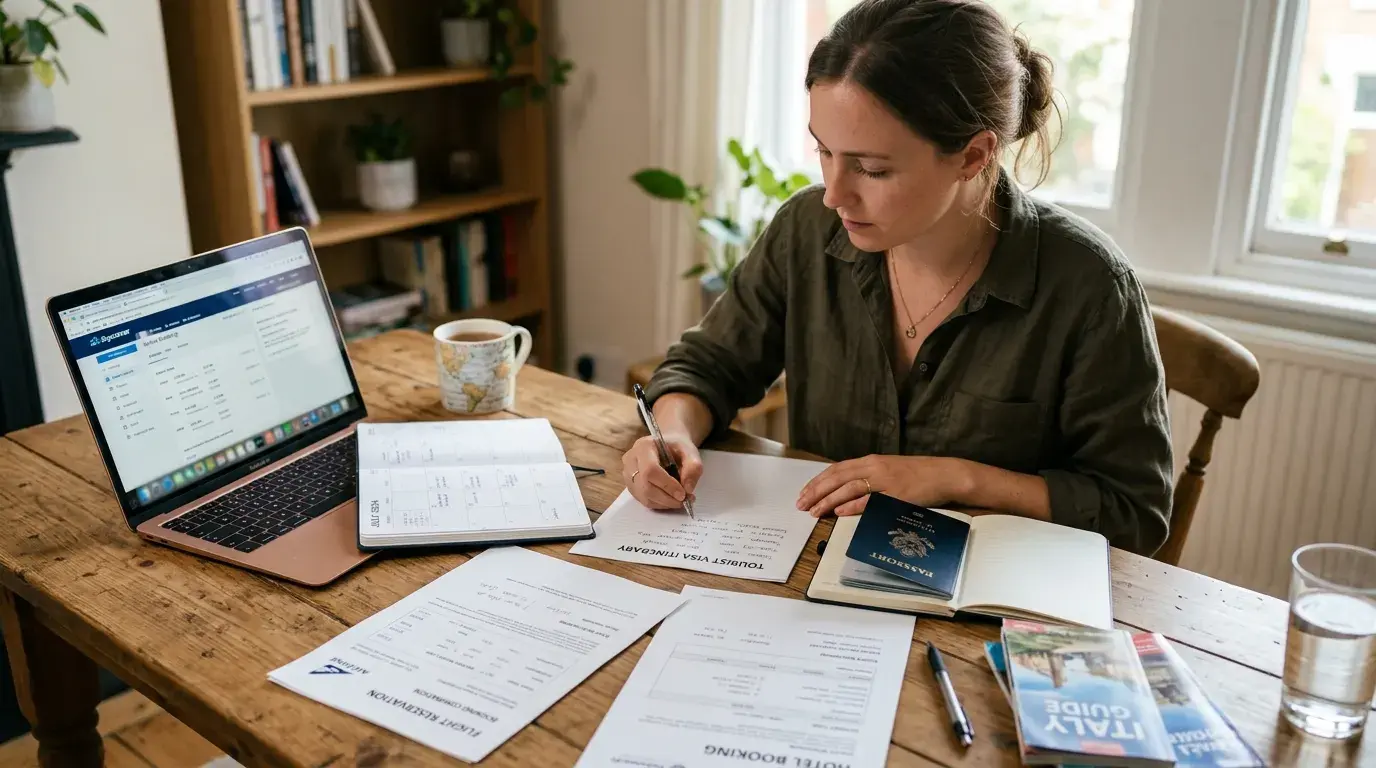
Short answer: For a Dutch student MVV from India, your university files the application, so your checklist is passport, proof of funds (EUR 1,130.77 a month in 2026), funder papers, legalised records and the TB declaration. No flight booking for visa files is required; buy travel after the sticker.
A Netherlands student file from India is unusual in one respect: you never submit it. Your university, as a recognised sponsor, sends the combined entry and residence application to the IND. What you control is the folder that goes to the university, and whether that folder is complete, current and consistent decides how fast everything after it can move.
This checklist is organised around that folder. It sorts every item into required, conditional and supporting, sets out the 2026 study amount and the six ways to show it, explains the three-month age limit on financial proof, lists the fees and who pays them, and walks a fictional Hyderabad student through a document-readiness timeline. Later sections cover the papers you need at the MVV sticker appointment and in your first weeks in the Netherlands.
If you already have IND approval and your question is when to fly, our companion guide to Netherlands student MVV flight timing after IND approval covers the sticker-to-arrival calendar. This page stays with documents and money.
Use it in three passes. Read the role table and the funds sections once, before you contact the bank. Return to the funding scenarios and the worked examples when you prepare statements and funder papers. Then use the self-test and the final folder list as a last check before the university files. Every rule is tied to an IND or NetherlandsWorldwide page named in the official-source box, and every example uses invented names and dates so you can replace them with your own without confusion.
Key facts for the student file
- The university (a recognised sponsor) files the MVV and residence application; the IND decides.
- 2026 study amount for university or HBO: EUR 1,130.77 per month, EUR 13,569.24 for 12 months.
- Financial documents must be no older than 3 months.
- IND fee for a study residence permit: EUR 254 in 2026, normally invoiced by the university.
- Legal decision period for study: 60 days; often faster for recognised sponsors.
- No flight or hotel booking is on the IND student list. If you want a dated plan for a parent, scholarship body or bank, BookForVisa flight and hotel reservations are a flat $15 per person, with a real PNR on flights, valid 48-72 hours and free date changes on the booking day only.
A scholarship office or education loan bank wants planned travel dates? Show them a verifiable reservation instead of buying a fare before the IND decides. It can be issued even while you are at the visa centre.
Get a $15 flight reservationIn This Guide
- Who Is This Student MVV Checklist For?
- Who Prepares Which Part of the File: You, the University or the IND?
- Which Documents Are Required, Conditional or Supporting?
- What Should You Ask the University Before It Files?
- When Do Records Need Legalisation and Translation, and What About the TB Declaration?
- How Much Money Does a Dutch Student MVV Need in 2026?
- Which Six Ways Can You Show the Study Amount?
- How Old Can Your Bank Statements Be, and What Must They Show?
- How Do Education Loans and Scholarships Fit the Funds Rule?
- What Fees Will You Pay, and to Whom?
- How Does One Hyderabad Student Build the File Week by Week?
- What Changes if Your File Straddles 1 January?
- Which Documents Do You Need After the IND Decision?
- How Does a Scholarship-Funded Student From Pune Compare?
- Which Papers Will You Need in Your First Weeks in the Netherlands?
- Which Document Mistakes Delay Student Files, and How Do You Fix Them?
- Where Does Travel Fit in a Student File?
- What Does the Decision Mean for the Documents You Hold?
- What If Family Members Will Join You, or You Are Not an Indian National?
- Is Your Student File Ready? A Twelve-Point Self-Test
- How Do You Read the Sticker Once It Is Issued?
- How Much Time Should the Documents Leave Before Orientation?
- How Should You Organise the Folder on Paper and on Your Phone?
- Which Official Pages Were Used for This Checklist?
- Frequently Asked Questions
Official-source check: Conditions and document rules follow the IND student residence permit page; the 2026 study amounts come from the IND required amounts page; the EUR 254 fee from the IND fees page. Sticker steps in India follow NetherlandsWorldwide's MVV page for India.
Reviewed for: 2026 study amount and arithmetic, the three-month rule, funder paperwork per route, legalisation and translation triggers, the EUR 254 fee and India sticker-appointment documents.
Who Is This Student MVV Checklist For?
It is for a student from India admitted to a full-time bachelor's or master's programme at a Dutch university or university of applied sciences (HBO), who will stay longer than 90 days and therefore needs an MVV and a student residence permit.
A stay of more than 90 days falls outside the short-stay Schengen visa, which allows at most 90 days in any 180-day period. Indian nationals coming to study for longer need the MVV, the "machtiging tot voorlopig verblijf", a type D long-stay entry visa placed in the passport by a Dutch mission. The MVV gets you into the country; the residence permit is what lets you stay for the programme.
What This Checklist Covers
- The documents your university will ask for, sorted by role.
- The study amount, its arithmetic and the six accepted ways to show it.
- Age limits and content rules for bank statements.
- Fees and who pays them.
- Papers for the sticker appointment in India.
- Papers for the first weeks in the Netherlands.
What It Leaves Out
Secondary and senior secondary vocational (MBO) programmes have their own IND page and a lower 2026 study amount of EUR 928.58 per month; this guide stays with higher education. EU and EEA nationals follow a different route, and some other nationalities do not need an MVV, so non-Indian readers should confirm their position with the university first. Family members who come with you can be sponsored by the institution through separate applications, but their paperwork is a separate task.
A short campus visit or open day is a Schengen short-stay trip with a different checklist. A short business visit has its own Schengen checklist as well.
Why Amounts in This Guide Carry a Year
The IND resets the study amounts every 1 January. All figures here are 2026 figures, valid from 1 January to 31 December 2026. A file the university submits in 2027 uses the 2027 amount, so check the IND page again before you move money.
Who Prepares Which Part of the File: You, the University or the IND?

You supply documents and money; the university checks them and files; the IND decides; a Dutch mission places the sticker. Knowing which party owns each step tells you whom to ask and where delays come from.
For study, only a recognised educational institution can submit the residence application, and for a university or HBO programme that institution is the one that admitted you. It files the MVV and the residence permit together in one combined procedure, often called TEV (entry and residence). You cannot file a standard study application with the IND yourself, and visiting a mission does not speed up the decision.
| Party | Main tasks | What you get from them |
|---|---|---|
| You | Supply passport scan, proof of funds, funder documents, legalised records, TB declaration if asked; report changes | - |
| University | Checks conditions, completes the IND study application form, pays the IND and invoices you, receives the decision | Proof of registration, fee invoice, V number email |
| IND | Decides the application within the legal period | Decision letter (sent to the university) |
| Dutch mission in India | Takes your passport and places the MVV sticker | Passport with sticker, receipt, tracking number |
Which Conditions Must Be Met Before the University Files?
The IND lists the conditions for a university or HBO student permit, and the university checks them before it applies:
- You have proof of registration, or temporary proof of registration, as a student.
- The programme is accredited by the NVAO (Accreditation Organisation of the Netherlands and Flanders) or registered in EQAR.
- The institution is a recognised sponsor listed in the IND public register for study.
- You will follow a full-time programme.
- You meet the income requirement (the study amount).
If any condition is missing, the file stays at the university. That is why the fastest files are the ones whose students sent clean documents early.
Your Obligations and the Sponsor's
A recognised sponsor for study carries an obligation to provide information, to keep records and a duty of care. You, as the student, carry the obligation to provide information: a change in your situation must be reported, and the IND can fine for breaches. After arrival, study progress becomes the running condition; the IND page sets the standard at 50% of the credits for each study year, and the institution must report insufficient progress without good reason to the IND.
Checking the School Before You Pay
A listing in the IND register does not replace the university's own checklist, but a missing listing is a reason to stop and ask before transferring money. Our guide on how to check an IND recognised sponsor for a Dutch study plan walks through the lookup.
Preparatory Year, Transfers and Study Abroad
If the institution requires a preparatory year, pre-master or language course first, the student permit also covers that preparatory period, usually up to 1 year; if you then do not meet the admission requirements, the institution deregisters you with the IND. You may later transfer to another recognised institution; both you and the new institution notify the IND. A period of study elsewhere in the EU is possible within limits, with the institution notifying the IND in time. None of this changes the first file, but it explains why the sponsor relationship lasts for the whole permit.
Which Documents Are Required, Conditional or Supporting?
Your university's checklist always takes precedence. Still, sorting the IND rules into three roles shows which items are fixed and which depend on your situation, so you do not over-prepare the wrong things or miss the right ones.
| Document | Role | When it applies | Who provides it |
|---|---|---|---|
| Valid passport (scan of photo page) | Required | Every applicant | You |
| Proof of registration or temporary proof as a student | Required | Every applicant | University |
| Proof of sufficient funds for 12 months | Required | Every applicant | You or your funder |
| IND application form for study (recognised sponsor) | Required | Every applicant | University |
| Own statement on income within the context of a study (appendix) | Conditional | Completed per study year | You |
| Scholarship declaration | Conditional | A scholarship funds you | Awarding body |
| Statement of financial support (company or private person) | Conditional | Someone else funds you | Funder |
| Legalised and translated foreign documents | Conditional | The university asks for civil records; translation if not in Dutch, English, French or German | You |
| Declaration of intent to undergo a TB test | Conditional | Your nationality is not on the IND exemption list | You, via the university |
| Health insurance arrangements | Supporting | If the university checklist names them | You or the university |
| V number email | Supporting (later) | Needed at the sticker appointment | University |
The Three Items You Cannot Skip
Passport. Every later stage reads from it: the application, the sticker and the residence card all carry its number. Renewing mid-process creates a mismatch you will have to explain, so renew before the university files if the passport is close to expiring, and tell the university the new number. At the sticker appointment it must be valid at least 6 months from the appointment date with at least 2 empty pages.
Proof of registration. The university generates it from its admission system; you rarely have to fetch it, but check that your name matches the passport exactly.
Proof of funds. The amount, the age limit and the six accepted routes are covered in the next sections.
Naming and Scanning
Name each scan plainly, surname first, then the document type and date (for example "RAO-bank-statement-2026-10-02.pdf"). Spell your name exactly as in the passport on every upload; the passport is the master record. Never alter a document yourself, even to fix a typo, and ask the university whether it wants uploads, couriered originals or both. Where the IND accepts a printout or copy, it still expects the details it names; where it wants an original, such as a foreign bank statement, a scan alone is not the same thing.
What Is Not on the List
There is no hotel booking, no flight booking and no first-night rental agreement on the IND student list. Those belong to short-stay visits. You do not need to buy a ticket to make the file look complete, and no one should tell you otherwise. If a university, scholarship body or bank asks for a travel plan for its own purposes, follow its wording exactly.
What Should You Ask the University Before It Files?
Ask five things in one email: the filing date, the funding route it prefers, whether it wants uploads or originals, whether civil records are needed, and whether the TB declaration applies to you. The answers set every deadline in your folder.
- When will you submit my application to the IND? The filing date starts the three-month window for financial documents, so it decides when you visit the bank.
- Which way of showing funds do you prefer? Some institutions favour a deposit into their own account; others accept bank statements or funder statements. Ask before you request paperwork.
- Do you want scans, originals or both? A foreign bank statement must be an original for the IND; ask how the university wants to receive it and by when.
- Do you need a birth certificate or other civil record? If yes, ask whether an English copy is enough and start the apostille immediately; legalisation is the slowest task.
- Does the TB declaration apply to my nationality? The university tells the IND at the time of application, so it needs your signed declaration before it files.
Two follow-up questions are worth asking if the email reply leaves room. First, how the university will send the V number after a positive decision, so you can watch for it. Second, whether it organises IND permit collection days on campus after arrival, which affects how much of the sticker's 90 days you need to keep free.
Keep every reply. If anything changes later, a dated written answer from the institution is the document that settles the question, not a forum post or an agent's message.
When Do Records Need Legalisation and Translation, and What About the TB Declaration?
Official foreign documents must be legalised, and translated into Dutch, English, French or German when they are in another language. For India, legalisation means an apostille from the Ministry of External Affairs. Only prepare civil records the university actually asks for, but start early, because legalisation is usually the slowest task in the folder.
Some institutions ask for a birth certificate as identity evidence beyond the passport; others do not. Follow the checklist rather than guessing. For a Hindi record, NetherlandsWorldwide allows two orders: translate in India by a sworn translator and apostille both, or apostille the original and have it translated by a sworn translator in the Netherlands, in which case the translation needs no legalisation. It also warns that obtaining and legalising documents in India can take up to 8 to 12 months in difficult cases.
Funder Documents Change the List
- Scholarship: a scholarship declaration from the awarding body.
- Company: the IND statement of financial support plus the company's own bank statement.
- Person abroad (for example a parent in India): the private-person statement, a copy of the funder's passport and their bank proof.
- Person in the Netherlands: the private-person statement, a BRP extract, a passport copy and proof of income.
Each funder document must meet the same language rule and, where it is financial proof, the same three-month age limit as your own statements.
The TB Declaration
Depending on nationality, the IND requires a tuberculosis test after arrival. Before the application, the university asks whether this applies and, if so, you sign a declaration of intent to undergo the test; the university informs the IND. The test itself happens in the Netherlands, at the municipal public health service (GGD), within 3 months after you receive the residence permit. A test taken in India is not the step the IND describes. The IND publishes the list of exempt nationalities, and your university checklist tells you whether you are on it.
Health Insurance and Identity Records
Health insurance is not an IND condition for the student permit in the way the study amount is, but it can appear on a university checklist. If it does, treat it as part of the file; if not, keep your insurance paperwork ready for arrival, when the university's instructions tell you what to arrange.
How Much Money Does a Dutch Student MVV Need in 2026?
For university and HBO students, the IND study amount for 2026 is EUR 1,130.77 per month. You show it for 12 months, so the proof must cover EUR 13,569.24. Tuition is a separate sum on top.
The study amount equals what Dutch students living away from home can receive in study financing. It is a living-cost threshold, not a budget. Real costs in student cities are often higher, especially for housing, so plan your own budget above the minimum. The IND tests only whether the threshold is met when the university files.
| Item (2026) | Amount | Source |
|---|---|---|
| Study amount, university or HBO, per month | EUR 1,130.77 | IND required amounts |
| Proof for 12 months | EUR 13,569.24 | 12 x monthly amount |
| Study amount, MBO or secondary, per month | EUR 928.58 | IND required amounts |
| IND fee, study residence permit | EUR 254 | IND fees |
| Tuition | Set by the university | University invoice |
Worked Arithmetic
A fictional student whose own account holds EUR 9,000 is EUR 4,569.24 short of the 12-month proof. That gap calls for a scholarship, a company or a private funder with complete paperwork, not a one-day top-up. If tuition is EUR 10,000, the family needs to plan for EUR 23,569.24 across both purposes, although only EUR 13,569.24 is the IND study amount.
Whose Control Must the Money Be Under?
The money must be freely available to you, or deposited with your educational institution. A balance you cannot withdraw does not count; a fixed deposit counts only if its terms show you may withdraw the money. A joint account needs a statement that you may and can use the funds. Money in a bank in India is fine as long as these conditions are met and the statement contains the required details.
Do Future Earnings Count?
No. The IND tests money available when the university applies. Planned part-time income in the Netherlands is not part of the proof, and spending savings on a fare before the decision only lowers the balance you have to show.
Which Six Ways Can You Show the Study Amount?
The IND accepts six routes. Each has its own paperwork, and the university may prefer one; ask before you request anything from a bank.
| Route | What you provide | Watch for |
|---|---|---|
| 1. Own bank account | Statement in your name showing freely available funds | Not older than 3 months; required details on the statement |
| 2. Deposit with the institution | Transfer of a year's study amount to the university's account | Follow the university's instructions and deadline |
| 3. Scholarship | Scholarship declaration | Must state the amount and period |
| 4. Company | IND appendix plus the company's bank statement | Company statement also within 3 months |
| 5. Person abroad | Private-person statement, passport copy, bank proof | Funder's bank proof within 3 months |
| 6. Person in the Netherlands | Private-person statement, BRP extract, passport copy, proof of income | Separate IND amounts apply to the financier |
Documents must be in Dutch, English, German or French, or be translated. Combining routes, for example your own savings plus a parent abroad, is common; then each part needs its own complete paperwork.
Which Route Suits Which Family?
- Savings already in your name: route 1, with a statement timed to the university's filing date.
- Parents paying from India: route 5, or a transfer into your own account early enough to show a clean history.
- Education loan: ask the university whether a sanction letter is acceptable or whether disbursed funds must appear in an account or be deposited (route 2).
- Employer-sponsored study: route 4.
- University or government scholarship: route 3, sometimes combined with route 1 for the remainder.
If an education loan provider or scholarship office wants a dated travel plan before releasing funds, see how a scholarship flight reservation for a visa file can show dates without buying a fare.
How Old Can Your Bank Statements Be, and What Must They Show?
No older than 3 months on the day the university files. That applies to original statements, copies of account statements and printouts from the bank's website. A foreign bank account needs an original statement.
Each statement must show:
- The date.
- Your initials and surname.
- The account number.
- The balance.
- The bank's contact details.
Check every line before you hand it over; a missing contact block or a truncated name slows the file.
Timing the Statement
Ask the university when it plans to file, then request statements as late as its upload deadline allows. A statement pulled in July for a file submitted in October will be stale. If the university asks for an updated statement after a delay, that is normal; budget a bank visit for it.
Sudden Deposits
Do not move money in for a day to pass a check. The funds must be genuinely available to you, and an unexplained large deposit raises questions that a steady history avoids. If a parent transfers savings to you, do it early and keep the transfer record so you can explain the source if asked.
Funder Statements Too
The three-month rule applies to a funder's bank proof as well. Coordinate dates with parents or a sponsor company so all statements fall inside the same window.
How Do Education Loans and Scholarships Fit the Funds Rule?
Only money that is freely available to you, deposited with the institution, or covered by a recognised funder statement counts. A loan that has been sanctioned but not disbursed may not meet that test, so ask the university how it treats your loan before you rely on it.
Many Indian families combine savings with an education loan. The IND rule does not mention loans by name; it looks at whether the study amount is available to you. In practice that leaves three common patterns:
- Loan disbursed into your account: the money appears on your statement and is treated like your own funds, subject to the three-month rule and the required details.
- Loan paid to the university: if the bank pays the university directly and the university counts it as a deposit for living costs, it may fit route 2. Ask the university to confirm in writing.
- Sanction letter only: a promise of future money is not a balance. Ask whether the university accepts it; if not, plan another route for the gap.
Scholarships
A scholarship is shown with a scholarship declaration from the awarding body. Check that it states the amount and the period it covers. If it covers only part of the year, or only tuition, the remaining living-cost months must be shown another way, for example from your own account. A scholarship that pays tuition does not reduce the EUR 1,130.77 monthly living-cost threshold.
Mixing Routes Cleanly
When two routes combine, write a one-line summary for the university: "EUR 8,000 own account (statement dated 2 November), EUR 6,000 father (private-person statement, passport copy, statement dated 2 November)". It helps the person checking your file and makes gaps visible before the IND sees them.
Lenders and scholarship offices sometimes want travel dates before releasing money. They are asking for their own records, not for the IND. A dated reservation can answer them without spending savings you still need to show.
What Fees Will You Pay, and to Whom?
The IND fee for a study residence permit is EUR 254 in 2026 for a first application or a change of purpose. The university pays the IND and normally invoices you, so the university's invoice is the amount to trust.
Fees are adjusted periodically, so figures in older guides may be outdated. Read the current IND fees page for the year of filing. Do not pay an agent for an IND fee the university will invoice; if anyone asks for the IND fee up front, check the university's own fee notice first.
Other Costs to Budget
- Tuition, invoiced by the university on its own schedule.
- Legalisation and translation of any civil records the university asks for.
- Dutch-standard passport photos for the sticker appointment.
- DTDC courier for the passport return, if you choose it (850 Indian rupees for an AWB number, per NetherlandsWorldwide).
- Health insurance and housing deposits after arrival.
How Does One Hyderabad Student Build the File Week by Week?
Rohan is a fictional student in Hyderabad admitted to a fictional Dutch university for a February 2027 start, with orientation on Monday 25 January 2027. Every date below is invented; the rules come from the IND and NetherlandsWorldwide. The file is submitted in 2026, so the 2026 study amount applies.
| Date | Document step | Rule behind it |
|---|---|---|
| 1 Sep 2026 | Checks the university in the IND study register; confirms programme is accredited and full-time | Recognised sponsor, accreditation, full-time study |
| 8 Sep 2026 | Asks the university for its document checklist and filing date (mid-November) | University checklist prevails |
| 15 Sep 2026 | Confirms no civil records are requested; passport valid to 2031 | Legalisation only when asked |
| 1 Oct 2026 | Father agrees to fund EUR 6,000; Rohan holds EUR 8,000 | Two routes combined: own account plus person abroad |
| 20 Oct 2026 | Father completes the private-person statement and passport copy | Route 5 paperwork |
| 2 Nov 2026 | Both bank statements issued with all required details | Not older than 3 months on filing |
| 5 Nov 2026 | Signs the TB declaration of intent at the university's request | Nationality not on the exemption list |
| 12 Nov 2026 | University files; invoices the EUR 254 IND fee | Combined MVV and residence application |
| 11 Jan 2027 | Latest legal decision date | 60 days for study |
| 30 Nov 2026 | Positive decision; V number email arrives 1 Dec | Email is enough at the appointment for students |
| 8 Dec 2026 | Sticker appointment at the consulate-general in Bangalore | Any of the three India locations; within 3 months |
| 17 Dec 2026 | Sticker issued | 90 days from issue date |
Why the Funds Row Worked
EUR 8,000 plus EUR 6,000 is EUR 14,000, above the EUR 13,569.24 threshold, and both statements were dated ten days before filing. Had the university filed in February instead, both would have expired and needed replacing.
What Would Have Slowed Him Down
- A statement from August: stale by the filing date.
- A father's statement with no bank contact block: returned for correction.
- A passport renewal after filing: a number mismatch on the sticker.
- A loan sanction letter without disbursed funds: possibly not accepted as freely available money; ask first.
Building Your Own Version
Copy the table into a spreadsheet, keep the rule column, and fill in your own dates. Never put passport numbers, payment details or logins in a shared sheet. Highlight the dates that cannot move: the university's filing date (which sets the three-month window), the 3-month sticker deadline after the decision, and the orientation date.
What Changes if Your File Straddles 1 January?
The study amount and the fees can change on 1 January, so a file prepared in December and submitted in January must meet the new year's figures. Check the IND pages again in the first week of January and top up proof if the threshold rose.
For a February intake, many universities file in October or November, which keeps the whole file inside one calendar year. For a September intake, filing usually happens between spring and early summer, also inside one year. The risk appears when a file is delayed, for example because a civil record took longer to legalise or because admission came late.
| Situation | What to check | Action |
|---|---|---|
| Statements issued in November, filing slips to January | The new study amount; statement age | New statements if the amount changed or the 3 months will lapse |
| Fee invoiced in December, filing in January | The new fee | Follow the university's updated invoice |
| Funder statement signed in December | Whether the funder's required amount changed | Ask the university whether a new statement is needed |
| September intake, filing in June | Mid-year changes for funders in the Netherlands (some IND amounts change on 1 July) | Read the IND required amounts page for the filing month |
The rule of thumb: whatever the year, the figures on the IND page on the day the university files are the figures that count. Keep a screenshot of that page with the date in your folder.
Which Documents Do You Need After the IND Decision?
For the sticker appointment in India: your passport and photo-page copy, a Dutch-standard photo, the university email with your V number and any other documents the IND letter lists. Students do not need a copy of the IND letter itself.
The decision goes to the university by letter; a positive decision means you will receive the MVV and the student residence permit, and a negative decision can be challenged by objection. The university then emails you the V number, your alien registration number. Save that email first; copy the number exactly.
Appointment Rules in India
- Locations: embassy in New Delhi or consulate-general in Bangalore or Mumbai. You may use a different one from the location in the letter without permission.
- Deadline: within 3 months of the positive decision.
- Booking: each location has its own online appointment link on the NetherlandsWorldwide India page; a confirmation email follows. If it does not arrive, check spam, then contact NetherlandsWorldwide.
- Availability: slots fill quickly; if none are free, try again later, as slots open when other applicants reschedule.
- Passport: valid at least 6 months from the appointment date, at least 2 empty pages. If you are not an Indian national living in India, also bring your residence permit and a copy.
Getting the Passport Back
You hand in the passport, and it can take up to 10 working days before the sticker is ready. Choose at the appointment between DTDC courier delivery, arranged beforehand with an AWB number and a signed disclaimer form, or collection with the mission's permission, bringing the receipt and ID. Someone else can collect with your signed authorisation letter, the receipt and their own ID. Check the name and validity on the sticker as soon as you have it.
Read the sticker fields before you leave the desk; the table in the next section shows what each line means.
How Does a Scholarship-Funded Student From Pune Compare?
Ananya is a fictional student in Pune admitted to a fictional Dutch master's programme starting in September 2027. A foundation scholarship covers EUR 9,000 of living costs; her own savings cover the rest. Dates and names are invented.
| Date | Document step | Note |
|---|---|---|
| Feb 2027 | Admission; asks the university for its checklist and filing date (early May) | Filing date sets the 3-month window |
| Mar 2027 | Scholarship declaration received, stating EUR 9,000 for 12 months | Route 3 |
| Mar 2027 | Checks the 2027 study amount on the IND page | New calendar year, new figure |
| Apr 2027 | Own statement shows the remaining balance with all required details | Route 1 for the gap |
| Early May 2027 | University files; she signs the TB declaration if it applies | Combined application |
| Within 60 days | Decision; V number email | Legal period for study |
| Within 3 months of decision | Sticker appointment at Mumbai, the nearest location | Any of the three India locations |
Ananya's file differs from Rohan's in two ways. Her scholarship declaration does not expire like a bank statement, but her own statement does, so she times only that one. And because her file sits in 2027, she uses the 2027 study amount, not the 2026 figure in this guide. Her lesson is the same, though: build the folder around the filing date and the threshold on the IND page that day.
What If the Scholarship Covers Tuition Only?
Then it does not help with the living-cost threshold at all. She would need to show the full 12-month study amount from another route, and the scholarship letter would go to the university for tuition purposes only.
Which Papers Will You Need in Your First Weeks in the Netherlands?
The residence permit card, municipal registration papers, the TB referral if it applies, and health insurance documents. Keep them together from the day you land.
Collecting the Residence Permit
You or the university receive a message from the IND when the permit is ready. Collection is by appointment at an IND desk, and the MVV must still be valid on that day; it is valid 90 days from its "Issued on" date. Some institutions organise collection days with the IND, so follow their instructions. Check the card at the desk and report any error immediately.
Municipal Registration
Register with your municipality after arrival; registration is normally how you receive a citizen service number (BSN), which banks, insurers and employers ask for. Book early, because student cities fill slots before term. Bring the documents the municipality lists, typically including your rental contract or host statement.
The TB Test
If the university indicated a TB test at the application stage, make an appointment with the GGD within 3 months after receiving the residence permit and take the TB referral form.
Work and Insurance
A student permit allows paid work only with a work permit (TWV) obtained by the employer, up to 16 hours a week, or full-time in June, July and August. Self-employment is possible if you meet the conditions and register with the Chamber of Commerce. Health insurance steps follow your university's arrival information.
Study Progress and After Graduation
The institution checks your credits each year against the 50% standard. After graduation, you can apply for an orientation-year permit to look for work, or for work as a highly skilled migrant with a lower income requirement for recent graduates. Before a trip home, check the IND rules for travelling with your residence permit.
Which Document Mistakes Delay Student Files, and How Do You Fix Them?
Most delays come from small, preventable mismatches. Fix them before the university files, when correction is still cheap.
| Mistake | Effect | Fix |
|---|---|---|
| Bank statement older than 3 months on filing day | Funds not accepted | Request a new statement timed to the filing date |
| Statement missing name, balance or bank contact details | Returned for correction | Ask the bank for a full statement with all five details |
| Funds locked in a fixed deposit | Not freely available | Show terms allowing withdrawal, or move funds |
| Name spelled differently on documents and passport | Questions and delay | Align every upload to the passport spelling |
| Passport renewed after filing | Number mismatch | Tell the university immediately |
| Civil record not apostilled or not translated | Document not usable | MEA apostille; sworn translation if needed |
| Funder paperwork incomplete | Funding route fails | Use the correct IND statement plus passport copy and bank proof |
| Paying an agent for the IND fee | Double payment risk | Pay only the university invoice |
If a mistake is found after filing, the university usually tells you what the IND needs. Answer quickly and to the same standard; a late document that repeats the original problem only extends the wait.
Where Does Travel Fit in a Student File?

At the end. The IND student requirements do not include flight proof, and the sticker appointment does not ask for it. Paid travel belongs after the sticker is in your passport, when its 90 days and its "From" and "Until" dates are known.
Keep three items apart. A flight reservation is a booking record that shows a planned route, with a real PNR. A paid ticket is what you travel on. The airport's departure documents are a third, separate thing. Some agents sell a dummy ticket for student files; for this route the IND has no use for one, and when a bank or scholarship office wants dates, what it can check is a verifiable reservation.
A BookForVisa flight reservation costs a flat $15 per person, carries a real PNR you can check with the airline, stays valid for 48-72 hours and allows free date changes on the booking day only. It is a reservation for your file, not a paid ticket for travel.
Plan your arrival a few days before orientation, inside the sticker dates, and leave time in the 90 days for the IND permit appointment. The MVV is also valid for travel via other Schengen countries but not for the Caribbean parts of the Kingdom.
What Does the Decision Mean for the Documents You Hold?
A positive decision means the IND will issue the MVV and the student residence permit, and your documents now move from proving eligibility to supporting the sticker appointment and arrival. A negative decision can be challenged by an objection, and the documents you kept become the basis for it.
After a positive decision, do not discard anything. The funds statements, the funder papers and the university correspondence remain useful: the IND appendix on income within the context of a study is completed each study year, and the institution may ask for updated information if your situation changes. Keep the originals of any legalised civil records safe, because the municipality may ask to see them at registration.
After a negative decision, read the reasons carefully with the university. The decision letter explains the grounds and the objection route. Gaps in funds proof, an expired statement or a missing funder document are common reasons that can sometimes be addressed. Do not book or pay for travel while an objection is pending.
Reporting Changes
Your obligation to provide information continues. If your funding route changes, you change programme or institution, or your passport is replaced, tell the university so it can meet its own reporting duties to the IND. A change reported late can create a problem that a quick email would have prevented.
What If Family Members Will Join You, or You Are Not an Indian National?
Family members need their own applications and their own documents; your checklist does not cover them. If you are not an Indian national but live in India, the sticker appointment also asks for your Indian residence permit or comparable document and a photocopy.
Your educational institution can apply for residence permits for family members, such as a partner or children, but it is only ever responsible for you as a student. Their files carry relationship evidence, often legalised civil records such as a marriage or birth certificate, and the sponsor's income rules for family members are separate from your study amount. Start their records at the same time as yours if they will travel with you, because legalisation in India can be slow.
For non-Indian nationals living in India, two things change. First, whether you need an MVV at all depends on nationality; some nationalities are exempt, so confirm with the university. Second, at the sticker appointment you bring proof of legal residence in India in addition to the usual items. The money rules, the three-month limit and the university-led filing stay the same.
If your nationality is one where the sticker must be requested in another country, read the NetherlandsWorldwide page for that country. The India steps in this guide, such as the DTDC courier, apply only to the three Dutch missions in India.
Is Your Student File Ready? A Twelve-Point Self-Test
Answer yes to all twelve before the university files. Any "no" is a task for this week.
- The university appears in the IND public register for study.
- The programme is accredited and full-time.
- You know the university's filing date.
- Your passport is valid well beyond the likely sticker appointment plus 6 months, with 2 empty pages.
- Your name is spelled identically on every document.
- The funds cover at least the current 12-month study amount.
- Every financial statement will be under 3 months old on the filing date.
- Each statement shows date, name, account number, balance and bank contact details.
- Every funder has signed the correct IND statement and supplied a passport copy and bank proof.
- Any requested civil record carries an MEA apostille and, if needed, a sworn translation.
- You have answered the university's TB question.
- You know the fee and will pay only the university invoice.
When all twelve are yes, the remaining waiting time belongs to the IND, and your next task is watching for the V number email.
How Do You Read the Sticker Once It Is Issued?
Check the name, passport number, type, "Valid for", "Issued on" and "From" and "Until" lines as soon as you hold the passport. Errors are fastest to fix at the desk or with the mission that issued it.
| Field | Should show | Why it matters |
|---|---|---|
| Name | Exactly as in the passport | Must match the university and IND records |
| Passport number | The passport you will travel on | The sticker belongs to that passport |
| Type | D | Type D with only the Netherlands under "Valid for" marks an MVV |
| Issued on | Issue date | Starts the 90 days to travel and collect the permit |
| From / Until | Entry window | Arrival must fall inside it |
If you hold a second passport, travel on the one with the sticker. If that passport expires before you travel, carry the new one together with the old one, as long as the sticker stays legible and undamaged, and tell the university. If the passport with the sticker is lost or stolen, contact the IND immediately.
How Much Time Should the Documents Leave Before Orientation?
Work backwards from orientation week: the sticker needs up to 10 working days after the appointment, the appointment must fall within 3 months of the decision, and the study decision has a 60-day legal period. A file filed about four months before orientation leaves room for each step.
| Step (counting back from orientation) | Typical margin to plan | Why |
|---|---|---|
| Arrival | A few days before orientation | Keys, registration appointment, settling in |
| Sticker in hand | At least a week before arrival | Courier transit and a final document check |
| Sticker appointment | Up to 10 working days before the sticker is ready | Mission handling time in India |
| IND decision | Up to 60 days after a complete filing | Legal decision period for study |
| University filing | Funds statements dated within the previous 3 months | Three-month rule |
These are planning margins, not official processing times; recognised sponsors often receive decisions faster. If the university tells you its filing date is late, ask early whether orientation can be joined later or online, rather than finding out after the sticker appointment.
Once the sticker is in your passport and its dates are clear, choose the arrival day, then tell the university. Until then, keep any dated plan flexible.
How Should You Organise the Folder on Paper and on Your Phone?
Keep one physical folder and one encrypted digital copy, arranged in the order each stage asks for documents. A clear folder saves time at the university, the mission, the IND desk and the municipality.
- Identity: passport copy, passport photos, any civil records with apostille and translation.
- Admission: admission letter, proof of registration, accreditation and sponsor-register notes.
- Funds: statements with dates, funder statements, passport copies of funders, scholarship declaration.
- Fees: university invoice and payment proof.
- Decision: V number email, appointment confirmation, receipt, tracking number, DTDC AWB.
- Arrival: housing contract, municipal appointment, IND permit appointment, TB referral, insurance.
Digitally, use the same six folders and the same file names. Do not keep passwords or card details in the folder, and never share the whole folder in a group chat. Share single documents with the person who needs them.
Carry the passport with the sticker, the admission email, the V number email and your first address in hand luggage when you travel. Border staff may ask about your studies, and clear paperwork answers most questions in seconds.
Which Official Pages Were Used for This Checklist?
- IND, Student residence permit for university or higher professional education.
- IND, Required amounts income requirements (study amounts 2026).
- IND, Fees (costs of an application).
- IND, Decision periods.
- NetherlandsWorldwide, Applying for an MVV visa sticker for the Netherlands in India.
- NetherlandsWorldwide, How long is my MVV visa sticker for the Netherlands valid?
- NetherlandsWorldwide, Legalisation of documents from India for use in the Netherlands.
Checked in October 2026. Amounts reset each 1 January; check the live pages before you transfer money.
What Should Your Final Student Folder Contain?
Before the university files: passport scan, proof of registration, proof of funds no older than 3 months, funder statements and passport copies, legalised and translated records if asked, the TB declaration if asked, and the fee invoice. After the decision: the V number email, photo and passport for the sticker appointment, and the DTDC AWB or collection plan. After arrival: the residence card, municipal registration papers, the TB referral and insurance documents. Travel paperwork comes last and never replaces any of them.
If one item is still missing, write down who owns it, what they need from you and the date you asked. A file with three named open tasks is easier for the university to help with than a vague worry, and it keeps the timeline honest for everyone involved, including parents and funders.
Funds ready and the decision pending? If a parent, bank or scholarship office wants dates, hold them with a real PNR, valid 48-72 hours, for a flat $15 per person, and buy the fare after the sticker.
Create your $15 flight reservationFrequently Asked Questions
Can I apply for the MVV sticker in a different Indian city?
Yes. The IND letter names New Delhi, Bangalore or Mumbai, but NetherlandsWorldwide says you may apply at another of these three locations without permission from the IND or the mission. Apply within 3 months of the positive decision and bring the V number email instead of the IND letter copy.
What documents does a Dutch student MVV need from India?
Your university files the application, so you supply a passport scan, proof of funds for 12 months no older than 3 months, funder statements if someone else pays, legalised and translated records if the university asks, and a TB declaration if your nationality requires it. The university adds proof of registration and the IND form.
How much money do I need to show for a Dutch student visa in 2026?
For university or HBO study the IND amount is EUR 1,130.77 per month in 2026, so 12 months is EUR 13,569.24. Tuition is separate. MBO and secondary students use EUR 928.58 per month. Amounts change every 1 January, so check the IND page before you move money.
How old can my bank statement be for the IND?
No older than 3 months on the day the university files. It must show the date, your initials and surname, the account number, the balance and the bank's contact details. A foreign bank account needs an original statement. Time it to the university's filing date.
Can my parents in India fund my Dutch studies?
Yes. A person abroad can fund you with the IND private-person statement, a copy of their passport and their bank proof, which also must be no older than 3 months. You can combine this with your own savings, as long as each part has complete paperwork.
What is the IND fee for a Dutch student residence permit?
EUR 254 in 2026 for a first study application. The university pays the IND and normally invoices you, so pay the university invoice, not an agent. Check the IND fees page for the year your file is submitted.
Do I need a flight ticket for the Dutch student visa application?
No. The IND student requirements and the sticker appointment list do not include travel proof. Buy travel after the sticker is in your passport. If a bank or scholarship office wants dates earlier, a reservation with a real PNR can show them without buying a fare.
Do I need a TB test for a Dutch student permit?
It depends on nationality. If your university says it applies, you sign a declaration of intent before the application and take the test at the GGD within 3 months after receiving the residence permit, bringing the referral form. A test taken abroad is not the IND step.
Friendly reminder: BookForVisa prepares flight and hotel reservations to support visa applications and onward-travel proof. Requirements vary by destination, consulate, visa category and applicant situation. A reservation supports your file; it is not a paid ticket for travel and does not guarantee visa approval or entry.