
Short answer: A cruise-linked flight itinerary for visa should show the complete chain: arrival airport, port transfer, embarkation, permitted port or country entry, disembarkation and the final return or onward route. Match cruise confirmation, visas, accommodation and transport dates, allow realistic transfer time, and avoid treating a ship schedule as a guarantee of airport readiness. A reservation can support a visa file, but it cannot guarantee approval, boarding or entry.
Embassies rarely question a cruise trip because the ship looks unusual. They question it when your flight lands too late, your port entry does not match the visa logic, or your onward plan goes vague the moment you disembark. A clean reservation is not enough here. You need a route that reads like one workable journey from airport arrival to final exit.
When a cruise starts in one country, boards from another city, and ends in a different country, small inconsistencies can sink an otherwise solid file. We are looking at how to show flights, port access, and post-cruise travel. Hence, your itinerary stays consistent, believable, and easy for an officer to follow without second-guessing how you actually plan to make the whole trip work on paper. For a cruise-linked visa route, keep your dummy ticket booking aligned with embarkation and exit cities.
Key facts:
- Arrival airport, port, embarkation and disembarkation should form one route.
- Cruise confirmation, visas, accommodation and flights should cover the same dates.
- Show material port transfers and allow realistic time after disembarkation.
- Onward or return travel should follow the cruise and fit the visa purpose.
- A reservation supports evidence; it does not replace visa, transit or entry requirements.
Need temporary flight proof for a cruise-linked visa file? BookForVisa can help keep the passenger name, flight dates, port route and onward plan consistent while you confirm the destination checklist.
Official-source check: Confirm the destination consulate or visa centre’s current cruise, port-entry, transit and travel-document requirements, plus the cruise line and airline’s document rules. Use the IATA Travel Centre for passport, visa, health and carrier-facing transit checks; the destination authority controls the visa decision.
Reviewed for: embarkation and disembarkation logic, port transfers, cruise dates, visa entry points, onward travel, accommodation and document consistency.
Why Cruise-Linked Visa Reservations Fail Even When The Flight Booking Looks Fine

Cruise-linked visa files are judged differently from ordinary city-break itineraries. Your flight reservation may look clean on its own, but the embassy is usually checking whether the full route works from touchdown to embarkation to final exit.
| Trip link | Evidence to match | Check before submission |
|---|---|---|
| Arrival to port | Flight, airport and ground transfer | Allow realistic time before embarkation |
| Port entry | Visa, passport and cruise itinerary | Confirm every required country or port permission |
| Disembarkation | Ship arrival and final-city plan | Do not assume immediate airport readiness |
| Final exit | Return or onward reservation | Match the final port, accommodation and visa window |
The Embassy Is Reading A Travel Story, Not Checking Boxes
A cruise trip forces an officer to read your file as one connected travel story. That changes how your flight reservation is judged.
On a simple trip, a return flight can do a lot of work on its own. On a cruise-linked trip, it cannot. The officer is asking a more practical question: Does this reservation fit the trip you claim to be taking?
That means your documents need to tell a sequence the officer can follow without effort:
-
You arrive in the right country or region
-
You have enough time to reach the port
-
Your cruise begins where your papers say it begins
-
The route continues logically after disembarkation
If one part looks disconnected, the reservation loses strength fast.
This is where many applicants misread the standard. They assume a valid flight hold proves travel intent. For a cruise file, it only proves one thing: that a flight exists on paper. It does not prove you can actually board the ship, follow the cruise route, or believably leave the region.
That difference matters because embassies do not just screen for document presence. They screen for itinerary credibility.
If your application says you are boarding a Mediterranean cruise from Barcelona, but your reservation lands in Paris late in the evening with no visible transfer plan, the issue is not the flight itself. The issue is that the travel story now has a hole in the middle.
A strong cruise-linked reservation file feels easy to understand. A weak one feels like separate bookings are collected for compliance.
Cruise Line Itineraries Create “Missing Middle” Problems That Normal Trips Do Not
The hardest part of a cruise-linked visa application is often not the entry or the exit. It is the missing middle.
That missing middle is the part between airport arrival and ship boarding. On a regular trip, that gap is usually simple. You land, you go to your hotel, and your city stay begins. On a cruise trip, that gap is operational. You need to show that you can actually move from one transport system to another without the itinerary collapsing.
Common missing-middle problems include:
-
No visible route from the airport to the port
-
Arrival too close to embarkation cut-off
-
Overnight gap with no clear logic
-
Entry into one country, but cruise departure from another
-
Port city does not match the arrival airport in any practical way
These gaps make officers pause because they suggest the applicant has reserved documents, but not a trip.
Cruise travel always adds at least one extra layer of movement. Sometimes it adds two or three. You may land in one city, transfer to another, stay overnight, board the ship, disembark in a different country, and then fly home from a third city. That is normal for cruise travel. But it also means the file must work harder.
What hurts applications is not complexity by itself. It is an unexplained complexity.
If your reservation shows you landing in Rome, but the cruise leaves from Civitavecchia, that can still be a perfectly solid route. But the logic has to be obvious. Rome and Civitavecchia are connected in real life, so the officer needs to feel that you understand that connection, too.
The same principle applies across regions:
-
Athens airport versus Piraeus port
-
Venice-area arrival versus Ravenna embarkation
-
Amsterdam arrival versus Rotterdam departure
-
Miami arrival versus Fort Lauderdale embarkation
None of these is inherently problematic. They only become risky when the file acts as if the airport and the port are the same thing.
The Most Common Contradiction Is Between Where You Enter And Where The Cruise Actually Starts
This is one of the fastest ways a cruise reservation starts to feel weak.
You may enter through one country or city for perfectly reasonable travel reasons. That is not the problem. The problem begins when the arrival point and the embarkation point do not line up in a way the officer can understand immediately.
A few examples make this clear:
-
You fly into Madrid, but your cruise starts in Lisbon
-
You arrive in Milan, but your cruise departs from Genoa with no buffer
-
You land in Brussels, but the ship leaves from Amsterdam, and the file never shows how you get there
Each of these routes could be workable. But if the reservation does not support the transition, the officer may start reading the flight as random rather than intentional.
This contradiction shows up in two forms.
The first form is a geographic mismatch.
The arrival city looks too far, too unrelated, or too inconvenient for the port. Even if the route is technically possible, it may feel improvised.
The second form is a jurisdiction mismatch.
The first country you enter may not be the country most closely tied to the cruise. That is where visa logic gets tested more carefully.
For instance, if your cruise departs from Italy but you fly first into France, the officer needs to understand why that first entry makes sense within your full itinerary. If that explanation is not visible through the route itself, the file may appear stitched together.
You do not need perfect symmetry. You need visible logic.
The cleaner approach is to make sure your entry point supports one of these clear stories:
-
It is the most practical airport for the embarkation port
-
It is the true first entry point before reasonable onward movement
-
It allows enough time to reach the ship without strain
Once that logic is missing, even a real reservation can stop helping.
Officers Notice Timing Problems in Visa Application Faster Than Applicants Do
Timing is where many cruise-linked visa files quietly fall apart.
Applicants often focus on whether the dates technically fit. Officers often focus on whether the timing looks realistic. Those are not the same standard.
A reservation can match the cruise date and still raise immediate doubt.
The biggest timing problems are easy to recognize once you start reading the itinerary like a travel planner instead of a document collector:
-
International arrival on the same day as embarkation
-
Late-night landing before a morning port check-in
-
Tight layovers before a region change
-
Return flight departing too soon after disembarkation
-
Border crossings are squeezed into a few hours with no margin
These do not just look risky. They make the whole file feel fragile.
Cruise travel is schedule-sensitive. Ships do not wait for delayed passengers the way a hotel check-in can absorb a late arrival. That makes buffer time part of your reservation logic, not just a comfort preference.
If your flight lands at 1:40 p.m. and your ship boards at 4:00 p.m. from a port that still requires airport transfer, baggage collection, and possible traffic, the officer may see that as poor planning. Even if the timing is barely possible, it does not look stable.
The same applies after the cruise. If the ship docks at 8:00 a.m. and your onward flight leaves at 10:15 a.m. from an airport outside the port city, the exit plan can feel more fictional than firm.
Good cruise-linked timing usually has three qualities:
-
It respects transport reality
-
It leaves room for normal delays
-
It makes your trip look intentional, not optimistic
Embassies notice that difference very quickly because timing problems often signal that the itinerary was built around document convenience instead of real movement.
Why Cruise-Linked Onward Proof Is Judged More Harshly Than Standard Return Flights
On a regular visa file, a return flight often closes the loop neatly. On a cruise-linked trip, the onward plan carries more pressure because the middle of the journey is not static.
You are not just entering and leaving one city. You are entering a route that moves.
That means the officer wants to see that your exit still makes sense after the cruise changes your location.
This is where weak files often go vague. The application shows a flight into the departure region and a cruise booking, but the end of the journey becomes blurry. The officer is left asking:
-
Where exactly do you disembark?
-
Are you staying on land after the cruise?
-
Are you leaving from that same country?
-
Is the onward reservation actually connected to the cruise endpoint?
A standard return template can look artificial here. If the ship ends in Athens, but your reservation shows a return flight from Rome with no clear link, the issue is not just distance. It is that the exit no longer closes the story you opened.
Cruise-linked onward proof is judged more harshly because the officer knows your location changes during the trip. Your file has to keep pace with that movement.
When the exit plan is vague, the reservation starts to look like placeholder paperwork. When the exit plan clearly reflects the disembarkation reality, the itinerary feels grounded.
When A Valid Cruise Booking Actually Increases Scrutiny Instead Of Reducing It
Many applicants assume the cruise booking will reassure the embassy. Sometimes it does. Sometimes it has the opposite effect.
A cruise confirmation can raise the quality bar because it gives the officer more route detail to compare against your other documents.
Now the officer can see:
-
The embarkation port
-
The sailing date
-
The disembarkation point
-
The overall travel region
-
In some cases, the port sequence
That detail helps only if your reservation chain matches it.
If it does not, the cruise booking exposes the weak points faster. A flight arriving too late now looks clearly too late. A wrong entry city now looks harder to justify. A return flight from an unrelated city now looks less believable.
So the cruise booking is not a shortcut. It is a cross-check.
For broader visa-file planning, see BookForVisa’s 2026 flight-reservation guide and apply the same date and route checks around embarkation.
How To Build A Flight Reservation Around The Cruise, Not Around The Cheapest Route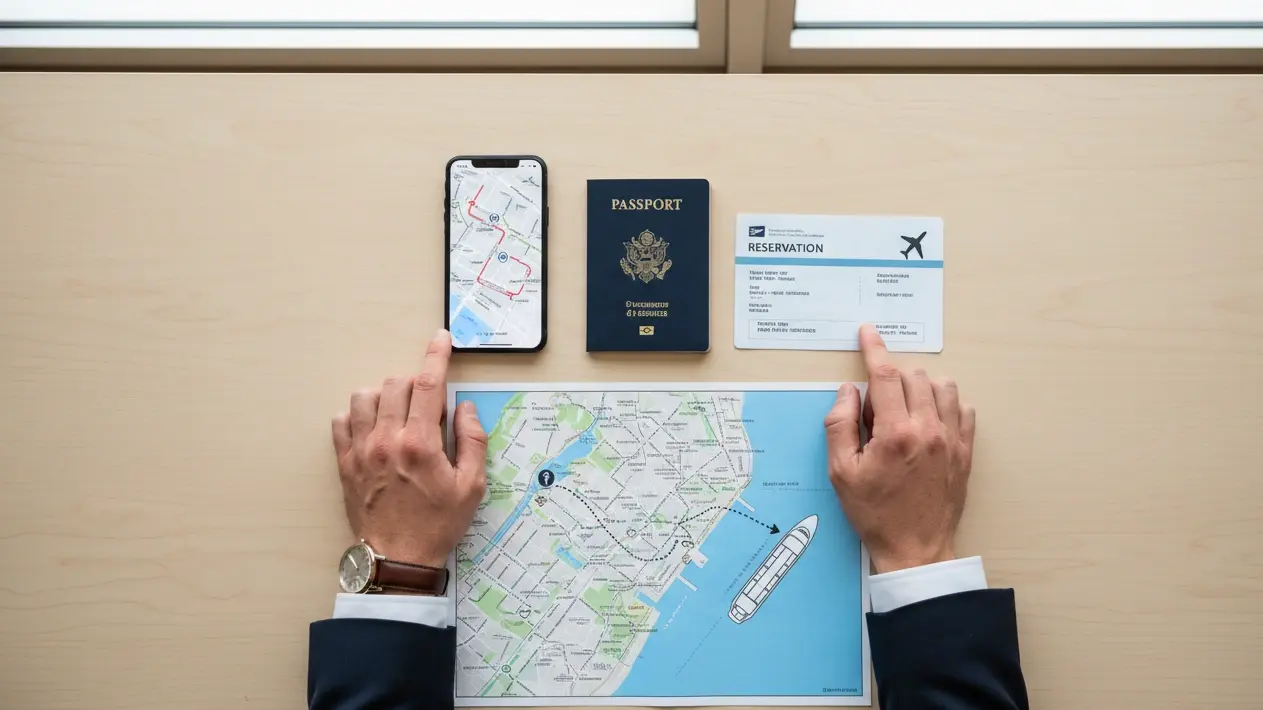
Once the cruise is fixed, your flight reservation has one job: support that itinerary cleanly. That usually means resisting the cheapest or most convenient air routing if it creates extra questions the visa officer now has to solve.
Start With The Embarkation Port, Then Work Backward To The Flight
The cruise departure port is the anchor point. Not the cheapest airport. Not the city with the most flight options. Not the capital that seems easiest to reserve.
If your ship departs from Civitavecchia, Piraeus, Southampton, or Fort Lauderdale, that port decides what the flight needs to do. Your air reservation should be built backward from the point where you must physically board.
That changes how you choose the route.
You are not asking, “What is the easiest way to enter the region?” You are asking, “What arrival pattern makes this cruise boarding plan look realistic on paper?”
That usually means checking four things first:
-
Which port does the ship actually use
-
Which airport most sensibly serves that port
-
How much time does the airport-to-port transfer take
-
Whether the cruise begins in the same country you first enter
This matters because cruise marketing often centers on the nearest famous city, while embarkation happens somewhere else. A traveler may think “Rome cruise,” but the ship boards at Civitavecchia. They may think “Athens cruise,” but embarkation is through Piraeus. A visa officer will notice that distinction if your reservation ignores it.
The strongest flight reservation does not just get you into the general region. It gets you close enough, early enough, and clearly enough for the cruise to look workable from the moment you land.
That is why the flight should be shaped by the port first, then by price and convenience second.
Choosing The Right Arrival City When The Cruise Leaves From A Secondary Port
Secondary ports create one of the most common reservation mistakes. Applicants book a flight into the most obvious city, then assume the rest will take care of itself.
Sometimes that works. Often it does not.
A secondary port is not a problem by itself. The issue is whether your arrival city feels like the natural gateway to that port. If the link is obvious, the file stays clean. If the link feels stretched, the officer starts looking for missing steps.
Some practical examples:
-
A cruise from Civitavecchia can be supported by arrival in Rome because the transfer is well understood.
-
A cruise from Ravenna may require more thought if your reservation lands in Venice, Bologna, or another nearby hub.
-
A cruise from Rotterdam may be supported by Amsterdam arrival, but only if the timing and onward path are sensible.
-
A cruise from La Romana or another destination port with fewer long-haul options may still justify arrival through a different airport, but the route must feel deliberate.
The right arrival city usually has one of these qualities:
-
It is the closest realistic international gateway
-
It is the most common access point for the port
-
It creates the fewest extra border or transfer questions
-
It supports a calm timeline before boarding
What weakens the file is when the arrival city looks chosen for fare convenience alone. That is especially risky if the port is not in the same metro area and the file gives no sign that you understand the transfer involved.
When the port is secondary, your reservation should make one quiet point very clearly: you know where the cruise actually starts, and your flight reflects that reality.
Why Arriving One Or Two Days Early Often Strengthens The Application
On a cruise-linked visa file, early arrival does more than reduce travel stress. It improves the look of the reservation.
One extra night before embarkation can turn a tight, fragile route into a credible one. Two nights can make a complicated port access plan look calm and intentional.
That matters because cruise departures are not flexible. If you miss hotel check-in, the trip can usually recover. If you miss embarkation, the trip may be over.
A visa officer knows that.
Arriving early helps your reservation communicate practical judgment. It shows that you are not relying on perfect flight punctuality, instant baggage delivery, or zero traffic between the airport and the ship.
This becomes especially useful when:
-
The cruise leaves from a port outside the arrival city
-
You are landing after a long-haul route with one or more connections
-
The airport is known for heavy immigration queues
-
Embarkation closes earlier than applicants expect
-
The cruise begins during peak travel season or on a weekend
An early arrival buffer also helps the flight read more naturally when the flight involves transits. A route with two flight segments plus same-day cruise boarding often looks tight even if technically possible. Add one overnight before embarkation, and the same file looks much more thought-through.
The key is that the buffer should look purposeful.
If you arrive early, the timing should support the cruise cleanly. It should not look like a random extra stop that introduces new questions. One or two nights near the embarkation area makes sense. Several unexplained days in an unrelated city can weaken the focus of the itinerary.
In cruise-linked reservations, earlier arrival is often not excess. It is evidence that the trip is designed to work in the real world.
When An Open-Jaw Flight Makes More Sense Than A Round-Trip Ticket
Many cruise routes are not circular in a way that supports a standard round-trip flight. Trying to force one into that shape can make the reservation look less credible, not more.
An open-jaw flight is often the cleaner option.
That means you fly into one city or country near the embarkation port and fly out from a different city or country after disembarkation. For cruise travel, that structure is often the most honest reflection of the journey.
This is common on:
-
Mediterranean cruises that start in Barcelona and end in Athens
-
Baltic itineraries that begin in Copenhagen and finish in Stockholm
-
River cruises that move one-way across several countries
-
Repositioning cruises that do not return to the original embarkation point
If the ship ends far from where it started, a same-city round-trip flight can make the reservation feel artificial. The officer may now wonder how you are getting back to the original departure airport and why that movement is missing from the file.
Open-jaw routing solves that neatly. It aligns the air reservation with the actual shape of the cruise.
That does not mean every cruise needs open-jaw flights. Some cruises begin and end close enough to justify a standard round-trip. But when the disembarkation city clearly differs from the embarkation side, open-jaw logic usually looks more natural.
It also helps keep the file simpler. Instead of adding an extra internal flight or overland return just to preserve a round-trip format, you show the route as it really works:
-
Arrive near where the cruise starts
-
Depart from where the cruise ends
That kind of structure often reduces questions instead of creating them.
How To Handle Repositioning Flights Before Or After The Cruise Without Overcomplicating The File
Some cruise-linked trips need a short extra flight before embarkation or after disembarkation. That is not unusual. What matters is how much of that complexity the reservation introduces.
A repositioning flight may be reasonable when:
-
The embarkation port is not well served by long-haul flights
-
The cruise ends in a city with limited intercontinental connections
-
The most practical route requires a short regional leg
-
The port sits on an island or in a location better reached through a nearby hub
What weakens the file is not the extra flight itself. It is a stacked movement that makes the route harder to trust.
For example, if your reservation shows an intercontinental arrival, then a regional flight, then a same-day port transfer, the officer may start reading the itinerary as overly tight. The more moving parts you add, the more each one has to look realistic.
A better approach is to simplify wherever you can.
That may mean:
-
Choosing a direct gateway closer to the port, even if the fare is higher
-
Leaving a full overnight before the regional hop
-
Avoiding unnecessary extra cities that do not help the cruise logic
-
Keeping the pre-cruise air chain easy to follow at a glance
The same applies after the cruise. If you need a short post-disembarkation repositioning flight before the long-haul departure, the timing has to look calm enough to survive normal port delays and airport procedures.
The principle is simple: one extra flight can still look clean. Too many compressed movements can make the reservation feel engineered for paperwork rather than for travel.
What A Strong Cruise-Linked Flight Reservation Should Silently Communicate
A good cruise-linked flight reservation should answer questions before the officer asks them.
Not through explanations. Through structure.
When the routing is right, the file quietly communicates several things at once:
-
You are arriving for a specific operational purpose
-
You have enough time to get from the airport to the ship
-
Your arrival city matches the geography of embarkation
-
Your final exit reflects where the cruise actually ends
-
The route was planned around the cruise, not around a random airfare
That silent clarity is important because officers do not want to reconstruct your itinerary line by line. They want to see a pattern that already makes sense.
If the reservation lands near the correct port, respects timing, and closes with a believable onward exit, it does more than prove movement. It shows judgment.
Showing Port Entry Correctly When Your Flight, Visa Entry Point, And Cruise Departure Do Not Match

This is where cruise-linked visa files often become harder to read than they need to be. Your reservation may still be perfectly usable, but if your first landing point, visa entry point, and embarkation port are not aligned clearly, the officer has to do too much guesswork.
Port Entry Is Not Just “Where The Ship Leaves”; It Is Where Your Visa Logic Starts Being Tested
Applicants often treat the port as the only destination that matters because that is where the cruise begins. For visa review, that is too narrow.
The officer is usually looking at three separate moments:
-
Where you first land
-
Where you first enter under the visa logic that applies to your trip
-
Where do you actually board the ship
Those points may be identical. On many cruise trips, they are not.
That distinction matters because a flight reservation does more than show movement. It shows the path by which you enter the relevant territory. On a cruise itinerary, that path often starts before you ever reach the ship.
Take a common example. You may fly into Amsterdam, continue onward by land, and board a cruise in Rotterdam. The port is Rotterdam, but the entry logic starts the moment you arrive in the Netherlands through Amsterdam. If your file only makes the cruise port obvious and leaves the arrival logic blurry, the officer may feel that the itinerary starts halfway through.
The same issue appears when the airport is in one city, the cruise embarks from another, and the visa case depends on the country of first entry being easy to identify. Your file needs to show the real opening movement of the trip, not just the headline destination printed on the cruise booking.
A good rule is simple: the port tells the officer where the sailing begins, but your arrival route tells them whether your visa story begins cleanly.
How To Present A First-Entry Country That Is Different From The Cruise Departure Country
This is one of the more delicate cruise situations because the route can be completely valid while still looking poorly assembled on paper.
If your first entry country differs from the cruise departure country, your reservation has to make that difference feel natural, not accidental.
A workable presentation usually has three visible qualities:
-
The first entry point makes geographic sense
-
The onward movement to the port is believable
-
The timing does not suggest rushed or improvised travel
For example, imagine a cruise that departs from Italy, but your flight lands first in France. That route can still be credible if France is the true first operational entry point and your onward movement toward the Italian embarkation city follows a realistic pattern. What weakens the file is when France appears only because the airfare was convenient, while the rest of the itinerary never explains why that was the logical way to begin.
The officer is not only asking where the ship leaves. They are asking whether your first arrival is consistent with the trip structure you are claiming.
To make that clearer, your flight reservation should support one of these messages:
-
You entered through the most practical gateway before proceeding to the port
-
You arrived in the country that naturally serves your onward route
-
You used a first-entry point that fits the regional flow of the cruise
What you want to avoid is a route where the first entry feels disconnected from the rest of the trip. That can happen when:
-
The entry country sits far off the cruise path
-
The onward movement to the port is too compressed
-
The file never makes it clear why you are entering there first
The more countries involved, the more important this becomes. A cruise itinerary that crosses regions or starts after a cross-border transfer needs a reservation structure that helps the officer understand the trip in the same order it actually happens.
When The Port Is In One Country But The Practical Airport Is In Another
Some cruises begin from ports that are best accessed through an airport across the border or outside the immediate port country. That is not unusual. It just needs careful handling.
This can happen with:
-
Border-adjacent ports
-
Ports served mainly by a neighboring country’s airport
-
Island or coastal departures with more efficient access through a regional hub
-
Smaller embarkation cities with weak long-haul connections
In these cases, applicants often make one of two mistakes.
The first mistake is pretending the airport and the port are effectively the same place. That can make the route look careless, especially if the officer knows that a border crossing or longer transfer is involved.
The second mistake is overexplaining the route with too many disconnected transport details. That can clutter the file and make a straightforward route seem more complicated than it really is.
What works better is a balanced approach. Your flight reservation should show the practical airport. The rest of the file should make it easy to see that this airport is a realistic gateway to the actual embarkation point.
For instance, if your port is in one country but your arrival airport sits just across the border, the officer should be able to understand three things quickly:
-
Why is that airport the logical choice
-
How does the timing support a transfer to the port
-
Why the route still fits the visa path cleanly
The key is not to force perfect geographic symmetry. It is to show practical access without leaving hidden steps for the officer to solve.
When the airport and the port fall in different countries, your reservation should look like travel planning, not map confusion.
How To Avoid Making The Port Segment Look Invisible in Your Travel Documents
A very common cruise-file weakness is that the port transition exists in real life, but disappears in the paperwork.
The file shows:
-
A flight reservation in the general region
-
A cruise confirmation with the embarkation port
-
No clear bridge between the two
That missing bridge makes the port segment feel invisible.
The officer now sees two valid-looking documents that do not fully speak to each other. One says you will arrive by air. The other says you will board a ship. The gap between them is where doubt starts to grow.
This happens most often when the applicant assumes the port is “close enough” to the arrival city that it does not need to be reflected anywhere. Sometimes that is true in practice. For visa review, the issue is whether the route still looks complete on paper.
You do not need to turn the application into a transport dossier with every train, shuttle, and taxi. But you do need the itinerary to make the port transition legible.
That can be done by making sure the timing and routing already imply a workable bridge:
-
Arrival early enough to support port access
-
Flight landing in the correct gateway region
-
No unexplained overnight gaps that make the route look unstable
-
No city mismatch that suggests the port was added later
The test is simple. If someone unfamiliar with your trip can read the file and immediately see how you get from airport arrival to ship boarding, the port segment is visible enough. If they have to start guessing, it is not.
Cruise-linked reservations succeed when the port feels integrated into the route rather than floating separately as an isolated booking detail.
Matching Your Route To The Visa Officer’s Likely Map Of The Journey
Visa officers do not read your itinerary the way you do. You already know what you mean. They are seeing your route fresh, often very quickly.
That means your reservation should match the mental map they are likely to form in seconds.
Most officers will build a simple sequence in their head:
-
Country and city of arrival
-
Direction of onward movement
-
Embarkation port
-
Cruise path in broad terms
-
Disembarkation point
-
Final exit
If your route supports that mental map, your file feels easy to trust. If the route forces them to stop and reconstruct geography, your documents start doing less work.
This is especially important when there are cities that are famous but not operationally central to your trip. Cruise branding often highlights the best-known destination, while the transport reality depends on another city entirely. Your reservation should follow the transport reality.
A few things help the officer’s map stay clean:
-
Arrival and embarkation should belong to the same plausible travel corridor
-
Country order should feel natural, not backtracked
-
The first entry point should be obvious without explanation
-
The port should appear as part of the route, not as a detached detail
You do not need to simplify the trip beyond recognition. You do need to structure it so the officer can understand it on first reading.
That is what makes a complex cruise route feel organized rather than messy.
Why Port-Entry Clarity Matters Even More On One-Way And Multi-Country Cruises
One-way and multi-country cruises raise the stakes because the first entry point sets the tone for everything that follows.
On a closed-loop cruise that begins and ends in roughly the same place, a little ambiguity can sometimes be absorbed by the overall simplicity of the route. On a one-way itinerary, that cushion is gone. The start and end are different, and the officer is more likely to pay attention to how the journey opens.
This is where first-entry clarity becomes critical.
If the trip begins with a confusing air arrival, then moves to a different embarkation country, and then ends in yet another country, the reservation needs to establish order immediately. Otherwise, the whole itinerary can start to feel like separate travel ideas packed into one application.
The strongest one-way and multi-country cruise files usually make these points obvious:
-
Where you first enter
-
Why is that entry point the right one
-
How do you reach the actual port
-
How does the opening of the trip connect to the later exit
Without that clarity, even a solid cruise confirmation may not be enough. The officer can start wondering whether the traveler truly understands the route, the legal entry path, and the logistics of boarding.
How To Show Onward Plans After The Cruise Ends Without Making The Exit Look Invented
The return side of a cruise-linked visa file often gets less attention than the arrival side. That is a mistake, because the embassy is still checking whether your route makes sense once the ship docks and your trip shifts back onto land.
The End Of The Cruise Is Where Many Applications Become Vague
A cruise booking gives structure to the middle of the trip. Once that structure ends, many files suddenly become loose.
That usually happens because applicants assume the cruise itself already proves the main purpose of travel. So they focus on getting to the ship, then submit a weak or loosely connected exit. On paper, that creates an uneven route. The front half looks planned. The back half looks assumed.
Visa officers notice that quickly.
A cruise reservation only answers one part of the story: what happens while you are on board. It does not show what happens when you step off the ship with your bags in a port city that may be different from the one where you entered.
That gap matters because the officer is no longer looking at a closed trip. They are looking at an itinerary that must re-enter the world of airports, transfers, and border logic.
A vague ending often looks like one of these:
-
A return flight from a city that the cruise never reaches
-
An onward reservation dated too far after disembarkation, with no clear reason
-
A same-day departure from an airport that seems unrealistic for the port
-
A final exit from a different country with no visible connection
None of those automatically fails a file. But they do create a new question: what is the real plan once the cruise is over?
Your onward proof should answer that question cleanly. If it does not, the officer may start to treat the return leg as placeholder paperwork instead of part of an executable route.
Matching The Return Or Onward Flight To The Actual Disembarkation Port
The most important rule on the exit side is simple. Your onward flight should reflect where the ship actually leaves you.
That does not always mean the airport must be in the same city as the port. But it does mean the departure point should feel like the natural air gateway for the disembarkation side of the itinerary.
For example:
-
If the ship ends in Barcelona, a flight out of Barcelona reads naturally.
-
If the ship ends near Venice but uses a different operational port area, the chosen airport still needs to fit that corridor.
-
If the cruise disembarks in Athens through Piraeus, the onward flight should clearly work from the Athens side of the route.
Problems begin when the departure city looks detached from the port where the cruise ends.
That can happen when applicants use a generic round-trip structure out of habit. They may arrive near the embarkation side, complete a one-way cruise, then still show a return flight from the original arrival city. If the cruise never circles back there, the file suddenly needs an extra land or air segment that does not appear anywhere.
That missing link weakens the exit.
A strong onward reservation usually does one of two things:
-
It departs from the same city or metro area as the disembarkation
-
It departs from a nearby airport that clearly serves that port region
What you want to avoid is a return flight that forces the officer to invent an extra journey you never showed.
Onward proof works best when the final transport decision looks like the obvious next step after leaving the ship.
When To Show Onward Travel Instead Of A Flight Back Home Immediately
Not every cruise trip ends with a direct return to your home country. Some travelers continue onward to another lawful destination. That can still be a strong visa file, but only if the onward route is clearly tied to the cruise ending point.
This is where many applications become overly loose. The file shows a cruise, then a later flight to another country, but it never makes it clear whether the applicant is staying near the disembarkation port, moving overland first, or simply holding a disconnected onward booking.
The issue is not whether onward travel is allowed. The issue is whether it looks real.
A good onward plan after a cruise should still answer practical questions:
-
Where do you go immediately after disembarkation?
-
Is the onward departure city connected to the port?
-
Does the timeline look calm enough to be believable?
-
Does the next destination fit the visa path you are presenting?
For instance, if your cruise ends in Greece and your onward flight is to another non-home destination, that can be perfectly coherent. But the file needs to show that Greece is truly the point from which you continue. If the onward booking departs from another city or country without visible transfer logic, the exit starts to feel detached.
This is where applicants should be careful not to submit an onward reservation that looks globally plausible but locally weak.
The local connection matters most. The officer wants to see how you move from the cruise terminal into the next stage of travel. If that transition looks grounded, the onward plan can be just as strong as a direct return home.
Why Same-Day Post-Cruise Departures Often Weaken Credibility
A tight departure after disembarkation can make a route look more efficient to the traveler. To an embassy, it can look optimistic.
Cruise arrivals do not operate with airline precision. Ships can dock late. Passenger disembarkation can take time. Port procedures, baggage handling, customs checks, and transfers to the airport can all stretch longer than expected. That makes same-day flights more sensitive than they first appear.
The issue is not that same-day departure is impossible. The issue is whether the timing looks robust enough for a visa officer to trust.
Here are the most common pressure points:
-
The ship arrives in the morning, but the flight departs too soon after docking
-
The airport is not close to the port
-
The route requires crossing a large city after disembarkation
-
The cruise line’s listed arrival time is treated as if it guarantees immediate airport readiness
A file with a very tight post-cruise departure can feel as if it were built around clean dates rather than real port conditions.
That is especially risky when the cruise ends in:
-
Large port cities with busy urban transfer times
-
Ports outside the main airport zone
-
Countries where exit immigration or customs may take longer
-
Itineraries involving luggage-heavy family or group travel
A more believable post-cruise exit usually leaves enough room for the ship to arrive, the traveler to disembark, and the airport transfer to happen without turning the whole route into a race.
Even when a same-day departure is technically workable, a wider buffer often makes the file look more mature and more credible. The reservation should tell the officer that you planned for travel reality, not for perfect conditions.
Handling Disembarkation In A Different Country From The Visa-Issuing State
Cruise itineraries often end in a different country from the one most closely associated with the visa review. That does not make the trip problematic. It does mean your exit plan has to stay consistent with the legal and geographic shape of the route.
This can become tricky when the traveler mentally treats one country as the “main destination,” but the ship actually ends somewhere else. The embassy, however, sees the ending country as highly relevant because that is where the land-based exit happens.
So if your visa file centers on one country, but your cruise disembarks in another, the onward reservation needs to prove that the trip still closes cleanly from that second country.
The most common mistake here is submitting a flight home from the wrong place simply because that place feels more central to the trip narrative. But a visa officer will focus less on your impression of the trip and more on the actual final location.
You want the disembarkation country to look operationally acknowledged.
That means the route should show:
-
A realistic departure from that country, or
-
A clearly connected onward movement before final departure
If the onward flight ignores the actual final country, the file can start to feel unfinished. It may look as though the reservation was built around the application form rather than the itinerary.
This matters even more on multi-country cruises because the exit country is part of the officer’s judgment about whether the route holds together across borders. A clean disembarkation-side reservation shows that you are not just entering lawfully. You are exiting in a way that matches where the journey truly ends.
The Onward Plan Should Close The Loop. The Flight Reservation Opened
Your flight reservation at the start of the trip introduces the logic of your arrival. Your onward reservation has to complete that logic.
That means the end of the file should feel like the natural answer to the beginning.
If your opening route says you are entering Europe to board a cruise from a defined port, your exit should show what happens once that cruise leaves you on land in a different place. If your arrival route looks deliberate but your onward route looks generic, the flight stops feeling like one trip.
A strong closing loop usually has these qualities:
-
The departure side begins where the cruise actually ends
-
The onward city is operationally linked to the port
-
The dates respect realistic post-cruise movement
-
The route does not rely on hidden internal repositioning
-
The exit choice matches the shape of the cruise, whether circular or one-way
This is also where consistency becomes more important than visual simplicity. A basic round-trip format may look neat, but if the cruise route is not round-trip in practice, the neat version can look less believable than an open-jaw or onward structure that mirrors the actual trip.
Use this flight-reservation guidance when a cruise is one part of a larger visa itinerary.
The Reservation Chain: How To Make Flights, Cruise Confirmation, And Transfers Read As One Coherent TripOnce the route itself makes sense, the next challenge is how the paperwork reads together. A cruise-linked visa file works best when the officer can move from one document to the next without stopping to solve gaps, mismatches, or missing transitions.
Think In Chains, Not Documents
A common mistake is treating each reservation as its own proof item. You may have a flight reservation, a cruise confirmation, and a rough transfer idea, but the file still feels weak if those pieces do not read as one connected journey.
Cruise-linked visa files are judged in motion.
The officer is rarely asking whether each document looks acceptable on its own. The real question is whether all of them describe the same trip in the same order.
That means your paperwork should behave like a chain:
-
The flight reservation shows how you enter
-
The cruise confirmation shows where the core travel begins and ends
-
The transfer logic connects the two
-
The onward leg closes the route from the actual disembarkation side
If one link is missing, the entire chain loses force.
This is especially important on cruise itineraries because the trip changes transport mode midstream. Air travel gets you into the region. The ship carries the middle of the itinerary. Land or air transfer may appear again at the end. That structure is more complex than a normal city street, so the documents cannot just coexist. They have to cooperate.
A good chain feels obvious.
You land where the cruise plan says you should land. You board where the cruise confirmation says you board. You leave from where the ship actually leaves you. Nothing in the file pulls in a different direction.
When applicants think in separate documents, they often produce files that look technically complete but narratively split. The officer sees a reservation set, not a route. Your goal is to make the reservations behave like a single piece of evidence rather than a pile of acceptable papers.
What Needs To Match Across The Flight Reservation And Cruise Booking
A cruise-linked visa file becomes much stronger when the flight reservation and the cruise confirmation quietly support each other line by line.
This does not mean they need to repeat the same details. It means they should not contradict each other in ways that force the officer to pause.
The first item that must match is identity.
Passenger naming should look consistent across the air and cruise documents. Small formatting differences can happen, but the traveler should still appear unmistakably to be the same person. If the naming style shifts too much, the file starts to feel assembled from unrelated records.
The second item is date logic.
Your flight reservation should support the cruise timeline, not compete with it. The arrival date should leave realistic room before embarkation. The departure or onward date should respect the disembarkation side of the route. The cruise cannot appear to begin before you could reasonably reach the port, and your exit cannot appear to happen from a place the ship never takes you to.
The third item is location logic.
The flight does not need to land in the exact port city, but it must clearly serve that embarkation side of the trip. The same rule applies at the end. If the ship finishes in a different country or metro area, the onward flight should reflect that operational reality.
The fourth item is regional logic.
This matters on cruises that cross visa zones or begin after a cross-border arrival. Your air route should not suggest a totally different travel center from the one shown on the cruise booking.
A quick matching check usually includes:
-
Passenger name consistency
-
Arrival date before embarkation with a sensible margin
-
Departure date after disembarkation with enough transfer time
-
Arrival airport aligned with the embarkation corridor
-
Final departure airport aligned with the disembarkation corridor
-
No unexplained country jumps that the cruise booking does not support
The strongest files often feel simple because the matching work has already been done before submission. The officer is not asked to reconcile anything. The pieces already fit.
The Transfer Segment Is Often The Weakest Link In The Chain
Transfer planning is where many cruise-linked files become thin.
Not because the transfer is impossible. Because it often exists only in the applicant’s head.
You know how you plan to move from the airport to the port. The officer does not. If the rest of the route is detailed but that connection stays invisible, the chain can look incomplete.
This is especially true when the transfer is not automatic or local.
A short ride from a city airport to a nearby cruise terminal may need little attention if the timing already makes sense. But the following situations usually need much clearer route logic:
-
Arrival in one city and embarkation from another
-
Port access that depends on rail or regional road transfer
-
Cross-border movement between the landing point and the ship
-
Port regions served by multiple airports, not all equally practical
-
Late arrivals followed by next-day embarkation
The danger is not that the officer expects a full ground-transport file. The danger is that the itinerary gives no visible sign that the transfer was considered at all.
You do not need to overbuild this part. You need to make it legible.
That usually comes from structure, not volume. If your arrival airport, cruise date, and buffer timing already imply a practical transfer, the chain feels stable. If your route lands far away, close to embarkation, or across a border with no breathing room, the transfer becomes the weak link because the file now depends on an invisible assumption.
When reviewing this part of the chain, ask whether the transfer feels:
-
Obvious
-
Timed realistically
-
Geographically natural
-
Consistent with the visa path
If the answer is no, the transfer segment is doing less work than it needs to.
Using Sequencing To Reduce Officer Doubt
Even a well-built reservation chain can feel messy if the file is presented out of order.
Cruise-linked applications benefit from chronology more than most travel files because the route has more moving parts. If the officer sees the documents in the same order as the trip happens, the itinerary feels easier to trust.
That means sequencing is not just about neatness. It is part of credibility.
A clean order often follows this pattern:
-
Flight reservation for the embarkation side of the route
-
Any supporting transfer logic, if needed for clarity
-
Cruise confirmation showing embarkation and disembarkation
-
Onward or return reservation from the actual end side of the trip
This order mirrors the journey.
It also reduces two common sources of doubt.
The first is backtracking confusion. If the cruise confirmation appears first and the arrival flight later introduces a different city or country, the officer may need to mentally rebuild the trip. That is where mismatches become more noticeable.
The second is false discontinuity. Documents may align perfectly, but if they are not presented in travel order, they can look disconnected.
Sequencing matters most when your cruise includes country changes, non-obvious ports, or open-jaw flights. In those cases, the order of presentation helps the officer understand the route before they start testing it for weak points.
A good sequence does not explain the itinerary in words. It lets the document order explain it for you.
How To Keep The File Clean When The Cruise Includes Many Ports Of Call
Many cruise bookings list a long string of ports. That can tempt applicants to include too much detail everywhere else in the file.
Usually, that makes the visa file harder to read.
For reservation purposes, most officers do not need every port stop to carry equal weight. What matters most is the routing backbone of the trip:
-
Where you enter
-
Where you embark
-
Where the cruise ends
-
Where you exit
The more stops the cruise contains, the more important it becomes to separate core route proof from background itinerary detail.
Your file stays cleaner when you keep the focus on the parts that affect visa logic directly. A twelve-night cruise with seven ports of call may be exciting from a travel perspective, but the air reservation only needs to align with the start and finish of that sailing, not every stop in between.
Too much detail can create its own problems.
It can:
-
Pull attention away from the entry and exit logic
-
Make minor itinerary variations look more significant than they are
-
Encourage the officer to compare less relevant details against the flight reservation
-
Turn a clean route into a cluttered one
That does not mean hiding the cruise route. It means recognizing which details actually matter for the visa file.
A leaner structure usually works better:
-
Show the cruise confirmation clearly
-
Let embarkation and disembarkation do most of the work
-
Keep the flight reservation aligned with those two points
-
Avoid layering in extra route material unless it solves a real question
The cleaner the backbone, the easier it is for the officer to understand a longer or more ambitious sailing. When embarkation or disembarkation dates need careful coordination, BookForVisa’s flight-reservation service can help keep the passenger name, airports and dates aligned before final airfare is purchased. Confirm current service terms and the destination checklist before relying on any reservation.
Applicants applying from India may receive VFS or destination-portal instructions, while applicants in the United States may follow a consular checklist. For both, the responsible destination authority’s current rules control, and the cruise itinerary, port permissions and flight proof should tell one consistent story.
Country-And-Route Scenarios Where Cruise Reservations Commonly Go Wrong
Some cruise-linked visa files look fine until you test them against the actual map of the trip. That is where certain route patterns expose weak flight planning faster than standard travel itineraries ever do.
Flying Into One Schengen Country And Boarding The Cruise In Another
This is one of the most common cruise patterns in Europe, and one of the easiest to mishandle on paper.
The route itself is often perfectly normal. You may land in one Schengen country because it is the most practical entry point, then continue to another Schengen country where the ship actually departs. That can work well. The problem begins when the flight reservation does not make that sequence feel intentional.
A weak version usually looks like this:
-
The arrival city is only loosely connected to the embarkation port
-
The timing between arrival and boarding is too tight
-
The first entry country feels chosen for airfare convenience rather than route logic
-
The file never makes the onward movement toward the port feel real
A stronger version gives the officer a clean regional flow. If you land in one Schengen country and board in another, the reservation should make three things easy to see:
-
Why is the first country your real entry point
-
How the onward corridor toward the port works
-
Why does the timing leave enough margin before embarkation
This matters more than many applicants expect because the Schengen movement can create a false sense of simplicity. Since border formalities may be lighter within the zone, travelers sometimes assume the visa officer will also treat the transfer casually. That is not how document review works.
The officer still wants a route that reads clearly from arrival to embarkation.
If your cruise starts in Italy but you land first in France, the reservation should not leave the impression that Italy was just added later because of the cruise booking. The air route should already support the broader journey into the embarkation side of the trip.
When this scenario is handled well, the first-entry country looks like the natural beginning of the cruise plan. When it is handled poorly, the itinerary can feel like a flight to one trip and a cruise from another.
Cruise Departs From A Port City With Limited International Flights
This scenario causes a different kind of problem. The route is often practical in real life, but the reservation can look unfinished because the port itself is not a major long-haul gateway.
Smaller or secondary cruise ports create pressure on the arrival side of the file. You may need to land in a larger nearby city and continue onward to the embarkation port. That is normal. What matters is whether your air reservation reflects a realistic gateway instead of just a famous city in the same region.
This goes wrong when applicants choose an airport that is technically possible but operationally weak.
Typical issues include:
-
Landing at the biggest city in the country, even though it is not the best access point to the port
-
Choosing an airport with poor connection timing to the embarkation city
-
Leaving too little time for the airport-to-port movement
-
Treating all nearby airports as equal when they clearly are not
A limited-flight port needs a reservation that respects the actual transport hierarchy of the region.
That means asking:
-
Which airport most naturally feeds this port?
-
Does the arrival time allow a calm onward move?
-
Is the airport-to-port connection obvious enough for the file to hold together?
If the port is secondary, your reservation should not pretend it is served like a global hub. At the same time, it should not force a complicated arrival just because cheaper air options exist elsewhere.
The cleanest approach is usually the one that minimizes the number of unanswered questions. A longer but more logical gateway often looks stronger than a cheaper arrival that leaves the officer wondering how you actually plan to reach the ship.
In cruise-linked visa review, limited-flight ports are less about distance and more about whether your chosen airport looks like the right door into that sailing.
The Cruise Starts Outside The Country Where The Visa Is Being Scrutinized Most Closely
Some cruise applications revolve around one country in the applicant’s mind, but operationally begin somewhere else. That difference can create confusion in the file if the flight reservation is built around the wrong country.
This happens when the traveler sees one destination as the emotional or main focus of the trip, while the visa logic is actually shaped by where the cruise starts and where the first entry occurs.
A few common patterns look like this:
-
The cruise marketing highlights Greece, but embarkation is in Italy
-
The itinerary is thought of as a Spain trip, but the ship boards in France
-
The applicant frames the holiday around Norway, but the boarding process starts elsewhere on the route
On paper, the embassy is often scrutinizing the country that controls the route opening more closely than the country the traveler informally thinks of as the main destination.
That affects the flight reservation directly.
If the reservation is built around the country that feels central to the holiday, but not around the country where the travel actually begins, the file can feel miscentered. The officer may see that your air route does not support the country most relevant to embarkation, visa handling, or first-entry logic.
A better approach is to let the operational start of the trip lead the reservation strategy.
That means your flight should reinforce:
-
Where the journey truly begins
-
Which country first anchors the visa route
-
How do you reach the embarkation port without detours that weaken the file
This scenario often causes a subtle mismatch rather than an obvious contradiction. The reservation may look valid. The cruise booking may look valid. But together they point to different “main” countries. That split is what makes the application harder to trust at first glance.
The Ship Returns To A Different Country, But The Applicant Submits A Round-Trip Reservation Anyway
This is one of the clearest signs that a flight reservation was built around habit instead of the cruise route.
Many applicants default to a round-trip flight because it looks neat and familiar. But if the ship does not return to the same country or airport corridor, that structure can weaken the file.
The problem is not the round-trip format itself. The problem is what it implies.
If your flight arrives near the embarkation point, your cruise ends somewhere else, and your return flight still departs from the original arrival side, the officer is left with an unstated question: how do you get back there?
That missing repositioning segment can damage credibility because the cruise has already changed your location. A return flight that ignores that change exits looks artificial.
This is common on:
-
One-way Mediterranean sailings
-
Baltic cruises with different start and finish points
-
River cruises that end in another country
-
Longer itineraries with non-circular routing
A round-trip reservation can still work on cruises that genuinely loop back to the same area. But when the ship returns elsewhere, the better fit is usually an air plan that respects the actual end of the voyage.
What weakens the file most is not that the officer dislikes round-trip flights. It is that the route on paper stops matching the route on water.
When applicants force symmetry where none exists, the reservation begins to look like a generic air pattern attached to a very specific cruise itinerary. That disconnect is easy to spot.
A reservation should mirror the sailing shape closely enough that the final departure feels like the obvious next move once you disembark.
Island Cruises, Ferry-Linked Cruises, And Cruises Requiring Pre-Boarding Movement
These are some of the most logistically sensitive cruise files because the air reservation only solves part of the access problem.
The cruise may depart from an island, a coastal terminal reached by ferry, or a location that requires an extra pre-boarding movement beyond standard airport-to-port transfer. That does not make the itinerary weak. It does mean the air reservation needs to support a more layered arrival.
What often goes wrong is that the applicant submits a flight only to the general region, while the actual path to the ship still includes another meaningful leg that never appears in the logic of the file.
That creates trouble when:
-
The port cannot be reached directly from the arrival airport on the same timeline shown
-
A ferry or domestic connection is effectively required, but not reflected in the schedule
-
The arrival day is too tight for the extra movement
-
The chosen airport is not the practical gateway for the island or the coastal departure point
These itineraries need especially careful timing.
A mainland arrival may be fine. But if the cruise leaves from an island-connected port or requires another transport stage before boarding, the flight must leave enough room for that reality.
You do not need to overload the application with every transfer detail. You do need the route to make sense to someone who knows that cruise access is not immediate from the airport.
In these cases, the strongest air reservation usually does two things:
-
It lands at the right gateway for the final pre-boarding movement
-
It arrives early enough that the extra transport step feels calm, not compressed
Island and ferry-linked cruise routes test whether your reservation reflects true port access rather than a rough geographic approximation.
Back-To-Back Cruise Segments Or Cruise-Plus-Land Extensions
These itineraries often fail because they are planned like holidays but reviewed like document chains.
A back-to-back cruise or a cruise-plus-land extension can be completely legitimate. But once you combine multiple travel blocks, the flight reservation has to support the overall route without letting the file become bloated or confused.
The most common problem is that the application tries to show too much at once.
That can lead to:
-
An arrival flight that fits only the first segment
-
A departure flight that fits only the final segment
-
Large unexplained gaps between cruise and land portions
-
A route that becomes too detailed to read quickly
-
Too many cities appearing important even though only a few actually shape the visa logic
The trick is not to document every travel idea equally. It is to identify the routing backbone of the full trip.
If you have back-to-back cruise segments, the reservation should still make the opening and closing movement clear. If you are adding a land extension after the cruise, the final flight should respect the actual last location of the trip, not just the cruise endpoint, if you are staying onward lawfully.
What hurts the file is when the extra segment pulls the route away from the clean logic the officer needs to see.
That is why combined itineraries work best when you keep the flight reservation focused on the real start and real finish of the entire journey, while avoiding unnecessary detail that competes with those two anchors.
Review Framework Before You Submit A Cruise-Linked Visa Reservation
Before you submit a cruise-linked visa file, review it the way an officer would. Your reservation should not only look organized. It should also match the visa requirements, route timing, and entry logic of the trip you actually intend to take.
Read The Route From The Officer’s Perspective In Under Sixty Seconds
Start with a fast reading test.
An officer should be able to understand your route in under a minute. That means they should quickly see where you land, how you reach the port, when you board the cruise ship, where you disembark, and how you leave the destination country.
That first scan should also make clear that you hold a valid passport and, where applicable, a valid visa for the part of the trip you are entering first. If the cruise begins in the Schengen area, for example, the route should not leave doubts about whether a valid Schengen visa fits the air arrival and embarkation sequence.
This is where cruise-linked files often become harder than regular land itineraries. The officer is not just checking your arrival city. They are checking whether your flight reservation supports the exact cruise destination and whether the entry point makes sense under the route you are presenting.
A quick-read test should answer these questions without effort:
-
Where do you land first?
-
How do you reach the port side of the itinerary?
-
Which country handles your first admission into the route?
-
Where does the sailing end?
-
What transport gets you out after the cruise?
If those answers are hard to find, the file needs work.
This matters even more for indian passport holders, because cruise itineraries often cross multiple visa-controlled points, and a route that looks casual on paper can raise sharper questions once the officer tests it against port timing and border sequence.
A clean file usually looks like it was built with official review in mind, not copied from separate bookings made at different times.
Check The Three Timing Stress Points That Trigger Requests For Additional Information
Cruise-linked reservations are highly sensitive to timing. That is why your review should focus on the three moments where officers most often spot weak planning.
Arrival To Embarkation Buffer
Your first timing check is the space between landing and boarding.
This is where the reservation has to prove that your air arrival gives you enough time to clear the airport, collect baggage, reach the port, and board without depending on perfect conditions. If the file assumes a tight same-day transfer, the officer may question whether you understand the mandatory cut-off times attached to embarkation.
This is also the point where you should verify whether the route triggers any visa-required issues before boarding. Some cruise routes start in one country and sail immediately toward another, so the first hours of the trip may already be subject to local immigration laws.
Use practical timing, not optimistic timing.
Check:
-
Arrival hour
-
Airport-to-port distance
-
Traffic or rail connection
-
Cruise check-in closure
-
Buffer before final boarding
If the embarkation side includes an extra regional step, obtain that timing before you finalize the route. That is especially important where the port sits away from the main airport corridor.
Disembarkation To Departure Buffer
Your second stress point is the time between leaving the ship and catching your onward or return flight.
A port arrival does not mean instant airport readiness. Guests still need to disembark, collect luggage, move through terminal procedures, and transfer to the airport. If your file shows a same-morning flight from a distant airport, the route may look fragile even if it is technically possible.
That review becomes stricter when the cruise ends in a country with complex exit timing, or when the port is not in the same city as the departure airport. If the route needs extra airport processing, check that in advance rather than assuming a standard land-trip timeline.
A wider margin usually reads better than a tight connection, especially when the final air exit is central to proving you will leave the region on time.
Cross-Border Transfer Feasibility
Your third stress point is any border movement between the airport, port, and final exit.
This is where a route may look fine until you compare the clock against geography. If you land in one country, board in another, and depart from a third, the officer will test whether that sequence is actually workable.
This is also the stage where some travelers forget that cruise-linked routes may require visas beyond the headline departure point. Certain itineraries require visas for transit, embarkation, or post-cruise land exit even when travelers focus only on the sailing itself.
For that reason, verify the air-and-port sequence against the applicable rules of each stop that matters to your boarding and exit path.
Look For Silent Contradictions, Not Just Missing Documents
A cruise-linked file can contain all the right papers and still undermine itself.
The real risk is often a silent contradiction. That is when two documents look fine alone but do not work together once the officer reads the trip as one continuous route.
Typical contradictions include:
-
Your flight lands too late to make the port transfer believable
-
Your embarkation date leaves no margin for error after arrival
-
Your onward flight departs from a city that the ship never reaches
-
Your first entry point does not fit the country sequence shown elsewhere
-
Your final exit assumes a repositioning leg that never appears
Cruise itineraries raise this risk because the reservation chain has more moving parts. The officer is comparing the flight route, the cruise line schedule, and the exit booking all at once.
This is where proper documentation matters more than document quantity. You do not need a huge file. You need documentation that supports the same travel story from beginning to end.
When checking for contradictions, compare the document against the document:
-
Flight arrival time versus embarkation logic
-
Cruise end point versus departure airport
-
First arrival country versus actual port access
-
Onward exit versus the last land location
If your route involves a health-control stop or a region where yellow fever proof can affect entry handling, check whether that changes the required travel documents you may need to bring at boarding or arrival. That kind of issue does not usually change the core reservation, but it can affect whether the route still looks complete.
Remove Anything That Makes The Itinerary Look Padded
Cruise-linked files get weaker when they include movement that adds no value to the route.
Extra cities, unnecessary flights, and loose stopovers can make the itinerary look staged rather than planned. A padded file is not more convincing. It simply gives the officer more chances to spot inconsistency.
Keep the route focused on what the embassy cares about:
-
How you enter
-
How do you reach the ship
-
How do you leave after disembarkation
Anything outside that should earn its place.
For example, a random overnight stay in another city may look harmless, but if it does not help the embarkation logic, it can pull attention away from the core route. The same applies to a return flight from a city chosen only because it was cheaper or easier to reserve.
This is also where travelers should be cautious about relying too heavily on a travel agent to structure the file without reviewing the cruise details themselves. The final route remains your sole responsibility, especially when the trip spans several entry points, and the officer may request additional information later.
A leaner file usually feels stronger because every movement has a purpose.
Make Sure The Application Answers The Hidden Question: “Can This Person Actually Take This Trip?”
This is the real standard behind most cruise-linked visa reviews.
The officer is asking whether the trip works in the real world. Not just whether the papers exist.
That means your reservation should show that you can actually board and complete the route with the travel documents the trip demands. If you are visiting ports that require visas based on nationality, the officer may look more closely at whether the reservation chain fits that reality.
This question matters even more when travelers have special status situations, such as permanent residence in a country different from their passport nationality, because the officer may expect the file to reflect the correct entry basis and any additional documents tied to that status.
A strong answer usually includes these signals:
-
The route begins in the right place
-
The port is reachable with realistic timing
-
The first entry path is easy to understand
-
The cruise endpoint matches the exit flight
-
The file does not depend on invisible repositioning
If the route includes destinations such as Singapore, South Korea, Canada, or the UAE, do not assume cruise marketing replaces consular research. Check the official website or consulate guidance for each operational entry and exit point that affects your boarding or final departure.
You may also need to contact the carrier or relevant authority to verify whether your sailing segment changes the entry rules that would normally apply to a land-only itinerary.
Final Pre-Submission Checklist For Cruise-Linked Reservation Logic
Before you file the application, run one last decision check. This is the point where you stop reading each booking separately and test the whole route as one visa case.
Confirm all of the following:
-
Your passport details match across all bookings
-
The arrival airport supports the embarkation corridor
-
The timing allows you to bring proper documentation to the right checkpoints
-
The cruise start and flight arrival do not conflict
-
The disembarkation side matches the onward or return exit
-
The route does not hide a missing transfer
-
Any extra entry condition is already checked against the official process
You should also review whether the file needs extra documentation beyond the reservation chain itself. Some cases involve employment ties, proof of residence, or status-related evidence that helps the officer see why the route is coherent and why your admission and exit plan should be accepted.
Where relevant, check:
-
Whether any route segment is subject to extra port-entry rules
-
Whether boarding is granted only after a document check at the terminal
-
Whether certain citizens on your itinerary need to request pre-clearance or port-side approval
-
Whether any local fees or port-side charges affect documentation expectations
-
Whether any entry is accepted only with a valid e-authorization
-
Whether any route point uses multiple e-entry systems that can confuse travelers
-
Whether your file needs additional information because the sailing touches more than one controlled border
If a cruise operator or intermediary offers support services, treat them as useful logistics help, not as a substitute for checking the underlying visa framework yourself. Officers care about whether the route satisfies visa requirements, not whether a booking source assumed it would.
Also, pay attention to practical points that applicants often ignore:
-
Some tickets or holds may be subject to timing limits
-
Some processing steps apply only to certain nationalities
-
Some consular decisions remain subject to internal review even after a document is submitted
-
Some payments or handling fees are non-refundable, while other travel products may have partial refunds depending on status and timing.
When Your Cruise Route Reads Clearly, Your Visa File Gets Stronger
A cruise-linked visa file works best when your flight reservation, port entry, and onward plan all point to the same trip. You are not just showing that you can fly in. You are showing that you can reach the ship on time, follow the route you claimed, and leave from the place where the journey actually ends.
That is the standard to use before you submit anything. If your itinerary reads cleanly from first landing to final exit, you are giving the embassy less to question and more to trust. A final review with that mindset is often what turns a complicated cruise plan into a clear, convincing application.
Ready to prepare a clear cruise-linked visa route? Recheck the port entry, cruise dates, transfers and final exit together before submitting.
FAQ
What should a cruise-linked visa reservation show?
It should show the flight to the embarkation area, port transfer, cruise dates, required port or country permissions and the final return or onward route.
Do I need a visa for every cruise port?
Check the responsible authority and cruise line requirements for each port and passport; do not assume the ship itinerary replaces a visa.
How much time should I allow between a flight and embarkation?
Allow practical time for immigration, baggage, ground transfer, delays and the cruise line’s check-in window.
What should I show after the cruise ends?
Show the disembarkation city, any hotel or transfer, and a truthful return or onward reservation that fits the visa window.
Can I change the flight if the cruise schedule changes?
Update the reservation and supporting documents together, following the destination authority’s process for changes.
Can cruise-linked flight proof guarantee visa approval?
No. It can support a coherent travel chain, but approval, boarding and entry depend on the responsible authorities and complete evidence.
Friendly reminder: BookForVisa provides travel-proof documents for planning and visa-application support. Requirements vary by destination, consulate, visa category and applicant situation. A flight reservation can support a file, but it does not guarantee approval, boarding or entry.