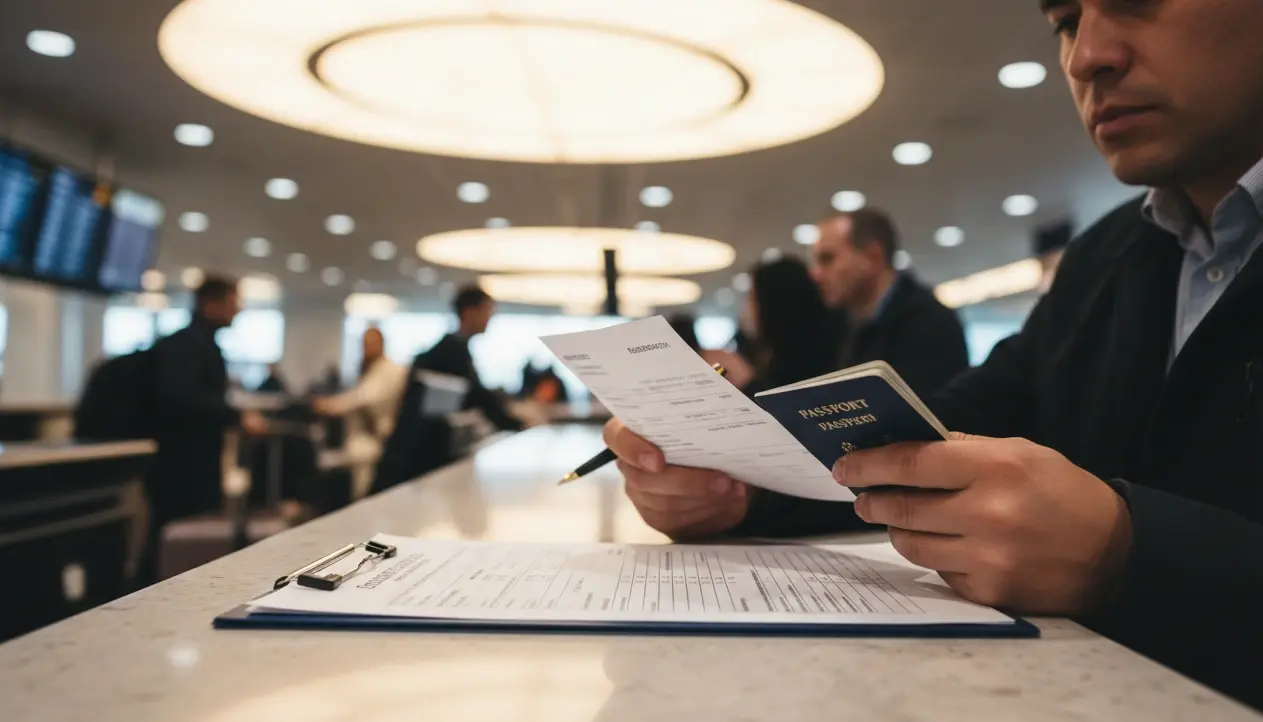
Short answer: If your cover letter mentions flexible travel dates, choose one realistic travel window, state the intended arrival and return dates inside it, and make the reservation, leave letter, hotel, insurance and visa form repeat that plan. A flight reservation for visa may support a truthful application where permitted, but it cannot guarantee approval, boarding or entry.
Key facts:
- Flexibility should be explained around one intended itinerary, not several competing options.
- Use approved leave, host, meeting or appointment evidence to choose a defensible date window.
- Passenger name, entry and exit cities, dates and route should match across every controlled document.
- Preserve the submitted version and update the complete evidence set if a real date changes.
- Follow the destination checklist; a reservation supports evidence only where permitted.
Need a reservation that matches your flexible-date cover letter? Choose one clear window and keep the route, dates and supporting documents aligned.
In This Guide
- Why A Flexible Date Range In Your Cover Letter Puts Your Flight Reservation Under Pressure
- Turning Loose Plans Into One Clear Window Your Reservation Can Match
- Building A Flight Reservation That Still Works If Your Dates Shift
- Making Every Supporting Document Agree With The Dates You Chose
- Submit One Clear Window And Let Your Reservation Prove It
- FAQ
Official-source check: Confirm the destination embassy or consulate’s current checklist and rules for itinerary, accommodation, insurance and flexible travel dates. Use the IATA Travel Centre for passport, visa and transit checks; the authority handling your application makes the final decision.
Reviewed for: flexible-date wording, intended travel windows, route and purpose alignment, leave and accommodation matching, reservation retrieval and post-submission update handling.
Flexible-date evidence check:
- Choose one primary window supported by leave, host, meeting or appointment evidence.
- Make the reservation and cover letter use the same arrival, departure and city sequence.
- Save the submitted version and update every linked document together if dates shift.
Your cover letter says you can travel any time between June and August. Your flight reservation shows one Tuesday in July. The visa officer reads both pages side by side, and that mismatch raises a fair question. Which plan is real?
You can keep your real flexibility and still file a tight application. Choose one window, match your reservation to it, and explain the flexibility in a single confident sentence. Nothing here requires special tricks, only precise wording.
Below, we cover how to word the letter, how to build the reservation, how to fix common wording slips, and how to align every supporting document with your stated dates. Before you submit, pair your window with a dummy ticket for visa planning that mirrors the exact range you wrote.
Why A Flexible Date Range In Your Cover Letter Puts Your Flight Reservation Under Pressure

Flexibility feels honest when you type it. On an officer's desk, it can read like a plan that does not exist yet.
What The Officer Reads When Your Letter Says Any Time In June
A consular desk moves quickly. Each file gets a fast scan for the same signals, and dates are among the easiest to test.
Three habits of embassies explain why the letter matters so much here:
-
Including a cover letter is often expected by embassies.
-
A cover letter summarizes your travel intentions clearly.
-
It helps visa officers verify your application quickly.
Verification needs something fixed to check. Suppose your Schengen visa cover letter says you may fly out "any time in June." The officer has no single date to test. The only hard date left in your file is the one printed on your flight reservation.
Now the two pages compete. If they disagree, the officer trusts the document with a booking reference, not the sentence with a "maybe" in it. In most cases, they decide with the papers already in front of them, so nobody phones you to ask what you meant.
Consider what the officer is really asking. Will this person leave when they say they will? A fixed range plus a matching reservation answers yes at a glance. A vague range forces the officer to build the answer from scattered clues.
Visa officers look for precision, consistency, and clear intent in applications. A clear cover letter can make the evidence easier to review, but it cannot guarantee approval. The visa process rewards applicants who make an officer's job easy.
The Credibility Gap Between A Loose Letter And A Fixed Reservation
Meet Daniel, who lives in Delhi. His letter says he will travel "between 5 June and 30 July, depending on work." His reservation shows Delhi to Rome on 12 June and a return on 26 June.
The letter suggests up to eight weeks. The reservation suggests two. The officer cannot tell how many days Daniel really needs, and that uncertainty touches everything else in the file.
Daniel's file leaves three questions unanswered:
-
Does he plan to stay two weeks or eight?
-
Which month does his employer's leave actually start?
-
Does the reservation belong to this plan or to a different one?
Duration matters as much as the start date. A range of eight weeks reads like a request for a long stay, and the officer may wonder whether your funds and leave can support it. A two-week reservation then looks like a different trip. Keep the length identical in both places.
Any one of these can turn a quick check into a slow one. Providing a specific date range helps avoid a credibility gap in visa applications. Visa officers expect a clear, proposed itinerary rather than multiple options. Ambiguity in travel plans can complicate visa applications.
Compare that with Eleanor, who also applies from Mumbai. Her letter says 8 to 28 June, and her reservation shows exactly those days. The officer checks one line against one line and moves on. Nothing in her file asks for a second look.
None of this means flexibility is banned. Clear explanations are needed if flexibility in travel dates is mentioned. What hurts you is silence, when the letter waves at a range and the reservation quietly picks a day.
How Flexible Wording Slips Into Letters Without You Noticing
Most applicants do not plan to be vague. Real constraints push them there: an employer who has not signed off, an appointment that might move, or fares that change daily. The wording that follows often sounds like this:
-
"Around mid-June, or slightly later"
-
"Any suitable date after my leave approval"
-
"Flexible depending on flight prices"
-
"For about two to three weeks"
Each phrase invites a question the officer cannot ask. Avoid vague statements about travel dates in your cover letter.
Each constraint has a cleaner fix than vague wording:
-
Leave not signed yet: ask HR for a dated approval before you write the letter.
-
Appointment might move: choose dates that leave room after the earliest slot.
-
Fares keep changing: pick your dates first, then build the reservation around them.
Free online templates make this worse. Many include a polite line about being open on dates. That politeness costs you precision, so swap it for one range that is real.
The same drift shows up across the whole application. Your visa form may list one arrival day, your letter a month, and your reservation a third date. Your departure dates should read the same on the visa application form and on every attachment.
Before you edit anything, list every place your dates appear: the letter, the visa form, the reservation, the leave letter, the insurance, and any hotel bookings. Inconsistencies between application documents can lead to delays or refusals.
The fix starts before you type a word. You need to decide which dates you will stand behind, and that decision comes next.
Turning Loose Plans Into One Clear Window Your Reservation Can Match

You do not have to give up your real flexibility. You only have to convert it into one window and place one plan inside it.
Choosing The Window Before You Write A Single Line
Start with facts you can prove. Your approved leave dates are the strongest anchor because they exist on paper. If your employer approved 8 to 28 June, your window is 8 to 28 June, not "June or July."
If two windows both feel possible, rank them by proof. Pick the one backed by a signed leave letter, a confirmed host, or a fixed meeting. Keep the length sensible too. A ten-day family trip does not need a six-week range.
Then check three inputs:
-
Your appointment timing. A Schengen visa application is generally accepted only within a set period before departure.
-
Your visa type and trip purpose. A Schengen business visa often ties dates to meetings named in an invitation letter, while a family visit ties them to a host's availability.
-
Your entry needs. Ask for a multiple-entry visa only if you can explain why. If one trip covers your plan, request a single entry.
Your reservation covers only the first trip either way. Consulates assess the dates you declare, so an oversized window can require more explanation. A short-stay tourist visa is also easier to justify with a compact range. Requirements vary by consulate, so read the checklist of the office handling your application.
Matching Entry And Exit Cities To Your Reservation
Mention entry and exit cities in your travel plan. Your reservation should show the same two cities. For example, Delhi to Paris on the way out and Rome to Delhi on the way back.
If you are visiting multiple Schengen countries, name where you land first and where you fly home from. Most consulates want the application lodged with the country where you will spend the most nights, and your letter should say which one that is.
The same rule applies across multiple Schengen countries, so name your main destination early and explain the order of the others.
Write each city the same way everywhere. If the letter says Delhi, the reservation should say Delhi, not a different departure city without a reason.
Add a brief itinerary that lists each city with its night count. Attach a detailed itinerary only if your consulate asks for one.
Include specific travel dates that match your itinerary. If you arrive in Rome on 8 June, the reservation must land on 8 June. If your last night is in Paris on 27 June, the return flight leaves on 28 June.
A Sample Layout You Can Adapt Line By Line
A strong cover letter format stays plain. These six key elements cover it:
-
A cover letter should be one page long.
-
Include your personal information at the top of the letter.
-
State the purpose of travel clearly in the letter.
-
Mention travel dates and itinerary in the cover letter.
-
Clearly state how you will fund the trip in the letter.
-
List attached documents at the end of the cover letter.
Aim for a one-page letter with short paragraphs. A well-written cover letter reads like a briefing, not a story. Here is a sample cover letter that shows the habits in action:
Dear Visa Officer,
My name is Daniel Whitmore, passport number XXXXXXXX, and I live in Delhi. I kindly request a short stay tourist visa to visit Italy and France for tourism from 8 June to 28 June.
I will arrive in Rome on 8 June and return from Paris to Delhi on 28 June. A brief itinerary is attached. My trip is funded by my savings, and my bank statement is enclosed.
My employer has approved leave for these exact dates, and I resume work on 30 June. I respectfully request your consideration of my application.
Sincerely, Daniel Whitmore
Attached documents: employer letter, salary slips, bank statement, flight reservation, hotel reservations, travel insurance.
Notice that no sentence asks the officer to choose. Every date is a decision you have already made. That is what a strong cover letter does with flexibility: it removes it from the page and keeps it in your planning.
Wording: The Flexibility Sentence So It Reads As A Plan
Sometimes flexibility is real. Your employer's leave may shift, or an appointment may slide. If so, say it once and tie it to a fixed plan:
"My employer approved leave from 8 to 28 June. I will arrive on 8 June and return on 28 June. If my appointment is delayed, I will send my updated leave letter and reservation."
Compare two ways of saying the same thing:
-
Weak: "Travel dates are flexible in June or July."
-
Strong: "Arrival is 8 June, and return is 28 June."
The first hands the officer a puzzle. The second hands them a date to verify. Then keep the rest of the letter disciplined:
-
Use direct language to avoid vague statements about travel.
-
Do not write emotional pleas; keep the tone factual.
-
Ensure your cover letter matches your actual travel itinerary.
-
Avoid using generic templates that lack personal details.
With the wording settled, the reservation has one job: to prove the same dates.
Building A Flight Reservation That Still Works If Your Dates Shift
A reservation cannot be vague, but it can be easy to change. That difference is where you get real flexibility without weakening your file.
Picking Outbound And Return Legs That Mirror Your Letter
Visa authorities typically require a verifiable flight itinerary that matches the proposed timeline. Build the reservation from the letter, never the other way around.
Take the first and last day of your window and use them as your departure dates. If the letter says 8 to 28 June, the outbound arrives on 8 June, and the return leaves on 28 June. Travel reservations should reflect the exact duration requested in the application.
Keep to a single outbound and a single return. Two sets of flight bookings for the same window tell the officer you are still deciding. Ensure your itinerary aligns with your flight reservations.
Review the actual issuing and operating carrier shown on the reservation, then check the route, dates and retrieval instructions rather than relying on a general provider claim.
If your trip ends in a different city, use an open-jaw route with the same dates. For instance, Delhi to Rome outbound and Paris to Delhi back. The letter and itinerary must then name those same cities. Avoid padding the routing with extra legs, since every extra stop is another line to explain.
Run four quick alignment checks before moving on:
-
Your name matches your passport.
-
The outbound date equals the first day in your letter.
-
The return date equals the last day in your letter.
-
The route matches your entry and exit cities.
Use the exact dates from your letter, down to the day. Do not shift a flight to a weekend for convenience. Your flight tickets, or the reservation PDF standing in for them, should show your name exactly as printed in your passport.
What A Verifiable Reservation Looks Like In Your File
An embassy officer may check the booking reference against the airline system. So the reservation needs a real PNR, a name that matches your passport, and a clean PDF showing the itinerary.
A provider may issue a reservation with a reference and PDF; confirm its current validity, change terms and price before relying on it.
Before you submit, open the PDF and read it as a stranger would. Check the name, the dates, the route, and the booking reference. Confirm the reservation stays retrievable while your application is processed. If any detail differs from the letter, fix the reservation, not the letter.
Timing helps as well. Create the reservation close to your submission date, so its status is current when an officer looks at it.
Consistency matters on the small details too. Your visa form and cover letter should carry the same passport number, and every page should spell your name the same way.
Save the PDF in the same folder as the rest of your visa file. Add the travel dates to the file name. That way, you can spot a mismatch at a glance before the officer does.
Date Changes, Refund Rules, And When To Buy The Real Flight
Dates move for ordinary reasons. A leave approval slip, or an appointment, shifts by a week. A reservation with provider-set change terms may let you move the window; update the letter and related documents together when a real change occurs.
When that happens, work in a fixed order:
-
Change the reservation dates first.
-
Rewrite the dates in the cover letter second.
-
Ask your employer to reissue the leave letter third.
-
Check insurance and hotel reservations last.
Think of the reservation as a low-cost placeholder and the paid ticket as a commitment. Because the placeholder can move, you can write the letter with firm dates today. If the appointment slips, you change the placeholder instead of absorbing a fare penalty.
A paid ticket is a bigger step. Most applicants wait for visa approval before buying one. Some fares offer free cancellation, but the conditions differ. Even a low-cost airline may charge a cancellation fee when plans change.
A truthful temporary flight reservation may reduce exposure before a decision, subject to the provider terms and destination checklist. Use it as your temporary proof, then buy the real seat once your visa is issued.
With the letter and reservation locked together, every other document now needs to fall in line.
Making Every Supporting Document Agree With The Dates You Chose
Your letter and reservation now carry the same window. The last job is making every other page agree with them.
Leave Letters, Salary Slips, And Proof You Are Coming Home
Supporting documents must align with the proposed travel dates in the cover letter. Document consistency is critical for visa applications. Cover letters clarify your ties to your home country. Your papers must back that claim.
Use the letter to point to these ties:
-
Mention your job and employer to show employment ties.
-
Include approved leave dates to confirm return intentions.
-
State family responsibilities to reinforce your commitment to return.
-
Provide property ownership details to demonstrate stability at home.
-
Mention ongoing business operations to show professional ties.
Then match each claim with paper. Your leave approval letter should show the same start and end dates as your reservation. Ask HR for an employer letter that names your role, your salary, and your approved leave.
Read each document's dates against the cover letter, one by one. A leave letter that starts on 10 June cannot support a letter that says 8 June.
Business owners should add proof that operations continue while they travel, such as registration papers and recent tax filings. Students can use an enrollment letter with the term calendar, so the officer sees a fixed return point.
Keep salary slips and income tax returns ready to back up your income. If you have dependents, a marriage certificate supports your family ties. If you hold a valid US visa, mention it as proof of earlier travel history. Attach only relevant documents, and keep them in the order your letter lists them.
Funds, Hotels, And Insurance That Follow The Same Calendar
Sufficient funds are judged against the number of days you state. Clearly state who is funding your trip in the cover letter. Then attach financial documents that match:
-
A personal bank statement covering recent months, ideally from your main savings account.
-
Financial proof of regular income, such as salary credits.
-
A sponsorship letter, with the sponsor's own statements, if someone else pays.
Check recency too. A statement that ends months before your appointment looks stale, so download a fresh copy close to the date.
Your bank balance should comfortably cover every night of your stay. A balance that only covers a shorter trip quietly contradicts your dates.
State travel purpose clearly in the cover letter. If a host is involved, repeat the same purpose and dates in the invitation letter. For a family visit, the host's letter should list the same arrival and departure days as your reservation.
Hotel bookings and hotel reservations should cover the same nights as your flights. If you use a dummy hotel booking, give it the same check-in and check-out dates. Add travel insurance that starts on your first day and ends on your last.
Insurance is easy to forget. A policy that starts a day late leaves your first night uncovered, and one that ends early leaves your last night bare. Match its dates to the reservation, then place the certificate beside it in your file.
If Your Plans Really Do Shift After You Submit
Plans sometimes move after submission. Do not quietly swap the reservation. A new document that contradicts the old one creates the exact inconsistency you worked to avoid.
Follow this order instead:
-
Contact the consulate or visa centre and ask how to submit updates.
-
Send a short note with the new dates and the reason.
-
Attach the revised reservation and updated leave letter together.
-
Label old and new dates clearly.
Procedures vary, and some offices accept no changes after submission. Ask before you send anything. If they allow an update, keep the note short:
"My approved leave now starts on 15 June instead of 8 June. Please find the revised leave letter and updated flight reservation attached. All other details remain unchanged."
Treat a timing shift as new information for the officer, not as a fix to hide.
Handled calmly, a date change becomes a footnote instead of a warning sign. That calm is worth carrying into your final review.
Submit One Clear Window And Let Your Reservation Prove It
Flexible dates are not the problem. Unexplained flexibility is. Choose one window, state it plainly in your letter, and let your flight reservation, leave papers, funds, and insurance repeat it day for day.
Before you submit, read your file the way an officer would. Every page should tell the same story without leaving a question behind. That one habit does more for your file than any clever phrasing. Walk into your appointment with a plan that looks as steady as you are.
Ready to submit a clear flexible-date plan? State one intended window, keep the reservation current and make every supporting document tell the same story.
Frequently Asked Questions
Can I mention flexible travel dates in a visa cover letter?
Yes, but anchor the flexibility to one intended window, a clear purpose and a specific arrival and return plan that your evidence supports.
Should the reservation show one date or a range?
Use the format the destination checklist accepts. In most cases, one intended itinerary is easier to verify than several alternative bookings.
What documents should match the flexible dates?
Check the visa form, reservation, leave or invitation letter, accommodation, insurance, funding evidence and day-by-day itinerary.
What if my appointment or leave dates change after submission?
Preserve the submitted version, ask the consulate or visa centre how to update the file, and send one revised evidence set if updates are permitted.
Can a reservation support an application before the final ticket purchase?
It may where the destination checklist permits reservations. Describe it accurately and buy the final ticket only when your travel and visa decision justify it.
Does a consistent flexible-date file guarantee approval?
No. It improves clarity and reduces avoidable contradictions, but the destination authority evaluates the complete application and retains final discretion.
Friendly reminder: BookForVisa provides temporary travel-proof documents for planning and application support. Requirements vary by destination, airline, route and applicant situation. A reservation can support a file, but it does not guarantee approval, boarding or entry.