
Embassies rarely get stuck on one travel document in isolation. They get stuck when your flight dates, hotel nights, insurance window, leave approval and cover letter stop telling the same story. A clean reservation can still create problems if one arrival date shifts, one city order looks odd, or one supporting document still reflects an older plan.
This checklist is about catching those mismatches before an officer does. You will compare the documents that shape your trip, decide which details must match exactly, and spot the small contradictions that can make your file look careless, risky or hard to trust.
When your paperwork reads like one believable journey, you give the application a stronger foundation. Use one current flight reservation, one matching flight itinerary for visa, one hotel timeline and one set of supporting letters before you submit your embassy travel file.
- Match the traveler identity before checking dates, route or funding.
- Use one master trip story as the control version for every document.
- Flight dates, hotel nights, insurance and leave approval should support the same window.
- Complex routes are acceptable only when the purpose and city sequence are clear.
- One clean final set is stronger than several older versions mixed together.
Build One Master Trip Story Before You Compare Any PDFs
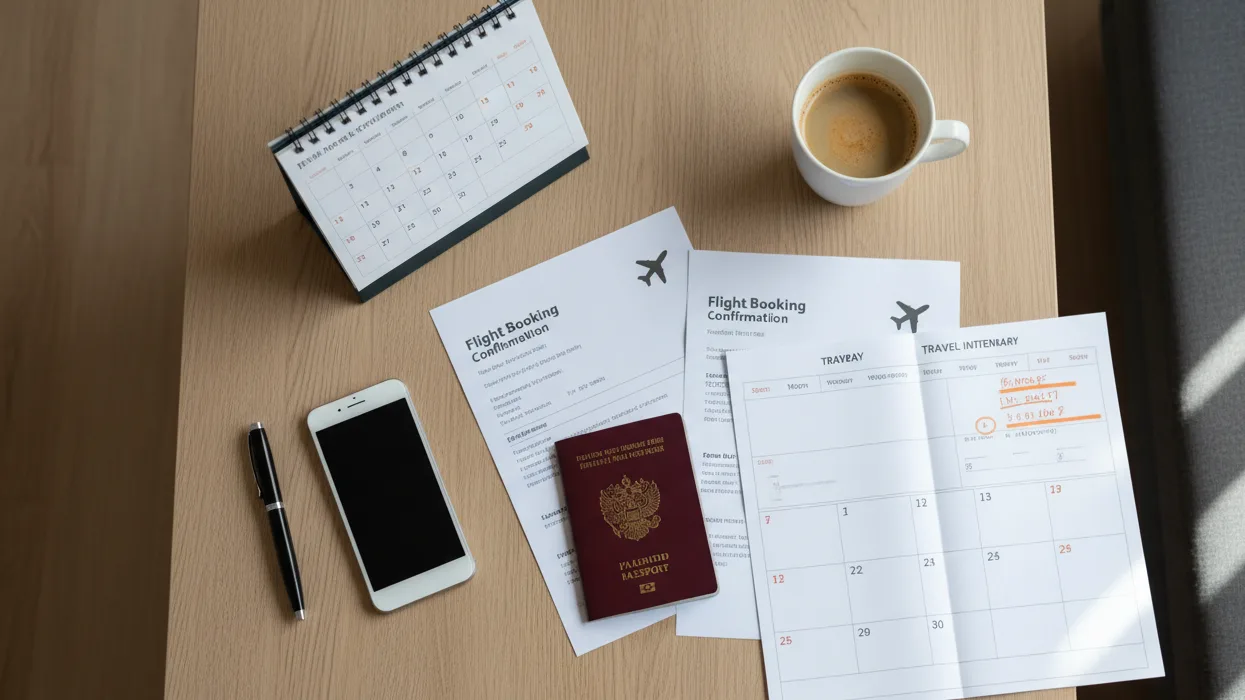
Before you compare flight reservations, hotel confirmations, insurance and supporting letters, you need one version of the trip that controls everything else. Without that anchor, even accurate documents can pull the application in slightly different directions.
Start With the Single Sentence That Explains Your Trip
Write one clear sentence that explains the trip in full. It should cover where you are going, why you are going, how long you will stay and when you return.
For example: you are traveling to France for nine days for tourism, entering on 12 June and returning on 21 June. That sentence becomes the standard against which every document is checked.
If a document cannot support that sentence, it needs attention. A reservation may still be valid. A hotel may still exist. An insurance policy may still be active. But if one item suggests a different trip, the file stops feeling coordinated.
Lock the Five Core Facts That Must Never Drift
Before reviewing any PDF, lock the five facts that define the visa-file story:
- Purpose of travel.
- Departure date.
- Return date.
- Main destination.
- Who is paying.
These facts should stay consistent across the visa form, cover letter, flight itinerary, booking proof, financial evidence and supporting letters. Small drift creates avoidable doubt.
A common problem starts when applicants treat each document as separate administrative work. They create a flight reservation first, draft the cover letter later, update the form last, and suddenly a seven-day holiday becomes eight days in one document and nine in another.
Separate Flexible Details From Non-Negotiable Details
Not every detail carries the same weight. Some parts of the plan can change without affecting the core story. Others should stay fixed once the file is built.
Flexible details often include:
- Airline choice.
- Transit city.
- Exact departure hour.
- Hotel property.
- Internal train timing.
Non-negotiable details usually include:
- Travel window.
- Destination logic.
- Traveler identity.
- Purpose of visit.
- Funding source.
This distinction matters when you make edits. You may swap one flight option for another and still keep the same trip story. But if that change pushes arrival into the next day, you must check hotel dates, insurance start date, airport transfer timing and anything else tied to arrival.
Decide Which Document Becomes the Source of Truth
Choose one document or draft to act as the source of truth. For most applicants, that should be the visa form draft or a short itinerary sheet prepared before collecting final documents.
Once you choose it, stop making random edits elsewhere first. Every new reservation, every revised cover letter and every supporting document should be compared against that source.
This simple order is safer:
- Finalize the trip story.
- Draft the core dates and route.
- Create or collect supporting documents.
- Compare each document against the anchor version.
- Submit only the final matched set.
That approach is safer than correcting mismatches after several documents are already saved, printed or uploaded.
Use a Matching Lens, Not a Collection Lens
A strong file is not the file with the most attachments. It is the file that reads clearly from start to finish.
Many applicants assume they are safer once they have collected enough proof. But volume does not solve inconsistency. If the flight reservation says one arrival date, the hotel starts the next evening, and the leave letter covers fewer days than the return flight, the application becomes harder to trust no matter how polished the PDFs look.
Review documents with one question in mind: does this confirm the same trip, or does it introduce a second version of it?
Where Tourist and Business Applications Create Contradictions
Most mismatches do not come from major mistakes. They come from routine edits made at different times.
Watch for problems like these:
- A leave letter approved for one week while flights now show nine days.
- A cover letter still mentioning the old destination sequence.
- Insurance issued for original booking dates, not updated dates.
- A sponsor letter offering support for a shorter stay than the itinerary shows.
- A passport number corrected on one document but not another.
These issues often appear after an appointment is moved, a route is adjusted, or a return date changes by one or two days.
What Matching Means Beyond Exact Dates
Matching is not only about identical dates and names. It also includes whether the trip makes practical sense as a whole.
Your file should show that:
- Your leave period covers the full journey.
- Your hotel nights fit the arrival and departure pattern.
- Your budget supports the route and length of stay.
- Your stated purpose matches the destination plan.
- Your return timing supports the reason you gave for coming back.
That is the real standard to use before submission, because the next step is checking whether the whole timeline holds together.
Check the Timeline Like an Embassy Officer Would

A file can look organized and still fail the date check. What matters is whether every travel document points to the same trip window without gaps, overlaps or timing that feels careless.
Compare the Travel Window With Insurance and Other Documents
Do not check dates one file at a time over several days. Put every travel-facing document side by side and review the full timeline in one session.
Start with the documents that define the trip most clearly:
- Visa application form.
- Flight reservation.
- Hotel confirmations or stay plan.
- Travel insurance.
- Employer leave letter or enrollment letter.
- Invitation letter, if relevant.
- Cover letter.
- Sponsor documents, if someone else is funding the trip.
You are not only checking whether the same month appears everywhere. You are checking whether the trip opens and closes on the same dates, and whether each document supports that window without strain.
Arrival and Departure Dates Should Match, But Buffers Should Make Sense
Exact matching matters, but practical timing matters too.
A hotel booking that starts on the arrival date usually works well. A hotel booking that starts the day after arrival can still work, but only if the rest of the file explains that first night clearly. The same logic applies at the end of the trip. If the return flight departs late at night, the last hotel night should still make sense.
Check for problems like these:
- Arrival flight lands on 12 June, but the first stay starts on 13 June.
- Insurance starts after the outbound flight date.
- Leave approval ends before the return flight lands.
- The invitation letter mentions a shorter visit than the travel dates show.
- The flight reservation includes a transit day that the cover letter ignores.
Embassies do not always need minute-by-minute perfection. They do expect a file that does not force them to guess where you are meant to be on each key day.
Internal Travel Should Support the Main Reservation
Once the main flight window looks correct, check movement inside the trip.
A multi-city plan should still feel easy to follow. If the first flight lands in one city, the first hotel is in another, and there is no clear same-day connection, the file becomes harder to read. The issue is not complexity itself. The issue is whether the sequence looks workable.
This matters when the itinerary includes:
- Open-jaw flights.
- Rail transfers.
- Overnight buses.
- Day trips across borders.
- A conference, wedding, medical appointment or family event tied to a fixed date.
Make sure internal movement supports the main reservation rather than competing with it. If the return flight leaves from Rome, but the hotel plan shows the trip ending in Milan with no travel link between the two, the officer has to fill in the gap.
Watch for Date Drift After Passport Renewal, Rescheduling or Rebooking
Timeline problems often begin after a legitimate change. You update the passport. You move the appointment. You adjust the return by two days. The reservation is reissued correctly. Then one older document stays in the file and quietly breaks the date chain.
Recheck the whole set after any of these events:
- Passport renewal.
- Visa appointment rescheduling.
- Reissued flight reservation.
- Changed hotel dates.
- Updated travel insurance.
- Revised leave letter.
- Fresh invitation from the host.
If one part of the file changes, recheck all connected documents the same day. A new travel window should trigger a new comparison, not a simple replacement of one PDF.
Treat Weekends, Public Holidays and Overnight Flights Carefully
Calendar logic matters more than many applicants expect.
An overnight flight can shift arrival to the next day. A public holiday can affect check-in, onward transport or the date your host expects you. A Sunday return can clash with a work letter that says you resume duties the same morning.
If insurance starts on the departure date but the flight lands after midnight local time, make sure coverage still fits the actual travel window. If accommodation starts on the wrong side of an overnight arrival, fix it before submission.
Small Jurisdiction-Specific Timeline Issues
An applicant departing from Delhi on a late-night international flight may land the next calendar day in Europe, the Gulf or East Asia. If the hotel confirmation still starts on the original departure date rather than the local arrival date, the mismatch sits right at the front of the file.
The same issue appears in Schengen files where the main-destination country depends on nights stayed. A one-night error can change how the route looks. It can also affect whether the consulate feels like the right place to review the application.
Timeline Audit: Pre-Submission Checklist
Before you upload or print anything, run a final date check:
- Departure date is identical across the form, reservation and cover letter.
- Return date fits the leave window, sponsor support and insurance.
- Arrival date matches the first night of stay.
- No older reservation or draft remains in the file.
- Transit or internal travel does not create unexplained date gaps.
- Trip length stays consistent everywhere.
Once the time side holds together, the next question is whether the route itself looks logical from first entry to final exit.
Make Your Route Look Real, Coherent and Easy to Believe

Once the dates work, the route becomes the next pressure point. Among travel documents, the route is what ties flight proof, hotel proof, invitation details and purpose of travel into one believable plan.
Your Route Should Show a Reasonable Journey
A strong route looks like something a real traveler would actually do. It does not jump between far-apart cities without reason, and it does not pile on stops because they look impressive on paper.
For a first-time applicant, this matters even more. A short trip that touches too many places can feel harder to trust than a simpler plan with fewer moving parts. In many countries, officers read the route as proof that you understand your own travel plans and are not just assembling documents to satisfy visa requirements.
If you are traveling for six days, three cities may already be enough. If you are crossing multiple borders, each move should have a clear purpose, visible timing and sensible cost.
First Entry, Main Stay and Final Exit Must Tell the Same Country Story
Your first entry, longest stay and final exit should support one country story, not three competing ones.
If you apply through a French consulate but the reservation lands in Amsterdam, the longest hotel stay is in Belgium, and the return leaves from Spain, the reviewer has to work harder to understand which country is actually central to the trip. That does not always make the file wrong, but it makes the route less clean.
This is especially relevant for Schengen files, but the same logic applies elsewhere. If the event, host address or conference venue is in Germany, the route should not make that stop look minor unless the documentation explains why.
A good check is simple: could someone reading only the route identify the main destination without guessing?
Open-Jaw, Multi-City and Side-Trip Plans Need Cleaner Explanations
Complex routes are not a problem by themselves. They just need better structure.
Open-jaw travel can work well when it saves time or avoids backtracking. A side trip can also fit naturally. But if you enter through one city, move across a region and leave from another, every step should feel connected.
Use a brief explanation when the file includes:
- A family visit in one city and tourism in another.
- Business meetings followed by private travel.
- A parent traveling with children on different dates.
- A host in one place and a return airport in another.
Family routes need extra care. If the file shows a relation to a host, the city sequence should support that relationship. If one parent is not traveling, any consent letter should match the exact dates and destination sequence shown in the itinerary.
Airport Codes, City Names and Transit Hubs Need Manual Checking
This is where small technical errors can undermine an otherwise solid plan.
Do not rely on airline screens alone. Check airport codes, terminal cities and transit points manually. A traveler may think the booking says Paris, while the arrival airport or onward segment points somewhere else. A long transit can also look like a stay if the city name appears without explanation.
Check these details closely:
- Airport code matches the intended city.
- Final destination is not confused with a transit hub.
- Hotel city aligns with the airport actually used.
- Return airport is reachable from the last planned stop.
- Personal details match the passport exactly.
This last point matters more after a new passport is issued. If the reservation still carries an old number or outdated name format, the route can appear disconnected from the traveler even when the dates look fine.
The Route Must Also Match the Purpose of Travel
The route has to fit the reason for travel. A business visa should read like a business trip. If the file says meetings in Frankfurt, but most nights sit elsewhere with no clear work link, the route weakens the purpose.
The same applies to a family visit, medical appointment, short training program or tourist route. Compare the route against any invitation, employer letter, host contact, event schedule or medical appointment. If those documents point to one city but the booking places most of your time elsewhere, adjust the route before submission.
Where a Verifiable but Editable Flight Hold Helps
When the route is still being refined, a verifiable and editable flight hold can help you control the file, especially when appointment timing, likely processing delays or date uncertainty make final airfare risky.
BookForVisa can help in that narrow practical moment by preparing a flight reservation that supports a visa file while giving you room to align dates before submission. The value is not just the reservation itself. The value is keeping the travel document aligned with the form, hotel proof, cover letter and leave evidence.
Catch the Hidden Mismatches That Make a File Feel Unsafe
By this point, your dates and route may already look solid. What often remains are quieter contradictions outside the reservation itself — funding, work, study, family authority, old drafts and documents that sound polished but do not fit the trip logic.
When Travel Documents and Financial Story Disagree
A travel plan does not stand alone. It has to match the money story behind it.
If the flight reservation shows a 12-day trip across expensive cities, but bank activity only supports a short stay with limited daily spending, the travel plan starts to feel stretched. The problem is not only affordability. It is whether the trip you present matches the level of expenses your documents can realistically cover.
The same issue appears when one document says you are self-funding and another says a sponsor is covering the trip. That mismatch often slips in when the cover letter is edited late or a sponsor letter is added after the reservation is already fixed.
Check these points carefully:
- Who is paying for flights, stay and local movement.
- Whether the trip length fits the available funds.
- Whether prepaid and unpaid items are described consistently.
- Whether the sponsor relationship matches the documents provided.
Good matching here is not about making the budget look perfect. It is about making the travel plan look plausible.
When Work, Study or Family Documents Quietly Contradict the Trip
Support documents often weaken a file without looking obviously wrong.
An employer letter may approve leave from 3 July to 10 July while the return flight lands on 11 July. A university document may show classes or exams during the travel window. A family application may include a consent letter from one parent while the route suggests a longer stay than that letter authorizes.
These are contradictions that force an officer to stop and compare. They also show up in identity documents. If one supporting file uses a shortened name, an old passport number or a different date format, the trip can look less controlled.
For family files, pay attention to the chain of authority. If one adult is traveling with children, any consent letter should match the exact dates and destination sequence shown in the itinerary.
Why Over-Perfect Files Can Create Their Own Problems
A polished file can still raise questions if it looks assembled rather than lived through.
Some applications have neat PDFs, formal language and tidy reservations, yet the file still feels unnatural. That usually happens when presentation is stronger than the underlying logic.
Common examples include:
- A detailed day-by-day plan with no convincing funding trail.
- A business trip with polished meeting language but no clear reason for the chosen route.
- A medical visit with exact flight dates but weak support for why treatment happens in that city.
- A form that is visually complete while supporting documents describe a slightly different trip.
Presentation matters, but it cannot replace internal consistency. Clean formatting helps. Clean logic matters more.
Decide Which Document Wins If Two Documents Conflict
When two documents disagree, do not keep both and hope the officer will understand. Decide which one controls the file, then correct the rest around it.
A practical order usually works best:
- Visa application form.
- Cover letter or itinerary sheet.
- Employer, host or sponsor letters.
- Flight and stay documents.
- Extra attachments and older drafts.
The form sits at the center because it is often the first structured version of the travel plan. If the reservation says one thing and the form says another, fix the reservation or update the form before submission. Do not rely on the officer to choose the right version.
Build a Final Officer Scan Before Submission
Right before you submit, stop reading the file like the applicant who created it. Read it like the person who has five minutes to judge whether it feels coherent.
Use a final scan built around direct questions:
- Does every document refer to the same traveler?
- Do names, passport details and travel dates align?
- Does the purpose stay constant from the form to the cover letter?
- Do financial documents support the reservation window?
- Does any attachment still reflect an older version of the trip?
- Do appointment records match the file you now present?
These are not cosmetic checks. They are essential because small contradictions often survive until the very end.
The Submission-Day Rule
On submission day, treat every travel-facing document as part of one final set, not as separate paperwork collected over time.
Check the file after printing, after downloading fresh PDFs, and after any last-minute edits to the form, the reservation or supporting letters. Small mistakes often enter at the final stage, especially when you are rushing through uploads, photo specifications or appointment instructions.
A calm last review usually does more for the application than another round of generic tips.
Make Your Travel File Read Like One Clear Trip
Embassies do not review your flight reservation, hotel stay, insurance and support letters in isolation. They read them together. When the dates align, the route makes sense, and every document supports the same purpose of travel, the application feels easier to trust from the first page.
That is your final job before submission. Put every travel-facing document side by side and check whether they describe one believable journey, not several partial versions of it. If you do that well, you can submit with far more confidence and far less risk of an avoidable mismatch.
Prepare a clear flight reservation that matches your passport name, route, dates and visa-file timeline before embassy submission.
Create Your Flight ReservationFrequently Asked Questions
What is an embassy travel document matching checklist?
It is a pre-submission review that compares your visa form, passport name, flight reservation, hotel proof, insurance, leave letter, sponsor proof and cover letter to make sure they describe the same trip.
Which visa documents must match exactly?
Passport name, travel dates, route, main destination, passenger details and trip purpose should match as closely as possible. Funding and accommodation details should also support the same travel window.
Can a small date mismatch cause a visa issue?
Yes, if it affects leave approval, hotel proof, insurance or return logic. A small mismatch is easier to fix before submission than to explain after the officer notices it.
Should the hotel booking match the flight reservation?
Yes. Hotel nights should make sense beside the arrival and departure dates. If there is a gap, the file should show where the applicant is staying or why the gap exists.
Does travel insurance need to match flight dates?
Insurance should cover the required travel window for the visa type. For Schengen-style files, coverage timing is especially important because insurance is part of the document review.
What if my flight reservation changes after appointment booking?
Update the connected documents if the change affects dates, route, entry city, exit city or travel duration. Keep one final version in the submitted file.
Is it better to submit more documents?
Not always. A smaller set of consistent documents is usually stronger than a large file with old drafts, conflicting dates or unsupported claims.
What should I check first before submitting?
Start with passport name and number, then check travel dates, route, hotel proof, insurance, funding and cover letter wording. Identity and dates are usually the highest-priority checks.
Can BookForVisa help align my flight reservation?
BookForVisa can prepare a flight reservation for visa use based on the dates, passenger details and route you provide. You should still compare the final document against your full visa file before submission.
Does a matched travel file guarantee visa approval?
No. A matched travel file reduces avoidable document confusion, but approval depends on the full application, eligibility, finances, purpose, travel history and officer assessment.
Friendly reminder: BookForVisa provides temporary travel-proof documents for planning and application support. Requirements vary by country, visa category, airline, route and applicant situation. A flight reservation can support a file, but it does not guarantee approval, boarding or entry.