Short answer: No public rule tells us that every visa officer reads an application in the same order or reaches a view in a fixed number of minutes. Use a four-pass applicant-side audit instead: verify identity and dates, link purpose to evidence, explain funding, and check the planned end of the visit. Start with your destination’s official category checklist; a neat file or flight reservation cannot guarantee approval.
Key facts
- This four-pass sequence is a preparation tool, not a claimed consular workflow.
- Follow the current category-specific checklist before adding or removing documents.
- Reconcile the form, passport, itinerary, invitation, stay and financial records wherever those are relevant.
- Explain genuine differences; never alter issuer records or manufacture evidence.
- Visa decisions depend on the applicable law and the full case, not document formatting or word count alone.
Does your checklist ask for travel evidence? Confirm the required format first. If a reservation is appropriate, match the real route and dates to your application.
Review BookForVisa optionsIn This Guide
Official-source check: The European Commission’s Schengen guide identifies supporting-evidence categories including purpose, means, accommodation and intention to return; the responsible consulate supplies local detail. The UK visitor supporting-document guide describes evidence for that separate route and treats most flight bookings as less useful. Neither source prescribes a universal officer reading order. Check your destination’s own instructions.
Reviewed for: identity and date reconciliation, purpose evidence, funding and sponsorship, return-plan evidence, prior refusals, genuine booking limitations, and the difference between public criteria and undocumented officer habits.
| Applicant-side pass | Compare | Action if inconsistent |
|---|---|---|
| 1. Identity and timeline | Form, passport, names, travel and leave dates | Correct the form or obtain genuine supporting evidence |
| 2. Purpose | Trip explanation, invitation, event, itinerary, accommodation | Remove unsupported detail or explain a real route difference |
| 3. Funding | Required statements, income, sponsor and trip cost | Document the actual source of funds; do not stage a balance |
| 4. End of visit | Return plans and relevant work, study or family commitments | Supply category-relevant evidence, not generic promises |
Work in this order only as a pre-submission checklist. A consulate may review the evidence differently and may ask for additional material. For the distinct issue of deciding which documents are formally required, use the document-triage guide; for matching the itinerary to the rest of the file, see the travel-document matching checklist.
Pass 1: Reconcile Identity, Form Fields and Dates
Begin your own review with the form and identity records. A public checklist can tell you which documents are required, but it cannot tell you how an individual officer will read the packet or what they think in the first moments.
Make Identity and Dates Easy to Verify
Check that the same name, passport details and key dates appear consistently on the form and supporting records. Clear scans and useful labels help you identify which evidence supports each claim; they do not create a favorable presumption.
A readable file helps you see whether each claim has a supporting record. It does not establish how long an officer spends or what mental sequence they follow.
Group Related Evidence So Each Claim Is Traceable
A strong case can look weak when the evidence is scattered. If employment proof and salary records are separated, or leave approval is hard to locate, assemble a simple index so each claim can be matched to the underlying record.
The important issue is substantive consistency, not presentation theater. Put related evidence together where the application portal permits, without assuming a particular reviewing sequence or omitting required pages.
Use the Correct Category Form as Your Cross-Check
Use the official form as your own cross-check. Compare each key answer with the relevant supporting document before submitting.
That means small form errors matter more than applicants expect. If your stated job title, income, marital status, or travel dates differ from the supporting papers, that difference may need an explanation. Check the correct value and provide the appropriate supporting record.
Review Passport History and Disclose Previous Refusals Accurately
Your passport and prior-application history can provide relevant context where the form asks for it. Check each answer against your records, including previous refusals that must be disclosed.
This does not mean a new traveler is doomed. It means your file needs to work harder on overall clarity. If you have limited travel history, state that truthfully. The official eligibility and evidence requirements still apply; do not invent travel history to fill a perceived gap.
Specify the Trip Purpose Without Inventing Details
A trip purpose should be supported by the evidence the relevant visa category requests. “Tourism” without a believable schedule, “business” without a clear event or meeting reason, or “family visit” without a timely explanation may leave a material question unanswered.
The opposite can also look strange. When the purpose sounds over-produced, full of polished phrases but light on matching proof, it can feel assembled for approval rather than rooted in real travel plans.
Explain Genuine Name and Identity Differences
Identity mismatches change the reading mood of the whole file. A spelling variation, swapped surname order, old passport number, or inconsistent birth detail may be minor on its own.
But one mismatch can make the overall record harder to reconcile. Your case stops being read as a smooth narrative and starts being checked for hidden problems. That is why even simple details need careful alignment across every page.
Compare Employment, Leave, Travel and Document Dates
Dates are easy to cross-check. If a leave letter covers six days but the itinerary shows ten, resolve the mismatch. If a financial letter predates the period required by the checklist, obtain an appropriate current record.
Common timeline problems include:
Employment start dates that do not match older records
Leave approvals that do not cover the full trip
Documents issued too early to support a current travel plan
Travel dates that clash with stated business or family events
These gaps make the file feel assembled in parts instead of built around one real trip.
Keep the Cover Letter Within What the Evidence Supports
A confident cover letter helps only when the documents underneath support it. If the letter promises clear professional ties, strong finances, and a tightly planned visit, the evidence has to carry the same weight.
If it does not, the letter becomes a problem. It makes the file feel narrated beyond what the records can prove. Officers notice that quickly, especially when the strongest language appears in the one document written to persuade them directly.
Separate Checklist Completeness From Readability
Many applicants aim for completeness and stop there. They include every possible page, extra statements, duplicate proofs, and broad explanations.
But a complete file can still be hard to assess. Volume alone does not prove an eligibility requirement. Use the current checklist and make relevant documents easy to identify. An organized file can make relevant evidence easier to locate, but never omit a required document merely to shorten the packet.
Arrange Evidence Around the Official Checklist
Your goal is not to impress the officer with quantity. Your goal is to make the officer do less detective work.
A practical order usually looks like this:
Application form
Passport and travel history pages
Cover letter
Purpose-specific evidence
Employment or business proof
Financial documents
Ties to the home country
Pass 2: Link Travel Purpose to the Evidence You Actually Have
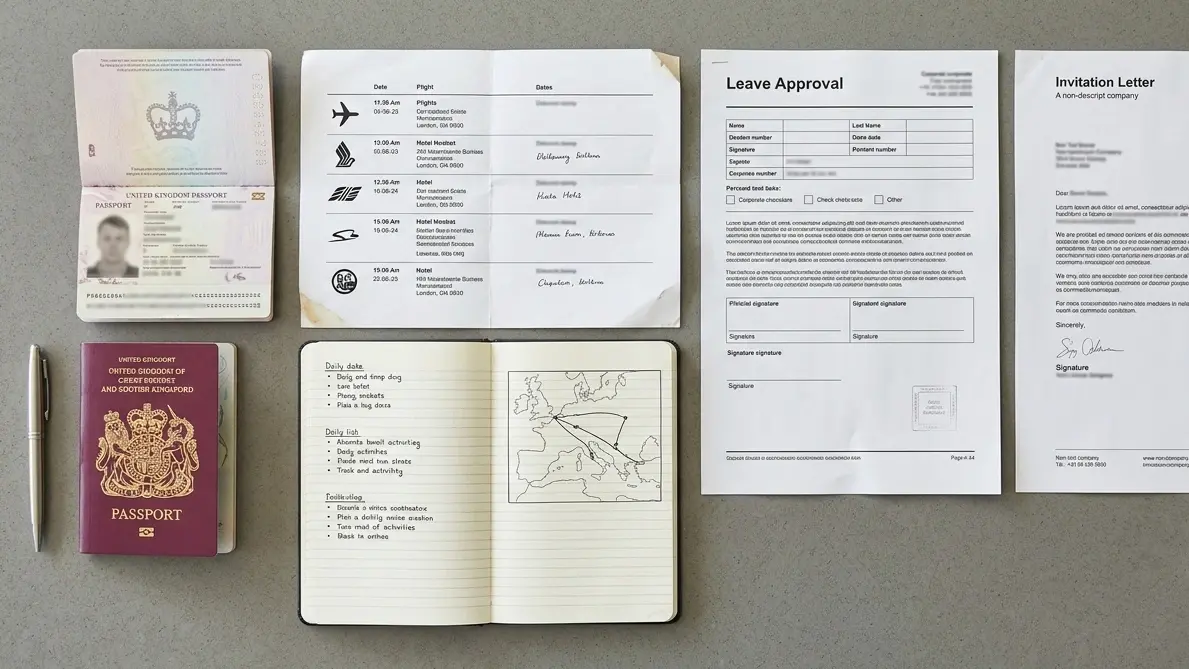
Once the officer has a first impression of your file, the next question is simple but decisive: Does your stated reason for travel actually make sense when the documents are read together? This is where your application stops being a stack of papers and starts being tested as one joined-up story.
Connect Each Purpose Claim to a Relevant Record
Your purpose of travel becomes the officer’s filter. If you say you are traveling for tourism, they read your leave letter, bank activity, travel dates, and daily plan through that claim. If you say you are visiting family, they read the same file with a different set of expectations.
That matters because the same document can help or hurt depending on the purpose you declared. A three-week leave period may look normal for a family visit, but feel harder to justify for a short business event. A modest sightseeing plan can feel believable for tourism, but incomplete if you claim to be attending a trade fair and include no event proof.
Compare the Itinerary With Your Actual Commitments
Officers look for fit. They want to see whether the trip matches the life you appear to have on paper.
If you work full-time, the trip length should fit the leave you received. If you run a small business, the travel dates should not clash with documents showing active business obligations at home. If you are a student, the visit should sit comfortably around your academic schedule.
This is where unrealistic plans start showing. A long, expensive itinerary can feel out of step with a modest income profile. A weekday-heavy tourism trip may prompt closer reading if your job letter suggests you have limited flexibility. The officer is not asking whether travel is possible in theory. They are asking whether this trip makes sense for you, now.
Describe a Feasible Tourism Plan
A genuine tourism case usually feels proportionate. The duration is believable. The route is sensible. The pace is human.
What often helps:
Dates that match your approved leave
A trip length that fits your income and work situation
A route that does not jump unrealistically between too many cities
Travel timing that matches weather, holidays, or a clear vacation window
What often creates doubt:
A packed schedule that reads like a brochure
City combinations that make little geographic sense
A luxury-heavy plan unsupported by your finances
A purpose statement that says “tourism” but offers no real shape to the trip
The officer does not need a dramatic travel narrative. They need a trip that feels like something you would actually take.
Use the Evidence Required for Your Own Visa Category
Different trip types trigger different reading habits.
For a business trip, officers usually want to see why you need to travel in person, why now, and how the trip connects to your role.
For a family visit, they often look at relationship proof, timing, host details, and whether the visit feels natural in context.
For a conference or event case, they focus on registration, professional relevance, dates, and whether your profile supports attendance.
For a short study or training visit, they look for course structure, payment logic, and how the visit fits your current path.
So the file cannot use one broad tone for every purpose. A family-visit case should not read like a tourism application with an invitation letter added at the end. A business file should not rely on vague travel language when the officer expects a precise commercial purpose.
Explain Enough to Resolve a Gap Without Inventing a Story
Many applicants think that more explanation always helps. It does not.
When a file explains every movement in excessive detail, it can start sounding defensive. Use enough factual detail to make the plan intelligible. Extra polish or length does not establish that a trip is genuine.
Underexplaining causes its own problem. If your trip has unusual timing, a long duration, or a sponsor, the officer may need a little more context to understand it. The right balance is simple: give enough detail to make the trip credible, but do not write as though you are trying to talk the officer into believing it.
Cross-Check Invitations, Events, Leave and Travel Timing
Supporting documents do not work alone. They either line up or they collide.
A solid invitation letter helps only if the dates match your leave approval and travel plan. An event registration matters more when it fits your profession. A family host’s letter looks stronger when the timing of the visit makes sense alongside your own obligations.
Officers notice when documents agree in form but not in timing. A conference letter dated months ago with no recent payment or attendance proof can feel stale. A family invitation for a long stay may raise questions if your work documents show very limited leave. Reinforcement happens when several documents quietly point to the same conclusion without forcing it.
Check That the Stay Length Fits the Stated Purpose
Length of stay often reveals whether a trip is believable. Officers look closely at whether the number of days fits the reason.
A four-day business meeting with a two-week stay can invite questions. A short family visit during a major holiday may feel natural. A tourism case with ten cities in seven days can look aspirational rather than realistic.
Duration is not judged in isolation. It is measured against your job, finances, host situation, and the event or purpose you named. When the stay length feels out of proportion, the officer starts asking whether the stated reason is the real one.
Check Whether the Trip Cost and Time Away Are Feasible
Ambition is not the problem. Misalignment is.
If your file shows limited savings, no prior travel, and tight work constraints, but your plan suddenly involves a long, high-cost, multi-country visit, the officer may see a gap between the trip and the profile behind it. That does not mean you must travel modestly. It means the scale of the visit should still look plausible for your circumstances.
In family-visit cases, the officer does more than confirm that the relative exists. They look at why this visit is happening at this time, how long it will last, and whether the surrounding documents support that timing.
A credible purpose becomes much easier to accept when the officer can see not only who you are visiting, but also why the trip fits your life and theirs.
Pass 3: Explain Funding, Sponsorship and Trip Cost
At this stage, the officer is no longer asking whether your file looks tidy. They are trying to determine whether the money behind your trip feels real, controlled, and consistent with the rest of your visa application.
Explain the Source and Availability of Funds
Check what the official instructions actually require: a minimum amount, a period of bank history, evidence of income, sponsor documents, or a combination. Avoid inventing a universal financial formula. Do not assume that one closing balance alone answers the applicable funds requirement.
That is why visa officers check movement, source, and timing. A high number can still raise doubts if the money appeared suddenly, sits in one account without a history, or does not match your job, business, or sponsor story.
Review the Statement Period Required by Your Checklist
A bank statement is read like a habit report. The officer will review deposits, withdrawals, salary rhythm, savings behavior, and whether the documentation shows steady financial stability.
They also use it to verify whether your written claims match the record. If your cover letter says you save monthly, your statement should show that pattern. If it says a relative will support you, the sponsor’s papers should answer where that support is coming from and how long it has existed.
Explain Large Recent Transactions Truthfully
Large recent deposits often slow the review. The problem is not that the funds are recent by themselves. The problem is that the source becomes unclear.
What often causes extra scrutiny:
Cash deposits just before submission
Round-number transfers with no paper trail
Funds are moving in and out too fast
Sponsor transfers that do not match the sponsor’s own records
Unexplained transactions may leave the source or availability of funds unclear under the relevant criteria. The officer may conclude that the money was arranged for the process rather than for the trip itself.
Reconcile Income, Work and Financial Records
No single page carries this stage on its own. Salary slips, tax filings, employer letters, and bank activity are read as one set of factors.
If you are employed, the officer expects your income proof to line up with your deposits. If you are self-funded, your savings habit should look ordinary for your profile. If you are a business owner, turnover, personal withdrawals, and tax history should make your financial means traceable. Good required documents work best when they support each other quietly.
Document a Sponsor Only Where Relevant
Sponsorship can help, but it does not erase questions. The embassy still wants to know why the sponsor is paying, whether that support is realistic, and whether you remain financially responsible in your own life.
That is especially true in family or study visa cases. Officers may examine the sponsor’s background, the relationship, prior immigration history, and whether the applicant's ability to support part of the trip is completely absent. A sponsor can strengthen a file, but only when the arrangement looks honest and sustainable.
Compare Your Proposed Trip With Available Funds
Officers compare the trip budget to your normal life. Whether the embassy is handling a visitor file, a student visa for Canada, a study visa application for Australia, or a short-stay case for the UK, the logic stays similar.
They ask whether the travel cost, stay length, and spending plan fit your income, obligations, and nationality-based risk context. This is part of how they determine whether the applicant meets basic eligibility. If the trip would consume an implausibly large share of your resources, the officer may doubt the whole answer you gave for why you are traveling now.
Distinguish Available Funds From a Temporary Balance
Some files show money but not control. The balance looks strong, yet the pattern behind it is unstable.
This often happens when a person has access to funds but no clear authority over them, or when the file shows short-term access without long-term responsibility. That can matter in both tourist and student visa cases.
For international students, the officer may accept the education plan, the program, and even the academic qualifications, but still question whether the funding will actually carry the applicant through higher education in the host country until completion.
Explain Self-Employment or Freelance Income With Real Records
Self-employed applicants should check the required evidence for their category and use authentic business, tax, banking or client records where relevant.
Invoices, tax returns, client payments, registrations, and spending habits need to create a believable commercial picture. If the file shows revenue but no usable personal access to it, or lifestyle claims far above declared income, the officer may question both qualifications and intent.
In these cases, property papers can help as background evidence, but they do not replace liquid and documented control over funds.
Check Affordability Without a Universal Balance Formula
Affordability is not just about paying for the flight or stay. It is about what remains after the trip.
Officers think about whether you can travel, return home, and still comply with your normal commitments. For students planning to study abroad, this means tuition, living costs, and whether universities or the chosen program require additional proof.
For other applicants, it means whether the visit leaves your financial position looking plausible after the return. That is one reason student visa approval and broader visa approval can fail even when the headline funds look impressive.
Choose Financial Evidence That Answers a Specific Question
More paperwork does not always fix a weak story. Ten extra pages cannot repair one missing explanation about the source of funds.
Sometimes applicants try to compensate with excess documentation before an interview or a visa interview. But if the core issue remains unresolved, even personal interviews and body language will not repair it. The officer’s financial review may already have shaped the outcome before any background checks, security screening, or final embassy note is added.
Once the money side looks believable, the file moves to the last and hardest judgment of all: whether your overall profile shows a credible reason to leave the host country and comply with the visa after arrival.
Pass 4: Check Return Plans, Prior History and Open Questions
In the fourth applicant-side pass, check whether the planned end of the visit and any requested return evidence are supported. This is not a claim about the order of official review. It is less about collecting facts and more about deciding whether your file supports lawful, temporary travel with believable follow-through.
Show the Planned End of the Visit Where Required
A genuine travel plan is important, but it is rarely the final question. The officer also wants to know what pulls you back once the visit ends.
That is why return logic can outweigh a neat itinerary or a well-funded stay. You may show a clear reason to travel, yet still lose trust if the file does not show why you would leave on time. Some temporary-visit routes require evidence about the intention to leave. They want to see whether your visa application reflects a temporary purpose, not just an entry plan.
Document Relevant Work, Study or Family Commitments
Not all home-country ties carry the same weight. Officers look less at labels and more at how active, current, and provable those ties are.
A job helps when it shows real continuity. A business helps when the records show you are genuinely involved in running it. Ongoing studies matter when the timeline shows you must return for classes, exams, or completion milestones. Family obligations can help when they are specific and evidenced, not just mentioned. Property papers may support your background, but they rarely do enough on their own.
Useful anchors usually have three features:
They are current
They are documented
They would be disrupted if you stayed abroad longer than allowed
The applicable legal standard differs by destination and visa category; consult the official instructions rather than treating this list as a universal test.
Show Evidence of Commitments Rather Than a Bare List
Many applicants list ties in the same way they list required documents. Officers do not read them that way.
A persuasive tie fits the rest of the file and carries consequence. If you say you must return to work, your leave window, employer record, and salary pattern should support that. If you say you are enrolled in education, the dates, academic qualifications, and program schedule should make that urgent and real. If you say you support family members, the file should show that role believably.
Weak ties are usually not false. They are just too abstract. A sentence in a cover letter saying you will return home is not enough if the surrounding papers do not make that outcome feel more likely than the alternatives.
Make Current Claims Consistent With the Record
No document can prove future conduct. A file can only supply evidence relevant to the legal criteria and the applicant’s stated plan.
Consistency matters here more than emotion. A calm file with aligned dates, stable finances, clear intent, and sensible timing signals compliance. A file with gaps, shifting explanations, and selective documentation suggests risk, even when no single page is fatal.
This is also where small issues accumulate. If your story changes between the form, supporting letters, and interview notes, the officer may stop treating the problem as clerical. They may read it as a reliability issue.
Understand That a Genuine Plan Does Not Guarantee Eligibility
This is one of the hardest parts for applicants to accept. A person can be completely honest about wanting to travel and still fail the risk test.
That happens when the officer believes the trip is real but remains unconvinced about the stay being temporary. In other words, the purpose may be accepted, but the overall credibility is not strong enough for visa approval. This is common when the file shows aspiration without an anchor, or opportunity without a clear reason to return.
A refusal may follow when the applicable requirements are not established, but the legal test and available review rights depend on the destination and visa category. Read the official refusal reasons, not a generalized theory of officer suspicion.
Address Previous Refusals According to the Current Form
A previous refusal does not automatically block a new decision. But it changes the reading frame.
If the earlier issue was narrow and clearly addressed, the officer may treat it as context. If the same concern appears again, it becomes caution. If the file repeats the same weaknesses across applications, it can start to look like a pattern.
That is why it matters to respond to the real reason behind the refusal, not just add more pages. Officers notice when applicants submit a larger file without correcting the exact weakness that led to the earlier outcome.
Resolve the Actual Checklist or Refusal Issue
Some applications are full of effort but still miss the officer’s actual concern. You may provide extra bank pages when the real doubt is your return logic. You may add relationship proof when the issue is trip timing. You may prepare heavily for a visa interview, while the written file still leaves obvious gaps.
This can also happen with social media accounts or other digital background material if the officer’s concern is consistency and the file ignores that issue entirely. Extra material only helps when it answers the question the officer is actually trying to resolve.
Prioritize Material Contradictions Over Extra Pages
A single contradiction can change how everything else is read. If your file says one thing about your work, another about your finances, and something slightly different about your travel purpose, the officer may stop seeing the documents as mutually supportive.
Common contradictions that carry weight include:
A trip length that clashes with your stated obligations
A sponsor story that does not match your own financial record
A previous refusal explanation that conflicts with the new file
A stated plan to leave that is not supported by your timeline
Once that happens, the rest of the review becomes stricter.
Do Not Confuse Missing Proof With a Fraud Finding
Many refusals happen in the grey zone. The file does not look fraudulent. It just does not close the distance between possibility and confidence.
That matters because officers work inside a legal and policy framework. They are making a judgment under uncertainty. If the application leaves several reasonable doubts unresolved, they may refuse even without a dramatic red flag. In practice, credibility wins when the file feels easier to trust than to question.
Run a Final Evidence-to-Claim Check
Decision confidence usually comes from accumulation, not one perfect page. The officer reads identity, purpose, money, and return logic together, then asks whether the whole file supports lawful travel and likely compliance with the visa terms.
When that answer feels solid, the relevant criteria can be assessed more clearly. When it still feels divided, even a well-prepared case can stall at the finish line.
Finish the Four-Pass Visa File Review
A visa file is easier to assess when its claims and evidence agree; consistency alone cannot establish eligibility or guarantee approval. Your identity, travel purpose, finances, and return reasons need to support each other without forcing the officer to guess. When the story stays consistent from the form to the final document, your application becomes much easier to trust.
Before you submit, read the file once from the officer’s side, not your own. Check whether the trip makes sense, the money looks believable, and your reasons to return feel real on paper. A final review can reveal gaps that are still correctable before submission.
Frequently Asked Questions
Do visa officers always read documents in the same order?
No public rule establishes a universal sequence or time limit. This article’s four passes are an applicant-side check, not a description of an individual officer’s workflow.
Can a well-organized visa file guarantee approval?
No. Organization helps make evidence readable, but eligibility depends on the applicable requirements and the full circumstances of the case.
Should I submit every supporting document I own?
No. Follow the current official checklist and add relevant evidence that explains a genuine claim or gap. Do not omit required material to make the file shorter.
What if my name or travel date differs across documents?
Identify which underlying record is correct and follow the authority’s correction instructions. Explain a genuine difference with appropriate evidence; never hand-edit an issuer document.
Does a flight reservation prove I will receive a visa?
No. Some checklists request travel plans, while others do not. A genuine reservation can support a proposed route where relevant, but it does not establish all eligibility criteria.
How should I explain a large recent bank deposit?
State the true source and provide relevant records if the applicable guidance or circumstances call for them. Do not create a temporary or misleading balance.
What should I do after a prior refusal?
Read the refusal notice and current form instructions, disclose the history where requested, and address the documented issue with truthful evidence. Appeal or reapply according to the authority’s rules.
Friendly reminder: BookForVisa provides travel-proof documents for planning and visa-application support. Requirements vary by destination, consulate, visa category and applicant situation. A flight reservation can support a file, but it does not guarantee approval, boarding or entry.