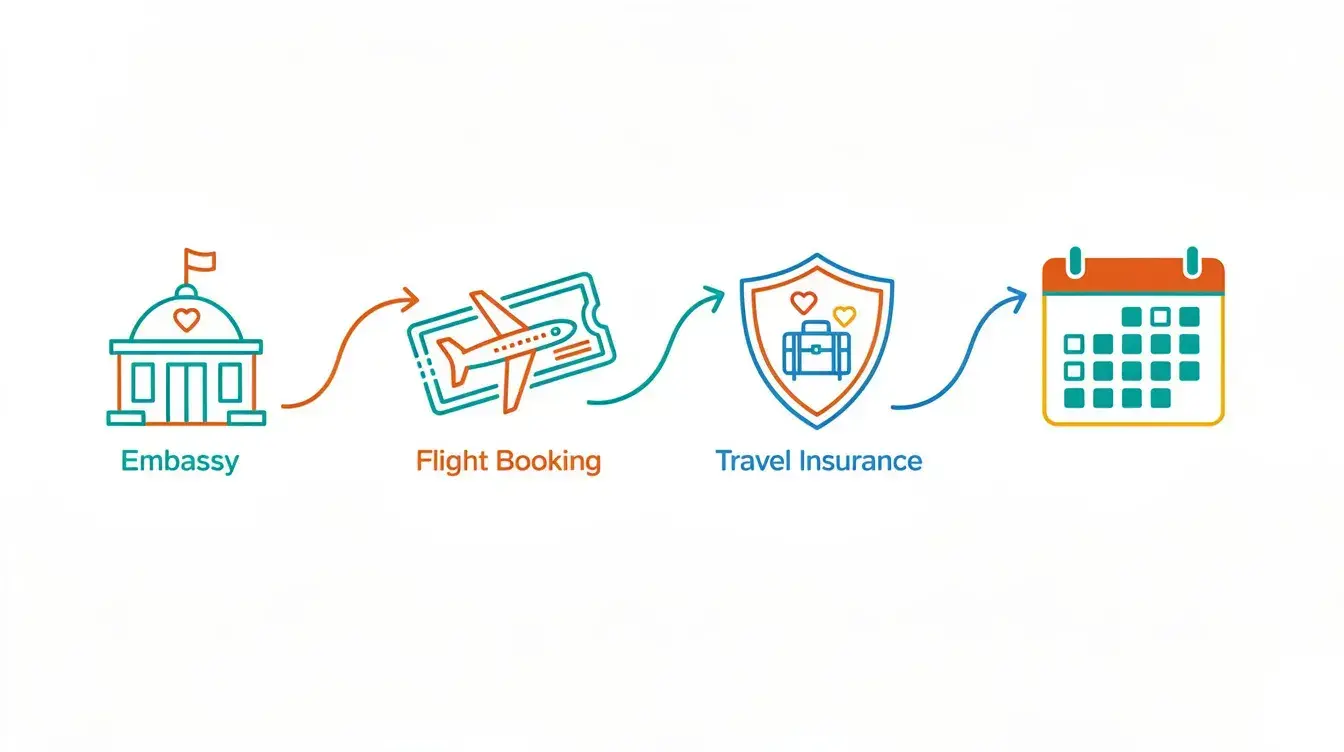
Your flight reservation says you leave on the 12th. Your travel insurance starts on the 13th. Or your policy ends before the return shown in your booking. That is where small data gaps stop looking small. Embassy staff may not compare every document the same way, but they can notice when the timeline feels inconsistent, rushed or stitched together.
The issue is not perfect symmetry. The issue is whether your insurance and booking support the same trip, with the same travel window and the same level of planning. Some differences are harmless. Some invite questions. Some are easy to correct before submission. A clean visa file should make the officer feel that the trip has been planned as one coherent journey, not assembled from unrelated documents.
- Insurance should normally cover the entire intended stay or transit exposure.
- A wider insurance window is usually safer than a shorter one.
- A booking date change should trigger an insurance-date review.
- Hotel, flight, insurance, form and cover-letter dates should tell the same story.
- One or two buffer days can be reasonable when they support the real travel timeline.
Create Your Visa Reservation
- Official-source check
- Why small date differences are not always a problem
- Date mismatches that pass quietly or invite questions
- How review changes by trip type
- What date alignment signals about the applicant
- Which date should lead: booking or insurance?
- Common submission mistakes
- Final review method
- FAQ
Why a Small Date Difference Is Not Always a Problem
An embassy does not usually review a flight reservation, insurance policy, hotel booking and cover letter as four disconnected pages. The officer reads them as one timeline. If the timeline makes sense, a minor buffer may pass quietly. If the timeline feels confused, even a one-day gap can become a reason to look closer.
Embassy staff usually read your timeline as a story
A visa file is a story told through documents. The flight reservation says when you plan to travel. The insurance says when you are covered. The hotel booking says where you will stay. The form and cover letter explain why the trip happens. If those pieces point in the same direction, the file feels planned.
Problems appear when one document seems to belong to a different version of the trip. A flight shows May 12 to May 22, insurance shows May 14 to May 20, and the hotel booking covers May 13 to May 21. None of those dates is far apart, but together they create uncertainty. The reviewer has to ask which document reflects the real plan.
The difference between “not matching exactly” and “not making sense”
Exact matching is not always required. Insurance that starts one day before departure can look careful. Insurance that ends one day after return can look careful. A wider insurance window can be useful when arrival time, overnight transit or processing uncertainty matters.
What creates risk is a mismatch that exposes a gap. Insurance starting after the flight departure is harder to defend. Insurance ending before the return booking is harder to defend. A booking that changed but insurance stayed old can make the file look unrevised. The question is not “Are the dates identical?” The question is “Is the traveler covered for the full realistic travel exposure?”
Think of the difference this way. A traveler leaving on the 12th with insurance from the 11th to the 23rd has a wider safety window. A traveler leaving on the 12th with insurance from the 13th to the 20th has a visible exposure gap. A traveler leaving on the 12th with insurance from the 1st to the 30th may be safe, but if the trip is only five days, the wide window can look like a document bought without a defined plan. The best date pattern is not always the widest one; it is the one that fits the trip naturally.
Insurance dates often reflect caution, while booking dates reflect planning
A flight reservation shows a planned route. Insurance shows risk coverage. Those two documents serve different purposes. A good policy can be slightly wider than the booking because it protects against late-night flights, early airport arrival, overnight transit, missed connections or small schedule changes.
That wider window should still look intentional. A policy covering two extra days is easy to understand. A policy covering 90 random days for a seven-day trip may need explanation, especially if the visa category does not support open-ended travel.
What officers may infer when the windows do not overlap cleanly
When the reservation and insurance do not overlap cleanly, the officer may infer several things. The applicant may have changed plans and forgotten to update one document. The applicant may not understand the itinerary. The booking may be temporary, expired or disconnected. The insurance may have been purchased first and then ignored. None of these assumptions automatically means refusal, but they reduce confidence.
The safest approach is boring consistency. If your flight reservation for visa shows an intended departure and return date, your insurance should clearly cover those dates plus any sensible buffer.
Safety coverage versus credibility review
Insurance is partly about medical and repatriation coverage. But in a visa file, it also becomes a credibility signal. A policy that starts late suggests the traveler may not be covered at the beginning of the trip. A policy that ends early suggests the traveler may be outside coverage before leaving. A policy that does not match the route can make the whole file look less controlled.
That is why insurance-date review is both practical and reputational. The officer wants to see that the applicant is covered, and that the applicant prepared the file carefully.
The review is usually faster than applicants imagine
Most officers are not doing a forensic audit of every date unless something looks wrong. They scan the file. They compare the visible travel window. They notice if one document breaks the pattern. That means your file does not need a complicated explanation when the dates are clean. It needs a simple, obvious timeline.
The problem begins when the first scan creates friction. If the officer has to calculate whether the policy covers a late-night return, or guess whether the applicant changed travel dates, the file feels less prepared. That is why small clarity improvements matter: clear file names, visible date ranges, consistent trip summaries, and one final timeline check before upload.
Date Mismatches That Usually Pass Quietly — and the Ones That Invite Questions
Not every mismatch has equal weight. Some differences are normal planning buffers. Others create a visible exposure gap. The key is to separate harmless padding from contradictions.
Insurance starting one or two days before departure
This is usually safe. Many travelers buy insurance to start before the actual flight date because they want coverage for airport travel, pre-trip disruption, early departure, or a route that begins late at night. If the policy starts before the booking, it normally does not weaken the file.
The only time it may look odd is when the gap is very large and unexplained. If your trip is five days but the insurance starts six weeks earlier, the officer may wonder whether the documents belong to the same plan.
Insurance ending one day after the reserved return
This is also usually safe. A small end-date buffer can protect against overnight flights, delays, missed connections or schedule changes. For Schengen-style files, coverage that extends beyond the return can feel more careful than coverage that ends too early.
The policy should still make sense beside the booking. One or two days of buffer is easy to understand. A much longer end-date window should match a flexible visa category, multi-entry plan or genuine uncertainty described elsewhere in the file.
For example, a return flight landing after midnight can justify insurance that runs one day longer than the visible departure date. A traveler leaving Europe late at night and arriving home the next morning may also choose coverage that extends through the arrival day. That is a rational safety buffer, not a contradiction.
A flight reservation changed, but insurance still reflects the original plan
This is a common mistake. The applicant updates the flight reservation after an appointment moves, a route changes, or a consulate asks for revised proof. But the insurance still shows the first plan. The file then contains two timelines.
If the new booking still falls inside the insurance window, the mismatch may be harmless. If the new booking falls partly outside the policy, correct the insurance. If the change is material, update the cover letter or document note so the file does not look stitched together.
The risky pattern: insurance expires before the return flight
This is the mismatch to avoid. If the insurance ends before the return date shown in the booking, the file creates a direct coverage gap. For Schengen, official rules require insurance for the intended stay or transit. A policy ending before the planned exit is hard to justify unless another policy covers the remaining days.
Even outside Schengen, an early insurance end date can look careless. It suggests the applicant prepared documents separately instead of building one complete travel plan.
If you discover this before submission, the fix is usually simple: extend or replace the policy so it covers the full travel window. If you discover it after submission, do not silently upload a second unrelated policy unless the portal allows document updates clearly. Use the consulate or visa-center correction process when available, and make sure the revised document supports the same booking dates.
The subtle risk: insurance covers fewer days than the intended stay
Sometimes the return flight is not the only issue. The accommodation or cover letter may show a longer stay than the insurance. For example, the hotel booking covers 14 nights, but insurance covers only 10 days. The return ticket might still seem close, but the stay exposure is not fully covered.
Reviewers can notice this when they compare hotel nights, travel insurance and application dates. A clean flight itinerary for visa should sit inside the same coverage logic as the hotel and insurance.
When a long insurance window makes sense
A longer insurance window can make sense for flexible trips, uncertain appointment dates, multi-city travel, long-stay applications, business travel with movable meetings, or trips where the traveler may shift the departure slightly after approval. But the long window should not contradict the booking.
If your insurance is intentionally wider, the cover letter can explain the planned trip dates and the reason for the buffer. Keep the wording simple. Do not over-explain a normal buffer. Explain only when the wider window might otherwise look unrelated.
| Date pattern | How it usually reads | Action |
|---|---|---|
| Insurance starts before departure | Usually careful | Keep if the trip dates are clear |
| Insurance ends after return | Usually safe | Keep as a buffer |
| Insurance starts after departure | Coverage gap | Correct before submission |
| Insurance ends before return | High-risk mismatch | Correct before submission |
| Insurance is much wider than trip | Can be reasonable or random | Clarify only if it may confuse the file |
- Insurance starts before the outbound flight.
- Insurance ends after the return flight.
- Insurance covers the full first intended Schengen visit.
- Policy dates include transit or overnight travel days.
- Flight changes remain inside the insurance window.
How Embassy Review Changes by Trip Type, Visa Category and Itinerary Shape
The same date difference can look harmless in one file and risky in another. A simple tourist trip is judged differently from a multi-country route, a long family visit, a flexible business trip or a visa file built around temporary reservations.

Single-country short stays face the simplest comparison
For a short single-country trip, the review is straightforward. If the booking says you arrive on June 5 and leave on June 12, the insurance should cover that period. A one-day buffer on either side is fine. A gap inside the trip is not.
Because the route is simple, inconsistencies stand out faster. There are fewer moving parts to explain them. The safest file makes every date line up without requiring a note.
For simple tourist files, avoid trying to be clever. If the trip is June 5 to June 12, the policy can be June 4 to June 13, but it should not look like a completely different travel window. The more ordinary the trip, the more ordinary the documents should look.
Multi-country trips allow buffers but create more room for errors
Multi-country travel naturally creates more date movement. You may enter one country, sleep in another, take a train, add a domestic flight, or leave from a different airport. A slightly wider insurance window can be reasonable, but the accommodation and transportation sequence must still make sense.
For Schengen, the main-destination and first-entry logic can matter. If the flight reservation, hotel itinerary and insurance do not support the same travel route, the file may invite extra review. This is where a clean night-by-night timeline helps.
Multi-country files also create more comparison points. The insurance may cover “Schengen area,” but the hotels may show France, Italy and Spain, while the flight reservation enters through Germany. That can still be valid, but the sequence should be easy to follow. If the applicant is applying through France because France has the most nights, the hotel plan should support that. If the first entry is Germany but the main stay is France, the cover letter should not leave the reviewer guessing.
Long visits and family visits are reviewed differently
Long visits often have more flexible dates. A family visitor may not know the exact day they will return until the host schedule is confirmed. A parent visiting children abroad may plan a wider travel window. A long-stay applicant may have an entry period rather than a fixed vacation itinerary.
Even then, insurance should not be shorter than the stay exposure. If the trip is flexible, build a coverage window that protects the realistic plan and make the booking dates look like a credible first plan, not a random placeholder.
Family visits can also create a special issue: the invitation may mention a broad visit period, while the flight reservation shows one exact plan. That is normal. The insurance does not have to cover every possible week inside a broad invitation if the actual intended trip is narrower. But it should cover the actual planned stay shown by the reservation and explained in the application.
Transit nights and late arrivals can legitimately affect dates
Late arrivals, overnight flights and border-crossing timing can explain why insurance starts before or ends after the visible booking dates. A flight leaving India on July 1 and arriving in Europe on July 2 may require coverage logic that includes both travel and arrival exposure.
Do not treat calendar dates too casually. Time-zone shifts, overnight sectors and midnight arrivals can create one-day differences that are perfectly reasonable, but they need to remain understandable.
Example: a traveler departs Delhi late on August 10, lands in Paris on August 11, and returns from Rome late on August 20. Insurance from August 10 to August 21 is easy to defend. Insurance from August 11 to August 20 may still look close, but it can create edge-case questions if the traveler is already in transit before coverage begins or lands home after midnight.
Complex itineraries need internal consistency more than perfect symmetry
When the itinerary is complex, exact date symmetry matters less than internal logic. The officer wants to see that the applicant understands the route and has covered the exposure. If the flight, hotel, insurance and cover letter all explain the same sequence, a buffer is normal. If they create competing versions of the trip, the file weakens.
- Short tourist trip: insurance should cover the exact stay plus any sensible buffer.
- Multi-country trip: insurance should cover the full route, not only the main city.
- Family visit: insurance should match the actual travel dates, even if invitation wording is broader.
- Business trip: insurance should support meeting, conference or event dates.
- Transit route: insurance should not ignore overnight or airport-transfer exposure.
What Date Alignment Signals About You as an Applicant
Date alignment is not only a technical check. It signals how carefully the applicant prepared the file. Clean dates suggest planning discipline. Poor dates suggest confusion, rushed work or document recycling.
Clean alignment suggests planning discipline
A clean file does not require the officer to solve the puzzle. Departure, arrival, accommodation, insurance and return all move together. The reviewer can understand the trip in seconds. This helps the document set feel professional and credible.
For BookForVisa articles, this is one reason we keep emphasizing reservation architecture rather than isolated PDFs. A booking is strongest when it sits inside a complete file.
Poor alignment raises the “which document is real?” question
If one document shows one plan and another document shows a different plan, the officer may wonder which one reflects the real trip. That question can create friction even when the applicant is honest. A careless mismatch can look like an intentional inconsistency if the file is already weak.
This is especially important when using temporary travel proof. A temporary reservation can be useful, but it requires stricter date discipline because it must prove an intended plan clearly.
Last-minute corrections can help or hurt
Correcting a mismatch before submission is usually better than submitting a flawed file. But messy last-minute corrections can create their own issues. If the booking is updated, check the insurance. If the insurance is updated, check the booking. If the route changes, check the hotel and cover letter too.
Do not submit a new reservation while leaving the old travel story in the cover letter. The fix should make the file cleaner, not create a second timeline.
Temporary reservations require more discipline
A temporary reservation, visa booking or flight hold should not look disposable. It should show the same route and dates the applicant genuinely intends to use. If the document is created only to satisfy a checklist, but the rest of the file points elsewhere, the inconsistency can show.
If the article or application naturally involves dummy ticket booking, the same rule applies: the document should support the real intended route and date window rather than act like a random formality.
The hidden question: do you understand your own trip?
When an officer compares booking and insurance dates, the deeper question is often whether the applicant understands the trip. If you cannot explain why the insurance starts later, why the return is outside coverage, or why the booking changed, the file feels less prepared.
A strong applicant does not need a long speech. They need documents that match and a simple explanation if a buffer exists.
Carelessness can be more damaging than applicants expect
Applicants often assume date mismatches are harmless because the officer can “understand what they meant.” That is risky thinking. The officer is not there to repair the file. If the file is crowded, rushed or borderline, carelessness becomes part of the overall impression. A booking-insurance mismatch may not be the refusal reason by itself, but it can add to a pattern of weak preparation.
The better approach is to remove friction before submission. If a mismatch is easy to fix, fix it. If a buffer is intentional, make it obvious. If the travel plan changed, update every document that still carries the old dates. A clean file gives the officer fewer reasons to doubt the applicant’s planning.
Which Dates Should Lead — Your Flight Reservation or Your Insurance Policy?
Many applicants build documents in the wrong order. They buy insurance first, then force the flight reservation to fit it. Or they create a booking, then forget to update the insurance after a route change. The better approach starts with the real intended travel window.
Start with the real intended travel window
Write the intended departure date, arrival date, stay dates and return or onward date before creating any document. Then build the booking, insurance and hotel proof around that same timeline. This prevents the common problem of one document leading the rest in the wrong direction.
If your trip is still uncertain, choose a sensible first plan and add enough insurance buffer to cover likely changes. Do not create documents around dates you already know are unrealistic.
This is where applicants often damage otherwise strong files. They choose dates based on the cheapest insurance policy, the first flight search result, or a copied itinerary from an old article. Then the cover letter, hotel booking and appointment date have to bend around a weak starting point. Start with the real travel plan, then create the documents around that plan.
When the flight reservation should lead
The flight reservation should usually lead when the itinerary is fixed: short tourism, business meeting, conference, medical appointment, school start date, family event or a route tied to a booked activity. In those cases, the insurance should cover the reservation dates and any reasonable travel buffer.
The booking is the spine of the trip. Insurance wraps around that spine. If the spine changes, review the coverage.
This is especially true for business travel, conferences, exams, interviews, medical visits and family events. The reason for travel often creates the real date anchor. The flight reservation should support that anchor, and insurance should cover the full exposure around it. If the meeting is on July 16, a flight arriving July 15 and insurance starting July 15 reads naturally. Insurance starting July 17 does not.
When the insurance window can be slightly wider
The insurance window can be wider when there is genuine uncertainty or risk exposure. Examples include overnight transit, multi-city Schengen travel, flexible exit dates, appointment delays, processing uncertainty or long-stay entry windows. Wider is usually safer than shorter, as long as it remains believable.
For Schengen, the official logic is coverage for the intended stay or transit. A wider policy usually supports that requirement. A shorter one works against it.
For multi-country routes, a wider window also protects the edges of the trip. You may enter through one Schengen country, spend the main stay in another, and depart from a third. In that case, the insurance should make the whole route feel covered, not just the main hotel dates.
Why reverse engineering dates around a pre-bought policy creates problems
Applicants sometimes buy the cheapest insurance first, then adjust the booking to fit it. This can create a trip that looks unnatural: strange departure days, too-short stays, awkward hotel gaps or return dates that do not match the purpose. The file may technically fit the policy but fail the travel-story test.
Build the travel plan first. Then buy or adjust insurance around the real plan.
If you already bought the wrong policy, do not force the booking to match it unless the new dates are still realistic. A corrected policy is usually cleaner than a strange itinerary built around an old insurance purchase.
Your insurance should never look shorter than your exposure
This is the simplest rule. If your booking or hotel proof shows travel exposure from March 10 to March 18, insurance should not cover only March 12 to March 17. If the stay is uncertain, choose a wider coverage window. Do not make the reviewer wonder why the applicant is uncovered during part of the trip.
- Confirm the real travel purpose and likely trip window.
- Create the flight reservation or route plan around that window.
- Choose insurance that covers the full travel exposure.
- Match hotel proof to the same arrival and departure logic.
- Update the cover letter after the documents are final.
Common Submission Mistakes That Make Booking and Insurance Dates Look Unreliable
Most booking-insurance problems are preventable. They happen because applicants update one document and forget the rest. A final timeline review catches them before the officer does.

Updating the outbound flight but forgetting the insurance start date
If the outbound flight moves earlier, insurance must be checked immediately. A one-day earlier departure can create a coverage gap at the front of the trip. This is especially common after appointment rescheduling, cheaper route selection or airline schedule changes.
Do not assume the insurer’s start date updates automatically. In most cases, the policy date is whatever you purchased or selected. If your revised flight departs one day earlier, the policy may need a manual change. That single change can decide whether the file shows complete coverage or a visible front-end gap.
Matching the main flight but ignoring the return leg
Applicants often check the departure date but forget the return. The policy starts correctly but ends too early. This is one of the easiest mistakes for a reviewer to spot because the return date is normally visible on the flight reservation.
This mistake becomes more common when travelers change only the return leg after finding a cheaper fare or better schedule. The outbound still matches the insurance, so the applicant feels safe. But the final day is now outside coverage. Always review both legs.
Using approximate dates in one document and precise dates in another
A cover letter may say “around the second week of June,” while the booking says June 8 to June 18 and insurance says June 10 to June 16. Approximate wording can be useful while planning, but the final submission should be precise. The documents should not feel like drafts from different stages.
Submitting a reservation hold that expires too soon
A flight hold or temporary reservation can expire before the appointment or review date. If the hold expires too soon, the document may still show intended travel, but it becomes weaker as proof. Review validity timing alongside insurance timing.
If the booking is temporary, make sure it is fresh enough for the submission context. If the appointment is delayed, do not assume the old reservation still supports the file.
This does not mean the insurance must expire when the reservation expires. They are different documents. It means the overall file should not look stale. A current insurance policy beside an old expired reservation can still create uncertainty because the travel proof may no longer support the intended route.
Letting appointment delays push the timeline out
Visa appointment delays can move the realistic travel window. If you booked insurance for the original plan, then the appointment moved two weeks later, the old coverage may no longer match. The same applies to flight reservations and hotel bookings.
When the appointment moves, review the whole file: booking, hotel, insurance, cover letter, invitation and travel dates.
High-volume VFS routes with revised travel dates
In high-volume application routes, travelers often revise dates several times before submission. This is normal, but it increases the chance of old documents staying in the file. A document upload folder can contain two versions of the same plan without the applicant noticing.
Before submission, remove old PDFs, rename current files clearly and verify that every date belongs to the final version.
Mixing old and new travel stories in the cover letter
The cover letter is often the last document applicants update, but it is one of the first documents that explains the trip. If the cover letter says March 3 to March 12 while the reservation now shows March 5 to March 14, the file creates a visible inconsistency. Even if insurance covers both ranges, the travel story is no longer clean.
When dates change, update the cover letter after the booking and insurance are final. The cover letter should summarize the current plan, not preserve the first draft.
Uploading documents in the wrong order
Some portals ask for flight proof, hotel proof, insurance and supporting documents in separate fields. Others allow one merged PDF. In both cases, order matters. If the officer sees insurance before the trip dates, the policy may not make sense. If the officer sees a flight reservation before the explanation, the route may look abrupt.
A clean order usually works best: application dates, flight reservation, hotel or accommodation proof, insurance, cover letter or explanation, then supporting documents. If the portal fixes the order for you, make each individual file clear enough to stand alone.
Leaving old dates inside file names
Old file names create unnecessary suspicion. A PDF named “insurance-old-trip-may.pdf” beside a June booking can make the reviewer wonder whether the policy belongs to the current trip. Rename files in a neutral, current way before upload.
- Good: Travel Insurance - Applicant Name - June Trip.pdf
- Good: Flight Reservation - Applicant Name - June Dates.pdf
- Risky: final-old-insurance.pdf
- Risky: changed-ticket-new-version-2.pdf
Forgetting the accommodation layer
Booking and insurance dates may match each other but still conflict with accommodation. If the flight reservation shows arrival on May 10, insurance starts May 10, but the first hotel starts May 12, the reviewer still sees a gap. The question changes from “Are you covered?” to “Where are you staying?”
That is why the final review should include hotel proof, host letter or accommodation explanation. A strong visa file is not only flight plus insurance. It is travel route plus stay plan plus coverage plus purpose.
- Insurance starts after the outbound flight.
- Insurance ends before the return date.
- Hotel dates exceed the insurance period.
- Old booking remains after route changes.
- Cover letter describes a different date range.
- Temporary reservation expires before review.
A Smarter Final Review Method Before You Submit
Do not review each document in isolation. Review the visa file as a sequence. This is the fastest way to catch date gaps and story mismatches.
Read the file in sequence
Start with the departure flight. Then check arrival, first hotel night, insurance start, middle-route movement, final hotel night, return or onward booking, insurance end and cover-letter summary. This sequence should feel smooth.
If the sequence does not feel smooth, do not immediately add a long explanation. First ask whether one document is wrong, old or unnecessary. Many problems can be fixed by updating the document rather than adding more text. Explanations are useful when the mismatch is legitimate. They are not a substitute for broken date logic.
| Document | What to compare | Safe result |
|---|---|---|
| Flight reservation | Departure and return dates | Inside insurance window |
| Hotel proof | Check-in and check-out dates | Covered by travel dates and insurance |
| Insurance policy | Start date, end date and region | Covers full intended stay or transit |
| Cover letter | Trip dates and purpose | Matches booking and insurance timeline |
Check for exposure gaps, not just matching start dates
Applicants often check only whether the insurance starts before the flight. That is not enough. Check the entire exposure period. Does the policy cover transit? Does it cover the last day? Does it cover the hotel stay? Does it cover the intended area? For Schengen, does it cover the territory and duration required?
Ask whether a stranger could understand the trip in 30 seconds
This is a powerful test. Give the file a fast read. Can a stranger understand when you leave, where you stay, when you return and how you are covered? If yes, the file is strong. If no, the issue is not only dates. It is presentation.
The 30-second test is especially useful before VFS or consulate upload. Open the exact PDF you plan to submit, not the booking page inside your account. Make sure the printed version still shows the date range, booking reference, passenger name and insurance validity. If the important data disappears when printed, fix the export.
Decide whether the mismatch needs correction, a cover note or no action
Not every difference needs correction. A one-day insurance buffer usually needs no explanation. A late insurance start needs correction. A long flexible window may need a short cover-letter note if it could otherwise look random.
- No action: insurance starts before departure and ends after return.
- Correction: insurance starts after departure or ends before return.
- Short note: wider window exists because travel dates are flexible or appointment timing is uncertain.
The three-date rule for clean submission
Before submitting, compare three dates: first travel date, last travel date and insurance coverage end. If the insurance fully covers the first and last travel date, the file is usually much safer. Then check whether hotel and cover-letter dates fall inside the same window.
Final checklist for flexible or temporary reservations
- The booking shows the intended route, not a random placeholder.
- The insurance covers the full intended travel exposure.
- The hotel proof sits inside the same travel window.
- The cover letter explains the same trip dates.
- The reservation is fresh enough for the appointment or upload date.
- The applicant can explain any buffer calmly.
- Old versions of booking or insurance are removed from the upload folder.
The final goal is simple: booking and insurance should tell the same travel story. If the officer compares them, the file should become clearer, not weaker.
When to correct, when to explain, and when to leave it alone
Applicants sometimes overcorrect harmless differences. If insurance starts one day early and ends one day late, that is normally not a flaw. Leave it alone. If the insurance starts after the first flight, correct it. If the policy covers a long flexible period because the visa appointment may move, keep the wider window and explain only if the file would otherwise look strange.
Use this decision rule: correct gaps, keep sensible buffers, explain unusual but legitimate flexibility. That keeps the file clean without turning a simple application into an over-defended one.
How BookForVisa should fit into the timeline
The best time to prepare the reservation is after your intended travel window is reasonably clear and before you lock insurance around the wrong dates. If the trip dates change, adjust the booking and recheck the policy. If the insurance is already purchased, do not blindly force the booking into that window if it makes the route unrealistic.
A well-prepared BookForVisa reservation should act as the date spine of the file: planned outbound, planned return or onward route, passenger details and booking reference. Then the insurance and accommodation proof should support that same spine.
Prepare Your Flight Reservation
FAQ
Does an embassy always compare booking and travel insurance dates?
No. Review depth varies by country, consulate, visa type and file risk. But embassies can compare the dates, and obvious gaps can weaken the file.
Should insurance dates exactly match the flight reservation?
Not always. Insurance can start before departure and end after return. That often looks safer. The problem is when insurance is shorter than the actual travel exposure.
Is it bad if insurance starts before my flight?
Usually no. A small early-start buffer can look careful and may cover airport travel, overnight flights or route changes.
Is it risky if insurance ends before my return flight?
Yes. That creates a visible coverage gap and should usually be corrected before submission, especially for Schengen applications.
What if my flight reservation changes after I buy insurance?
Check whether the new travel dates still fall inside the policy window. If not, update the insurance or adjust the booking before submission.
Can insurance be wider than the booking dates?
Yes. A wider policy can be reasonable for flexible travel, transit, delays or appointment uncertainty, as long as it does not contradict the intended trip.
Do hotel dates also need to match insurance?
Yes. Hotel proof should sit inside the insured travel window. If the hotel stay extends beyond the policy dates, the file can look inconsistent.
What is the safest final check before submission?
Compare departure date, return date, hotel dates, insurance start and insurance end. If all documents support the same timeline, the file is much cleaner.
Friendly reminder: BookForVisa provides travel-proof support for planning and visa-document preparation. Requirements vary by destination, consulate, insurer, route and applicant situation. A flight reservation can support a file, but it does not guarantee visa approval, boarding or entry.