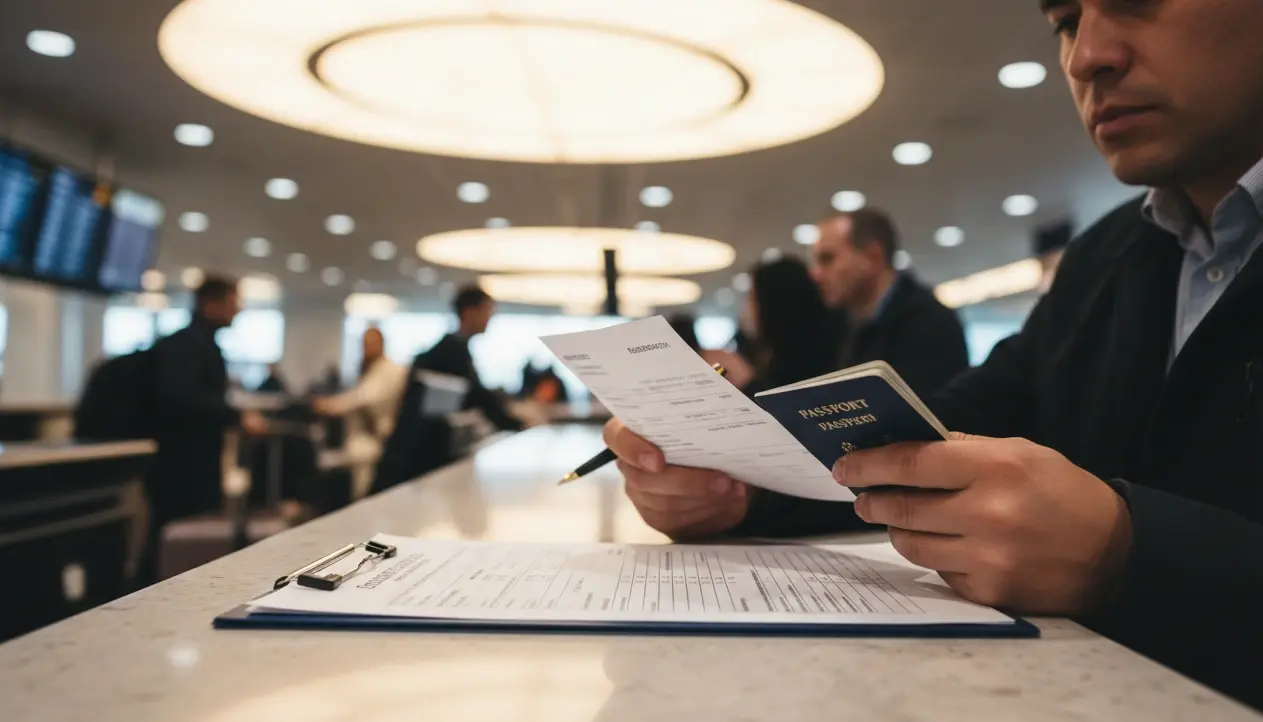
Short answer: When a trip combines family visits and tourism, use a flight reservation for visa that covers the full entry and return plan, then separate the nights spent with family from the nights in hotels. Choose the category that matches the primary purpose, explain the second purpose briefly, and keep flights, accommodation, insurance and financial evidence consistent. A reservation supports an application but cannot guarantee approval, boarding or entry.
Key facts
- Choose the visa category that matches the main purpose and largest part of the stay.
- Show family nights through invitation, host address and relationship evidence.
- Cover independent tourism nights with genuine hotel or accommodation proof.
- Match passenger name, flight dates, hotel dates, insurance and return plan.
- Follow the destination authority’s current checklist when its evidence rules differ.
Need travel proof for a family-and-tourism visa plan? Prepare a temporary reservation around your real dates, route and accommodation split.
Create your flight reservationIn This Guide
- When Your Trip Mixes Family Time and Sightseeing, Your Visa Category Needs a Clear Answer
- Building a Flight Itinerary That Works for Both a Family Stay and a Few Tourist Stops
- Proving Where You'll Sleep: Accommodation for the Family Portion and the Tourism Portion
- The Paperwork Trail That Ties Your Family Visit and Tourism Plans Together
- A Dual-Purpose Trip Deserves a Single, Consistent File
Official-source check: For passport, visa, health and carrier-facing checks connected to your route, consult the current IATA Travel Centre. The destination embassy, consulate or visa centre controls the final checklist and any family-visit or tourism evidence request.
Reviewed for: dual-purpose visa logic, family and tourism evidence, accommodation coverage, flight-date consistency, return planning and official-source alignment.
A trip that combines a family reunion with a few days of sightseeing puts your visa application in an unusual spot. For broader document alignment, review the visa flight itinerary requirements guide. Embassies want one clear purpose, and yours has two. Get the balance wrong and a consular officer may ask why your flight itinerary shows a return date that doesn't match your family visit, or why your hotel reservation stops the moment your relative's address takes over.
This guide walks through how to build a flight reservation, hotel booking, and supporting file that holds together when your reasons for travel aren't singular. You'll see how to pick the right visa category, time your accommodation dates correctly, and avoid the paperwork gaps that trigger a visa refusal. For a dummy ticket for visa that fits both legs of a family-and-tourism trip, match your dates before you apply.
When Your Trip Mixes Family Time and Sightseeing, Your Visa Category Needs a Clear Answer

Combining a family visit with tourism sounds simple until you sit down to complete the application form. The visa category you choose shapes every document that follows, from your flight itinerary to your hotel reservation, so it pays to settle this question first.
Choosing Between a Family Visit Visa and a Tourist Visa
Most applicants assume a tourist visa covers any leisure travel, including time spent with relatives. That assumption causes problems later. A Visitor/Family Visit Visa is more appropriate for family stays, while a Tourist Visa is typically chosen for sightseeing trips.
If most of your nights will be spent at a relative's home, lean toward the family visit category. If sightseeing dominates your schedule and the family visit is a short stop along the way, the tourist category may fit better.
The visa category must match the primary purpose of the trip to avoid complications during review or at your visa interview.
Think about where the bulk of your time and budget goes:
-
How many nights will you stay with family versus in paid accommodation?
-
Is the family visit the reason for the trip, or a stop within a larger tourism plan?
-
Does one family member's invitation cover most of your stay, or only part of it?
Answering these questions before you touch the flight tickets or hotel booking saves you from resubmitting a visa file later.
Consider a trip where you land in the destination country, spend ten nights with a sibling, then move to a coastal city for four nights of sightseeing before flying home. Here, the family stays clearly dominate the schedule, so a Visitor/Family Visit Visa fits better than a general tourist category, even though sightseeing still appears on the itinerary.
Getting this weighting right at the start reduces avoidable questions, since every later document reinforces the same primary purpose instead of arguing for two different ones to a reviewing officer. A little planning here saves several rounds of clarification down the line, and it keeps your cover letter, itinerary, and interview answers pointed at the same story.
Why Consular Offices Want One Primary Purpose, Not Two
Consular offices prefer identifying a primary purpose for visa applications, even when your trip genuinely serves two goals. This isn't bureaucratic stubbornness. It lets visa officers apply the correct checklist, request the right supporting documents, and process your visa application without confusion over which rules apply.
Navigating the visa application process requires clarity and transparency, especially when family time and tourism sit side by side on the same trip. Decide which purpose covers more of your travel dates and lead with that one throughout your paperwork, your interview answers, and your itinerary details.
Submission of biometric data is standard for short-stay visa processes, and this step usually happens early, often before your final flights are booked. Treat it as confirmation that your visa type and application are moving forward, not as a signal that your documents are already settled.
It also helps to keep a written note for yourself, separate from what you submit, listing which visa category you applied under and why.
If a follow-up question arrives from the consulate, or if you need to reference this application when preparing a future trip, having that reasoning on hand saves you from reconstructing your logic from memory months later.
Matching Your Cover Letter to a Dual-Purpose Trip
Cover letters are crucial for dual-purpose visa applications. A well-written letter explains, in plain terms, why your trip includes both a family visit and tourism, how many days belong to each, and why you chose the visa category you did.
For a family visit, proof of relationship may be required alongside the letter itself. Invitations from family or proof of relationship are critical for applications involving family visits, since they confirm the connection between you and the person you're staying with.
Keep the cover letter short and specific:
-
State your travel dates and the visa category you're applying under.
-
Break down which nights are with family and which are tourism.
-
Reference the person inviting you, their relationship to you, and their address.
-
Mention your return date and your reason for coming back.
A cover letter that reads as an afterthought rarely helps your visa decision. One written with the same care as your flight reservation and hotel booking tells the officer reviewing your visa file that you understand exactly what you're asking for.
Some applicants confuse this kind of trip with a business visa. A business trip follows its own visa requirements and official checklist, built around meetings and work invitations rather than family ties or sightseeing, so keep that paperwork separate from your file.
Understanding the difference between these visa purposes early prevents you from mixing documents meant for a different visa type into your application. Once the purpose and category are settled, the next step is making sure your flights back up that story.
Building a Flight Itinerary That Works for Both a Family Stay and a Few Tourist Stops
Your flight itinerary is often the first document a visa officer checks against your cover letter, so it needs to reflect the same trip you described on paper. Getting the dates and structure right here prevents a lot of back-and-forth later.
What Your Round-Trip Flight Reservation Should Show Embassies
Some destination checklists request a flight reservation, and a round-trip itinerary can make the proposed entry and exit clear when the visa process permits it. A flight reservation typically includes passenger name and travel dates, and both need to match the person applying and the dates listed elsewhere in the file.
Embassies may verify flight reservations through booking references, so the reservation number and passenger name on your itinerary should be consistent across every copy you submit. A flight itinerary should include passenger name and travel dates in a format that matches your passport exactly, down to spelling.
If your trip touches more than one city, whether for family time in one location and sightseeing in another, a multi-city itinerary must have clear reasons for each stop. List why you're arriving at each location and roughly how long you're staying, so the pattern of arrival airports lines up with the story in your cover letter.
When family and tourism happen in different cities within the same destination country, a connecting flight or a short domestic hop between the two often makes more sense than treating them as entirely separate trips.
Keep the connecting flight's date sitting neatly between your family visit dates and your tourism dates, rather than leaving a wide, unexplained window on either side. A tidy sequence of arrivals and departures across both cities does more to reassure an officer than a lengthy written explanation ever could.
Keeping Departure and Return Dates Aligned With Your Real Plans
Flight reservations should match the visa application dates and purpose, which means your departure date should align with when the family visit or tourism portion begins, and your return date should reflect when both are genuinely finished. A travel itinerary must match your visa application dates, not just approximately, but to the specific day where possible.
Some authorities may verify a flight itinerary during review, which is why a truthful, well-prepared record matters. Arrival and departure dates that shift between your application form, your cover letter, and your actual ticket create doubt, even when the shift is small and unintentional.
Inconsistencies in documents can lead to visa application rejection, so before submitting, cross-check:
-
The departure date on your flight itinerary against your stated trip start.
-
The return date against your stated trip end and your reason for coming back.
-
The passenger name and passport number against your application form.
-
The flight number and airline details across every printed copy.
Avoiding the Financial Risk of a Fully Paid Ticket Before Approval
Buying a fully paid ticket before your visa is approved carries obvious financial risk. Avoid purchasing non-refundable tickets before obtaining a visa, since a visa refusal would leave you covering the cost of a real ticket for a trip you can no longer take.
Many applicants instead submit a verifiable reservation rather than an actual ticket at the application stage, then convert it to a final ticket once the visa decision comes through. This approach protects your budget while still satisfying the embassy's need to see planned flights with a real booking reference attached.
If your trip involves a stop in more than one country, the main destination rule dictates where to apply for a visa in multi-country travel. Apply in the country where you'll spend the most nights, whether that's the family visit portion or the tourism portion, and build your itinerary start and end dates around that primary stop.
A round-trip flight reservation, sometimes shown as a round-trip itinerary, works well as a visa flight reservation. It displays both onward travel and a return flight in a single document, unlike booking a real flight ticket or airline ticket right away, which locks you into a full flight booking before your travel visa is even decided.
Where the relevant process accepts a reservation, it can show the proposed route, dates and passenger details without requiring a fully paid fare. With your flights settled, the next question is where you'll actually be sleeping each night. For a broader explanation of reservation evidence, see the complete flight-reservation guide.
Proving Where You'll Sleep: Accommodation for the Family Portion and the Tourism Portion

A trip split between a relative's home and a string of hotels needs an accommodation plan that accounts for every single night, not just the nights that are easy to document.
Hotel Reservations for the Days You're Sightseeing on Your Own
Many destination checklists ask for accommodation evidence, and the tourism segment usually needs a hotel reservation covering each night you are not staying with family. Hotel bookings must cover every night of your planned stay, including short stopovers between the family visit and the sightseeing portion.
A hotel reservation should match the travel itinerary dates exactly. If your flight lands on a Tuesday and your family stay doesn't begin until Thursday, your hotel booking needs to cover both nights in between, not just one.
Pay attention to check-in and check-out times too, not just the calendar dates. A flight that lands late at night still needs a hotel booking for that same night, even if you'll only sleep there for a few hours before moving on.
Reviewing officers rarely question this level of detail directly, but a schedule that accounts for it reads as far more credible than one with a night quietly left uncovered.
Embassies verify hotel reservations by checking booking references, so keep your confirmation number, the hotel's name and address, and your check-in and check-out dates together in one document. A booking reference that doesn't match what's printed on your itinerary details is an easy way to raise unnecessary questions.
Handling the Nights You'll Spend With Family Instead of a Hotel
Accommodation proof is required for both tourism and family visit portions, but the family visit nights don't need a hotel reservation. Instead, they're typically covered by the invitation letter, the host's address, and proof of relationship mentioned in your cover letter.
Round-trip flight reservations and proof of accommodation are necessary parts of a visa application, and for the family segment, "accommodation" simply shifts from a hotel booking to a documented address where you'll be staying.
Make sure the dates in this section of your accommodation plans line up with the dates in your invitation letter, so there's no ambiguity about which nights belong to which purpose.
If your host's home is far from the airport, factor that distance into your first night's plans as well. Some travelers book one hotel night near the arrival airport before joining family the next day, simply to avoid a late, disorienting drive right after a long flight.
That extra night still needs to appear in your accommodation plans, matched to the correct date.
A simple way to keep this organized:
-
List each night of the trip in order, from arrival to departure.
-
Mark which nights are covered by a hotel booking and which by the family stay.
-
Note the address for each segment, whether it's a hotel or a relative's home.
Why Gaps Between Accommodation Dates Raise Questions
Unexplained gaps in accommodation can lead to visa rejection, and dual-purpose trips are especially prone to this problem. A night that falls between your flight's arrival and your family stay's start date, with no hotel booking covering it, is exactly the kind of gap a reviewing officer will flag.
Walk through your full trip day by day and confirm that every night has a matching accommodation dates entry somewhere in your file, whether that's a hotel reservation or the host's address.
Accommodation coverage should be part of a well-prepared itinerary, not something added right before the meeting dates for your family visit. If you're visiting family within the Schengen area, remember a reservation expires after a set window, so time your hotel booking around your actual travel dates rather than booking far ahead and letting it lapse.
Once accommodation is fully accounted for, the remaining task is tying the financial and legal paperwork together so the whole file reads as one coherent trip.
The Paperwork Trail That Ties Your Family Visit and Tourism Plans Together
Flights and accommodation carry most of the weight in a dual-purpose visa file, but the supporting paperwork around them is what convinces an officer the whole trip is genuine and affordable.
| Trip segment | Evidence to show | Consistency check |
|---|---|---|
| Family visit | Invitation, host address and relationship proof | Nights, address and sponsor role match the cover letter |
| Tourism portion | Hotel booking and local itinerary | Hotel dates cover every independent night |
| Entire journey | Round-trip flight reservation and insurance | Entry, exit, purpose and return plan form one timeline |
Financial Proof That Matches a Two-Part Trip
Proof of financial means typically includes recent bank statements and salary slips, and for a trip covering both family time and tourism, your statements should reflect enough funds to cover the tourism segment's hotel costs, meals, and activities on top of any travel to reach your family.
Financial proof demonstrates the trip's feasibility and intention to leave after the visit, which matters more on a dual-purpose application since the officer is weighing two sets of expenses instead of one.
If a family member is covering part of your costs during their portion of the stay, a short note explaining this alongside your bank statements helps clarify the full financial picture.
Alongside your finances, proof of stable ties to your home country carries extra weight on this kind of trip, since mixed purposes can read as an open-ended stay. Employment letters, enrollment records, or property documents help show your return date is a firm plan rather than a formality.
None of this replaces the flight and accommodation paperwork already covered, but it rounds out a file that explains both why you're going and why you're coming back. A reviewing officer sees the whole picture at once, rather than piecing together two half-explained trips.
Insurance, Passport Validity, and Other Boxes to Check
Standard requirements for visas include recent bank statements and medical travel insurance, and travel insurance is mandatory for visa applicants in many countries regardless of whether the trip is for family, tourism, or both. Travel medical insurance is required for Schengen visa applications specifically, and travel insurance must cover a minimum of EUR 30,000 for Schengen visas.
Travel insurance should cover the entire duration of stay, including the family visit portion, not just the days you're touring on your own. Travel insurance provides financial security during unforeseen events, which is worth remembering if illness or an accident occurs while you're staying with relatives rather than in a hotel.
Beyond insurance, a few basic checks apply to nearly every application:
-
A valid passport must be issued within the last 10 years and have at least three months of validity beyond departure.
-
Visa applications require a fully completed and signed application form.
-
Your passport number, passenger name, and other identifying details should match across every document in the file.
Timing Your Application Around Family Events and Sightseeing Windows
Applications generally can be submitted up to six months and at least 15 days before travel, which gives you room to plan around a family event date while still leaving time to add the tourism portion afterward. If your family visit is tied to a specific occasion, work backward from that date when deciding when to apply.
Build in a buffer between your expected visa decision and your departure date as well. Processing times vary by consulate and by season, and a family occasion with a fixed date leaves little room for delay.
Applying closer to the six-month mark, rather than waiting until the final weeks, gives you space to adjust your tourism plans if the family portion needs to shift.
If your application is ever refused, an objection letter addressing the specific reason given can support future visa applications, provided you correct the issue rather than resubmitting the same file unchanged.
A reservation number that remains active while your application is under review also matters, since a canceled or expired booking partway through processing can create the same gap problem seen with accommodation.
Every required document in your file should reinforce the same visa requirements you identified when choosing your category, rather than introducing a new angle the officer has to reconcile. Keep a simple official checklist on hand as you gather bank statements, insurance, and your itinerary, and cross it off piece by piece before you submit.
With the flights, stays, and supporting paperwork all pointing to the same story, your visa file is ready to reflect a trip that genuinely serves two purposes without confusing either one.
A Dual-Purpose Trip Deserves a Single, Consistent File
A trip that mixes family time with sightseeing doesn't need to complicate your visa application. It needs consistency. Once your flight reservation, hotel booking, and cover letter all point to the same dates and the same primary purpose, most of the guesswork disappears.
Treat your accommodation plans and financial proof as one connected story rather than separate boxes to check. When every document agrees with the next, you're free to focus on the parts of the trip that actually matter: the time with family and the places you'll finally get to see and experience together.
Ready to make your dual-purpose trip clear? Keep the family stay, sightseeing nights, flight route and return evidence consistent before submission.
Prepare your reservationFrequently Asked Questions
Which visa category should I use for a family-and-tourism trip?
Use the category that matches the primary purpose and the destination authority’s current rules. Explain the secondary purpose rather than presenting two conflicting stories.
Do I need a flight reservation for both parts of the trip?
Your travel proof should show the complete entry and return plan. The route and dates should fit both the family stay and the tourism portion.
How do I prove nights spent with family?
Use the applicable invitation, host address, relationship and sponsorship evidence required by the destination checklist.
What if some nights are in hotels and others are with family?
Create a night-by-night accommodation plan showing which nights are covered by a hotel and which by the host’s address.
Can an embassy verify a flight reservation?
Some authorities or visa centres may check a reference through an issuing system or airline-facing tool. Keep the record truthful and retain what you submitted.
Does a family visit and tourism reservation guarantee approval?
No. It is supporting evidence. Approval depends on the complete application, the applicant’s circumstances and the destination authority’s current rules.
Friendly reminder: BookForVisa provides temporary travel-proof documents for planning and application support. Requirements vary by destination, airline, route and applicant situation. A flight reservation can support a file, but it does not guarantee approval, boarding or entry.