
Qatar Airways is a common choice for Indian travelers because it connects major Indian cities through Doha to Europe, the UK, North America, the Middle East, Africa and Asia. That route network makes it useful for visa files, but it also creates a common question: should you book directly, use a hold, work through an office, use an agency, or prepare a flexible flight reservation for visa submission?
The answer is not the same for every applicant. A student with a fixed reporting date, a family applying together, a business traveler waiting for invitation confirmation and a tourist with flexible dates all need different reservation logic. The document should help the visa officer understand your planned travel, not create extra questions about payment, route, validity or date mismatch.
For BookForVisa, the strongest way to handle this topic is not to turn it into a general airline sales guide. The article should help applicants decide which Qatar Airways proof belongs in a visa file: a held itinerary, a ticketed booking, a reservation prepared for application-stage proof, or an agency-issued document. Each one can be useful, but only when the status is described honestly and the dates match the rest of the file.
For the wider visa document framework, start with BookForVisa’s complete flight reservation for visa guide. This Qatar Airways article owns the airline-specific question: when a Qatar Airways booking, hold, PNR, e-ticket or agency reservation is the right proof for a visa file.
If you need an application-stage document rather than a final paid ticket, BookForVisa’s flight reservation for visa service page explains the cleaner reservation workflow.
In This Guide
Book Direct on Qatar Airways Website or App
Booking directly with Qatar Airways is the cleanest route when you are ready to manage the booking yourself. You control the search, passenger details, fare family, payment method and later changes through Qatar Airways channels. For visa applicants, the main advantage is clarity: you can retrieve the booking using official Qatar Airways tools and keep the record under your own email and contact details.
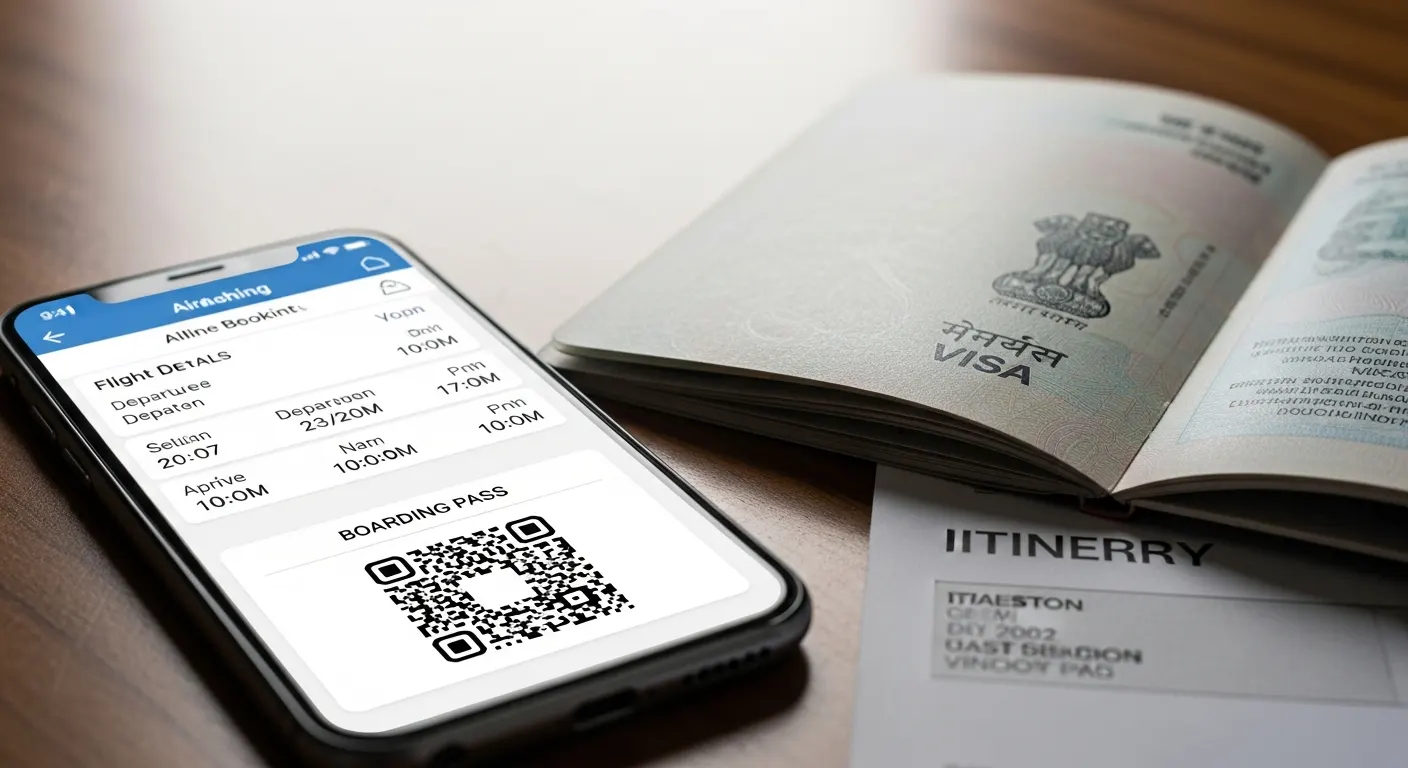
Why going direct works well for travelers in India
India-based travelers often use Qatar Airways from cities such as Delhi, Mumbai, Bengaluru, Chennai, Hyderabad, Kochi, Ahmedabad and Kolkata, depending on current schedules and availability. A direct booking can reduce confusion because the airline controls the itinerary, payment record, booking reference and service changes. If a visa center asks for travel proof, the booking details are easier to explain when you created them yourself.
Direct booking is especially useful when your dates are firm, your payment method is ready and the itinerary is simple. It is less ideal when your visa decision timeline is uncertain and you do not want to purchase a final ticket yet. In that case, a hold or visa-focused reservation may fit better.
A quick primer on fare families that matter for visas
Qatar Airways fare families can differ in baggage, seat selection, changes, refund conditions and other flexibility features. The visa applicant should not choose a fare only by price. If the visa decision may arrive late, change and refund rules matter. If your file requires a paid ticket, the fare’s flexibility can become part of your risk control.
For application-stage proof, a paid ticket with rigid conditions may be unnecessary. For post-approval travel, the fare family matters more because you are buying the trip you actually plan to take. Read fare rules before payment, especially when the booking is tied to embassy appointments, VFS slots, university reporting dates or fixed events.
A visa applicant should look beyond the headline fare. A lower fare may restrict changes, refunds or baggage. A higher fare may give more flexibility but can block more money before the visa result. If your visa outcome is uncertain, the cheapest ticket can become expensive after one date change. If your visa is already approved, the final fare comparison becomes more straightforward.
The step-by-step path on the website or app
- Search your route from India or your current departure city.
- Choose dates that match the visa form and supporting documents.
- Select flights with realistic connection times through Doha.
- Review fare rules before payment or hold selection.
- Enter passenger names exactly as passports allow.
- Use an email and phone number you can access during visa processing.
- Save the booking reference, itinerary receipt or e-ticket details.
- Check the booking in Manage Booking after confirmation or hold creation.
The order matters. Do not choose flights first and force the visa file to match later. Build the visa calendar first: form dates, hotel dates, insurance period, invitation dates and leave approval. Then choose the Qatar Airways route that supports that calendar.
For Schengen, UK, Canada, Australia and other visitor files, the reservation should not quietly change the story. If your form says a seven-day visit, your Qatar Airways proof should not show three weeks unless the rest of the file supports three weeks. If your leave letter ends on 18 June, a return flight on 25 June creates a question. These are small checks, but they are often where rushed files break.
Payment tips that reduce friction in India
International airline payments can fail because of card limits, OTP delays, bank fraud checks, currency settings or insufficient international usage permissions. Before paying for a ticket or hold, make sure the card is enabled for international transactions and has enough limit. Keep the booking email open so you can confirm whether payment succeeded, failed or stayed pending.
If payment fails during a visa-sensitive timeline, do not create duplicate bookings in panic. Qatar Airways’ Hold My Booking terms say duplicate bookings can affect the hold option. Slow down, check the email, check Manage Booking, and only then decide whether to retry.
For Indian cards, also check international transaction activation, per-transaction limit, OTP delivery and whether the bank flags airline payments as unusual. If a family member is paying, keep the payer available until the booking is clearly confirmed. Payment friction is not an SEO detail, but it matters in real visa preparation because applicants often prepare these documents close to appointment day.
After you book: manage it like a visa document
Once you have a Qatar Airways record, treat it as part of the visa file. Save the itinerary, booking reference, passenger name, dates and route. Compare it with hotels, insurance and the visa form. If you paid and received an e-ticket, keep the e-ticket receipt. If you only held the booking, understand the expiry and do not represent it as a fully ticketed record.
Smart search habits for better results from India
Search nearby dates before locking a visa itinerary. Qatar Airways fares and connection times can vary sharply across a few days. If your leave window allows flexibility, choose a date that gives a reasonable buffer after the visa appointment. Very tight departures can make the file feel rushed and create stress if the decision is delayed.
For Europe or UK routes, one Doha connection each way is usually easy to explain. For North America, Africa or multi-city itineraries, connection logic matters even more. Avoid complicated routing if your visa purpose is simple tourism or a short business visit.
A practical route test is whether a stranger can explain the itinerary in one sentence. “Delhi to Doha to Madrid, then return the same way” is clean. “Mumbai to Doha to Paris, stay in France, exit from Amsterdam after documented hotel nights” can also be clean. A route with multiple unexplained stops, split tickets or unclear return logic is harder to defend in a visa file.
Reading fare rules without getting lost
Fare rules can be dense, but visa applicants should focus on five items: refundability, change fees, fare difference, no-show rules and ticketing deadlines. If the visa is not yet approved, those rules decide how painful a date change could become.
A cheap ticket is not always cheaper after a visa delay. A slightly more flexible option may protect the applicant from rebooking costs. On the other hand, if the checklist only needs reservation proof, buying any paid ticket before approval may be more risk than reward.
Ticketing deadlines also matter. A booking can exist before ticketing, but the airline or agency may cancel it if the deadline passes. If you receive a Qatar Airways booking reference from an agency, ask whether it is ticketed and whether a ticketing time limit applies. A PNR by itself is not always the same as a final ticket.
Common direct-booking pitfalls
- Using a nickname instead of passport name.
- Choosing dates before hotel and insurance are aligned.
- Buying a rigid fare before the visa result.
- Ignoring hold expiry time.
- Creating duplicate bookings after payment uncertainty.
- Submitting a held booking as if it were a paid e-ticket.
When the app is better than desktop
The Qatar Airways app can be useful for checking booking status, trip details and later services. Desktop may be more comfortable for comparing fare rules and downloading or printing documents. Use whichever gives you the clearest record, but always keep the same passenger details and email access.
A simple direct-booking workflow
Use this workflow when dates are firm enough for direct booking: confirm the visa travel window, compare Qatar Airways routes, review fare rules, enter passport names carefully, complete payment or hold selection, retrieve the booking, save the itinerary, and compare it with hotels and insurance before submission. If any date changes, update the whole calendar instead of fixing only the flight.
Booking Through Qatar Airways Offices and Call Centers
Offline booking can be useful when your itinerary is complicated, payment is failing, you need special assistance, or you want a human to confirm whether a hold or ticket option is available. It can also help families, students and travelers with unusual route requirements.
The source article spent a lot of space on offline booking because it is genuinely useful in India. Online booking is convenient, but visa-related cases often have small complications: spelling, family passengers, ticketing deadlines, payment problems, student dates, or the need to understand whether the document is only held or fully ticketed.
When an offline conversation saves your day
An offline conversation can help when you need to clarify name order, split passenger types, infant or child requirements, baggage rules, special meals, mobility assistance or a route that online search does not display well. It can also help when a payment deadline is close and you need to know whether payment can be completed at a local Qatar Airways office.
Qatar Airways’ Hold My Booking terms note that payment may be completed online or offline at a local Qatar Airways office in the country of departure, wherever applicable. That can matter for India-based travelers who hold a fare and then need to complete payment before the deadline.
Prepare before visiting or calling
- Passport names for every traveler.
- Dates that match the visa form.
- Departure and destination cities.
- Preferred connection tolerance through Doha.
- Visa appointment and expected decision timing.
- Payment method and card limits.
- Whether you need a hold, reservation, ticket or flexible fare.
The clearer your brief, the cleaner the booking. If you simply ask for the cheapest ticket, you may get a fare that is not ideal for visa timing. If you explain that the visa decision is pending and dates may shift, the agent can help you think through flexibility.
What to expect at a ticket office or call center
You may be asked for passenger details, route, dates, payment method and contact information. If a booking is created, ask what status it has: held, confirmed but unpaid, ticketed, or issued. Ask whether an e-ticket number exists. Ask when the booking expires if payment is not completed. Ask how changes or refunds work after payment.
For visa purposes, those status differences matter. A booking reference can exist before a ticket is issued. An e-ticket number means a ticket has been issued. A held booking may expire. Do not submit one type of document while describing it as another.
When you call, use direct questions. “Is this booking ticketed?” “Do I have a 13-digit e-ticket number?” “When is the payment deadline?” “Can I change the date if my visa is delayed?” “Which office can take payment?” “Will a service fee apply?” Those questions prevent later confusion.
PNR and e-ticket: what you must walk away with
Qatar Airways describes a booking reference or PNR as a six-character alphanumeric code. It describes the e-ticket number as a 13-digit number. A visa applicant should understand the difference. A PNR helps retrieve a booking. An e-ticket number points to an issued electronic ticket.
If you paid for the ticket, request the itinerary receipt and e-ticket details. If you used a hold, save the hold confirmation and expiry terms. If you only need a flight reservation for visa, keep the document honest and aligned with the application.
Do not let the terminology blur. A PNR is useful for retrieval. An e-ticket is evidence of ticket issuance. A reservation document supports travel intent. A hold protects a fare briefly. Each item has a different purpose. Visa documents should not pretend these categories are the same.
Special cases that benefit from human help
Families with infants, unaccompanied minors, travelers needing assistance and mixed-cabin itineraries often benefit from direct support. Qatar Airways’ family guidance includes specific rules for infants, children and young travelers. These details may not matter for every visa file, but they matter when the traveler category affects booking, seating or supporting documents.
Troubleshooting offline issues
If the name is wrong, correct it immediately. If payment is pending, wait for confirmation before creating another booking. If the office quotes a different fare from the website, ask whether the fare family, baggage, change rules and ticketing conditions are the same. If a hold expires, do not assume the same fare will remain available.
Offline playbook for Indian applicants
- Prepare passport names and visa travel dates.
- Ask the office or call center for route options.
- Confirm whether the booking is held, unpaid, or ticketed.
- Ask for PNR, expiry and e-ticket status.
- Check payment method and office deadline.
- Review the document against visa form, hotels and insurance.
- Keep a record of who handles later changes.
Getting Qatar Airways Reservations Through Agencies and OTAs
Agencies and OTAs can be useful, especially when the traveler wants help comparing routes, holding options, group bookings or mixed airlines. They can also create confusion because the after-sales owner may be the agency rather than Qatar Airways. For visa applicants, the key question is who can correct the booking if dates, names or travel plans change.

Why an agency or OTA can be the right move
An agency can help when you want manual route advice, local payment support, multi-passenger coordination or a reservation document formatted for visa submission. It can also help when your travel plan combines Qatar Airways with other carriers or when online availability is unclear.
The risk is quality variation. Some agents understand visa-document alignment. Others focus only on selling a ticket. Before you proceed, ask whether the document is a reservation, a hold or a paid ticket. Ask whether an e-ticket exists. Ask who handles changes. Ask whether the booking can be checked with Qatar Airways using the provided details.
Agencies can be especially helpful for applicants who do not want to navigate fare rules, international card payments or airline office timing alone. But they also add another layer between you and the airline. If your visa date changes, the speed and quality of the agency’s after-sales support becomes important.
India-ready credibility checks
- The agency gives a clear invoice or receipt.
- Passenger details are reviewed before booking.
- The route matches your visa purpose.
- The agent explains PNR, ticketing status and expiry.
- The agent does not promise visa outcomes.
- The agency can correct mistakes through a proper process.
Speak the same language: PNR, e-ticket and TTL
PNR is the booking reference. E-ticket is the issued ticket number. TTL, or ticketing time limit, is the deadline by which a booking must be ticketed before it is cancelled. Not every applicant needs to use these terms, but understanding them prevents confusion.
If an agent says your booking is “confirmed,” ask whether it is ticketed. If the agent gives a PNR, ask whether an e-ticket number also exists. If the booking is held, ask for the expiry. If you submit the document for visa, keep the status accurate.
This is one of the biggest visa-proof misunderstandings. “Confirmed” can mean different things in casual conversation. A traveler may think it means paid and ticketed. An agent may mean space is booked but payment or ticketing is pending. A visa officer only sees the document. Make sure the document does not overstate its status.
How to brief an agent for visa use
Give the agent your visa country, intended travel dates, route, passenger names and whether dates may move. Tell them if you need a reservation for application-stage proof rather than a paid ticket. Ask for a route that matches hotel and insurance dates. If you are applying for Schengen, tell them the main country of stay so the route does not create consulate confusion.
Comparing quotes without getting lost
Compare more than the price. Check baggage, change rules, refund conditions, connection time, ticketing deadline, agency service fee and who handles changes. A cheaper quote may be poor value if it creates a hard-to-change ticket before the visa decision.
Also check whether the quote uses Qatar Airways-operated flights, codeshares, or partner segments. Qatar Airways’ Hold My Booking terms exclude selected itineraries involving partner airlines. Even outside hold usage, partner segments can affect baggage, changes, airport handling and after-sales support.
After-sales with an intermediary
If the booking is made by an agency or OTA, changes may need to go through that intermediary. Qatar Airways may not be able to handle every change directly if the ticket was issued through another channel. For visa applicants, this matters because date corrections may be needed quickly.
Before relying on an agency document for visa submission, ask who will issue corrections if your appointment moves or your travel dates change. A low-cost agency with slow response can become expensive when a visa center asks for updated documents.
Clean agency workflow
- Build the visa document calendar first.
- Brief the agent with exact names and dates.
- Ask whether the booking is held, reserved or ticketed.
- Check the route against hotels and insurance.
- Verify the booking details where possible.
- Keep only the final version in the visa file.
Qatar Airways Hold My Booking, Fare Holds and Pay-Later Options
Qatar Airways’ official Hold My Booking can be useful when you need short-term control over a fare. According to Qatar Airways, you can hold selected bookings for 24, 48 or 72 hours depending on departure date, after paying a non-refundable fee. If payment is not completed within the chosen timeframe, the booking is cancelled.
What a hold really buys you
A hold buys time. It keeps the selected fare available for the selected flights during the hold period. It does not buy a ticket. It does not influence whether a visa will be issued. It does not remove the need to pay before expiry. It is a short-term decision tool, not a long-term visa processing solution.
This distinction matters for visa files. If your appointment is tomorrow and you only need short-term proof, a hold may fit. If your visa decision may take weeks, a 24- to 72-hour hold may expire long before review. In that case, a visa-focused flight reservation may be more suitable.
Think of Hold My Booking as a fare-control tool. Think of a visa flight reservation as an application-proof tool. Sometimes they overlap, but they are not identical. A traveler about to pay may benefit from a hold. A traveler still waiting for a Schengen, UK, Canada, Australia or student visa result may need a document strategy built around a longer timeline.
Who can use it and when it appears
Qatar Airways says Hold My Booking is available for all Qatar Airways marketed flights with exceptions, including flights from Brazil and selected itineraries involving partner airlines. It may not be available for some origins during sales or promotions, and it does not apply to award bookings. Availability can vary by route and timing.
Because availability can vary, do not build your entire visa plan around the assumption that the hold button will appear. Search the actual route, confirm the option during booking, and have a backup plan if the option is unavailable for your itinerary.
How long can you hold and what does it cost?
Qatar Airways describes 24, 48 and 72-hour hold options depending on departure date, with a non-refundable fee based on region and hold duration. The fee is not deducted from the ticket price. For visa applicants, the cost may be acceptable if the hold supports an immediate decision. It is less useful if the visa process will outlast the hold period.
Departure-country timing also matters. Qatar Airways’ Hold My Booking terms list when payment must be completed by country or region, and for “all other countries” the booking must be completed four days before departure. For India-based applicants, check the live terms shown during the booking because departure date and country conditions affect whether the option fits your plan.
What happens if the hold expires?
If payment is not completed on time, the booking is cancelled. The fare may no longer be available. The hold fee is not refunded. If you planned to use the held booking for visa submission, you need to understand whether the document will still support your file after expiry. Do not rely on a held booking as if it were valid indefinitely.
If a visa office later asks for updated travel proof, an expired hold may not be the right response. You may need a refreshed reservation or a newly ticketed itinerary, depending on what was requested. The safest update is one that keeps the same overall travel story unless your dates genuinely changed.
The cleanest online hold flow
- Search flights after your visa dates are aligned.
- Choose Qatar Airways marketed flights where hold appears.
- Review route and connection times.
- Select the hold option and timeframe.
- Pay the hold fee.
- Save the booking reference and expiry details.
- Complete payment through Manage Booking if you decide to ticket.
PNR versus e-ticket during a hold
A held booking may provide a booking reference. That does not mean an e-ticket has been issued. Qatar Airways’ Manage Booking page separates booking reference from e-ticket number. For visa purposes, describe the document accurately. A hold confirmation is not the same as a paid ticket receipt.
If your cover letter mentions the flight document, use careful wording. Say “flight reservation” or “held booking” if that is what it is. Say “ticketed itinerary” only if an e-ticket has been issued. This small wording choice protects the credibility of the file.
Common hold mistakes
- Assuming the hold lasts through visa processing.
- Submitting a hold as a paid ticket.
- Missing the payment deadline.
- Creating duplicate bookings after payment confusion.
- Choosing a hold before hotels and insurance are aligned.
- Ignoring partner-airline or route limitations.
Official Hold or Flexible Visa Reservation?
The best tool depends on your timeline. Qatar Airways’ official hold is strong when your decision window is short and you may actually buy the ticket quickly. A visa-focused flight reservation is stronger when you need application-stage proof that aligns with a longer visa process.
There is no universal winner. A hold is more airline-native. A visa reservation is more application-timeline friendly. A paid ticket is more final. An agency document may be more convenient but depends on support quality. Choose the tool based on visa timing, not on what sounds most impressive.
Where the official hold wins
The official hold wins when you are close to ticketing. For example, your visa is already issued, your payment card is ready, your dates are firm and you want a short window to confirm details before paying. It also works when your appointment is very close and the hold period comfortably covers submission.
It can also help when a fare is moving quickly and you need a little time to coordinate with family, employer or sponsor. But because the fee is non-refundable and the window is short, it should be used deliberately. Do not treat it as a replacement for a long-validity application document.
Where a flexible reservation does the heavy lifting
A flexible reservation is useful when the visa review timeline is uncertain. If your appointment is next week but the decision may take several weeks, a short hold may not remain useful. A visa-focused reservation can be built around the application calendar without forcing ticket purchase too early.
This is common for Schengen peak season, UK visitor files, Canada visitor applications, Australia tourism and student-related travel where dates may shift after the decision. The reservation helps demonstrate travel intent while protecting the applicant from premature airfare commitments.
What officers actually look for
Visa officers and visa centers generally care about consistency. Does the name match the passport? Do the dates match the form? Does the route match the purpose? Do hotels and insurance cover the same period? Does the trip length fit the funds and leave approval? The flight document should answer those questions clearly.
They may not care whether the route was found through the app, office, agency or a reservation provider. They care whether the document is credible, readable and consistent. A Qatar Airways itinerary can be strong when it supports the file. It can be weak when it contradicts the file.
The money math
| Option | Money risk | Timing strength | Visa-file use |
|---|---|---|---|
| Qatar Airways hold | Hold fee is non-refundable | Short-term only | Useful near submission or near ticketing |
| Paid Qatar Airways ticket | Depends on fare rules | Strong if dates fixed | Useful when required or low-risk |
| Visa-focused reservation | Lower than paid airfare | Built around application timing | Useful before final ticket purchase |
| Agency booking | Varies by agent and ticket status | Depends on TTL and support | Useful with careful verification |
Timing scenarios
If your visa appointment is tomorrow and your trip is two months away, a clean reservation may be enough for submission. If your visa is approved and you are checking fares today, Qatar Airways Hold My Booking may buy time to coordinate payment. If your employer has not approved leave, avoid final ticket purchase until dates are clear. If a consulate asks for updated proof, refresh the reservation and keep the rest of the file aligned.
If you are traveling as a family, choose the document that keeps everyone aligned. If you are a student, choose the document that matches the reporting date and program schedule. If you are a business traveler, match the invitation and meeting dates. If you are a tourist, keep the route simple and the return logic clear.
For Schengen-specific transport logic, BookForVisa’s Schengen visa flight reservation requirements guide explains how reservation proof should connect with accommodation, insurance and main-destination logic.
Risk control red flags
- A provider promises visa results.
- The document has a PNR but no clear route logic.
- The name differs from the passport.
- The dates do not match hotels or insurance.
- The booking is held but described as ticketed.
- The agent cannot explain change or expiry rules.
Converting a reservation to a real ticket
After visa approval, check the visa validity, permitted stay, number of entries and final travel dates before buying. If the approved visa dates differ from the requested dates, adjust the ticket accordingly. If you used Qatar Airways hold and still want the same flights, complete payment before expiry. If the hold expired, search again and choose the best current fare.
Do not assume the visa will exactly match your requested dates. Some visas are issued with different validity periods. Some permit fewer entries than expected. Buy the final ticket after reading the visa, not only after seeing that the passport has returned.
Use BookForVisa to prepare reservation proof that matches your visa form, route and travel dates.
India-Focused Checks Before You Submit
India-based visa files often fail on small details: names, date gaps, payment confusion, stale holds, hotel mismatches and unclear booking status. A Qatar Airways reservation can be a strong travel-proof document, but only if the rest of the application supports it.
Read fare rules like a lawyer, decide like a traveler
You do not need to understand every fare-rule paragraph, but you should know whether changes are allowed, whether refunds apply, whether no-show rules are harsh and whether fare differences may apply. If you are not ready to travel, do not buy a rigid ticket just to make the visa file look stronger.
For visa timing, “change allowed” is not the same as “free change.” A fare may allow changes but still charge fare difference. Refundable may not mean instant refund. No-show rules may change the economics if the visa is delayed beyond departure. Treat fare rules as part of your visa-risk budget.
Build a validity window that fits visa review
If a reservation expires quickly, it may not support a long review timeline. If your decision may take weeks, choose a document strategy that can be refreshed or corrected without changing the entire travel story. Do not let a short-term airline hold become the weak link in a long visa process.
The stronger approach is to preserve the travel story even if the exact document needs refreshing. Same route logic, same trip length, same purpose, same supporting documents. If dates move, move the calendar consistently across flights, hotels, insurance and letters.
Name, passport and contact details
Use passport names. Check surname order. Avoid nicknames. Use an email you can access. If a family member or agent books for you, make sure contact details do not prevent you from retrieving or correcting the booking later.
Middle names and long Indian names deserve special attention. Airline systems may compress spacing, but the identity should still map cleanly to the passport. If the visa form uses one spelling and the flight document uses another, fix it before submission.
PNR versus e-ticket for visa proof
A PNR can help retrieve a booking. An e-ticket number indicates ticket issuance. A visa-focused reservation may show a booking reference without being a paid ticket. The document label and your cover letter should not confuse these categories.
If the visa checklist asks for flight reservation, a reservation is the natural label. If you submit a paid ticket, include the ticketed itinerary. If you submit a held Qatar Airways record, keep the status clear. Honest labeling is a small but important trust signal.
Baggage and transit as quiet factors
Baggage allowance and Doha connection time may not be central to visa approval, but they affect route plausibility. A very tight connection, complex self-transfer or route with baggage confusion can make the travel plan look less practical. Choose a route that a real traveler would reasonably use.
Agency, OTA or direct: decide by after-sales
Direct booking gives you more control with Qatar Airways. Agencies can help with local support and complex itineraries. OTAs may offer pricing but can complicate changes. For visa applicants, after-sales support matters because dates may change after submission.
When choosing a channel, ask yourself who you will contact if the visa date changes tomorrow. If the answer is unclear, the channel may not be ideal for a pending visa file. Convenience at booking time should not create chaos at correction time.
Quick recovery plays
- If the name is wrong, correct it before submission.
- If dates shift, update hotels and insurance too.
- If a hold expires, do not submit it as current proof.
- If payment fails, check status before creating another booking.
- If an agency issued the ticket, ask who handles changes.
- If the visa is delayed, refresh proof only when needed or requested.
One-page pre-submission checklist
- Passenger name matches passport.
- Route matches visa destination and purpose.
- Entry and exit dates match the form.
- Accommodation covers the same stay.
- Insurance covers the required travel period.
- Booking status is described accurately.
- PNR or e-ticket details are not manually edited.
- Only one final version is submitted.
A Qatar Airways reservation can be a clean, credible part of a visa file when it is used deliberately. The best version is not always the most expensive ticket. It is the document that matches your real travel plan and keeps your application easy to understand.
Check-in with confidence after approval
Visa proof and airport check-in are different contexts. Once your visa is approved and you buy the real ticket, carry the documents you may need for travel: passport, visa, ticket, accommodation, insurance, return or onward proof, and any destination-specific forms. A reservation used at application stage should not be assumed to be enough for boarding unless it has been converted into a valid ticket.
At check-in, airlines care about travel documents, ticket validity, baggage, transit and destination rules. For visa submission, the officer cares about the application evidence. Keep those two stages separate in your planning.
Qatar Airways Flight Reservation: Reserve Smart, Submit Cleaner
For visa purposes, Qatar Airways gives travelers several paths: direct booking, official hold, call center support, ticket office payment, agency help and later Manage Booking access. Each path can work, but each has different timing and money risks. Your job is to choose the one that fits your visa timeline.
If your visa dates are uncertain, do not rush into a final ticket. If your trip is approved and the fare is right, a hold or paid ticket may make sense. If you need application-stage proof, a properly prepared flight reservation can keep the file coherent without turning airfare into a gamble.
The final decision is practical: direct ticket when you are ready to fly, Qatar Airways hold when you need a short decision window, agency support when complexity requires help, and visa-focused reservation when the application needs travel proof before the trip is final. Used in the right order, these tools help you stay organized and avoid unnecessary cost.
Qatar Airways reservation proof by visa scenario
For Schengen tourism, the Qatar Airways route should support the main destination and the hotel calendar. If the itinerary enters Paris, Madrid or Rome through Doha, the country where you apply should still match the main stay or main purpose. If your application is for the UK, the flight proof should support a genuine visitor timeline and a clear return plan. If the application is for Canada, Australia or another long-haul visitor route, the reservation should fit the stated trip length and available funds.
For student travel, do not choose dates only because the fare is attractive. Match the reservation with the reporting date, course start date, accommodation availability and any required arrival window. For business travel, match the reservation with invitation dates, meeting schedules and employer letters. For family travel, make sure every traveler’s route, dates and names align unless the difference is intentional and documented.
For onward or multi-city travel, Qatar Airways can be useful because Doha connections often create clean long-haul routing. But the reservation still needs to be simple enough for the visa file. If the applicant submits a complicated route, the supporting itinerary should explain each destination, each overnight stay and the exit plan. Complexity is acceptable when it is documented; unexplained complexity creates questions.
What not to over-optimize
Do not over-polish the travel proof to the point that it stops matching reality. Do not add extra countries because the route looks more impressive. Do not select premium cabins if the financial file does not support that travel style. Do not use a ticketed-looking document if the booking is only held. The best visa document is not theatrical; it is consistent.
Also avoid changing only the flight reservation when the travel plan moves. If departure shifts by ten days, the hotels, insurance, leave approval, invitation and cover letter may all need review. A corrected Qatar Airways reservation is useful only when the rest of the application calendar moves with it.
FAQ
Can I use a Qatar Airways flight reservation for a visa application?
Yes, a Qatar Airways flight reservation can support a visa application when it accurately shows your intended route and dates and matches the rest of your documents.
Does Qatar Airways offer a hold option?
Qatar Airways offers Hold My Booking on eligible marketed flights, allowing selected bookings to be held for 24, 48 or 72 hours depending on departure date and availability.
Is a Qatar Airways hold the same as an e-ticket?
No. A hold can create a booking reference, but an e-ticket number is issued after ticketing. Do not describe a held booking as a paid ticket.
How do I check a Qatar Airways booking?
Qatar Airways Manage Booking allows retrieval with booking reference or e-ticket number and last name.
What is a Qatar Airways PNR?
Qatar Airways describes the booking reference or PNR as a six-character alphanumeric code that appears on the booking confirmation or ticket.
What is a Qatar Airways e-ticket number?
Qatar Airways describes an e-ticket number as a 13-digit number mentioned on the e-ticket.
Should I buy a Qatar Airways ticket before visa approval?
Only when the checklist or your own travel situation justifies it. If dates are uncertain, a reservation may reduce financial risk before approval.
Can an agency book Qatar Airways reservations for visa proof?
Yes, but confirm whether the booking is held, reserved or ticketed, who handles changes, and whether the details match your visa file.
What if my Qatar Airways hold expires?
If payment is not completed before the deadline, the booking is cancelled and the fare may no longer be available. Use updated proof if your visa file needs current travel evidence.
What should I check before submitting the reservation?
Check passport name, route, dates, hotel coverage, insurance period, booking status and whether the PNR or e-ticket details are accurate.