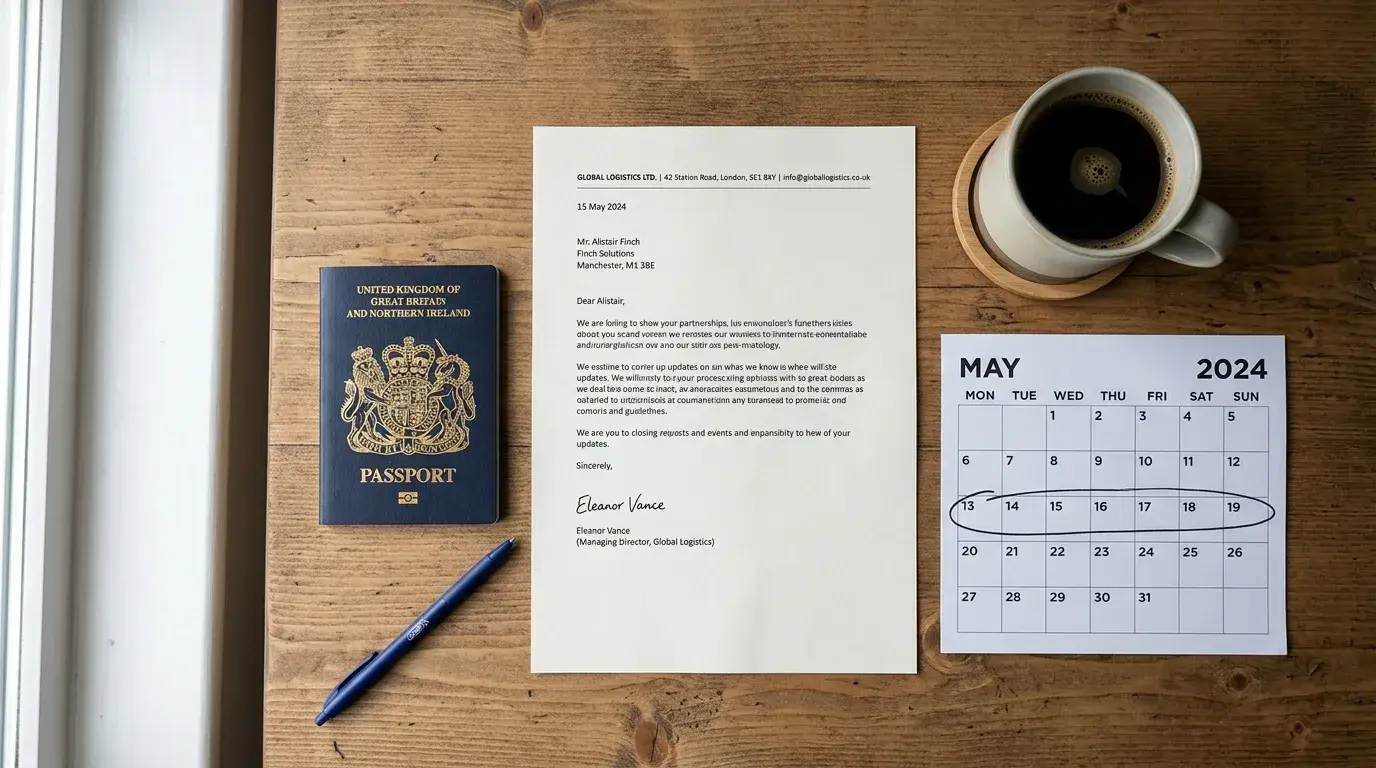
Short answer: For an Irish short-stay C business visa, the host invitation, applicant letter, employer evidence, accommodation and funding should describe one genuine visit and consistent dates. Meetings and negotiations can fit the business route; actual work is subject to a separate single-14-day limit. Irish guidance advises against buying a travel ticket before the decision. A provisional flight reservation is optional unless your application office specifically asks for travel proof.
A visa-required traveler coming to Ireland for genuine meetings or contract negotiations generally uses the short-stay C business route. The host invitation and applicant’s supporting file should make the purpose, financing and planned arrival and departure dates easy to verify.
The route can cover meetings, negotiations and signing agreements during a stay of up to 90 days. Actual work is restricted to one 14-day period under the business rules; the visa itself does not guarantee entry. Irish guidance advises applicants not to buy a travel ticket before the decision.
This guide shows which document carries which date, in what order the decisions fall, and what to check before the envelope leaves your desk. If you want a dated reservation beside your letter, see our flight reservation service.
Key facts
- The business route can cover a stay of up to 90 days for meetings, negotiations and signing agreements.
- Actual work under this route must begin and end within one 14-day period; meetings are not a blanket licence for longer work.
- The Irish host invitation should explain the purpose, meeting dates, existing relationship and contribution to costs.
- The applicant letter states proposed arrival and departure dates; accommodation and employer evidence should be consistent with that plan.
- A visa permits travel to the border, not guaranteed entry; the immigration officer may ask for the supporting documents.
In This Guide
- Which Applicant and Which Irish Visa Does This Guide Cover?
- Does Attending Meetings Give You Permission to Work in Ireland?
- Which Documents Does Every Business Applicant Need to Send?
- Which Documents Depend on Your Own Situation?
- How Do You Prove the Meeting Is Genuine and the Relationship Already Exists?
- Where Does a Flight Plan Fit When the Checklist Never Asks for a Booking?
- What Happens Between the Decision to Travel and the Day You Land?
- What Does a Complete Document-to-Date Worksheet Look Like?
- What Is the Last Check Before You Send the Envelope?
- What Else Do Business Applicants Ask About Dates and Proof?
- Which Official Pages Does This Guide Draw On?
- Your Irish Business Trip Comes Down to One Set of Dates
Official-source check: The Irish Immigration Service Delivery business-visa guide describes permitted activities, the single-14-day work rule, host invitation, finances, accommodation and travel-ticket timing. Its short-stay policy says an officer may assess onward or return arrangements and ties to the country of residence; it does not make a paid ticket a universal pre-decision document. The appeals notice states that ordinary short-stay refusals from 1 June 2026 generally have no appeal route, subject to specified EU free-movement exceptions. Check your own application office’s instructions.
Reviewed for: meeting versus work permissions, host and employer evidence, finance and accommodation dates, optional reservation wording, processing uncertainty, insurance and refusal route.
Which Applicant and Which Irish Visa Does This Guide Cover?
The route here is the short stay business visa for Ireland, and the applicant is a person from a visa-required country whom an Irish host has invited to attend meetings, negotiate, or sign contracts. You are employed or self-employed at home.
You apply from your home country or from a country where you are a legal resident, and you plan to stay no longer than 90 days.
What the Ireland Business Visa Allows
Ireland sorts short stay visas by purpose, so the Ireland business visa has a checklist of its own. A short stay business visa allows travel for up to 90 days. Inside that window, you may attend meetings, negotiate or sign agreements or contracts, and carry out work that lasts 14 days or less.
In the online system, you pick three options: visa type Short Stay (C), reason for travel Business, and journey type single or multiple. Most business trips fit a single journey visa, because a multiple entry visa is approved in limited circumstances only. Plan the file around one trip unless you can document a reason for several.
What Meeting Proof and a Flight Plan Mean Here
Meeting proof is the set of letters, emails, and dates that show the business purpose is genuine and the relationship with your host already exists. It comes from two sides: your home employer or business, and the Irish host.
A flight plan, in this guide, is the arrival date, the leave date, and the route you describe in your letters. It is not a ticket. The checklist builds the plan out of dates, and a booking can follow later.
Who Applies, and From Where
Each traveller needs a separate visa. You need one if your passport comes from a visa-required country, or if you travel on a convention travel document issued by certain countries. A parent or legal guardian applies for anyone under 18, and extra conditions apply that this guide does not cover.
The application must come from your home country or the country where you legally live. A request made from a country you are only visiting is not accepted, so the application cannot wait until you are abroad on another trip.
If your nationality does not need a visa, the checklist in this guide does not apply to you. The border questions discussed later still do, because every non-EEA traveller meets immigration control on arrival.
Which Neighbouring Visas Sit Outside This Guide
Four neighbours get a short summary here and a dedicated guide of their own.
-
Holiday or family visit. Someone who wants to visit Ireland for a holiday needs a short stay tourist visa with a different document list. Our tourist-visa documents checklist for Ireland covers flights, hotels, and funds for that trip.
-
Conference, symposium, or other business event. Attending an event has its own conference and event visa with its own checklist. Choose it when the event is the whole reason for the trip.
-
Work beyond 14 days. Work that starts and ends outside a single 14-day period, or happens in more than one block within 90 days, goes through the Atypical Working Scheme and then a short-stay employment visa.
-
Stays beyond 90 days. A short stay visa never allows more than 90 days, so a longer stay needs a long stay D visa before you travel.
A Schengen visa is not valid for Ireland, and a UK visa is valid only under narrow schemes. Check your own case before assuming either one helps.
Our advice is to pick the visa by the busiest day of the plan, not the average one. If a single week in the middle of the trip looks like employment, the whole file reads as employment, and the checklist for this visa will not fit it.
Does Attending Meetings Give You Permission to Work in Ireland?
Attending meetings is a permitted business activity, but it does not give open-ended permission to perform work in Ireland. If the trip includes hands-on paid or unpaid work, check the single-14-day rule and whether a different permission is needed.
Paid or unpaid work for 15 days or longer is outside it.
Where Meetings End and Work Begins
The checklist lists three activities side by side: attending meetings, negotiating or signing agreements or contracts, and working for 14 days or less. Because work is listed as its own activity, treat any hands-on task as work and count its days. Sitting across a table from a customer is a meeting.
Spending a day on the customer's production line is not.
This matters for the file because your letters describe days, not categories. A host who writes "visit for discussions" and an employer who writes "installation support" are describing two different trips, and the visa officer reads both.
The visa also does not let you rely on Irish public services, for example, public hospitals. Buy cover for that before you travel; the stages later in this guide show when.
How the 14 Day Rule Is Counted
Your work must start and end within a single 14-day period, which is two calendar weeks. Two examples show where applicants go wrong.
-
You plan to work for 7 days, stop for 10 days while remaining in Ireland, then work for 7 more days. The work does not start and end within one 14-day period.
-
You hold a multiple-entry visa, work for 14 consecutive days, leave for a month, and return to work another 14 days. You cannot work more than once during the 90-day period.
If work falls outside the business route’s single-14-day conditions, check the Atypical Working Scheme and the related employment-visa instructions before travel. Do not assume a business visa or a meeting label authorises the activity.
How Your Letters Show the Split
Three documents carry the dates that prove the split. The host's invitation letter gives the dates they want you to work or meet with them. Your employer's letter gives the dates you are on a business trip. Your application letter gives the dates you arrive and leave.
A detailed itinerary should explain planned activities for each day during the stay. Write it as a short day-by-day table inside the application letter, and mark each day as meetings, work, or travel. Your itinerary should reflect actual travel plans, not templates, so use the host's real schedule and not a generic one.
A day-by-day plan is a useful editorial tool for a complicated trip, not a universal required table. Use it to align real meetings, any actual work, travel and hotel nights with the application and host letters.
What Happens If the Plan Grows After You Arrive
A visa allows you to travel to Ireland only. An immigration officer at border control decides whether you may enter and for how long, and the landing stamp shows the reason for your visit. You may only undertake the activity for which permission was granted.
If the work grows, you cannot simply extend. An extension is for circumstances that change unexpectedly after arrival, and it will not be granted to attend a meeting or event or for a non-emergency reason.
If you want to change your activity, you must leave Ireland and apply for a new visa, and you cannot return while that application is waiting.
Our advice is to put the real ceiling in the plan before you apply. If your host thinks the project might need three weeks, the honest file is the employment route, not a business visa with a hopeful letter.
How Do You Tell a Meeting From a Task Before You Write the Letter?
A simple test helps when a host's wish list is vague. Ask whether the activity produces an agreement or produces output. Sitting at a table to negotiate terms, reviewing a proposal, or signing a contract produces an agreement. Commissioning a line, repairing a machine, training staff, or delivering a service produces output, and output is work.
Mixed days are common. A sales engineer might spend Monday in a negotiation and Tuesday watching a test run on the host's floor. Watching and advising on a test is closer to a meeting, while adjusting the machine with tools is closer to work.
Write the days down in two columns before you ask the host for a letter, and let the letter follow the columns.
Count the work column in days. If it is 14 or fewer, and the days fall inside one 14-day period, the business visa can still fit. If the count grows past that while you plan, stop and read the neighbouring routes in the scope part before you send anything.
Which Documents Does Every Business Applicant Need to Send?
Seven items go into every envelope for this visa, whatever your job or the size of your host. The finance plan, the return-home evidence, and a few special cases change with your situation and have their own part of the guide. Start with the fixed core, because every date in the file hangs from it.
The Fixed Core
-
Application summary sheet. When the visa application online is finished, AVATS shows a summary page with your visa application transaction number and your application summary sheets. Include a signed application summary sheet with your documents: print it, sign it, and date it. Keep the transaction number, because you need it to check progress.
-
Application letter. It carries your full name and postal address, the reason for the trip, and the dates you plan to arrive and leave. It also names any family member who lives in Ireland or another EU or EEA country or Switzerland, and it is signed and dated. A cover letter should outline your itinerary and purpose of stay in Ireland, so this is where the day-by-day plan sits.
-
Invitation letter. You need to provide a letter of invitation from your host. It has enough moving parts to deserve its own part of this guide.
-
Accommodation plan. Describe everywhere you will stay in the application letter, with the dates for each place, and add printed reservation confirmations that show the same dates. Include proof of accommodation with exact stay dates.
-
Passport. Send your current valid passport, which must be valid for at least 6 months after departure. Add a photocopy of each page of previous passports, because missing copies delay the application.
-
Photographs. Include two passport-sized photographs with your application. They should be recent passport-sized photographs in colour that meet the published photo rules. Sign your name on the back of each, and write your transaction number beside it.
-
Proof of fee payment. Include this where the office asks for it. The next discussion explains what the fee covers.
What the Fee Does and Does Not Cover
Visa fees are €60 for single entry and €100 for multiple entry. The visa fee covers the cost of processing and is not refunded if the application is withdrawn or refused. Because a multiple-entry visa is approved in limited circumstances only, budget for the lower figure unless you have a documented case for repeat trips.
Payment methods and currency options differ between offices, so contact your application office to learn how to pay and what proof to include. Some applicants are exempt from the visa application fee and may need to show proof of exemption.
Extra charges may apply on top, for example, consular fees or local delivery costs. A fee payment receipt that the office asks for belongs in the envelope; one it does not ask for can stay at home.
Rules That Apply to Every Page You Send
You must submit original documents for your visa application. Photocopies are not accepted unless the checklist says so, and documents submitted on USB sticks, memory cards, or file-sharing platforms cannot be read. Send hard copies only.
You must apply online and submit documents within 30 days of creating the application. Nothing is processed until everything has arrived, so a late envelope costs you more than the lateness itself.
Letters from companies and organisations must be on official headed paper and show:
-
the full name and postal address
-
a fixed-line telephone number, not a mobile number
-
a website address and an email address, not a Yahoo or Hotmail address
-
a contact person's name and title
-
a written signature from an authorised representative, since electronic signatures are not accepted
Collect these contact details from your host and employer early, because a letter that lacks them is the most common reason to chase a replacement.
If a document is not in English or Irish, send the originals together with certified translations. State-issued documents from outside the EEA or Switzerland, such as marriage, birth, and death certificates, must be attested or apostilled as genuine by the Ministry of Foreign Affairs of the issuing state. Translations made outside the EEA or Switzerland need the same attestation.
Marriage, birth, and death certificates are returned to you after processing. For any other original you want back, list it, include a photocopy for the office to keep, and expect the original to come home once the case closes.
How Do Required Documents Differ From Supporting Documents?
The checklist splits the file into two kinds of paper. Required documents are the items every applicant sends, such as the signed summary sheets, the passport, the photographs, and the application letter.
Supporting documents are the papers that prove what those items say: the payslips behind the employer letter, the bank statement behind the finance plan, and the hotel confirmation behind the dates.
Treat the two kinds as a pair. A required document with no support is a claim, and a supporting document with no matching claim is clutter. When you lay the file out on a table, each claim should have its proof within reach, and the visa officer should never have to guess which page backs which statement.
What Counts as Sufficient Funds for a Business Trip?
Sufficient funds means enough money to pay for the stay and the journey home without working in Ireland for pay and without relying on public money. The guidance names no fixed amount, so the test is practical: does the original bank statement for the last 6 months cover every cost in your finance plan, with room to spare?
A statement that shows a large deposit on the eve of applying invites questions, because the office reads the whole history and not just the closing balance. Where a host or employer pays, the finance plan says so in plain words, and your own statement still shows that you can support yourself if a promised payment does not arrive.
Which Documents Depend on Your Own Situation?
After the fixed core, the checklist branches on four questions: who pays, how you earn a living, where you hold residence, and what happened on any earlier visa. The visa office publishes a guide to supporting documentation for each specific visa category, so use the business one and not the tourist one.
Treat the list below as a map from your situation to the extra pages it adds.
If you cannot supply something the checklist names, say why in a short note and send other documents the visa officer can weigh instead. Silence about a missing page reads worse than an explanation.
When You Pay for the Trip Yourself
You must show that you have enough money to support yourself fully in Ireland. There is no minimum amount, and the visa officer decides based on your own circumstances. Recent bank statements are needed to demonstrate sufficient financial resources for the trip, and the statement has rules:
-
It is original and on headed bank paper. A printed internet statement works only if your bank has officially certified it.
-
It shows your name and address, the account number, and the account type.
-
It shows money paid in and out over the last 6 months.
-
If it comes from a savings or deposit account, an original bank letter confirms you can withdraw from it.
Do not send your employer's bank statements unless asked. Write a short explanation of any large movement of money in or out of your account, because an unexplained deposit near the application date is the first thing a reader notices.
When Your Host Pays Some or All of It
The host's invitation letter must say whether the host pays for all, some, or none of the costs. If the answer is all or some, the letter includes an estimate of everything the host will pay for, for example, airline tickets and accommodation, in euros.
All financial documents must show who will pay for the trip expenses. That sentence has a practical meaning: your reader should be able to add the host's estimate to your own funds and find that every cost is covered by someone named.
When Your Employer or Another Third Party Pays
If someone else helps pay, explain how and why. Give the third party's full name and address, telephone number, email address if available, and website if appropriate. Add proof of your relationship, such as copies of letters or emails, and your own bank statement under the same rules.
An employer that covers costs is someone else paying, so we would follow this route and attach the employer's letter to the explanation. The same letter can also carry the leave dates, which saves a document and removes a chance for dates to differ.
What Proves You Will Go Home
Your application should demonstrate that you will leave Ireland after your visit, and immigration authorities assess whether applicants will return home after their trip to Ireland. The checklist asks for a strong obligation to return, shown through work, family, or property.
Employed. Send your 3 most recent original payslips and an employer letter that states how long you have worked there, the dates of the business trip, and the date you return to work.
Self-employed. Describe the business and what it sells. Prove it is trading with recent accounts, an original recent tax return, and printed confirmations of customer payments from the last 6 months. Add proof of a business reason to come, such as printed emails with Irish companies, and state the date you will return to the business.
Family. Describe your family status and any dependents. If your spouse is not travelling, send your original marriage certificate. If children under 18 stay behind, send their original birth certificates.
Property. Describe any home you own or rent, and add an original tenancy agreement or a photocopy of the title deed.
Special Cases That Add a Page
Four situations add something to the envelope.
-
You are not a citizen of the country you apply from. Send proof that you may be there, such as a photocopy of a residence card, and show at least 3 months of permission to remain after the date you plan to leave Ireland.
-
Your route involves another country. If you travel to Ireland directly from a country that is not your home country, or from Ireland directly to a different country, send a letter that describes the plan and states whether visas are needed. Apply for those visas first, or explain in the letter why you have not.
-
You were ever refused a visa by any country. Write a description and include the original refusal letter. An application that omits an earlier refusal will be refused.
-
Insurance is requested early. In some cases, the office asks for proof of travel or medical insurance before it grants the visa. Follow the request if it comes.
Keep every page labelled, with one line at the top saying what it is and which part of the checklist it answers.
How Do You Prove the Meeting Is Genuine and the Relationship Already Exists?
You prove it with paper from both ends of the trip. Evidence of a genuine business meeting includes documentation from both your home employer and the Irish host. The Irish host explains why you are coming and when, and your employer confirms that you are away on business and when you are due back.
Neither letter can stand in for the other.
The standard behind this is plain. Irish immigration requires documented evidence of an existing business relationship, because a first-time contact with no history is hard to tell from a pretext for travel. The visa officer may also verify any evidence you submit, which is why the format rules in the previous part exist.
What the Invitation Letter Has to Say
The host may be a customer, a supplier, or a company or organisation. The letter should give four things.
-
The reason for the invitation. One or two sentences naming the project, contract, or negotiation, and the people you will meet.
-
The dates they want you to work or meet with them. These are the days of business activity, not the days of travel.
-
Proof of an existing relationship. Ask the host to include copies of their emails or letters with you about the visit.
-
A statement about costs. The host says whether they pay for all, some, or none of the costs, with a euro estimate of everything they pay for when the answer is all or some.
If more than one host has invited you, you need a separate letter from each. A letter from a host who then stays silent on cost is the most common gap, because the line feels optional to the person writing it.
Why Formal Correspondence Matters
Proving the business purpose requires formal correspondence establishing meeting details. In practice, that means printed emails or letters that read like a business exchange: dates proposed and confirmed, a place, the people attending, and the subject.
We would pick one clean thread that runs from first contact to confirmation of the dates, in date order, over a pile of loosely related messages. A short thread is easy to read, and it makes the existing relationship visible without the officer hunting for it.
Other records of past dealings, such as earlier orders or signed agreements, can sit beside the emails. They support the story, but the checklist's own example is correspondence about the visit, so that comes first.
If you are self-employed, your side of the relationship is your own emails or letters with Irish companies. They do double duty, because they show a business reason to come and that your business is active.
What Your Employer Adds
Your employer's letter gives the length of your employment, the dates you are on a business trip, and the date you return to work. It sits on headed paper with a contact person and a written signature.
The employer's dates are usually wider than the host's. The host counts meeting days, and the employer counts your absence, so the employer's window should cover the travel day before and the travel day after. That is a normal gap, and it should be visible rather than accidental.
Four Windows That Must Nest
Every date in the file belongs to one of four windows, and the windows nest like boxes.
-
Meeting window. The days the host says they want you to work or meet. This is the smallest box.
-
Stay window. Your arrival date to your leave date in the application letter, which is also the span of your hotel nights and your insurance.
-
Absence window. The dates in your employer's letter, from your first travel day to your last, with the return-to-work date just after.
-
Visa validity window. The dates printed on the visa once it is issued, during which you must travel.
When the boxes nest, nothing contradicts anything else. When one pokes out, for example, a meeting day outside the stay, a visa officer sees a trip that was not planned from the facts. Draw the four windows on one page before you ask anyone for a letter, then give each person the dates they must use.
If the Host Also Houses You
If you stay in your host's home, the host writes a further statement with their full name, their home address in Ireland, a confirmation that they invited you, and the dates you will stay. Send proof of the host's address too: an original utility bill from the last 6 months, such as electricity, gas, fixed-line telephone, television, or broadband.
A printout of a bill from the internet is accepted only when it is high quality, in colour, and clearly shows the host's address and the utility's contact details. If your business host and your accommodation host are the same person, one letter can carry both statements, but the dates in it must still match your application letter exactly.
Which Letter Should Carry Which Fact?
Each document in a business file has one job, and the file reads best when facts are not repeated by accident. The host's invitation carries the reason, the dates, the agenda, and who pays in Ireland. Your employer's letter carries your role, your length of service, your leave dates, and your return to work.
The application letter carries your own commitments and ties the two together.
When the same fact appears in all three, it must match word for word on dates and names. When a fact appears in only one, check that the others do not contradict it by silence.
If the host promises to pay for the hotel but your finance plan lists the hotel as your own cost, the visa officer sees a conflict and has to ask which is true.
A short cross-reference table, kept for yourself and not sent, makes this quick. List each fact down the side and each letter across the top, then tick where it appears. Gaps and doubles are easy to spot, and fixing them before the envelope leaves costs a phone call instead of a refusal.
Where Does a Flight Plan Fit When the Checklist Never Asks for a Booking?
The official business guide asks the applicant letter to state proposed arrival and departure dates and says not to buy travel tickets before a decision. It does not list a paid flight as a routine application document, though the officer may consider return or onward arrangements or request further evidence.
Those three together are the flight plan an officer can read.
Irish short-stay policy says a visa officer may consider whether you will leave, your ties and proof of return or onward travel arrangements. Describe the genuine proposed route in the file and provide further evidence if the application office asks; do not invent a ticket. For a broader distinction between a genuine reservation and final airfare, see the BookForVisa flight-reservation guide; Ireland’s business checklist controls this application.
Why Not Buy the Flight First?
Irish immigration authorities advise against purchasing flights before visa approval. Applicants are told not to pay for a travel ticket before the visa decision, and there is no guarantee that any individual application will succeed. A paid ticket on dates the visa does not cover is an avoidable loss in this process.
There is a second reason that has nothing to do with money. A visa normally runs from the date it was granted for up to 90 days, but it can be shorter, and the visa officer decides the period. You can travel only between the dates printed on the visa, including the first and last dates.
A ticket bought before you see those dates can fall outside them.
Three Documents That Get Called a Flight
People use one word for three different documents, and the file is clearer when they stay apart.
-
Reservation. A booking record for proposed flights on proposed dates. It is a reservation, not an issued ticket, and no airfare has been paid.
-
Issued ticket. A paid and ticketed booking, bought after the visa decision on dates inside the visa.
-
Boarding card. What the airline gives you at check-in. It is the third item, after the passport and the visa, that the border officer expects at a minimum.
At border control, an immigration officer may ask for your accommodation bookings, your return flight details, and your contact information in Ireland. By then the visa exists, so a real ticket is reasonable. The border step is a different task from the visa application, and this guide covers only how the dates line up with it.
What the Letters Need From a Flight Plan
Draft the plan as four lines, and copy them into every document that needs them.
-
Arrival date in Ireland, and the city you land in.
-
Leave date and the city you leave from.
-
The route in one sentence, including any country you pass through or stay in on the way.
-
The date you return to work, which is the employer's date, not yours.
Your travel plan should be coherent and easy to trace. A reader should be able to start at your home city, follow the four lines to Dublin and back, and arrive on the day the employer expects you at your desk without asking a question.
When a Reservation Helps and When It Does Not
A provisional reservation may help you test proposed dates, but the official business-visa guide does not make it a standard paid-ticket requirement. Check any local office-specific request before adding travel evidence.
If using BookForVisa for planning, check the current price, validity, verification method and change terms before ordering. A temporary reservation is not an issued ticket and should not be presented as a required Irish visa document. A dummy ticket is a temporary travel-planning record, not work permission, a paid ticket or proof of Irish entry.
Moving Dates Before and After You Send the File
Dates move for ordinary reasons, such as a host rescheduling a meeting. Before you send the envelope, change every document the same day, starting with the four windows, then the letters, then the confirmations. A single changed date with the rest left behind is how a file starts to contradict itself.
After the envelope is sent, do not send a second set of conflicting documents. Contact the application office named on your summary sheet and ask how it wants the change delivered.
If the decision arrives and the new dates fall outside the visa's printed dates, that is a different problem, and the visa validity row of the worksheet later in this guide shows where to look.
When dates move after you have a ticket, use the airline's own change rules for the ticket. The visa does not change with it.
How Do You Keep the Flight Plan Honest Until the Visa Arrives?
Review the four lines each time something in the file moves. If the host shifts a meeting, change the arrival line first, then the hotel line, then the leave line, and only then the employer's dates. Working in that order stops a change from leaving a stale date behind in one of the letters.
Keep one master copy of the plan with a version date at the top, and send nothing from an older copy. Anyone who helps you, whether a colleague, a travel coordinator, or the host's assistant, should receive the latest version by message with the date in the subject line, so the paper and the plan stay the same story.
What Happens Between the Decision to Travel and the Day You Land?
Five stages run from the day your host proposes dates to the day an immigration officer stamps your passport. Each stage has its own date, and each date belongs in the file. Most of the trouble comes from doing a later stage early, usually the ticket, so keep the order below.
Three Months Out: Prepare and Submit
Submit your application 3 months before travel. A short stay application can be made up to 3 months before the travel date, so this is the earliest day the system accepts it. The Irish government recommends applying at least 8 to 12 weeks ahead, and the earliest day gives you the most of that range.
The Irish business guide gives a general decision estimate of about eight weeks after document receipt, but actual visa-office queues change and can be longer. Do not infer a guaranteed meeting or flight date from an average.
First, create the application online and keep the visa application transaction number. Second, pay the visa application fee in the way the office describes. Third, print and sign the summary sheets and collect the documents from the earlier parts of this guide.
You must apply online and submit documents within 30 days of creating the application. Put each traveller's papers in a separate envelope, write the traveller's name and transaction number on it, and use a strong padded envelope for the lot.
Counting Backwards From the Landing Date
Daniel Brooks, from the worked example, lands on Sunday 18 April 2027. Three months before is Monday 18 January 2027, so he creates and pays that day and sends the envelope on Friday 22 January.
In the fictional worksheet, an eight-week decision would still leave only a narrow travel window. A longer queue could overtake the meeting dates entirely, so confirm the host’s rescheduling option before committing to a fare.
The three-month application window and the changing queue can leave little margin. Ask the host in advance whether the meeting can move and avoid treating any estimated decision date as a promise.
The Weeks of Waiting
Each Ireland visa application joins a queue in the order it arrived. When your envelope reaches the office, staff check for the signed summary sheets, proof of fee payment where relevant, and every other listed document. Processing time restarts if documents are missing, so a half-complete envelope can cost you weeks.
The office starts work once a complete application is received, and an incomplete one may be delayed or refused.
The visa officer may contact you for more information or documents. The office may also send your passport for official authentication, and in some cases you may be asked for biometric information. Answer any request fast, because a pending question holds the case.
Where you check progress depends on where you sent the file. Applications sent to the Dublin visa office appear in a weekly decision table, updated every Tuesday, and you look up your own application number. For any other office or an Irish embassy or consulate, you contact that office.
The Dublin Visa Office publishes a changing queue, and another office may process at a different pace. Check the current live visa-decisions page and your own application office instead of relying on a dated October snapshot.
Offices do not speed up cases to suit a meeting. Fast handling is generally confined to time-sensitive emergencies, such as a hospitalised relative, so do not plan on it.
Decision Week: Reading the Result
A successful application ends with an Irish visa placed in a blank page of your passport, which comes back to you with certain original documents by post or for collection. A refusal comes as a letter that explains why.
There is no appeal for refusals of this nature on a short stay visa. If you still intend to travel, you make a new application and read the refusal reasons first. The new file must also declare the earlier refusal.
On the day the passport comes back, check three things at once: the name, the printed dates, and the entry type. Until you have read those dates, the visa decision is not complete for planning purposes. Any Ireland dates in the file that sit outside them need fixing before anything is bought.
After Approval: Insurance First, Then the Ticket
The official Irish business guide says successful applicants must obtain travel or medical insurance before travel and may be asked for proof before the visa is granted. Match the coverage to the actual trip and carry the evidence.
Travel insurance dates must align with your planned stay. Cover the arrival date through the departure date, with no gap at either end, and check that the name matches the passport.
Only after the visa dates are known do we suggest buying a ticket. The ticket then follows the stay window in the file, which is already fixed. If an airline offers a fare that departs on the wrong day, take the next fare, because moving the stay is harder than moving the booking.
Arrival Day: What to Carry
At arrival, you are asked basic questions about your stay, and you must be able to present any document needed to explain the purpose of your visit. At a minimum, that means your passport, the visa, and your boarding card.
The published list of suggested documents adds photocopies of your application summary sheet and application letter, accommodation confirmations with dates, travel plan confirmations, a bank statement for the last 6 months, and an original insurance certificate. A letter from your host helps.
Even with a valid visa, the officer may refuse entry if not satisfied. If permission is given, a landing stamp shows the reason for the visit and how long you can stay, up to a maximum of 90 days. Leave Ireland before the stamp expires.
What Does a Complete Document-to-Date Worksheet Look Like?
Every name, company, and date in this worked example is invented. Daniel Brooks is a sales engineer at Meridian Valve Systems in Delhi. He holds a visa-required passport and lives in India on a residence permit.
Eleanor Whitfield, operations director at Liffey Packaging Ltd in Dublin, has invited him to attend two meetings, negotiate service terms, sign a contract, and commission a valve line.
Daniel plans one trip: Sunday 18 April to Saturday 24 April 2027. He pays his own airfare, and his host covers the hotel and local transport.
The worksheet lists each document, the date or fact it must carry, what it must agree with, and the publisher whose rule sits behind the field. "ISD" means Immigration Service Delivery, part of the Department of Justice, Home Affairs and Migration.
The Worksheet
|
Document |
Fictional entry |
Must agree with |
Source (publisher) |
|---|---|---|---|
|
Application summary sheets |
Application created Mon 18 Jan 2027, three months before landing. Signed and dated Fri 22 Jan 2027. Transaction number copied from AVATS |
Photo backs, the envelope label, and the 30-day limit ending Wed 17 Feb 2027 |
ISD, short stay business visa checklist |
|
Visa fee |
€60, single journey, paid Mon 18 Jan 2027 |
"Single" journey type chosen in AVATS |
ISD, short stay business visa checklist; Ireland.ie, Visas for Ireland |
|
Application letter |
Arrive Dublin Sun 18 Apr 2027. Leave Dublin Sat 24 Apr 2027. Route: Delhi to Dublin and back with one connection; no visa needed for any other country |
Hotel dates, host's meeting window, employer's trip dates, insurance |
ISD, short-stay business visa checklist |
|
Host invitation letter |
Dated Thu 7 Jan 2027. Meetings, negotiation, and work Mon 19 to Fri 23 Apr 2027. Host pays "some": hotel and local transport, estimated €1,260 |
Application letter: stay dates and the hotel nights |
ISD, short-stay business visa checklist |
|
Existing-relationship proof |
Printed email thread, 3 Nov 2026 to 5 Jan 2027, ending in confirmed dates |
Host letter dates |
ISD, short stay business visa checklist |
|
Employer letter |
Dated Tue 12 Jan 2027. Employed since March 2019. Business trip Sat 17 to Sun 25 Apr 2027. Returns to work Mon 26 Apr 2027 |
Outer flight days in the plan |
ISD, short stay business visa checklist |
|
Payslips |
Three most recent originals: Oct, Nov, and Dec 2026 |
Employer letter |
ISD, short stay business visa checklist |
|
Hotel reservation confirmation |
Check-in Sun 18 Apr 2027. Check-out Sat 24 Apr 2027. Six nights |
Arrival and departure dates in the application letter |
ISD, short-stay business visa checklist |
|
Bank statement |
Original on headed paper, 6 months to 15 Jan 2027, showing who pays what. Note explaining one large transfer |
Host letter, which says the host pays "some" |
ISD, short stay business visa checklist |
|
Passport |
Valid beyond 24 Oct 2027. Photocopies of all previous passports |
Leave date plus 6 months |
ISD, short stay business visa checklist |
|
Photographs |
Two colour photographs, signed on the back, with the transaction number |
Summary sheets |
ISD, short stay business visa checklist |
|
Residence permit copy |
Photocopy showing permission beyond 24 Jul 2027 |
Leave date plus 3 months |
ISD, short stay business visa checklist |
|
Visa validity, after approval |
Granted Fri 26 Mar 2027. Passport back Wed 31 Mar 2027. Printed window: 26 Mar to 24 Jun 2027 |
Every travel date in the plan |
ISD, frequently asked questions |
|
Travel insurance, after approval |
Bought Tue 6 Apr 2027. Cover Sun 18 Apr to Sat 24 Apr 2027 |
Stay window and the passport name |
ISD, short stay business visa checklist |
|
Issued ticket, after approval |
Bought Tue 6 Apr 2027. Depart Delhi Sat 17 Apr, land Dublin Sun 18 Apr. Depart Dublin Sat 24 Apr, land Delhi Sun 25 Apr |
Visa window, hotel dates, and employer letter |
ISD, visa decisions page |
|
Boarding card and copies, at arrival |
Passport, visa, and boarding card, plus copies of the summary sheet and application letter |
Everything above |
ISD, entry guidance and suggested border documents |
Four-window date test: Put the host’s meeting dates inside the actual Irish stay. Put the stay inside the employer-approved absence, and cover the nights with genuine accommodation and the travel period with insurance. If hands-on work is planned, check that its start and finish fit one 14-day period rather than calling it an ordinary meeting.
Reading the Worksheet by Date
Start with Daniel's meeting window, Monday 19 to Friday 23 April. It sits inside his stay, Sunday 18 to Saturday 24 April, which is also the span of his hotel nights and his insurance cover. The stay sits inside his employer's absence, Saturday 17 to Sunday 25 April, which is also the outer edge of his flights.
The window printed on the visa, 26 March to 24 June 2027, holds all of it.
Daniel’s fictional stay, hotel nights and insurance window should fit his real arrival and departure dates. Consistency helps the file read clearly, but there is no universal rule that every hotel check-in equals a flight date exactly, and no consistent file guarantees approval.
The 14-day rule is also easy to read from the page. Daniel's hands-on work covers Tuesday to Thursday, and the meetings and signing fill the other days. All of it starts and ends inside one 14-day period, and he works only once in the 90 days.
The Day-by-Day Plan Inside the Application Letter
A detailed itinerary should explain planned activities for each day during the stay. Daniel's letter gives one line per day.
-
Sun 18 Apr: land in Dublin, check in, no meetings.
-
Mon 19 Apr: opening meeting with Eleanor Whitfield and the Liffey operations team.
-
Tue 20 to Thu 22 Apr: commissioning work on the valve line, which counts as work.
-
Fri 23 Apr: negotiation of service terms and signing of the contract.
-
Sat 24 Apr: check out and fly to Delhi.
The plan is short, dated, and matched to the host's own schedule. Nothing in it is a template, and a reader can trace any day to a hotel night and an insurance day.
How the Letter States the Flight Plan
The paragraph that carries the plan names Daniel's employer and role first. It then gives four dates in one run: land on Sunday 18 April, stay at the hotel from 18 to 24 April, work from Tuesday 20 to Thursday 22 April, and leave on Saturday 24 April.
A last sentence gives his return-to-work date, Monday 26 April. Because every date appears once and in order, the same paragraph can be copied almost word for word into the host's and employer's letters.
Where This File Could Drift, and the Repair
Five small breaks show how a clean file goes wrong. Each repair changes the source document first and then every document that quotes it.
-
Hotel check-out says Sun 25 Apr; flights leave Sat 24 Apr. Amend the hotel so the check-out is Saturday, and reprint the confirmation. Do not leave an extra night for the reader to explain.
-
Host letter gives meetings to Mon 26 Apr. The host's window now sits outside the stay. Ask the host to reissue the letter with dates inside the stay, since an invitation cannot be longer than the trip.
-
Insurance starts Mon 19 Apr. The arrival day has no cover. Replace the policy so cover begins on arrival, and check the name against the passport.
-
A second work week follows two weeks later. The work no longer starts and ends in one 14 day period. Either drop the second block or move the whole plan to the employment route.
-
Ticket dates fall after 24 Jun 2027. The ticket sits outside the printed visa window, so the dates must change or a new application is needed.
What Is the Last Check Before You Send the Envelope?
Run this check on the paper itself, not from memory. Lay every page on a table in the order you will send it, and tick each line below. The check has four passes: dates, pages, format, and truth. A fifth short list covers what to do after the envelope is gone.
The Date Pass
-
The application letter, the host's letter, and the hotel confirmation show the same arrival and departure dates.
-
The host's meeting days sit inside the stay, and any hands-on work starts and ends inside one 14-day period.
-
The employer's trip dates cover your travel days as well as the stay, and the return-to-work date falls after your plane lands.
-
Hotel check-in equals the arrival date, and check-out equals the leave date.
-
Nothing in the envelope mentions a ticket you have not bought or insurance you have not yet arranged.
Read each date aloud to someone who has never seen the file. If they can draw the trip on a calendar without a question, your travel plan is coherent and easy to trace.
The Page Pass
-
The application summary sheets are printed, signed, and dated, and the transaction number is on the photographs and the envelope.
-
The application letter names you, your address, the reason, the dates, any family in Ireland or elsewhere in the EU or EEA, and the three commitments.
-
Each host who invited you has sent a separate invitation letter that states the reason, the dates, the relationship evidence, and what they will pay.
-
The employer letter and three recent payslips are there, or the self-employed pack is complete.
-
The finance plan shows who pays for each cost, with an original bank statement for the last 6 months.
-
The passport is valid for at least 6 months after the leave date, and copies of previous passports are attached.
-
Special cases are covered: residence proof where you are not a citizen of the country you apply from, a travel letter where another country is involved, and the original refusal letter if you were ever refused.
The Format Pass
-
Every document is an original unless the checklist allows a copy, and nothing is on a USB stick or a sharing platform.
-
Letters sit on headed paper with a fixed-line telephone number, a named contact person, and a written signature.
-
Email addresses on letters are not Yahoo or Hotmail addresses.
-
Anything not in English or Irish has a certified translation beside it.
-
Marriage, birth, and death certificates from outside the EEA or Switzerland are apostilled or attested by the issuing state.
-
You are within 30 days of creating the application.
The Truth Pass
Do not include false or misleading information or documents in your application. If you do, the application may be refused, and in some circumstances you may not be allowed to appeal and may be blocked from getting an Irish visa for 5 years. No date, signature, or letter is worth that risk.
If a host gives you a letter with the wrong dates, send it back for correction. Never edit another person's letter yourself, and never fill a gap with a guess. A short honest note about a missing page costs far less.
Even with every document in place, there is no guarantee that a visa will be granted. The checks above make the file easy to read, and the decision still sits with the visa officer.
What to Do After the Envelope Leaves
-
Keep a full copy of everything you sent, because you will need some of it at border control.
-
Keep the transaction number where you can find it.
-
Do not buy a ticket or insurance until the decision arrives, unless the office asks for insurance earlier.
-
If a date changes, contact the application office named on your summary sheet before sending anything new.
-
When the passport returns, read the printed dates before you book anything.
What Else Do Business Applicants Ask About Dates and Proof?
Can You Apply for a Multiple Entry Visa to Cover Repeat Trips?
You can ask for one in AVATS by choosing the multiple journey type, and the fee is €100 instead of €60. Multiple entry visas are approved in limited circumstances only, so the file needs a reason for the repeat trips.
The work limit stays the same: you cannot work more than once during the 90-day period, even with repeat entries.
Do You Need to Attach a Flight Booking?
The business guide does not routinely require a purchased flight ticket before decision. It does require truthful proposed arrival and departure dates in the applicant letter; the host, accommodation and employer documents should support them. Provide travel arrangements if specifically requested.
Can You Send Your Employer's Bank Statements Instead of Yours?
Not unless the office asks for them. The finance plan needs your own statement, and if your employer or another person pays, you add an explanation, their details, proof of the relationship, and your statement as well. The goal is a file where every cost has a named payer, so say who pays for what.
What If My Host Can Only Email a Letter?
The checklist asks for original letters on official headed paper with a written signature, and it does not accept electronic signatures. Ask the host to print, sign, and send the letter by post or courier, and keep the email thread as relationship evidence. Start this early, because letters from busy hosts are the slowest part of the file to collect.
Is the Visa Valid for the Same Time as My Stay?
No. Validity normally starts from the date the visa is granted and expires 90 days later, though it can be shorter, and the visa officer decides. That window only controls when you may travel. Your length of stay is set by the immigration officer on arrival, up to a maximum of 90 days, and shown on the landing stamp.
Can a Colleague Apply Together With Me?
Each traveller needs a separate visa, and each completes a separate application. If you send documents at the same time, put each person's papers into a separate envelope, write the name and transaction number on each, and place them inside a larger envelope.
Two colleagues on one trip should still check that their dates match, since the same host letter may serve both.
Do My Letters Need Translating if They Are Not in English?
Yes, where a document is not in English or Irish, you send the original together with a full certified translation. A letter from an employer in Delhi written in Hindi would need one, and a letter already in English does not.
Because mixed-language files are easy to get out of order, label each translation with the name of the original it matches.
Can a Schengen or UK Visa Replace the Irish One?
No. A Schengen visa is not valid for travel to Ireland, and a UK visa is not valid except in limited cases under specific schemes. Check the Irish rules for your nationality and your visa before you assume either one helps.
Business travellers often plan a stop in another country, which is why the application letter has to say whether any other visa is needed.
What Happens If the Visa Is Refused?
You receive a letter with the reasons. There is no appeal for refusals of this nature on a short stay visa, so the route is a new application that follows the published guidelines and answers the reasons in the decision letter. The new application must also declare the refusal, or it will be refused on that ground alone.
Which Visa Application Form Do You Complete?
The application is made online through AVATS, which replaces a paper visa application form. You choose Short Stay (C), then Business, then single or multiple journey, answer the questions, and the system produces summary sheets with your transaction number. Print and sign those sheets, because they travel in the envelope with the rest of your documents.
How Long Is the Visa Processing Time for a Business Trip?
The published business guide gives an approximate eight-week decision time after receipt of documents, not a service guarantee. Check the current queue for your office and build room for a delayed decision or changed meeting.
The stages above count backwards from a landing date so you can see the margin yourself.
Do Other C Visas Follow the Same Rules?
The short stay C type covers several purposes, including tourism, family visits, and business, and each purpose has its own document list. This guide covers only the business purpose. A colleague travelling as a tourist, or a relative visiting your host, should read the list for that purpose and not copy yours.
Should My Return Date Match My Employer's Leave Date?
The employer-approved absence should cover the genuine travel and meeting schedule. An extra travel day may be sensible but is not an Irish visa rule; explain real overnight flights or remote-work arrangements instead of forcing dates into an artificial match.
Fix this at the drafting stage, when changing a sentence is free.
Can You Add a Few Days for Rest at the End?
You can, but every extra day must appear in the host letter, the hotel confirmation, the finance plan, and the employer's leave dates. Rest days are not a problem for the visa officer when they are declared. They become a problem when the hotel shows six nights, and the letter says four.
Which Official Pages Does This Guide Draw On?
Irish Immigration Service Delivery’s current business, policy, border and appeals pages were checked on 24 October 2026. Rules and queues can change; confirm the live pages and the instructions for your application office.
-
Immigration Service Delivery, Department of Justice, Home Affairs and Migration: "Short stay business visa," page last updated 29 May 2026.
-
Immigration Service Delivery: "Frequently asked questions," in the coming to visit Ireland area, page last updated 14 February 2024.
-
Immigration Service Delivery: "Short stay visas policy," page modified 1 February 2023.
-
Immigration Service Delivery: "Suggested documents to present at border control," page last updated 1 February 2023.
-
Immigration Service Delivery: "Entry for non-EU, non-EEA, non-Swiss and non-UK nationals," page last updated 27 June 2024.
-
Immigration Service Delivery: "Visa Decisions," page last updated 20 October 2026.
-
Department of Foreign Affairs and Trade, Ireland.ie: "Visas for Ireland," page modified 15 October 2026.
A dated Dublin queue applies only to that office. Other visa offices, embassies and consulates may publish different timings; no snapshot predicts the outcome for an individual applicant.
Your Irish Business Trip Comes Down to One Set of Dates
For an Irish short-stay business visa, anchor the file in the real meeting purpose, host invitation, employer evidence, accommodation, finances and proposed arrival and departure dates. Keep any actual work within the correct permission. Buy travel only after checking the decision and visa dates.
The next step is small: write the four-line flight plan and check it against the worksheet. If a dated reservation helps you test those dates first, our flight reservation service is there for that, and the visa checklist stays your guide.
If a provisional route helps your team reconcile meeting and travel dates, check BookForVisa’s current reservation validity and change terms. Do not buy final airfare until the Irish decision and visa dates are known, and do not send a reservation as if it were a paid ticket.
Review flight-reservation optionsFrequently Asked Questions
Is a paid flight ticket required with an Irish business-visa application?
The official business guide advises not buying travel tickets before a decision. State the proposed dates in the application letter and follow any office-specific request for travel arrangements.
Can I work in Ireland on a short-stay business visa?
The route permits specified business activities and work that starts and ends within one 14-day period. Longer or repeated work may need the Atypical Working Scheme and a different visa.
What should the Irish host invitation include?
It should identify the business purpose, meeting or work dates, prior relationship and what costs the host will pay, if any.
What if the meeting dates move after submission?
Follow the application office’s update instructions and obtain accurate revised host, employer, accommodation and travel documents. Do not edit a booking PDF yourself.
Does an approved visa guarantee entry?
No. The visa permits travel to the border; an immigration officer decides entry. Carry the relevant letters, accommodation, finances and insurance.
Can an ordinary refused short-stay business visa be appealed?
The current Irish appeals notice says ordinary short-stay refusals from 1 June 2026 generally cannot be appealed, with specified EU free-movement exceptions. Read the refusal letter and consider a truthful new application if appropriate.
Friendly reminder: BookForVisa provides travel-proof documents for planning and visa-application support. Requirements vary by destination, consulate, visa category and applicant situation. A flight reservation can support a file, but it does not guarantee approval, boarding or entry.