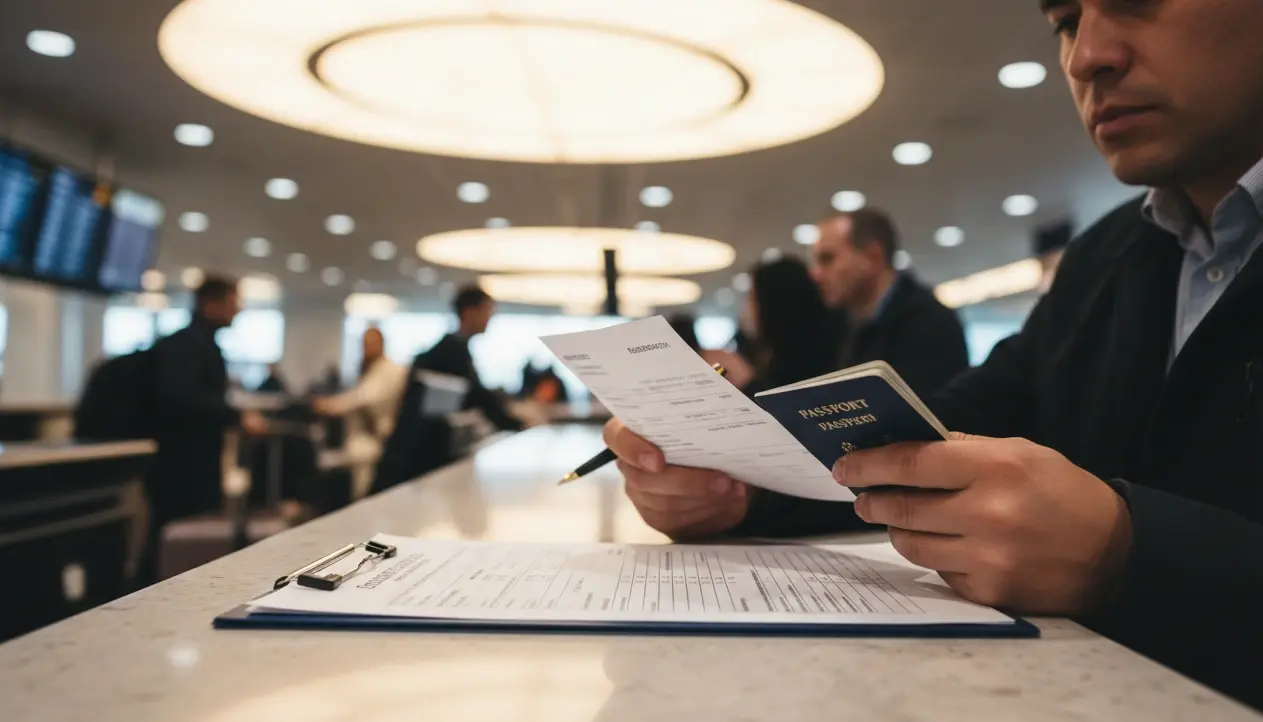
You pull up fares for your visa appointment route, and the price makes you flinch. A last-minute embassy slot lands in a high-demand month, your corridor has few direct options, and suddenly the “correct” itinerary feels impossible to afford. That reaction pushes many applicants toward the wrong fix: swapping airports, layovers or dates just to bring the number down.
Route logic and reservation cost are two separate problems. When applicants try to solve both with one panicked fare search, mistakes creep in. A cheap-looking route can make the file look less believable if the airport is far from the stated destination, the connection makes no practical sense, the return date contradicts the leave letter, or the ticket story does not match the money shown in the bank statement.
This guide shows you how to keep your itinerary geographically sound, visa-category consistent and budget-aware even when real airfare looks painful. The aim is not to pretend an expensive trip is cheap. The aim is to present a believable flight reservation for visa that supports your travel story without forcing you to buy final airfare before the visa outcome is clear.
- Route logic matters more than the cheapest fare shown on a booking site.
- A low fare can weaken the file if the airport, layover or return point does not match the trip story.
- Embassies usually care about believable travel intention, date consistency, accommodation alignment and financial capacity.
- A reservation should match your visa form, cover letter, invitation, hotel proof, leave letter and insurance dates.
- If real airfare looks too expensive, fix the presentation problem without breaking the itinerary logic.
Need a route that looks logical without buying final airfare? Create a clean flight reservation for visa with BookForVisa before price pressure pushes you into a weaker route.
Create Your Visa Reservation- Official-source check
- Why your correct route suddenly looks expensive
- How visa officers judge whether your route makes sense
- How to keep route logic intact without buying full airfare
- Budget shortcuts that quietly break route logic
- How budget proof and route cost should support each other
- Practical route plan before creating the reservation
- Why route logic beats route price
- FAQ
Why Your Correct Flight Route Suddenly Looks Expensive

You open a fare search for your visa appointment dates and the number staring back does not match what you budgeted. That gap between expectation and reality is where most routing mistakes begin, so it helps to understand why the price looks the way it does before you change the route.
A route can be correct for the visa file and still look expensive in a commercial fare search. Visa timing, airline inventory, seasonal demand, airport availability and connection rules all affect price. None of those automatically mean your route is wrong. They simply mean the real-world fare market is not always friendly to the travel proof your file needs.
Long-haul corridors with few direct options push prices up
Some corridors are expensive because the route itself has limited supply. If you are applying from a city with fewer international departures, or your destination is served mainly through one or two hubs, prices can jump quickly. A traveler going from a secondary city to Europe, the UK, North America, Australia or a smaller Schengen destination may see higher fares than expected because there are fewer practical combinations.
That does not mean the applicant should invent a cheaper-looking airport that does not match the actual trip. If your visa form says you will attend meetings in Paris, visit family in Rome, study in London or join a conference in Amsterdam, the airport path should still feel connected to that declared purpose. A cheaper routing through a distant city can look clever to a fare engine and careless to a visa reviewer.
Long-haul travel also brings return-ticket pressure. A return date that sits inside the requested stay window, matches your hotel or host plan and fits your leave approval is more useful than a randomly cheap return that forces the file to explain contradictions. Your flight itinerary for visa should make the trip easy to understand, not merely cheap to price.
Peak travel windows around your visa appointment inflate the route you need
Visa applicants often search fares only after an appointment becomes available. That timing can be brutal. School holidays, public holidays, festival seasons, summer travel, winter travel, religious travel windows and last-minute embassy slots can push fares higher than the original budget.
When the correct dates are expensive, many applicants panic and select a route with lower pricing but weaker logic. They may choose a departure date before their leave starts, a return date after their insurance ends, a cheap layover that creates an overnight transit problem, or a different entry city that conflicts with their main destination. The fare looks better, but the visa file becomes harder to defend.
Embassy and consulate teams do not usually need you to prove that you found the cheapest possible fare. They need your documents to support one coherent trip. If the travel plan is expensive because the appointment is close or the season is busy, your job is to show that the route still makes sense and that your financial evidence can support the declared trip.
The mistake of assuming a logical route must match the priciest option
Another common mistake is the opposite: applicants see a high fare and assume the only “serious” route must be the most expensive one. That is not true. Route logic does not require luxury timing, premium airlines or the shortest possible connection. A believable route can be economical, indirect and practical at the same time.
The key is whether the route answers basic questions cleanly:
- Does the departure city match where the applicant is actually starting?
- Does the arrival city match the declared destination or a sensible entry point?
- Does the return or onward movement fit the visa duration?
- Does the route avoid unrealistic layovers or impossible airport changes?
- Does the trip length match accommodation, insurance, leave approval and funds?
If those answers are strong, the reservation does not need to copy the highest fare you found online. It needs to represent a route a real traveler could actually use for the declared purpose.
How Visa Officers Judge Whether Your Route Makes Sense
A visa officer is not shopping for your ticket. They are reading your route as part of a larger story. The flight reservation is checked beside your form, cover letter, accommodation proof, invitation, financial documents, travel insurance, employment evidence and stated purpose. If the route supports those documents, it helps the file feel organized. If it contradicts them, it creates doubt.
This is why route logic matters even when the actual airline fare is high. The officer is unlikely to reward a strange itinerary just because it was cheaper. A cheap but confusing route can look like a weak travel plan. A logical route with a clean reservation usually communicates more confidence.
Geography checks come first
The first test is simple geography. If your destination is Barcelona, does the arrival airport make sense? If you are applying for a Schengen trip with France as the main stay, does the first entry and city order look reasonable? If your conference is in Dubai, does your arrival plan support that purpose? If your route enters a faraway city with no clear transfer plan, the document starts raising questions.
Geography does not have to be perfect or luxurious. Travelers often use nearby airports, regional hubs and multi-city routing. But the reason should be obvious enough that the officer does not need to guess. If the airport is cheaper but creates a long domestic transfer, your cover letter and hotel plan should explain the movement. If the route enters one country before the main destination, the itinerary should show how that entry fits the trip.
Airport pairing should match visa category and purpose
Different visa purposes create different route expectations. A tourist route should match the cities being visited. A business route should connect to the meeting city. A student route should fit the school start date. A family-visit route should make sense beside the host address. A medical route should support the appointment date and treatment location.
If the flight reservation shows one airport, the hotel shows another city, the invitation letter names a third city and the cover letter describes a fourth plan, the file becomes difficult to read. Budget pressure often causes this problem because applicants start changing only the flight route without updating the surrounding documents.
The safest approach is to plan the route from the visa story outward. Start with the destination, purpose, stay length, accommodation and exit plan. Then create the reservation around those facts. Do not start with the cheapest fare and force the visa story to follow it.
Connection times should look possible, not heroic
A cheap fare can hide a risky connection. Some routes have short layovers that may be impossible for immigration, terminal changes, baggage recheck or airport transfer. Others require overnight stops that may trigger transit visa questions. Some airport changes look possible on a map but unrealistic for a first-time traveler with luggage.
Visa reviewers and airline staff may not inspect every connection in detail, but impossible routing weakens trust. A clean reservation should avoid the kind of itinerary that makes a person pause and ask, “Could this traveler really make that connection?”
For visa use, believable timing beats bargain-hunting. A route with a slightly longer layover, clearer airport sequence and stronger date alignment is usually easier to present than a cheaper route that needs a long explanation.
Budget documents should support the trip, not contradict it
The cost of a real ticket is not the only budget question. Officers may look at whether the entire trip is financially believable. If your bank statement is thin but the route looks like a long, multi-country itinerary during peak season, the file may invite more scrutiny. If your route, hotel plan, trip length and available funds support each other, the file feels more coherent.
This does not mean you must buy expensive airfare before the visa decision. It means your travel proof should not create a financial story your documents cannot support. A reservation can protect cash flow, but the trip itself still needs to look affordable for the applicant.
How to Keep Route Logic Intact Without Buying Full Airfare

The strongest move is to separate two questions that applicants often mix together:
- What route makes sense for the visa file?
- How much should I risk before the visa is approved?
Those are not the same question. A route can be logical while the real airfare is too expensive to purchase early. A reservation can show the logical route without locking you into a non-refundable ticket before the decision. This is where a properly prepared reservation becomes useful.
Separate the cost of travel proof from the cost of final travel
Buying final airfare too early can be risky when the visa outcome, appointment timing, processing speed or final travel date is still uncertain. Many applicants search for a cheaper workaround because they do not want to risk the full fare. That fear is understandable, but the workaround should not damage the file.
A clean flight reservation strategy lets you present planned travel details while keeping final purchase decisions open. The reservation should show enough information for the visa file: traveler name, route, dates, booking reference or PNR, and a format that looks readable and consistent.
The reservation is not a magic approval tool. It is a supporting document. Its job is to help the officer understand the travel plan, not to replace financial proof, accommodation proof, purpose evidence or truthful application details.
What the reservation must preserve
When real airfare looks too expensive, preserve the parts that matter most for the visa story:
- Passenger name exactly as it appears on the passport or application.
- Departure city that matches the applicant’s real starting point.
- Arrival city that supports the declared destination or sensible entry point.
- Travel dates that fit the appointment, leave approval, invitation and insurance.
- Return or onward plan that sits inside the intended stay period.
- Booking reference or PNR that is readable and not hidden inside a messy screenshot.
- Document format that can be uploaded, printed or reviewed without confusion.
If those details remain aligned, the file stays strong even when you have not purchased final airfare. If those details drift, the reservation can become a liability because it makes the wider application harder to trust.
What can flex without weakening the file
Not every detail has to be treated as sacred. Some flexibility is normal before visa approval. Airline choice, exact flight time, fare class and final payment decision can change later if the trip is approved and the traveler books the real ticket. The important part is that the reservation reflects a realistic travel plan at the time of submission.
For example, a traveler may later choose a different airline after visa approval because prices change. That is normal. But if the visa reservation says the traveler will arrive in Rome on 10 September and the hotel starts in Madrid on 8 September, that is not a normal fare adjustment. That is a document mismatch.
Keep the reservation flexible where real travel naturally changes, but strict where the visa file depends on consistency.
Where a fixed-fee reservation removes the wrong kind of pressure
Price pressure makes applicants behave strangely. They choose inconvenient airports, overnight layovers, remote entry cities or return dates that do not match the stay because the fare engine shows a lower number. A low-cost reservation service removes that pressure by letting you focus on document logic first.
That does not mean you should create an unrealistic reservation. It means you can stop allowing fare volatility to dictate your visa story. The route should be chosen because it supports the application, not because a fare calendar forced the cheapest visible option.
Budget-Driven Shortcuts That Quietly Break Route Logic
Budget pressure usually creates subtle mistakes. The applicant does not intend to mislead anyone. They simply try to make the route look affordable. But each small shortcut can create a contradiction the visa officer has to process.
Here are the most common shortcuts that weaken an otherwise reasonable file.
Swapping to a cheaper airport that does not match the trip
A cheaper airport can be fine when the transfer is obvious and realistic. It becomes a problem when the airport is chosen only because it is cheaper and the rest of the application still points somewhere else.
For example, if the application says the traveler will attend a conference in Munich but the flight reservation lands in a distant city with no hotel, train, domestic flight or explanation, the route feels incomplete. If the arrival airport is not the destination, the itinerary should show how the traveler gets from arrival to purpose.
A nearby hub may be practical. A random cheap airport may not be. The difference is whether the route can be explained in one calm sentence.
Choosing a layover city because the fare engine likes it
Fare engines optimize for price, not visa clarity. A layover city can look harmless until it creates a transit-visa issue, overnight stay, airport change or route pattern that does not match the traveler’s experience. A low fare can also route through a country that creates extra entry questions.
Before using a cheap layover, ask whether the route still feels like a normal trip for your destination, budget and travel purpose. If the layover needs too much explanation, it may not be worth the saving. The flight proof should simplify the file, not create a side investigation.
Forgetting to update return route logic after changing dates
Many applicants adjust only the outbound flight because that is the expensive part they notice first. Then the return route, hotel dates, travel insurance and leave approval remain unchanged. The file ends up with one updated detail and several old details.
This is a classic visa-file weakness. If you move the departure date, check everything around it:
- Return date
- Hotel check-in and check-out
- Host invitation dates
- Travel insurance start and end dates
- Employer leave dates
- School, conference, medical or business appointment dates
- Cover letter timeline
The route does not live alone. Every date touches another document.
Using a dummy-style document when the article intent belongs elsewhere
Applicants sometimes use the words “reservation,” “booking,” “ticket” and “dummy ticket” as if they all mean the same thing. They are related in everyday search behavior, but the intent matters. For BookForVisa, the focus is visa reservation and flight-reservation presentation. If a traveler specifically needs to understand a dummy ticket, that topic belongs more naturally to DummyFlights.
For this article, the main question is not which label sounds best. The main question is whether the travel proof supports the budget and route story without creating contradictions.
How Budget Proof and Route Cost Should Support Each Other
When a route looks expensive, the visa officer may not compare every fare in the market. But they may notice whether your trip appears financially believable. This is especially true when the route involves long-haul travel, multiple countries, peak-season dates, luxury destinations, a long stay, family travel or a sponsor-funded visit.
Your reservation should not make the financial side of the file look impossible. A traveler with modest funds can still have a real reason to travel, but the documents need to explain the trip responsibly. If a sponsor is paying, the sponsor letter and proof of funds should support the route. If the applicant is self-funded, the bank statement and employment evidence should make the trip feel affordable.
Budget alignment does not require you to show a paid ticket. It requires the trip to feel realistic beside the money, employment, accommodation and purpose evidence. A reservation that shows a sensible route, reasonable stay length and clear return plan helps the budget story because it limits uncertainty.
When an expensive route is still believable
An expensive route can still make sense when the reason is clear. Peak dates, limited flights, last-minute appointments, family events, conferences, school starts, medical appointments and business meetings can all create higher travel costs. The file becomes stronger when the reason for the timing is visible in the supporting documents.
For example, a conference invitation explains why a traveler cannot simply move the dates to a cheaper week. A school start date explains why arrival timing matters. A medical appointment explains why the route must match a particular city. A family event explains why the travel window is fixed. In these cases, route logic can outweigh price discomfort.
When price and budget create a warning sign
The warning sign appears when the trip looks expensive, the funds look weak and the documents do not explain why the travel is necessary or supported. That does not automatically mean refusal, but it makes the file less persuasive. The reservation cannot fix that alone.
If the route cost looks high, strengthen the surrounding proof:
- Show a realistic stay length instead of an inflated itinerary.
- Align hotel or host details with the arrival and return dates.
- Use a cover letter that explains the purpose without overclaiming.
- Make sponsor support visible if someone else funds the trip.
- Avoid adding extra countries or cities only because they look attractive.
- Keep the route practical enough that the trip feels planned, not improvised.
This is where a clean reservation supports the whole file. It gives structure to the route while the other documents support the applicant’s ability and reason to travel.
Practical Route Plan Before Creating the Reservation
Before you create the reservation, slow down and map the trip from the visa officer’s point of view. The best route is not always the cheapest or shortest. The best route is the one that makes the file easiest to believe.
Use this sequence before submitting travel proof:
- Confirm the visa purpose: tourism, business, study, family visit, medical, conference or transit.
- Confirm the first real destination and the main stay location.
- Choose an arrival airport that naturally supports that destination.
- Choose a return or onward route that fits the requested stay period.
- Check whether the route creates transit or overnight stop questions.
- Match flight dates with hotel, host, insurance, leave approval and cover letter dates.
- Check whether the route looks financially believable beside the budget proof.
- Create the reservation only after the route story is stable.
This order prevents the common mistake of starting with a fare calendar and then forcing every other document to obey it. Visa files work better when the story leads and the reservation supports it.
What to write in the cover letter if fares look high
You usually do not need to discuss airfare prices in the cover letter unless the cost directly affects the travel plan. The cover letter should focus on purpose, dates, route, accommodation, funding and return intention. If the route is expensive because the dates are fixed by an event, appointment or invitation, explain the fixed timing calmly.
A strong explanation is simple:
- “I plan to arrive in Milan on 12 September for a conference beginning on 14 September.”
- “My return is planned for 20 September, after the conference and two days of tourism.”
- “My accommodation and insurance cover the same travel window.”
You do not need to say, “I chose this because cheaper routes looked strange.” Let the documents do the work.
How to avoid looking underprepared
A route can look expensive and still professional if the file is complete. What looks weak is inconsistency: missing return proof, unclear accommodation, vague sponsor support, dates that drift, or a PDF that looks edited. If every document answers the same timeline, the reviewer has less reason to question why the route is not the cheapest option.
Your reservation should make the trip feel organized. The route should not require the officer to solve puzzles about where you are going, why you are entering there, how long you will stay, where you will sleep, or how you will leave.
Route Logic Beats Route Price Every Time
When fares look too expensive, do not let the fare engine rewrite your visa story. Price matters for your wallet, but route logic matters for the application. A believable reservation is built around the trip you are actually presenting: where you start, where you enter, why you are going, how long you stay, where you sleep, how you fund it, and when you leave.
The best reservation is not the fanciest route or the cheapest route. It is the cleanest route for the file. It should sit naturally beside the application form, cover letter, accommodation, travel insurance, invitation, employment proof and bank statement. If those pieces agree, the reservation does its job.
If real airfare is high, solve that problem after the visa decision. For the application stage, focus on a route that looks real, readable and consistent. That is the safer path than chasing a cheap fare that quietly breaks the logic of the whole file.
Submitting a visa file with an expensive-looking route? Create a BookForVisa reservation that keeps your dates, airports, route and budget story aligned before you upload or print your documents.
Create Your Visa ReservationFAQ
Should I change my visa reservation route if the real fare looks too expensive?
Not automatically. Change the route only if the new route still matches your destination, dates, accommodation, purpose and exit plan. A cheaper route that creates contradictions can weaken the file.
Does an embassy care how expensive my flight route is?
Embassies usually care more about whether the trip is believable and financially supported. If the route looks expensive beside weak funds, the wider file may invite more questions. The reservation should support a realistic budget story.
Can I use a flight reservation for visa instead of buying a full ticket?
Many applicants use a flight reservation to show planned travel before buying final airfare, especially when the visa outcome is still pending. Always follow the checklist wording for the specific embassy or consulate.
What makes route logic believable for a visa reservation?
The route should match the applicant’s real starting city, destination, travel purpose, stay length, accommodation, insurance dates, return plan and financial evidence. The officer should not need a long explanation to understand the trip.
Is the cheapest flight route always risky for visa use?
No. A cheap route can be fine if it is geographically practical and consistent with the rest of the file. It becomes risky when the lower price depends on strange airports, unrealistic layovers or dates that contradict other documents.
Should my cover letter mention that flights are expensive?
Usually no. The cover letter should explain the travel purpose, dates, accommodation, funding and return intention. Mention fixed timing only when it helps explain why the route or dates cannot easily move.
What should I check before creating a visa reservation?
Check passport name, travel dates, entry airport, return or onward plan, accommodation, insurance, leave approval, invitation dates and budget proof. Create the reservation after the timeline is stable.
Can I update the real ticket after visa approval?
Yes, real travel plans can change after approval if the final booking still follows visa conditions and entry rules. The reservation submitted with the application should still be truthful and consistent at the time you submit it.
Visa rules, embassy checklist wording and airline practices can change. Always confirm the latest requirements with the official embassy, consulate, visa center or airline before submitting documents or traveling.