How Do You Plan a 15-Day Schengen Visa Itinerary?

A 15-day itinerary is long enough to show a meaningful multi-country trip but short enough that excessive city changes quickly consume the available time. The route should work as an actual journey before it is treated as supporting evidence.
This guide preserves a complete France–Belgium–Netherlands example, day ranges, optional variations, booking and transfer checks, first-time and family pacing, self-employed applicant considerations, and a final audit. Adapt the structure to the real trip rather than copying its facts.
Why a 15-Day Schengen Itinerary Becomes Coherent—or Contradictory
The main destination is not chosen for appearance. The European Commission’s Schengen application guidance states that a multi-country applicant should apply at the consulate of the country where the longest time will be spent. Official FAQs further clarify that the main purpose can determine the primary destination and that first entry resolves equal-length stays when no other main destination can be identified.
This page owns the route-design problem for one specific trip length: distributing 15 days across a small number of Schengen bases while keeping the main destination, entry, exit, transfers, and overnight records coherent. The complete flight-reservation planning framework owns the broader choice of booking method, timing, verification, and document control. Use that pillar for the reservation process; use this itinerary for day allocation and city sequencing.
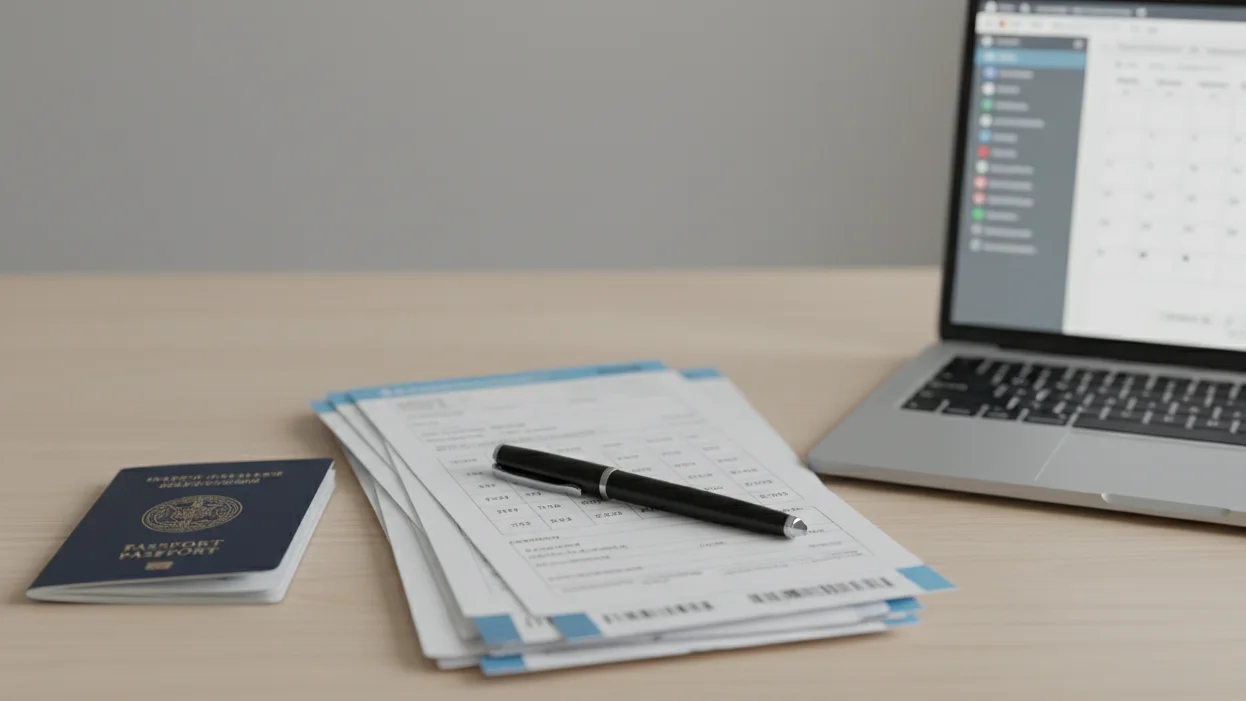
A 15-day Schengen plan is judged for logic before it is judged for ambition. If your route looks scattered, overpacked, or oddly constructed, the rest of the file has to work harder to make the trip feel genuine.
Pick One Main Country First, Then Build Your Europe Trip Around It
A strong 15-day itinerary usually starts with one clear anchor country. That is the country where your trip makes the most sense on paper and where you spend the largest portion of your stay.
This matters because your route needs a center of gravity. If you land in France, stay longest in the Netherlands, add a quick stop in Belgium, and then struggle to explain why France was the application point, the itinerary starts to feel assembled rather than planned.
A cleaner approach is to decide your main country first, then build the rest around it. Ask:
- Where will you spend the most nights?
- Which stop feels like the core purpose of the trip?
- Which country makes the entry and onward route look most natural?
Once that decision is clear, every other stop should support it, not compete with it.
Why Two to Four Bases Are Usually Easier to Explain Than Six to Eight Cities
Fifteen days sounds long enough to do a lot. On a Schengen application, it is usually long enough to do enough, not everything.
The mistake we often see is confusing destinations with hotel bases. You can visit more than one place without changing accommodation every night. That distinction makes a big difference. A plan with three stable bases looks calmer and more believable than a route with seven city names squeezed into the same two weeks.
For most applicants, the strongest rhythm is:
- 2 bases if you want a slower trip with day trips
- 3 bases if you want variety without strain
- 4 bases only if the countries are close and transfers are simple
Once you move beyond that, the file starts to look restless. Each extra base creates more hotel dates, more transfer points, and more chances for the route to feel forced.
A visa-friendly itinerary should look like something you would actually enjoy, not something designed to impress by volume.
Entry City, Longest Stay, And Exit City Must Tell The Same Story For Your Trip to Europe
These three points are where the route either clicks or falls apart.
Your entry city should connect logically to your main destination. Your longest stay should support the country you are applying to. Your exit city should feel like the natural end of the route, not a random add-on because cheap transport existed on that date.
A simple sequence is usually easiest to defend. For example, Paris to Brussels to Amsterdam reads as one continuous journey. Paris to Prague to Barcelona to Amsterdam in 15 days reads like four separate ideas.
Open-jaw travel can work well, but only when the geography is clean. Landing in one city and departing from another is not a problem by itself. It becomes a problem when the route zigzags across Europe without a clear reason.
Before you finalize the plan, look at the map and test one question: Does the trip move forward in a way that feels ordinary?
Why Weekend Splits, Overnight Transfers, And Same-Day City Hops Often Hurt The File
A route can be technically possible and still look weak.
That usually happens when applicants compress too much movement into too few days. One-night stops are a common example. They save space on paper, but they often damage credibility. If you arrive late, sleep, check out the next morning, and move again, that stop starts looking decorative rather than meaningful.
The same issue appears with overnight transfers and same-day switches between countries. They may seem efficient, but they can make the trip feel like a scheduling exercise instead of a real visit.
Be careful with patterns like these:
- Late-night arrival followed by sightseeing the next morning
- One-night stays in expensive or major cities
- Back-to-back transfer days over a weekend
- Crossing borders just to add another country stamp to the plan
A better itinerary leaves room for arrival fatigue, train delays, normal check-in times, and the simple reality that travel days do not function like full sightseeing days.
The Plain-Language Test: Can You Explain the Route Without Repairing It?
This is one of the best tests for a 15-day Schengen plan.
Try explaining your route in one breath to someone else. If it sounds smooth, the file usually reads well. If you hear yourself adding too many justifications, the structure probably needs work.
A natural explanation sounds like this: you arrive in your main country, spend the first stretch there, continue to one nearby stop, then finish in a final city with an easy departure. That is easy to follow because it mirrors how real travelers usually move.
An unnatural explanation sounds defensive. It depends on cheap fares, odd timing, or quick stops that only make sense if someone studies the route for several minutes.
A 15-Day France, Belgium, and Netherlands Itinerary Example
The example below assumes the reader already understands what a flight reservation contains. If passenger, route, date, PNR, or ticketing terminology is unclear, use the foundational flight reservation for visa guide. It owns the document definition; this page owns how arrival and departure flights connect to a 15-day France–Belgium–Netherlands plan.

A sample route only helps if it looks like something you would actually take, not something built to impress on a map. For a 15-day Schengen application, the best example is one that balances tourism, movement, and common-sense pacing.
Sample Route: France, Belgium, And The Netherlands Without Overstuffing The Trip
A strong 15-day example is France, Belgium, and the Netherlands. This route works because the geography is simple, the transport links are easy to understand, and the trip can show one clear main destination without making the rest feel artificial.
A clean structure looks like this:
- Day 1: Arrive in Paris
- Days 2 to 6: Stay in Paris
- Day 7: Travel to Belgium
- Days 8 to 9: Stay in Brussels or Bruges
- Day 10: Travel to Amsterdam
- Days 11 to 14: Stay in Amsterdam
- Day 15: Depart from Amsterdam
This route does not try to “collect” Schengen countries. It stays focused on a compact Western Europe circuit that many applicants can explain easily if asked. France remains the main destination because it holds the longest stay, and Belgium fits naturally as a middle stop rather than a separate trip.
It also avoids a common weakness in sample itineraries: pretending every city needs equal weight. In a visa file, equal distribution often looks less believable than a route with one clear anchor and two shorter extensions.
Days 1 To 6: Use The First Leg To Establish Stability, Not Speed
The opening stretch should feel settled. Paris works well here because it gives you enough substance for several days without needing constant movement.
A realistic first leg often includes:
- Day 1: Arrival, hotel check-in, light local activity only
- Day 2: Central sightseeing
- Day 3: Museum or neighborhood-focused day
- Day 4: Another Paris day at a normal pace
- Day 5: Optional day trip or second full city day
- Day 6: Final Paris day before onward travel
This part of the route matters because it shapes the tone of the whole application. If the first city already looks rushed, the rest of the trip starts to feel fragile. A six-night stay in Paris, on the other hand, makes the plan feel grounded. It gives the file a proper starting point.
It also creates room for ordinary travel behavior. People do not usually land from an intercontinental flight and immediately jump into another city the next morning. A strong itinerary respects that.
Days 7 To 9: The Middle Of The Trip Should Show Continuity, Not A New Vacation
Belgium works best here as a short but meaningful extension. It keeps the route moving without breaking the rhythm established in France.
This middle stretch is strongest when it stays simple. You leave Paris, take a direct train, and continue the trip in a neighboring country that fits the route naturally. That reads far better than inserting a distant city just because it is famous.
For most applicants, Brussels is the easier middle stop because it supports a straightforward file. Bruges can also work if the rest of the plan still looks balanced and the onward movement remains clean.
A practical pattern could be:
- Day 7: Paris to Brussels, check in, relaxed evening
- Day 8: Full day in Brussels
- Day 9: Brussels day or short excursion before next transfer
Those two or three nights matter more than they look. They show that Belgium is part of the route, not just a border crossing added for variety. That distinction is important on paper. A short middle country can still look genuine if it has enough time attached to it.
Days 10 To 15: End With A Strong Final Base And A Clean Exit Plan
Amsterdam works well as the final base because it gives the trip a clear closing stretch. The city is easy to justify, and it supports a smooth international departure.
The final segment can look like this:
- Day 10: Brussels to Amsterdam
- Days 11 to 14: Full stay in Amsterdam
- Day 15: Departure
This arrangement does two useful things. First, it avoids ending the trip with a rushed one-night stop. Second, it keeps the final days stable, which helps the itinerary feel finished rather than stretched.
A clean last leg is especially useful in a visa file because the departure point should not look improvised. If you arrive in Paris, move through Belgium, and leave from Amsterdam, the route has a natural direction. Nothing about it feels circular or confusing.
Two Optional Variations That Still Keep The 15-Day Structure Credible
Not every applicant wants France, Belgium, and the Netherlands. That is fine. What matters is preserving the same structural logic.
One variation is Italy and Switzerland. You could spend the first and longest stretch in Italy, add a short Swiss segment, and depart from a final city that sits naturally on the route. This works best when the transfer pattern stays limited, and the Swiss stop does not become a scenic detour with too many hotel changes.
Another option is Spain and Portugal. That route can suit applicants who want a Western Europe plan with fewer border crossings and a warm-weather travel story. It still works best when one country clearly carries the mainstay, and the secondary stop feels like a continuation, not a restart.
In both cases, the route succeeds for the same reason as the France-Belgium-Netherlands example. It does not overload the trip with extra names just because 15 days seems generous.
Once the route itself looks believable, the next question is whether the dates, travel sequence, and supporting documents all line up without small inconsistencies weakening the file.
Match the Itinerary With the Rest of the Application File
Supporting-document scope depends on the application channel. For example, the Spanish Embassy in New Delhi’s Schengen guidance asks for round-trip flight bookings and hotel accommodation for the duration of the stay, and advises applicants not to buy the air ticket until the visa is granted. This is precise evidence for that channel, not a universal promise that every consulate requests an identical packet.
Because this is a Schengen-specific itinerary, the route must be checked against the competent-consulate and supporting-document rules rather than treated as a generic Europe plan. The Schengen flight-reservation requirements guide owns main-destination interpretation, round-trip evidence, entry/exit alignment, and checklist differences. Use it to validate the final itinerary before adapting this example.
A strong route can still lose credibility when the paperwork tells a slightly different story. In a Schengen visa application, small mismatches often do more damage than big mistakes because they make the file feel assembled instead of planned.
Dates, Bookings, And Internal Transfers Must Line Up Down To The Day
Your dates should match across the whole visa application, not just inside the main itinerary. That means your flight reservation, hotel reservations, travel insurance, and departure date should all reflect the same 15-day window.
The same rule applies to supporting paperwork. If your cover letter says your Europe trip runs from 4 June to 18 June, your leave sanction letter, employment proof, pay slips, bank statements, and any sanction letter or objection certificate should not point to a different travel period. If you show financial means through tax papers, even recent assessment years should support the same timeline rather than create confusion around when you can actually travel.
For family members, details should also stay consistent across civil status records. If a spouse is included in the file, a marriage certificate should not conflict with names or trip dates. If you apply from a country where you are not a citizen, your legal residence status and local id card details should fit the same travel window. A valid passport, required documents, and medical insurance dates should all support one clean trip to Europe.
Your Transport Logic Should Be Boring In The Best Possible Way
You do not need a clever transport chain. You need one that reads clearly.
For this Paris, Belgium, and Amsterdam example, high-speed trains usually make more sense on paper than overnight buses, scattered budget airline bookings, or a loose Eurail pass idea without fixed dates. Even though the Schengen area allows free movement across many European countries, your file still needs a route that is easy to follow from one stop to the next.
That matters even more for first-time applicants or anyone with limited travel history. A short-stay visa looks stronger when the internal movement feels ordinary. Paris to Brussels by train, then Brussels to Amsterdam by train, is easier to trust than a flight itinerary patched together with odd timings and airport changes.
If your route really uses refundable tickets or a round-trip structure, keep the logic simple. The point is not to show every possible option for your European trip itinerary. The point is to show the route you are actually presenting in the visa process.
Hotel Distribution Should Match The Rhythm Of The Trip
Your overnight pattern should support the story of the route. If you spend six nights in Paris, three in Belgium, and five in Amsterdam, the hotel reservations should reflect that exact rhythm without any stray one-night gaps.
Problems start when the file shows a calm main itinerary, but the stay pattern says something else. For example, if your cover letter frames the trip around Paris and Amsterdam, but your bookings suddenly insert one night in central Europe, the trip starts to look copied from a generic visit Europe checklist rather than built for this application.
The same issue appears when applicants add famous places that do not belong to the route they are submitting. A Paris, Brussels, and Amsterdam plan does not need random references to Vatican City, the Brandenburg Gate, or the Gothic Quarter just because they appeared in another European trip online. Those details weaken coherence.
The Best Itinerary Usually Leaves Some Things Unbooked In Narrative Terms, Even If The File Is Fully Organized
A credible file does not read like an hour-by-hour production schedule. Your itinerary should show where you are staying, how you move, and what the travel purpose looks like at a practical level. It does not need to micro-plan every museum and afternoon.
You do not need to assign a specific time for the Eiffel Tower, Arc de Triomphe, Louvre Museum, Anne Frank House, Van Gogh Museum, or a canal tour. You also do not need to list a guided tour, Walt Disney Day, or every sightseeing stop across the entire trip.
That level of detail often backfires. It makes the file feel over-scripted, especially when the dates are already supported by hotel reservations, internal transfers, sufficient funds, and a policy with medical expenses coverage and an adequate sum insured. A cleaner narrative is often stronger than an overloaded one.
If Your Appointment File Uses A VFS Center In India, Keep City Sequencing Extra Clean
If your appointment file is being scanned through a VFS center in New Delhi, keep the route especially easy to read at a glance.
That means one clear entry point, one obvious longest stay, and one logical exit point. The easier the city sequence is to scan, the less likely your Schengen visa application feels cluttered by extra pages, separate visa questions, or route confusion linked to most European countries inside the broader European Union framework.
Once the file reads as one consistent plan, the next step is adjusting that same structure to your own profile without making the route harder to defend.
How To Adjust The Example For Your Profile Without Breaking The Logic Of The Trip
A good sample itinerary gives you a structure, not a script. The real task is adapting that 15-day route to your profile without turning a clean Schengen plan into something that starts to feel forced.
If This Is Your First Schengen Application, Reduce Ambition Before You Add More Countries
A first application should not try to prove too much. The fastest way to weaken a solid route is to keep adding countries because you think a bigger Europe trip looks more impressive.
It usually does the opposite. More borders, more bookings, and more transfer points create more room for mismatches and more chances for the plan to look inflated. If this is your first Schengen file, keep the route modest. One main country and one or two nearby extensions are often enough.
This is especially true if you are traveling in shoulder season. A quieter period can work well for a visa file because hotel availability, transport planning, and sightseeing flow often look more realistic than a peak-season route trying to squeeze everything in at once.
You also do not need to design the trip around the idea of multiple-entry visas unless your actual route requires leaving and re-entering the Schengen zone. For most first-time applicants, a straightforward single-trip structure is easier to defend and easier to document.
Solo Travelers, Couples, And Families Should Not Use Identical Itinerary Pacing
The same country sequence can look credible for one traveler and too aggressive for another. That is why pacing should match who is taking the trip.
A solo traveler can often handle a slightly faster route. That does not mean chaotic movement. It means you may be able to justify three bases in 15 days without the itinerary looking strained.
Couples usually benefit from a steadier pattern. A route with longer stays in two or three cities often looks more natural than constant relocation. It also gives the file a calmer tone, especially when the trip is framed around sightseeing, local neighborhoods, and a normal travel pace rather than maximum coverage.
Families need even more restraint. If children or older family members are part of the plan, the itinerary should reflect that. Fewer transfers and longer stays make sense. A family route through Paris, Belgium, and Amsterdam can still include major attractions, but the pacing should leave room for real travel days, not idealized ones.
That matters even when the destinations are tempting. Great weather in summer does not automatically make a fast route believable. A family plan that jumps too often can look less genuine than one built around a stable base, a museum day, a lighter day, and a walk through an old town rather than nonstop intercity movement.
Self-Employed, Remote, Or Flexible-Schedule Applicants Need An Even Cleaner Travel Story
Applicants with fixed office calendars often have a built-in explanation for their trip dates. If you are self-employed, remote, freelance, or otherwise flexible, your itinerary needs to carry more of that narrative on its own.
That means the 15-day structure should answer simple questions without making the officer work for the answer. Why these dates? Why these countries? Why this order? Why 15 days instead of 9 or 22?
A clean answer is better than a creative one. If your work situation already looks flexible, your travel plan should look firm. Fixed hotel dates, clear rail connections, and a route that moves in one direction all help.
The same principle applies if you are applying for an indian passport while living or working abroad. In that case, the file benefits from an especially tidy link between your residence status, departure point, and itinerary, so the route does not have to carry extra uncertainty that belongs elsewhere in the application.
When To Shorten The Route Instead Of Defending It
Sometimes the smartest fix is not better wording. It is a smaller plan.
If your itinerary starts to feel overwhelming even when you read it back to yourself, that is usually the signal. The route may still be technically possible, but a Schengen file works better when it feels ordinary and stable.
You should usually cut a stop if any of these problems appear:
- One city has only one night with no clear purpose
- The main country is no longer the obvious center of the trip
- Transfers are eating too much of the 15-day window
- The arrival and departure pattern looks awkward on a map
- You need long explanations to justify why a place is included
This is where many applicants go wrong. They defend the extra stop because the visa fee is the same whether they visit two countries or five. But a stronger file is not built by maximizing value from the application. It is built by showing a route that looks believable from start to finish.
How To Personalize The Example Without Destroying The Core Structure
You can change a lot without harming the logic of the trip. You can swap Paris for Rome, Belgium for Austria, or Amsterdam for Barcelona if the geography and pacing still work.
You can also tailor the tone of the route to your travel style. Some people want art museums and historic centers. Others want a lighter trip with parks, food, neighborhoods, and one or two landmark visits. Both can work if the structure stays disciplined.
What should remain stable is the framework:
- One clear main destination
- Limited hotel changes
- Simple internal movement
- A final city that makes sense for departure
That is the part you protect. Once that structure is in place, the itinerary becomes easier to adapt to your profile, season, and purpose without losing credibility.
Complete the 15-Day Schengen Route and Document Audit
A strong 15-day Schengen itinerary does not need to look ambitious. It needs to look coherent. If your main country is clear, your city order makes sense, and your dates stay consistent across the file, your trip reads like real travel rather than a visa exercise.
That is the standard you want. Use the sample route as a structure, then adapt it carefully to your own pace, profile, and departure plan. If you are finalizing your file now, review your itinerary one more time and make sure every booking, transfer, and stay supports the same travel story.
15-Day Schengen Itinerary FAQ
How should I divide a 15-day Schengen itinerary?
Use a small number of logical bases and count every overnight. A three-country route can work when the transfers are realistic and one country remains the main destination by purpose or length of stay.
Which country should be the main destination?
Apply the official rule: the main purpose can determine the destination; otherwise it is generally the country of the longest stay. If stays are equal and no main destination is identifiable, first entry becomes relevant.
Is France, Belgium, and the Netherlands realistic in 15 days?
Yes. The neighboring-country sequence allows rail travel and limited transfer time, provided the overnight distribution, arrival, and departure points match the submitted plan.
How many cities should I include in 15 days?
There is no official city limit, but two to four bases are usually easier to execute and document than constant one-night moves. Add cities only when transport and overnight coverage remain clear.
Do hotel bookings need to cover every night?
Follow the responsible consulate’s checklist. When full accommodation coverage is requested, each night should map to a city and property without overlaps or unexplained gaps.
Can I enter through one country and apply through another?
Yes, first entry and main destination can differ. The application must still be lodged with the competent country under the main-purpose, longest-stay, and equal-stay rules.
Should internal train tickets be included?
Include or retain internal transport evidence when the checklist requests it or when it explains a material city transition. Do not overload the application with optional sightseeing detail.
Can I copy the sample itinerary exactly?
Use it only as a structural example. Replace every date, city, overnight, transfer, and activity with the genuine plan and ensure all supporting documents reflect those facts.
Disclaimer: This itinerary is an editorial example, not an official visa form or guaranteed route. Schengen requirements vary by competent consulate and application channel. Confirm the current checklist and use only genuine dates, bookings, transfers, and travel plans.
Related posts

Visa Reservation With a Land-Border Exit
11 Oct, 26
Flight Itinerary for Visa With Cross-Border Car Travel
11 Oct, 26
Booking for Visa With an Overnight Train
11 Oct, 26
Flight Itinerary for Visa With a Ferry Departure
11 Oct, 26
Flight Reservation for Visa Before a Cruise
11 Oct, 26
Booking for Visa With a Domestic Positioning Flight
11 Oct, 26
Flight Itinerary for Visa With an Airport Transit Visa
11 Oct, 26
Booking for Visa When an Airside Transit Hotel Is Used
11 Oct, 26
Flight Booking for Visa With a Protected Connection
11 Oct, 26