
A flight itinerary for visa for artists, musicians and performers should match the first required event duty, venue city, rehearsal or soundcheck schedule, group role and final contracted obligation. The strongest itinerary looks like a real performance trip: it arrives early enough for preparation, routes through believable airports, covers late-night timing correctly and leaves after the artistic work is complete.
An artist visa file can look strong until the flight itinerary tells a different story. If the contract says rehearsal starts Friday but the reservation lands Saturday morning, the officer now has a reason to question the trip. The same problem appears with late-night sets, festival lineups, multi-city tours, and crews arriving before performers.
The flight reservation must support the performance schedule, not simply show an entry and exit date. The route should match the venue city, the arrival buffer should fit rehearsal and soundcheck, and the departure date should respect the final contracted obligation. This guide helps artists, musicians, DJs, performers, theatre groups, dancers, production staff and touring managers decide which dates, airports, routing patterns and PNR details make the visa file easier to trust during document review.
Key facts before creating a performer flight itinerary:
- Use the first required in-person duty, not only the public performance date, to choose arrival timing.
- Match the venue city to a believable arrival airport and allow realistic ground transfer time.
- Separate solo artist, group performer, manager and crew routing when their roles require different timing.
- Handle late-night sets by checking the actual end time, not only the poster date.
- Update the flight itinerary if contracts, venue dates, rehearsal calls or group travel plans change.
Need a performer travel plan before buying final airfare? Create a flight itinerary for visa with route, date and passenger details aligned to your contract, venue schedule and final performance obligation.
Create Your Flight Itinerary for VisaIn This Guide
- Official-source check
- Start with the event file
- Choose realistic arrival and departure dates
- Design believable performance routing
- Align contracts, invitations and performer proof
- Solve performer-specific itinerary problems
- Use verifiable reservations carefully
- Run the final itinerary stress test
- FAQ
Official-source check: UK visitor rules specifically discuss permitted activities for artists, entertainers, musicians, support staff and production teams, including performances and certain permitted paid engagements when the rule conditions are met. GOV.UK also warns that visitors cannot work in the UK except where a permitted activity applies. For U.S. travel, State Department business-visitor guidance is narrower and does not replace dedicated work or performer visa categories. The EU Visa Code requires purpose-of-journey evidence, accommodation, return or transit means and information showing intention to leave before visa expiry. Sources: UK Appendix Visitor: Permitted Activities, GOV.UK business visitor guidance, U.S. B-1 fact sheet, and EU Visa Code.
Start With The Event File Before Choosing Any Flight Route
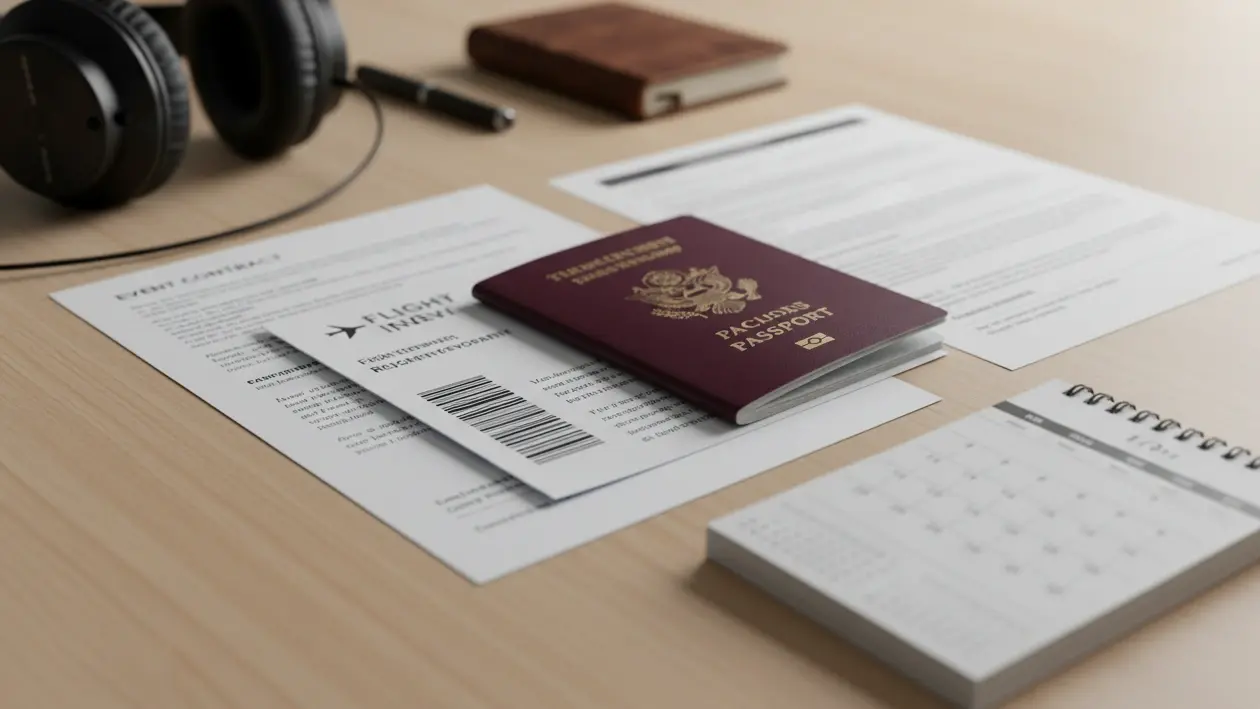
A performer’s flight itinerary should never be built in isolation. For artist, musician, DJ, theatre, dance, festival, cultural-event and crew visa files, the route must grow out of the event evidence first. Before airports or dates are chosen, the file needs to show what the documents already prove.
Identify the contract dates first
A contract may show several dates, but not all of them control the flight reservation. A singer may sign a contract in March for a concert in July. A dancer may have a performance date on the poster, while the contract requires arrival two days earlier for stage blocking. A band may be listed for one festival night, while the production schedule includes soundcheck, media calls and an artist briefing before the public show.
The flight itinerary should follow the first date the applicant is expected to be physically present. For a performer visa file, check these dates first:
- Contract start date
- Rehearsal date
- Soundcheck time
- Technical setup date
- Performance date
- Workshop or masterclass date
- Final contracted appearance
- Departure expectation, if the organizer mentions one
The public performance date is important, but it may not be enough. If the event is on Saturday and the contract says Friday soundcheck is mandatory, a Saturday arrival can make the file look careless. The same issue appears with theatre and stage productions: a play may open on June 20, but the cast may need technical rehearsal on June 17. A flight arriving on June 19 may still look late because the artistic obligation started earlier.
Separate public show dates from rehearsal and call times
Event posters are designed for audiences, not visa officers. A poster usually shows the show date, venue, artist name and ticket details. It rarely shows the full movement of the performer. The visa file needs more than the public-facing version of the event.
For musicians, the real timeline may include instrument check, acoustic testing, setlist confirmation and full-stage rehearsal. For DJs, it may include equipment setup, controller checks, lighting sync and a late-night call time. For dancers, it may include floor inspection, costume fitting, spacing rehearsal and safety checks.
If the organizer has sent a call sheet, rehearsal email, artist schedule or production note, use that as the timing anchor. A violinist performing in Vienna should not arrive after the scheduled orchestra rehearsal. A DJ booked for a 1:00 a.m. festival set should not use a departure flight that leaves before the set ends. A dance group performing in Paris should allow time for stage spacing, costume checks and final rehearsal.
Match the venue city to the arrival airport
A cheap-looking flight is not always the strongest flight for a performer visa file. The arrival airport should make sense for the venue city. If the contract says the event is in Berlin, a flight to Berlin is easy to understand. If the contract says the event is in a smaller German city, arriving in Frankfurt or Munich may still make sense when that is the practical international entry point.
The problem begins when the route looks disconnected from the event. If a festival invitation says Barcelona, but the flight lands in Madrid with no onward plan, the reservation raises questions. If the performance is in Manchester, but the itinerary lands in London the morning of the show, the officer may wonder how the traveler reaches the venue on time.
For performer travel, the airport choice should answer three questions:
- Is this a logical airport for the event city?
- Does the arrival time allow realistic movement to the venue or rehearsal location?
- If the airport is far away, is the onward movement easy to understand?
Not every performer needs to arrive directly in the performance city. A classical musician may land in Zurich for a performance in Lucerne. A folk group may land in Rome before traveling to a regional cultural festival. A crew member may land in Doha because it is the main international gateway. Those choices can work when the route looks practical.
Check whether the applicant is solo, group, or crew
A solo artist’s itinerary is usually straightforward. A group file needs more care. For a singer, dancer, actor, speaker, magician, DJ or solo instrumentalist, the flight route should reflect that person’s contract and performance schedule. They arrive before the required appearance and leave after the final obligation.
For bands, orchestras, theatre casts, dance troupes and touring teams, timing may not be identical for everyone. The lead performer may arrive early for press. The production manager may arrive before the artists. The sound engineer may travel with equipment. A choreographer may stay later for a workshop. One musician may join from another country because they are already on tour.
The key is not to force every traveler into the same route. The key is to make every route explainable:
- Performers should arrive before rehearsals, soundchecks or performance obligations.
- Technical staff may need earlier arrival for setup and venue checks.
- Managers may arrive early for organizer coordination.
- Supporting artists may travel only for assigned performance dates.
- A member joining from another country should have documents that support that starting point.
Build a mini event-file snapshot before reserving the flight
Before creating the flight reservation, prepare a simple event snapshot from the contract, invitation letter, performance schedule and organizer emails. This keeps the itinerary tied to documents instead of guesswork.
| Event-file item | Why it affects the flight itinerary |
|---|---|
| Passport name and stage name | The flight reservation must use legal passport identity, while event proof may show the stage name. |
| Event title, organiser and venue city | The route should clearly connect to the performance location. |
| First required in-person date | This controls the earliest sensible arrival, not only the public show date. |
| Final artistic or production obligation | This controls the earliest sensible departure. |
| Next performance destination | This can justify onward or multi-city routing when supported. |
If the contract says “technical rehearsal on 14 September,” the flight should not arrive on 15 September. If the invitation lists Milan but the route enters through Rome, decide whether that entry point makes practical sense. If a group has five performers and two crew members, the snapshot helps separate who needs to arrive early and who can arrive closer to show day.
Citation-ready baseline: a performer flight itinerary for visa should not be built from the poster date alone. It should be built from the first required artistic duty, venue geography, role-specific timing and final contracted obligation.
Choose Arrival And Departure Dates That Fit The Performer’s Reality
For artist, musician, DJ, theatre, dance and crew visa files, travel dates must feel operationally possible. A flight itinerary that looks technically valid can still weaken the file if it ignores how performances actually work.
Avoid the “arrive hours before the show” mistake
A same-day arrival may look efficient on paper, but it often looks risky in a performer visa file. A performance trip is not a casual weekend visit. The traveler is entering to fulfill a scheduled artistic obligation.
If a concert starts at 7:00 p.m. and the flight lands at 2:00 p.m. the same day, the timeline feels tight. The performer still needs immigration clearance, baggage collection, airport transfer, venue access, preparation and possible rehearsal. If instruments, costumes, stage props or technical gear are involved, the risk becomes clearer.
The right buffer depends on the performance type:
- Solo singer: vocal rest, rehearsal and soundcheck
- Band member: coordination with other musicians, instruments and stage setup
- DJ: controller testing, booth setup and venue access timing
- Dancer: spacing rehearsal, costume checks and physical recovery after travel
- Theatre actor: technical rehearsal, blocking, makeup and costume preparation
- Crew member: setup and production checks before performers arrive
The goal is not a longer stay. The goal is a travel window that supports the actual performance schedule.
Use rehearsal and soundcheck dates to justify earlier arrival
An earlier arrival becomes easier to understand when it connects to a documented rehearsal or soundcheck. If an invitation says “performance on 18 August,” but the flight lands on 14 August, the gap may need context. If the artist schedule shows rehearsal on 15 August, technical setup on 16 August and soundcheck on 17 August, the same arrival looks practical.
Ask the organizer for written timing details when arrival depends on pre-event duties. Useful details include rehearsal time, soundcheck access, technical walkthrough, production meeting, costume fitting, stage blocking, media appearance, artist briefing, festival registration and equipment handover.
A guitarist performing in Madrid on 10 October may need to arrive on 8 October because the band rehearsal is scheduled for 9 October. A dance troupe performing in Seoul may need three days to adjust to the stage, rehearse formations and inspect the floor. A DJ booked for Lisbon may need to arrive the day before for technical coordination. Earlier arrival works best when the reason appears in the documents.
Keep departure close to the final artistic obligation
The departure date matters as much as the arrival date. A performer visa file can look weaker when the applicant stays long after the event without a clear artistic, contractual or logistical reason.
A short post-event stay can make sense for final payment, post-show media, meet-and-greet, workshop, masterclass, closing ceremony, equipment packing, costume return, production debrief, travel recovery after a late-night performance or limited flight availability. The key is that the departure date should not feel detached from the event.
If the final contracted obligation is a Sunday night performance, a Monday or Tuesday departure often looks easy to understand. If there is a Monday workshop in the invitation, a Tuesday departure becomes even clearer. If equipment handover is confirmed on Tuesday, leaving on Wednesday may be reasonable.
Problems appear when the return flight suggests a stay that the event file does not support. For a performer entering the UK for one contracted show, a long unexplained gap after the event can invite questions. For a cultural performer traveling to Canada or the Schengen area, the itinerary should still show a return plan that matches the invitation and purpose of travel.
Handle late-night performances without date confusion
Late-night performances create a common itinerary problem. A DJ set may be advertised for Friday night but scheduled from 1:00 a.m. to 3:00 a.m. on Saturday. A club performance may appear on a poster as 12 July while the contract lists the technical performance time as early 13 July. A festival may place the set after midnight on the second event day.
If the departure flight leaves too early, the itinerary can accidentally show that the traveler is leaving before the obligation ends. This is especially important for DJs, nightclub performers, festival artists, comedians with late sets, theatre performers in evening shows, musicians booked for afterparties and cultural performers at closing-night events.
Align four details:
- Advertised event date
- Contracted performance time
- End time or final obligation
- Flight departure time
If a set starts at 12:30 a.m. on 22 September, a flight departing at 6:00 a.m. the same morning may look unrealistic. A later departure often looks more practical. A simple organizer note can help when the date crosses midnight.
Adjust flight dates when the organizer changes the schedule
Artist travel changes often. A festival can move the set from Friday to Sunday. A venue can shift rehearsal from morning to evening. A promoter can add a workshop. A production team can require earlier arrival for technical setup. A visa appointment can also move, affecting reservation timing.
Update the flight reservation when the performance date changes, rehearsal is added, the venue city changes, the contract period is extended, a workshop or media appearance is added, the final event moves later, the visa appointment is rescheduled, or the group travel plan changes.
A verifiable PNR with outdated dates can still create a visible conflict. The reservation may be readable, but the officer can still question why it no longer matches the latest event documents.
Design Routing That Looks Like A Real Performance Trip

A performer’s route should look like it was chosen for the event, not pulled from the cheapest airport pair available. For artist visa files, consulates often read the route as part of the travel story.
Start from the artist’s actual travel point
The flight itinerary should begin where the travel story actually begins. For many applicants, that is the country of residence. Nairobi to Paris for a Schengen concert, Delhi to Dubai for an event, or Manila to Singapore for a performance can be easy to understand.
Performers, however, often travel differently from regular visitors. A Brazilian musician living in Portugal may fly from Lisbon to Berlin. A Turkish DJ already performing in Amsterdam may fly from Amsterdam to Ibiza. A South African dancer studying in London may fly from London to Milan. These routes are not a problem when the wider file explains them.
Problems begin when the departure airport has no connection to the documents. If the application says the traveler lives in Manila but the reservation starts from Bangkok, the file needs an explanation. If a band contract says the group is traveling from Cairo but one member starts from Istanbul, that member may need residence proof, current visa proof or tour evidence.
Use open-jaw or multi-city routing when the schedule requires it
A round-trip itinerary is not always the best fit for performer travel. A simple return route works for one event in one country. But artist files often involve more movement: entering through one city, performing in another, and leaving from a third; traveling between Schengen countries for a second event; or finishing the tour in a different city from where it started.
Open-jaw or multi-city routing can look more realistic when the performance schedule supports it:
- Milan arrival for rehearsal and Rome departure after the final show
- Barcelona entry, Valencia performance and Madrid departure
- Mumbai to Paris, then Amsterdam back to Mumbai after a second event
- New York arrival and Los Angeles departure after a final performance
- Toronto entry and Montreal departure after a workshop
The route must follow the contracts in order. If the itinerary shows the traveler leaving one country before a scheduled appearance there, the route conflicts with the event file.
Make transit believable for instruments, costumes and equipment
Artists and crew do not always travel light. Instruments, costumes, DJ controllers, camera gear, makeup kits, props, lighting accessories and touring equipment can change what looks like a believable route. Multiple tight connections may be physically possible, but they may look impractical for a performer carrying sensitive gear.
A violinist traveling with an instrument, a theatre group with costumes, or a DJ with equipment may benefit from a cleaner route even when it is not the cheapest. The flight itinerary for visa should not create a movement pattern that makes the event harder to believe.
Add a short route explanation when the path is not obvious
Some performance routes are legitimate but not self-explanatory. A performer may fly into a neighboring country because it is the nearest international gateway. A group may start from different cities because members are already on tour. A manager may arrive before the artists. A crew member may leave later because of equipment return.
When the path is not obvious, a short explanation in the cover letter or event schedule can prevent confusion. The flight itinerary itself should remain clean; the explanation should connect the route to the performance logic.
Align Contracts, Invitations And Performer Proof
Once the route looks believable, the next test is document alignment. The flight reservation should sit neatly beside the contract, invitation letter, artist schedule and performance proof without forcing the officer to guess which document is correct.
Echo the invitation without copying it blindly
The invitation letter gives the official reason for travel, but it may not show the full working schedule behind the performance. A cultural organizer may write that the artist is invited to a concert on 12 September. The contract may show rehearsal on 10 September. The production email may request arrival on 9 September for soundcheck and venue briefing.
In that case, a 9 September arrival can make sense even if the invitation highlights only the concert date. The strongest alignment is not identical copying. It is practical agreement between the reservation and the documents.
Use this logic:
- If the invitation says concert on 20 May and rehearsal on 19 May, an 18 or 19 May arrival may look practical.
- If the festival runs from 4 to 7 August, a 3 August arrival and 8 August departure may feel clear.
- If one performance is on 15 November but the flight shows a three-week stay, the extra days need support.
- If the contract says two shows on 10 and 12 June, the flight should not depart on 11 June.
Match the performer’s legal name across every document
Performer files often contain more name variations than ordinary visa files. There may be a passport name, stage name, band name, production company name and promoter-facing artist profile. These can all be valid, but the flight reservation must use the passport name.
If the passport says “Muhammad Adeel Khan,” the reservation should not use only “DJ Adeel.” If the passport says “Maria Fernanda Costa,” the reservation should not use “M.F. Costa Live” because that is the performance brand.
| Document | Preferred identity format |
|---|---|
| Passport | Legal name |
| Flight reservation | Same legal name as passport |
| Contract | Legal name, with stage name if useful |
| Poster or portfolio | Stage name or group name may appear |
| Invitation letter | Legal name plus role or performance name |
Stage names should support the file, not replace legal identity on the flight reservation.
Coordinate group applications without artificial sameness
A band, dance troupe or theatre production does not need identical itineraries for every member. What matters is whether each route fits the traveler’s role. A lighting technician invited for setup should not arrive after technical rehearsal. A costume handler should not leave before costume return. A tour manager may enter early to meet the promoter.
Realistic differences are fine. Random differences are not. If group members travel at different times, the contract, role list, crew letter or schedule should explain why.
Solve Performer-Specific Itinerary Problems Before Review
Performer visa files often look simple until the event schedule gets messy. Multiple promoters, midnight showtimes, crew roles and last-minute confirmations can all create flight itinerary conflicts if they are not caught early.
Freelance artists with multiple promoters need one clean timeline
Freelance performers often receive invitations from more than one organizer. That can be a strong file when dates are clean. It can create confusion when the reservation does not match the order of events.
A singer may have one contract for a private concert in Dubai and another for a cultural festival in Abu Dhabi. A dancer may perform in Berlin, then lead a workshop in Hamburg. A DJ may play Lisbon and Porto two days apart. The flight itinerary needs to show these events can happen in sequence.
Place every obligation on one timeline: arrival airport, first rehearsal, first performance, transfer city, second rehearsal, second performance, final workshop, press event or settlement meeting, and departure airport. If two promoters are involved, remember that each invitation may describe only its own event. The visa file still needs one coherent travel sequence.
Bands and ensembles need role-based date logic
A group application should not treat every traveler as if they have the same job. A band file may include vocalists, instrumentalists, tour manager, sound engineer and photographer. A dance troupe may include principal dancers, understudies, choreographer, costume support and production coordinator.
Each person’s flight reservation should fit their role. A lead vocalist may arrive early for a press call. A sound engineer may need to reach the venue before anyone else. A choreographer may stay after the main performance for a masterclass. These differences are practical, not problematic, when the documents support them.
DJs, night performers and festival artists need midnight logic
Late-night performance timing is one of the easiest places to create an accidental contradiction. A Friday-night poster may hide a Saturday-morning end time. A festival date may not show the true call time or closing obligation.
For night performers, compare the advertised date, actual set time, end time, departure flight and hotel night. A performer who finishes at 3:00 a.m. should not appear to be leaving before the work is complete. If the date crosses midnight, ask the organizer to clarify it in writing.
Touring crew should not use performer-only routing logic
Technical staff, production assistants, managers, camera operators, makeup artists, stylists and stage crew often travel for a different operational reason than performers. Their itinerary may need earlier arrival for setup or later departure for packing and handover. A crew route should match the crew role, not only the headline performance date.
Last-minute confirmations need cleaner choices, not riskier ones
Artist invitations sometimes arrive late. That does not mean the flight itinerary should become rushed or random. A last-minute file needs cleaner alignment because there is less room for confusion. If the event confirmation is late, make sure the reservation, hotel dates, invitation, contract and cover letter all point to the same final version of the trip.
Use Verifiable Flight Reservations Without Creating Credibility Problems
A performer’s flight reservation should be flexible enough for visa uncertainty, but solid enough for document review. The goal is to show a believable travel plan without locking into expensive tickets before the visa decision is clear.
Reserve around the visa file instead of buying too early
Artist travel often changes faster than ordinary travel. A concert date can move. A festival lineup can shift. A rehearsal can be added. A venue can change. A group member’s appointment may be delayed. The promoter may revise the contract after the first invitation is issued.
For visa purposes, the flight reservation should be built around the document file first. It should match the event schedule, support the invitation letter and show a return or onward plan. It should not force the traveler to pay for a fixed ticket before the application has been reviewed.
The reservation should still look like a real travel plan. It should not use random dates just to satisfy a checklist. It should not ignore the artist’s schedule. It should not show a route that makes the performance impossible.
Check the PNR, PDF and passenger details line by line
The file should not make the officer work hard to read flight details. Before submission, check the passenger name, route, arrival airport, transit points, return segment, flight dates, and any PNR or booking reference shown on the PDF.
Compare the reservation against:
- Rehearsal date
- Soundcheck date
- Main performance date
- Workshop or masterclass date
- Final contract obligation
- Hotel check-in and check-out
- Visa form intended travel dates
- Travel insurance dates, if required
If the performance date moves, update the itinerary before submission. If the route changes, update the hotel and cover-letter logic too. Do not submit one old version and one new version of the same trip.
Avoid itinerary details that invite unnecessary questions
Some details make a performer file harder to read than it needs to be. Avoid airport choices that do not match the venue city, departure dates before final obligations, names that do not match the passport, multi-country routes that do not follow contracts, and wide gaps after the final show with no role-based reason.
The flight itinerary for visa should make the performance trip easier to understand, not create a second puzzle beside the event documents.
Run A Final Artist Itinerary Stress Test Before Submission
Before submitting the visa file, read the flight reservation like an officer who has only a few minutes to understand the performance trip. Good itinerary planning catches artist-specific conflicts before they become questions during review.
Compare the itinerary against the event timeline line by line
Open the contract, invitation letter, rehearsal schedule, artist call sheet, hotel proof and reservation PDF together. Then check the dates in the order they happen. For performers, the real travel window often starts before the public show and may continue after the final performance because of equipment handover, workshop, media duties or settlement meetings.
| Check | Question to answer |
|---|---|
| First arrival date | Does it support the earliest rehearsal, call time or performance duty? |
| Venue city | Does the airport choice make sense for the venue location? |
| Group roles | Do performer, manager and crew routes match their responsibilities? |
| Late-night timing | Does the departure happen after the true end of the set or event? |
| Final obligation | Does the return date close the trip after the contracted work is complete? |
| PNR status | Is the reservation still valid close to the appointment or upload date? |
Can the trip be understood in under two minutes?
A strong travel itinerary should be quick to scan. The officer should not need to rebuild the tour from scattered emails, posters and contracts. The file should show who the traveler is, where they are performing, when they arrive, why those dates matter and when they leave.
This is especially important when the performance file crosses more than one city. A musician entering Germany for a Berlin concert and then moving to Amsterdam for a second show should have a route that follows that order. A dancer traveling to Canada for a Toronto festival and a Montreal workshop should show dates that support both obligations.
Prepare a short explanation for unusual routing
Not every legitimate performance route is obvious. If the traveler enters through a neighboring city, departs from a different airport, joins the tour from another country, or stays later because of crew duties, a short explanation can help. Keep it factual and tied to documents. Do not over-explain a route that can be made clearer by choosing a better airport or cleaner return segment.
Make Your Performance Itinerary Easy To Trust
The show may stay in memory forever, but the visa file needs a clear travel story. The flight itinerary should match the contract, rehearsal timing, venue city, route order, group role and final obligation without forcing the officer to guess.
When creative work becomes an international visa file, every bit of timing matters. Check the dates, confirm the PNR, and make sure the route shows the real way the artist, performer or crew member will travel. If you find a mismatch, fix it before submission so the file feels complete, practical and easy to trust.
Build the route around the performance, not the other way around. BookForVisa helps prepare a flight itinerary for visa that aligns with contracts, rehearsals, venue cities, group roles and return timing.
Create Your Flight Itinerary for VisaFrequently Asked Questions
What is a flight itinerary for visa for artists and performers?
It is a travel-plan document showing proposed flight route, dates, passenger details and return timing for an artist, musician, performer or crew visa file. It should match the contract, invitation, event schedule, venue city and final obligation.
Should an artist arrive on the same day as the performance?
Same-day arrival is often weak for performers because it leaves little room for immigration, venue transfer, rehearsal, soundcheck, costume checks or equipment setup. The itinerary should allow a realistic preparation window.
Can crew members arrive earlier than performers?
Yes, when their role requires setup, venue checks, production meetings, equipment handling or technical preparation. The crew itinerary should match the crew role and supporting documents.
How should late-night DJ or festival sets be handled?
Check the actual set time and end time, not only the poster date. If the performance crosses midnight, the departure flight should not make it look like the artist leaves before the obligation ends.
Can a performer use a multi-city flight itinerary?
Yes, when the route follows the contracts, venue cities and tour order. Multi-city routing can be stronger than a forced round trip when the performer enters one city, performs in another and departs after a final event elsewhere.
Should the flight reservation use the stage name?
No. The flight reservation should use the legal passport name. Stage names can appear in contracts, posters, invitations or portfolios, but they should not replace passport identity on the flight itinerary.
What if the organizer changes the performance schedule?
Review the flight itinerary again. If the performance date, rehearsal, venue city, contract period or final obligation changes, update the reservation and supporting documents so the file does not show conflicting versions.
Does a flight itinerary guarantee visa approval?
No. A flight itinerary can support the travel-plan part of a visa file, but it does not promise approval, boarding or entry. The full application must satisfy the relevant visa rules and evidence requirements.
Friendly reminder: BookForVisa provides travel-proof documents for planning and visa application support. Requirements vary by country, consulate, visa type, route and applicant situation. A flight reservation can support a file, but it does not promise approval, boarding or entry.