At the airport, a booking QR code can feel like the moment of truth. You hand over your passport, the officer reviews your itinerary, and a silent scan or follow-up question suddenly feels bigger than the PDF itself. The real issue is not whether a code exists on your booking. It is whether the reservation still holds up when someone checks beyond the visual page.
Some officers scan. Some only read. Some ask airline staff to confirm what your document claims. Some check the passport and visa first, then ask for return or onward proof only when the route feels unclear. That is why the safest approach is not to obsess over the square code. It is to carry travel proof that survives ordinary questions: who is traveling, where are they going, when are they leaving, and does the story match the documents?
- A QR code is useful only if the reservation behind it is current and consistent.
- Airline check-in staff, transit desks and border officers may verify different things.
- Name, route, date, booking reference and entry conditions matter more than design.
- Weak screenshots and cropped PDFs can invite more manual questions.
- A booking that matches your visa file is stronger than a flashy document with mismatched details.
Create Your Visa Reservation
What Border Officers Usually Verify When a Booking QR Code Is in Front of Them
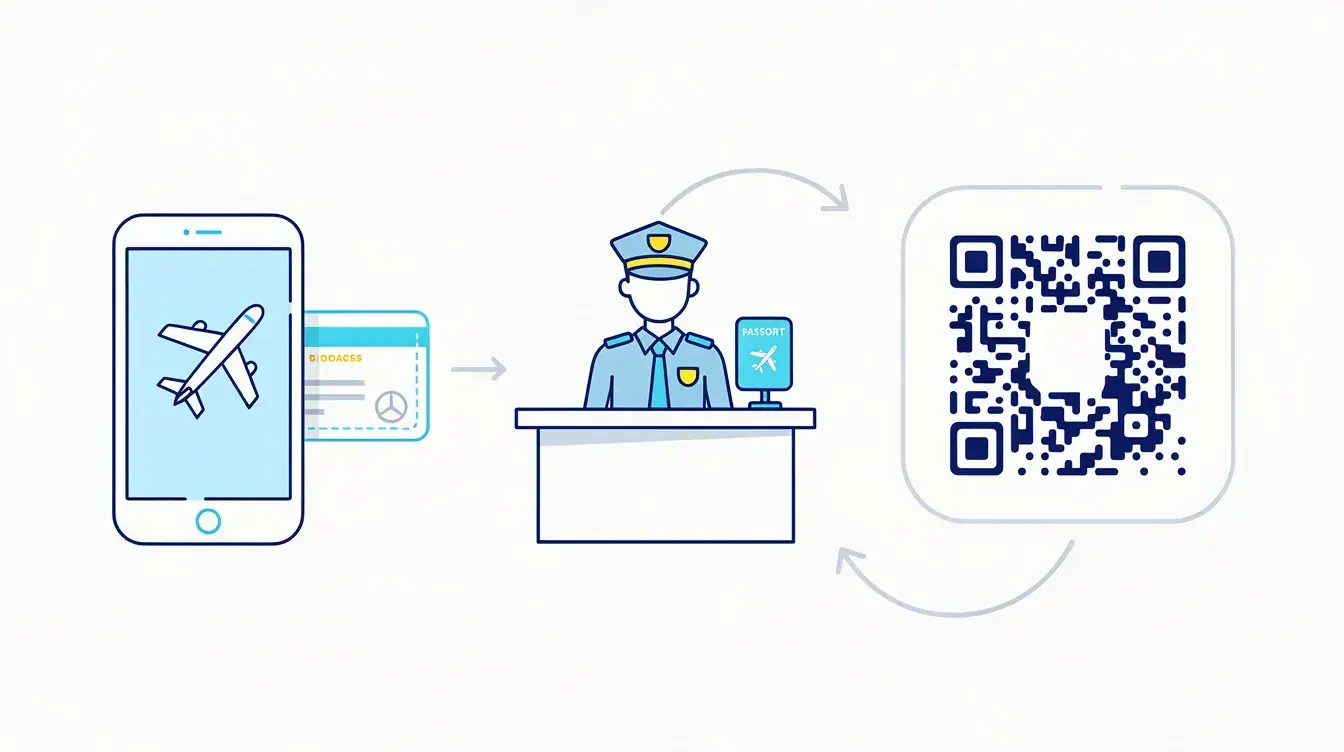
A booking QR code can look like the most important square on the page. In practice, it is usually one access point into the larger document. The person reviewing your trip may scan it, but they may also ignore it and read the fields around it. The important question is whether the booking data makes sense when compared against your passport, visa, arrival purpose and exit plan.
The QR code is not the main test
When someone looks at your reservation, they are not admiring the code. They are checking whether the trip details are believable. That usually starts with ordinary fields:
- Does the passenger name match the passport spelling?
- Do the travel dates fit the visa, stay period or entry rule?
- Does the route match what the traveler says at check-in or arrival?
- Is there a booking reference or PNR that is easy to find?
- Does the document look current rather than stale, edited or disconnected?
A sharp QR code means very little if the reservation behind it is inactive, expired, mismatched or unrelated to the trip. A plain-looking PDF can be stronger if it has clean passenger data, coherent routing and a reference that supports the same travel story.
Border control, airline staff and transit counters do not check the same way
Travelers often call every airport check “immigration,” but the roles are different. Airline staff usually think first about boarding risk. If they carry someone who does not meet destination or transit requirements, the airline may face penalties, disruption or return-transport responsibility. That is why airline counters often look closely at onward proof, visa validity, transit rules and route logic before boarding.
Transit staff care about whether you can continue the journey without getting stuck at the next point. If your trip uses separate tickets, a tight connection, a visa-sensitive transit country or a one-way route, they may inspect travel proof more aggressively than the arrival desk.
Border officers focus on admissibility, identity, purpose of travel and whether your documents support the entry you are requesting. They may not need to scan a booking QR code if your passport, visa, return proof, funds and accommodation already make sense. But if something feels unclear, the booking can become part of the conversation.
They are often looking for mismatches, not fancy technology
Most travel-proof problems are not high-tech QR problems. They are mismatch problems. The name is slightly different. The return date sits outside the allowed stay. The hotel dates end before the flight out. The booking status looks pending. The route suggests a country you did not mention in the form. The ticket number, PNR or reservation reference is missing or hidden.
That is why the safest flight reservation for visa is built around consistency first. The QR code can support the document, but it cannot rescue a route that contradicts the application.
What verification may look like in real life
Verification can be quiet. It may look like a staff member typing your booking reference into an airline system, asking where you are going after the first destination, checking your return date against your allowed stay, or comparing your accommodation proof with your arrival city. Sometimes nobody scans the code. Sometimes the code is scanned only because the PDF is hard to read. Sometimes the code opens a page that does not show enough useful information.
Your job is not to predict the exact tool. Your job is to make the reservation easy to read through any normal check. If the reviewer asks, “Where does this person go next?” the document should answer without a long explanation.
When Someone Is More Likely to Scan, Open or Double-Check Your Reservation
Not every traveler gets the same level of attention. A simple round trip with matching dates, clear accommodation and a valid visa may pass with little interest in the QR code. A flexible route, one-way ticket, unclear accommodation pattern or inconsistent answer can make the same document receive much closer review.

One-way tickets and flexible exit plans attract more questions
One-way travel is not automatically wrong. Students, workers, relocating families, long-stay visitors and digital nomads may have legitimate reasons for entering without a neat round-trip ticket. But one-way travel often raises the next question: what proves that the traveler is allowed to stay, continue onward or leave later?
In those cases, the booking proof needs to carry more weight. It should show a route that fits the visa or entry category, a believable exit or onward plan, and dates that do not look random. If the traveler says “I will decide later,” but the destination expects onward proof, the counter conversation can become harder.
A scan becomes more likely when your story and documents do not move together
Airport staff and border officers do not need a perfect story. They need a coherent one. If your cover letter says ten days in France, your hotel booking shows three nights in Paris, your return proof leaves from Rome, and your verbal answer says you might go to Germany, the file invites checking.
The same applies to visas and travel dates. If the visa starts after the flight date, the booking is instantly weak. If the flight reservation shows one passenger and the hotel booking shows another, the reviewer has to decide whether the documents belong to the same file. If the applicant name has a missing surname, reversed order or old-passport spelling, the reservation should be prepared with extra care.
Screenshots, cropped PDFs and low-information printouts invite manual scrutiny
A screenshot can be useful when it supports a complete document, but it becomes risky when it hides the reference, date, passenger name or booking status. Cropping may remove exactly the details a reviewer needs to trust the file. A low-information printout with only a logo, city and QR code can look less reliable than a simple PDF that shows all fields clearly.
If you use a travel-proof service, the output should be more than a pretty itinerary. A strong flight itinerary for visa should be readable, route-consistent and easy to compare with your form, accommodation and insurance documents.
Transit points and gate checks can be more aggressive than arrival desks
Some travelers assume the only serious check happens after landing. In reality, the airline counter or transit desk can be stricter because they are deciding whether to carry you. A destination border officer may have more context on arrival, but the airline needs to decide before the aircraft departs.
Separate tickets, overnight transit, mixed airlines and last-minute route changes can create extra questions. If the first airline cannot see the full journey, your printed reservation or PDF needs to show the onward or return logic clearly. A QR code that works only inside one app may not help if the staff member needs a readable document immediately.
- Your ticket is one-way and the exit plan is unclear.
- Your visa category does not obviously match the route.
- Your reservation dates conflict with hotel, insurance or form dates.
- Your document shows no booking reference or PNR.
- Your PDF is cropped, edited or missing passenger details.
- Your transit point has strict document requirements.
What Happens When the QR Code Fails or the Booking Looks Weak
A failed scan does not automatically mean refusal, denial of boarding or a cancelled trip. But it changes the conversation. The reviewer may move from “quick check” mode into “explain this” mode. That is where many weak reservations cause stress.

A failed scan is not the same as a failed document
QR codes fail for ordinary reasons. The printout is blurry. The phone screen is dim. The code opens a page that requires login. The airline system is slow. The booking platform has changed its display. The staff member may simply move to manual review.
If the surrounding document is strong, manual review is manageable. If the document already looks thin, the failed scan becomes one more reason to ask questions. This is why your PDF should never rely entirely on the QR code. It should show the essential booking data in visible text.
The common weak points are structural
Most problems come from the structure of the reservation, not the code itself. The document may show a booking but no payment status, a route but no passenger name, a reference but no airline details, or a flight date that does not match the visa timeline. The reviewer is not rejecting the QR code. They are reacting to the uncertainty around it.
A temporary reservation, fare hold, booking confirmation or visa reservation can be useful when it is presented honestly and consistently. It becomes weak when the traveler treats it like magic proof instead of part of a complete travel file.
How officers read behavior once the document stops doing the work
If the reservation is unclear, your answers matter more. A calm traveler who can explain the route, stay length and next step usually looks more prepared than someone who cannot explain why the ticket was created. The worst answer is usually vague: “It is just for formality,” “I will decide later,” or “The agent made it for me.”
Those phrases shift attention away from the document and toward intention. A better answer is simple and factual: “This reservation shows my planned arrival and return dates. The hotel and insurance match the same trip window.” If you need a separate dummy ticket for a visa-style use case, it should still match the real travel plan rather than look like a disposable PDF.
When a stronger reservation service becomes worth it
A stronger service becomes useful when the travel file has real complexity: multi-city route, uncertain visa timing, separate return proof, overnight transit, no-surname passport, old and new passport, business invitation, medical travel, family group travel or destination-specific entry rules. In those cases, you are not paying only for a document. You are paying for cleaner alignment.
For BookForVisa, the most valuable work is not placing a QR code on a page. It is making the route, dates, passenger identity and reservation format match the file the reviewer sees.
How to Prepare a Reservation That Still Holds Up If Someone Checks It
The best preparation starts before you create the reservation. Build the route logic first, then create the document around it. If the route is weak, a QR code cannot make it strong.
Build around the checkpoints most likely to matter
Think through the places where someone may ask for proof: airline check-in, transit desk, destination border, hotel desk, visa appointment, document-upload portal or return-ticket review. Each checkpoint may care about a slightly different thing.
- Airline check-in: destination eligibility, transit rules and onward or return proof.
- Transit desk: ability to continue to the next country or airline.
- Border officer: purpose, stay length, funds, accommodation and exit logic.
- Visa officer: consistency between form, cover letter, flight reservation and hotel proof.
- Upload portal: readable PDF, file size, document type and visible fields.
This is why a complete flight reservation for visa guide matters. The document is not isolated. It sits inside a larger travel-proof system.
Match the reservation to the rest of the travel story
Before you fly or submit the file, compare the reservation against every related document. Passport spelling should match. Visa dates should cover the travel dates. Hotel dates should cover the stay. Travel insurance should not start late or end early. A business letter should not mention dates that contradict the flight proof. A cover letter should not describe a route the booking does not show.
When all documents point in the same direction, the QR code becomes less dramatic. The reviewer can see the story without digging.
Carry the booking in more than one usable format
Do not depend on one phone screen. Carry a PDF on your phone, a printed copy if manual checks are likely, and a clean version that opens offline. If the QR code requires internet, the visible document should still contain enough information to be understood without scanning.
Make sure the file name is clear. A file called “reservation-final-v3-newnew.pdf” does not inspire confidence. A file name such as “Flight Reservation - Passenger Name - Travel Dates.pdf” is easier to identify when you are under pressure.
Know the difference between looking prepared and being prepared
Looking prepared means having a polished document. Being prepared means knowing what the document says and why it fits your trip. If asked, you should be able to explain the route, the exit date and the relationship between flight proof, accommodation and visa conditions.
You do not need to volunteer unnecessary details. You do need to avoid answers that make the booking sound fake, disposable or disconnected. Keep the explanation short, factual and aligned with the paperwork.
What Matters More Than QR Code Clearance
QR clearance is one signal. It is not the whole decision. A travel file is stronger when the human reading it can understand the trip without relying on the code. That is the difference between a booking that merely exists and a reservation that supports the traveler.
Clean route logic
The route should make sense for the traveler’s purpose. A tourist itinerary should not jump through countries for no reason. A business itinerary should fit meeting dates and locations. A student route should match program timing. A medical route should support appointment or treatment dates.
Readable booking details
The reservation should show the airline or route details, passenger name, travel dates, booking reference or PNR where available, and enough status information to understand what kind of proof it is. Do not hide the important fields behind screenshots or visual design.
Consistent supporting documents
Flight proof, hotel proof, insurance, cover letter and application form should all support the same timeline. If one document changes, the others may need to be checked again. This is especially important when an appointment moves, a passport is reissued, or the traveler changes airports.
Honest wording
A reservation should not pretend to be something it is not. If it is a temporary reservation, it should be used as travel proof, not misrepresented as a fully paid ticket. Honest wording protects the file because it keeps the document aligned with how it was created.
- Visible passenger name and passport-matching spelling.
- Travel dates inside the visa or entry window.
- Route that fits the purpose of travel.
- Readable booking reference or PNR where available.
- Accommodation and insurance dates that match the route.
- PDF that opens offline and prints clearly.
Final Pre-Airport Checklist
Before you leave for the airport, run one final check. This is faster than dealing with a confused counter conversation later.
- Your passport name matches the booking.
- Your visa or entry permission covers the travel dates.
- Your return or onward proof sits inside the allowed stay period.
- Your accommodation proof covers the intended stay.
- Your booking reference or PNR is visible.
- Your PDF opens offline and prints clearly.
- Your route matches your cover letter or travel explanation.
- You can explain the trip in one calm sentence.
If any item fails, fix the document before travel. A clean reservation should reduce conversation, not create it. When the booking, route, dates and explanation all line up, the QR code becomes a backup detail rather than the foundation of the file.
Prepare Your Flight Reservation
FAQ
Do border officers always scan booking QR codes?
No. Some may scan, some may read the document manually, and some may focus on passport, visa, return proof, funds or accommodation instead. The safer assumption is that any important detail on the booking may be checked.
Is a booking QR code enough to prove travel plans?
No. A QR code is only useful if the visible booking details are consistent. Passenger name, route, dates, reference number and travel purpose matter more than the code itself.
What happens if the QR code does not open?
A failed scan does not automatically mean refusal. The reviewer may switch to manual review. That is why the PDF should show the key information clearly even without scanning.
Do airlines check bookings differently from immigration?
Yes. Airlines usually focus on boarding risk and destination eligibility. Border officers focus on admissibility, identity, purpose and whether the traveler meets entry conditions.
Can a temporary flight reservation be used for visa proof?
Yes, when the destination or consulate allows reservation-style travel proof and the document is presented honestly. It should match the application form, hotel proof, insurance and cover letter.
What booking details matter most during checks?
The most important details are passenger name, travel dates, route, booking reference or PNR, reservation status and consistency with the rest of the travel file.
Should I carry a printed copy?
It is smart to carry a printed copy when manual checks are possible, especially for one-way travel, transit-heavy routes, visa-sensitive destinations or situations where your phone may not have internet.
What is the safest way to avoid QR-code problems?
Use a clean reservation that opens offline, shows all important fields visibly, matches your passport and travel dates, and supports the same route described in your visa or entry documents.
Friendly reminder: BookForVisa provides travel-proof support for planning and visa-document preparation. Requirements vary by destination, airline, route and applicant situation. A flight reservation can support a file, but it does not guarantee boarding, visa approval or entry.