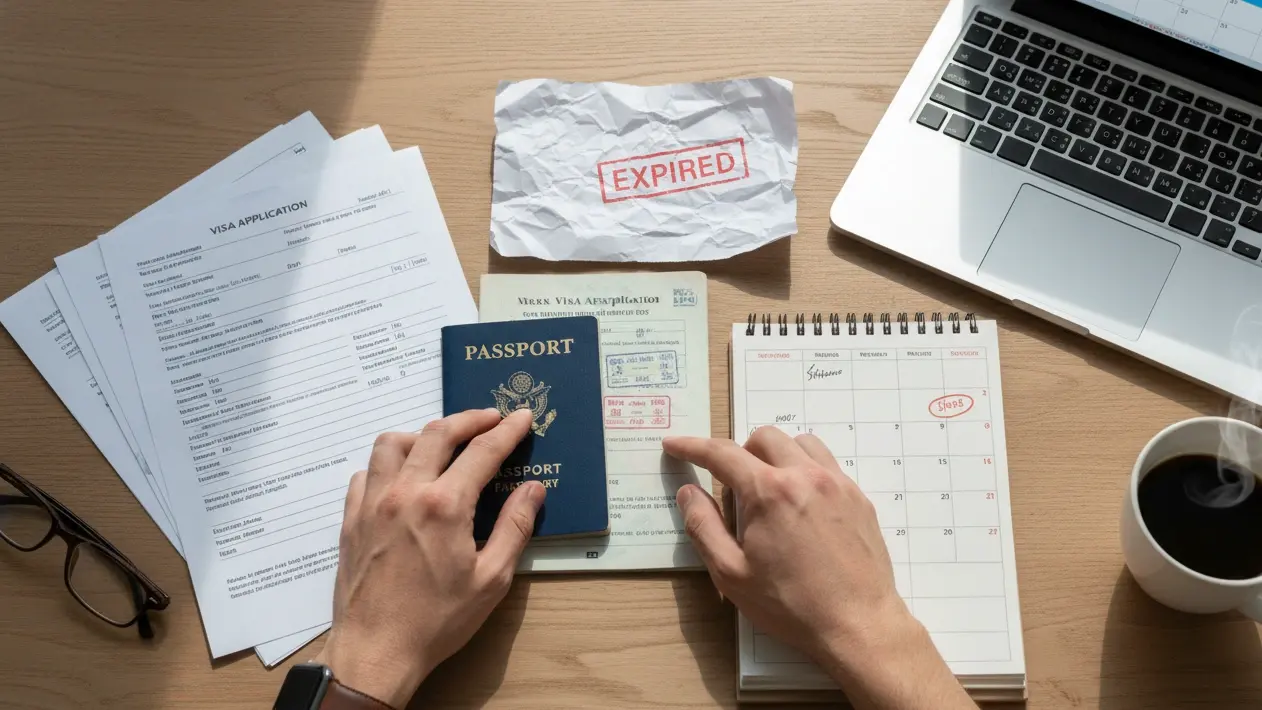
If an airline hold expires before your appointment, do not carry the expired record as your main flight reservation for visa. Recheck the PNR, compare the expiry date with your upload or interview deadline, then extend, rebook or replace the reservation before submission. A visa file is stronger when the route, dates, passenger name and booking reference are current enough to support the application on review day.
An airline hold is built for a short ticket-purchase decision. A visa appointment is built around embassy availability, document queues and possible rescheduling. Those two timelines rarely move together, so the real task is not only getting a reservation. It is keeping the reservation alive long enough to be useful.
This guide explains how to read the hold expiry, when an expired PNR becomes a problem, how to calculate the buffer before an appointment, and when a purpose-built BookForVisa reservation is cleaner than repeatedly extending a short airline hold.
Key facts before relying on an airline hold:
- A short airline hold may expire long before the visa appointment or upload deadline.
- An expired PNR may still appear briefly, but it should not be treated as an active reservation.
- The safest file uses travel proof that is current on the review date, not only on the booking date.
- Appointment reschedules should trigger an immediate reservation-status check.
- A paid ticket is not automatically the best answer if the visa outcome is still uncertain.
Airline hold expiring before your appointment? Create a BookForVisa flight reservation for visa with current dates, clean route logic and document-ready proof.
Create Your Flight ReservationIn This Guide
- Official-source check
- Why airline holds and visa dates mismatch
- What happens with an expired PNR
- Extend, rebook or start over
- Buffer math before interview day
- Which hold policies work
- When the embassy reschedules
- Build a longer-timeline strategy
- Confirm the reservation before appointment day
- Expiry traps to avoid
- Final timing check
- FAQ
Official-source check: The U.S. Department of Transportation says qualifying airline bookings must either allow a 24-hour hold at the quoted fare or a 24-hour penalty-free cancellation, but airlines are not required to offer both and are not required to make later changes free. GOV.UK visitor guidance says applicants must show they can pay for a return or onward journey, while also warning that submitted documents do not guarantee success and listing flight bookings as less useful evidence unless the traveler is transiting. Sources: U.S. DOT buying a ticket guidance, U.S. DOT refunds guidance and GOV.UK visitor supporting documents guidance.
Reviewed for: airline-hold expiry logic, PNR-status wording, appointment buffer timing, flight reservation for visa targeting, rebooking decision paths and official-source claim safety.
Why Airline Holds and Visa Appointment Dates Almost Never Line Up

You booked your flight hold the same week you filed your visa application, feeling ahead of schedule. Then your appointment letter arrived with a date that sits well past your hold's expiry window, and suddenly you're back to square one before you've even sat down with a visa officer.
The Hold Was Never Designed With Visa Applicants In Mind
Airlines build holds for one purpose: giving a paying customer a short runway to commit before someone else takes the seat. That's it. Nothing about the hold structure accounts for embassy processing queues, document checklists, or interview scheduling.
Take a typical airline "reserve now, pay later" option on a Mumbai to Toronto route. Many carriers offer a 24 to 72 hour window to finalize payment before the fare is released back into inventory. That window makes sense if you're deciding between two flight times. It makes no sense if you're waiting on a Canadian visitor visa appointment that hasn't even been scheduled yet.
This is where the confusion starts. A confirmation email that says "your seat is held" reads like security. In reality, it's a countdown that has nothing to do with your visa timeline. The airline's system doesn't know, and doesn't care, that you have an appointment in six weeks. It only knows the fare class expires on a set date and time.
Some fare classes stretch the hold to 7 or 14 days for an added fee. That's still built around booking psychology, not around how long a consulate takes to process a file. The mismatch isn't a flaw in the airline's system. It's simply a different system solving a different problem.
How Far Out Visa Appointments Actually Get Scheduled
Appointment timelines vary enormously depending on the visa category and the post handling your file, and this is exactly where applicants get caught off guard.
Some categories move fast. A short-term business visa appointment at certain consulates can open up within a week or two of application. Book a flight hold on day one, and there's a real chance it survives until interview day without any intervention.
Other categories don't move fast at all. Consider these common patterns:
- US B1/B2 visitor visa appointments at high-demand consulates have, at various points, run several months out from the date of scheduling
- Schengen short-stay visa appointments at certain consulates fill weeks in advance, especially during peak travel seasons
- Canadian visitor visa biometric and interview requirements (where applicable) can add additional weeks beyond the initial application timeline.
Here's the part that catches most applicants: the appointment date is often unknown at the exact moment they feel pressure to book a flight. An applicant named Sarah, applying for a UK visitor visa from Delhi, might book a flight and hold the same day she submits her application, purely to have something ready. Three weeks later, her appointment slot comes through for a date nearly two months out. The hold she arranged in a rush is now irrelevant, and she didn't even get the benefit of knowing her actual travel window before locking anything in.
The lesson isn't to avoid booking early. It's to recognize that "early" only helps if the hold's lifespan is long enough to reach the appointment date, whenever that turns out to be.
The Three Clocks Running At Once
Most applicants think they're tracking one deadline. They're actually tracking three, and each one moves independently of the others.
Your visa appointment date. This is fixed once scheduled, but not permanently fixed. Consulates reschedule appointments for capacity reasons, document issues, or at the applicant's own request. Treating this date as locked in stone is the first mistake.
Your reservation or hold expiry date. This is set by the airline or booking platform and, in most cases, will not move unless you take action. No consulate reschedule can automatically extend it. No visa delay pauses the countdown. It simply expires on schedule, regardless of what else is happening with your file.
Your document submission deadline. Some consulates require the itinerary uploaded to an online portal ahead of the interview, not just carried in physically on the day. If your hold expires before that upload deadline, you have a problem well before the actual appointment even arrives.
The applicants who run into trouble are almost always the ones tracking only the appointment date and assuming the other two clocks will somehow sort themselves out. They won't. A flight hold that expires two weeks before an upload deadline is just as much a problem as one that expires the morning of the interview.
Once you start looking at these as three separate timelines instead of one combined deadline, the expiry problem stops feeling random. It becomes something you can actually plan around, provided you know what to do the moment the numbers stop lining up.
What Actually Happens When You Show Up With an Expired PNR
Nobody hands you a rulebook explaining what a visa officer sees when they pull up your booking reference. But understanding that process is exactly what separates applicants who walk in prepared from those who get an uncomfortable surprise mid-interview.
The Difference Between Expired And Invalid
These two words get used interchangeably by applicants, but they mean very different things to a visa officer, and the difference matters.
An expired reservation usually means the record still exists in the system, but the hold period attached to it has run out. The PNR might still pull up. It might even show your name and route correctly. What it won't show is an active, confirmed status. Depending on the airline, that unconfirmed record can sit anywhere from a few days to a couple of weeks past its original hold window before it disappears entirely.
An invalid PNR is a harder problem. This is a booking reference that no longer resolves at all, or one that pulls up as cancelled outright. GDS-based reservations typically run their course somewhere between 7 and 21 days depending on the airline and fare class, and once that window closes without action, the record can move from "expired but visible" to "not found" fairly quickly.
Here's why this distinction matters for you. An officer who sees an expired but still-traceable reservation is looking at something explainable. An officer who gets a "no record found" result is looking at something that raises more questions. Neither scenario should be your goal, but knowing which one you're walking into changes how you handle the conversation.
How Verification Actually Happens At The Counter Or Interview
Visa authorities can and do verify reservations, and it happens more often than many applicants assume.
The process usually looks like one of two things:
- Manual lookup, where the officer enters your booking reference directly into the airline's system or a shared GDS terminal during your interview. This is more common at posts handling smaller daily volumes or higher-scrutiny visa categories.
- Passive review, where the reservation document is checked visually against your application but not actively looked up in real time. This tends to happen at high-volume posts where per-applicant interview time is limited.
Both approaches exist side by side, sometimes even within the same consulate depending on the day and the officer. That inconsistency is precisely why "it worked fine for my cousin" isn't something you can plan around. Some officers may check the live PNR or booking reference, so treating verification as impossible is the wrong assumption to build your paperwork strategy on.
It's also worth being clear about what's actually being verified. Many consulates require proof of a reserved itinerary, not proof of a purchased ticket. Many visa files are reviewed against the itinerary or travel-plan evidence requested by that authority, rather than against a fully paid ticket in every case, and that distinction is well established across visa guidance globally. A flight reservation must include a real booking reference precisely because that reference is what makes it checkable. Anything without one isn't functioning as a reservation at all, regardless of how convincing the printout looks.
This is also the moment to be direct about something important. Do not submit a fake or fabricated ticket or PNR for a visa application. A reservation that can't be verified through an actual airline booking system doesn't just risk rejection; it risks the kind of documentation red flag that follows an applicant into future applications.
What An Officer Typically Does When A Reservation Doesn't Check Out
Here's the part that tends to calm applicants down once they understand it: an expired or unverifiable reservation is rarely, on its own, the reason a visa gets denied.
The most common outcome is far less dramatic. The officer asks for an updated itinerary, either on the spot if you have one available, or as a follow-up submission before a final decision is made. This is consistent with how flight reservations are treated across most visa categories. Paid tickets are usually not required until after approval, and several embassies state this outright, so an officer flagging an outdated reservation is often just asking you to bring the paperwork back in line, not questioning your intent to travel.
The less common, but real, outcome is when an expired reservation gets treated as one data point in a broader pattern of inconsistent documentation. If your reservation dates don't match your stated travel dates, and your financial documents raise separate questions, and your employment letter has gaps, an outdated PNR stops looking like an isolated oversight. It starts looking like part of a pattern. That's the scenario worth actually worrying about, and it's avoidable.
A useful way to think about it: an expired reservation by itself is a paperwork gap. An expired reservation combined with other weak spots in your file is a credibility problem. Keeping your reservation current doesn't just satisfy a checkbox. It removes one more variable an officer could use to question the rest of your file, which is exactly why getting the timing right from the start matters so much more than most applicants assume walking in.
Extend, Rebook, or Start Over: How to Decide When Your Hold Is About to Lapse

You're staring at a reservation that expires in three days and an appointment that's still five weeks away. This is the moment where most applicants freeze, so let's break down exactly how to make the call.
When Extending The Existing Hold Is The Right Call
Extending makes sense in one specific scenario: your appointment is close enough that a short extension covers the entire remaining gap without needing a second decision later.
Reservations typically remain valid for 48 hours to 14 days depending on the airline and fare rules, and some carriers offer paid hold options that stretch that window further, from 72 hours up to two weeks in certain cases. If your appointment lands 10 days out and your current hold has 4 days left, paying to extend by a week is usually the cleanest fix available.
Here's why this matters more than it seems. Embassies understand that reservations expire faster than visa processing takes, which is exactly why booking close to your actual submission date keeps the PNR active and relevant throughout the process rather than lapsing halfway through. An extension, when available, lets you preserve that alignment without starting the paperwork over.
A few things worth checking before you pay for an extension:
- Whether the extension fee is refundable if your appointment gets moved up unexpectedly
- Whether the new expiry date actually clears your appointment date with a few days of buffer, not just barely reaching it
- Whether the airline's extension terms match what you originally saw, since some carriers quietly shorten the extended window compared to the initial hold
Extending is the least disruptive option on this list. But it only works when the math genuinely lines up, not when you're hoping it will.
When Rebooking The Same Route Is Smarter Than Extending
Sometimes the extension fee alone tells you everything you need to know. If extending costs nearly as much as booking a brand new reservation on the same route, extending stops being the practical choice.
This happens more often than applicants expect, particularly on high-demand routes like Mumbai to London or Delhi to Frankfurt, where fare classes tied to short-term holds carry steeper extension pricing than the base reservation itself.
Run a quick three-way comparison before deciding:
- Extension fee on your current hold
- Rebooking fee for a fresh reservation on the same or similar route
- Availability risk if you wait and try to book again closer to your appointment date, since fares and hold options can shift in the meantime.
There's also a pricing reality worth factoring in. Fares often move between the time you first booked and the time you'd need to rebook weeks later. If your original hold was placed during a fare dip, rebooking later might land you a noticeably higher price for the same route. That's not a reason to panic, but it is a reason to compare numbers rather than assume rebooking is automatically cheaper.
If you do rebook, this is also a good moment to reconsider the type of reservation you're using. Some official guidance recommends reservations that can be cancelled or changed without additional cost, precisely because visa timelines shift more than fixed-fare tickets are built to handle. A reservation with that flexibility built in from the start saves you from running through this same decision again if your appointment date moves.
When It's Time To Abandon The Original Reservation Entirely
There's a point where neither extending nor rebooking on the same fare makes sense anymore, and recognizing that point early saves you a lot of wasted effort.
This usually happens after an appointment reschedule pushes your interview date out significantly further than your original booking was ever designed to cover. An applicant named James, applying for a Schengen visa from Delhi, might book a 14-day reservation expecting a routine appointment timeline. Since Schengen applications can take up to 15 working days to process, and appointment availability can shift during that window, a sudden reschedule that adds another three weeks makes his original 14-day hold irrelevant well before his new interview date arrives.
In situations like this, chasing the same airline hold repeatedly, extending it once, then again, then rebooking under pressure, often costs more in fees and stress than simply starting fresh with a reservation built for a longer, less predictable runway.
This is also where it helps to separate two very different products that often get lumped together. A fully refundable ticket can technically be used for a visa appointment and cancelled afterward for a refund, and consulates generally advise against purchasing non-refundable tickets until a visa is actually granted. But a refundable paid ticket still ties up a much larger amount of money than most applicants want committed during an uncertain waiting period.
A legitimate visa reservation service, by comparison, provides a verifiable Passenger Name Record without requiring that full payment, and may offer a longer reservation window than a short airline hold, depending on the route and provider, which comfortably outlasts a short airline hold and gives you far more room to work with if your appointment timeline shifts again. For most applicants dealing with a genuinely uncertain interview date, a 14-day reservation window tends to be the ideal middle ground, long enough to survive normal scheduling delays, short enough to stay realistic and verifiable.
Once you've hit this stage, stop thinking of it as losing your original booking. Think of it as matching your reservation to the timeline you're actually working with now, not the one you guessed at weeks ago.
The Buffer Math: Checking If Your Reservation Will Survive Until Interview Day
Every applicant we talk to eventually asks the same question in different words: how do you actually know if a reservation will last long enough? The answer isn't a guess. It's a calculation you can run in under a minute.
A Simple Three-Date Check Anyone Can Run
Forget instinct. Forget "it should be fine." This comes down to three dates and basic subtraction.
Step 1: Find your reservation's exact expiry date and time.
Not "sometime next week." The literal date and time stamped on your confirmation or hold agreement. If the airline's system shows an expiry of 11:59 PM on a Tuesday, that's your number. Round it down in your head if anything, never up.
Step 2: Find your confirmed appointment date.
This should already be sitting in your appointment confirmation email or portal. Write it down separately from everything else, since it's easy to lose track of once you're juggling multiple documents.
Step 3: Subtract the expiry date from the appointment date.
If the result is positive, your reservation lapses before your appointment. That's a problem you need to act on now, not closer to the date. If the result is negative, meaning your reservation outlasts your appointment, you're currently in good shape.
Take an applicant named Rachel, applying for a UK visitor visa from Mumbai. Her reservation, booked through a standard airline hold, expires on the 14th of the month. Her appointment letter, which arrived two weeks after she booked, confirms an interview on the 26th. That's a twelve-day gap where her reservation simply won't exist anymore by the time she walks into the visa center. Running this check the moment her appointment came through, rather than assuming her original booking was still good, is what caught the problem in time.
Here's the part applicants consistently underestimate: this isn't a one-time exercise. Run it again every single time either date changes. If your appointment gets pushed back, rerun the subtraction immediately. If you extend or rebook your reservation, rerun it again. Treating this as a single calculation done once at the start is how gaps slip through unnoticed.
Building In A Buffer Instead Of Cutting It Close
Even when the math technically checks out, landing your reservation's expiry exactly on your appointment date is a riskier move than it looks.
Interviews don't always run like clockwork. Some finish early. Others run behind schedule by hours, occasionally by an entire day if the consulate is dealing with a high-volume period or unexpected closures. If your reservation expires the same evening as your scheduled appointment and the interview gets bumped by even 24 hours, you've gone from prepared to scrambling in a single afternoon.
A better approach is to build in deliberate padding beyond your appointment date, not just up to it. A few practical guidelines:
- Aim for your reservation to remain valid at least several days past your scheduled appointment, not just through it
- If your visa category is known for last-minute rescheduling or document follow-up requests, extend that buffer further
- Treat the appointment date as the earliest point your reservation needs to still be valid, not the latest
Think about what's actually at stake if you cut it close. An applicant who needs an emergency rebooking the night before an interview isn't just dealing with a logistics headache. They're walking into their appointment stressed, distracted, and potentially without a fully verified document in hand if the new booking didn't process in time. None of that helps the actual interview go well.
Padding isn't about being overly cautious for the sake of it. It's about giving yourself room to absorb the small, ordinary disruptions that happen constantly around appointment scheduling, without those disruptions turning into a documentation crisis.
Common Buffer-Math Mistakes
Even applicants who understand the three-date check often trip over the same handful of errors when actually running it.
Counting calendar days instead of the real expiry timestamp. A reservation that "expires in 14 days" doesn't always mean it's valid through the entirety of day fourteen. Some holds expire at a specific hour on that final day, sometimes as early as midnight the night before. If you're counting days on a calendar without checking the actual timestamp, you can end up a full day short without realizing it.
Ignoring time zone differences. This trips up more applicants than you'd expect, especially when the booking was made through a platform based in a different time zone than the one your appointment is scheduled in. A reservation that "expires at midnight" might mean midnight in a completely different part of the world, which could shift your real deadline by several hours in either direction. When in doubt, convert everything to your local time zone before running the calculation.
Treat the confirmation email date as the system's actual expiry date. These aren't always identical. An email might say "your hold is valid through the 20th," while the underlying airline system shows a slightly earlier internal expiry tied to fare rules or ticketing deadlines. Whenever possible, verify the expiry directly through the booking reference or manage-booking portal rather than relying solely on what the confirmation email states.
Each of these mistakes shares the same root cause: assuming approximate information is close enough. It rarely is, not when the entire point of this exercise is precision. A reservation that's off by even a day in either direction defeats the purpose of running the buffer math in the first place, which is exactly why the extra few minutes spent confirming exact timestamps and time zones is worth far more than the convenience of guessing.
Which Hold Policies Actually Work for Visa Timelines (and Which Don't)
Not all holds are created equal, and lumping them together is where a lot of applicants go wrong. Breaking them into their actual categories makes it much easier to see which one fits your situation and which one is setting you up for the exact expiry problem this guide keeps circling back to.
Short-Window Holds (24–72 Hours)
These are the tightest holds you'll come across, and they're built for a very specific kind of traveler: someone who already knows their exact appointment date and is booking within days of it.
Airlines offer this type of hold as a courtesy for indecisive shoppers, not as a documentation tool. A "risk-free cancellation" window on a Delhi to Amsterdam route, for example, might give you 24 hours to confirm before the fare releases back into general inventory. Some carriers push that slightly further, up to 72 hours, but the underlying purpose stays the same. It's a brief pause button on a purchase decision, not a reservation meant to survive weeks of waiting.
For an applicant with an appointment scheduled for later this week, this window can work perfectly well. There's little gap between booking and interview day, so the hold's short lifespan isn't really a liability.
The trouble starts when applicants mistake this short window for something longer. An applicant named Daniel, applying for a business visa from Bangalore, might book a 48-hour hold assuming he has plenty of time, only to realize his appointment hasn't even been scheduled yet. By the time his appointment letter arrives ten days later, the hold expired over a week ago without him noticing, since nothing about the original confirmation email flagged how narrow that window actually was.
If your appointment date is unknown or more than a few days away, a short-window hold almost never survives long enough to be useful on its own.
Mid-Range Fare Locks (3–14 Days)
This category offers noticeably more breathing room, and it's where a lot of applicants land once they realize a 24-hour hold won't cut it.
Mid-range fare locks typically come with a fee attached, since you're asking the airline to protect a fare and seat allocation for longer than their standard courtesy window. Depending on the carrier and route, this can stretch anywhere from three days up to two weeks. For an applicant whose appointment is confirmed and sitting comfortably within that window, this option can genuinely work without needing to revisit the buffer math constantly.
There's a catch worth flagging clearly: that lock fee is rarely refunded if the hold simply expires unused. If your appointment gets pushed back and the hold lapses before you've had a chance to use or extend it, you've paid for a window that never actually served its purpose. This is different from a standard reservation cancellation, where terms can vary but where a fare lock fee specifically tends to be treated as a cost of the hold itself, not a refundable deposit.
Mid-range locks work best for applicants in a fairly narrow situation:
- The appointment date is already confirmed, not pending
- The gap between booking and interview sits comfortably inside the lock's window, with some buffer to spare
- There's low likelihood of a reschedule pushing the appointment further out
Outside of that fairly specific scenario, a mid-range lock starts running into the same fundamental issue as the short-window hold, just on a longer timeline.
Why Relying On Any Airline Hold Alone Is A Structural Mismatch For Longer Queues
Airlines have zero incentive to design hold windows around visa processing times. There's no connection between the two systems, and there never has been.
An airline's hold policy is calibrated around fare class risk, seat inventory turnover, and how long they're willing to let a seat sit unsold while a customer makes up their mind. None of that calibration has anything to do with how long a consulate takes to schedule an appointment, process a document review, or work through a backlog during a busy travel season. The two systems were built by entirely different institutions solving entirely different problems, and expecting them to align by coincidence is where the expiry gap keeps showing up again and again.
This is a structural issue, not a policy oversight anyone is likely to fix. Airlines aren't going to extend their hold windows to accommodate visa applicants specifically, because doing so works against their own inventory management. And consulates certainly aren't going to speed up processing to match airline fare rules. The mismatch isn't a bug in either system. It's just two unrelated timelines that happen to intersect in your specific situation.
Once you see it this way, the limitation of relying purely on an airline hold becomes obvious. Even the longest fare lock available, sitting at roughly two weeks on the high end, is still built around a purchase decision window, not around the reality of a visa queue that can stretch well beyond that in certain categories or during peak seasons.
This doesn't mean airline holds are the wrong tool in every situation. For applicants with tight, confirmed timelines, they can work exactly as intended. But for anyone dealing with an appointment date that's still uncertain, likely to shift, or simply further out than a couple of weeks, treating an airline hold as the sole solution is setting up the same expiry problem this entire guide has been walking through, just with slightly more time before it catches up.
When the Embassy Reschedules You After You've Already Locked In a Flight
You did everything right. You ran the buffer math, booked a reservation that comfortably outlasted your appointment date, and moved on to the rest of your paperwork. Then an email lands in your inbox informing you that your appointment has moved, and suddenly all that careful planning needs a second look.
Why Appointment Reschedules Happen More Often Than Applicants Expect
Reschedules aren't a rare glitch in the system. They're a routine part of how consulates manage capacity, and applicants who don't expect them are the ones caught most off guard.
A few common triggers explain most of these shifts:
- Slot reallocation, where a consulate redistributes appointment capacity across visa categories based on demand, sometimes bumping previously confirmed dates in the process
- Document resubmission requirements, where a missing form or unclear document triggers a request for additional paperwork, and the consulate pushes the interview date back to allow time for review.
- Capacity changes at the post itself, including staffing adjustments, public holidays, or temporary closures that ripple through the entire appointment calendar
There's also a second category worth naming honestly: applicant-initiated reschedules. Sometimes it's a scheduling conflict. Sometimes a required document simply isn't ready in time. Whatever the reason, requesting a new date yourself has the exact same downstream effect as a consulate-initiated change, since your original reservation was built around a date that no longer applies.
Consider an applicant named Michael, applying for a work visa from Chennai. He books a reservation carefully timed around his confirmed appointment, only to receive a notice three weeks later that his interview has been moved up due to a cancellation opening earlier availability. That's a reschedule too, and it cuts the other direction, shrinking his available runway instead of stretching it. Reschedules don't only push dates later. They can pull them forward just as easily, which is often the more disruptive version since it leaves less time to react.
The pattern worth internalizing here is simple: once you treat a reschedule as a "when," not an "if," you stop being caught flat-footed when it happens. This is, by a wide margin, the single most common way a previously safe reservation quietly becomes an expired one overnight.
What To Check The Moment You Get A New Appointment Date
The instinct when a reschedule notice arrives is to feel relief that at least there's a new date to work with. That relief is exactly what causes applicants to skip the one step that actually matters.
The moment a new appointment date lands, go back to the three-date check and run it again, this time against the new date, not the old one. Don't estimate. Don't assume your existing reservation "should still be fine" because it felt comfortable under the original timeline. A reservation that had ten days of buffer under your old appointment date might now have negative buffer under the new one, and the only way to know is to redo the calculation immediately.
Once you've confirmed whether the math still works, there's a second question to answer just as quickly: does your current reservation source even allow a date change, or does adjusting it mean starting an entirely new booking from scratch?
This varies significantly depending on how the original reservation was made:
- Some airline holds allow a straightforward date modification, sometimes with a small change fee
- Others require cancelling the existing hold entirely and rebooking under new terms, which can mean different pricing or availability than what you originally secured.
- Reservations made specifically for documentation purposes often build date flexibility in from the start, since the entire point of that product is accommodating exactly this kind of shift.
Knowing which category your reservation falls into before you actually need to change it saves valuable time. Finding out only after the reschedule notice arrives, while also trying to figure out the new buffer math under time pressure, is a stressful way to handle something that's genuinely a routine part of the visa process.
The trap to avoid here is a specific kind of inertia: leaving the old reservation untouched simply because it's easier not to think about it. "It's probably still fine" is not a plan. It's a guess, and it's exactly the kind of guess that led to the expiry surprise this entire guide is built around addressing.
Do You Need To Notify The Airline When Your Appointment Moves?
This question comes up constantly, and the honest answer surprises a lot of applicants: no, and there's genuinely nothing to notify them of.
The airline has no visibility into your visa appointment date, and more importantly, no reason to care about it. Your reservation exists in their system as a booking record tied to a route, a set of passenger details, and an expiry window. It was never connected to your interview date in the first place, so there's no update to push through on their end when that date shifts. Calling an airline to explain that your visa appointment moved will get you a polite response and nothing else, since it's simply not information their system is built to use.
What actually matters isn't the airline relationship at all. It's whether your reservation, independent of anything happening on the visa side, still matches your new interview date once you've rerun the buffer math. That's an internal check you run yourself, not something the airline participates in.
This is precisely the situation where a reservation built to support date changes without requiring a full rebooking starts to show its real value. Instead of treating every reschedule as a fresh booking decision, complete with new availability checks and potential price differences, a flexible reservation lets you simply update the travel dates on the same verified record and move on. For an applicant who's already dealt with one reschedule and knows there's a reasonable chance of another, that flexibility stops being a nice-to-have and starts being the difference between a five-minute update and another round of the extend-or-rebook decision covered earlier in this guide.
Reschedules are going to happen to a meaningful share of visa applicants. The ones who handle them smoothly aren't the ones who got lucky with a stable appointment calendar. They're the ones who built their reservation strategy assuming a date change was always a possibility, not an exception.
Building a Reservation Strategy That Can Outlast a Slow Visa Process
Everything covered so far has been about reacting, checking expiry dates, handling reschedules, deciding when to extend or rebook. Instead of responding to problems as they show up, this is about setting up your reservation from the start so most of those problems never reach you in the first place.
Booking For The Appointment Timeline, Not The Application Date
The single biggest shift in thinking that prevents expiry problems is this: base your reservation choice on how far out your appointment realistically sits, not on how soon you personally want to feel like the process is moving.
Most applicants do the opposite without realizing it. The moment a visa application gets submitted, there's a natural urge to check off every remaining item on the list, including the flight reservation, even though the appointment date hasn't been assigned yet. That urge is understandable. It's also exactly what creates the mismatch this entire guide has been walking through.
Think about what actually happens when you book immediately after submission. You're locking in a reservation based on a guess, not a confirmed date. If the appointment comes through quickly, that guess might work out fine. If it doesn't, and for many visa categories it doesn't, you've started the countdown on a reservation before you even know what it needs to survive until.
A more reliable sequence looks like this:
- Submit your application and complete whatever steps are required before an appointment gets assigned
- Wait for the actual appointment confirmation, even if that means a short delay before booking a reservation
- Once the date is confirmed, choose a reservation type based on the real, known gap between today and that appointment
This isn't about slowing yourself down unnecessarily. It's about making sure the one number that actually matters, your appointment date, exists before you commit to a reservation that has to last until that date arrives.
Matching Reservation Type To Visa Category
Not every applicant needs the same approach, and treating every visa category identically is its own kind of mistake.
For fast-turnaround categories, where appointments open up within days or roughly a week or two of application, a shorter-hold reservation is often perfectly reasonable. There's little benefit to overengineering a reservation strategy when the actual waiting period is short and fairly predictable. In these cases, a standard short-window or mid-range hold, timed close to the confirmed appointment, does the job without extra complexity.
Longer-queue categories need a different mindset entirely. If appointment scheduling at a particular post has historically run several weeks to a few months out, or if the visa category itself is known for unpredictable timelines, the reservation needs to be built around flexibility from day one, not adjusted after the fact when a hold unexpectedly lapses.
Then there's a third group worth calling out specifically: multi-country or multi-stage applicants. Some visa processes involve more than one interview, a biometric appointment separate from the main interview, or document checkpoints spread across several weeks. An applicant navigating a process like this needs a reservation that can flex more than once, since a single extension or rebooking might not be enough to cover the full sequence of steps involved.
Matching your reservation type to which of these three profiles actually describes your situation is a far more useful exercise than picking whatever reservation option happens to appear first when you start searching.
Where A Purpose-Built Verification Reservation Fits In
For applicants whose appointment date is genuinely uncertain, or who fall into that longer-queue or multi-stage category, there's a practical alternative worth understanding clearly.
A reservation made specifically for documentation purposes, rather than an actual near-term purchase hold tied to airline fare rules, removes the expiry guesswork almost entirely. Instead of working within a system built around fare class inventory and short purchase windows, you're working with a reservation designed from the outset to serve exactly this use case: proving an itinerary to a consulate while your actual travel plans remain genuinely undecided until your visa outcome is known.
For applicants dealing with an uncertain or shifting appointment timeline, BookForVisa.com issues an instantly verifiable reservation complete with a real PNR and PDF, includes unlimited date changes so a rescheduled appointment doesn't force you back to square one, and keeps pricing transparent at $15, roughly ₹1,300.
A reservation with built-in date flexibility answers that question before it's even asked. Instead of running through the extend-or-rebook decision every time a date shifts, the update happens on the same verified record.
This isn't a suggestion that every applicant needs this specific approach regardless of circumstances. An applicant with a fast, confirmed appointment and a short waiting period may do just fine with a standard airline hold, timed appropriately as covered earlier in this guide.
But for anyone whose appointment date is still moving, whose visa category is known for longer queues, or who's already been through one reschedule and doesn't want to repeat that process again, a reservation built specifically to flex with a changing timeline solves the core problem this entire guide has been built around, rather than requiring constant vigilance to work around a system that was never designed for this use case in the first place.
How to Confirm Your Flight Reservation Is Still Valid Before Appointment Day
Everything up to this point has been about strategy and timing. Now, we'll discuss the the final check, the one you run in the days right before you actually walk into your appointment, to make sure the reservation you're carrying still holds up.
Checking The PNR Yourself Before You Travel To The Appointment
Don't wait for a visa officer to be the first person to discover a problem with your reservation. Check it yourself first, using the same tools available to anyone.
Start with the airline's own manage-booking lookup. Most carriers let you pull up a reservation using your booking reference and last name, and this reflects real-time status rather than a snapshot from whenever you originally booked. If the airline shows the reservation as active and confirmed, that's a strong signal going into your appointment. If it doesn't, you want to know now, not while an officer is running the same check across the desk from you.
Pay attention to what a "not found" or "cancelled" result actually tells you, since the two aren't quite the same thing. A "not found" result can sometimes reflect a temporary display issue on the airline's site, particularly right around a system update or during high-traffic booking periods. A "cancelled" or "expired" status showing clearly against your reference, on the other hand, is not a glitch. That's the reservation telling you plainly that it no longer holds.
Timing matters here more than applicants usually expect. Checking your reservation status weeks before your appointment tells you very little about whether it'll still be valid on the actual day, especially if your hold window is on the shorter side. A far more useful habit is checking a day or two before the appointment itself, close enough to reflect the reservation's real status without leaving room for anything to shift again in between.
An applicant named Emily, applying for a visitor visa from Mumbai, might check her reservation two weeks before her appointment and see it listed as confirmed, only to have it quietly lapse a few days later without her noticing, since she assumed the earlier check was good enough. Rechecking closer to the actual appointment date would have caught that gap in time to fix it.
What Embassies Are Actually Looking At When They Check
Knowing what an officer is actually scanning for helps you look at your own reservation the same way, before anyone else does.
Passenger name matching exactly to the passport. This sounds obvious, but it trips up more applicants than expected, particularly when a reservation was booked using a nickname, a shortened first name, or a slightly different spelling than what appears on the passport's machine-readable zone. A reservation under "Alex Turner" when the passport reads "Alexander James Turner" can raise an unnecessary question that a moment of careful booking would have avoided entirely.
Travel dates aligning with the stated purpose and length of the trip on the application. If your visa application describes a ten-day trip and your reservation shows a return flight three weeks later, that inconsistency stands out immediately. Officers are trained to notice mismatches like this because they're one of the more reliable indicators of a document that wasn't updated alongside the rest of the file.
A PNR or booking reference that resolves to a real, current record. This is the one that connects directly back to everything covered earlier in this guide. A reservation document can look completely correct on paper, formatted properly, dates lining up, passenger name spelled right, and still fail this check if the underlying booking reference no longer pulls up an active record. This is precisely why a document that looks valid but fails a live lookup is a worse outcome than simply not having a lookup performed at all. It creates a moment of direct contradiction between what the paperwork claims and what the system actually shows, right in front of the person deciding your case.
Running your own version of this same three-point check before your appointment- name accuracy, date alignment, and live PNR status- puts you in the same position as the officer reviewing your file, just a few days earlier and with time to fix anything that doesn't hold up.
Red Flags That Draw Extra Scrutiny
Some issues are minor enough that an officer simply asks a clarifying question. Others tend to invite a closer look at the rest of your file. Knowing the difference helps you prioritize what to fix first if you're short on time.
A few patterns worth flagging specifically:
- Reservation dates that don't match the stated travel dates on the visa form. Even a difference of a few days between what's written on your application and what your reservation actually shows can prompt a follow-up question, particularly at posts where officers cross-reference documents closely.
- A booking made and then silently left to expire without any updated version on file. If your original reservation lapsed weeks ago and nothing newer has replaced it, that gap itself becomes visible, especially if the consulate requires the itinerary uploaded ahead of the interview rather than presented only on the day.
- Round-trip dates that no longer make sense against a rescheduled appointment or an adjusted travel window. This connects directly back to the reschedule scenario covered earlier. An applicant whose appointment moved but whose reservation dates stayed frozen on the original schedule ends up presenting an itinerary that no longer reflects a coherent trip, arriving before the visa would even be issued, for example, or scheduled around a date that's since become irrelevant.
None of these red flags are unfixable, and catching them yourself before your appointment is almost always straightforward. The goal isn't to achieve a flawless file with zero possible questions. It's to make sure that when an officer does look closely, what they find lines up cleanly with the story your application is telling, rather than raising a new question your reservation should have already answered.
The Expiry Traps Applicants Fall Into (and How to Sidestep Them)
Most reservation problems trace back to one of a small handful of avoidable habits, and they show up across nearly every visa type and every stage of visa preparation.
Booking Too Early, Before An Appointment Date Even Exists
This is the trap that starts almost everything else covered in this guide, and it's also the easiest one to fall into without realizing it.
The pattern looks like this: an applicant submits their visa file, feels a natural urge to keep momentum going, and jumps straight into flight booking that same week, sometimes that same day. At that point, there's no embassy appointment confirmed yet. The reservation is essentially a guess about how long the visa application process might take, dressed up as a completed task.
An applicant named Sophia, applying for a study visa from Delhi, might book a 14-day reservation the day after she wraps up her travel itinerary, feeling productive and organized. Her appointment letter doesn't arrive until five weeks later. By then, her flight reservation expired three weeks ago, and the sense of being ahead of schedule has turned into needing to redo a step she thought was already finished.
This is exactly why front-loading the reservation step creates the expiry risk this entire guide has been addressing. The countdown on any flight reservation starts the moment it's confirmed, regardless of whether the appointment date has even been assigned yet. There's rarely a reason to rush into a full flight ticket before that date is locked in, since most consulates don't expect the final ticket or full ticket payment until visa approval is granted anyway. It's just an early deadline you've voluntarily added to your own process.
The better sequence is simpler than it sounds: wait until the appointment date is confirmed, then choose a reservation based on the real, known gap between today and that date. Only one approach actually lets you submit travel details that still hold up on the day of your interview.
Assuming Any Confirmation Email Is Enough
A confirmation email feels final. It carries a booking code, flight details, and airline details that make it look like solid proof. That feeling of completeness is exactly what causes this second trap.
Confirmation of a hold is not the same as confirmation of a paid airline ticket, and conflating the two is one of the more common and avoidable mistakes applicants make. A hold confirmation tells you that a seat has been temporarily set aside pending further action. It does not tell you that the booking is locked in beyond whatever window the hold specifies, and it's certainly not the same as an actual ticket you could board with.
Look closely at what your flight confirmation actually says, rather than treating the arrival of any email as proof of a settled reservation. A few things to check specifically:
- Whether the email references a hold, a reservation, or a completed purchase. These are different states, and airline websites don't always use the terminology consistently, so the wording alone can be misleading if read too quickly.
- Whether there's an explicit expiry date or time mentioned anywhere near the reservation details, since that's your real deadline, not the date you happen to be traveling on.
- Whether the email mentions any action required to keep the booking active, such as completing ticket payment or confirming within a set number of days.
An applicant who files away a hold confirmation as a finished task, without registering that it's a temporary state rather than a proper reservation, is often the same applicant who's surprised weeks later when the reservation no longer pulls up. Checking directly on the airline page for your booking reference is a better habit than trusting the inbox alone.
Not Checking The Cancellation-Fee-Free Window Before It Closes
This trap is quieter than the other two, since it doesn't involve the reservation expiring outright. Instead, it involves losing flexibility without noticing until it's needed.
Many holds and reservations come with two distinct phases. There's an initial window, often narrower than the full hold period, where changes or cancellations are free. After that window closes, the terms shift, sometimes toward a status close to a final ticket purchase, non-refundable and locked. Even a low-cost carrier's airline ticket can carry stricter change fees than a full-service one once that window shuts, so it pays to read the fine print regardless of who you're flying with. The full expiry date and the fee-free deadline are not always the same date, and treating them as identical is where this trap catches people.
An applicant might book a reservation covering specific flight numbers out of their home departure city, only to discover that free changes were only available during the first five days, with anything after that subject to a modification fee. If an appointment reschedule happens on day eight, that applicant is now paying to adjust flight dates they assumed were still fully flexible. This applies whether you booked directly or went through a travel agency, since the fee structure is set by the airline, not the source of the booking.
Set a reminder for the fee-free deadline specifically, distinct from the full expiry reminder. Missing that narrower window doesn't mean losing the reservation entirely, but it does mean losing the ability to adjust it without a cost, particularly for anyone working from a Schengen visa flight itinerary where appointment shifts are common enough to expect.
Treating This As A One-Time Task Instead Of An Ongoing Check
The last trap ties directly back to something worth restating in its own right, because it's the habit that prevents the other three from ever becoming a problem in the first place.
Appointment dates shift. Document requirements sometimes change mid-process, particularly for applicants working through the EU visa code and its accompanying documentation standards. Reservation status can move from active to expired without any dramatic warning, on its own timeline, without any single event announcing that something now needs rechecking.
The applicants who consistently avoid a visa rejection tied to paperwork gaps aren't the ones with unusually smooth visa decision timelines. They're the ones who treat the buffer math as a habit they return to periodically, rather than a box checked once at the very start and never revisited again.
It's worth being clear about one more thing while covering these traps: none of them involve a fabricated ticket or an unverifiable booking. Every scenario here assumes a genuine, verifiable flight reservation obtained the right way, whether booked directly with an airline or arranged through a reliable reservation service. A reliable provider should produce a checkable reservation record rather than a static printout that cannot be confirmed when reviewed.
A strong reservation, paired with a clear cover letter explaining your onward travel plans and, where relevant, accommodation proof or hotel reservation documents, gives your file a consistency that holds up regardless of which of these four traps you might otherwise have fallen into. Applicants working from a Schengen itinerary often keep their booked flight itinerary and onward ticket details close at hand alongside their hotel reservations, since consulates reviewing flight and hotel reservations together tend to expect the same dates and the same level of accuracy across both documents.
A travel ticket that matches a hotel booking exactly reads as far more credible than two documents clearly arranged without reference to each other. Whether you're working with travel agents or booking independently, the same standard applies: a reservation that resolves to a real, current record when checked, not a printout that only looks convincing on paper.
Getting The Timing Right Before Your Interview Date
Your reservation only does its job if it's still standing on the day you walk into your appointment. That comes down to one habit: check the gap between your hold's expiry and your interview date, and recheck it every time either one moves.
Extending, rebooking, or switching to something more flexible are all reasonable moves. What matters is making the call before the reservation lapses on its own, not after. Keep your dates aligned, verify your PNR before appointment day, and you'll walk in with paperwork that holds up under a second look.
If your appointment date still feels uncertain, a reservation built for flexibility can save you from running this check under pressure later.
Need travel proof that survives your appointment timeline? Prepare a flight reservation for visa with a current booking reference, aligned dates and flexible document-ready timing.
Create Your Flight ReservationFrequently Asked Questions
Can I use a flight reservation for visa if the airline hold expires before my appointment?
You should not rely on an expired hold. Use a current, checkable reservation or update the itinerary before submission so the booking reference, dates and route still support the visa file.
Is an expired PNR the same as a fake document?
No. An expired PNR may have been real but no longer active. A fabricated document was never supported by a real reservation. Both can weaken a file, but they are different problems.
How close to my appointment should I create the reservation?
Create or refresh it close enough that it remains current through the upload deadline or interview day, with a small buffer for rescheduling. The exact timing depends on the reservation window and appointment date.
Can I extend an airline hold instead of rebooking?
Yes, if the airline allows it and the new expiry date comfortably covers your appointment or document-upload deadline. If the extension still leaves a gap, rebooking or using a more flexible reservation may be cleaner.
Do visa officers always check the PNR live?
No. Some files are reviewed visually, while others may involve a booking-reference check. Because either can happen, the safest file uses a reservation that is still current and consistent.
What if the embassy reschedules my appointment?
Recheck the reservation expiry immediately. If the new appointment falls after the hold expires, update the reservation dates or create a fresh version before the new deadline.
Is a 24-hour airline hold enough for a visa appointment?
Usually only when the appointment or upload deadline is very close. A 24-hour hold was designed for ticket-purchase decisions, not long visa queues.
Should I buy a full ticket to avoid expiry problems?
Not automatically. Many applicants avoid paying for non-refundable travel before a visa decision. Check the official checklist and choose a travel-proof option that fits the requirement and timeline.
What should I check before appointment day?
Check the passenger name, route, travel dates, booking reference or PNR status, document-upload deadline and whether the reservation still matches the cover letter and accommodation proof.
Does a valid reservation guarantee visa approval?
No. It supports the travel-proof part of the application, but approval depends on the full file, official rules, purpose of travel, finances and officer assessment.
Friendly reminder: BookForVisa provides temporary travel-proof documents for planning and application support. Requirements vary by country, visa category, airline, route and applicant situation. A flight reservation can support a file, but it does not guarantee approval, boarding or entry.
| Check | Status |
|---|---|
| Meta title under 55 characters | Pass |
| Meta description around 140 characters | Pass |
| CMS title and meta title distinct | Pass |
| Primary keyword contextual link in AI answer | Pass |
| No body H1 | Pass |
| Official-source check boxed | Pass |
| Reviewed-for block before first body H2 | Pass |
| CTA before FAQ | Pass |
| Individual FAQ blocks | Pass |
| Compact list spacing CSS | Pass |
| Cross-brand keyword leakage removed | Pass |
| Original substance preserved | Pass |