Can Travel Date Gaps Cause a Visa Application Refusal?
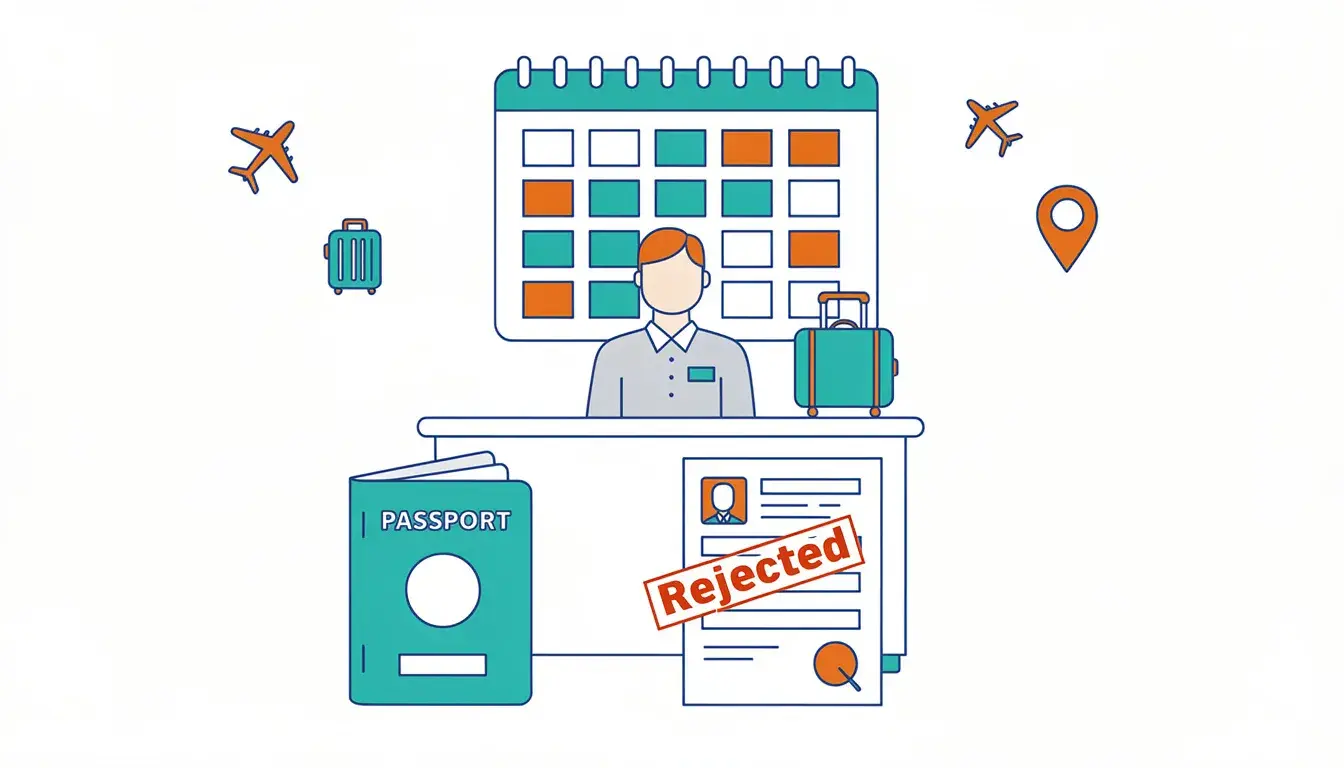
A date gap is any period or boundary that the submitted documents describe differently. Examples include landing one day before accommodation begins, insurance ending before the return flight, a leave letter shorter than the declared trip, or an unexplained night between cities. Some are harmless timezone or transit effects; others make the proposed journey incomplete.
This guide owns the consistency-and-repair question. It preserves the source’s gap types, routing cases, explanation methods, interview preparation and reapplication workflow while removing unsupported claims that reviewers follow one universal hidden checklist.
What Is the Official Framework for Reviewing Travel Dates?
The European Commission’s Schengen application guidance requires supporting documents for the purpose of stay, financial means, accommodation and intention to return. It also permits consulates to request additional documents. A date contradiction matters when it prevents those required elements from forming a credible, complete plan.
Official supporting-document lists demonstrate why dates are reviewed together. One European Commission list requires a return reservation, accommodation for the intended period and evidence of leave or return circumstances. The exact list depends on the applicant’s jurisdiction, so the responsible consulate’s current checklist controls.
| Possible gap | Harmless explanation | Problem requiring correction |
|---|---|---|
| Arrival versus hotel check-in | Overnight flight crosses calendar dates | No accommodation or host evidence for the first night |
| Hotel-city transition | Night train or documented transfer | Unexplained day between distant cities |
| Insurance versus flights | Policy wording explicitly covers the full journey | Coverage ends before departure from the visa area |
| Leave letter versus trip | Weekends fall outside formal leave | Applicant is scheduled to work while abroad |
| Open-jaw route | Internal itinerary connects arrival and exit cities | Exit appears unrelated to the stated trip |
For the wider choice of reservation type, timing and verification method, use the complete flight-reservation planning guide. This page owns cross-document travel-date gaps rather than the general reservation decision.
Your application says you will travel from June 10 to June 20. Your flight reservation shows June 12 out and June 19 back. To a visa officer, that gap is not “flexible planning.” It is an unanswered question. Where are you on the missing days, and why do your dates shift?
We will show you which travel date gaps trigger refusals and which ones pass without trouble. You will learn how reviewers reconstruct your timeline, what documents they cross-check, and how to fix gaps without creating new contradictions. When your dates read like one coherent trip, your file feels easier to approve. If your dates changed, update your so your flight timeline has no unexplained gaps.
Table of Contents:
- How Visa Reviewers Interpret Travel Date Gaps in Your Flight Timeline
- How To Build A Gap-Proof Flight Itinerary That Matches Your Declared Dates
- If You Truly Have Travel Date Gaps, How to Justify Them Without Raising Red Flags
- What to Do If You’ve Already Submitted, Get Questioned, or Face a Refusal Due to Date Gaps
- Your Flight Dates Should Read Like One Clean Trip
Can Travel-Date Gaps Lead to a Visa Refusal?

A visa officer rarely debates whether you “meant” to leave two days later. They check whether your dates form a clean, credible trip on paper. If the timeline feels unfinished, it can stall your file fast, especially on short-stay visas.
The “One Story” Rule For Visa Applications: Your Dates Must Read Like a Single Trip
For a Schengen short-stay application, the officer wants one simple story: you depart, you enter, you follow your purpose, and you exit on time. If your form says July 10 to July 20, but your flight reservation shows July 12 to July 18, the missing days do not look like flexibility. They look like uncertainty.
On a UK Standard Visitor file, the same gap can raise a different question. Your leave letter might be approved from July 10 to July 20, but the flight dates show fewer days. The officer can read that as weak planning or shifting intent, even if your bank activity looks fine.
On a US B1/B2 interview, you might be asked directly: “Why does your itinerary not match your stated travel dates?” If your answer turns into “we will decide later,” the gap becomes a credibility problem, not a scheduling problem.
The Gap Typology Map: 5 Gap Patterns That Get Flagged Most In Visa Rejections
Reviewers do not flag “gaps” in a vacuum. They flag patterns that create doubt. Here are five that show up often across Schengen, Canada TRV, UK Visitor, and Japan temporary visitor files.
- Type 1: Declared Window Vs Flight Window Mismatch
Your application states August 5 to August 16, but the reservation shows August 7 to August 14. For Schengen, that can collide with travel medical insurance dates. For Canada TRV, it can clash with your stated length of stay. - Type 2: Blank Days Inside The Trip
Your itinerary shows arrival in Paris on September 10, then nothing until a return segment on September 18. If the visa is for France and your cover letter claims a structured plan, those “silent” days can look like undeclared travel. - Type 3: “Floating Return” Look
Your outbound is fixed, but the return is missing, unclear, or outside your declared exit date. On a UK Visitor application, which can read as weak ties to return timing. In Schengen, it can look like you might overstay. - Type 4: Transit Confusion
A connection that lasts long enough to look like a stopover can confuse the file. A 20-hour “connection” in Dubai on the way to Europe can be fine, but if the itinerary layout makes it look like a separate trip, the officer may treat it as an unmentioned stay. - Type 5: Impossible Sequencing
Your invitation letter says the event runs from October 15 to October 18, but your entry flight arrives on October 17. Or your return flight leaves before your stated meeting ends. These are small data errors that can sink confidence quickly.
When a Gap Is Harmless For Visa Process vs When It Looks Like You’re Hiding Something
A one-day buffer can be normal on a Japan temporary visitor plan if it matches a clear purpose. Arriving one day early for a conference registration reads as practical, not suspicious, when your registration dates support it.
A two-day gap can also be harmless on a Schengen itinerary if it still forms a single-city stay and your documents align. Example: you land in Rome on May 2, your tour starts on May 3, and you return on May 10. That May 2 buffer is easy to understand.
The risky version is when the gap forces the officer to guess. If your Schengen form states “10 days in Spain,” but your flights only account for 7 days, the officer may wonder where the remaining days go. If nothing in your file anchors those days, the gap looks like hidden movement, not downtime.
Why Even Small Gaps Sometimes Matter More Than Big Ones
In Schengen cases, a one-day mismatch can cause a chain reaction. Your insurance might cover June 1 to June 10, but your flight shows June 2 to June 9. The gap is small, but it creates an internal contradiction that the officer can spot in seconds.
On a UK Visitor application, a small mismatch can collide with your employer's leave dates. If your leave approval is strict and your itinerary looks shorter or shifted, the officer may question whether you will actually travel as stated.
A longer gap can be acceptable when it is clearly tied to the purpose. A 14-day language course in Germany supported by admission dates can justify a two-week stay cleanly, even if your plan is simple. The length is not the issue. The issue is whether the timeline explains itself.
The Six-Point Date Cross-Check Reviewers Rely On
Before you assume a gap is “minor,” we should run the same cross-check an officer often runs, especially on Schengen short-stay and Canada TRV files:
- Your application form’s intended travel dates
- Your flight reservation’s departure, arrival, and return dates
- Your purpose documents’ fixed dates (conference agenda, admission window, invitation period)
- Your supporting availability proof dates (employer leave approval, school break letter, business travel approval)
- Your financial timeline around travel dates (salary credits, planned major expenses that align with the trip window)
- Any date-tied supporting items you included, like travel insurance coverage dates on Schengen applications
Once you see how quickly these dates get compared, the next step is making your flight itinerary read cleanly from the first scan, with no gaps that force an officer to guess.
Before correcting a gap, confirm that the flight document itself contains valid passenger and segment information. The foundational flight-reservation guide explains itinerary fields and booking status. A new legitimate reservation can repair changed dates; manually editing an old PDF cannot.
How Do You Build a Date-Consistent Flight Itinerary?
Once an officer sees even a small date mismatch, your file stops feeling “finished.” The goal is simple: your declared travel window and your flight itinerary should read like the same trip, at first glance.
Start With The Dates You’re Declaring, Not The Dates You’re Finding
Lock your declared travel window first. Then build the flight timeline to match it.
This matters most in systems where dates get cross-checked automatically or quickly. Schengen applications are a clear example. Your travel medical insurance often mirrors your intended dates, and reviewers compare that to entry and exit flights. A two-day difference can turn into a credibility question.
Start with three anchors:
- First possible departure date you can defend with leave or obligations
- The latest possible return date that still matches your declared window
- Purpose window that cannot move (conference days, appointment dates, family event dates)
Now choose flights that make those anchors obvious. If you have flexibility, keep it inside your declared window, not outside it.
If you are applying for a UK Standard Visitor visa and your employer letter approves July 10 to July 20, do not submit flights showing July 12 to July 18 unless your form also states that exact window. Reviewers read “extra days off work” and “actual trip days” as one package.
For a US B1/B2 interview, this approach helps in a different way. You can answer date questions without improvising. Your words match your documents because you built the trip around the declared dates from the start.
Use Buffer Days Intentionally, Not Accidentally
Buffer days can help you. They can also create gaps that look like unplanned time.
A buffer day is “intentional” when it has a clean reason that fits the visa context:
- Schengen: arriving one day early because long-haul delays can disrupt a fixed appointment in-country
- Japan: arriving one day early to adjust to the time zone change before a scheduled itinerary
- Canada TRV: building in a day to reach a non-major city after landing at a main hub
A buffer day looks accidental when it appears only in the flights and nowhere else. That is when it becomes a “missing day.”
Keep buffer logic tight:
- Put the buffer next to a fixed event, not floating mid-trip
- Keep it small and symmetrical when possible (one day before, one day after)
- Avoid “empty middle days” between two major segments unless your purpose clearly supports it
One practical rule works across embassies: if you cannot explain a buffer day in one short sentence without adding new destinations, you should not keep it.
Connection Vs Stopover Vs Separate Ticket: Where “Hidden Gaps” Come From
Many “gaps” are not real gaps. They are presentation problems.
A long connection can look like an extra stay if the itinerary layout is unclear. A 16-hour connection can be normal on certain routes, but if the document separates segments like two trips, an officer may read it as an unmentioned stop.
Separate tickets create a bigger risk. When your onward segment sits on a different booking, you can accidentally show:
- Arrival on June 10
- Next flight on June 12
- No stated reason for June 11
That missing day can trigger questions on Schengen and UK visitor files because it looks like an undeclared movement. It can also confuse purpose documents if your event starts on June 11.
Time zones create “hidden gaps” too. Overnight flights can shift dates by one day. Westbound routes can “arrive earlier” on the calendar. Eastbound routes can “lose” a day. If your declared dates do not account for that, reviewers can see a mismatch even when your plan is fine.
Keep the itinerary readable:
- Make sure departure and arrival dates are clear, not just times
- Avoid mixing local time assumptions in your own explanations
- If a date shifts due to time zones, keep your declared window aligned with what the itinerary shows
Round Trip Vs Multi-City: Choosing The Format That Minimizes Gap Risk
If your trip is single-purpose and single-base, a round trip reduces gap exposure. It is easier for an officer to validate quickly, especially for Schengen short-stay files, where the “enter and exit” scan happens fast.
Multi-city itineraries are useful when the purpose demands it. They are also easier to mess up. Reviewers are not allergic to complexity. They are allergic to unexplained complexity.
Use a multi-city flight plan when:
- Your purpose is clearly multi-point (meetings in two cities, an organized tour, family events across locations)
- Your documents already reference those places and dates
- Your timeline has no “silent days” between segments
If you apply for a Schengen visa through one country but your flights spend more time in another, that is not a “gap,” but it often triggers the same kind of scrutiny. Your flight format should reinforce your main destination claim, not undermine it.
Date-Matching Micro-Rules That Prevent “Reviewer Confusion”
These small rules prevent most date-gap issues before they start:
- Keep your application window and your flight window identical unless you have a clear reason
- Do not submit a return flight that lands after your declared return date
- Do not arrive after the start of your stated purpose (conference start, appointment, course start)
- Avoid “impossible movement” that implies you crossed countries faster than flights allow
- Align Schengen insurance coverage dates with the exact entry and exit dates shown in your flight itinerary
- If you update flights, update any date-tied documents you included that depend on those dates
A simple self-check works well: if an officer circles two dates and asks “what happens here,” you should already have the answer in your file.
When A Domestic Leg Creates A Gap
Positioning flights are a common source of confusion, especially when your international departure airport is not your home city.
Example: an applicant departing from Delhi submits an international flight leaving from another city the next day, but the domestic leg is missing from the timeline. The file shows “depart June 10,” then “international departure June 11.” That June 10 to June 11 space looks like a gap.
Fix it in one of two clean ways:
- Add the domestic connector so the timeline becomes continuous, with a realistic connection time
- Adjust your declared departure date so it matches the first flight segment you are actually showing
Avoid patchwork. Do not leave older versions of itineraries in the file. Reviewers do not average dates across attachments. They pick the version that looks most reliable and judge the rest against it.
For Schengen trips, gaps may also affect main-destination logic, accommodation coverage and the declared entry and exit dates. Apply the jurisdiction-specific tests in the Schengen flight-reservation requirements guide before changing only the flight layer.
How Should You Explain a Genuine Travel-Date Gap?
Some date gaps are unavoidable. The key is making them look intentional on paper, with one clear reason and one clean piece of proof.
Legit Gap Reasons Reviewers Usually Accept (When Properly Supported)
A consular officer will often accept a gap when it follows a fixed constraint in your trip. That could be a course start date, a conference check-in day, or a limited flight frequency to a smaller airport.
What usually works is simple. The gap supports your stated purpose, it does not change your exit date, and it does not create a second story inside the trip. Most visa applicants get flagged when the gap forces guessing, especially if it clashes with a leave window or your travel insurance dates.
Gap Justification Menu: Reason → Best Proof → What Not to Say
Pick the smallest fix that closes the question. Add supporting documents only when they directly explain the missing day.
- Fixed Start Date (Course, Event, Registration) → acceptance letter or agenda page → “We will finalize later.”
- Appointment Timing That Shifts Departure → visa appointment confirmation email → “Dates are flexible.”
- Airline Schedule Limits On Certain Routes → dated route search note or schedule snapshot → leaving an incomplete travel itinerary.
- Overnight Flights Or Time Zone Shifts → itinerary showing local depart and arrive dates → arguing about calendars in the cover note.
- Short Stop That Looks Like A Stay → one continuous itinerary layout → adding new plans in the transit city.
- Return Anchored To Work → job proof showing approved dates → return outside the declared window.
- Schengen Coverage Alignment → valid travel insurance certificate matching entry and exit → mismatched travel insurance plans.
If an officer can resolve the gap in seconds, you do not need extra pages of required documents. It also keeps bank statements from becoming the place they look for answers about the gap day.
The One-Paragraph Gap Explanation That Works (Without Oversharing)
Help reviewers evaluate the dates without guessing your intent.
Use three sentences and stop.
Example: “My intended travel window is 10–20 June, and the outbound flight is on 12 June due to limited same-day routing on this route. The purpose begins on 13 June, and the extra day is a buffer for arrival and local transfer. The schedule evidence is included in the submitted documents.”
Keep it steady for the visa interview. Give concise answers. Avoid adding side activities that trigger checks under specific visa regulations.
When Gaps Come From “Flexible Planning” and How to Make It Look Structured
Flexibility is fine. Unbounded flexibility is not.
If your travel plans cover multiple countries, lock two anchors first: entry and exit. Then keep every internal move inside that frame. It supports visa requirements around where you spend the most time, and it clarifies your travel intent.
Also, match the purpose to the correct visa category. If the file reads like meetings but you selected a tourist visa, the same gap can look like a wrong visa category issue.
Make sure the gap explanation also fits your financial stability story. If you add days, your financial proof must support the longer stay, or the gap can read as insufficient financial proof.
Interview Day Pushes Your Flight Dates
Sometimes the schedule that creates the gap is the process itself. An applicant in Mumbai may receive a visa interview slot close to departure, then move flights by one or two days so the itinerary aligns with the interview timeline.
Handle it with one clean update. If you applied via Visa online, avoid uploading multiple competing versions, because version clutter is one of the most avoidable common mistakes.
The “Do Not Create New Gaps” Rule When Updating Any Document
A gap fix should remove questions, not create new ones.
Before you resubmit anything, re-check the essentials: your dates, your purpose window, and your coverage window. Keep your necessary financial documents consistent with the revised trip length, and make sure your bank account activity does not contradict the new return date.
Do not patch gaps by submitting fake documents. That can turn a timing issue into a visa refusal and an official notification trail that affects future applications.
How Do You Repair Date Gaps After Submission or Refusal?
After submission, your dates are evidence. If a gap appears, you want a correction that makes the file simpler, not louder.
If You Spot a Gap After Submission, Don’t Panic. Use a Repair Protocol
Treat it like a mismatch between records. A one-day shift can look like incorrect details when the same date is repeated across uploads.
Use this repair protocol inside the visa application process:
- Note the declared window and every flight segment date, then mark the gap day.
- Find the source. It is usually an old attachment or a separate segment that makes the trip look split.
- Fix one thing only. Change the itinerary or the declared window, not both, unless the embassy asked for both.
- Upload one final set and remove older versions, so the officer is not reconciling duplicates.
Multiple versions can turn a quick review into an incomplete or incorrect application.
When an Embassy Asks for an Updated Itinerary, What They’re Really Testing
Most update requests are a stability check. Reviewers want to see that you can follow official guidelines and keep your trip coherent.
On a Schengen short-stay file, they often compare entry and exit flights against insurance dates, because countries require full-period coverage. On a UK Standard Visitor case, they look for dates that still match your leave approval.
Reply with the updated itinerary and one supporting item that explains the change. This supports complete documentation, helps you avoid unnecessary stress, and keeps immigration authorities focused on eligibility. Keep the same visa type across every form and attachment.
Interview Questions You’ll Get About Gaps and Clean Ways to Answer
At a US B1/B2 or UK visitor counter, many applicants lose ground by improvising new plans out loud.
Use a three-part answer: date, reason, proof.
Expect questions like:
- “Why does your itinerary not match what you declared?”
- “What happens on the day between these flights?”
- “Why is your return date different from your approved leave window?”
Answer with short sentences, then stop. If you worked with a visa counsellor, keep your wording aligned with what was submitted.
How to Re-Issue a Verifiable Flight Reservation Quickly (Without Making It Look Like You’re Rewriting History)
If the embassy wants a corrected itinerary, rebuild for readability. Keep entry and exit points stable, and adjust only what closes the gap.
Practical guardrails:
- Do not add a new stop that looks like an unplanned visit in a foreign country.
- Keep dates inside the range you already declared, unless the embassy told you to change it.
- Make the routing read as one continuous trip, not two journeys.
If you use a dummy flight ticket, legal for embassy use, keep it consistent with your stated travel plans.
If you need a fast re-issue that stays consistent, BookForVisa.com provides instantly verifiable reservations, a PNR with PDF, unlimited date changes, transparent pricing at $15 (~₹1,300), and accepts credit cards. It is trusted worldwide for visa use.
If You Were Refused, How to Reapply Without Repeating the Same Gap Problem
Start with the rejection letter and isolate the timeline concern from that file. Treat it as one of the reasons for visa rejection; you can remove it with clearer dates and fewer moving parts.
In the next visa process, keep your route simple and make sure the timeline supports your ties to your home country. Use sponsorship letters only when the sponsor can show bank support for the exact window.
If the refusal touches travel history or legal records, answer with adequate proof that matches the concern. If you have prior outcomes, disclose previous refusals honestly so the new file stays consistent.
If the earlier decision was a visa denial linked to confusion, seek assistance for professional guidance so your next submission supports visa approval.
Final Pre-Submission Checklist: A 2-Minute “No Gaps” Sweep
Before you reapply, scan for alignment:
- Flights match your declared entry and exit dates
- No blank day sits between segments
- Insurance covers the full window, with no travel insurance gap
- Supporting dates match your purpose and availability
- Only one final version is included
- You have all the necessary documents in the same date range
What Is the Final Date-Consistency Check?
When you’re applying for a visa, travel date gaps rarely fail you on their own. They become visa rejection reasons when your flight timeline conflicts with what you declared. Keep your visa application form dates and your itinerary dates aligned, and your file feels easy to trust under basic visa rules.
Before you submit, do one final sweep for relevant documents and essential documents, then confirm that all the documents tell the same story. That simple check helps you avoid visa rejection and prevents an incomplete visa application form. If you want extra confidence, review your dates once more, the way an officer would, before applying for a visa.
Frequently Asked Questions
Can a one-day travel gap cause a visa refusal?
It can prompt concern if the night, location or return plan is unexplained, but the number of days alone is not decisive. A documented overnight flight, transfer or host stay may explain it.
Which visa documents should have matching dates?
Compare the application form, flight itinerary, accommodation, insurance, leave approval, invitation, event schedule and day-by-day plan.
Is an overnight flight considered a date gap?
Not necessarily. Departure and arrival can fall on different dates because of flight duration and time zones. Accommodation and itinerary dates should reflect the actual local arrival.
How do I explain a genuine gap in my itinerary?
State the reason briefly and attach the document that resolves it, such as a night-train booking, host letter, airport hotel or revised transfer plan.
Should I update my visa application after finding a date gap?
Follow the authority’s update instructions. Correct a material contradiction or respond to a request through the official channel; avoid sending unsolicited competing versions without context.
Can I edit the dates on a submitted flight reservation?
Do not alter the PDF. Obtain a genuine replacement if an update is needed, then check every linked document before submission.
What if my hotel starts one day after my flight departure?
Check the local arrival date. An overnight flight may make this correct. If you arrive earlier than hotel check-in, document where you will stay or how the transfer works.
How should I reapply after a refusal mentioning inconsistent dates?
Address the refusal reason directly, rebuild one coherent calendar, provide supporting evidence for any unavoidable gap and avoid repeating conflicting documents.
Related posts

Visa Reservation After a Legal Name Change
02 Oct, 26
Visa Reservation With a Refugee Travel Document
02 Oct, 26
Visa Reservation for an Indirect Flight Route
26 Sep, 26
Visa Reservation for a Private Driver Route in India
26 Sep, 26
Visa Reservation Through Layered Document Review
26 Sep, 26
Visa Booking With Mixed Travel Proof Types
22 Sep, 26
Visa Reservation When Sponsor Is Outside Main Destination
22 Sep, 26
Visa Reservation When Cover Letter Dates Are Flexible
22 Sep, 26
Does Timing Affect Visa Approval?
20 Sep, 26