Visa officers do not only check whether your flight reservation is valid. They check whether your whole application still tells the same story. If your travel purpose changes after submission, the problem is not the change itself. The problem is what your form, cover letter, invitation, flight itinerary for visa, and ticket dates now appear to say together.
A tourism trip that becomes a business visit, a conference that moves, or a family visit that suddenly changes length can all require different handling. Sometimes you only update a reservation. Sometimes you send a short explanation. Sometimes the safer choice is to withdraw and reapply. We’ll help you read the risk before taking the next step. Align your revised purpose with a dummy ticket that supports the travel story.
Key facts:
- A purpose change is more serious than a date or route change because it can affect visa category, evidence and eligibility.
- If the new purpose still fits the same permitted activity, a clear update may be enough in some cases.
- If the new purpose requires a different visa type, continuing with the old application can create credibility risk.
- Updated documents should match the revised purpose, travel dates, accommodation, funds, sponsor story and return plan.
- When the application has already been approved, the trip must still fit the visa conditions and border-entry rules.
Need revised travel proof after your purpose changed? Create a reservation that matches the new route, dates and reason you can honestly explain to the embassy.
Create Your Visa ReservationIn This Guide
Official-source check: Official guidance supports treating a purpose change as a consistency and eligibility issue. GOV.UK visitor guidance says visitors should be able to explain their main reason for coming at application stage, entry and extension stage, and it also notes that a changed declared permitted visitor activity is not necessarily enough to cancel permission if the activity remains permitted and the visitor still meets the relevant criteria. IRCC says applicants must tell Canada if a life change affects information in an application and include proof. The Schengen Visa Code requires documents showing purpose and conditions of stay, allows additional-document requests in justified cases, and permits refusal where there are reasonable doubts about statements, documents or intention to leave. Sources: GOV.UK visitor caseworker guidance, IRCC update-your-application guidance and Schengen Visa Code.
Reviewed for: travel-purpose change classification, permitted-activity wording, visa-category risk, post-submission update logic, document contradiction control, reservation-date alignment, withdrawal/reapplication safety and official-source support.
First, Decide Whether Your Travel Purpose Actually Changed Or Only Your Itinerary Changed
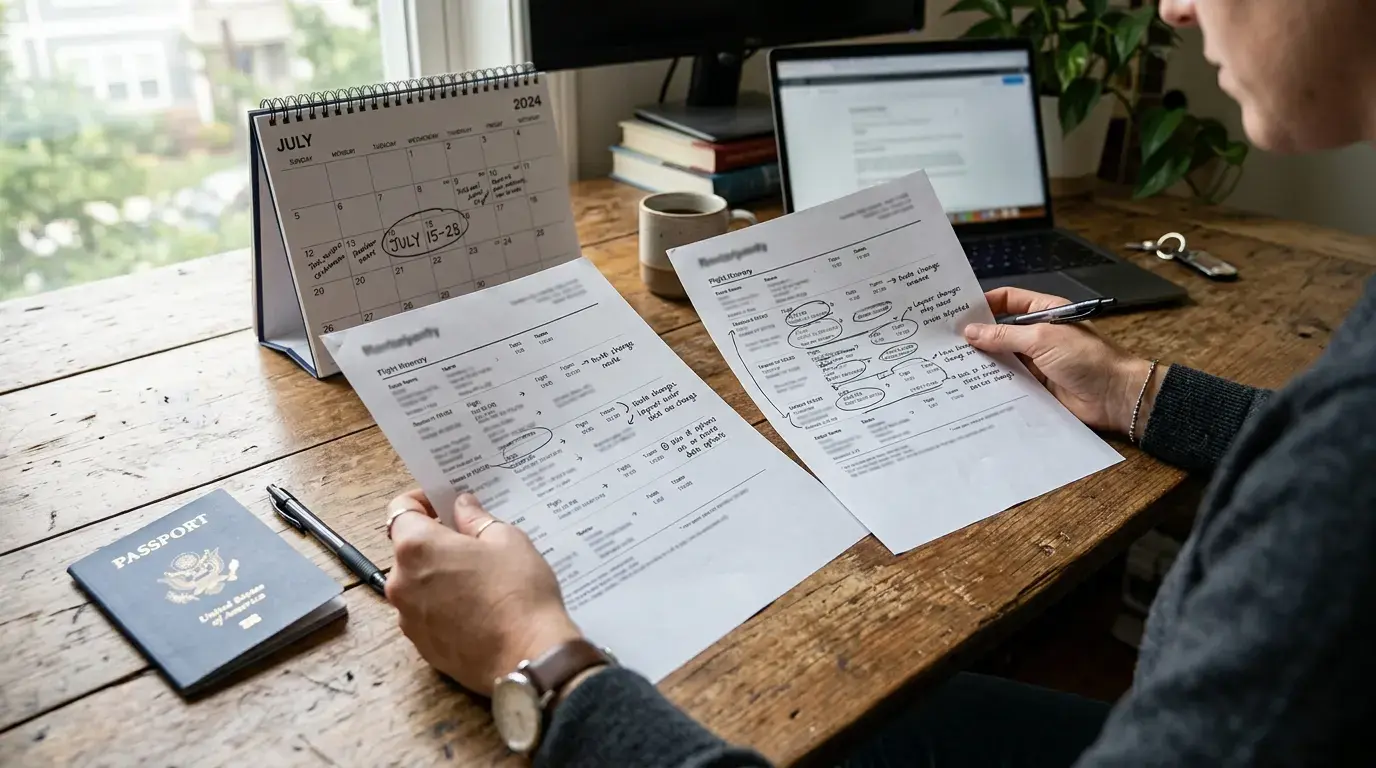
A changed plan does not always mean a changed visa purpose. Before you email the embassy or replace every document, separate a normal flight adjustment from a new reason for travel.
Separate A Real Purpose Change From A Date, Route, Or Flight Adjustment
Visa applicants often panic when the flight they submitted no longer fits the trip perfectly. A Delhi to Paris reservation for a Schengen tourist visa may expire, become unavailable, or need a later departure. That alone does not mean your purpose has changed.
A real purpose change affects why you are entering the country. A flight adjustment affects how and when you enter. Visa officers care about both, but they do not treat them the same way.
For example, you applied for a France Schengen visa for tourism from Delhi to Paris. You later decide to fly Delhi to Amsterdam and take a train to Paris because the fare is better. If your trip is still a short holiday in France and nearby Schengen cities, your purpose is still tourism. Your route changed, not your reason.
The same applies when a US B1/B2 visitor changes from a Mumbai to New York flight to a Mumbai to Newark flight. The airport changed. The stated purpose may still be tourism, family visit, or business meetings.
Avoid describing every date movement as a “changed purpose.” If your visa category, main destination, activity, and stay length still make sense, you are usually dealing with an itinerary correction.
The cleaner question is this: if an officer reads your form and then sees your new flight reservation, would the trip still look like the same trip?
Spot The Moment Your Application Story Stops Matching Your Real Trip
Your application is not judged document by document in isolation. It is read as one travel story. The form, cover letter, flight reservation, invitation, event proof, leave letter, and financial evidence should point in the same direction.
The risk starts when that story splits.
Say you submitted a Spain Schengen application for a 7-day tourist trip to Barcelona and Madrid. After submission, your real plan becomes a 19-day visit to your cousin in Valencia. Your flight reservation may still show Spain, but the purpose has moved from sightseeing to family visit, and the stay length has almost tripled.
That change matters because your cover letter may still describe city-to-city tourism. Your leave approval may mention annual vacation. Your itinerary may list museums and train routes. If you now intend to stay mostly with family, the file no longer speaks with one voice.
The same issue can happen with a UK Standard Visitor application. You may have submitted flight dates around a London holiday, then later receive a business meeting invite in Manchester. If the main reason becomes business meetings, the officer may expect documents that support that purpose.
Before taking action, review these items together:
-
Purpose selected on the visa form
-
Cover letter reason for travel
-
Flight arrival and departure dates
-
City or country where the main activity happens
-
Invitation, event, or meeting proof
-
Leave approval or employer letter
-
Trip length and funding explanation
If one document changed but the story remains stable, fix the document. If the story changed, you need a purpose-change strategy.
Examples Of Low-Risk Changes That Usually Stay Within The Same Purpose
Low-risk changes usually keep the visa category and trip logic intact. They may need an updated flight reservation, but they do not usually require you to rebuild the whole file.
A tourist applying for an Italy Schengen visa may move travel from 4 June to 8 June because the visa appointment was delayed. If the trip is still a Rome and Florence holiday, this is a timing issue.
A Canadian visitor visa applicant may change from a Delhi to Toronto route through Dubai to a Delhi to Toronto route through Doha. The route changed, but the purpose may still be visiting relatives or tourism.
A German trade fair attendee may shift their arrival by one day because the event organizer updates the entry schedule. If the applicant still attends the same fair in Frankfurt, the purpose remains business visitor activity, not a new category.
These changes are manageable because the officer can still understand the same core plan: where you are going, why you are going, and when you plan to return.
Still, updated flight details should not create confusion. A one-day shift is harmless. A new return date that quietly adds three extra weeks can change how the file is read.
Examples Of High-Risk Changes That May Alter The Visa Category
High-risk changes affect eligibility, not just scheduling. They can make the original application look incomplete or inaccurate if you ignore them.
A tourism trip to the Netherlands that becomes paid work is not a simple itinerary change. A visitor visa or Schengen tourist file is not meant to support employment. Even if your flight reservation looks neat, the declared reason no longer fits the activity.
A short US business meeting can also change character. If you first applied for meetings under a visitor category, then the company asks you to relocate, train staff for several months, or begin hands-on work, the original purpose may no longer match visitor activity.
A transit plan can become risky too. Suppose you submitted a flight reservation showing a short layover in Istanbul on the way to Rome, then later decide to spend five days in Turkey before continuing. That is no longer just transit.
Medical travel is another pressure point. A tourism application to Germany that later becomes a hospital consultation trip should not be treated as the same holiday. Medical purposes usually need clearer dates, appointment proof, funding evidence, and a flight plan that fits the treatment schedule.
The danger is not that your life has changed. Travel plans often change. The danger is letting an old visa file represent a new intention.
Why Visa Officers Care More About Intention Than The Label You Chose
The purpose box on a visa form is not just a label. It tells the officer what kind of evidence to expect and what risk questions to ask.
For a Schengen tourist file, the officer expects a coherent leisure itinerary, return flight timing, funds for the stay, and ties that support departure. For a business visitor file, the officer expects meeting details, company links, event dates, and a trip length that fits the activity.
When the stated purpose and flight plan stop matching, the officer may not know which version to trust. A London tourism cover letter with flight dates built around a Birmingham supplier meeting can look careless at best and misleading at worst.
That is why your first move is not always to replace the flight reservation. Your first move is to identify whether the purpose itself has moved. Once you know that, the timing of the change determines how safely you can correct it.
How The Timing Of The Change Affects What You Should Do Next
A travel purpose change is easier to handle when you catch it early. The same change can be simple before biometrics, stressful during processing, and risky after approval if the visa conditions no longer fit the trip.
If The Purpose Changed Before Biometrics Or Document Submission
This is the cleanest point to correct the file. Your application may already be submitted online, but the officer may not have reviewed your supporting documents yet.
If your appointment is still pending, do not walk in with old flight dates and hope to explain everything at the counter. Prepare the revised documents before the appointment. That gives the application center or embassy staff a clearer file to forward.
For example, you submitted a Schengen application for tourism in France. Before biometrics, your main purpose changes to attending a trade event in Paris. The flight reservation may still show Paris, but your purpose is no longer a simple holiday. You should bring the trade event confirmation, an updated cover letter, and a flight reservation that matches the event dates.
If the visa portal allows uploads, check whether you can replace or add documents. Some systems lock the form but still allow supporting evidence. Others require you to bring printed documents to the appointment.
A short explanation note can help. Keep it direct:
-
Original purpose: Tourism in France
-
New purpose: Attending a trade event in Paris
-
Reason for change: Event invitation received after submission
-
Updated document: Revised flight reservation and event confirmation
Do not rely only on a verbal explanation at biometrics. Application center staff may collect documents, but they may not record your full explanation. A written note protects the file from looking inconsistent later.
If The Purpose Changed After Biometrics But Before A Decision
This stage needs more care. Your documents may already be with the embassy, consulate, or visa processing office. You may not be able to edit the form, and the officer may already be reviewing the file.
If the change is small, such as a flight shift from 12 July to 14 July for the same tourism plan, you may not need to contact the embassy immediately. But if the purpose itself changed, silence can create a credibility issue.
Suppose you applied for a UK Standard Visitor visa for a 10-day holiday in London. After biometrics, a company invites you to attend meetings in Birmingham during the same trip. If those meetings become the main reason for travel, your file now needs a clearer explanation. The original flight reservation may still show the UK, but the purpose has moved.
In this stage, use the official channel listed for your application. That may be:
-
A visa portal upload option
-
A consulate email address
-
A webform
-
A visa application center enquiry channel
-
A paid enquiry system, depending on the country
Your message should not sound nervous or defensive. It should sound organized.
State that your travel purpose changed after submission. Explain whether the visa category still fits. Attach only the documents that prove the change. If the updated purpose requires a new visa type, ask whether withdrawal and reapplication is the correct route.
Avoid sending multiple versions of the story. One clear update is better than three anxious emails with slightly different wording.
Your updated flight reservation should support the revised timing. If a business meeting is now on 18 August in Milan, a flight arriving on 21 August will create a new problem instead of fixing the old one.
If The Purpose Changed After The Visa Was Approved
Approval does not always mean the purpose question disappears. Many visas allow reasonable flexibility, but not every approved visa can be used for a completely different activity.
If you received a visitor visa for tourism and later decide to attend a short unpaid business meeting, the risk depends on the destination country’s visitor rules. Some visitor categories allow limited business activities. Others separate tourism, business, study, work, and medical travel more strictly.
Check the visa sticker, approval letter, grant notice, or online visa conditions. Look for wording about:
-
Permitted activities
-
Duration of stay
-
Number of entries
-
Sponsor or host restrictions
-
Work or study limits
-
Event or program conditions
Flight plans matter here too. If your approved Schengen visa covers 10 days and your revised flight reservation shows a 28-day stay, you may face questions at the border even if the visa is valid. If your approved visa was tied to a conference date, but you now plan to travel a month later for a private visit, the officer may ask why your trip no longer matches the application basis.
For flexible visitor visas, a modest date change may be fine. For purpose-specific visas, a major shift can be unsafe. A student visa should not be used as a visitor visa before the course begins if the conditions do not allow it. A medical visa should not be used for general tourism if the treatment plan no longer exists.
Before booking the final paid ticket, compare your new trip with the approved visa conditions. If the new purpose no longer fits, get official guidance before traveling.
If The Purpose Changed After A Refusal
A refusal resets the strategy. Do not treat the next application as a chance to quietly replace the old story. Visa officers may compare your new purpose with your previous application history.
If your first application said tourism in Spain and your next application says business meetings in Spain, explain what changed. The new purpose can be genuine, but it needs a clean bridge between the two files.
A refusal may also reveal that the original purpose was weakly supported. Maybe your flight dates were too long for the stated trip. Maybe your cover letter said tourism, but your documents suggested a host-led visit. If your purpose changed after refusal, use the new application to correct the record.
Do not copy the old cover letter and simply change the title. Build the new file around the current reason for travel.
For example, after a rejected Italy tourist visa, you receive an invitation to attend a design fair in Milan. Your next file should not look like a recycled tourism application with an event letter attached. The flight reservation should match the fair dates, the cover letter should explain the business visitor purpose, and the employer or company documents should support the reason.
If the refusal letter mentioned unclear purpose, inconsistent itinerary, or weak justification, address those points directly. A new flight reservation helps only when it fits the improved purpose story.
Passport Retention: If The Purpose Changed While The Passport Is Already With The Embassy
This is one of the most uncomfortable stages because you have limited control. Your passport may be inside the embassy workflow, and the file may be close to a decision.
Still, you should not ignore a serious purpose change just because the passport has been submitted. If the new purpose makes the original application inaccurate, use the official enquiry route and send a concise update.
Do not ask for the passport back unless you are ready to pause or withdraw the application. Passport return requests can affect processing, and rules vary by country.
If your changed purpose is minor, wait carefully. For example, your flight from Delhi to Madrid shifts by two days, but the same tourism plan remains. That may not justify interrupting processing.
If your changed purpose is major, act before the decision if possible. For example, your submitted flight reservation supported a 6-day tourism trip to Vienna, but the real plan is now a 30-day stay for medical consultation. That is no longer a small flight change.
Your message should include:
-
Application reference number
-
Passport submission date
-
Original travel purpose
-
New travel purpose
-
Date the change happened
-
Updated flight plan, if available
-
Request for guidance on whether to submit documents, wait, withdraw, or reapply
Do not over-explain. The officer needs facts, not a long personal story.
Why Waiting Too Long Can Turn An Honest Change Into A Credibility Problem
Visa officers understand that flights move, events change, and personal plans shift. The issue is whether your application remained truthful after you knew the facts had changed.
If you knew your conference was cancelled before the decision, but you kept the old flight reservation and event letter in the file, the officer may question the whole application. If you knew your tourism trip had become a work-related stay, but you waited until the border to explain it, the problem becomes harder to defend.
Timing affects credibility because it shows how carefully you handled the process. A quick correction suggests transparency. A late correction can look like damage control.
Keep a record of the change. Save emails showing the event date moved, the meeting invitation arrived late, or the family situation changed after submission. These details can explain why the original application was accurate when filed but needed updating later.
Your next move should match the stage your application is in, not just the size of the change.
The Purpose-Change Risk Ladder: When To Update, Explain, Withdraw, Or Reapply
Not every travel purpose change deserves the same response. The safest move depends on how far your new plan has moved from the application already sitting with the embassy.
Level 1: Same Purpose, Minor Flight Or Schedule Shift
This is the lowest-risk situation. Your reason for travel has not changed. Only the flight timing, route, or small schedule detail has moved.
For example, you submitted a Schengen tourist visa application for a 9-day Italy trip from Delhi to Rome. Your outbound flight shifts from 3 September to 5 September because your appointment date changed. Your return date also moves by two days. You still plan to visit Rome and Florence for tourism.
That is not a new purpose. It is a revised travel schedule.
In this level, your action is usually simple. Keep the application story stable and update the flight reservation only if the embassy asks, the portal allows it, or the old reservation now creates confusion.
Small changes can include:
-
A departure date moving by one or two days
-
A different airline route to the same destination
-
A nearby arrival airport replacing the original one
-
A return date moving within the same approved leave period
-
A conference arrival shifting slightly while the event remains unchanged
The key test is practical. If a visa officer compares your form, cover letter, and revised flight reservation, would the same purpose still be obvious?
If yes, do not overcomplicate the file. Over-explaining a minor flight adjustment can make a simple case look more unstable than it is.
Level 2: Same Purpose, Material Evidence Has Changed
At this level, your purpose remains the same, but one important document behind that purpose has changed.
This is more serious than a simple flight-date correction. The officer may still approve the same visa purpose, but the supporting evidence needs to stay accurate.
Suppose you applied for a Germany Schengen visa to attend a trade fair in Frankfurt. The fair organizer moves the event from 10 October to 13 October. You are still going for the same business event. Your visa type may still fit. But your flight reservation, event ticket, employer letter, and cover letter may now point to different dates.
That mismatch can weaken the file.
The same can happen with a Canada visitor visa for a family visit. Your host changes address from Toronto to Mississauga after you submit the application. Your purpose is still visiting family, but the invitation details and flight arrival plan should not look disconnected.
At this level, you should consider submitting updated evidence if the system allows it. If your appointment is still pending, bring the corrected documents. If your file is already under review, use the official enquiry or upload channel when the change is material.
Material evidence may include:
-
Revised event dates
-
Updated invitation letter
-
Changed host location
-
New meeting confirmation
-
Corrected employer support letter
-
Updated flight reservation matching the new dates
The goal is not to flood the embassy with documents. The goal is to remove contradictions before they create questions.
Level 3: Purpose Still Legal, But The Main Reason Has Shifted
This is where many applicants misjudge the risk. The new purpose may still be allowed under the same broad visitor category, but the main reason for travel has changed enough that the file needs context.
For example, you applied for a UK Standard Visitor visa for tourism. After submission, a company invites you to attend two short meetings during the same travel window. The visitor route may still allow certain business visitor activities, depending on the rules. But if the meetings become the main reason for going, the application no longer reads like a pure holiday.
The same issue can happen with a Schengen trip. You first applied for tourism in Spain, then your plan shifts toward visiting your brother in Madrid. You are still a short-stay visitor, but the main purpose may now look like a family visit.
At this level, your file may not need withdrawal. It may need a clear explanation.
A good explanation should answer three points:
-
What changed after submission?
-
Why does the current visa category still fit?
-
Which documents now support the revised purpose?
Do not pretend the original purpose still controls the trip if it no longer does. Also, do not create a second story that fights with the first one.
A practical example works better than a long explanation:
You submitted tourism documents for a Netherlands visit. After submission, your friend confirms they can host you for part of the stay. Your updated flight dates remain similar, but your cover letter should clarify that the trip is now a mix of tourism and personal visit, if that is allowed for the visa category.
The officer should not have to guess why the documents changed.
Level 4: Purpose Now Requires A Different Visa Type
This is a high-risk level. Your new purpose may no longer fit the visa category you selected.
A flight reservation cannot solve this problem by itself. Even a perfectly matched arrival and return date will not fix an application filed under the wrong category.
Common examples include:
-
Tourism changing into paid work
-
A short business meeting becoming employment
-
A visitor trip becoming a study program
-
A conference trip becoming long-term training
-
A transit plan becoming a multi-day stay
-
A medical consultation becoming extended treatment
Suppose you applied for a France Schengen tourist visa for a 12-day holiday. After submission, a company in Paris asks you to begin paid work for three weeks. That is not a revised itinerary. That is a different activity.
Or imagine you submitted a US B1/B2 application for meetings, then the company offers you a temporary role that involves hands-on work. The original purpose may no longer be enough.
At this level, you should seriously consider withdrawal and reapplication under the correct category. Continuing with the old application can create problems beyond one refusal. It may affect future credibility because the record can show that your documents did not match your real intention.
If you are unsure whether the new purpose needs another visa type, check official guidance or use the embassy’s enquiry channel. Ask the question clearly. Do not travel on assumptions when the activity has changed category.
Level 5: Purpose Change Makes The Submitted Application Misleading
This is the most sensitive level. The issue is not only that your purpose changed. The issue is that the submitted file now gives an impression that is no longer true.
For example, you applied for an Austria Schengen visa to attend a conference in Vienna. After submission, the conference is cancelled. You still want to travel on the same dates for sightseeing, but your application is built around an event that no longer exists.
Another example: you applied for a business visitor trip to Milan using a company invitation. After submission, the host company cancels the meeting. You then decide to visit friends in Rome instead. Your flight reservation still shows Italy, but the original reason, host, and document basis are gone.
This level needs careful handling because silence can look like you are relying on outdated evidence.
Your safest options may include:
-
Sending a short correction through the official channel
-
Uploading cancellation proof and revised purpose documents
-
Asking whether the application can continue under the new purpose
-
Withdrawing if the old file no longer represents your real trip
-
Reapplying with a clean, honest purpose
Do not try to stretch the old documents to fit the new trip. A cancelled event letter, outdated invitation, or mismatched flight timeline can make the application look less reliable.
The better approach is to show when the change happened and what the current plan is now.
How To Choose Between Updating The File And Starting Over
The hardest choice is whether to repair the current application or begin again. Use the depth of the change as your guide.
Updating the file may be enough when the visa category still fits, the main destination remains logical, and the documents can be corrected without creating a new story.
Starting over is safer when the selected visa type no longer matches the activity, the sponsor has changed completely, or the new trip length looks very different from the submitted plan.
Ask these questions before deciding:
-
Does the same visa category still cover the new purpose?
-
Would the original application form still be mostly accurate?
-
Can a short explanation remove the confusion?
-
Does the updated flight reservation match the new activity dates?
-
Has the trip length expanded beyond your leave, funds, or invitation?
-
Would a visa officer understand the change without feeling misled?
If most answers are yes, an update may work. If several answers are no, a fresh application may protect your long-term visa record better.
A clean file is not always the file with the fewest changes. It is the file where every document supports the same travel purpose, especially before we look at the contradictions that can appear inside the visa file itself.
How A Changed Travel Purpose Can Create Document Contradictions Inside Your Visa File
A visa file can look weak even when each document looks acceptable on its own. The problem begins when the documents no longer support the same travel purpose after your plans change.
Your Flight Reservation May Still Be Valid But No Longer Persuasive
A flight reservation can still be active, verifiable, and correctly issued, yet no longer support the purpose shown in your application.
That happens when the travel dates, destination, or trip length now point to a different story.
For example, you submitted a France Schengen visa application for a 5-day tourism trip to Paris. After submission, your actual plan becomes a 17-day visit to relatives in Lyon. Your flight reservation may still show entry into France, but it no longer supports the short tourism plan described in your cover letter.
The reservation is not the problem. The mismatch is.
Another example: you applied for a Germany visa to attend a trade fair in Frankfurt from 8 to 12 October. Your flight reservation shows arrival on 14 October because you changed dates after submission. Even if the reservation is valid, it now weakens the event purpose because you arrive after the event.
A flight reservation should help the officer understand your plan quickly. It should answer three questions without confusion:
-
When are you entering?
-
When are you leaving?
-
Do those dates support the stated purpose?
If the purpose changes, the flight details should follow the revised plan. If you need a corrected flight reservation quickly, BookForVisa.com provides an instantly verifiable PNR with PDF and unlimited date changes for $15.
The important point is alignment. A revised reservation should not simply show new dates. It should support the reason you now plan to travel.
Your Cover Letter Can Become The First Document That Betrays The Change
Your cover letter often explains the trip more directly than the application form. That makes it useful, but also risky when your purpose changes.
A form may say “tourism.” A flight reservation may show the destination. But the cover letter usually gives the full reason, the travel dates, the cities, and the return plan.
If that letter is outdated, it can expose the mismatch immediately.
Suppose you applied for an Italy Schengen visa with a cover letter saying you will visit Rome and Venice for sightseeing. After submission, your real purpose becomes attending a design exhibition in Milan. If you send an updated flight reservation to Milan but leave the old cover letter unchanged, the officer sees two different trips.
Do not try to hide the change by keeping the original wording. Also, do not rewrite the full story as if the first version never existed.
A better approach is to add a short clarification note. It should say that your purpose changed after submission and explain why the new documents now differ from the original ones.
Keep it factual:
-
The original purpose was tourism.
-
The new purpose is attending a professional event.
-
The change happened after submission.
-
The updated flight reservation now matches the new event dates.
-
The visa category still fits, if that is true.
This helps the officer understand the timeline of the change. It also prevents the file from looking careless or inconsistent.
Invitation Letters Can Create Bigger Problems Than Flight Changes
Invitation letters carry more weight than many applicants realize. They do not just support the trip. They often define the purpose.
A business invitation tells the officer that you are traveling for meetings, training, a conference, or an event. A family invitation tells the officer that your main reason is a personal visit. An event invitation ties your travel dates to a specific program.
If your purpose changes, the invitation letter can become the strongest contradiction in the file.
Imagine you submitted a Netherlands visa application with an invitation from a company in Amsterdam for meetings on 6 and 7 May. After submission, the meeting is cancelled, but you still want to travel for tourism. Your old invitation now supports a purpose that no longer exists.
Or suppose you applied for a Canada visitor visa with a family invitation from Toronto. Later, your main reason becomes attending a business event in Vancouver. Your flight reservation may show Canada, but your invitation and new purpose no longer point to the same trip.
In these cases, changing the flight alone is not enough.
You may need one of these supporting documents:
-
A revised invitation with corrected dates and purpose
-
An event postponement notice
-
A meeting cancellation email
-
A new invitation from the correct host
-
A short explanation connecting the old purpose to the new one
Avoid submitting a fresh invitation without context if it conflicts with the original application. A new host, new city, and new purpose can look abrupt unless you explain when and why the change happened.
The officer should not have to guess whether you changed plans, made an error, or submitted documents that do not belong together.
Employment And Leave Letters Must Still Match The Trip Reason
Employment documents often confirm that you are expected to return. They can also support the purpose of travel.
When your purpose changes, your employer or leave letter may need to change too.
For example, your employer approved leave for a 6-day holiday in Spain. After submission, your trip changes into attending a supplier meeting in Barcelona. The leave letter still proves time off, but it does not explain why your company is connected to the trip.
A business-related purpose may need stronger employer support. That could include a company letter stating:
-
Why you are traveling
-
Who you will meet
-
Whether the company funds the trip
-
Your expected return date
-
Your role in the business activity
The opposite can happen too.
You may have submitted an employer letter for a business trip to France. Later, the business meeting is cancelled, and you decide to travel for a short holiday instead. The company letter may now overstate the business purpose. If left unchanged, it can make the revised tourism plan look unclear.
Leave dates also matter.
A flight reservation showing a 14-day stay should not conflict with a leave letter approving only 7 days. If your purpose changed and the stay became longer, update the leave evidence before it creates a return-intention concern.
Visa officers often look for consistency between employment, dates, and purpose. If your work documents support one trip and your flight plan supports another, the file becomes harder to trust.
Financial Proof Can Look Different Depending On The New Purpose
A changed purpose can change how your finances are read.
A short tourism trip usually needs enough funds for flights, daily expenses, and the planned stay. A family visit may involve partial host support. A business visit may be funded by your employer or company. A medical trip may require proof that treatment, stay, and return travel are covered.
The same bank balance can look sufficient for one purpose and weak for another.
For example, you submitted a 5-day tourism application for Austria. Your flight reservation, leave letter, and funds all matched a short city break. After submission, your plan becomes a 22-day family visit. The officer may now expect stronger funding, clearer host details, or proof that the longer stay is affordable.
Or take a business trip. You applied for meetings in Sweden and showed personal bank statements. Later, your company decides to sponsor the trip. That may be fine, but the file should explain who now pays for the revised travel. Otherwise, personal funds and company-purpose documents may feel disconnected.
A changed purpose can affect money questions such as:
-
Who pays for the flight?
-
Who pays for the stay?
-
Why is the stay longer than before?
-
Does your balance support the revised duration?
-
Is the sponsor connected to the new purpose?
-
Does the employer letter match the funding source?
Do not assume financial proof is separate from purpose. It helps the officer judge whether the trip is realistic.
If the purpose changes from tourism to business, make the funding source clear. If the purpose changes from business to private visit, remove confusion about whether your employer is still involved.
The Application Form Is Often The Hardest Document To Change
The application form is usually the most rigid part of the file. Once submitted, many visa systems do not allow direct edits.
That creates a problem when your purpose changes after submission. Your supporting documents may be updated, but the form may still show the original category, original travel reason, original date range, or original destination.
This is why the explanation matters.
If the form says tourism and your updated documents show business meetings, the officer needs a clear note explaining the change. If the form says France as the main destination but your revised flight plan now centers on Germany, the file needs correction or guidance. If the form shows a 7-day stay and your new reservation shows 21 days, the difference cannot be left unexplained.
You may have only a few options:
-
Upload a clarification letter if the portal allows it
-
Bring the correction to the appointment if biometrics are pending
-
Send a case-specific enquiry after submission
-
Ask whether withdrawal is required
-
Reapply if the category no longer fits
Do not treat the application form as a minor detail. It is the officer’s starting point. Every updated document is compared against it.
If the form cannot be edited, your clarification should be precise. State what changed after submission, not what you wish you had written earlier. That distinction protects your credibility.
The next challenge is deciding how to communicate the correction without creating more confusion for the embassy or visa center.
How To Tell The Embassy Or Visa Center Without Making The Situation Worse
A purpose change needs careful communication because the embassy does not need a long story. It needs a clear correction that helps the officer understand what changed, when it changed, and whether your flight plan still supports the visa request.
When You Should Proactively Contact Them
You should contact the embassy, consulate, visa center, or official processing channel when the new purpose changes the meaning of your application.
This is especially important when your submitted flight reservation now supports a trip that no longer matches your real reason for travel.
For example, you applied for a Schengen visa for a 6-day holiday in Prague. After submission, your employer asks you to attend business meetings in Berlin during the same dates. Your flight reservation may still show entry into the Schengen Area, but the main purpose has shifted from tourism to business activity.
That is not a small travel adjustment. The visa officer should not discover it by comparing conflicting documents.
You should usually contact them when:
-
The purpose selected on the form is no longer accurate
-
Your new reason may require a different visa category
-
The event, meeting, or invitation used in the file was cancelled
-
Your flight dates now show a much longer stay
-
Your main destination changed because the purpose moved
-
Your supporting documents now point to different activities
-
The officer may decide before seeing the corrected information
Timing matters. If your biometrics are done and the file is under review, use the official case enquiry or document upload route. If your appointment is still ahead, prepare a written correction and bring updated flight documents with you.
Do not wait until the interview or border if the submitted file is clearly outdated. A calm update before a decision looks more credible than a rushed explanation after a problem appears.
When You May Not Need To Contact Them Immediately
Not every flight-related change needs an embassy message.
If your trip purpose is unchanged and the difference is minor, contacting the embassy may create more confusion than clarity. Visa offices receive many enquiries, and unnecessary updates can distract from an otherwise simple file.
For example, you applied for a Spain tourist visa from Mumbai to Madrid. Your outbound reservation moves from 10 May to 12 May, but your trip is still a short tourism stay in Spain. Your cover letter, leave approval, and return plan still fit. In that case, you may only need a corrected reservation if the officer asks or if you can upload it without reopening the whole story.
You may not need to contact them immediately for:
-
A small date shift within the same purpose
-
A route change to the same destination
-
A different airline with the same travel window
-
An updated flight reservation replacing an expired one
-
A minor airport change that does not affect the itinerary logic
-
A same-city arrival change, such as Heathrow instead of Gatwick
The key is whether the officer would still understand the same purpose from the file.
If the answer is yes, do not create a dramatic update. Keep the corrected reservation ready. Carry it to biometrics or the interview if relevant. Upload it only if the platform allows document updates and the change is useful.
A small correction should stay small. Treating it like a major purpose change can make the officer wonder whether something bigger changed too.
What To Include In A Purpose-Change Explanation
A purpose-change explanation should be short, dated, and easy to verify. The embassy does not need every private detail behind your decision. It needs enough context to connect the old application with the new travel plan.
Start with your application details. Include your full name, passport number if appropriate, application reference number, appointment date if available, and intended travel dates.
Then explain the correction in plain language.
For example:
You submitted your application for tourism in Italy. After submission, your company confirmed a business meeting in Milan during the same travel period. Your revised trip is now for business meetings, with adjusted flight dates that match the meeting schedule.
That is enough to frame the change.
Your explanation should include:
-
Original stated purpose: Tourism, family visit, business meeting, conference, medical appointment, or transit
-
New or corrected purpose: The purpose that now reflects the trip
-
Date of the change: When you learned the plan changed
-
Reason for the change: Event rescheduled, meeting confirmed, invitation updated, family situation changed, or flight timing adjusted
-
Visa category position: Whether the current visa type still fits the new purpose
-
Updated flight details: New arrival and return dates if they changed
-
Attached proof: Revised flight reservation, new invitation, event update, employer letter, or cancellation notice
Be careful with the wording. Say the purpose changed after submission only if that is true. If the original application had an error, say it was an error and correct it directly.
Do not blur those two situations. Officers can usually tell when an explanation is trying to avoid the real issue.
What Not To Say In A Purpose-Change Message
A bad message can make a manageable change look suspicious. The risk usually comes from emotional wording, vague timing, or statements that suggest the original application was not genuine.
Avoid saying things like:
-
“We applied as tourists because it was easier.”
-
“The purpose is not important because the destination is the same.”
-
“Please ignore the old documents.”
-
“We forgot to mention the business meeting.”
-
“We will explain everything later.”
-
“The ticket dates do not matter.”
-
“We changed the trip completely, but the visa should still be fine.”
These phrases create avoidable doubts.
Do not blame the embassy, visa center, airline, or travel agent for your purpose change. Keep the focus on the facts. If a conference moved, say the conference moved. If a meeting was confirmed after submission, say it was confirmed after submission.
Also avoid attaching too many documents. A 2-day flight correction does not need a 20-page evidence bundle. A business-purpose change may need a revised flight reservation, meeting confirmation, and employer letter. It does not need unrelated bank updates unless the funding position changed too.
Do not send screenshots that are hard to read if you can provide clean PDFs. Do not send inconsistent flight dates across attachments. Do not send a new itinerary that quietly adds cities unrelated to the revised purpose.
The message should reduce confusion, not create a second file inside the first one.
A Practical Email Structure For A Changed Travel Purpose
A purpose-change email should be simple enough for a busy visa officer to scan in under a minute.
Use a subject line that identifies the application and the correction.
A useful subject line could be:
Application Reference [Number]: Updated Travel Purpose And Flight Dates
Then structure the message in short blocks.
First, identify the application:
-
Full name
-
Passport number, if commonly used in that process
-
Application reference number
-
Visa type applied for
-
Appointment or submission date
Next, state the correction clearly:
“After submitting the application, the main purpose of travel changed from tourism in Paris to attending a confirmed business meeting in Paris.”
Then give the reason:
“The meeting was confirmed by the host company on 14 August, after the application was submitted.”
Then connect the flight reservation:
“The updated flight reservation now shows arrival on 17 August and return on 21 August, matching the confirmed meeting dates.”
Then state the visa-category position:
“We understand this purpose must fit the correct visitor rules. Please advise if the current application can continue with the attached correction or if withdrawal and reapplication is required.”
Then list attachments:
-
Revised flight reservation
-
Updated invitation or meeting confirmation
-
Employer support letter, if relevant
-
Short corrected cover note
Close politely. Do not demand urgent approval. Do not ask the officer to “just approve” the file. Ask them to attach the update to your application or guide you on the correct next step.
The strongest message is factual, respectful, and easy to process.
Why One Clear Update Is Better Than Multiple Nervous Messages
Sending too many messages can damage the clarity of your file.
One message says: the situation changed, here are the corrected facts, and here are the supporting documents.
Multiple nervous messages can say something different: the trip is unstable, the applicant is unsure, and the documents may keep changing.
For example, if you first email that your France trip changed from tourism to business, then send another message saying it is partly tourism, then a third message with different flight dates, the officer may struggle to identify the real purpose.
That confusion can matter more than the original change.
Before contacting the embassy, prepare the full correction. Check every date. Compare the revised flight reservation with the new invitation, employer letter, and cover note. Make sure the arrival date supports the activity. Make sure the return date fits the stay length you can justify.
Then send one organized update through the official channel.
If you later receive a request for more documents, respond directly to that request. Do not keep adding new explanations unless something important changes again.
A purpose change is easier to accept when it looks controlled. Your communication should show that the trip has changed, but your handling of the visa file remains careful, honest, and organized.
What Happens If You Do Nothing And Travel With The Changed Purpose Anyway
Ignoring a changed travel purpose can feel tempting when the visa is still valid or the flight reservation still looks acceptable. The risk appears later, when an officer compares your travel reason with the file you submitted.
The Visa May Be Approved, But Border Questions Can Still Expose The Mismatch
A visa approval does not always end the purpose check. Border officers can still ask why you are entering, how long you will stay, where you are going, and whether your documents support the trip.
This matters most when your real purpose has changed after approval.
For example, you applied for a Schengen visa through the French consulate for a 7-day tourism trip in Paris. The visa is approved. Later, you decide to spend most of the trip attending supplier meetings in Germany. You may still hold a valid Schengen visa, but your travel purpose and main stay no longer match the application basis.
Schengen rules say you apply at the consulate of the country you intend to visit, or if visiting more than one Schengen country, where you will spend the longest time. If stays are equal, you apply at the consulate of your first entry. That means a major shift in primary stay can create questions even when the visa sticker itself allows Schengen travel.
You may also be asked to show documents at the Schengen external border. The European Commission notes that a short-stay visa does not automatically entitle entry, and travelers may need to show documents such as invitation letters, travel confirmations, and proof of purpose.
So if your flight reservation now shows Berlin, your cover letter says Paris tourism, and your meeting invitation says Munich business visit, the issue is not the airport. The issue is the mismatch.
The same applies outside Schengen. A UK visitor visa, US B1/B2 visa, Canada visitor visa, or Australia visitor visa may allow some flexibility, but the activity must still fit the visa conditions. If your purpose changed to work, study, medical treatment, or a much longer stay, approval alone does not protect the trip.
The Visa Can Be Refused If The Officer Notices A Purpose Mismatch During Processing
If the file is still under review, doing nothing can lead to refusal before you even travel.
A visa officer may compare your application form, cover letter, flight reservation, invitation, employer letter, and travel dates. If those documents point to different purposes, the officer may decide the intention is unclear.
For example, you submitted a Netherlands Schengen application for a short holiday. Your updated flight reservation, uploaded later, shows arrival in Amsterdam but departure three weeks later from Milan. You also attached a business fair invitation in Italy without explaining the change. The officer may question whether the Netherlands is still the primary destination and whether tourism is still the main purpose.
That kind of inconsistency can weaken the file even when each document is genuine.
A changed purpose can also affect the required documents. A conference visit may need event proof. A family visit may need a host invitation. A business meeting may need employer support. A longer stay may need stronger financial proof. If you leave the original file untouched, the officer may only see missing evidence.
For UK in-country applications, travel itself can create a separate problem. GOV.UK guidance says that if an applicant has applied for permission to stay and travels outside the Common Travel Area before a decision, the application must be treated as withdrawn on the date they left the CTA. The CTA includes the UK, the Republic of Ireland, the Channel Islands, and the Isle of Man, and the rule is set out under paragraph 34K of the Immigration Rules.
That is not a purpose mismatch. It is a processing consequence. If you leave while the application is pending, the application may end before the purpose question is even considered.
Future Applications May Be Affected By Inconsistent Purpose History
Visa officers often see previous applications. That means an ignored purpose change can follow you into later files.
Suppose your previous application said you planned a 6-day tourism visit to Spain. You were approved, but you actually used the trip mainly for business meetings in Germany. On your next Schengen application, you apply for business travel and submit documents from the same German company. The earlier travel history may raise a simple question: why did your previous file say something else?
That does not mean every changed plan causes future problems. Travel plans can change for valid reasons. The issue is whether your record shows a clear explanation.
The purpose of history matters because it helps officers judge credibility. If your old applications, travel stamps, and future documents do not line up, the officer may look more closely at your current flight reservation and trip reason.
Keep proof when plans change. Save emails showing that a meeting was confirmed late, a conference was moved, or a family visit replaced a holiday after submission. Those records can help explain why your previous application was accurate when filed but changed later.
This is especially important for travelers who apply often. Business travelers, family visitors, students attending interviews, and conference attendees may have repeated visa records. One unexplained mismatch can make future applications harder to present cleanly.
A Changed Purpose Can Make Your Flight Reservation Look Like Decoration Instead Of Evidence
A flight reservation should support the timing and purpose of your trip. It should not sit in the file as a disconnected attachment.
If you ignore a purpose change, the reservation may stop doing its job.
For example, you applied for an Italian visa to attend a design fair in Milan from 5 to 9 April. Your flight reservation originally showed arrival on 4 April and return on 10 April. That made sense. Later, the fair is cancelled, and you decide to visit Rome for tourism from 20 to 28 April. If you keep the old Milan flight reservation in the file, it no longer proves the trip you now plan to take.
The reservation may still be valid. But it is no longer persuasive.
The same problem happens when the stay length changes. A 4-day business meeting itinerary can be supported by a short return flight. If the trip becomes a 24-day family visit, the old reservation makes the application look unfinished.
A flight reservation becomes weak when:
-
The arrival date falls after the event date
-
The return date no longer matches the approved leave
-
The destination city does not match the new purpose
-
The trip length expands without supporting funds
-
The main country of stay changes without explanation
-
The route now supports a different activity than the cover letter
The safest file is not always the one with the newest reservation. It is the one where the reservation supports the current purpose.
Using The Wrong Category For Schengen or UK Visa Can Be More Serious Than Submitting An Expired Reservation
Applicants often worry most about the flight reservation. In many cases, the bigger risk is the visa category.
An expired or revised reservation is usually a document issue. A wrong visa category is an eligibility issue.
For example, a Schengen short-stay visa is generally for temporary visits of up to 90 days in any 180-day period. The European Commission also notes that a Schengen visa is not suitable if you want to remain longer than 90 days, take up employment, or establish a business, trade, or profession.
So if your original tourism trip changes into paid work, a new flight reservation cannot solve the core problem. The activity may need a different permit or visa.
Visa validity also matters. You must travel within the validity dates shown on the visa, respect the number of entries, and stay within the permitted duration. Schengen visa stickers show validity, duration of visit, and number of entries, including single-entry, two-entry, or multiple-entry conditions.
The same principle applies globally. A visitor visa does not become a work visa because the flight dates are tidy. A business visitor file does not become a study permit because the course is short. A transit visa does not cover a longer stay because the traveler booked a return flight.
If your purpose now requires another category, using the old approval can create bigger consequences than resubmitting a corrected reservation.
How To Reduce Damage If You Have Already Stayed Silent Too Long
If you have already waited, do not add another mistake by inventing a story to match the old file.
Start by identifying when the purpose changed. The date matters. It can show that the original application was honest when submitted.
Then collect proof of the change:
-
Event postponement or cancellation email
-
New meeting invitation
-
Updated employer instruction
-
Family emergency confirmation
-
Revised travel dates
-
New flight reservation
-
Any official message from the embassy or visa center
Next, check whether your current visa type still fits the new purpose. If it does, prepare a concise explanation. If it does not, ask the embassy, consulate, or official visa channel whether you should withdraw, reapply, or avoid travel.
For UK pending applications, be extra careful before leaving the country. Travel outside the CTA can cause a permission-to-stay application to be treated as withdrawn under paragraph 34K. Travel within the CTA does not trigger that specific outside-CTA withdrawal rule, but you still need to understand your route conditions before moving.
Do not assume compassionate travel removes withdrawal risk. If your route is covered by a pending-application travel restriction, a family emergency, or an urgent reason may explain why you traveled, but it may not stop the rule from applying. Get route-specific guidance before leaving.
If you are already near the travel date, fix the documents that create the clearest contradiction first. The flight reservation should match the purpose you can honestly explain. The cover note should explain the timing of the change. The supporting documents should prove the new reason without burying the officer in unrelated evidence.
That is where a clean, revised file becomes more useful than a rushed pile of replacement documents.
Building A Clean Revised File After Your Purpose Changes
Once your purpose changes, your file needs order before it needs volume. The safest approach is to make the revised reason, flight plan, and documentation easy for an immigration officer to understand without guessing.
Create A One-Page Purpose Change Note Before Touching Any Document
Start with one short purpose change note before you replace your flight reservation or edit your cover letter.
This note should control the entire application after the change. It helps you avoid fixing one document while creating a new contradiction somewhere else.
Keep it to one page. Use dates. Use plain language. Avoid emotional detail unless it directly explains the new travel purpose.
Your note should answer:
-
What was originally stated?
-
What is the travel purpose now?
-
When did the purpose change?
-
Why did it change?
-
Does the same visa category still fit?
-
Which additional documents now support the revised plan?
For example, you had an application submitted for tourism in Rome from 12 to 18 September. After submission, your company confirmed a temporary business meeting in Milan from 15 to 17 September. Your note should explain that the original plan changed after submission and that your updated flight reservation now matches the Milan meeting dates.
This is especially important when a previous visa file showed a different purpose. A clear note helps the officer see that your current trip has a fresh reason, not a hidden inconsistency.
If you are handling a UK visa matter, the wording should be even tighter. UK routes can treat travel, status, and pending decisions differently depending on whether you have an extension application, ilr application, a citizenship application, or another immigration application in progress.
Replace Only The Documents That Now Create Confusion
A purpose change does not mean you must replace every document. Replacing too much can make the file look unstable, especially after biometric information has already been provided.
Focus on the papers that now conflict with the revised purpose.
If your flight reservation still supports the new trip, keep it. If the arrival date, return date, route, or destination no longer fits, change travel dates so the reservation matches the new activity.
For a shift from tourism to business meetings, you may need:
-
Updated flight reservation
-
Revised cover note
-
Business invitation
-
Employer support letter
-
Meeting confirmation
-
Corrected trip schedule
For a shift from conference travel to a family visit, you may need:
-
Updated flight reservation
-
Host invitation
-
Purpose change note
-
Revised travel dates
-
Conference cancellation proof, if relevant
Do not add bank statements, employer records, or sponsor papers unless the purpose change affects them. If your stay becomes longer, funds may matter more. If your employer now pays, the employer letter should say so. If the business purpose disappears, employer sponsorship may no longer fit.
Also check whether the change affects the application fee or any fee already paid. Some systems will not refund fees after submission, even if withdrawal becomes the cleaner option.
If you later receive a refusal notice, your revised documents should not look like rushed repairs. They should show a logical change from the first plan to the current one.
Keep The New Flight Reservation Aligned With The Revised Purpose
Your revised flight reservation should support the new reason for travel, not just show available seats.
If your new purpose is attending a conference in Madrid from 8 to 10 November, the flight should arrive before the event starts and return after it ends. A reservation arriving on the final day creates doubt. A return date two weeks later may need more explanation.
If your purpose changes to visiting family, the stay length should match that purpose. A short visit for a wedding may be generally acceptable. A long stay may need stronger leave approval, funding proof, and host support.
If your Schengen plan changes from one country to several, keep the main country logic clean. If France was the primary stay when you applied, do not quietly move most of the trip to Germany without explaining the change.
A clean revised flight reservation should match:
-
The new travel purpose
-
The main destination
-
The event, meeting, or visit dates
-
The leave period
-
The funds you can show
-
The entry and exit plan in your note
This also matters for border risk. If your visa is valid but your real trip no longer matches the file, you could face detailed questions or even be denied boarding if airline staff or border authorities find the documents unclear.
For UK-related travel, check passport retention options carefully. Keeping your passport during processing does not always mean you can safely leave and re-enter without affecting the pending case. If an applicant travels while certain applications are pending, route-specific rules can affect whether they remain lawfully in the country or whether the pending matter is treated as withdrawn.
Make Your Revised Travel Dates Easy For A Visa Officer To Follow
A clear timeline makes the purpose change easier to believe.
The officer needs to see that the first application was accurate when filed and that the facts changed later. Do not make them piece this together from scattered documents.
Use date order:
-
4 July: Application filed for tourism in France
-
9 July: Business meeting invitation received
-
10 July: Employer approved revised travel purpose
-
11 July: Flight reservation updated
-
12 July: Purpose change note prepared
This format helps show that you did not submit one purpose while secretly planning another.
Use exact dates where possible. Keep the same date format across the file. If your note says 11 August, your flight reservation should not show 12 August unless there is a reason.
Watch overnight flights too. A flight leaving Delhi on 7 March may arrive in London on 8 March. If your meeting starts at 9 AM on 8 March, the timing may look unrealistic. Choose a reservation that meets normal travel logic and international standards for arrival, transit, and departure timing.
The same discipline helps applicants applying after a refusal, after a changed invitation, or after a route correction. Most applicants create risk by mixing old and new dates without showing the sequence.
Prepare For Interview Questions About The Changed Purpose
If your visa process includes an interview, prepare short answers that match the revised file. The same questions can also matter at the border.
You may be asked why the purpose changed. Answer with the event, meeting, family reason, or travel development that caused the change. Keep the answer tied to the date it happened.
You may be asked why the same visa type still fits. Answer only if you are eligible under that category. If you are unsure, say that you requested advice or are prepared to follow up through the official channel.
You may be asked who pays for the revised trip. Match the answer to the documents. If your employer pays, the employer letter should confirm it. If you pay personally, your funds should support the revised stay.
You may be asked why the stay became longer. Give a practical reason that your flight reservation and leave approval support.
For UK cases, the answer can depend on the route. British citizens waiting on passport or registration matters, people with settled status, and applicants with indefinite leave can face different travel considerations from someone with a pending permission-to-stay case. Continuous residence may also matter in some routes, so do not treat every UK process the same.
The strongest answer is the one your documents already prove.
Decide Whether The Honest Answer Is To Withdraw And Reapply
Sometimes the cleanest revised file is a new file.
That can feel frustrating when you have already paid a fee, attended biometrics, or submitted your passport. But forcing a changed purpose into the wrong category can put the entire application at risk.
Withdrawal or reapplication may be better when:
-
The new purpose needs another visa type
-
The new activity is not allowed under the current route
-
The main destination has changed completely
-
The sponsor or host is different
-
The stay length has expanded sharply
-
The form cannot be corrected
-
The old documents are too central to explain away
For example, a tourist application cannot usually be repaired with a new flight reservation if the real purpose is now paid work. A conference-based file may not work if the conference is cancelled and the new trip has no connection to the event. A transit plan may not fit if you now plan a longer stay.
In UK immigration, certain pending applications can be affected by travel outside the Common Travel Area. Rules linked to the immigration act and related Immigration Rules can affect whether an application continues, whether section 3C leave applies, and whether you can remain lawfully while waiting. For that reason, UK applicants should check the route before leaving, especially if permission has not yet been granted.
A fresh file lets every document support the same purpose from the start. Your flight reservation, cover note, invitation, employer letter, funds, and travel dates can all point to one clear trip.
If you withdraw and reapply, keep the explanation simple. Say the purpose changed after submission, and the new file now reflects the current travel plan.
The officer should not have to work hard to understand why you are traveling, when you are flying, and why the selected category fits.
Keep Your Revised Visa Story Clear Before You Travel
A changed travel purpose does not have to damage your visa application. The real risk starts when your form, cover letter, flight reservation, invitation, and travel dates stop telling the same story. Once you know what changed, act based on timing, visa category, and document consistency.
If the purpose still fits the same route, update only what creates confusion. If the new purpose needs another visa type, withdrawing and reapplying may protect your record. Keep the revised file honest, simple, and easy for the embassy or border officer to understand.
Keep the revised purpose easy to verify. If your travel reason changed, rebuild the reservation around the same dates, documents and explanation you will actually submit.
Start Your Booking for VisaFAQ
Can a changed travel purpose affect my visa application?
Yes. A changed travel purpose can affect the application if the new reason for travel no longer matches the form, cover letter, invitation, flight reservation, accommodation, funds, leave proof or visa category.
Is a travel purpose change the same as an itinerary change?
No. An itinerary change usually affects dates, route or flight timing. A purpose change affects why you are traveling, which can change the evidence required and sometimes the visa category itself.
Do I need to notify the embassy if my purpose changes after submission?
You may need to notify the embassy if the change is material. Use the official update channel and explain the change clearly if the new purpose changes your stay length, sponsor, activity, destination, documents or eligibility.
What purpose changes are usually higher risk?
Higher-risk changes include tourism becoming business, family visit becoming work, short event travel becoming a long stay, study becoming employment, or any change that requires a different visa type.
Can I keep the same flight reservation after my purpose changes?
Only if the reservation still supports the revised purpose and dates. If the route, stay length or return plan now tells a different story, update the reservation and every related document together.
Should I withdraw and reapply if my purpose changes?
Withdraw and reapply may be safer when the new purpose no longer fits the original visa type or evidence. If the purpose still fits the same category, an official update may be enough depending on the authority’s rules.
What should I include in a purpose-change explanation?
Include the original purpose, what changed, when it changed, why it changed, the revised purpose, and matching proof such as updated invitation, event documents, employer letter, reservation, accommodation and funds evidence.
What happens if I do nothing after my purpose changes?
If the officer or border authority notices the mismatch, it may create credibility concerns. The risk is higher when the new purpose requires different permission or contradicts the documents used to issue the visa.
Can I travel after approval if my purpose changed?
Sometimes, but only if the approved visa allows the revised activity, travel dates, entry count and stay length. If the new purpose needs a different visa or permission, get official guidance before traveling.
Does a corrected purpose-change file guarantee approval?
No. A corrected file does not guarantee approval, boarding or entry. It simply makes the changed purpose easier to understand and reduces avoidable inconsistency in the application.
Friendly reminder: BookForVisa provides travel-proof documents for planning and visa-application support. Requirements vary by destination, consulate, visa category and applicant situation. A flight reservation can support a file, but it does not guarantee approval, boarding or entry.