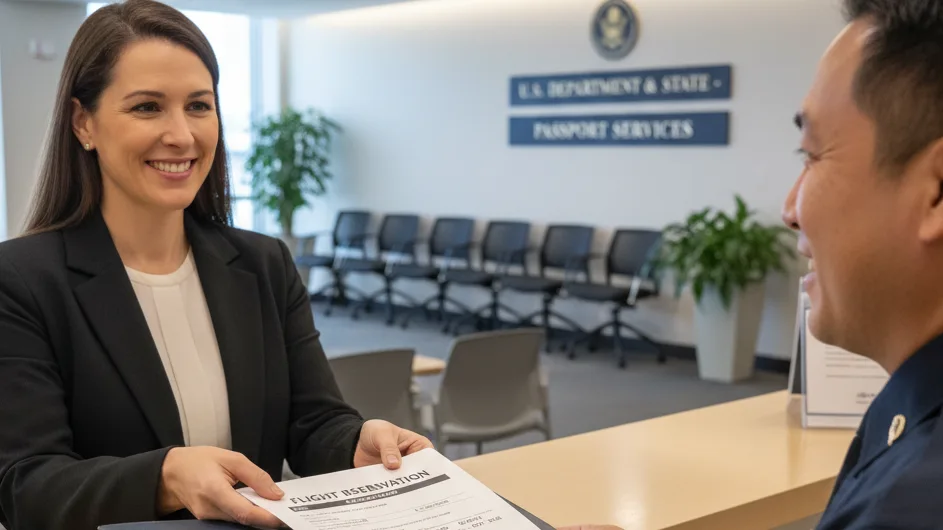
Short answer: When company travel approval is still pending, prepare a truthful flight reservation for visa only when the destination checklist permits it. Match the passenger name, route, dates and return or onward plan to the invitation, leave approval and stated business purpose. Explain that the employer’s final booking depends on internal approval; a reservation can support travel proof but cannot guarantee approval, boarding or entry.
Company travel approval and a visa appointment rarely move at the same speed. A consulate may ask for an itinerary before finance or a travel desk is authorised to buy the final ticket. That timing gap does not justify inventing a booking: it calls for a clear, provisional record that says what is known, what remains pending and which dates the applicant can support.
Use the route that your invitation, employer letter, leave plan, accommodation and insurance can explain. If approval later changes the dates or cities, update the file rather than letting an outdated reservation contradict the final plan.
Key facts
- Internal approval is not the same as a paid ticket or a visa decision.
- Every name, date, airport and connection should match the rest of the file.
- A provisional employer or invitation letter can explain why final ticketing is pending.
- The destination checklist controls whether a reservation is acceptable travel proof.
- Keep a record of what was submitted and replace it if the approved plan changes.
What each document proves
- Invitation letter: business purpose, host and proposed meeting dates; it does not prove that the employer has purchased travel.
- Provisional employer letter: role, approval status, funding or leave position and expected return ties; it does not become a ticket.
- Temporary reservation: route and dates where the checklist permits provisional proof; it is not a visa, payment receipt or entry permission.
- Final e-ticket: the later purchase made after the company authorises travel, subject to the carrier’s terms.
US and India perspective
Applicants in India may receive document-centre instructions through VFS or a destination-specific portal, while US applicants may work from the relevant consular checklist. Those processes differ, so use the destination’s current instructions rather than assuming that a reservation is accepted everywhere.
For a broader explanation of the document type, start with the complete flight reservation for visa guide before choosing dates or submitting a hold.
Official-source check: The destination embassy or consulate controls the business, tourist or student-visa checklist. For US examples, verify current State Department visa guidance and visa-service fees; use the IATA Travel Centre for current airline-facing passport and visa checks. A pending company approval does not itself make a reservation acceptable everywhere.
Your visa appointment is confirmed. Your company's travel approval is not. This gap catches thousands of business travelers off guard every year, especially those heading to a business conference or client meeting on a tight visa submission window.
Embassies do not pause their calendars while your finance team finishes budget sign-off. You still need a flight itinerary showing real travel dates, without paying for a ticket your employer has not cleared yet. The real decision here is not whether you need proof of travel. It is how you build a reservation that satisfies visa requirements while your internal approval catches up. Lock in a verifiable flight itinerary with a temporary flight reservation before your appointment date arrives.
For a plain-language explanation of how this document type is used, see what a dummy ticket means; acceptance still depends on the destination checklist and your actual travel evidence.
When Company Approval Lags Behind Your Visa Appointment Clock

A visa appointment slot and a corporate approval workflow answer to two completely different clocks. One moves on embassy calendars set weeks or months in advance. The other moves on your manager's inbox, your finance team's budget cycle, and however many signatures your company's travel policy demands. Understanding this mismatch early is the first step toward not losing time you can't get back later.
Why HR And Finance Timelines Rarely Match Embassy Deadlines
Corporate travel approval usually runs through several checkpoints. Your manager signs off on the purpose of the trip. Finance confirms a budget code exists. In some companies, a travel desk or procurement team has to log the trip before anyone books anything. None of these steps care about your visa appointment.
Each checkpoint also has its own bottleneck. A manager might be traveling and slow to respond to an approval email. Finance might be closing the quarter and deprioritizing new travel requests. A procurement team might require three quotes for flights before releasing a budget code, even when nobody intends to book those flights until much later. Stack two or three of these delays together, and a request that should take three days can easily stretch past three weeks.
Meanwhile, your visa application moves on its own track entirely. Processing times, appointment availability, and document checklists depend on the destination country, your nationality, and the specific visa category you're applying under. Requirements vary from one embassy to another, and a slow week at the consulate can push your visa decision back even further.
Neither clock adjusts for the other. Embassies process applications in the order they arrive, and most have no mechanism to prioritize a case simply because the applicant's employer is running behind on internal sign-off. Your visa officer has never heard of your company's approval matrix, and has no reason to care about it.
When your employer's internal chain stalls, your visa submission date does not wait for it. You're often left holding a confirmed appointment with no confirmed trip to attach to it. That's the exact situation this guide is built around, and it's more common than most employees realize until they're staring down a deadline.
Signs Your Company Approval Is Taking Longer Than Usual
A few patterns tend to show up before an employee realizes their travel approval is genuinely stuck rather than just running a day or two behind:
-
Your manager keeps saying "still checking with finance" without a timeline attached.
-
HR or finance asks for a second round of cost justification after you thought approval was close.
-
The business conference organizer shifts the event dates, and your internal request has to be resubmitted.
-
No purchase order or travel booking reference has been issued, even informally.
-
A provisional letter your employer promised to send keeps getting delayed by another department.
-
Your company's travel policy requires a director-level sign-off, and that person is out of office during the exact window you need approval.
-
You've been told the trip is "basically approved," but nobody has put it in writing.
If two or more of these apply to your situation right now, it's worth assuming your approval will not land before your visa appointment. Planning around that assumption early saves you from a last-minute scramble later.
None of these signs mean your trip is at risk of being cancelled outright. Most pending approvals do eventually clear, often within a reasonable window. The issue isn't whether approval will come through; it's whether it will come through before your visa appointment date, which is a much narrower and less forgiving question. Treating the two as separate risks, rather than assuming one automatically resolves the other, is what keeps you from being caught off guard.
The practical response isn't to chase your manager for a faster answer, since that rarely speeds up a finance cycle. It's to start preparing the parts of your visa application that don't require your employer's final word, starting with a flight itinerary you can put together independently.
What Happens If You Wait For Sign-Off Before Applying
Many applicants assume the safest move is to simply wait until their company confirms everything before starting the visa process. In practice, this often backfires. Visa appointment slots for popular destination countries can be delayed by weeks during busy seasons, and a slot you lose today may not reopen for a month.
Consider an employee in Mumbai invited to a business conference in the UK. Her manager verbally approves the trip but tells her the formal sign-off "should" come through in ten days. If she waits for that email before booking her visa appointment, she risks applying so close to her departure date that even a routine visa decision does not arrive in time.
Ignoring how long visa processing genuinely takes is one of the most common planning mistakes among business travelers, and it rarely has anything to do with the strength of their application. It has to do with sequencing. Applicants from India, and from many other countries with high visa demand, are especially exposed to this timing squeeze because appointment slots for popular destination countries fill up fast.
A similar pattern shows up with employees whose trips route through different countries on the same itinerary. A consultant traveling from Delhi to a client site in Germany with a connecting business meeting in the UK might need two separate visa applications, each with its own timeline and its own document checklist. Waiting for a single, unified company approval before starting either application only compounds the delay, since both consulates are working against their own independent calendars.
There's also a quieter cost to waiting that many applicants underestimate: the compressed timeline that results from a late start rarely leaves room for corrections. If an embassy asks for an additional supporting document or flags an inconsistency, an applicant who started early has time to respond. One who waited until approval finally cleared often doesn't, and a fixable issue turns into a missed trip entirely.
The workaround isn't to skip your visa submission until everything is locked. It's to separate the parts of your application that genuinely depend on company approval from the parts that don't, starting with your flight itinerary.
For route, city-order and date consistency, compare the file with the visa flight itinerary requirements guide before finalizing the provisional route.
Building A Flight Itinerary That Does Not Depend On Final Sign-Off
Your flight itinerary is one of the few application pieces you can prepare independently of your employer's internal approval chain, as long as you build it the right way. This is where a stalled sign-off stops being a blocker and starts being simply a background process you no longer need to wait on.
Why A Temporary Reservation Fits An Unconfirmed Business Trip
Embassies accept temporary reservations for visa applications precisely because they understand that most travelers, business or leisure, are not going to pay in full for a flight before knowing whether their visa will be approved. A flight reservation can be a temporary, verifiable itinerary that shows your intended travel dates without requiring full payment.
This distinction matters more when your trip itself is still pending internal sign-off. A dummy ticket, legal for embassy use in the vast majority of jurisdictions, gives you a real booking reference and real flight numbers tied to your travel dates, without asking you to commit your own money, or your company's, to a trip that might still shift.
Blocked tickets work differently from a confirmed booking. A blocked reservation is made without payment and simply holds your seat and itinerary details in the airline's system for a defined window. A confirmed ticket, by contrast, is fully paid and typically only makes sense to buy once your visa approval and your company's authorization are both final.
This is worth repeating because it's the exact tension a pending company approval creates. You can't confirm a real booking without your employer's authorization, but you also can't wait for that authorization without risking your visa submission. A temporary reservation resolves both problems at once, giving your visa file a real, checkable itinerary while leaving the financial decision untouched until your company actually says yes.
It also removes a subtle pressure many applicants don't notice until it's too late: the temptation to nudge your manager toward a rushed approval just to justify booking a real ticket in time. Separating the visa document from the financial commitment takes that pressure off the table entirely, letting your company's approval process run at whatever pace it needs to.
Choosing Dates That Still Hold Up If The Conference Shifts
Because your trip hasn't received final internal approval, there's a real chance the dates could still move. Build some cushion into your flight itinerary rather than locking it to the exact conference agenda published today.
A few practical habits help here:
-
Set your departure date a day or two before the event actually starts, giving you a buffer if approval finalizes later than expected.
-
Choose a return date that matches a reasonable, logical business trip length rather than the bare minimum, so the itinerary doesn't look rushed or improvised.
-
Avoid picking flight numbers or routings tied to a specific promotional fare that can't easily be recreated if you need to adjust dates later.
-
Leave at least a small window between your return date and any hard deadline back home, such as a Monday-morning meeting, so a minor shift in approval timing doesn't create a second scheduling problem.
None of this requires guessing. It just means treating your reservation as a placeholder built around realistic assumptions, not a locked commitment.
Take an example: a product manager based in Delhi is invited to a business conference in Berlin scheduled for the third week of next month. Her company's approval is expected "soon," but the conference organizers have already changed the agenda once. Rather than building her itinerary around the exact published dates, she sets her departure a day earlier and her return two days after the conference ends, giving her enough room to absorb either an agenda shift or a slightly delayed approval without needing to touch her flight itinerary at all.
This kind of buffer costs nothing extra when you're working with a temporary reservation, since you're not paying for the additional days, only reflecting them in the itinerary itself. It's a small adjustment that quietly removes one of the more common reasons applicants end up needing to renew or replace their reservation later.
Keeping Your Itinerary Flexible Enough For A Later Rebooking
The whole point of using a temporary reservation while your company approval is pending is flexibility. You want a document that satisfies your visa submission today, without boxing you into dates that no longer work once your employer finally confirms the trip.
This is where a dummy ticket booking has a practical edge over trying to hold a real airline reservation yourself. A dedicated service can reissue your itinerary with new dates for a small fee if your company approval lands later than planned, without touching your bank account or your corporate card. You get a fresh PNR, a fresh PDF, and a document that still lines up with whatever your visa application already stated, adjusted only where it needs to be.
Trying to hold a real airline reservation on your own, by comparison, is far less forgiving. Most airlines only hold seats without payment for a matter of hours, and few offer any flexibility once that window closes. If your company approval takes longer than expected, you'd be stuck rebooking a fresh reservation from scratch, often at a different fare, rather than simply extending or adjusting a document you already have.
There's a secondary benefit worth mentioning too. Because your itinerary isn't tied to real money, you're free to submit your visa application the moment your appointment slot opens, rather than waiting until you feel financially ready to commit. That single shift, decoupling your visa timeline from your payment timeline, is often what turns a stressful pending-approval situation into a manageable one.
Once your flight itinerary is solid, the next question most applicants face is how to explain the pending approval itself, and an invitation or provisional letter often does more work here than people expect.
What An Invitation Letter Can Do When Your Employer Has Not Approved Yet

An invitation letter is not just a formality for business visa applicants. When your own company's travel approval is still pending, it can carry more weight in your application than almost any other single document, since it comes from a source entirely outside your own employer's internal delays.
Using The Host Company's Invitation To Bridge The Approval Gap
If you're traveling for a business conference, client visit, or partner meeting, the inviting organization can usually issue an invitation letter well before your own employer finishes internal sign-off. This letter typically confirms the purpose of your visit, the dates involved, and sometimes even covers logistics like a hotel reservation made on your behalf.
This document does something useful for your visa submission: it demonstrates that a real business purpose exists, independent of whether your own company has finished its internal paperwork. Most embassies require proof of travel intent for business visa applications, and a signed invitation letter from a credible host organization goes a long way toward satisfying that.
Ask the host organization to include specific, verifiable details rather than a generic invitation template. A letter naming the exact business conference, the venue, and your role in attending, whether you're presenting, exhibiting, or simply attending as a delegate, reads far more credibly than a short note that only says you're welcome to visit. If the host is also covering part of your trip, such as a hotel reservation or local transport, having that spelled out in writing removes ambiguity from your financial documentation as well.
It helps to request this letter early, even before your own company approval shows real movement. Host organizations that regularly deal with international attendees, particularly for recurring events, are usually well practiced at issuing these letters quickly once you confirm your intent to attend, which makes this one of the fastest documents to secure while everything else is still in motion internally.
Keep in mind that the host's invitation letter and your own flight itinerary need to agree on your intended dates, even though they come from entirely separate sources. If the host confirms your attendance for specific conference days, build your temporary reservation around that same window rather than a rough estimate, so the two documents reinforce each other instead of leaving a gap for an officer to question.
What A Provisional Letter From Your Own Employer Should Include
Alongside the host's invitation, a provisional letter from your own employer can help explain the situation honestly rather than leaving a gap in your supporting documents. Obtaining a provisional letter from an employer, even before final budget approval, can support a visa application by confirming your role, your reason for travel, and your intent to return to your position afterward.
A useful provisional letter usually covers:
-
Your job title and how long you've worked at the company.
-
Confirmation that the trip has been requested and is under active review.
-
Your expected travel dates, matching what's on your flight itinerary.
-
A statement that your position and salary continue during the trip, reinforcing your ties to your home country.
This letter doesn't need to promise a fully paid ticket or a confirmed booking. It just needs to show the visa officer that your travel plans are grounded in a real employment relationship, not something fabricated to get through the counter.
Wording matters more than most applicants expect. A provisional letter that says "the company is reviewing this trip" reads as honest and low risk. One that overstates the situation, claiming a firm approval that doesn't actually exist yet, creates a problem if an officer ever cross-references it against other information, such as a follow-up call to your employer's HR line. Keep the letter factual, even where the facts include some uncertainty.
If your company uses a formal HR system to log travel requests, ask whether a screenshot or export of that pending request can accompany the letter. This small addition gives visa officers something concrete to look at beyond a paragraph of text, and it reinforces that your request is genuinely moving through a real internal process rather than existing only on paper for the visa file.
When Embassies Expect Both Documents Together
Some destination countries are stricter about pairing an invitation letter with proof of your own company's involvement, particularly for business visa categories tied to conferences or trade events. Others accept the host's invitation on its own, treating your flight itinerary and travel insurance as sufficient supporting evidence.
Because requirements vary this much by embassy, it's worth checking the specific checklist for your destination country before assuming one document will cover you. In many cases, submitting both letters together, even when one is only provisional, gives visa officers a clearer, more complete picture than submitting either document alone.
No single document decides your outcome on its own, and that's worth remembering if one piece of your file feels incomplete. A provisional employer letter paired with a strong invitation letter and a verifiable flight itinerary is often enough, even if none of the three individually reads as a finished, fully confirmed record of the trip. Officers are generally looking at the whole picture your supporting documents create together, not searching for one document that settles every question by itself.
If you're unsure which combination your specific embassy expects, checking recent guidance directly on the consulate's own website is more reliable than relying on general advice, since even neighboring consulates handling the same visa category can differ in what they ask applicants to submit.
With your invitation and provisional letters lined up, the next step is understanding how business visa categories actually treat a trip that technically hasn't been internally approved yet.
Reading Business Visa Requirements Through The Lens Of An Unapproved Trip
Business visa categories are built around the assumption that employer-sponsored travel involves some paperwork lag. Understanding how that assumption plays out at different embassies helps you avoid submitting a weaker application than necessary. This distinction is worth knowing early, since it shapes how much you need to explain, and how much simply gets assumed by the officer reviewing your case.
How Business Visa Categories Differ From Tourist Visa Expectations
A tourist visa application typically expects a clean travel itinerary built around personal plans that rarely change once submitted. A business visa application works differently. Visa officers reviewing business visa cases already expect some level of employer coordination, sponsorship, and back-and-forth that a personal trip wouldn't involve.
This works in your favor when your company approval is still pending. Many embassies do not require a fully paid ticket for a business visa application, understanding that most professionals wait until their visa is approved before committing to a confirmed flight booking. What they do expect is a coherent, verifiable set of travel arrangements: a flight itinerary, an invitation letter, and enough supporting documents to make your business purpose credible.
A tourist visa reviewer, by contrast, often puts more weight on personal ties, such as your home country address, family situation, or leave records at work, since there's no employer sponsorship narrative to lean on. A business visa applicant carries a different kind of built-in credibility: the trip exists because a company, not just an individual, has a reason for it to happen. That structural difference is exactly why pending internal approval reads less alarmingly on a business visa file than it might on a personal one.
This doesn't mean business visa applications get a free pass on documentation. It means the specific gaps an officer is watching for shift. Instead of questioning whether you'll return home, a business visa officer is more likely to focus on whether your trip, your invitation, and your employer's role in it all line up consistently.
This shift in focus is worth internalizing, because it changes how you should prioritize your prep time. Rather than spending most of your effort proving personal ties to your home country the way a tourist visa applicant might, put that same effort into making sure your employer's role in the trip, however incomplete it currently looks on paper, comes across as consistent and credible across every document you submit.
It's also worth understanding what happens once your visa is granted and your company's approval has finally cleared. At that stage, most applicants move from a temporary reservation to confirmed flight tickets, purchased only once both the visa decision and the internal budget sign-off are settled. Framing your current temporary itinerary as step one of that same sequence, rather than a workaround you're improvising, helps the whole process feel less uncertain to explain, both to your employer and to a visa officer if asked.
Why Some Consulates Are More Lenient With Corporate Applicants
Consulates that process large volumes of business visa applications, especially those tied to major trade shows or recurring corporate travel routes, tend to build in more tolerance for provisional documentation. They've seen enough legitimate corporate trips delayed by internal approval processes to recognize the pattern rather than treat it as suspicious.
That said, leniency is not universal. Embassies generally advise against buying tickets before visa approval regardless of visa category, and officers still expect your travel dates, flight numbers, and destination country to line up consistently across every document you submit, whether your trip is corporate or personal.
Consulates handling high volumes of applications from the same industry, such as technology or manufacturing hubs with regular trade delegations, tend to develop informal familiarity with how those companies typically structure travel approval. That familiarity can work in your favor, but it isn't something to rely on outright. Many applicants come from smaller companies or industries the consulate sees less often, where an officer has no prior pattern to compare your application against, so building a clean, self-explanatory file still matters more than hoping for institutional leniency.
What Schengen Countries Expect From Business Travelers Specifically
If your itinerary takes you into the Schengen area, the expectations shift slightly. A Schengen visa application usually asks for a complete travel itinerary covering your full stay, including entry and exit dates, even when you're only visiting one country within the group. Schengen countries also tend to expect travel insurance meeting a minimum coverage threshold, submitted alongside your flight itinerary and invitation letter.
The UK, by contrast, runs its own visa system entirely separate from the Schengen area, with its own document checklist and its own processing timelines. If your trip involves connecting through multiple destinations, especially those in different countries with separate visa regimes, it's worth confirming each country's specific requirements rather than assuming one itinerary format satisfies every embassy on your route.
A Schengen visa also expects your itinerary to account for every country you'll physically enter during the trip, not just the country hosting your business conference. If your pending company approval eventually adds a short client visit in a second Schengen country partway through your stay, your flight itinerary and travel insurance both need to reflect that full route once your plans are locked, rather than only the original single-country trip you first applied under.
Once you understand how your specific visa category treats a pending trip, the next practical concern is money, and how much of it you should actually put on the line before your company confirms anything.
The Financial Risk Of Booking Before Your Company Confirms The Trip
Spending your own money, or your company's, on a fully paid ticket before internal approval is finalized creates a financial exposure that a temporary reservation avoids entirely. Here we walk through exactly what that exposure looks like in practice, and why it rarely pays off to skip ahead of your company's own sign-off timeline.
What You Lose If You Buy A Non-Refundable Ticket Too Early
A non-refundable ticket bought before your company confirms the trip puts you in a difficult position on two fronts. If your visa is denied, you've paid for a flight you can't use. If your employer's approval falls through, or the conference gets cancelled, or the dates shift beyond what your fare rules allow, you're absorbing that financial commitment personally, with little recourse.
Applicants are generally advised against purchasing non-refundable tickets before visa approval for exactly this reason, and that advice applies even more strongly when the trip itself hasn't cleared internal sign-off yet. You'd effectively be taking on financial risk tied to two separate uncertain outcomes at once: your visa decision and your company's authorization, rather than just one.
Some employees try to solve this by booking the ticket on a personal card and expecting reimbursement once approval clears. This adds a third layer of risk on top of the visa decision and the company sign-off: whether your employer's expense policy will actually reimburse a booking made before formal authorization existed. Many companies explicitly exclude pre-approval purchases from reimbursement, which means you could end up covering a cancelled trip entirely out of pocket, even if your visa was approved and your company eventually confirmed the trip through other means.
Consider a sales manager based in Delhi who buys a discounted airline ticket to a client conference in Amsterdam while her director is still finalizing budget approval. The conference gets postponed by six weeks after a venue issue on the organizer's side. Her fare rules don't allow a free date change, and her director's approval, once it finally arrives, is for the new dates rather than the ones she already paid for. She's now out the cost of a ticket that no longer matches an approved trip in either direction. A temporary reservation would have let her wait out that uncertainty without any of that exposure.
Why Full Payment Before Approval Rarely Makes Sense
Embassies generally advise against buying tickets before visa approval in the first place, since a denied application leaves travelers holding an unusable, fully paid booking. Layer a pending company approval on top of that, and full payment becomes even harder to justify.
Most embassies require proof of travel intent, not proof that you've already spent money on the trip. A flight reservation shows intended travel dates without requiring full payment, which is exactly the balance you want to strike while both your visa outcome and your internal approval remain open questions.
This is worth explaining to a manager or finance team that pushes back on the idea of applying before approval is final. Their concern is usually financial, worrying that an early visa submission implies an early financial commitment. Once they understand that a flight itinerary can satisfy the visa requirement without a single rupee, dollar, or pound actually being spent, the internal conversation tends to get much easier.
It also helps to have a straightforward answer ready if a colleague or manager asks how you can submit proof of travel without an approved budget. The honest explanation is simple: a temporary flight reservation is designed exactly for this gap, giving embassies a real, checkable document while leaving every financial decision untouched until your company formally signs off.
How A Refundable Or Held Reservation Limits Your Exposure
Refundable tickets reduce financial risk if a visa is denied, but they typically cost significantly more than a standard fare, which defeats the purpose if your company hasn't approved a budget for the trip yet. A held or temporary reservation solves this more cleanly.
A dummy ticket booking usually involves a small fee rather than the full ticket price, giving you a verifiable itinerary for your visa submission without tying up capital in a trip that isn't finalized. It's worth being careful here, though: it is important to avoid fake or fabricated reservations that can't be verified through airline systems, since a document that fails verification creates far more risk than the temporary financial exposure it was meant to avoid. A legitimate temporary reservation, sourced properly, keeps your exposure limited to that small fee until your company gives the final go-ahead.
Compare the numbers directly, and the choice becomes clearer. A refundable economy fare on a competitive international route can run several times the price of a standard ticket, purely for the option to cancel later. A temporary reservation, by contrast, typically costs a small, fixed fee regardless of the route or airline involved, since you're paying for a verifiable document rather than an actual seat allocation. For an employee whose company hasn't even confirmed a travel budget exists yet, that difference is the entire point.
There's a version of this decision that comes up often enough to name directly: an employee who's confident their trip will be approved eventually, and considers buying a refundable ticket now just to feel like progress is being made. It's worth resisting that instinct. Confidence in an eventual approval doesn't change the math. The cost difference between a refundable fare and a temporary reservation stays the same whether the approval is likely or uncertain, and there's rarely a good reason to pay that premium before you actually need to.
With the financial side under control, the next practical concern is timing, since a temporary reservation only helps you if it stays valid long enough to matter.
Timing Your Flight Reservation Around An Approval That Could Still Change
A temporary flight reservation is only useful for as long as it stays valid, which means timing your booking against both your visa appointment and your company's approval timeline takes some coordination. Get this part right, and the rest of your application stays clean; get it wrong, and you risk the exact document doubt this entire approach was meant to avoid.
How Long A Temporary Reservation Typically Stays Valid
Reservations can expire anywhere from 48 hours to 14 days, depending on the service used and the airline's own hold policies. Some services default to a standard window of around seven days, which works well if your visa appointment is scheduled within that range but can create problems if your approval, or your appointment date, gets pushed further out.
Monitoring PNR validity is essential for temporary flight reservations, especially when your company approval timeline is genuinely uncertain. Submitting expired itineraries can lead to visa rejection, or at minimum, a request for updated documents that slows your application down further.
It helps to treat your reservation's expiration date the same way you'd treat a bill due date, something worth marking on a calendar the moment you receive it rather than something to check on only when you happen to think of it. Since your company's approval timeline is largely out of your hands, the validity window on your reservation is one of the few dates in this entire process you can actually control and plan around directly.
This matters just as much for your return dates as it does for your departure. Some applicants focus only on keeping their outbound flight valid and forget that the return portion of their itinerary carries equal weight in a visa officer's review. A reservation with a stale, technically expired return leg looks just as inconsistent as one with an expired departure, so treat both directions of your itinerary as needing the same attention.
What To Do If Your PNR Expires Before Approval Comes Through
If it becomes clear your company approval won't land before your current reservation expires, don't wait until the booking reference stops working to act. Reach out to whichever service issued your temporary reservation and request a renewal or reissue before the expiration date, keeping your flight numbers and flight details consistent with what you already submitted wherever possible.
Cancellable reservations may include airline hold options that extend this window slightly, but these vary by airline and route, so it's worth confirming directly rather than assuming every itinerary qualifies.
If your visa application has already been submitted with your original reservation and only your company approval remains pending, you don't necessarily need to resubmit anything to the embassy just because the reservation itself later expires. Many consulates only reference the itinerary at the point of submission and again briefly at the interview stage. Still, keep a current, unexpired version on hand in case an officer asks for an updated copy, particularly if your visa decision is taking longer than the original booking's validity window.
Set yourself a simple rule of thumb: renew a few days before expiration rather than waiting until the last possible moment. Reservation services can usually turn around a reissue quickly, but treating it as urgent only once the old document has already lapsed adds unnecessary stress to a process that doesn't need to be stressful at all.
Renewing Or Replacing A Reservation Without Raising Red Flags
When you do need to renew a reservation, keep a few things consistent to avoid creating discrepancies in your file:
-
Match your new travel dates to the same general timeframe you originally submitted, unless your company's confirmed dates have genuinely changed.
-
Keep your departure and return airports the same, even if the specific flight numbers shift slightly between reservations.
-
Choose logical layovers and routing that resemble a real, bookable itinerary rather than an unusual combination that looks generated purely to satisfy a document requirement.
-
Keep a dated copy of each version of your reservation, so if anyone asks why a document was updated, you can show a clear, simple timeline rather than an unexplained change.
A flight reservation should be verifiable to reduce document doubt, and that verifiability matters just as much on your second or third reservation as it did on your first. Airlines like Lufthansa, Emirates, and other major international carriers are commonly used for these reservations precisely because their flight numbers and schedules are easy to verify and rarely change on short notice, which keeps a renewed itinerary looking as stable as the original.
Even a low-cost airline may charge a cancellation fee if you ever do decide to convert a held reservation into a real booking and later need to adjust it, so it's worth checking a carrier's change policy before treating any itinerary as fully interchangeable with another.
None of this is complicated once you build the habit, but it does require treating your temporary reservation as an active document that needs occasional attention, rather than a one-time task you complete and forget about until your visa decision arrives.
A short weekly check, glancing at your reservation's expiration date alongside any update on your company's approval status, takes less time than most people expect and removes almost all the risk of an itinerary quietly lapsing while your attention is elsewhere. Given how much of this process depends on factors outside your control, this is one habit that stays entirely within your control.
Once your itinerary is properly timed and renewed as needed, it's worth understanding exactly what a visa officer is actually looking at when they review your flight details.
What Visa Officers Actually Check In Your Flight Details
Visa officers don't just glance at your flight itinerary and move on. Several specific details get cross-checked against the rest of your application, and inconsistencies here are a common, avoidable source of delay. Knowing what actually gets checked helps you build an itinerary that survives that scrutiny the first time, rather than triggering a follow-up request.
Matching Flight Numbers And Dates To The Rest Of Your Application
Flight dates must match your visa application to avoid raising doubt, and this applies to every document that references your travel window, not just your itinerary. If your invitation letter cites one set of dates, your provisional employer letter cites another, and your flight itinerary shows a third, that inconsistency becomes the officer's focus instead of your actual case.
This kind of mismatch happens more easily than most applicants expect, especially when documents are gathered over several weeks from different sources while a company approval drags on. A host organization might issue an invitation letter early, based on the original conference dates, while your own provisional letter gets drafted later, after a minor schedule adjustment. Left unreconciled, these small drifts accumulate into exactly the inconsistency an officer is trained to notice.
Flight itineraries must match your other supporting documents for credibility, right down to small details like the destination airport matching the city named in your invitation letter. A mismatch doesn't automatically mean rejection, but it does invite additional scrutiny that slows down your visa decision.
Before submitting, it's worth doing a simple side-by-side read-through of every document in your file: your visa application form, your invitation letter, your provisional employer letter, and your flight itinerary. Check that the destination city, the arrival and departure dates, and even the spelling of your name match exactly across all of them. This takes a few minutes and catches the kind of small, easily fixed error that otherwise turns into a delay at the counter.
When you submit proof of your travel plans, treat the flight itinerary as the anchor document that everything else needs to agree with, rather than one item on a checklist that stands alone. A well-sourced dummy ticket, one that's genuinely accepted by the embassy you're applying to, only helps your case if every surrounding document tells the same consistent story.
Why Layovers And Routing Choices Matter More Than Applicants Think
An itinerary with illogical layovers, like a routing that backtracks geographically for no clear reason, can look artificially generated rather than like a real trip someone would book. Visa officers who review large volumes of applications tend to notice these patterns quickly.
Choosing a route with logical layovers, ideally one that resembles how you'd actually travel between your home country and your destination country, makes your reservation blend in as a normal, credible booking rather than standing out as something built purely to satisfy a checklist.
A traveler flying from Mumbai to a client site in Frankfurt, for example, would typically connect through a major Gulf or European hub rather than routing through an unrelated region on the other side of the world. Reliable reservation providers already default to these standard, commercially sensible routes for exactly this reason, so this is rarely something you need to research yourself, but it's worth glancing at your itinerary once to confirm the routing looks like something a real traveler would actually book.
The same logic applies to timing between connections. A layover of twenty minutes at an unfamiliar airport, or one stretching past ten hours for no operational reason, both raise the same kind of quiet doubt in an experienced officer's mind. A realistic connection window, similar to what you'd see on any commercial airline's own booking engine, keeps your itinerary looking exactly like what it's meant to represent: a plausible, bookable trip.
How Officers Cross-Check Reservations Through Airline Systems
Embassies may verify flight reservations through airline systems, checking that the booking reference and flight numbers you've submitted correspond to a real, active reservation. This is exactly why it is important to avoid fake or fabricated reservations, since a document that fails this kind of check does far more damage than a temporary reservation ever would.
A dummy ticket sourced from a legitimate provider, one that generates a real PNR recognized in the airline's system, holds up to this kind of verification without issue. That verifiability is the entire value of using a proper reservation service rather than trying to fabricate a document independently.
This is also where a pending company approval can quietly work against an applicant who cuts corners. Faced with time pressure, some employees are tempted to create a rough itinerary themselves using a flight number and date copied from an airline's schedule page. These fabricated documents rarely include a real, checkable booking reference, and they fail exactly the kind of verification embassies increasingly rely on. The time pressure created by a slow company approval is a reason to move quickly through a legitimate provider, not a reason to skip verification altogether.
The good news is that this whole category of risk is entirely avoidable. Choosing a reservation service that issues a genuine PNR, rather than a static document that only looks like a booking, removes the verification question from your list of concerns completely, leaving you to focus on the parts of your application that actually need judgment calls.
Getting your paper trail right is only half the process. Many business visa applicants also have to explain their situation out loud, in a visa interview, and that conversation deserves its own preparation.
Handling The Visa Interview When Your Trip Is Still Technically Pending
If your visa category requires an interview, you'll likely need to explain your employer's pending approval directly to an officer, and how you frame that explanation matters. A confident, well-prepared answer here often does more for your application than any single document in your file.
Explaining A Pending Company Approval Without Sounding Uncertain
The goal in a visa interview isn't to hide that your company approval hasn't fully cleared. It's to explain the situation in a way that sounds like normal corporate process rather than personal uncertainty about the trip itself.
A steady, factual explanation works better than an apologetic one. Something like: "My attendance at the conference has been requested by my manager, and the formal budget sign-off is in its final stage internally" gives the officer a clear, confident picture without overexplaining or sounding unsure about whether the trip is happening at all.
Avoid over-apologizing for the gap or volunteering extra detail about internal disagreements, budget concerns, or scheduling drama at your company. None of that is relevant to your visa decision, and adding it only invites follow-up questions that pull the conversation away from your actual travel plans. Keep the explanation short, confident, and limited to the facts the officer actually needs.
A useful mental model here is to treat the interview the way you'd treat a status update to a client whose project is slightly behind schedule. You wouldn't dwell on internal friction or uncertainty; you'd state where things stand, what's still pending, and when it's expected to resolve. Visa officers respond to that same tone far better than to hesitation or excessive explanation.
Tone matters as much as content in this part of the interview. An applicant who pauses too long, second-guesses their own answer, or repeats "I think" before every sentence signals uncertainty even when the underlying situation is perfectly normal. Practicing your explanation once or twice beforehand, even just silently in your head on the way to the appointment, tends to smooth out exactly this kind of hesitation.
Questions Officers Commonly Ask About Employer Sponsored Trips
A few questions tend to come up specifically for business visa applicants whose trips involve employer sponsorship:
-
What is the purpose of your visit, and who invited you? Answer with the specific business conference or meeting name, matching your invitation letter exactly.
-
Who is paying for your flight and accommodation? Be honest about your company's role, even if final payment hasn't been processed yet.
-
What is your role at your company, and how long have you worked there? This ties directly to the ties-to-home-country argument your application is making.
-
When do you plan to return? Your answer should match the return date on your flight itinerary precisely.
-
Has your employer confirmed the trip in writing? If not fully, mention the provisional letter and where the approval currently stands, without hedging or sounding unsure.
-
Do you have travel insurance arranged for the trip? Even a placeholder policy that you plan to finalize once dates lock is a reasonable answer, as long as you say so clearly.
Rehearsing these answers out loud beforehand, even briefly, helps more than most applicants expect. An answer that sounds natural and immediate carries more weight than one that feels recalled from a script, and a pending approval is exactly the kind of detail that can make an underprepared applicant stumble if they haven't thought through how to phrase it.
If the officer asks a question you genuinely don't have a confident answer for yet, such as the exact final travel dates your company will confirm, it's better to give your best current estimate clearly than to freeze or guess wildly. Something like "the dates I've applied under reflect the conference schedule, and my company's final sign-off is expected to confirm those same dates" keeps your answer grounded without pretending to know something you don't.
What To Say About Your Return Date And Exit Plan
A round-trip itinerary supports your intention to leave the destination country after your visit concludes, and your interview answers should reinforce that same message. Be specific and consistent about your return date, your ongoing job responsibilities back home, and any commitments, like a follow-up meeting or a family obligation, that naturally pull you back.
Avoid vague answers about "seeing how the trip goes" or leaving your return plans open-ended. Even with company approval still being finalized in the background, your entry and exit plan should sound settled and specific in the interview room.
If asked directly what happens should your company's plans change after you land, a simple, honest answer works best: your return flight is booked for a specific date, and any change to your itinerary would go through the same employer-approved process that authorized the original trip. This shows the officer that even the uncertain parts of your situation are governed by a process, not left open-ended.
A calm, consistent answer about your return plans does more work in a short interview than any single document in your file. It's the part of the conversation most directly tied to the core question every visa interview is really asking: whether you intend to go home, and it deserves the same preparation as any question about your employer or your itinerary.
Once your visa decision comes through and your employer finally signs off, a few practical steps turn your temporary paperwork into a real, bookable trip.
When approval arrives and finance is ready to book, the BookForVisa reservation service can help keep the final booking aligned with the travel plan you documented.
What Changes Once Your Company Finally Confirms The Trip
Once approval lands, whether that's the same week you applied or right up against your departure date, the process shifts from temporary documentation to finalizing real travel arrangements. This is the payoff for handling the pending-approval period carefully: a clean transition rather than a scramble.
Converting Your Temporary Reservation Into A Confirmed Booking
With your visa approved and your company's sign-off finalized, it's time to convert your reservation into a confirmed flight booking. A confirmed ticket is fully paid and used after visa approval, which is exactly the sequence this entire approach was designed to protect. You now know your visa decision, your exact travel dates are locked, and your company has authorized the spend, so paying in full carries none of the earlier uncertainty.
If your original temporary itinerary is still within its validity window, many travelers simply confirm the same flight numbers and routing they already used for their visa submission, keeping the transition seamless and avoiding any last-minute date confusion.
Loop your travel desk or finance team in as soon as approval clears, rather than booking on a personal card and sorting out reimbursement later. Since your company has now formally authorized the trip, this is the point where their standard travel booking process, whatever platform or vendor they normally use, should take over cleanly. Keep your visa approval and your original flight itinerary on hand during this step, since some internal booking systems ask for the visa reference number before releasing payment for international travel.
This final step is also where the earlier caution around non-refundable fares stops applying quite so strictly. With your visa decision settled and your company's authorization in hand, purchasing confirmed flight tickets, even non-refundable ones if your company's travel policy prefers the lower fare, no longer carries the same layered risk it did while approval was still pending. The uncertainty that justified a temporary reservation in the first place has been resolved.
It's worth pausing here to appreciate what the temporary reservation actually accomplished. It let your visa application move forward on schedule, kept your finances untouched through weeks of internal uncertainty, and gave you a clean, verifiable document the entire time. Converting to a confirmed booking now is simply the last, straightforward step in a process that stayed low-risk from start to finish.
Adjusting Your Hotel And Insurance Once Dates Are Locked
Once your travel dates are final, it's worth revisiting any hotel reservation or hotel bookings you held provisionally, along with your travel insurance policy, to make sure both match your confirmed flight itinerary exactly. A mismatch between your flight, hotel, and insurance dates rarely causes problems after your visa has already been approved, but it can create headaches at check-in or during a claims process if something goes wrong during the trip itself.
This is also a good moment to double-check that your passport validity comfortably covers your full travel window, including a buffer beyond your return date, since this gets overlooked easily once the visa itself is no longer the main concern.
If your host organization arranged a hotel reservation on your behalf as part of the original invitation, confirm with them directly once your dates are locked, rather than assuming their booking automatically adjusts alongside your own. Hotel bookings tied to a conference block, in particular, often have their own separate cutoff dates that don't move just because your company approval finally came through.
Treat this final alignment step as a short checklist rather than an afterthought: flight itinerary, hotel reservation, travel insurance, and passport validity should all point to the same set of dates before you consider the trip fully locked. A few minutes spent confirming this now is far cheaper than discovering a mismatch once you've already landed.
What To Do If Approval Comes Through With Different Travel Dates
Sometimes company approval finalizes with dates that shifted slightly from what you originally submitted, whether because the business conference moved or your manager negotiated a shorter trip. If this happens, confirm your new flight booking against the updated dates rather than your original visa application dates, and keep a copy of both itineraries in case a border officer at entry and exit asks about the difference.
In most cases, a visa remains valid even if your actual travel dates shift slightly within the approved window, but it's worth confirming this against your specific visa's conditions before booking, since requirements vary by destination country and visa category. A single-entry visa tied tightly to specific dates behaves differently from a multi-entry visa valid across a broader window, so check which category your approval falls under before assuming any date shift is automatically fine.
If the shift is significant, more than a few days outside your originally stated window, it's worth a quick check with the issuing embassy or a qualified visa consultant before departure, rather than discovering a problem at the border. This step takes a short phone call or email, and it removes any doubt before you've already committed to a fully paid, confirmed booking.
By this point, the pending approval that once threatened to derail your visa timeline has simply become part of the trip's history rather than an ongoing concern. The temporary reservation, the provisional letters, and the careful date-matching all did their job, and the final booking reflects a trip that's fully authorized on every front: visa, employer, and itinerary alike.
Turning A Stalled Approval Into A Smooth Visa Submission
A pending company approval doesn't have to stall your visa timeline. Keep your flight itinerary verifiable, your provisional documents honest about where things stand, and your reservation flexible enough to survive a shifting internal sign-off.
Most applicants who get this right treat their temporary flight reservation as a bridge, not a gamble. When your employer's confirmation finally lands, whether that's next week or the day before departure, you'll already have a visa decision in hand and a clean paper trail to build your real travel arrangements around.
If you need a reliable, instantly verifiable dummy ticket booking while you wait on that sign-off, BookForVisa.com can issue one with a PNR and PDF in minutes, with unlimited date changes if your approval timeline shifts again. There's no need to let someone else's timeline decide yours. Build your travel documents around what you control, and let the approval catch up on its own schedule.
Need a visa reservation while company approval is pending? Use dates and routing supported by your invitation and employer documents, then give finance the same passenger and itinerary details for the final booking.
Prepare your flight reservationFAQ
Can I use a temporary reservation while company approval is pending?
Only if the destination checklist accepts provisional travel proof. Label it accurately and support the pending status with an employer or invitation letter.
Why do companies wait for approval before buying tickets?
Many employers require budget, leave, client or compliance approval before committing funds. That internal control does not replace the visa checklist.
What should a provisional employer letter say?
It should state your role, purpose, expected dates, who is reviewing or funding travel and why final ticketing is pending, without claiming a purchase that has not happened.
Should dates match the invitation and leave approval?
Yes. Keep the passenger name, route, dates and purpose consistent across the invitation, leave record, insurance, accommodation and reservation.
What happens after approval?
Confirm the approved route and dates, then let the authorised travel desk or finance team purchase the final ticket. Update any visa or airline record that now needs the paid itinerary.
Can a reservation guarantee visa approval?
No. It is supporting evidence only. Approval depends on the full application, destination rules, admissibility and the officer’s assessment.
Friendly reminder: BookForVisa provides travel-proof documents for planning and visa-application support. Requirements vary by destination, consulate, visa category and applicant situation. A flight reservation can support a file, but it does not guarantee approval, boarding or entry.